AI Reads SpaceX's IPO Prospectus, Writes Investment Memo in 12 Minutes
DeepTech Summary: An AI agent autonomously completed the work that an investment analyst team would take days to finish: read through the 226MB SpaceX S-1 document, purchased real-time market data on the Base chain using USDC, generated an investment committee memorandum containing multi-party arguments, valuation models, and a risk matrix, all at a total cost of only $1.87.
This is not a demo but a real paid API call record. The way Wall Street operates is being redefined when AI agents can pay for data themselves and decide on the analytical path.
An AI agent read through the 226MB SpaceX S-1 document submitted on Monday, purchased real-time market data on the Base chain using USDC, and then generated this investment committee memorandum within 12 minutes. Total cost: 6 paid API calls, $1.87 USDC, no API key required.
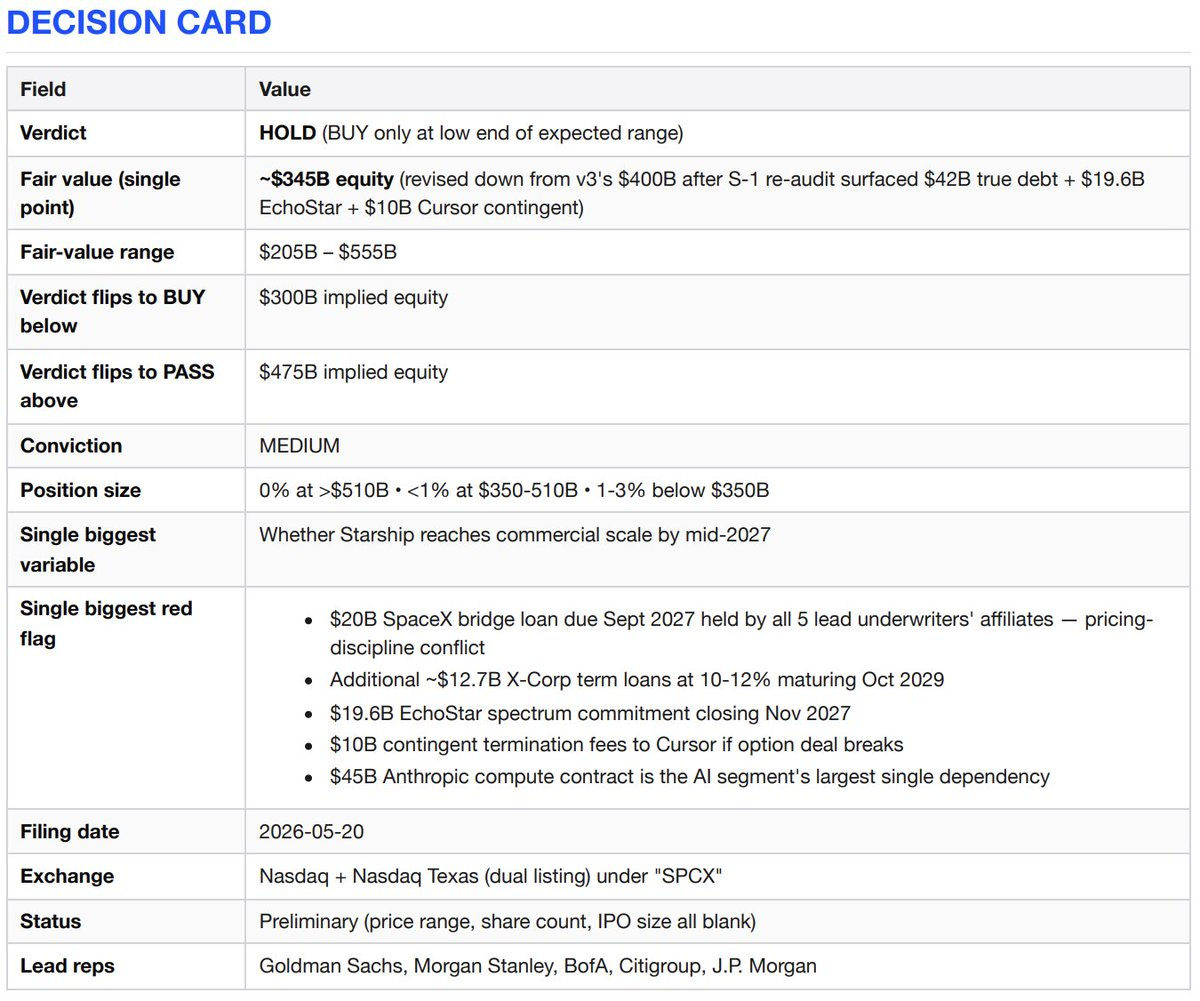
Decision Card (Conclusion = Hold and Wait)
Bull Case Argument
SpaceX holds three business aspects that competitors cannot replicate. Firstly, it has nearly a monopolistic position in commercial space access—holding an 80% share of global orbital mass since 2023, Falcon mission success rate at 99%, and a 10-year lead in reusable technology.
Secondly, it has the world's only deployed low-orbit broadband network—Starlink has 10.3 million subscribers in 164 countries, with a year-on-year growth of 49.8%, and an adjusted EBITDA of $7.2 billion. Thirdly, since acquiring xAI in February 2026, it has become the only vertically integrated AI lab into the rocketry layer, with future orbital computing capabilities.
Regardless of the valuation method used, this is a once-in-a-generation asset.
Bear Case Argument
Connectivity is a real and profitable business. But everything else is either burning money at an astonishing rate—the AI division is projected to have a revenue loss of $3.2 billion in 2025 against $6.4 billion in expenses—or betting on Starship, which has completed 11 test flights but has yet to deliver payload to orbit.
This IPO is, in part, a refinancing event. SpaceX borrowed $20 billion to acquire xAI, with a bridge loan due in September 2027, and the bridge loan lenders are the underwriters of this IPO. If the valuation exceeds $500 billion, what you pay for is unproven execution, non-negotiable corporate governance, and the underwriters' successful exit from the refinance transaction.
Investment Thesis
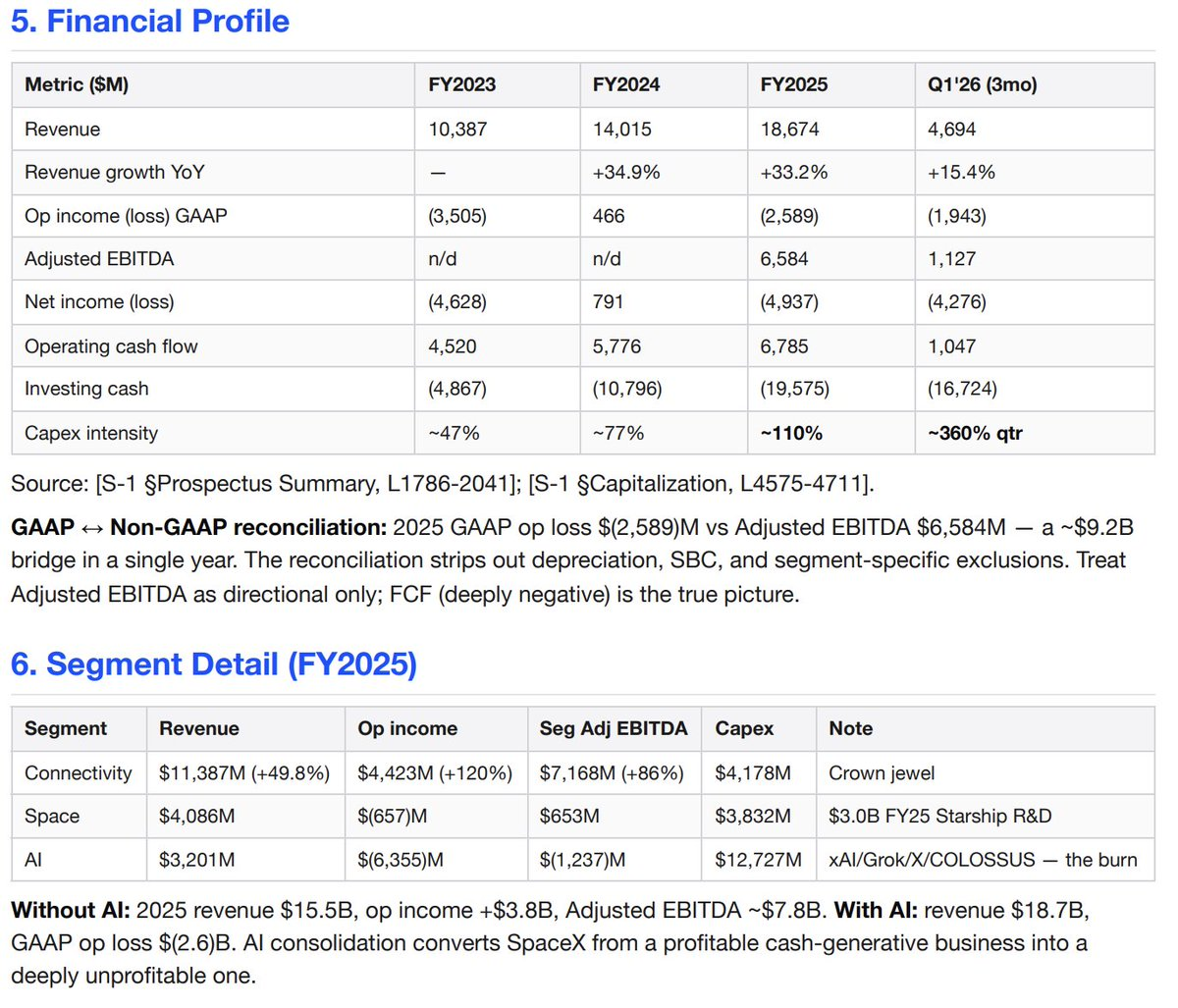
Starlink is a strong standalone business. In 2025, revenue is $11.4 billion (+49.8%), operating income $4.4 billion (+120%), and adjusted EBITDA $7.2 billion (+86%). High-priced subscription service with 10.3 million paid users.
The launch business is unparalleled. Accounting for over 80% of global orbital mass since 2023, Falcon success rate over 99%, Falcon 9 booster with up to 34 flights.
Vertical integration is real and compounding. Rocket → Satellite → Spectrum (EchoStar AWS-4/H-band transaction FCC approved) → AI capability (two COLOSSUS clusters around 1GW).
Government reliance is a moat, not a risk. Leading U.S. national security launch provider: 11 out of 12 national security space launch missions executed in 2025, all 5 NASA crew and cargo flights.
Orbital AI capability's option value slated for deployment in 2028. If Starship achieves even 50% of its targeted economics—99% reduction in launch costs—tapping into markets will expand by an order of magnitude.
Counterpoints
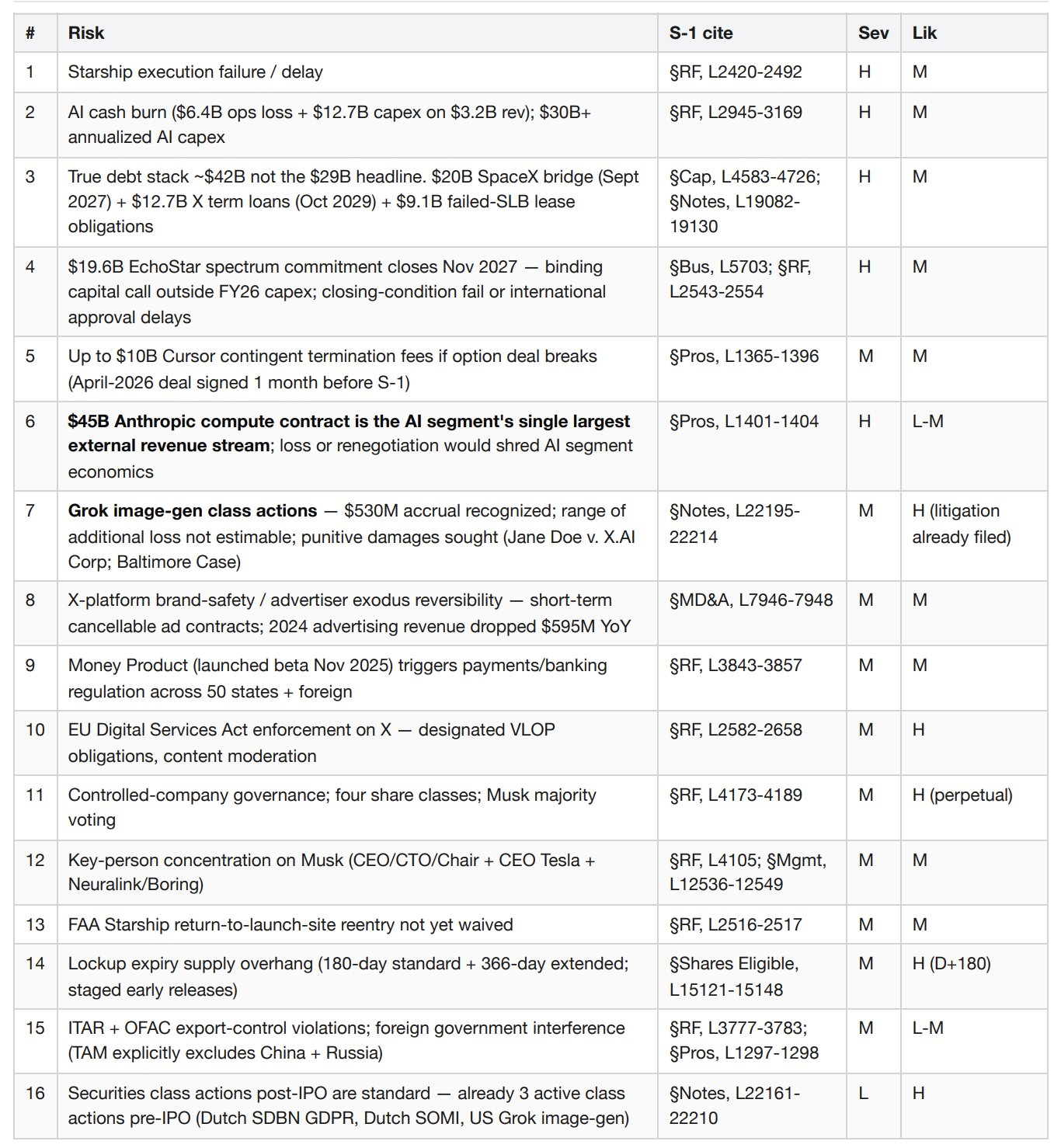
The AI division is a $6+ billion annual cash burn. In 2025: $3.2 billion revenue versus $6.4 billion operating loss, adjusted EBITDA -$1.2 billion, capex $12.7 billion. For Q1 2026 alone: $818 million in revenue against $2.5 billion in operating losses, capex $7.7 billion. Annualized AI capex has now exceeded $30 billion, while AI revenue is only $3.2 billion.
The actual debt amount is around $42 billion, not the headline figure of $29 billion.
Breakdown: Approximately $20 billion SpaceX Bridge Loan (maturing in September 2027), around $6.7 billion X Company B-1 Term Loan, and about $6 billion X Company B-3 Term Loan (both maturing in October 2029, effective interest rate 10-12%), as well as around $9.1 billion in "Other Financing," including obligations stemming from the failed AI infrastructure sale-leaseback. The X-related loans alone incur approximately $1.2-1.3 billion in annual interest expenses, attributed to the AI division.
A $19.6 billion EchoStar Spectrum Commitment is set to conclude in November 2027. It involves an equity-for-cash exchange for 65MHz of U.S. spectrum and a global mobile satellite service license. This is a binding capital commitment beyond the Bridge Loan and 2026 fiscal year capital expenditures.
The Option Agreement with Cursor could trigger a termination fee of up to $10 billion. SpaceX entered into a compute and option agreement with Anysphere (Cursor) in April 2026—just a month before this S-1 filing—inferred Cursor valuation at $600 billion.
If either party terminates, SpaceX would owe Cursor a $1.5 billion termination fee plus an $8.5 billion deferred service fee, payable in cash or Class A shares.
The $45 billion Anthropic contract represents the AI division's largest single external revenue source. A cloud services agreement signed in May 2026 obligates Anthropic to pay $1.25 billion monthly until May 2029. SpaceX is selling its COLOSSUS compute power to directly competing state-of-the-art model firms, creating significant counterparty concentration risk.
A $530 million litigation reserve is recognized on the balance sheet for the Grok image generation class-action lawsuits—Jane Doe v. X.AI Company (January 2026), Jane Doe 1 (March), and Baltimore (March). The plaintiffs are seeking compensatory, statutory, and punitive damages. The S-1 explicitly states that the range of additional losses is incalculable.
Revenue growth in Q1 2026 slowed to 15.4% ($46.9 billion vs. $40.7 billion YoY), down from the full-year 2025 figure of 33.2%.
SpaceX will be a controlled company with four classes of stock. Musk will hold a majority of the voting power post-IPO. The company will rely on Nasdaq's controlled company exemption, waiving the requirements for an independent compensation committee and independent nominating committee.
Adjusted EBITDA has been beautified by approximately $9 billion. Management’s 2025 headline number is $6.6 billion of “Adjusted EBITDA,” with GAAP operating loss of -$2.6 billion. Adjustments exclude depreciation, equity-based compensation, and division-specific exclusions.
Company Overview
SpaceX (Space Exploration Technologies Corp; SEC CIK 0001181412) designs and operates reusable rockets, the world’s largest LEO satellite constellation (about 9,600 broadband satellites plus around 650 direct-to-mobile satellites), and—following the acquisition of xAI in February 2026—the exabyte-scale AI training infrastructure.
Three reporting segments: Space, Connectivity (10.3 million Starlink subscribers), and AI (Grok models, X social platform with 550 million MAU, and COLOSSUS/COLOSSUS II computational clusters).
Revenue in 2025 is $18.7 billion; GAAP operating loss is -$2.6 billion; cash on hand $15.85 billion against $29.1 billion long-term debt listed on the cover of the capitalization table.
X (Social Platform) is a business unit and not a footnote
The corporate lineage is worth retracing. SpaceX acquired xAI in February 2026. xAI had previously acquired X Holdings in March 2025. X Holdings had acquired Twitter in October 2022. Result: Twitter/X is now subsumed under SpaceX’s AI segment, with its own balance sheet line items, litigation, and debt structure.
Scale. Supporting 1.3 billion accounts over the last 12 months with 550 million MAU (up from 520 million in December 2025), with 3.5 billion posts per day. Of these MAU, 117 million interact with the Grok feature—X being the primary distribution channel for this model.
The Money Product (Payments, Banking, Financial Services) launched a beta in November 2025 and is moving towards full availability. The X Ads Manager began a phased rollout in April 2026.
Financial Contribution. The AI Division's revenue from 2023 to 2024 mostly came from X - Advertising, X Premium Subscriptions, and Data Licensing. In 2024 alone, ad revenue declined by $595 million year-on-year due to "X Losing Ad Partners," partially offset by a $157 million increase in X Premium Subscription revenue and a $90 million increase in Data Licensing.
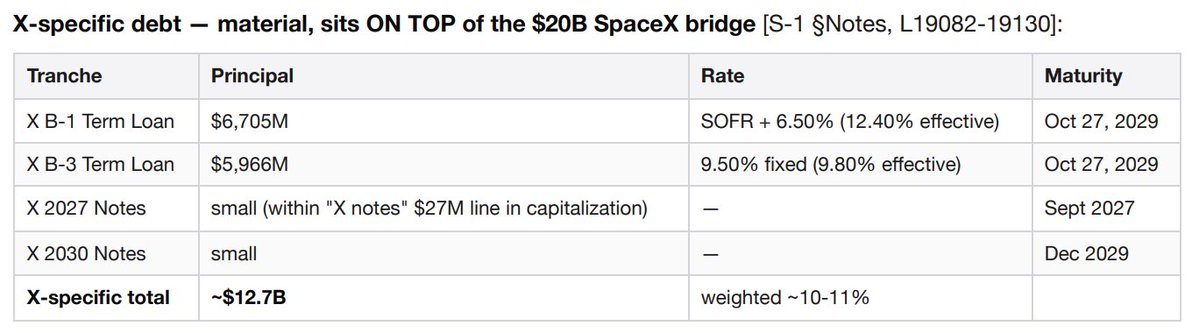
In addition to a $20 billion SpaceX bridge loan (September 2027) and $9.1 billion under "Other Financing" category, total long-term debt is approximately $42 billion - not the $29 billion headline number capitalized.
SpaceX faces risks specific to X that its other businesses do not. Enforcement of the EU's Digital Services Act on super large online platforms. Brand safety reversibility on short-term ad contracts that can be canceled at any time - the 2024 exodus could replay within a single news cycle.
The Money Product triggers payment/currency transmission/banking regulation across all 50 U.S. states and every foreign jurisdiction. Reversal of content moderation policies could simultaneously trigger advertiser pauses and user migration.
Market Position - Real-Time Comparable Data
This comparison table was assembled in real-time during the analysis by paying $0.10 to Jintel's GraphQL endpoint to retrieve bulk fundamental data for all five comparable companies. No Bloomberg Terminal, no FactSet contract needed.
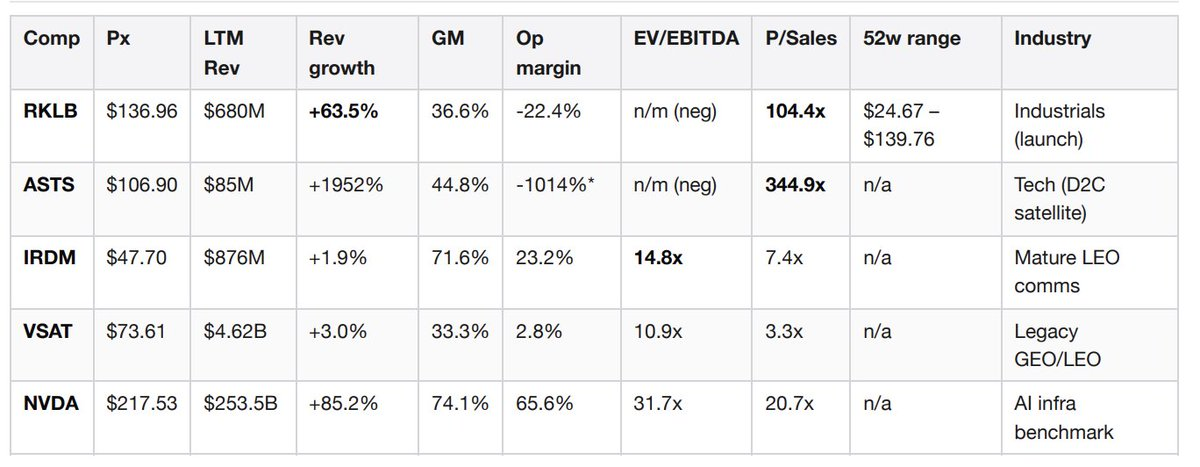
ASTS Operating Margin reflects pre-revenue scale investments.
Source: Retrieved via Base on-chain x402 from Jintel entitiesByTickers, query date 2026-05-22.
Interpreting the comparison set. Rocket Lab's 104x Market-to-Sales ratio is the closest narrative benchmark - investors are willing to pay a high multiple for scaled reusable launches plus the low Earth orbit option value, even with a negative profit margin. SpaceX should logically command a higher multiple than RKLB, but blindly applying the 104x to SpaceX's $11.4 billion revenue for just the satellite servicing business implies a $1.2 trillion equity value, anchored to nothing.
AST SpaceMobile's 345x is purely a pre-revenue narrative valuation, serving only as an upper bound reference for the in-the-money value of the straight-to-phone option. Iridium's 7.4x revenue and 14.8x EBITDA represent the look of a mature, profitable LEO communication—applying 7.4x to Starlink's $11.4 billion yields an $840 billion standalone enterprise value for Starlink (bear case anchor).
NVIDIA's 31.7x EV/EBITDA corresponds to an 85% revenue growth, the level of growth the AI division needs to justify a fundamental-based valuation. We are not there yet.
Noteworthy signal. Rocket Lab filed a 424B5 prospectus supplement on May 20, 2026—the same day SpaceX released its S-1. RKLB is diluting in the SpaceX news cycle, signaling management sees an open IPO window and competitive supply pressure looming.
Pending Significant Transactions and Contingencies
Each of these four is individually material and stack. Two of them were signed within 60 days prior to this S-1 filing.
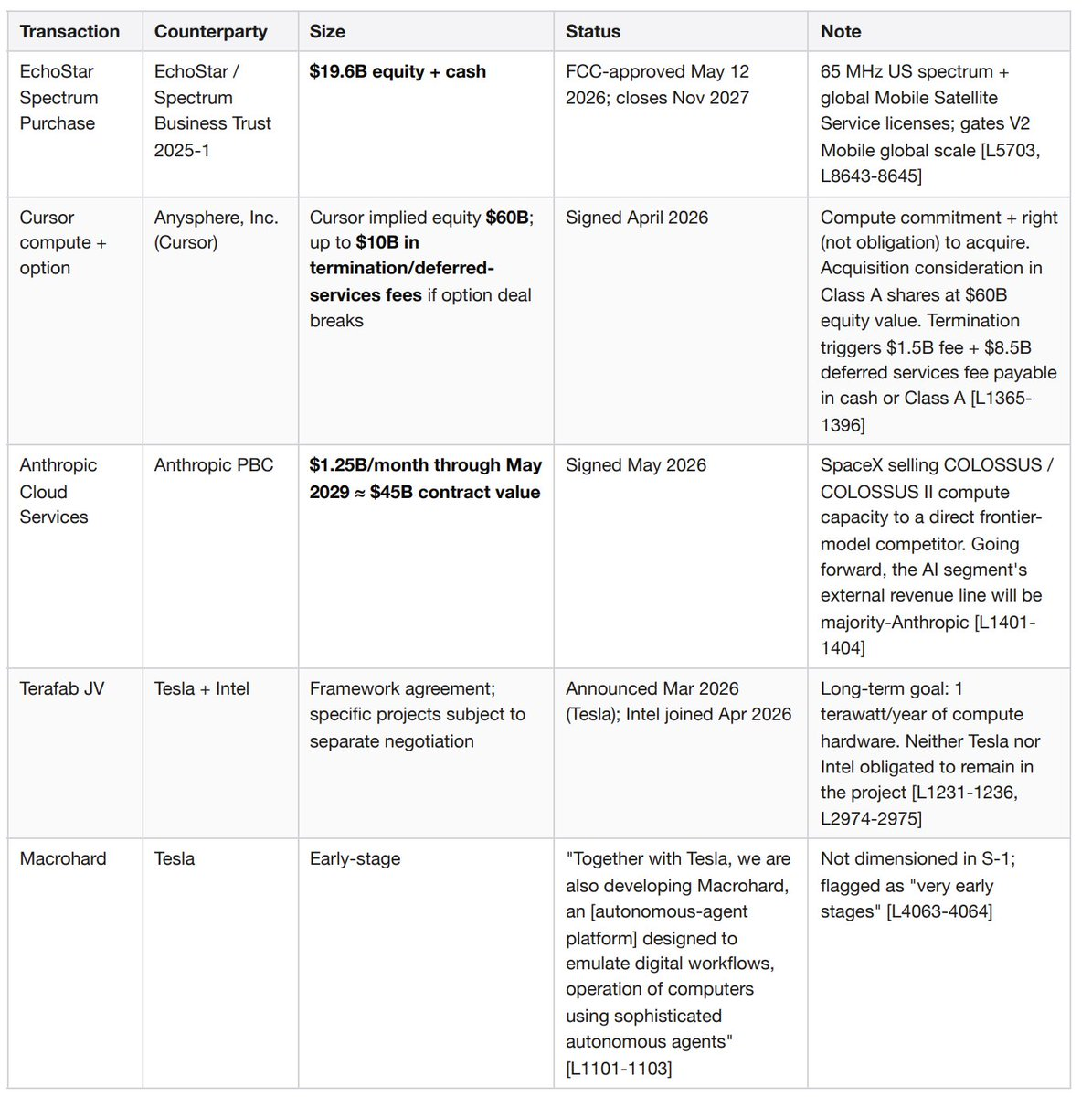
Why this matters for valuation. A clean view of "adjusted net obligation" is: $42 billion total debt plus $19.6 billion EchoStar commitment plus up to $10 billion Cursor contingencies, minus $15.85 billion cash on hand, equals approximately $550 billion net obligations, excluding any IPO proceeds.
This is three to four times the figure gleaned from a cursory glance at the capitalization cover page, substantially altering the bear case.
Valuation
Approach 1—based on standalone transaction multiples for the connectivity division, as it's the only one with positive standalone economics.
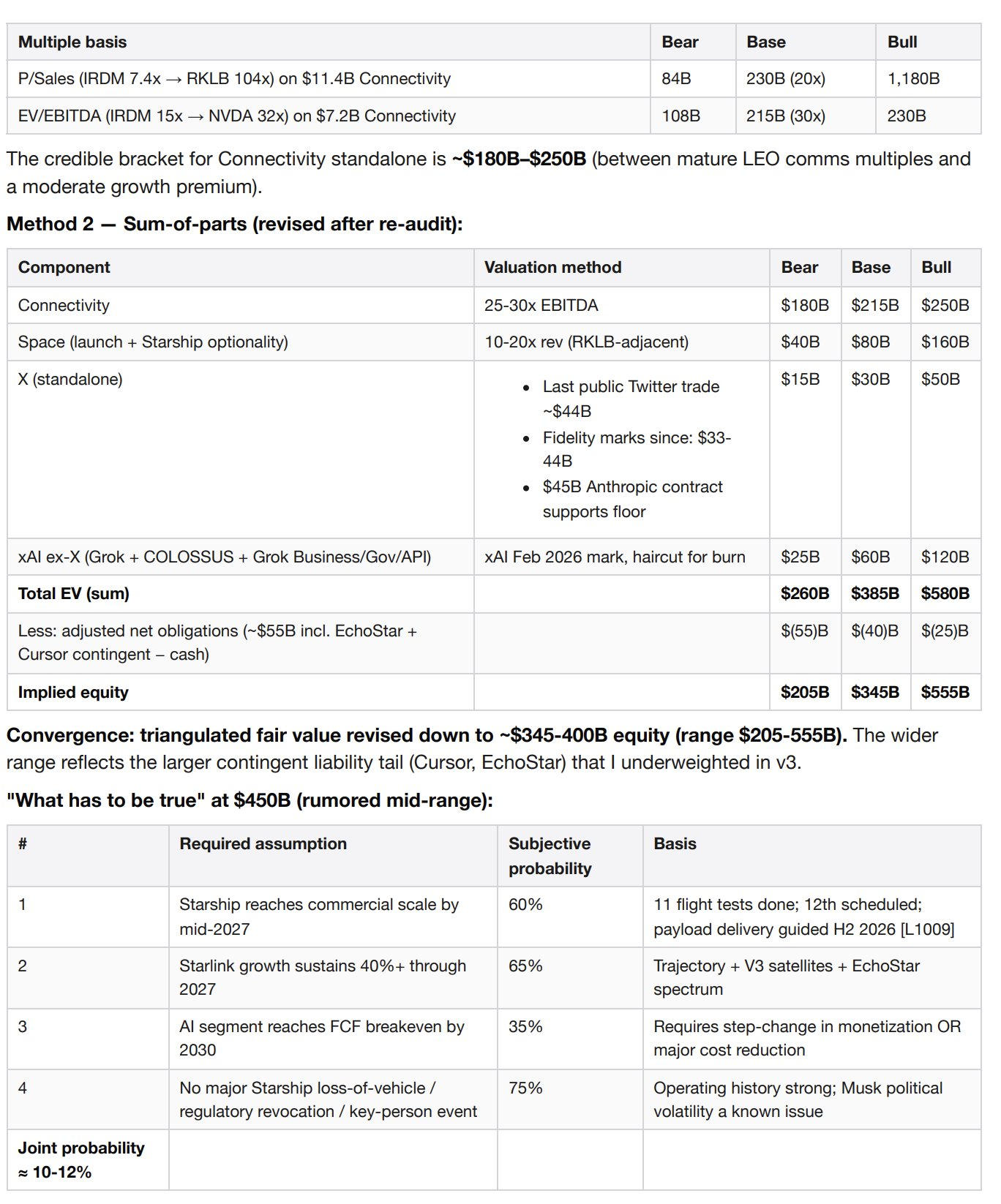
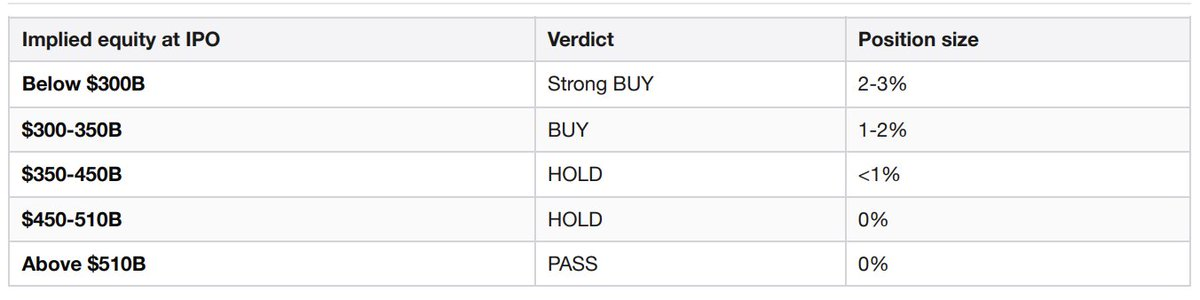
Position Size Tiers
Key Risks (Severity × Likelihood)
Underwriter Conflict of Interest
This point is buried deep in the underwriting section, rarely covered in the news, but it is of significance. The five lead underwriters (Goldman Sachs, Morgan Stanley, BofA Securities, Citigroup, JPMorgan) plus five additional book managers (Barclays, Deutsche Bank, RBC Capital Markets, UBS, Wells Fargo) are affiliated entities that provided the $20 billion SpaceX bridge loan and are now setting the IPO price for refinancing that loan.
Morgan Stanley also serves as an advisor for SpaceX's acquisition of xAI (funded by the bridge loan).
The underwriting syndicate has a direct financial interest in maximizing the IPO fundraising amount. This should prompt the investment committee to maintain pricing discipline.
Affiliated Entity Density
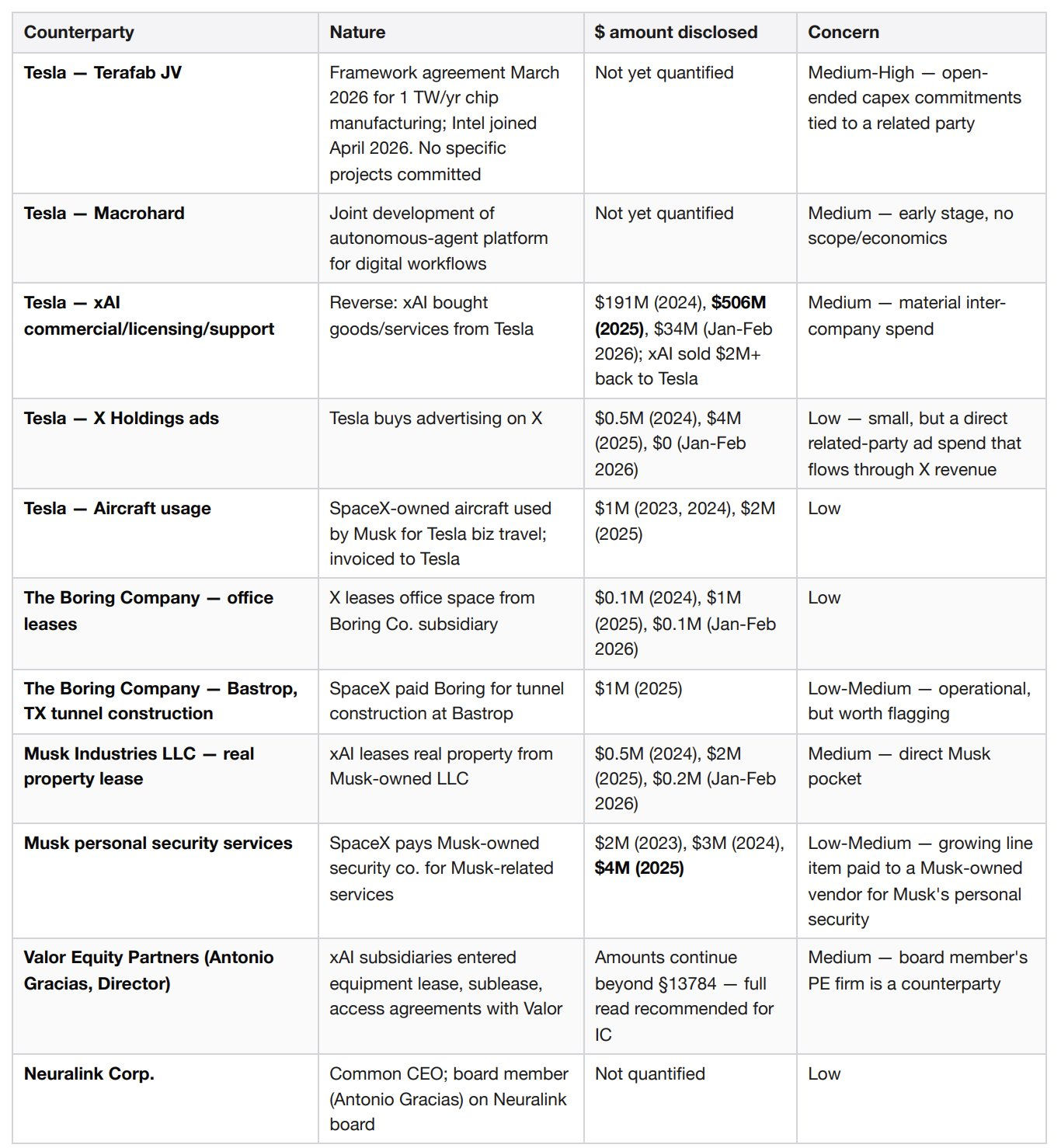
No single item looks concerning on its own. What is concerning is the density—entities controlled by Musk have at least nine different financial touchpoints with SpaceX. Corporate governance committees typically review one to two such relationships. Here, there is an order of magnitude more.
Decision Trigger Points
If the transaction is priced at an implied equity value of $350 billion or below, and Starship achieves commercial payload delivery as guided in the second half of 2026, and Q2 2026 sees a year-over-year business revenue growth of over 40%, then upgrade to overweight.
If the transaction is priced above $510 billion, or a Starship mishap results in V3 satellite deployment delays to post-2027, or the AI division's cash burn accelerates to an annualized operating loss exceeding $8 billion in Q2-Q3 2026, or the FAA imposes long-term grounding of Starship, then downgrade to underweight.
Initial 180-Day Plus Year Watchlist
D+1: Day-one price performance benchmark versus comparable IPOs
D+30: Initial quarterly earnings report (2026 Q2)—triggers early release of lock-up tranche (immediate release of 20%, additional 10% if stock price exceeds IPO price by +30%)
D+70, +90, +105, +120, +135: Staggered early release lock-up tranches, each 7%
D+90: Quiet Period Ends, Seller Analyst Initiates Coverage
D+180: All Standard Escrow Vesting Expires
2nd Half of 2026: Starship Guidance Achieves Commercial Payload Delivery
Q2-Q3 2026: Grok Image Generation Class Action Procedural Milestone (Focus on whether the $5.3 billion reserve has increased)
April 2027: Cursor Option Agreement One-Year Anniversary—Focus on Exercise or Termination Signal
September 2027: $20 billion SpaceX Bridge Loan Matures (Must Refinance or Repay)
November 2027: $19.6 billion EchoStar Spectrum Deal Completed—V2 Mobile Global Launch constrained by this
May 2029: $45 billion Anthropic Computing Power Contract Expires; Renewal terms to define AI Division's economic impact for the following years
October 2029: Aggregate $12.7 billion X Company B-1 and B-3 Term Loans Due
Source
SpaceX S-1, SEC File No. 0001628280-26-036936, Filed on May 20, 2026
Queried via Jintel GraphQL entitiesByTickers real-time comparable fundamentals, Base Chain x402, Retrieval Date May 22, 2026
Queried via x402helper/companies/profile real-time SEC composite filings for RKLB, IRDM, VSAT, Retrieval Date May 22, 2026
Queried via Parallel Search Industry IPO Background, Base Chain x402, Retrieval Date May 22, 2026
Four Scenarios of SpaceX IPO—Acadian Asset Management
Generated by IPO Analysis Pack on agentic.market. 6 Paid x402 Calls. $1.87 USDC on Base Chain. No API Key Required. No Registration Needed. Pay-Per-Request.
A Bloomberg Terminal seat costs $24,000 per year. This memo shows what it can produce now that agencies can pay for their own data.
Recommended
Desk: Brent Crude Tops $110, Musk's Net Worth Drops 528.6 Billion in Four Days After Tesla Roadster Launch
Oct 17, 21:49
JST Fifth Buyback and Burn Successfully Concludes: Over 170 Million Tokens Worth Approximately $23.53 Million Burned, Buyback Mechanism Set for Comprehensive Upgrade
Oct 17, 20:10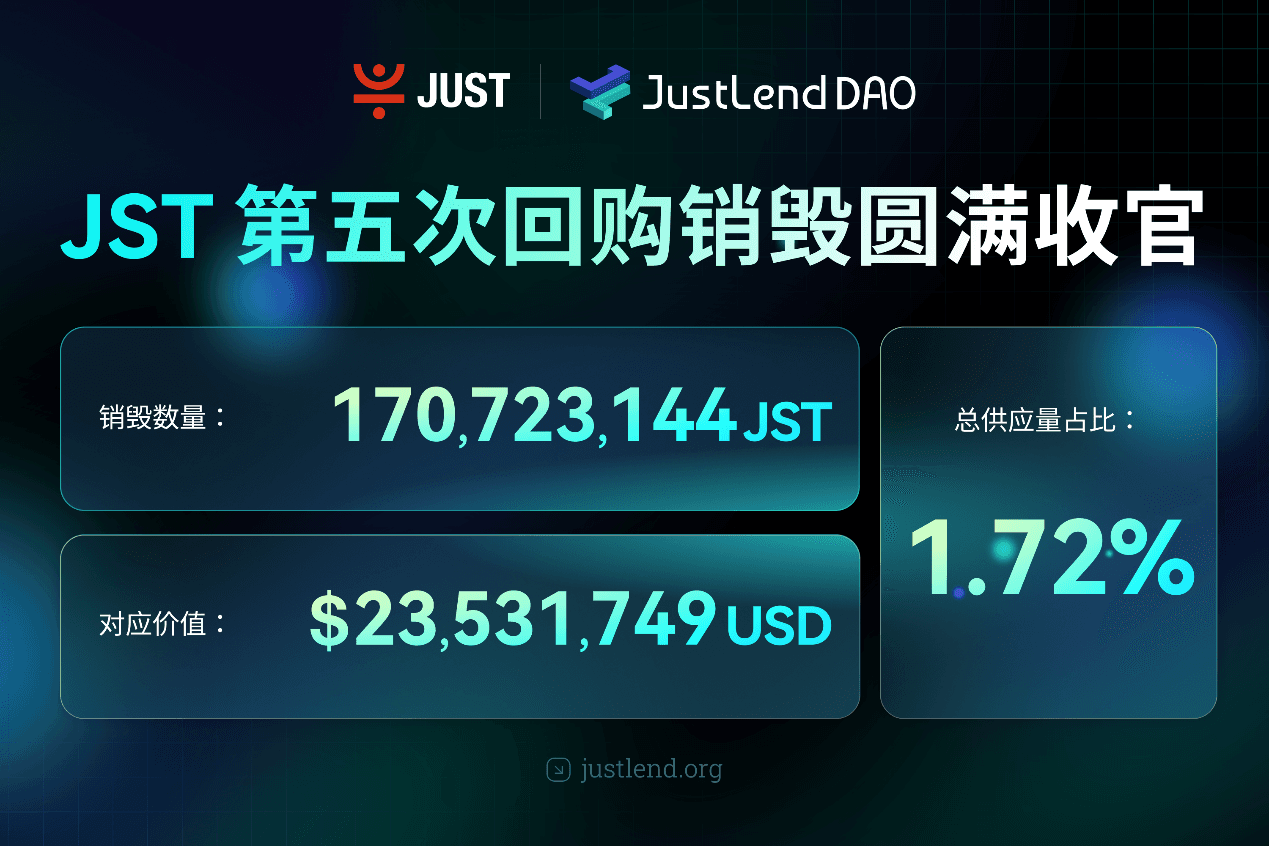
BitTorrent Brand Upgrade and Initial BTT Buyback & Burn Launch Simultaneously, Dual Engines Usher in New Era of Web3 Infrastructure
Oct 17, 20:00
Asia Market Daily: Japan's BOJ signals more rate hikes while Korea targets offshore perpetual platforms (2026/10/17)
Oct 17, 17:01Why did Papertrade backfire on you?
Oct 17, 17:01
The 'Strict Father' of Northern Myanmar: This Company Deploys 200,000 "AI Best Actors" to Strike Back Against Scammers
Oct 17, 15:34