
From Power Infrastructure to Tokenomics: The "Seven-Layer Cake" of the AI Industry Chain

Over the past two years, the narrative in the first half of the AI industry has mainly revolved around the "great model war" initiated by various tech giants. The number of parameters has transitioned from billions to trillions, training costs have escalated from tens of millions to hundreds of millions of dollars, and GPU clusters have expanded from thousands to tens of thousands of cards. Everyone has been discussing whose model is stronger, who is closer to AGI, as if the end goal of AI competition is the performance of large models themselves.
However, as we reach the year 2026, the driving logic of the AI industry has changed. According to JPMorgan's latest report, what will truly drive the continued expansion of AI infrastructure in the future is no longer model training but the massive demand for AI inference. The most significant future consumer of computing power will no longer be just training large models but the globally pervasive AI Agents. Every call, every interaction, every task execution fundamentally consumes a Token. The AI industry is transitioning from the "model era" to the "Token industrial era."
Because what will truly power the AI world in the future is not just the models themselves but the production, distribution, scheduling, and consumption system built around Tokens. Especially as AI Agents begin to appear on a large scale, how Tokens are generated in real-time, distributed across regions, dynamically scheduled, and efficiently consumed will become the most critical new issue for the entire AI industry.
As recently suggested by Huang Renxun, AI is not merely a simple software industry but an infrastructure system like electricity and the internet. In his "five-layer cake" architecture, the AI industry is divided into five layers: Energy, Chips, Infrastructure, Models, and Applications. And as the AI industry gradually shifts from the "training era" to the "inference era," GoodVision AI is inclined to view the entire AI economic ecosystem as a "seven-layer cake structure" revolving around Tokens:
Layer One: Power – Energy Foundation of the AI Era
Layer Two: AIDC – Token Factory
Layer Three: GPU – Token Production Equipment
Layer Four: LLM – Token Production Engine
Layer Five: Token Distribution – AI Era "Grid"
Layer Six: Token Optimization and Intelligent Scheduling – Brain of the AI Era
Layer Seven: AI Agent – Token Consumer Endpoint
From energy and GPUs to AIDC and edge nodes, to model inference and intelligent scheduling, the AI industry is forming an unprecedented "Token industrial ecosystem."
However, at the current stage, this system is still far from mature.
Some have the most advanced GPU but are limited by power supply; some have built massive AIDCs but lack efficient scheduling; some have developed powerful AI Agents but face high inference costs and latency; some control edge nodes but cannot form a unified collaborative network. Although the entire industry chain is developing rapidly, there are still significant fragmentation, redundancy, and efficiency bottlenecks among the layers.
Only when these seven layers of infrastructure are truly connected, coordinated, and interconnected, will the AI industry move from today's "Tool Era" to the "Mass Adoption Era" of the intelligent world.
The Industrial Revolution fought for coal and oil, the Internet era fought for traffic and servers, and in the AI era, the bottom-layer battle is returning to energy.
Because AI ultimately consumes electricity. The power consumption of a large AI data center is already close to that of a medium-sized city. New AIDCs (AI data centers) around the world are facing the same problem: GPUs can be purchased, land can be developed, but the power supply cannot keep up, and the power grid scheduling cannot keep up.
That is also why more and more AI companies are beginning to refocus on energy infrastructure. At GTC 2026, Jensen Huang even defined the future data center as a "Token Factory." Its factory upstream will give birth to a super energy industry.
In the Chinese market, companies such as Yangtze Power, China National Nuclear Corporation, China General Nuclear Power Group, Three Gorges Corporation, Longyuan Power, and Huaneng Renewables represent core energy directions such as hydropower, nuclear power, wind power, and photovoltaics. Among them, nuclear and hydropower, with their stable power supply capabilities, are becoming the most important basic energy sources for AIDCs; while wind power and photovoltaics are benefiting from the AI industry's increasing demand for green electricity and ESG. With the advancement of "computing in the East and data in the West" and the construction of large-scale AI data centers, the synergistic relationship between new energy bases and computing centers is rapidly strengthening.
In the U.S. market, traditional energy giants such as NextEra Energy, Dominion Energy, Duke Energy, Southern Co., and Exelon are also benefiting from the expansion of AI data centers. NextEra is the leading green electricity player in North America; Dominion controls the core transmission resources of the Northern Virginia "Data Center Alley"; and Exelon, with its stable nuclear power supply capability, has become a key beneficiary of the AI era's demand for "all-weather high-stability electricity." Overall, the global power industry is gradually transforming from traditional utilities to the core resource layer of the AI infrastructure era.
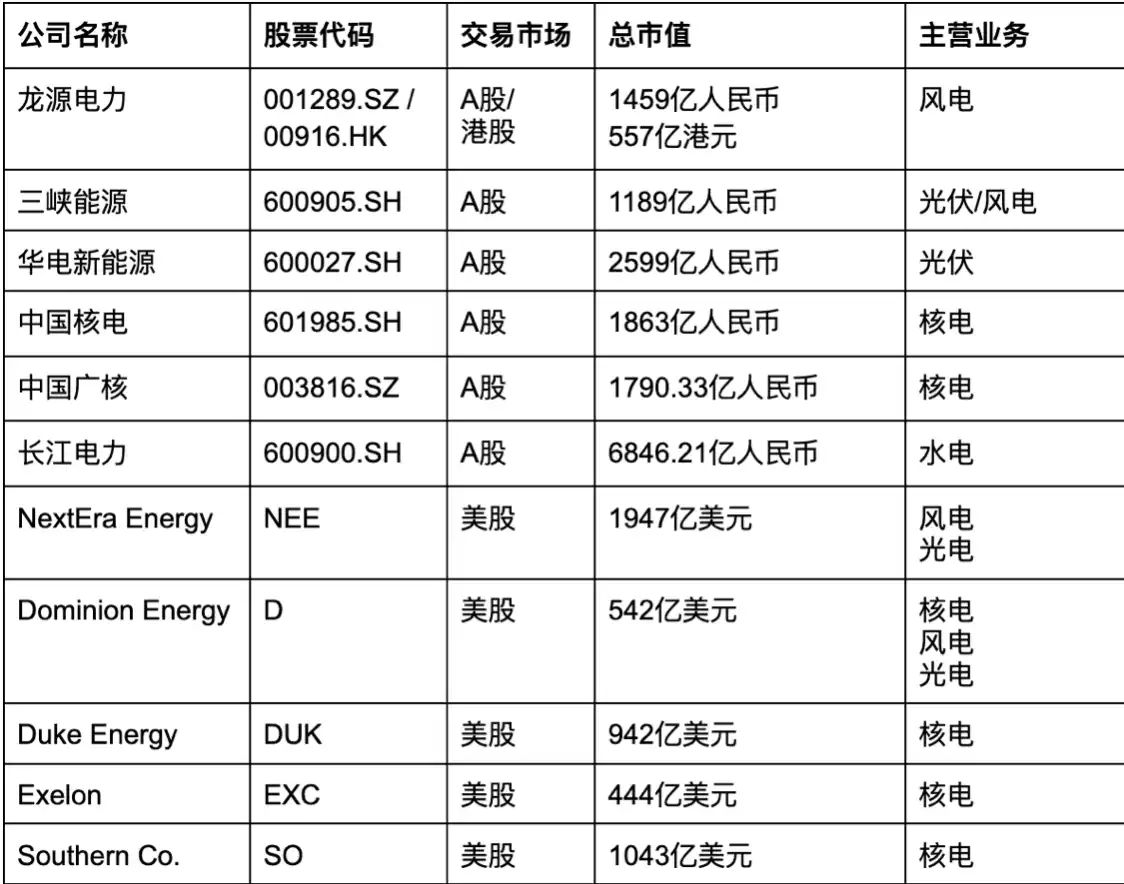
Overall, the competitive landscape at this layer is shifting from traditional energy companies' "electricity price competition" to downstream AI data centers, cloud providers, and energy companies' "power lock-in competition." Whoever can lock in long-term, stable, low-cost energy holds the first Dragon Ball of Token production.
A single GPU is meaningless; what truly matters is large-scale clusters. Thus, AIDC emerged.
Similar to the steel plants, power plants, and assembly line factories of the industrial age, it consolidates thousands of GPUs to form a stable Token production capacity. However, issues with the factory are beginning to arise: the traditional AIDC construction cycle often lasts 18 to 36 months, and grid expansion may take even longer. As AI demand grows exponentially, the construction speed of old-school IDCs is no longer able to meet the needs of the new Token economy.
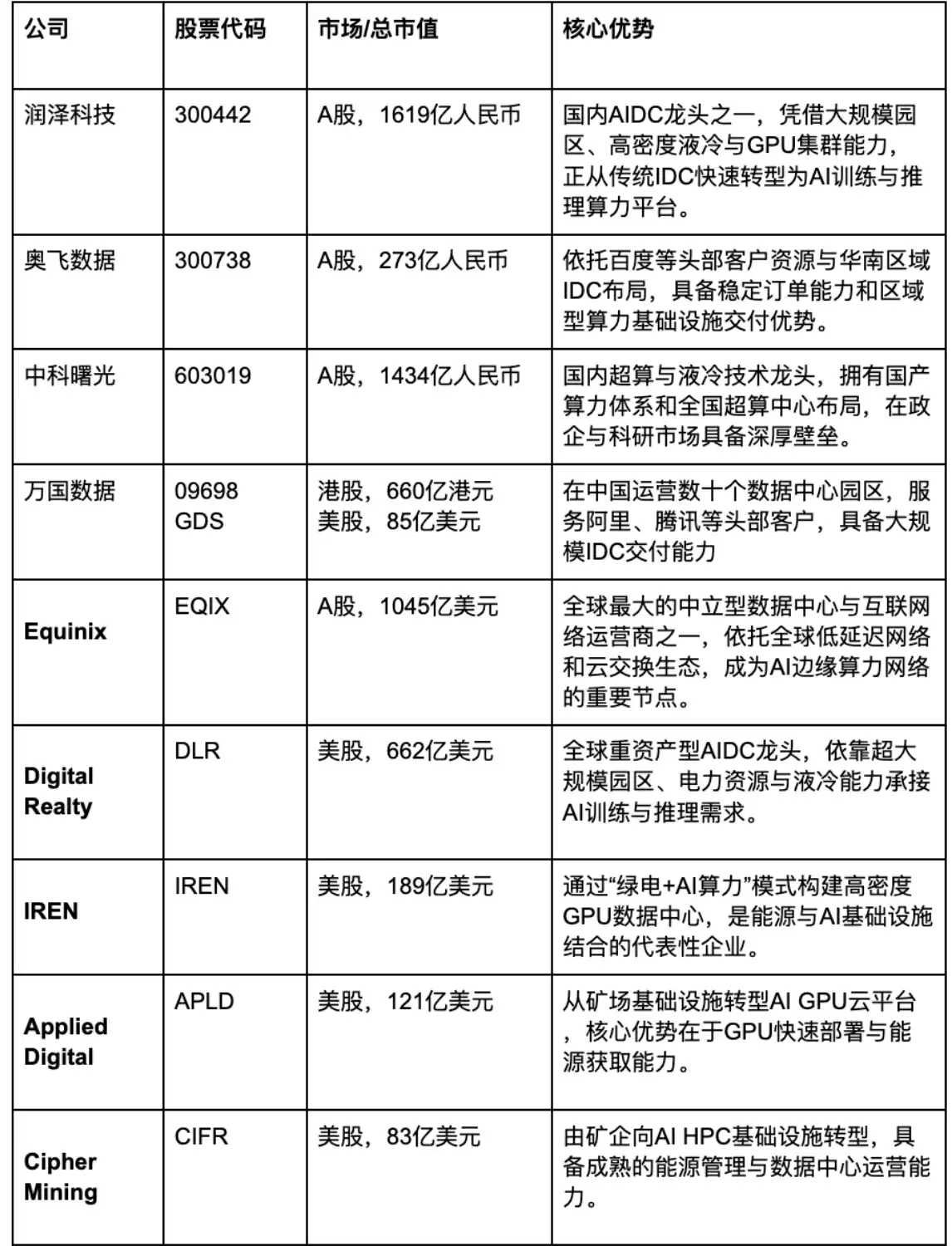
In the US stock market, Equinix is one of the world's leading data center operators, with over 240 data centers in 30+ countries. Its core advantage lies not only in the number of data centers but also in global interconnection capabilities and low-latency network resources, making it a crucial infrastructure node for AI computing power deployment.
Digital Realty, on the other hand, entered the AI infrastructure through the PlatformDIGITAL platform, catering to large cloud providers and financial institutions.
In the Chinese market, Runze Technology is one of the most typical AIDC operators listed on the A-share market. Its main business has gradually shifted from traditional IDCs to AI computing centers, with core competitiveness in large-scale data centers, power resources, and AIDC operation and maintenance capabilities. Companies like Oriental Ocean and Capital Online are continuously expanding in the directions of regional data centers, cloud infrastructure, and AI computing hosting. Sugon focuses on cooperation in the AIDC business in the government-enterprise and scientific research fields.
Another group of players comes from the "mining farm transformation." Companies like CoreWeave, IREN, Applied Digital, and Cipher Mining were originally primarily involved in cryptocurrency mining. However, with the skyrocketing demand for AI GPUs, they have rapidly shifted their focus to AI computing infrastructure. IREN emphasizes the "green energy + AI computing power" model by constructing high-density GPU data centers using renewable energy. Applied Digital and Cipher Mining are also transitioning from traditional mining farms to AI high-performance computing infrastructure.
In addition, the trends of marginalization, miniaturization, and modularization are emerging in the AI field. Similar to how the Internet era transitioned from mainframes to cloud computing, AI computation power needs to move from super large central nodes to gradually spread out to regional edge nodes.
Therefore, GoodVision AI has chosen a different path: to build a more lightweight, modular, and rapidly replicable AI Factory. Compared to traditional large-scale AIDCs, GoodVision AI places more emphasis on regional deployment capability, high-density GPU cluster efficiency, and the integrated synergy of energy and computation power.
The core idea is not to construct a single super large data center, but to rapidly deploy AI Factory nodes in high-density population areas globally, typically in small-scale 2-4MW inference computation rooms. This approach not only allows quicker access to local energy resources but also aligns better with the trend of future AI inference needs moving towards the edge.
If the traditional AIDC is more like a large steel plant in the industrial era, then what GoodVision AI is building is more like a "Regionalized Token Factory" of the AI era—lighter, more flexible, closer to users, and more suitable for the future development direction of a globally distributed inference network.
If electricity is the energy, then the GPU is the production equipment. In the initial years of the AI boom, GPUs mainly served for training; however, in the future, the greater demand will come from inference. While training is exclusive to a few leading companies, inference will permeate every application, every device, every endpoint. Robots need inference, autonomous vehicles need inference, AI glasses need inference, and even the real-time consumption of tokens between every future AI agent.
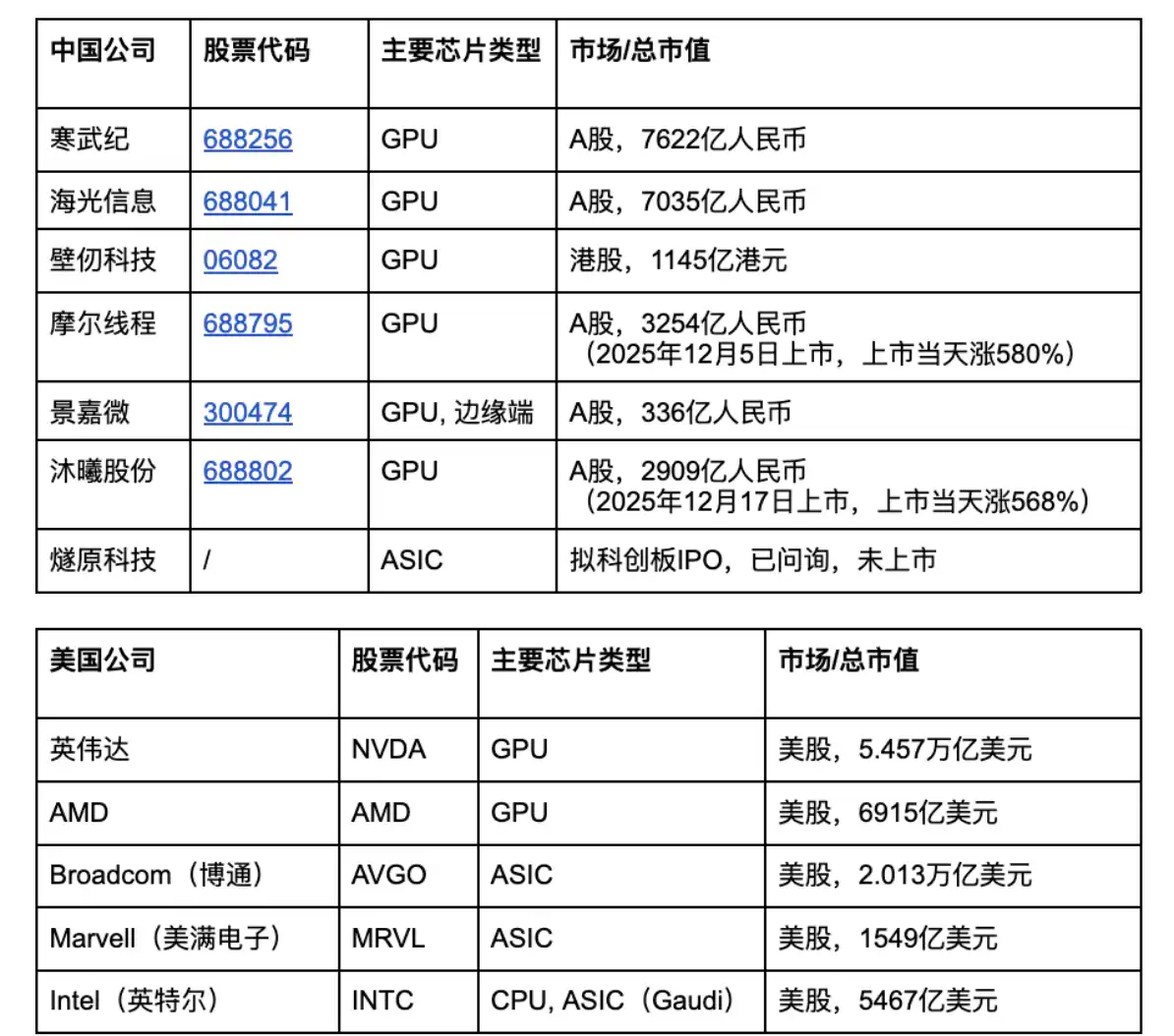
Currently, NVIDIA remains the absolute core of the global AI chip industry. Its GPU products such as H100, B200, Blackwell, almost define the current global standards for AI training and inference. More importantly, NVIDIA not only sells chips but has built a complete ecosystem through CUDA, TensorRT, DGX, HGX, etc., making it essential for its competitors to challenge not only GPU performance but the entire AI software ecosystem.
AMD is currently the primary challenger in the GPU market, with core products including AI GPUs like MI300X. Compared to NVIDIA, AMD emphasizes an open ecosystem and the ROCm software platform, hoping to attract AI developers and enterprise customers through a more open approach.
Broadcom and Marvell represent another path - ASIC and high-speed interconnect. As AI inference scenarios become increasingly complex, more and more enterprises are starting to explore custom ASIC chips to achieve higher energy efficiency and lower costs.
Intel, on the other hand, is entering the AI market through server CPUs and the Gaudi AI accelerator card, hoping to leverage its CPU ecosystem to re-engage in the AI infrastructure competition.
In the Chinese market, Cambricon is one of the most representative domestic AI chip companies, promoting the Cambricon MLU series AI chips and developing the in-house AI framework Neuware. Hygon Information possesses the AMD Zen architecture license, focusing on DCUs and the AI inference market.
Molythread, Horizon Robotics, Muixi Technology, Bitmain Technologies, and other domestic GPU companies represent the direction of "domestic substitution" for Chinese AI chips. They generally emphasize compatibility with the CUDA ecosystem and are trying to build a domestic GPU cluster.
From the CUDA ecosystem to HBM memory, and then to Tensor Cores, the core of the entire AI industry is actually continuously improving the "efficiency of generating tokens per unit of time." At the same time, GPUs and the underlying infrastructure such as servers, optical modules, liquid cooling, switches, etc., are also closely related to token production efficiency.
These things are not as dazzling as companies in the AI application sector like NVIDIA and OpenAI, but they determine whether the entire AI world can truly function. Just as the Industrial Revolution required not only steam engines but also railroads, electrical grids, and ports. The AI revolution will not only be a software revolution. It is a global industrial chain upgrade covering energy, chips, networks, cloud computing, and infrastructure.
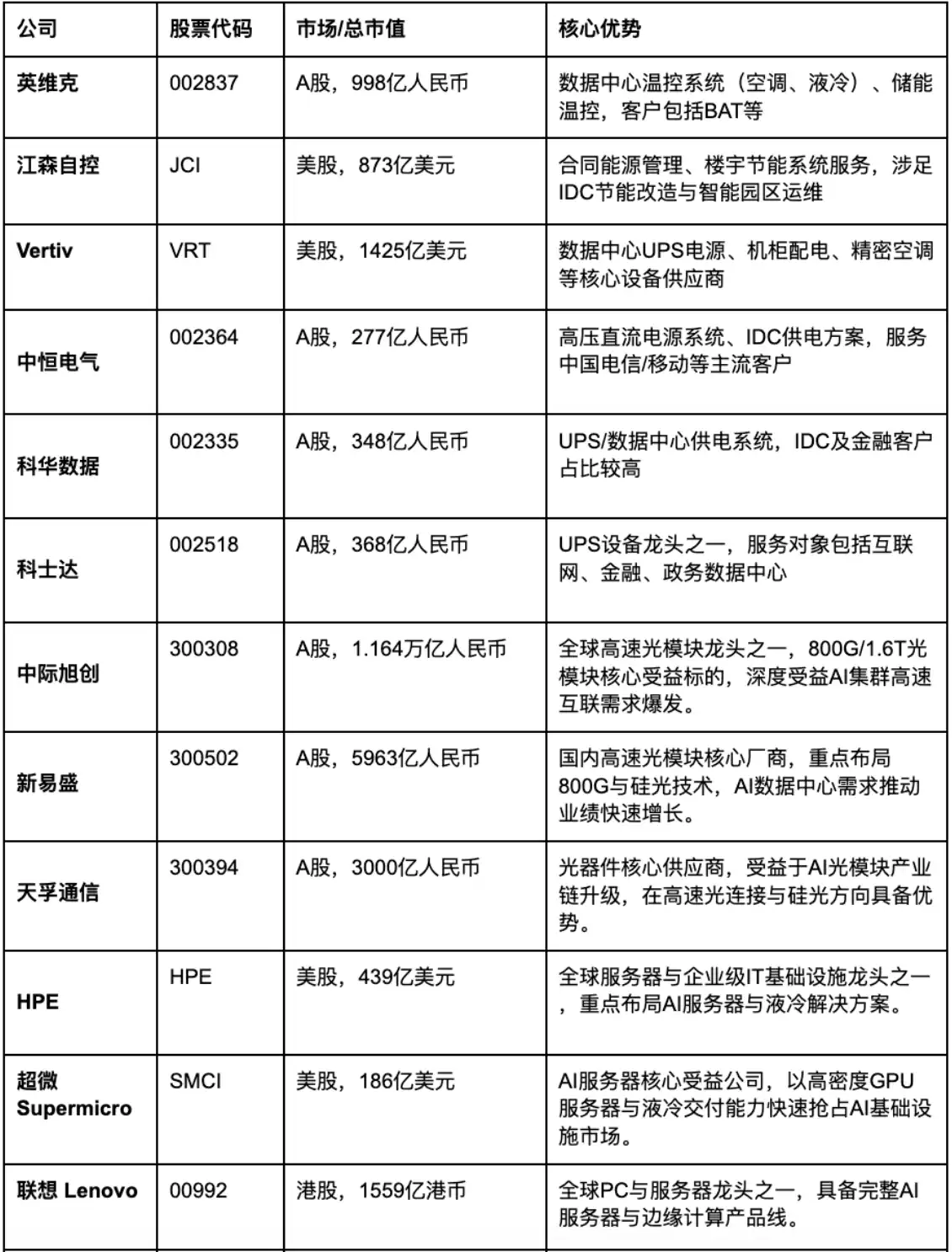
Vertiv is a global leader in data center UPS and power management, providing data center power supply, rack power distribution, and precision air conditioning systems.
Enice is a leader in A-share liquid cooling and temperature control systems, with customers including BAT and other large internet companies. As GPU power consumption continues to rise, liquid cooling is becoming an essential feature of AIDC.
Companies such as Zhongheng Electric, Kehua Data, and Kstar are important players in the UPS, power system, and IDC power supply fields.
In the networking and optical module space, InnoLight, InnoNegev, and Phenix Communications are benefiting from the surge in demand for high-speed communication within AI clusters.
When it comes to the direction of full-stack servers, companies such as Dell, HPE, Supermicro, Lenovo, and Inspur Information are responsible for the large-scale assembly and delivery of AI servers.
Although this layer does not directly face end users, it determines whether the AI infrastructure can run stably. Liquid cooling, UPS, optical modules, switches, energy storage, and full-stack servers, much like the railways, power grids, and ports of the industrial age, are becoming the true "earthmoving" business in the AI world.
LLM (Large Language Model) determines how Tokens are understood, generated, and organized. Over the past two years, companies such as OpenAI, Anthropic, Google, Meta, xAI, and DeepSeek have sparked a global "large model competition." The number of parameters has transitioned from billions to trillions, and the model's capabilities have expanded from text generation to multimodal, reasoning, code, agent collaboration, and long-term memory.
However, as the industry gradually develops, the market has also begun to realize that the truly important factor in the future is no longer just "who has the largest model," but who can sustainably operate the model at a lower cost and higher efficiency. Because the model itself does not directly create value; the real value is created by the inference process after the model is continuously invoked.
This also means that LLM is transitioning from the past "demonstrating model capabilities" to gradually evolving into the "Token Production Engine" in the AI world.
Closed-source and open-source models such as OpenAI, Anthropic, Google Gemini, Meta Llama are vying for the future entrance to the AI ecosystem. Emerging players like DeepSeek are beginning to reshape the industry's competitive landscape through lower costs and higher inference efficiency. The competition in the LLM layer is gradually shifting from a simple pursuit of parameter quantity competition to a comparison across multiple dimensions:
Token Cost
Inference Efficiency
Contextual Ability
Multi-Agent Collaboration
Long-term Memory
Model and Infrastructure Collaboration Ability
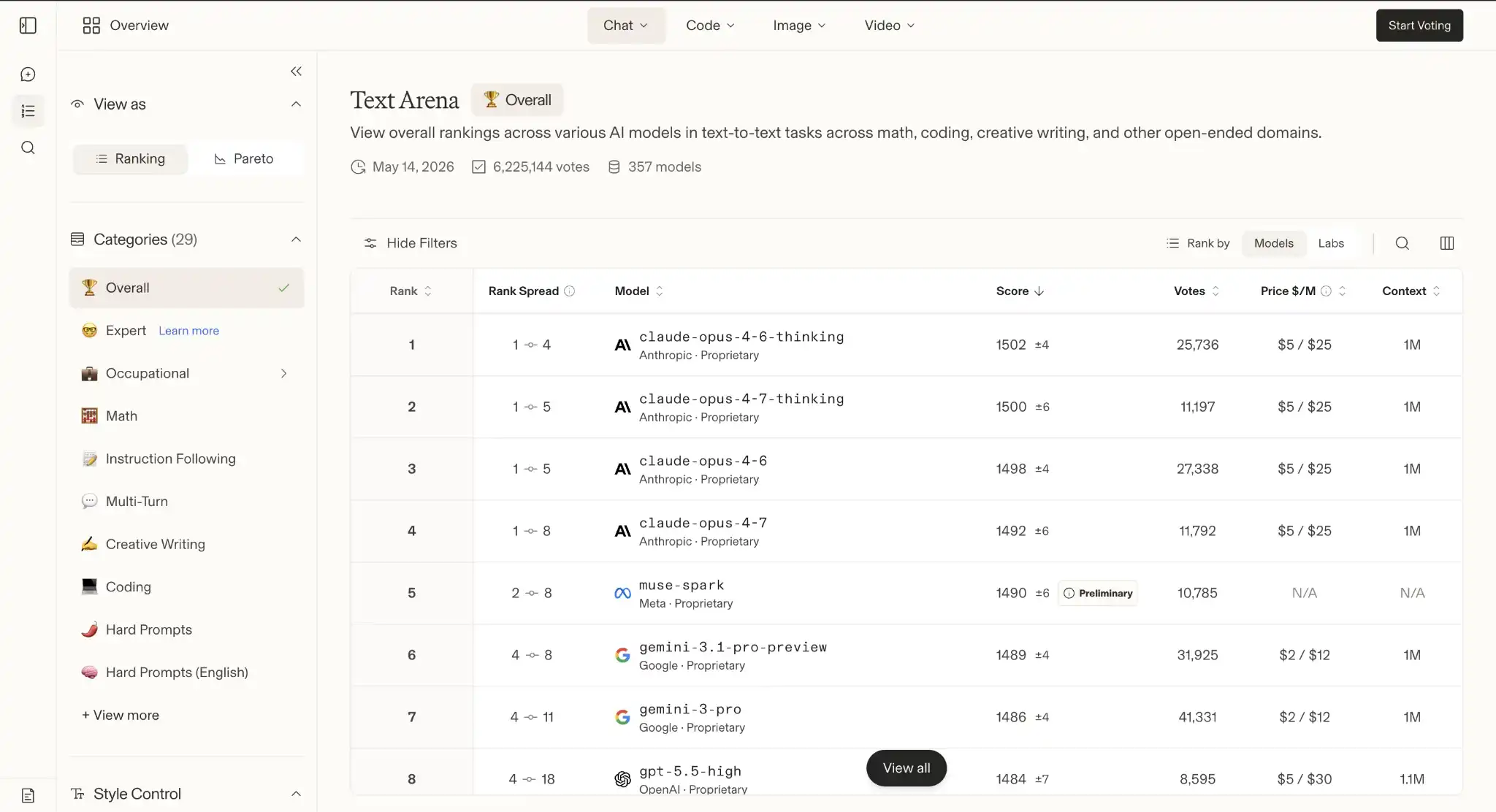
LLM Leaderboard, Data Source: https://arena.ai/leaderboard/text
Because in the AI era, what truly matters is not just having "smart" large models but whether the model can be continuously, at scale, and at a low cost globally. GoodVision AI also has its optimization solution at this layer: by partnering with large model manufacturers to deploy large models in the AI Factory data centers, transitioning from traditional computing power leasing business to directly providing Token services; this not only enhances business gross margin but also makes user experience more user-friendly.
Once AIDC was established, the next question arose: how would this computing power be used globally?
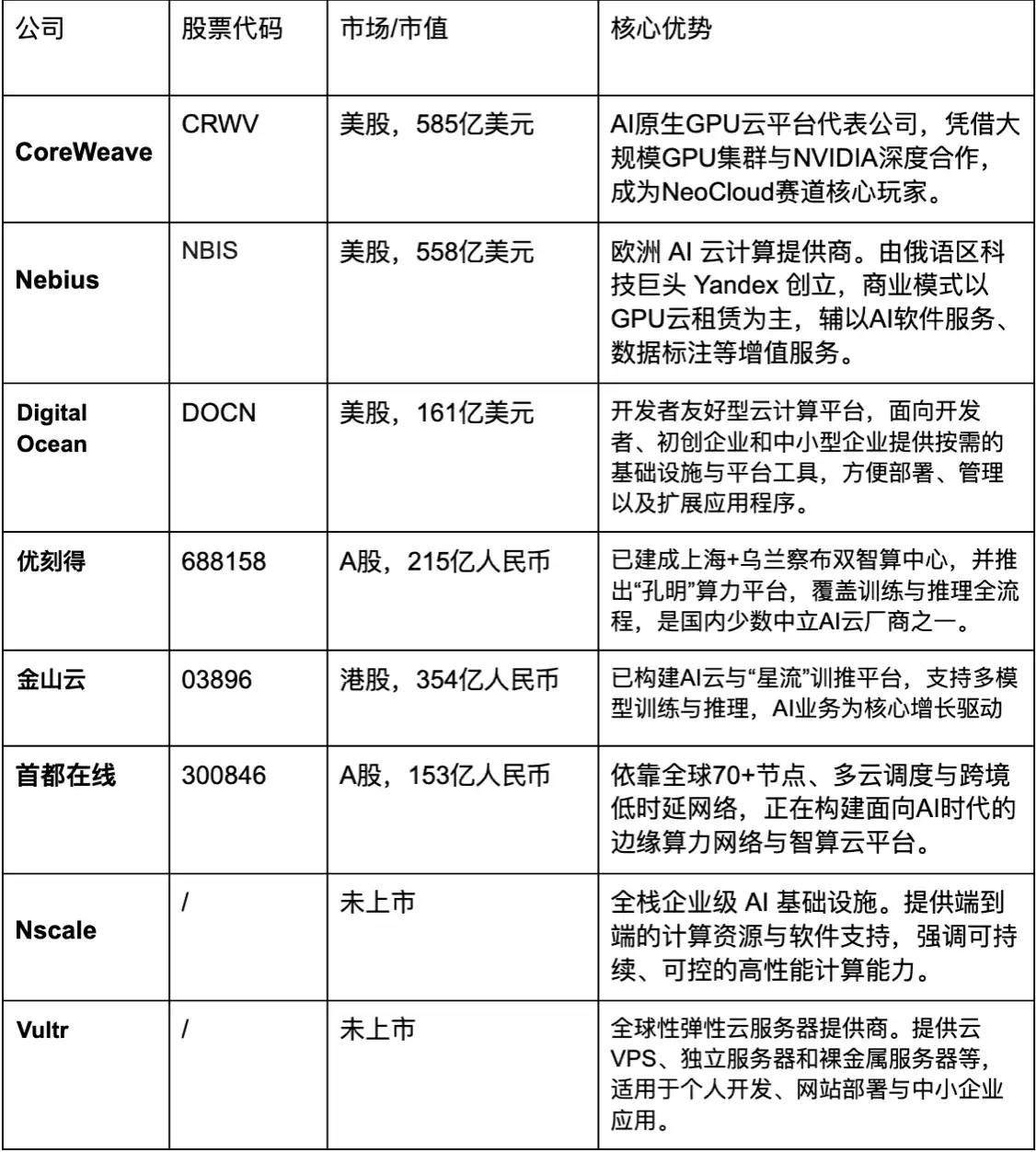
Thus, computing power rental platforms began to emerge. They function like the "grid system" of the AI era, breaking down and distributing the originally centralized GPU resources, then renting them out on-demand to developers, enterprises, and AI applications.
AWS, Azure, Google Cloud, Alibaba Cloud, and Tencent Cloud are still the most powerful players at this layer. They possess the world's largest cloud computing infrastructure and are gradually incorporating AI GPU resources into their own IaaS systems.
However, at the same time, a wave of "AI-native clouds" has started to rise rapidly. Companies like CoreWeave, Nebius, and Nscale specialize in building GPU cloud platforms around AI training and inference needs. Compared to traditional cloud providers, they are more flexible, more focused on AI tasks, and excel in GPU cluster optimization.
CoreWeave is one of the most representative companies in the NeoCloud at present. Initially focused on Ethereum mining, it later shifted to AI GPU cloud services and has now become a key NVIDIA-supported AI infrastructure company.
Lightweight cloud platforms like DigitalOcean and Vultr target small and medium developers and startups, emphasizing quick deployment and low-cost GPU services.
In the Chinese market, apart from the giants, companies such as UCloud, Kingsoft Cloud, and Capital Online are all major suppliers in the GPU cloud and AI computing rental market. The competitive landscape at this layer is very similar to the early days of the power grid: how to efficiently distribute dispersed computing power.
This is perhaps the most easily underestimated but also the most critical layer of the "cake." With the explosion in AI Agent usage, it was discovered that not all tasks are worth calling the most expensive large model. Many simple tasks can be completed by local models; many real-time tasks are more suitable for edge inference; many private tasks cannot even be uploaded to the cloud. Beyond the question of "is there enough computing power," another question arose, namely "how to use computing power more intelligently."
With the exponential growth in Token demand, "placing the right model on the right computing power to handle the right task." is the key to enabling Tokens to be used reasonably and efficiently. This is precisely one of the directions that GoodVision AI is working on apart from establishing an AI Token factory.
Similar to today's electricity system: some demand comes from the large grid; some demand comes from rooftop solar panels. However, the truly important element is the middle layer—the 'Smart Dispatch System'.
Future AI will follow a similar structure: simple tasks will be handled by local small models, complex tasks will invoke cloud-based large models, high-privacy tasks will be processed at the edge, and high-concurrency tasks will be dynamically scheduled through hybrid cloud setups.
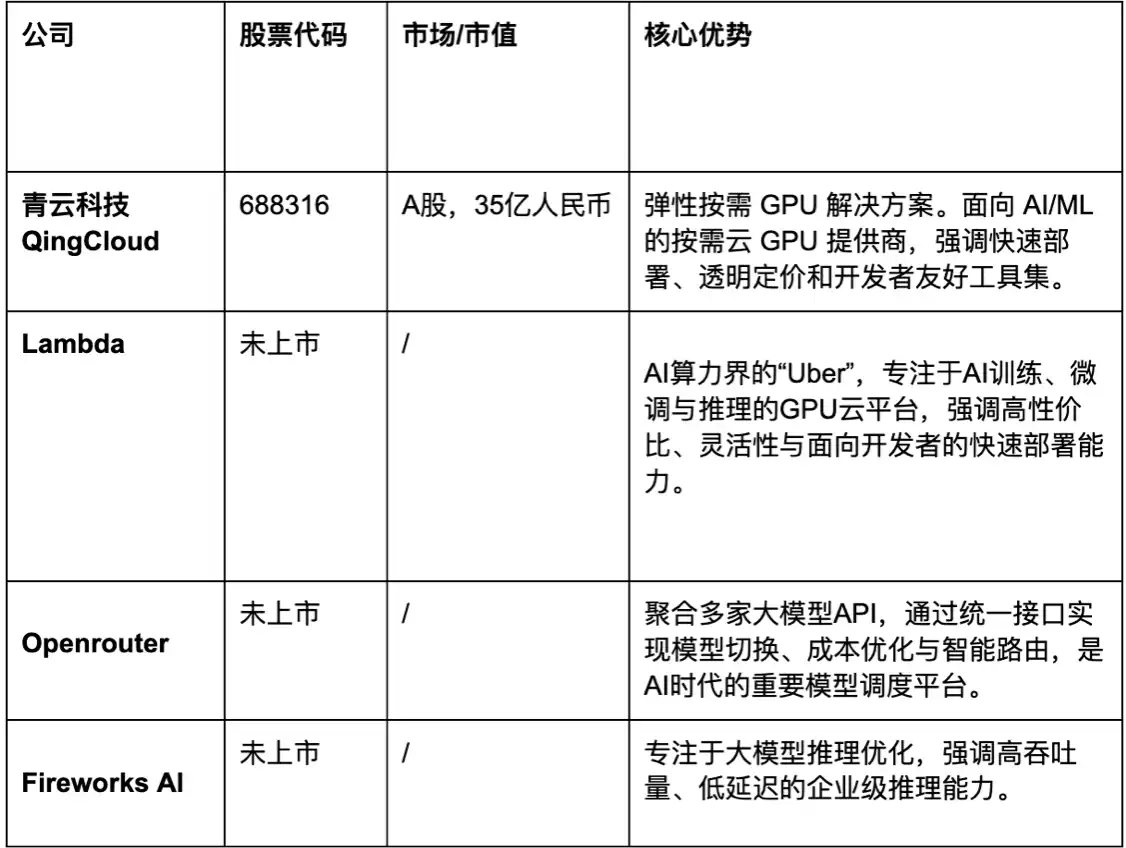
In addition to Goodvision AI, companies such as QingCloud, Lambda, OpenRouter, and Fireworks AI are also standout performers in Token optimization and intelligent scheduling.
Between this 'layer of the cake' and the previous two 'layers'—AIDC and computing power leasing—there are players with a high degree of overlap. As GPU resources, regional nodes, and inference task scales continue to grow, merely 'owning computing power' is no longer sufficient to establish long-term barriers. An increasing number of AIDC operators and GPU cloud platforms are realizing that the true determinants of efficiency and profitability in the future are not just the number of GPUs, but rather how to dynamically schedule models, computing power, and Token traffic.
Therefore, many platforms that were originally focused on AIDC and GPU clouds are also extending into the 'intelligent scheduling layer'. For example, companies like YOUCLOUD, Capital Online, and Inspur in the Chinese market are all attempting to combine their GPU cloud facilities, multi-cloud resources, and inference scheduling capabilities to gradually shift from 'selling computing power' to 'optimizing computing power'.
While this layer is closest to users and easily attracts traffic, the competition is equally fierce. At GTC 2026, Huang Renxun proposed the view that in the future, every company will become both a 'Token producer' and a 'Token consumer'.
An AI Agent may simultaneously call upon multiple models, tools, and APIs, and engage in continuous inference, planning, and execution. This means that in the future, the amount of Tokens consumed by AI will far exceed the scale of human-AI conversations today. Some heavy users of AI have already built systems with multiple concurrent Agents that call upon each other, easily consuming 1 billion Tokens per day.
The future will not see 1 billion people using AI, but rather 10 billion, even 100 billion AI Agents working simultaneously, calling upon each other. The real bottleneck will shift from 'model capabilities' to 'Token scheduling efficiency'.
It goes without saying that tech giants such as Microsoft, Google, Meta, Amazon, and others are gradually embedding AI capabilities into all products through office systems, search, social networks, and cloud services.
On the other hand, enterprise software companies like Adobe, Salesforce, ServiceNow, Palantir, among others, are rapidly advancing towards enterprise AI agents and automated workflows. Meanwhile, Hugging Face is becoming the "Github" of the AI era, serving not only as a model community but also as a crucial infrastructure for the global AI development ecosystem.
In the Chinese market, companies like iFlytek, Cambricon Technologies, 360, Kingsoft Office, and SenseTime are strategically positioning themselves in the AI assistant, AI office, and AI agent sectors.
Only When the "Seven-Layer Cake" Takes Shape Will the AI World Truly Commence
Today's AI industry is still operating within an infrastructure that has not fully matured.
Some have the most advanced GPUs but are constrained by power supply; some have deployed large-scale AIDCs but lack efficient scheduling; some have developed powerful models and agents but face high inference costs and latency; some control edge nodes but cannot form a unified collaborative network.
From power supply, AIDC, and GPUs to LLM, token distribution, intelligent scheduling, and AI agents, the entire AI industry chain is evolving rapidly. However, there are still significant fragmentation, redundancy, and efficiency bottlenecks among various layers.
Only when this "seven-layer cake" is fully constructed and begins to operate efficiently in concert, will the AI industry transition from today's "tool era" to the "era of massive adoption" in the intelligent world.
In the future AI world, it will no longer be just a few tech giants training large models, but billions of AI agents continuously online, collaborating, and invoking computing power and tokens. Every conversation, every inference, every tool invocation, every task automation corresponds to the coordinated operation of energy, GPUs, networks, scheduling systems, and inference nodes.
This also means that the AI industry is evolving from past "software logic" into a super industrial system that encompasses energy, chips, cloud computing, edge networks, and intelligent scheduling.
Similar to how the industrial revolution required not only steam engines but also railways, power grids, and ports, and the internet revolution required not only PCs but also fiber optics, data centers, and cloud computing, the true sign of maturity in the AI revolution will be the formation of a "smart infrastructure network" capable of continuous production, distribution, scheduling, and consumption of tokens on a global scale.
And when this seven-layer infrastructure is finally fully connected, the competitive logic of the AI industry will also be completely restructured. The most important companies of the future may not just be those with the largest models, but those that can connect energy, computing power, network, models, and Token flow.
Join the official Coincamps community:
Telegram: https://t.me/coin_camps
Recommended
Desk: Brent Crude Tops $110, Musk's Net Worth Drops 528.6 Billion in Four Days After Tesla Roadster Launch
Oct 17, 21:49
JST Fifth Buyback and Burn Successfully Concludes: Over 170 Million Tokens Worth Approximately $23.53 Million Burned, Buyback Mechanism Set for Comprehensive Upgrade
Oct 17, 20:10
BitTorrent Brand Upgrade and Initial BTT Buyback & Burn Launch Simultaneously, Dual Engines Usher in New Era of Web3 Infrastructure
Oct 17, 20:00
Asia Market Daily: Japan's BOJ signals more rate hikes while Korea targets offshore perpetual platforms (2026/10/17)
Oct 17, 17:01Why did Papertrade backfire on you?
Oct 17, 17:01
The 'Strict Father' of Northern Myanmar: This Company Deploys 200,000 "AI Best Actors" to Strike Back Against Scammers
Oct 17, 15:34