Microsoft Hits Pause on Vibe Coding: ‘Meme Tokens’ Now Pricier Than Staff

On May 14, 2026, Microsoft began revoking most employees' Claude Code internal licenses. The deadline is June 30, also the last day of Microsoft's fiscal year.
Just 6 months ago, Microsoft was doing the complete opposite—In December 2025, it opened Claude Code to thousands of employees, including engineers, product managers, designers, encouraging everyone to reshape workflows through vibe coding. Employees loved this tool, but perhaps, too much.
But 6 months later, Microsoft pulled the plug.
Almost in the same week, YC partner Tom Blomfield said another statement in a batch talk: "If your API bill doesn't hurt, you're not burning enough token."
In the same spring, Silicon Valley was offering two completely opposite answers to the same question—Is AI more valuable to use than humans?
01 The Failure Scene of Vibe Coding
What Microsoft revoked was not the Claude model. Anthropic's model will still be provided to Microsoft employees through Copilot CLI. What they revoked was the product entry of Claude Code itself.
The most affected was the "Experiences + Devices" department— the engineering team behind Windows, Microsoft 365, Outlook, Teams, and Surface. EVP Rajesh Jha packaged this decision as "toolchain unification" in an internal memo, but The Verge cited an internal Microsoft message that was more straightforward: Employees generally believed Claude Code was more user-friendly than Copilot CLI. The popularity of Anthropic's tool within Microsoft even made Microsoft's own Copilot CLI feel "neglected."
In other words, Microsoft withdrew Claude Code not because it was ineffective, but because it was too effective.
The deadline of June 30 was not a coincidence—it was the last day of Microsoft's fiscal year. Cutting off a tool preferred by many employees, switching back to an in-house product, and timing it at the fiscal year endpoint—how much of it was a product decision and how much was a financial consideration, everyone knows.

Image Source: Visual China
Microsoft is not alone.
A month ago, Uber's CTO Praveen Neppalli Naga revealed to The Information: the company's full-year 2026 AI programming tool budget was already burned through in the first 4 months. Uber had previously run an internal leaderboard, using a competition to motivate employees to use more AI—resulting in a budget collapse.
More bluntly, NVIDIA's VP of Applied Deep Learning, Bryan Catanzaro, said in an Axios interview: "For my team, the cost of computing power far exceeds the cost of employees." This came from an executive at a hardware company—whose core product is selling computing power.
Fortune connected these clues and gave the article a very Fortune-esque title: "Microsoft's Report Exposes the True Cost Problem of AI—Using This Thing is More Expensive Than Paying Employees".
If you stopped at this layer, the conclusion is simple: vibe coding has failed, and the story of AI replacing humans can be wrapped up.
But this conclusion came too early.
02 Copilot Mode Has Hit a "Wall"
To explain Microsoft's retreat, we first need to clarify what vibe coding is.
This term was coined by Andrej Karpathy in early 2025—he described a new way of programming: developers no longer write code line by line, but instead, describe their intent in natural language for the LLM to generate code. Developers don't even read the code; they only look at the results—if it runs, they accept it; if not, they have AI revise it.
This is the most tantalizing productivity promise of the AI era. It means: an engineer who doesn't know how to write Rust can let AI help them write Rust; a product manager can have AI help them create a prototype; a designer can have AI help them generate runnable code. Microsoft's December 2025 unveiling of Claude Code was aimed at—engineers, PMs, designers—exactly these three types of people. This was no coincidence; this was the most classic manifestation of vibe coding.
However, when vibe coding is introduced into large companies, it becomes a rather awkward structural affair.
Imagine a Microsoft engineer earning a $300,000 annual salary. After Microsoft assigns them a Claude Code, their output increases by 20%—this is the ideal scenario for vibe coding. But at the same time, what will be the monthly token cost for them: $200, $500, or $2,000? This number will only keep rising as their reliance on AI deepens.
What's even more troublesome is that they won't be laid off just because they "used AI"—their $300,000 salary, benefits, and their workstation will remain.
This means that Microsoft's total cost structure is "original employee salary + additional token bill." This formula only has one outcome—cost escalation.

Now, does the "employee output +20%" translate financially to "revenue +20%"? Not really. It translates to "revenue staying the same, but with an added AI cost in the cost structure"—because the increased output of most employees does not directly correlate to additional income; typing faster does not mean the company sells more.
This is the true meaning behind Catanzaro's statement that "computing power is more expensive than employees." It isn't that AI is dumb; it's that when you implant AI onto existing employees, the math just doesn't add up.
This logic is also backed by data.
In a recent forecast, Gartner stated that by 2030, the inference cost of a trillion-parameter model will have decreased by nearly 90% compared to 2025. While this may sound like AI is becoming more affordable, Gartner's actual conclusion is that this reduction won't make a company's overall AI bill cheaper. Gartner's Senior Director Analyst, Will Sommer, once said, "CPOs should not confuse 'deflation of commodity-grade tokens' with 'democratization of cutting-edge inference capabilities.'"
Goldman Sachs made a more direct prediction: by 2030, agentic AI will drive a 24x increase in token consumption, reaching $120 trillion per month. With a 90% drop in token prices and a 24x increase in consumption, the net result is that the total bill continues to rise.
Huang Renxun has a more radical version. He said in a public event a few months ago that in the future, every NVIDIA employee will have 100 AI agents working alongside them.
It sounds great. But if you are a CFO, what do you hear? You hear about 100 tokens burning, burning 24/7 every day.
The issue is not that AI is too expensive. The issue is the assumption of "giving each employee an AI copilot."
This posture has a popular name in the tech world — "copilot mode." Its core assumption is: humans remain in the driver's seat, while AI sits in the copilot seat providing suggestions. It doesn't replace you; it just makes you faster.
On the surface, this assumption is very gentle — "AI won't take your job, AI is just helping you." But financially, its implicit meaning is: the original salary remains unchanged, but there is an additional token cost.
And the token is not a fixed cost; it is billed based on consumption. The more employees use, the more the company pays — this happens to be the cost structure that companies least want to see: variable, uncapped, and inversely amplified with capacity.
When Microsoft opened up Claude Code in December 2025, it may not have fully realized this. The original idea was: let employees try it out and see how much AI can improve work efficiency. But six months later, employees were really addicted to it, Claude Code became too popular within Microsoft — the result was that the token bill far exceeded expectations, surpassing the outputs Microsoft could reap from this popularity.
Microsoft withdrew. But what it withdrew was not AI — it was the structure of "employees continuing in the driver's seat, AI in the copilot seat."
This was a structural failure. It will not disappear because the model is cheaper or because employees are more skilled — it will become more severe as employees become more proficient with AI.
03 Burning Tokens Because They Don't Burn Heads
Almost the same week as Microsoft's retreat, Tom Blomfield presented a completely different perspective at YC's batch talk. He didn't discuss "how AI should be used" — he discussed "what companies in the AI era should look like."
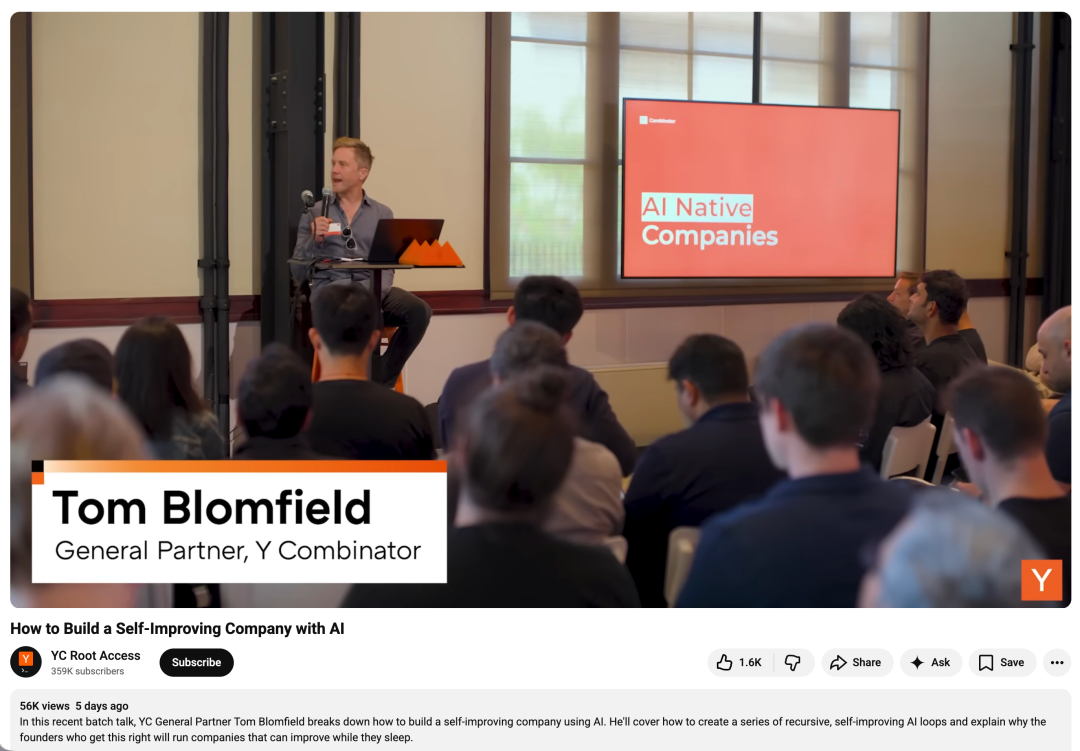
Blomfield's assessment is straightforward: Today, most companies still have a "Roman legion" structure—information flows upward, commands flow downward, and people are at the core of coordination. Putting AI into this structure is like giving advanced weaponry to Roman infantry—they may use it more effectively, but the tactics remain the same.
A true AI-native company should look different.
Blomfield used a very specific description: Every action should result in a recordable, callable artifact, making everything legible to AI; companies should be designed as a "self-improving AI loop," where the system can sense the environment, make decisions, utilize tools, receive feedback, and self-correct.
In such a company, people are left with only two roles. One is the Individual Contributor—everyone, regardless of department, is a builder and operator, bringing prototypes to meetings, not just ideas; the other is the DRI (Directly Responsible Individual)—every output has a clear person responsible, who "cannot hide behind AI."
Then Blomfield delivered the memorable line: "If your API bill doesn't make you wince, you're not burning enough."
If this statement were uttered in Microsoft's CFO office, it would be considered a joke; but in front of a room full of YC startup founders, no one thinks it's crazy.
Why?
YC's other partner Diana Hu provided the answer during Startup School in early May. She said, "It's not about maximizing heads, it's about maximizing token consumption." She had a more straightforward version: "One person plus an AI tool is equivalent to what used to be a large engineering team."
Pay attention to the key word here: "equivalent." Not "similar to," not "like"—a replacement.
Several companies in YC's P26 2026 Spring batch are already achieving tasks that used to require 20 to 30 people with just 5 or 6 individuals. Their token bill is naturally high, but their personnel bill is extremely low—overall, they are profitable.
A more radical case is Block. Jack Dorsey's fintech company recently laid off 40% of its staff. This is not the traditional sense of "cutting costs and increasing efficiency"—Block simultaneously increased internal investment in AI tools, adopting the new structure Diana Hu described: IC + DRI + AI agent.
In YC's context, burning tokens is not an expense but a substitution. It doesn't replace costs outside of AI; it replaces payroll. The reason the math adds up is that the company simultaneously removes positions that would have incurred payroll expenses.
This is the fundamental reason why Microsoft and YC see the same thing but come up with opposite answers—they are not burning the same type of token at all. Microsoft's token is for refueling the existing team, while YC's token is a substitute for the original driver.
04 The Real Asset is Being Redefined
In a conversation, Tom Blomfield also made another thought-provoking statement: "People are fleeting; contextual documentation is what matters."
This is an accounting judgment.
How is a traditional company's balance sheet structured? On the left, you have fixed assets, accounts receivable, goodwill, IP, and on the right, liabilities and equity. Employees are not under assets—they are a cost. But every company knows deep down that employees are the actual assets: customer relationships are in the salesperson's head, business intuition in the product manager's head, technical know-how in the engineer's head.
These kinds of "assets" are mobile. When an employee leaves, the asset walks out too.
Blomfield describes AI-native companies as doing one thing: extracting all these assets that originally existed only in human minds and turning them into AI-readable, callable, and iterative "contextual assets."
What form does this take? It's detailed requirement documents; it's process documents capturing every decision, email exchange, Slack discussion; it's open MCP interfaces and APIs; it's artifacts generated by every internal tool—all of these things form a company's new, inheritable asset layer that won't evaporate when an employee leaves.
In this type of company, people instead become "variables"—they can quickly join and exit because the core assets of the company are not in people's minds but in the documentation.
Image Source: Visual China
If this structure holds, it signifies more than just a new organizational model—it means the company's balance sheet is being rewritten. An AI-native company with six people burning a staggering token bill may seem financially unhealthy, but its true assets may be thicker than those of a traditional 60-person company—it's just that these assets are not yet accounted for under current accounting standards.
In other words, vibe coding is not dead. It just doesn't belong to traditional companies.
The day Microsoft pulled the plug on Claude Code was not a failure of AI economics—it was a day when the posture of fitting AI onto an old organization was self-defeating.
Meanwhile, in that room full of YC startups, a different posture is emerging—they are small, they are burning, they don't have "Employee AI Utilization Rate" on their KPI charts, and their CFOs are not panicking over skyrocketing token bills—because what they are burning is not for "employee co-piloting" but for "employee substitution."
In the next few years, all mid-sized companies still trying to make employees "use a little more AI" will hit the same wall Microsoft hit—the structurally rising token bill.
But the real reason for hitting the wall is not that AI is too expensive—it's that the organization hasn't changed yet.
And most companies, unfortunately, probably won't change anytime soon.
Recommended
Desk: Brent Crude Tops $110, Musk's Net Worth Drops 528.6 Billion in Four Days After Tesla Roadster Launch
Oct 17, 21:49
JST Fifth Buyback and Burn Successfully Concludes: Over 170 Million Tokens Worth Approximately $23.53 Million Burned, Buyback Mechanism Set for Comprehensive Upgrade
Oct 17, 20:10
BitTorrent Brand Upgrade and Initial BTT Buyback & Burn Launch Simultaneously, Dual Engines Usher in New Era of Web3 Infrastructure
Oct 17, 20:00
Asia Market Daily: Japan's BOJ signals more rate hikes while Korea targets offshore perpetual platforms (2026/10/17)
Oct 17, 17:01Why did Papertrade backfire on you?
Oct 17, 17:01
The 'Strict Father' of Northern Myanmar: This Company Deploys 200,000 "AI Best Actors" to Strike Back Against Scammers
Oct 17, 15:34