Dissecting the Underlying Architecture of the BIT US Stock Platform, Why is Real US Stock Important?
In 2026, cryptocurrency platforms collectively began to turn their attention to the US stock market.
Last Friday night, SpaceX went public on the US stock market, almost pushing this sentiment to a new high. As one of the most watched tech companies globally, SpaceX's IPO was not just a capital market event but also a global retail investor-focused "US Stock Market Gateway" stress test.
On one hand was the extremely high market enthusiasm. SpaceX's first-day trading performance was strong, with the stock price significantly rising above the issue price, and discussions around it quickly spreading from traditional brokerages and financial media to the crypto community. On the other hand, many investors had a more direct experience gap: some platforms had aggressively promoted participating in the SpaceX IPO allocation process, but in the end, did not actually allocate shares to users, leading to only a refund.
In fact, this case can very well illustrate a few things: the US stock trading business done by crypto platforms is basically a reflection of US stocks rather than real US stocks. It is in this context that breaking down and analyzing how BIT has become a professional US stock platform is of great practical significance.
BIT is not a newly emerged US stock trading platform. Its predecessor was Matrixport, which had mainly served institutions and high-net-worth clients. In February 2026, BIT launched its US stock trading service; by mid-May, about 100 days after the BIT US stock business went live, user AUM had already exceeded $200 million.
And the most significant feature of BIT's US stock product is that users trade real US stocks.
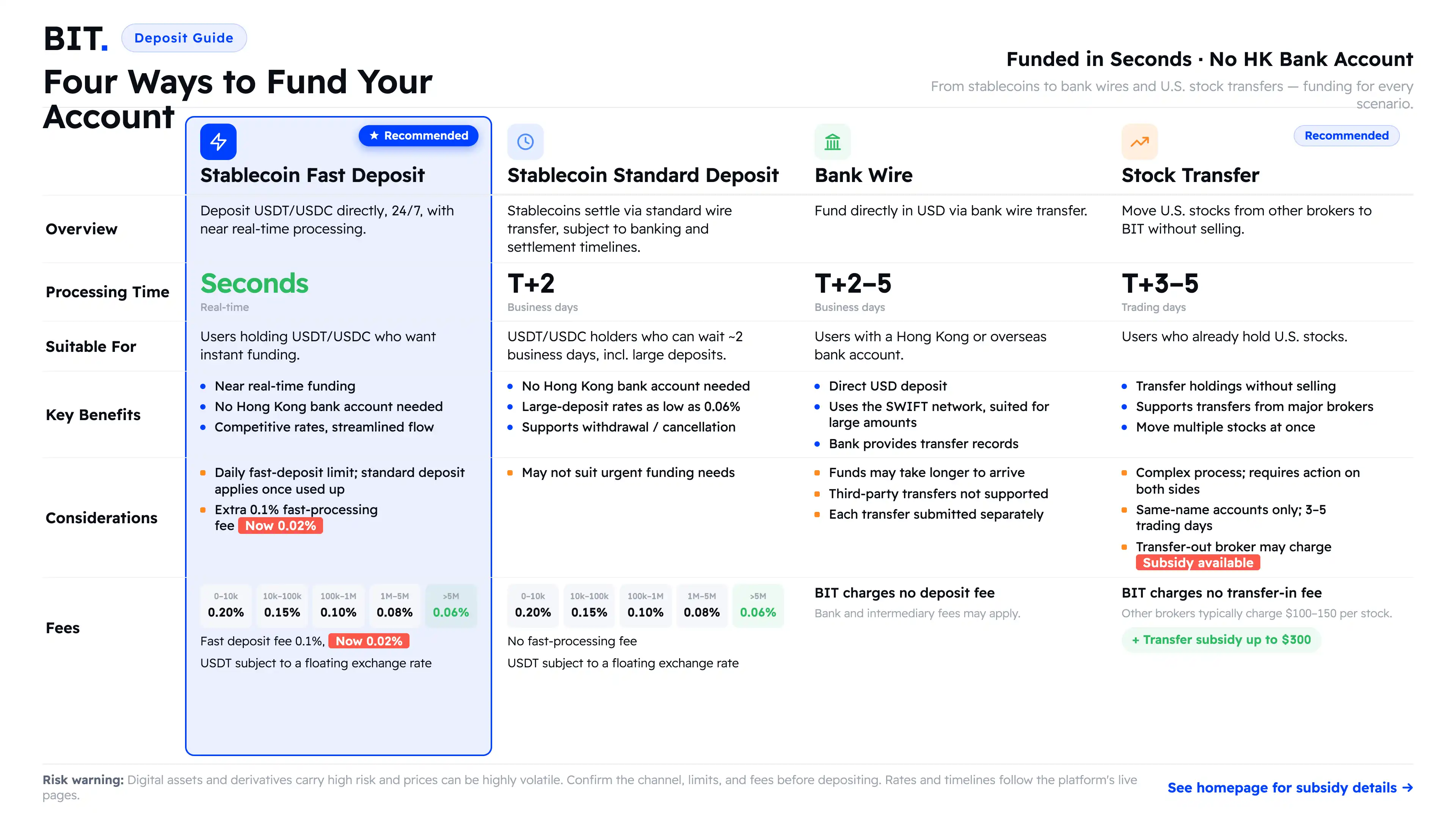
This means that in the fund transfer process, BIT is closer to the actual needs of both crypto users and US stock users. Users can deposit quickly with stablecoins such as USDT, USDC, achieving 24/7, second-level arrival; they can also choose to deposit using the stablecoin standard through the regular SWIFT process; if they have an overseas bank account, they can also directly recharge in USD via bank wire transfer.
What's even more special is that BIT also supports stock transfers. This means that users who already hold US stocks at other brokerages do not necessarily need to sell the stocks, transfer the funds out, and then repurchase them; instead, they can directly transfer their existing US stock holdings to BIT.
Although now there are cryptocurrency trading platforms online with US stocks that can basically solve the problem of "past crypto users have not smoothly entered the US stock market," a new problem arises: many users are actually not aware that on major crypto platforms, what they are buying is mostly synthetic stocks rather than real US stocks.
The distinction between synthetic and actual US stocks is not always clear, and it may not be easy to differentiate on a trading interface. You may see symbols like NVDA, AAPL, MSFT, all represented by a candlestick chart, a buy button, and your account's P&L.
For day traders, this difference may not be very noticeable. As long as the price is right, there is enough liquidity, and the orders are executed smoothly, many people may not inquire about what underlies the asset. However, once a user's goal shifts from "making a trade" to "allocating to a certain asset class," this distinction becomes significant.
Because owning actual stocks means the user is entering not just a pricing system but a realm of additional rights. This includes dividends, voting rights, corporate actions, securities custody, settlement, and even investor protection in extreme cases. A price contract can mimic price movements, but it is challenging to replicate the full rights chain behind a stock as a security asset.
Therefore, what you buy as NVIDIA on most crypto exchanges does not truly equate to "owning NVIDIA stock."
This is precisely why the entry of crypto platforms into the US stock market in 2026 marks a significant turning point for discussion.
The most straightforward example is dividends.
Stocks are not just about price appreciation. For many companies and ETFs, dividends are a significant part of long-term returns. According to Fidelity's data, dividends have contributed to approximately 40% of the total return of the S&P 500 over the long term.
Let's take a more concrete example with $1 million to illustrate.
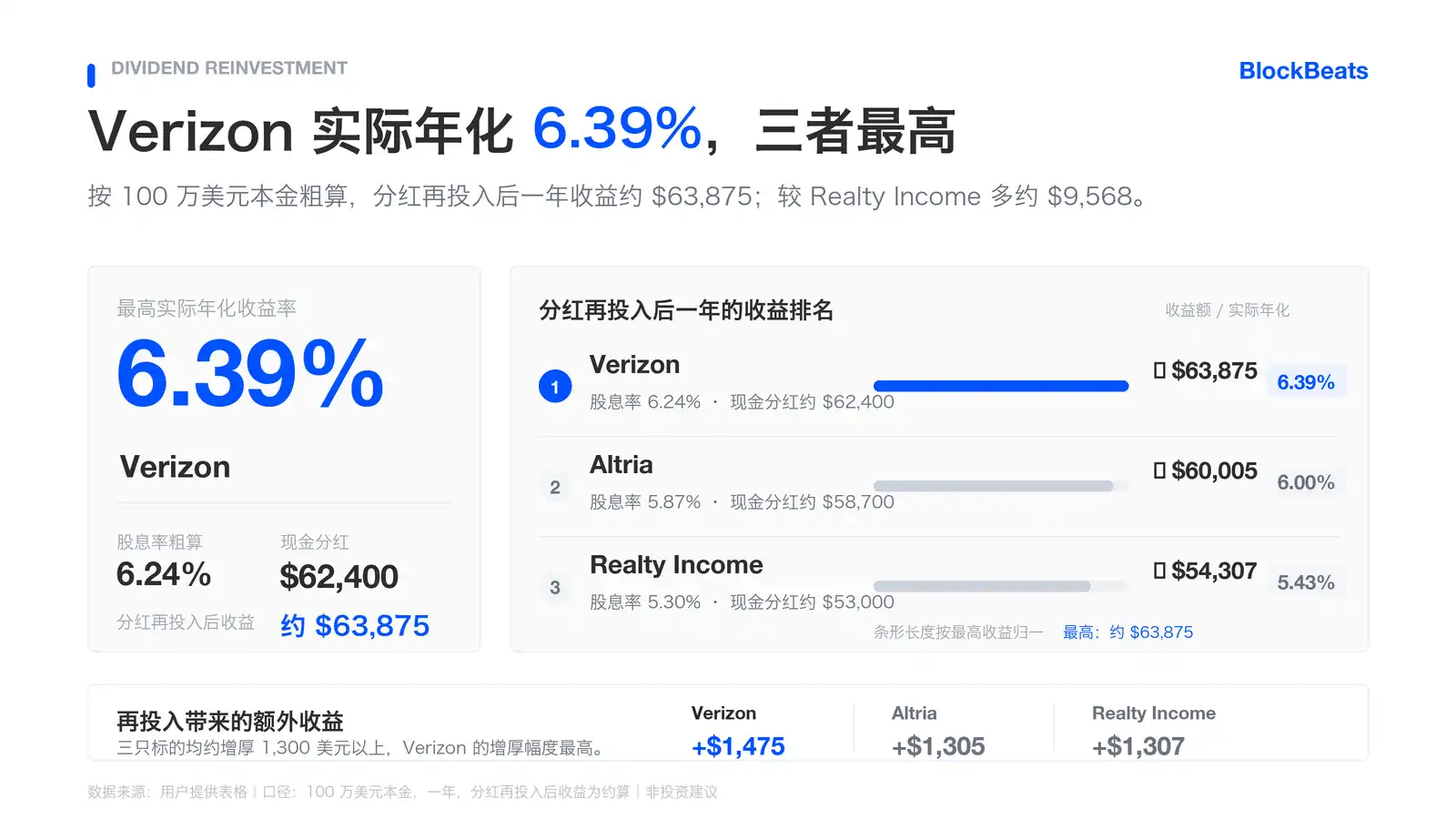
Consider some high-dividend US stocks. The annualized dividend per share for Altria is approximately $4.24, based on a rough calculation of the June 2026 stock price. With $1 million held for a year, the pre-tax cash dividend is about $58,700, corresponding to an annual dividend yield of around 5.87%. Verizon's latest quarterly dividend annualizes to around $2.83 per share. Similarly, with $1 million held for a year, the pre-tax cash dividend is about $62,400, corresponding to an annual dividend yield of approximately 6.24%. Realty Income, a company that pays monthly dividends, has an annualized dividend per share of about $3.246. With $1 million held for a year, the pre-tax cash dividend is about $53,000, correlating to an annual dividend yield of around 5.3%, distributed monthly.
These calculations only consider the results from dividends.
If these dividends are reinvested instead of withdrawn and used to purchase more of the same stock, the compounded returns would be even higher. Assuming pre-tax, constant stock price, constant dividends, and immediate reinvestment upon receipt, investing $1 million in Altria with subsequent reinvestment of dividends would yield approximately $60,000 in returns after one year, equivalent to a return rate of around 6%; reinvesting Verizon's quarterly dividends would result in returns of about $63,900 after a year, corresponding to a return rate of approximately 6.39%; Realty Income's more frequent monthly reinvestments would lead to returns of about $54,300 after one year, with a return rate of around 5.43%.
Even when switching to more familiar tech stocks, the dividend yield is not as high as that of high dividend stocks, but the difference still exists. NVIDIA now looks more like a growth stock, with a low dividend yield. Holding $1 million for a year, the pre-tax dividend is approximately $4,900, corresponding to an annual dividend yield of about 0.49%; Microsoft is a bit more mature. Holding $1 million for a year, the pre-tax dividend is approximately $8,700, corresponding to an annual dividend yield of about 0.87%. These numbers may not be as eye-catching as high dividend stocks, but they are still part of the actual holding return.
(It is worth noting that different platforms may use different methodologies to display dividend yield. Some platforms use Dividend Yield, calculated by dividing the current or latest dividend by the stock price; some platforms use Dividend Yield TTM, calculated by dividing the actual dividends over the past 12 months by the current stock price. Therefore, for the same stock, the dividend yield seen on different platforms may vary. The above calculation is mainly to illustrate the magnitude of cash flow and is based on a rough calculation of the current dividend level annualized.)
For many funds with a bias towards asset allocation, the attraction of these stocks lies not only in the stock price, especially when the fund size reaches $1 million, $10 million, or even higher. Dividends are no longer just "small change" but a very generous and continuous cash flow.
This is also the most easily overlooked difference between price mapping and the real asset path.
If a user holds actual stocks in a securities account, dividends can enter the asset portfolio through company actions and the brokerage account. If the user buys tokenized stocks, CFDs, or some kind of price mapping product, how dividends are reflected depends entirely on the product rules. Some products may reflect the economic effect of dividends through net asset value adjustments, price corrections, or other mechanisms, but this is not the same as receiving cash dividends in a shareholder account.
In addition to dividends, another easily overlooked difference is transferability.
Many US stock products on centralized exchanges (CEXs) are essentially a form of in-house price exposure provided by the platform. Users can buy, sell, and see P&L changes similar to US stock prices, but these products usually do not support transferring positions to other brokerages or custody accounts. In other words, if a user wants to leave the platform, most of the time they can only sell first, withdraw the funds, and then buy again on another platform.
This is different from holdings in a real US stock account. Real stocks can be transferred because they have clear securities accounts, custody relationships, and a settlement chain. Assets are not merely a string of ledger numbers existing within the platform but can migrate within a compliant securities system.
BIT supports off-chain transfers, and the core reason lies here: its U.S. stock product is not simply price-pegged, but based on real U.S. stock assets and the corresponding securities custody architecture. Therefore, users hold not just a price contract that can only be traded within the platform, but a U.S. stock position with more complete asset attributes.
This difference may not be obvious during intraday trading, but it is crucial for long-term allocators. The larger the fund size and the longer the holding period, the more users need to care about one thing: whether this asset can leave the platform, enter another custody system, and be migrated and managed like a real securities asset.
Naturally, the more comprehensive the rights, the higher the requirements on the platform.
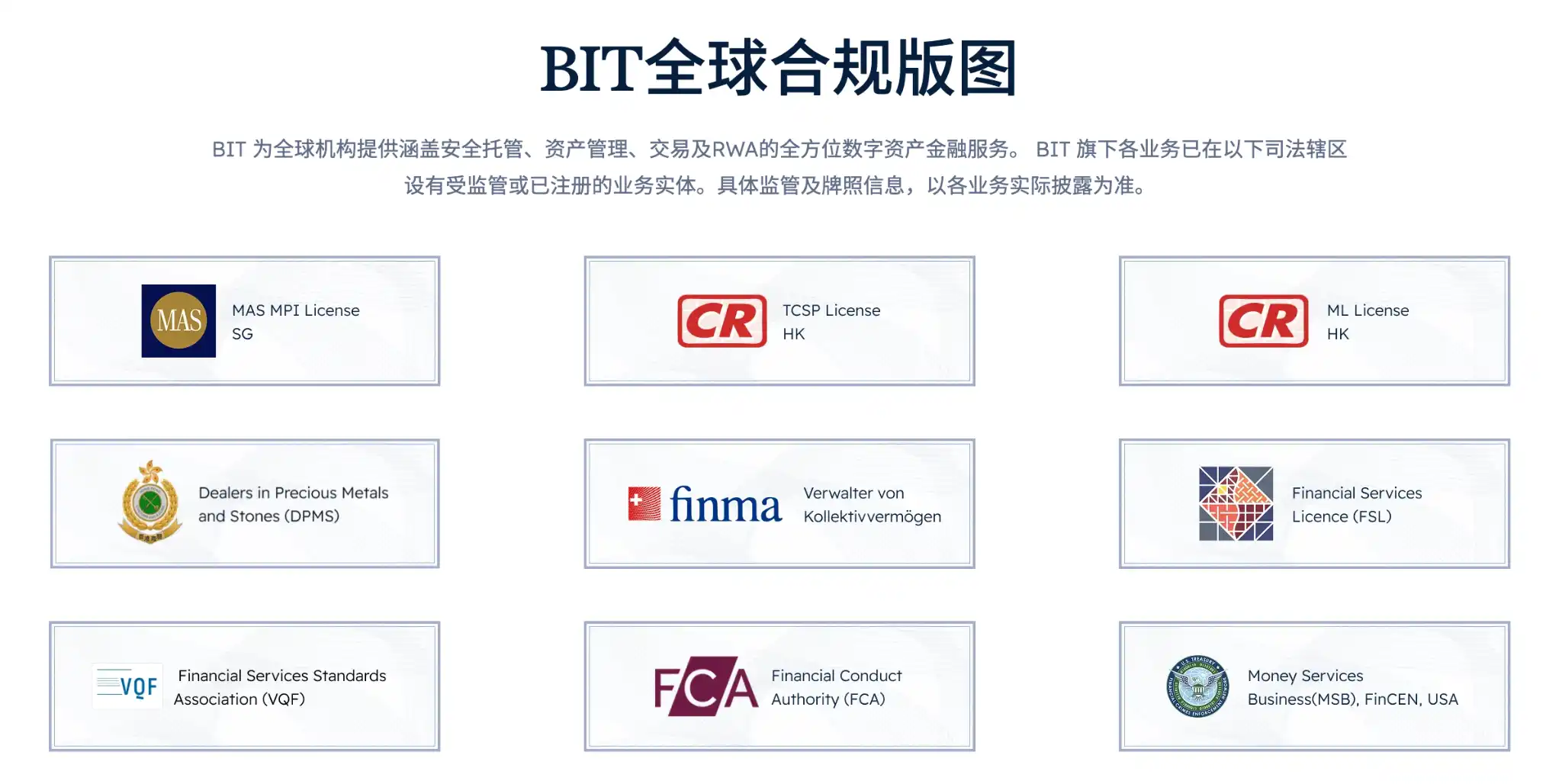
According to BIT's public information, its U.S. stock business does not turn stocks into internal price contracts but allows users to enter the U.S. stock securities trading and clearing system through Matrix Gelephu, licensed U.S. broker-dealers, and clearing partners. BIT's disclosed information mentions U.S. broker-dealer/clearing partners such as RQD Clearing and Atomic Vaults Securities, and also reveals the DTC off-chain transfer path.
If we delve into the specific operation of U.S. stock trading, the most core infrastructure is called the DTCC.
DTCC is not a name that ordinary users encounter daily, but almost every post-trade of a U.S. security transaction cannot avoid its subsidiary system. DTC is responsible for securities central custody. In simple terms, U.S. stocks do not physically move between buyers and sellers like paper certificates but transfer within the DTC system through electronic bookkeeping. As of DTCC's June 2025 disclosure, DTC's custody assets have exceeded $100 trillion.
NSCC is responsible for clearing. It processes a large number of broker-to-broker transactions for stocks, ETFs, corporate bonds, municipal bonds, ADRs, and more. DTCC's 2024 annual report shows that NSCC's average daily processed transaction amount reaches $22.19 trillion. More importantly, NSCC conducts multilateral net settlement to compress a large number of buy and sell orders in the market into fewer funds and securities settlement obligations. DTCC itself discloses that NSCC can reduce the need for exchanged payment amounts by approximately 98% on average every day.
At the core of this is the CCP novation mechanism. Originally, a transaction involved the buyer and the seller bearing each other's counterparty risk: the buyer worried that the seller would not deliver the stock, and the seller worried that the buyer would not pay. When entering the NSCC's central clearing system, the NSCC becomes the central counterparty, and the legal relationship shifts from "buyer to seller" to "buyer to NSCC, NSCC to seller." In other words, the NSCC stands in the middle, transforming the countless bilateral credit risks in the market into more standardized and manageable settlement risks.
This is why the US stock market is able to handle such a huge trading volume.
The OCC is mainly responsible for clearing derivatives such as options, while the FICC is responsible for clearing fixed income products such as US treasuries, corporate bonds, and MBS. For regular stock trading, users may not directly feel the presence of the OCC and FICC, but together they make up the backend infrastructure of the US capital market. The frontend is a buy button, but behind the scenes is actually a well-defined financial machinery.
For crypto platforms, entering this system is like learning a new language.
What crypto platforms are familiar with are wallets, matching engines, on-chain addresses, perpetual contracts, funding rates, and on-platform bookkeeping; what the US stock market is familiar with are broker-dealers, clearing brokers, DTC, NSCC, SIPC, account structures, corporate actions, and settlement.
Both systems deal with assets and trades, but the underlying logic is different. The former is more like a real-time ledger, while the latter is more like a property system built on law, accounts, and intermediary institutions.
Therefore, the real challenge of entering the US stock market is not "whether there is market data" or "whether a buy button can be created," but how the platform integrates with the broker and clearing systems.
In the traditional securities market, there are several models for brokers to access clearing. The first is self-clearing, where the broker becomes a clearing member and handles the trade backend, requiring significant capital, systems, compliance, and risk management capabilities. The second is fully disclosed introducing broker, where the introducing broker handles the clients and frontend, and the clearing broker opens a disclosed account for each client, handling custody and clearing. The third is omnibus introducing broker, where the platform or introducing broker uses a omnibus account structure at the clearing broker, with underlying client records maintained by the introducing party. The fourth is DVP/RVP, which stands for delivery versus payment / receive versus payment, more commonly used for securities settlement arrangements between institutional clients and custodian banks.
For a crypto-native platform, direct self-clearing is generally not the most realistic first step. A more feasible path is to leverage the mature brokerages and clearing infrastructure of the U.S. securities market to connect user onboarding, securities accounts, trade execution, and clearing custody. In other words, it's not about reinventing the U.S. stock market from scratch but about integrating crypto users into the existing financial rails of the U.S. stock market.
This is also why, in the current phase where trading platforms are collectively tapping into "U.S. stock flow," compliance and clearing have become the most critical parts.
For the average user, the specific mechanisms behind these "stages" may not necessarily be perceived. What users see at first glance is still whether they can buy, how fast the transaction settles, how much the fees are, and how user-friendly the app is.
However, as stocks transition from short-term trading targets to long-term asset allocation, the legitimacy of the mechanisms becomes crucial.
Because when holding a stock for the long term, users care not only about how much it has gone up today but also about whether it is truly their asset, how dividends and corporate actions are handled, where the securities account is, who handles the custody and clearing, and what mechanisms are in place to protect the assets in extreme scenarios.
This is also the core consideration of BIT's U.S. stock products: it genuinely aims to make U.S. stocks part of a crypto user's asset allocation, rather than another price game where leverage can be used to chase gains and losses.
"When we were still preparing the product at the end of last year, we made a very firm decision. This decision actually comes from the company's 7-year DNA of serving institutions and high-net-worth clients, stemming from a values-oriented approach to the long term."
As Elio Cui, Head of BIT Brokerage Business, mentioned at a recent roundtable, BIT's choice of this product line is intimately tied to its historical company DNA.
If we only look at this year's launch of the U.S. stock business, BIT could easily be seen as a new platform that suddenly entered the consumer market. However, by extending the timeline a bit, the logic becomes much clearer. BIT is the new brand after Matrixport's rebranding, and Matrixport has been serving institutions and high-net-worth clients since 2019, with businesses spanning custody, trading, asset and wealth management, liquidity and financing, RWA, and other areas.
Currently, BIT manages assets exceeding $6 billion, with a monthly trading volume exceeding $7 billion, a total interest paid to customers exceeding $2 billion, a valuation exceeding $10 billion, and has been selected for the "2024 Hurun Global Unicorn List" and "2025 Singapore Fintech Unicorn List."
More notably, BIT's co-founder and chairman Wu Jihan, who is also the CEO and chairman of Bitdeer, a well-known brand.
BIT is not a typical flow-driven trading platform.
In the past, its customers were mostly institutions, professional investors, and high-net-worth individuals. This type of customer often has different requirements for the product compared to retail traders. They are certainly concerned about returns, but they are more interested in knowing where their assets are, who is custodying them, how risks are isolated, who the counterparty is, whether the account structure is clear, and if the compliance boundaries can be clearly articulated.
Large clients are not easily swayed by the "high returns" allure. What matters more to them is whether issues can be traced, asset ownership can be confirmed, and underlying processes can be explained. For them, being a bit slower is not a flaw. Many times, slowness itself is part of risk control.
This is the product philosophy behind BIT's U.S. stock business.
If a company's DNA lies in matching, leverage, volume, and trading activity, when entering the U.S. stock market, it naturally chooses the lighter path: turning U.S. stocks into a rapidly tradable price product. This makes it more like a trading platform and also easier to generate short-term trading volume.
However, if a company's strength comes more from institutional financial services, when entering the U.S. stock market, its first consideration is not just "how to get users to trade," but rather "how should this asset be held."
There is no absolute right or wrong between these two approaches; it's just a matter of different service needs.
Trading-oriented users seek speed, volatility, and liquidity. Allocation-oriented users seek clarity, stability, and certainty in the asset chain.
The U.S. stock market is particularly suited to be understood from this perspective. The equity of U.S. listed companies is an asset formed by the company's profits, cash flow, governance structure, and shareholder equity. For long-term allocators, buying a stock is not just about today and tomorrow's price fluctuations but about buying a part of the value this company will create in the future.
In the crypto market, platforms excel at trading all assets. BTC can be traded, ETH can be traded, as can gold, U.S. stocks, indices, and macro events. This capability is powerful as it allows global funds to quickly access various asset prices. However, it also has a side effect: prices are amplified, and rights are weakened.
What BIT aims to do is to bring back that aspect of rights.
This also explains why their U.S. stock business focuses on "real holdings," "shareholder equity," and "direct connection to brokerages." It is not about creating another high-volatility trading venue but about enabling stablecoin users to smoothly enter the most mature and mainstream type of asset in the traditional market.
In the crypto industry, fast is usually considered a virtue. When a new narrative emerges, the platform needs to be fast; when a new asset is hot, the listing needs to be fast; users want quick entry and exit, and the market rewards speed, volatility, and responsiveness. Hundredfold, thousandfold, ten-thousandfold, fast, accurate, and ruthless is the most familiar language in this industry.
So, when a crypto platform says it aims to create real US stocks, a real securities account, a real clearing system, this may not sound as appealing.
For a crypto platform, the fastest approach is, of course, to create a price gateway. By bringing in US stock prices, creating trading pairs, tokens, or contracts, the product can be quickly launched. Users are already accustomed to spot trading, perpetual futures, leverage, funding rates, and 24/7 trading on exchange platforms, so this path naturally fits and is the easiest way to generate volume quickly.
However, financial products ultimately need to focus on user experience, especially during critical moments.
As mentioned at the beginning of this article, the night SpaceX went public is a great example. When a highly anticipated IPO is approaching, many platforms have vibrant pre-launch marketing, and users invest their time, attention, and even funds to await the outcome. But if they ultimately do not receive any shares and only get a refund, users not only lose the opportunity to subscribe but also incur the time cost and opportunity cost of waiting. The market does not pause because users are waiting; the real trading window often lasts only a few hours.
That is why stability, reliability, and executability are more important than just appearing "fast."
Instead of hyping up an IPO subscription only to disappoint investors in the end, BIT's approach is more like steadily providing users with a reliable opportunity. On the night of SpaceX's IPO, the BIT system ran smoothly, allowing users to participate in pre-market and regular trading through a real US stock trading gateway; many investors who bought in pre-market were able to seize the opportunities brought by the first-day price discovery.
In an industry that values speed, slowing down to focus on account creation, clearing, custody, compliance, and the path to real assets may not seem as exciting. However, many truly important aspects of finance are not achieved through posters and marketing slogans but rather through details such as order execution, asset confirmation, system resilience under pressure, and whether users can genuinely participate in the market during the window of opportunity.
The larger the fund, the more they care about just speed; the longer the investment horizon, the more they care about more than just the ROI snapshot. What institutions and high-net-worth clients truly care about is where the assets are held, how rights are confirmed, how risks are mitigated, and whether there is traceability in case of issues.
This may be the true path that the BIT US Stock Business wants to convey: not to create a US stock price gateway in the fastest way possible, but to bring stablecoin users into the real US stock asset system in a more solid manner.
Slow is fast.
Disclaimer: This material is for general information and market education purposes only, and does not constitute investment advice, nor does it constitute an offer, solicitation, recommendation, or endorsement of any security, product, platform, or service. US stock investment involves risks such as market, liquidity, custody, settlement, and clearing, and investors should assess their own situation carefully and seek professional advice when necessary.
Recommended
Desk: Brent Crude Tops $110, Musk's Net Worth Drops 528.6 Billion in Four Days After Tesla Roadster Launch
Oct 17, 21:49
JST Fifth Buyback and Burn Successfully Concludes: Over 170 Million Tokens Worth Approximately $23.53 Million Burned, Buyback Mechanism Set for Comprehensive Upgrade
Oct 17, 20:10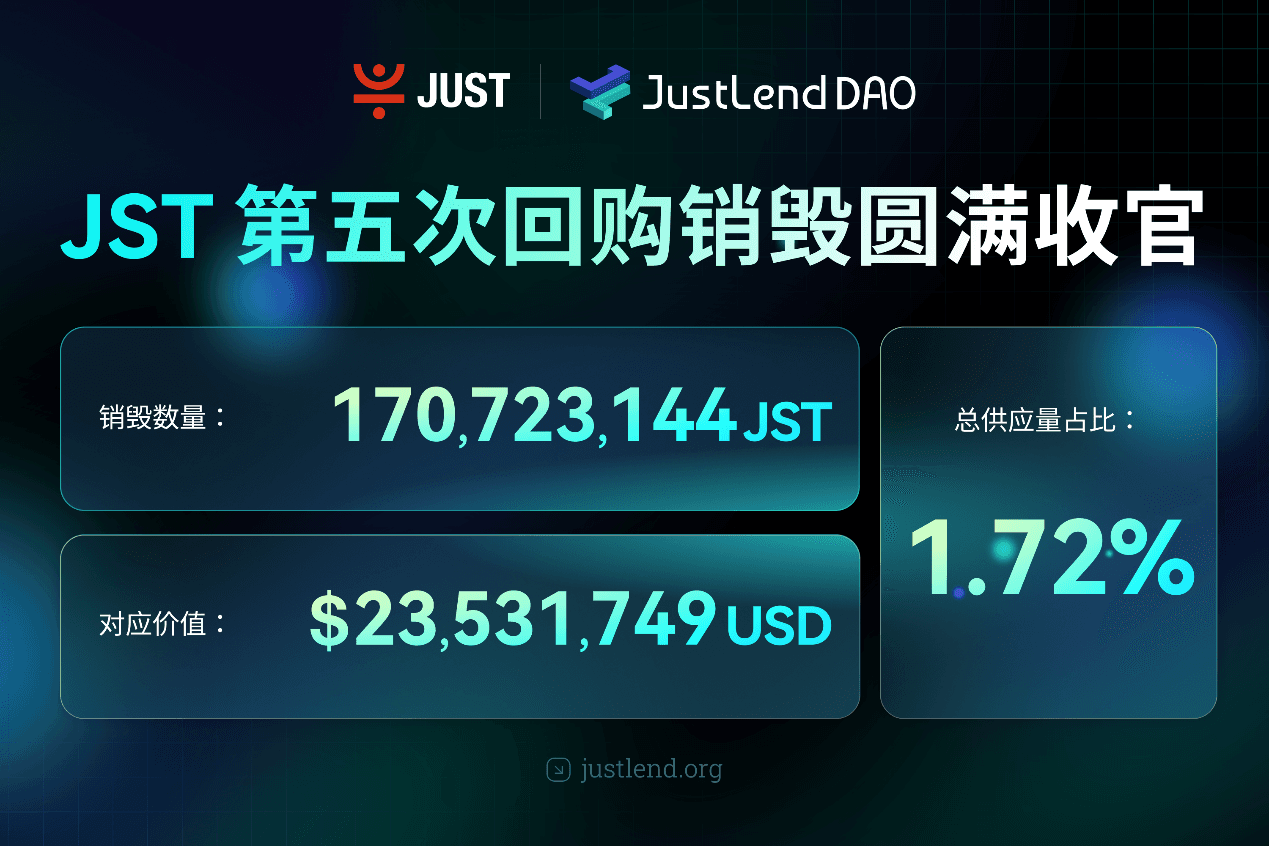
BitTorrent Brand Upgrade and Initial BTT Buyback & Burn Launch Simultaneously, Dual Engines Usher in New Era of Web3 Infrastructure
Oct 17, 20:00
Asia Market Daily: Japan's BOJ signals more rate hikes while Korea targets offshore perpetual platforms (2026/10/17)
Oct 17, 17:01Why did Papertrade backfire on you?
Oct 17, 17:01
The 'Strict Father' of Northern Myanmar: This Company Deploys 200,000 "AI Best Actors" to Strike Back Against Scammers
Oct 17, 15:34