The Whole Web Is Talking About Loop Engineering, But What Has It Really Changed?
TL;DR
· In June 2026, several AI practitioners almost simultaneously proposed Loop Engineering, with Stripe already using Minions to merge over 1300 AI-generated PRs weekly.
· This approach no longer relies on human-in-the-loop prompting but allows the system to autonomously discover tasks, handoffs, validate, persist state, and move to the next iteration.
· Reliability still depends on independent evaluators, hard gating, and manual review, where validation debt and comprehension decay may reverse-amplify risks.
Recently, an Anthropic engineer published an 11-page document on "Cyclic Engineering of Intelligent Systems," positioning Loop Engineering as a critical methodology for the next stage of AI programming after Prompt Engineering, Context Engineering, and Harness Engineering.
This document has garnered attention because it coincided with a turning point in AI programming discussions in June 2026. Addy Osmani, Boris Cherny, and Peter Steinberger nearly concurrently referred to this new phase of AI programming as Loop Engineering, while Stripe's Minions pipeline had already been merging over 1300 AI-generated Pull Requests weekly using a similar approach.
The significance of this number lies not in AI writing a few more lines of code but in the shift of software development focus from "humans telling models what to write" to "humans designing a system that can autonomously queue tasks, write code, check results, persist state, and continue running."
Over the past year, the narrative around AI programming tools has mostly revolved around model capabilities: more accurate code completion, longer context windows, and agents able to handle more complex tasks in one go. However, the discussion on Loop Engineering focuses on another aspect: as the cost of generating code itself becomes cheaper, what engineers truly need to design is a sustainable loop. Machines can continuously produce candidate solutions, and humans must decide which results are trustworthy, which must be blocked, and what long-term costs are being obscured.
Recently, an Anthropic engineer published an 11-page document on "Cycle Engineering of Intelligent Agent Systems," placing Loop Engineering after Prompt Engineering, Context Engineering, and Harness Engineering as a key method for AI programming to enter the next stage. This article takes this document as a starting point, combining public discussions by Boris Cherny, Addy Osmani, and others, as well as the case of the Stripe Minions merging over 1,300 AI-generated PRs weekly, to explain what Loop Engineering really is, why it has suddenly become a topic of widespread discussion, and how it truly changes not code writing but validation, scheduling, and judgment in software development.
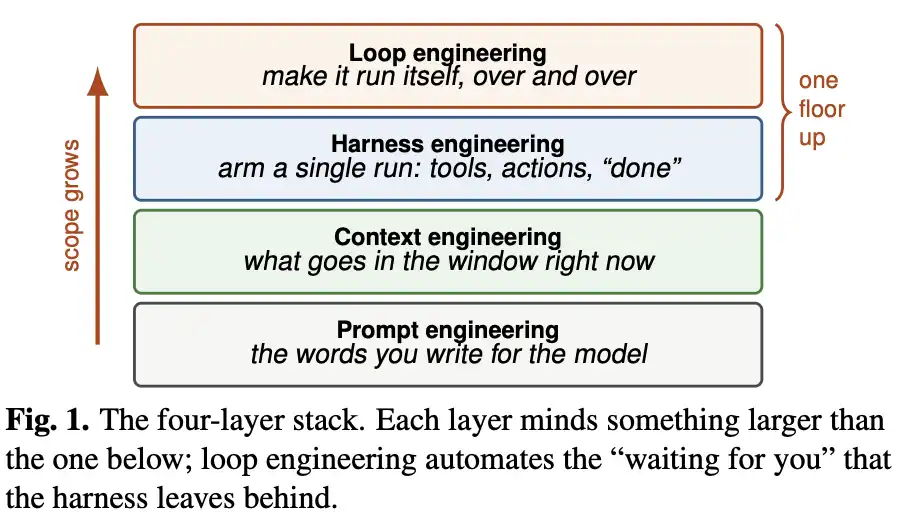
Loop Engineering is positioned as the fourth layer of the AI engineering stack, following Prompt Engineering, Context Engineering, and Harness Engineering.
Prompt Engineering addresses "how to ask"; Context Engineering addresses "what to show the model"; Harness Engineering addresses "how to integrate a single model run into tools, testing, and workflows." Loop Engineering takes one step further: the system does not just perform a one-time task but can restart at a fixed time or trigger condition, using the output of the previous run as input for the next round.
A complete loop usually consists of five actions.
The first step is job discovery, such as scanning CI failures, open issues, code commits, or tasks to be processed; the second step is task transformation, organizing tasks into the context that the model can handle; the third step is independent validation, checking if the model's code output actually runs, passes tests, and introduces no side effects; the fourth step is result persistence, writing the status, judgments, and outstanding items to a file or system; and the fifth step is loop scheduling, ensuring the next round continues to run at the right time.
Here, the most critical aspect is not "generation" but "validation." If a loop simply continues to let the model write code and then praises its own results repeatedly, it can easily become a "head-nodding loop": each round seems to move forward, but, in reality, it only wraps errors more neatly.
Osmani's own morning triage loop is a personal example: the system automatically reviews the previous day's CI failed tests, open issues, and recent commits, generates a status file, and puts unresolved items into a manual inbox. Its value is not to make all decisions for the engineers but to complete an initial screening before the engineers wake up, leaving attention to the parts that truly require judgment.
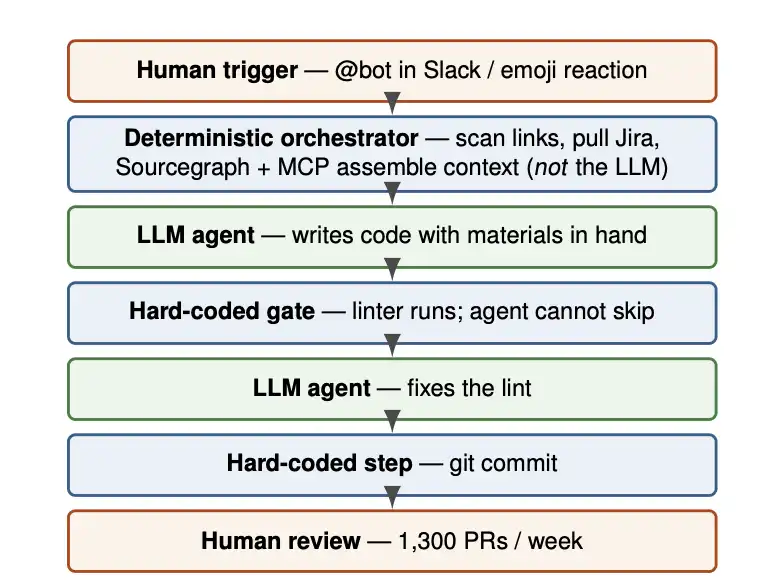
Stripe's Minions pipeline is the most impactful corporate case study in this round of discussions: merging over 1300 AI-generated Pull Requests weekly, with the code itself not being manually authored.
However, this does not mean that Stripe hands over the production system to a large unconstrained model. Instead, the key to Minions is a highly controlled process: a deterministic orchestrator first assembles the context, extracting task information from Jira, code search, and internal tools; LLM is responsible for generating code; then, through hardcoded linters, commit gates, and final human reviews, decisions on mergeability are made.
In other words, reliability does not come from the "model suddenly being smart enough" but from a series of constraints. The model is responsible for proposing candidate changes, the system is responsible for restricting what it can touch, which checks it must pass through, and humans are responsible for the final judgment on whether it goes into the mainline.
This is also the distinction between Loop Engineering and ordinary AI scripting. Ordinary scripts often focus on "getting the model to complete the task"; a looping system must consider where the task comes from, how to handle failures, how to maintain state, how to control budgets, and who prevents errors from going into the production environment.
Without these constraints, 1300 PRs per week are not an efficiency boost but could be a tech debt creation engine.
A core design of Loop Engineering is to separate generators and evaluators.
The generator is responsible for writing code, modifying files, and submitting candidate results. The evaluator is responsible for catching errors, and it is best to default to assuming that the code is flawed. The two cannot be done by the same "optimistic agent" because the model often tends to affirm its output when self-scoring, especially in cases of vague task descriptions, insufficient test coverage, or incomplete context.
An independent evaluator can be simpler, more skeptical, and easier to fine-tune. It does not need to creatively solve problems; it only needs to verify if a page can open, if tests can pass, if boundary conditions are not broken, and if the code complies with established rules. Some practices involve having the evaluator actually click through a page via a browser automation tool instead of just reading the code to make judgments.
This explains why "verification" is the most challenging step in the five-step loop. While code generation has become increasingly inexpensive, proving that a piece of code is truly correct remains costly. Especially in large codebases, errors may not be immediately exposed, and tests may not cover real business pathways. The faster the loop runs, the quicker unverified assumptions accumulate.
The risk of Loop Engineering lies not in writing incorrect code but in the possibility that it may make the team harder to self-discover a loss of understanding.
The first type of cost is validation debt. Errors not covered by tests will continue to accumulate in the loop until they erupt collectively during a merge or deployment. The second type is a decline in comprehension. As the codebase continues to expand, engineers may not have firsthand experience of key design choices, and their mental map remains stuck in an old version. The third type is cognitive surrender. Humans begin to passively accept machine output and only provide formal approvals. The fourth type is token consumption explosion. Retries, subagents, long contexts, and multi-round validations will cause the bill to rise rapidly.
These four costs feed each other: insufficient testing leads to validation debt, increased validation debt makes engineers less willing to delve into understanding, declining comprehension turns human reviews into rubber stamps, rubber stamp-style reviews then drive more automatic retries and higher costs.
Therefore, the same set of loop components may produce completely opposite results in the hands of different engineers. Those with strong judgment and clear boundaries can use the loop to amplify their understanding of the system, treating the machine as a tireless execution layer. On the other hand, those with weak judgment or excessive reliance on automation may, after several months, become the "gatekeepers" of their own system, only approving or rejecting but unable to explain why the system operates in a certain way.
Loop Engineering places a long-term trend in a clearer position: code, planning, PRs, and task breakdowns are becoming almost free, but "what is truly correct" has not become cheaper.
For enterprises, this means that the investment focus of AI programming may shift from acquiring stronger models to designing more robust processes: task boundaries, context assembly, independent assessments, state persistence, budget constraints, human review points, and how to halt the loop when anomalies occur. Model capability remains essential, but it is only a part of the system.
For engineers, roles are also evolving. The past core labor was coding, but now more and more labor is shifting towards reviewing machine-generated candidate answers: does it meet requirements, does it disrupt architecture, is it just superficially reasonable, does it push complexity to future maintainers.
This does not mean that programmers have been replaced. Instead, Loop Engineering is more like an amplification of judgment. It allows an engineer to produce the amount of changes that previously only a small team could accomplish, but it can also amplify laziness, blind trust, and a lack of validation into a production incident.
The real fork lies in whether humans still retain strong enough judgment and veto power. AI can submit endless PRs, but whether they can be merged, should be deployed, and whether they will eventually bring down the system still depends on humans.
Recommended
Desk: Brent Crude Tops $110, Musk's Net Worth Drops 528.6 Billion in Four Days After Tesla Roadster Launch
Oct 17, 21:49
JST Fifth Buyback and Burn Successfully Concludes: Over 170 Million Tokens Worth Approximately $23.53 Million Burned, Buyback Mechanism Set for Comprehensive Upgrade
Oct 17, 20:10
BitTorrent Brand Upgrade and Initial BTT Buyback & Burn Launch Simultaneously, Dual Engines Usher in New Era of Web3 Infrastructure
Oct 17, 20:00
Asia Market Daily: Japan's BOJ signals more rate hikes while Korea targets offshore perpetual platforms (2026/10/17)
Oct 17, 17:01Why did Papertrade backfire on you?
Oct 17, 17:01
The 'Strict Father' of Northern Myanmar: This Company Deploys 200,000 "AI Best Actors" to Strike Back Against Scammers
Oct 17, 15:34