The Invisible Bottleneck of AI Computing Power: Musk Also Steps into the Arena with "Photonic Module"
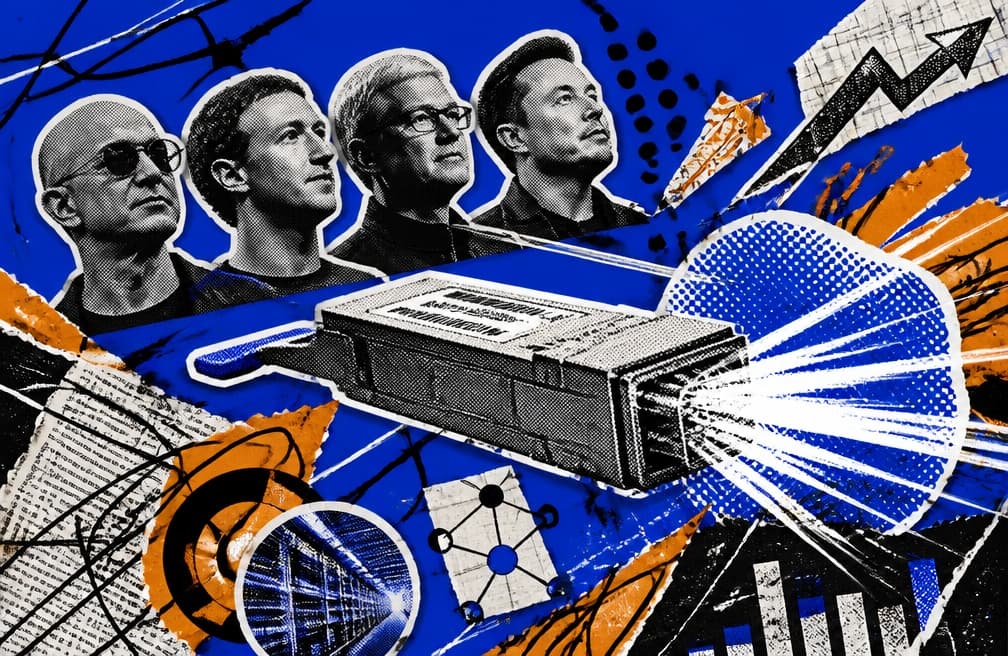
The "Optical Module" has become a key cornerstone of AI infrastructure. In this issue of the "Speed of Light" series, we explore how Silicon Valley giants are collectively betting on the optical module track.
The optical module is becoming the "new favorite" for Silicon Valley tech giants.
On June 27, local time in the United States, according to foreign media reports, Elon Musk's acquisition map has added another stroke.
This time, he set his sights on an optical communication startup company, Mesh Optical Technologies.
Documents from the Federal Trade Commission (FTC) show that the acquisition has passed the antitrust review through a fast-track process, clearing regulatory hurdles.
Musk's acquisition targets the most challenging problem in AI computing power infrastructure: as AI computing clusters grow larger, traditional copper cable data transmission is reaching its physical limits. As the signal speed increases, signal attenuation occurs, and as the distance increases, power consumption soars. Optical interconnection is seen as the only way to bypass this barrier.
Therefore, Musk's acquisition of Mesh is mainly aimed at laying the groundwork for his computing power empire. The optical module track he is eyeing is quietly becoming one of the most coveted tracks in the entire tech industry.
Over the past year, if we lay out the acquisition lists of Silicon Valley giants, we will find a hidden but clear theme: they are all starting to lay out optical modules.
From SpaceX to NVIDIA, Marvell, AMD, Broadcom, and others... From chip giants to rocket builders, almost all are placing their bets on the same "light" direction.
According to estimates from institutions such as Reuters, Futurum, and Goldman Sachs, by 2026, the capital expenditures of major cloud providers and AI infrastructure are approaching or even exceeding $700 billion. Within AI clusters, network interconnection is also becoming a key cost item alongside GPUs.
As hundreds of billions of dollars in capital expenditures flood in and connection costs account for an increasingly large portion of data center bills, the optical module has transitioned from a supporting role to the center stage, gradually becoming the industry's consensus.
01 Musk Becomes a "Light Chaser"
Let's first talk about SpaceX's logic and "ambition" in laying out optical modules.
The acquisition of Mesh has a close connection with Musk.
Founded in 2025, Mesh was established by three former SpaceX engineers: Travis Brashears, Cameron Ramos, and Serena Grown-Haeberli.
Prior to founding the company, the trio worked on the laser communication links between SpaceX's Starlink satellites, enabling interconnection among thousands of satellites in space. They have now transferred the optical communication technology developed in space to the ground, targeting the AI data center market.
Mesh's flagship product is an optical transceiver named Alpha C1, supporting speeds of 1.6T and 800G. The company claims that its power consumption is only one-third of similar modules.
The key to this product lies in the manufacturing of the optical engine, using flip-chip packaging technology similar to that used in modern processor chips. The company is also building a set of high-speed optical interconnection capabilities for scalable production around optical engine packaging, transceiver manufacturing, and automated testing.
Mesh believes that the current production methods for optical systems are too inefficient, with most U.S.-made optical systems still being hand-assembled like laboratory instruments, resulting in high costs and low output that cannot meet the demands of AI clusters for millions of optical connections.
What Mesh aims to do is turn large-scale manufacturing of optical systems into a reality.
In February of this year, Mesh emerged from stealth mode and announced the completion of a Series A funding round of over $50 million, led by Thrive Capital.
Now, with Musk's involvement, it is being integrated into a larger AI computing and space communication system.
The FTC's filing specifically listed Musk as the acquirer, rather than SpaceX or xAI. However, it is widely believed that Musk's cross-selling and personnel transfers among various companies are common practice, and post-acquisition, Mesh's technology and team are likely to serve the needs of Musk's entire computing system.
02 AI Data Centers Enter the Era of "Light-speed Competition"
The core significance of acquiring Mesh is to enhance the efficiency of SpaceX's data centers.
SpaceX has recently completed the largest IPO in history, and its business scope is expanding from rocket launches and satellite internet to AI computing power.
According to the plan, it may launch up to 1 million data center satellites into Earth's orbit in the future, a project recently referred to by outsiders as "Starmind."
These satellites do not operate in isolation. They are required to transmit data between each other at high speed, similar to servers in ground data centers, but using laser communication instead of wired or fiber optic connections. This is also a key advantage of the Mesh founding team: one of the core capabilities they accumulated when they participated in Starlink was enabling high-speed "communication" between satellites using lasers.
At the same time, SpaceX's AI layout on the ground is also accelerating. Its xAI subsidiary is building large-scale data centers in Tennessee and Mississippi, currently operating a computing power cluster of about 1 gigawatt, with core systems including Colossus and Colossus II. Colossus II will continue to expand, adding over 400 megawatts of computing power and introducing more than 220,000 NVIDIA GB300 chips.
It is evident that Musk is advancing on two fronts simultaneously: building super-large AI data centers on the ground and exploring "satellite data centers" in space. Whether on the ground or in the sky, high-speed optical communication will be a key foundation for AI computing power expansion.
Currently, SpaceX has signed computing power supply agreements with Anthropic, Google, and open-source AI developer Reflection AI, granting these companies access to chips and data centers. These agreements have brought substantial revenue to SpaceX, directly competing with major cloud service providers such as Amazon Web Services (AWS), Microsoft Azure, and Google Cloud.
In the long run, when SpaceX's space data center truly enters orbital operation, the demand for laser communication between satellites will significantly increase. The Mesh team's experience in laser links on the Starlink network and the optical transceiver technology they are currently developing will be valuable in both space and ground scenarios.
Furthermore, this acquisition is part of Musk's recent series of actions.
Prior to this, SpaceX had acquired the AI programming startup Cursor to enhance xAI's code generation and engineering development capabilities. At the same time, Musk is also continuing to promote the transformation of X into a payment system.
On June 26, he expanded access to the X Money payment tool for some U.S. premium subscription users on the social platform X, attempting to further propel X from a social platform to a "super app."
From a series of moves, Musk's recent actions are pointing in the same direction: further bridging the boundaries between SpaceX, xAI, and X to create a more tightly integrated ecosystem of computing power, software capabilities, payment gateways, and user networks.
03 The New Battlefield for Silicon Valley Giants
In the field of photonic interconnect, over the past year, large semiconductor companies and tech giants have engaged in intense M&A and investment activities at an accelerated pace.
In December 2025, Marvell announced the acquisition of optical interconnect company Celestial AI for $32.5 billion in cash and stock. If Celestial AI achieves revenue milestones, the total transaction value could reach $55 billion.
Celestial AI's "photonics-based" technology enables high-bandwidth, low-latency optical connections directly into GPU packages, rather than traditional rack-to-rack networking.
If we look only at the new wave of photonic interconnect M&A being driven by AI data centers, this is the largest acquisition in the current AI cycle, making Marvell one of the most prominent names in this photonic interconnect frenzy.
At the Taipei Computex conference on June 1, Jensen Huang referred to Marvell as the "next trillion-dollar company," with Marvell's stock price surging over 25% that day.
From the acquisition premium to the stock price surge, photonic interconnect is being repriced by the capital markets as a critical track for AI infrastructure.
At the time, AWS Vice President Dave Brown commented that the acquisition would help "further accelerate optical interconnect innovation for next-generation AI deployments." Marvell anticipates Celestial AI to achieve $500 million in annualized revenue by the end of the 2028 fiscal year, increasing to $1 billion by the 2029 fiscal year.
Also benefiting significantly from this AI wave, Nvidia's actions carry more weight.
In March 2026, Nvidia announced $2 billion direct strategic investments in two optical companies, Lumentum and Coherent, along with additional multi-billion dollar procurement agreements.
Simultaneously, NVIDIA also participated in the $500 million Series E funding round of the optical startup Ayar Labs. The company focuses on on-chip optical I/O technology aimed at chip-to-chip optical interconnect.
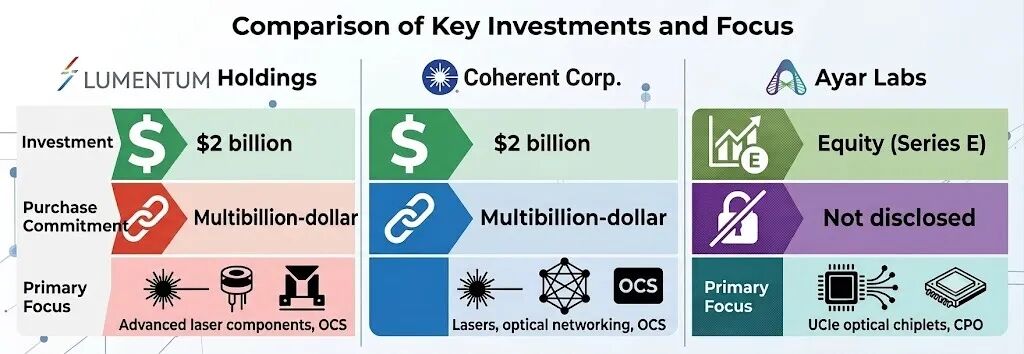
NVIDIA invested $2 billion each in Lumentum and Coherent and signed multi-billion dollar procurement agreements with them, while also acquiring a stake in Ayar Labs, proactively positioning itself in the optical interconnect field
Both of the first two partnerships are non-exclusive, while the investment in Ayar Labs is a strategic one, meaning that NVIDIA, while securing laser sources and optical component capacity, still maintains a competitive landscape among suppliers.
Through these investments, NVIDIA has extended its reach from the GPU and network switch fields to optical components, entering a more foundational layer of computational infrastructure.
There is also Broadcom, a pioneer in the Co-Packaged Optics (CPO) field. Its "Bailly" CPO switch based on Tomahawk 5 has been shipping to hyperscale customers since 2024 and has entered large-scale deployment scenarios at cloud providers like Meta.
In October 2025, Broadcom announced the Tomahawk 6 "Davisson," the industry's first 102.4 Tbps Ethernet switch with co-packaged optics, using 16 6.4T optical engines built on TSMC's COUPE process, reducing optical interconnect power consumption by 70% compared to traditional pluggable solutions. Broadcom's strategy is to vertically integrate optical engines from switch chips to achieve vertical integration.
AMD has also joined the fray, acquiring the optical I/O company Enosemi for interconnecting small chips. Astera Labs, on the other hand, acquired aiXscale Photonics, extending from the telecom retimer market to the optical domain.
It's not just at the company level that acquisitions are happening; the entire industry is trying to unify standards.
In March 2026, AMD, Broadcom, NVIDIA, OpenAI, Meta, and Microsoft jointly established the Optical Computing Interconnect Multi-Source Agreement (OCI MSA), with the goal of defining an open connection standard for AI data center optical interconnects.
The member list of this alliance covers basically all mainstream vendors of in-house AI accelerators. According to the plan, OCI MSA will support optical physical layer solutions ranging from 200G to 3.2Tb/s, covering different technology paths such as pluggable optical modules, onboard optical devices, and co-packaged optical chips.
Putting all these moves together, the conclusion is clear: Optical Interconnect has evolved from an optional technical exploration to a core component of competitive AI infrastructure.
Whether it's Musk acquiring Mesh, or NVIDIA, Marvell, Broadcom's strategies, they are all betting on the same trend. After all, copper cable transmission is approaching its physical limit, and as AI computing power advances, electricity must be handed over to light.
Recommended
Desk: Brent Crude Tops $110, Musk's Net Worth Drops 528.6 Billion in Four Days After Tesla Roadster Launch
Oct 17, 21:49
JST Fifth Buyback and Burn Successfully Concludes: Over 170 Million Tokens Worth Approximately $23.53 Million Burned, Buyback Mechanism Set for Comprehensive Upgrade
Oct 17, 20:10
BitTorrent Brand Upgrade and Initial BTT Buyback & Burn Launch Simultaneously, Dual Engines Usher in New Era of Web3 Infrastructure
Oct 17, 20:00
Asia Market Daily: Japan's BOJ signals more rate hikes while Korea targets offshore perpetual platforms (2026/10/17)
Oct 17, 17:01Why did Papertrade backfire on you?
Oct 17, 17:01
The 'Strict Father' of Northern Myanmar: This Company Deploys 200,000 "AI Best Actors" to Strike Back Against Scammers
Oct 17, 15:34