
UBS Analysis: Can Meta Alleviate EPS Stagnation Pressure by Selling Excess AI Computing Power?

TL;DR
· Bloomberg reported that Meta is considering selling excess AI computing power or opening up model access, UBS maintains a Buy rating with an $865 price target.
· UBS expects Meta's 2026 and 2027 EPS to remain nearly flat, with AI investment putting pressure on margins and operating leverage.
· The sale of computing power has not been officially confirmed by the company, and the ability to generate sufficient revenue from this remains a key uncertainty.
Bloomberg reported that Meta is exploring the option to sell excess AI computing capacity to external companies or to open up access to AI models hosted on its existing infrastructure; UBS subsequently maintained its Buy rating on Meta with a 12-month target price of $865 but did not revise any earnings forecasts upwards as a result.
The crux of these assessments is not whether Meta will immediately transform into a cloud computing company but whether it can find a closer revenue exit for its high-intensity AI capital expenditure. As of July 1, 2026, Meta's stock price was $601.85, and the $865 target price represents approximately 43.7% upside potential; however, in the UBS model, Meta's 2026 diluted GAAP EPS is $32.61, only slightly increasing to $32.98 in 2027, showing minimal growth and below the consensus expectation of $34.81 for 2027.
This is precisely what investors are most concerned about: AI infrastructure initially brings depreciation, server, data center, and operating costs, and it may take longer for Meta to scale revenue through AI chatbots, Business Agents, and other products. If excess computing power can be sold to external parties, Meta would have an additional means to alleviate profit pressure while awaiting a significant increase in AI application revenue.
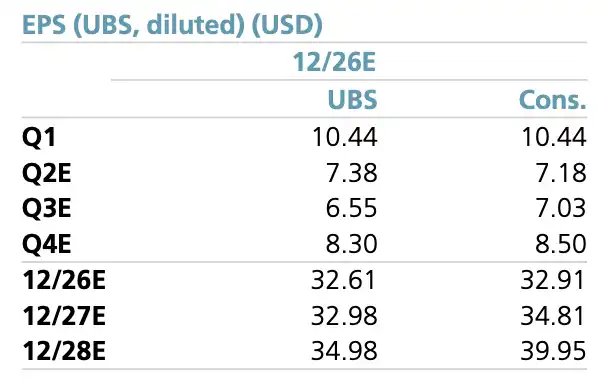
Meta Quarterly and Annual EPS Forecast Table; 2026E Diluted GAAP EPS at $32.61, 2027E at $32.98, showing EPS nearly stagnant.
UBS did not directly incorporate the Bloomberg news into its profit forecasts, which is crucial. The $865 price target is still based on a 26x multiple of the expected diluted GAAP EPS of $33.26 by the end of Q1 2028, and the target price has not been adjusted due to the "selling computing power" concept.
In other words, the current investment thesis is still built on Meta's core advertising business, the potential monetization of its AI products, and the long-term recovery of profitability, rather than being built on a yet-to-be-launched new cloud services business. Selling computing power is more like an optional buffer: if Meta's AI infrastructure built exceeds internal usage demands in the short term, the company can rent out some of that capacity to external customers, reducing the drag of idle resources on the income statement.
The financial pressure is already reflected in the profit margin forecast. UBS expects Meta's revenue to increase from around $201 billion in 2025 to $252.3 billion in 2026, $309.4 billion in 2027, and $360.9 billion in 2028. However, the EBIT margin is expected to decrease from 59.8% in 2025 to 47.6% in 2026, 44.3% in 2027, and further decline to 41.4% by 2028.
While revenue is still growing, the profit margin is declining, indicating that AI investment is eating into some operational leverage. For a platform company with an originally high-profit margin advertising business, the market's willingness to assign a high valuation depends on investors believing how much revenue this round of AI spending will ultimately bring, rather than just becoming a heavier cost structure.
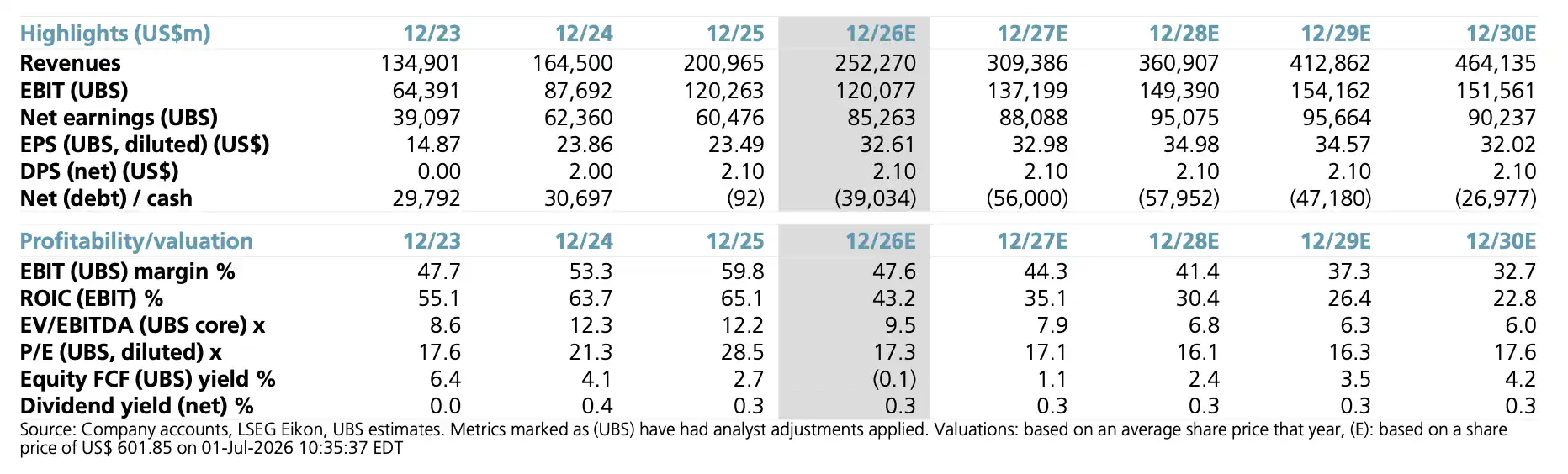
Financial Highlights and Long-Term Forecast Summary; Revenue forecast raised to $360.9 billion by 2028, but EBIT margin decreased from 59.8% in 2025 to 41.4% in 2028.
The direction mentioned by Bloomberg is not entirely sudden. Zuckerberg had previously publicly acknowledged that if there was excess capacity in computing, selling services externally was an option.
During a shareholder Q&A on May 27, 2026, he stated that if the company had excess capacity in computing construction, selling cloud services "is an option on the table," which is also one of the reasons he is more confident in the substantial investment. Even earlier, during an earnings call on October 29, 2025, he mentioned that almost every week there were external companies inquiring about API services or computing resource supply, and the company had not taken action at that time, but if there was excess capacity, it could be an option.
These two statements indicate that Meta's management has at least already considered "external monetization of internal AI infrastructure." There are two types of possible forms of external sale: one is closer to raw computing resource leasing, and the other is opening up access to AI models hosted on Meta's infrastructure. The former is more like computing power supply, while the latter is more akin to APIs or model services.
However, this is still a far cry from traditional cloud computing businesses. The business model of AWS, Azure, and Google Cloud is a complete cloud platform ecosystem, including computing, storage, databases, networking, security, developer tools, and enterprise services. The conclusion that can currently be drawn from the materials Meta has is: if AI infrastructure construction exceeds internal demand, the company may allocate some resources to monetize them, rather than confirming Meta's full-scale entry into the cloud market.
This distinction is crucial. If it is understood as Meta officially challenging the three major cloud providers, the conclusion would be overstated; if it is understood as a revenue buffer in the AI capital expenditure cycle, it is closer to the current materials.
Meta is now facing not a disappearance of revenue growth but a timing gap between growth and investment. The advertising business can still contribute cash flow, but AI investment requires the company to proactively build a significant amount of infrastructure. The issue lies in when and in what form these investments will be converted into visible revenue.
If external companies are willing to purchase computing resources or access models, Meta can recognize some revenue earlier, alleviating the "spend money first, monetize later" pressure. For investors, this will shorten the wait time for AI investment returns, and also explain why analysts are willing to maintain a high target price even as EPS is almost stagnant.
The return forecast provided by UBS also reflects this valuation tension: based on the current price of $601.85, the target price implies a 43.7% stock price appreciation, a total stock return of about 44.1%, compared to the market assumption of a 9.2% return, an excess return of about 34.9%.
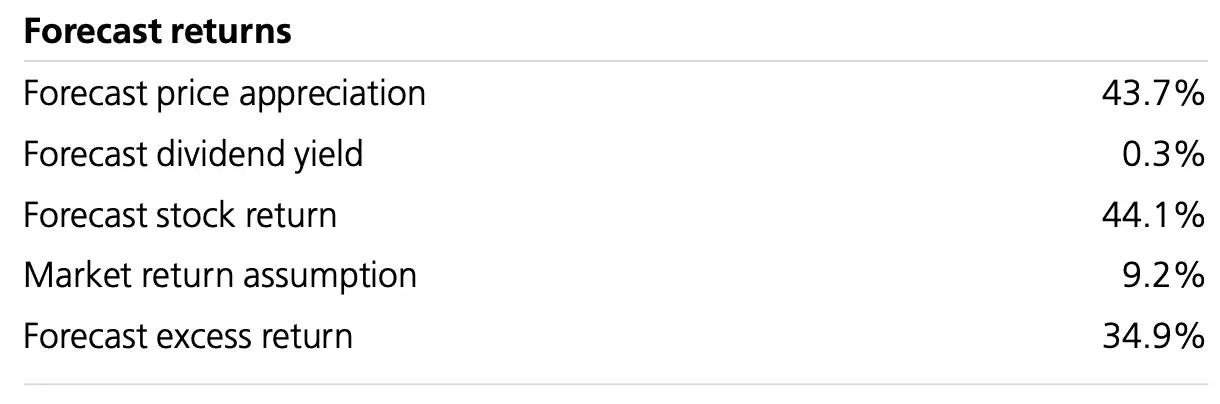
Return Forecast Breakdown Table; Stock Price Appreciation 43.7%, Total Return 44.1%, Market Return Assumption 9.2%, Excess Return 34.9%.
However, selling computing power does not mean that profit pressure automatically disappears. First, the company has not formally confirmed any related business plans, nor disclosed potential customers, pricing, scale, or launch time. Secondly, if AI computing power is sold to external parties, it may still face issues such as resource scheduling, service levels, customer support, security compliance, and infrastructure reliability. Furthermore, if internal AI product demand continues to grow rapidly, the "excess" scale available for external sale may not be sufficient.
A more realistic limit is that external monetization only truly makes sense in two scenarios: first, if Meta has indeed built up a phased surplus of computing power; second, if external customers are willing to purchase these resources or access models at a sufficiently high price. Otherwise, it will only ease the market narrative and will be difficult to significantly alter the EPS curve.
The most notable restraint in this report is the lack of directly translating the news into profit upgrades. UBS maintains a Buy rating and $865 price target, while making it clear that no estimates have been adjusted. This means that the "AI Compute Selling" is currently still a potential upside option, rather than a definite revenue already built into the model.
This also leaves two questions for the market.
The first question is whether the business is truly materializing. Meta can discuss selling excess cloud services, but there are still no answers to whether it will eventually launch, in what product form, to which customers. If it is just an optional plan discussed by management, the short-term impact on the financial model is limited.
The second question is whether the scale is large enough. Meta's AI capital expenditure pressure is reflected across the entire profit margin curve. To offset the EBIT margin pressure from 59.8% in 2025 to 44.3% in 2027, external compute revenue needs to reach a significant scale and have a sufficient profit margin. Simply selling a small amount of idle resources may only improve market sentiment, but may not necessarily change long-term profit expectations.
Meta is still an ad-centric cash-flow platform company, and AI infrastructure investment needs to either be recouped through ad efficiency, business intelligence, AI assistants, and developer ecosystems, or it will continue to suppress margins. Monetizing excess compute can shorten this path, but it cannot replace true scaling of the core AI product.
Therefore, the $865 price target and nearly stagnant EPS forecast together reflect the market's core divergence on Meta: whether investors are willing to continue to believe that these infrastructure investments will eventually generate sufficient returns despite the profit margin pressure from AI investments. Selling compute power provides a closer answer, but this answer has not yet been written into the financials.
Join the official Coincamps community:
Telegram: https://t.me/coin_camps
Recommended
Desk: Brent Crude Tops $110, Musk's Net Worth Drops 528.6 Billion in Four Days After Tesla Roadster Launch
Oct 17, 21:49
JST Fifth Buyback and Burn Successfully Concludes: Over 170 Million Tokens Worth Approximately $23.53 Million Burned, Buyback Mechanism Set for Comprehensive Upgrade
Oct 17, 20:10
BitTorrent Brand Upgrade and Initial BTT Buyback & Burn Launch Simultaneously, Dual Engines Usher in New Era of Web3 Infrastructure
Oct 17, 20:00
Asia Market Daily: Japan's BOJ signals more rate hikes while Korea targets offshore perpetual platforms (2026/10/17)
Oct 17, 17:01Why did Papertrade backfire on you?
Oct 17, 17:01
The 'Strict Father' of Northern Myanmar: This Company Deploys 200,000 "AI Best Actors" to Strike Back Against Scammers
Oct 17, 15:34