
Goldman Sachs Interpretation of Korean Memory: DRAM Stronger than NAND, Samsung Memory Price Hike Story Begins to Diverge

TL;DR
· Goldman Sachs cited TrendForce's forecast that the average price of mainstream DRAM is expected to increase by 13%-18% QoQ in 3Q26.
· PC and server DRAM continue to benefit from low inventory, expectations of tight supply, and the premium for DDR5.
· NAND is expected to see a 10%-15% price increase in the third quarter, lower than Goldman Sachs' 21% price hike assumption for Samsung.
Goldman Sachs, in a South Korean tech storage tracking report released on June 30, cited TrendForce's prediction that the average price of traditional DRAM in 3Q26 is expected to increase by 13%-18%, while the NAND average price is expected to rise by 10%-15%, below Goldman Sachs' model assumption of a 21% QoQ increase in Samsung Electronics' NAND prices.
For investors, the key is not "storage prices are rising again," but which type of storage can continue to drive up profit expectations for companies like Samsung Electronics and SK Hynix. DRAM prices are still in line with Goldman Sachs' assumptions for Samsung, and while NAND is also rising, the increase is not as significant as in more optimistic profit models.
The signal from this tracking report is very clear: there is still support for a price increase in DRAM in the third quarter, especially on the PC and server side; NAND is starting to differentiate internally, with enterprise SSDs still strong and consumer-grade mobile NAND showing a more moderate increase. Samsung continues to benefit from the uptrend in storage, but the profit elasticity of the NAND segment may be discounted.
DRAM is the strongest theme in this report.
Goldman Sachs cited TrendForce's forecast that in 3Q26, the average price of traditional DRAM is expected to increase by 13%-18%, closely aligning with Goldman Sachs' prediction of a 16% QoQ increase in Samsung's traditional DRAM prices. After a significant price surge in the previous period, DRAM did not immediately cool down.
The increase in PC DRAM prices is most significant. In the second quarter, PC DRAM prices had already risen by 45%-50% QoQ, and it is expected to continue to rise by 15%-20% in the third quarter. The report explains that PC OEM inventories are low, and even though memory and other component prices have risen, manufacturers are still willing to maintain their purchasing pace and continue to negotiate with suppliers for more supply.
The underlying concern is that overall DRAM supply in 2027 may be relatively tight. For downstream manufacturers, if they buy less now, they may face higher prices later on or have more difficulty obtaining goods. The price increase itself has not immediately suppressed purchases but has instead reinforced some early stocking demand.
The price trend in June also reflects this shift. A chart from Goldman Sachs shows that the price of DDR4 8GB remained relatively stable at $119, while the price of DDR5 8GB increased from $112 to $115, a 3% month-over-month increase. The discount of DDR5 compared to DDR4 has narrowed from a previous 3 percentage points to 3%, indicating that the prices of the new generation products are catching up to the older specification.
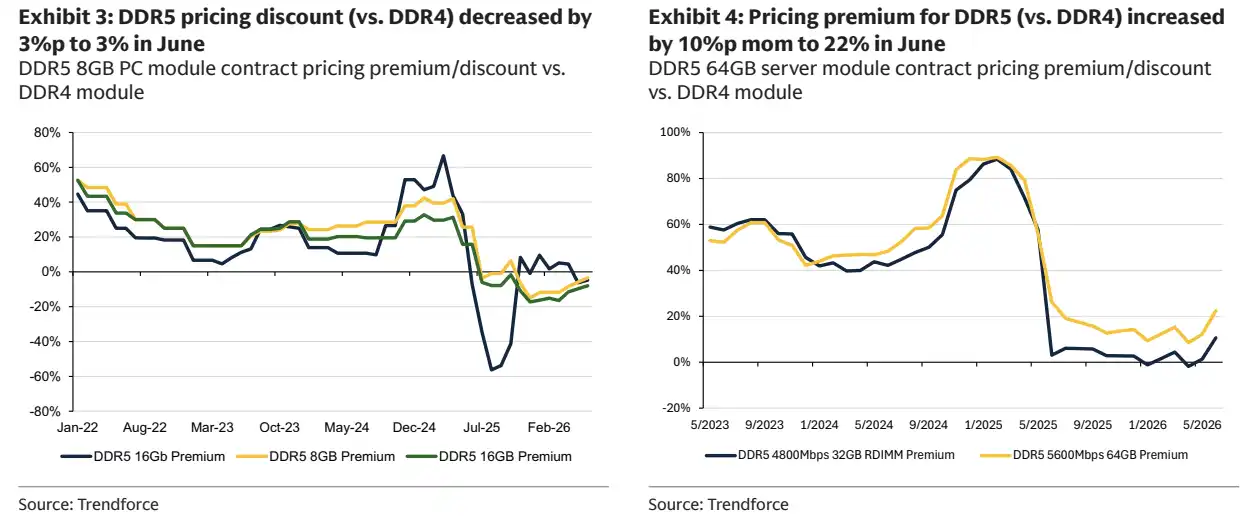
In June, the discount of DDR5 8GB PC modules compared to DDR4 shrank by 3 percentage points to 3%.Server DRAM Strengthens, DDR5 Premium Rises to 22%
The price signal for server DRAM is even stronger.
In the second quarter, server DRAM prices have already increased by 53%-58% compared to the previous quarter, and are expected to rise by another 13%-18% in the third quarter, closely aligning with Goldman Sachs' forecast of a 14% sequential increase in Samsung's server DRAM prices.
According to the Goldman Sachs chart, in June, the price of DDR4 64GB server modules held steady at $1,127, while the price of DDR5 64GB server modules increased by 9% to $1,380. More importantly, the premium of DDR5 over DDR4 increased from 12% in May to 22%.
This indicates that the price hike in the server segment is not only affecting traditional products but also higher-spec products like DDR5 which are commanding a higher premium. The demand for high-capacity, high-bandwidth memory for AI servers, general server upgrades, and data center purchases continues to support prices.
For storage manufacturers like Samsung and SK Hynix, the ongoing price increase in server DRAM is more significant than the rebound in consumer electronics prices. Server product prices are higher and demand is more concentrated, usually leading to more sensitive profit margin improvements. As long as server purchases do not significantly slow down, there is still room for profit transmission in the upward trend of DRAM prices.
The relationship between spot and contract prices is also providing support. A chart in the Goldman Sachs report shows that the spot price of DDR5 16Gb carries a 17% premium over the latest contract price, while the spot price of DDR4 8Gb carries a 38% premium over the most recent contract price. Spot prices higher than contract prices usually indicate a tight short-term supply or buyers willing to pay a higher price for immediate delivery.
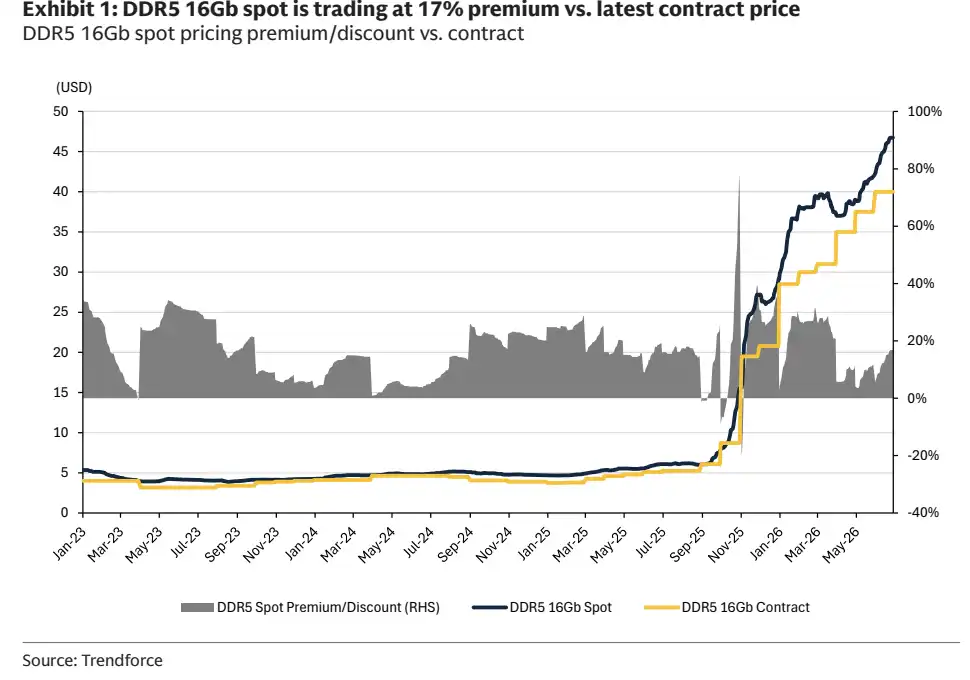
DDR5 16Gb spot prices carry a 17% premium over the latest contract price, indicating short-term price support.NAND Prices Continue to Rise, but Lagging Behind Goldman Sachs' Samsung Assumption
The NAND Story Is Not That Smooth.
Goldman Sachs cited TrendForce's forecast, expecting a 10%-15% quarter-on-quarter increase in NAND average prices in the third quarter of 2026, lower than Goldman's estimation of a 21% price hike for Samsung NAND. Considering TrendForce's earlier public calibrations of NAND prices in the first and second quarters showing significant increases, the price hike in the third quarter is still ongoing but not as intense as before.
This does not mean a downturn in NAND prices but rather that the increase is below a more optimistic profit assumption. For Samsung, if DRAM meets expectations while NAND falls short, the storage business will still trend upward overall, but the profit margin improvement will be held back to some extent by NAND.
There is also differentiation within NAND. Enterprise SSDs remain robust, with the third-quarter eSSD prices expected to rise by 18%-23% quarter-on-quarter. This demand is supported by data centers and enterprise storage, exhibiting better price resilience.
The consumer end is more moderate. The prices of eMMC/UFS are expected to increase by only 5%-10%. These products are more targeted towards smartphones, consumer electronics, and embedded devices, with suppliers adopting a more restrained price hike strategy for consumer-end customers to avoid disrupting the end market and the supply chain's stability.
This is also the main reason why NAND falls short of Goldman's assumption: enterprise-level products are driving the increase, but the price hike on the consumer end is not significant enough, thereby lowering the overall NAND price elasticity.
Goldman Sachs maintains a Buy rating on Samsung Electronics with a 12-month target price of 480,000 Korean Won on ordinary shares. The rationale behind this assessment remains the upward trend in storage prices, especially since the DRAM prices align closely with their forecast for Samsung.
However, this price tracking also reminds the market that the profit transmission varies across different storage categories. DRAM is closer to the theme of "continuing price hikes," while NAND is more about "still rising but below the most optimistic expectations."
This will impact investors' view on the pace of Samsung's profit recovery. If the actual third-quarter prices align more closely with TrendForce's range, the DRAM business may continue to realize a strong profit margin elasticity. However, if NAND stays within a 10%-15% price hike, the market's outlook on Samsung's storage business improvement potential will be more cautious.
The risk boundaries are also clear. Once the supply-demand dynamics in storage significantly deteriorate, the logic of price hikes will weaken. If smartphone profit margins contract significantly, the price increase space for consumer-end storage will be limited. If there is a loss of market share in mobile OLEDs, Samsung's non-storage business could also drag down the overall valuation.
The most important conclusion of this report is not "broad-based strength in storage," but a more nuanced differentiation: DRAM prices continued to rise in the third quarter, especially strong on the server side; NAND also saw an increase, although the rate of increase has cooled down. For Samsung, this is still a positive development, although the positive impact is not as pronounced as the DRAM price numbers may suggest.
Join the official Coincamps community:
Telegram: https://t.me/coin_camps
Recommended
Desk: Brent Crude Tops $110, Musk's Net Worth Drops 528.6 Billion in Four Days After Tesla Roadster Launch
Oct 17, 21:49
JST Fifth Buyback and Burn Successfully Concludes: Over 170 Million Tokens Worth Approximately $23.53 Million Burned, Buyback Mechanism Set for Comprehensive Upgrade
Oct 17, 20:10
BitTorrent Brand Upgrade and Initial BTT Buyback & Burn Launch Simultaneously, Dual Engines Usher in New Era of Web3 Infrastructure
Oct 17, 20:00
Asia Market Daily: Japan's BOJ signals more rate hikes while Korea targets offshore perpetual platforms (2026/10/17)
Oct 17, 17:01Why did Papertrade backfire on you?
Oct 17, 17:01
The 'Strict Father' of Northern Myanmar: This Company Deploys 200,000 "AI Best Actors" to Strike Back Against Scammers
Oct 17, 15:34