
Goldman Sachs Analysis: Bullish on Japan's Semiconductor Equipment Industry

TL;DR
· Kit Yu's public strategy update remains bullish on the four Japanese equipment companies: Lasertec, Ebara, Disco, and Tokyo Electron.
· SEAJ expects Japan's semiconductor manufacturing equipment sales for FY2026 to reach ¥55.004 trillion, with DRAM and AI advanced logic driving the growth.
· This bullish view is still constrained by order pace, profit margin realization, and export restrictions, with Lasertec facing short-term year-on-year pressure, reminding us of the non-linear nature of the cycle.
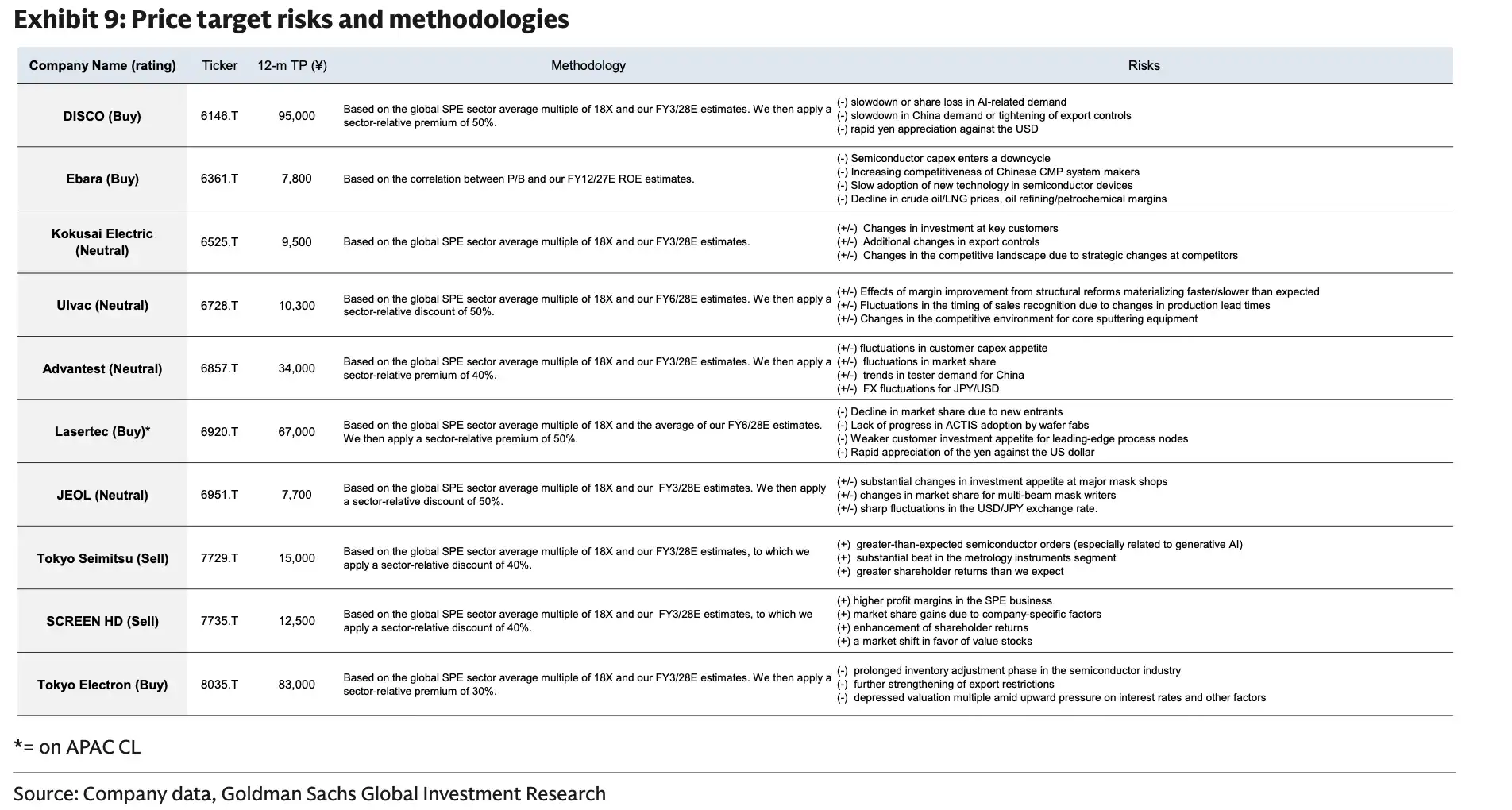
In a Japan Semiconductor Capital Equipment strategy update targeting the second half of 2026, Lasertec, Ebara, Disco, and Tokyo Electron are maintained as Buy-rated, betting that AI capital expenditure will continue to transmit to key Japanese manufacturers in areas such as inspection, CMP, dicing grinding, and coating/developing.
According to a public post by Kit Yu on LinkedIn, this screening process is not merely about finding the "most AI-like" companies, but rather assessing two aspects: whether sales growth can outperform the sector average and whether revenue growth can truly translate into margin improvement. For the four companies, the catalysts are Lasertec's ACTIS inspection platform, Ebara's CMP, Disco's advanced packaging equipment, and Tokyo Electron's broader product portfolio and profit enhancement.
The industry backdrop also provides a striking figure for this round of analysis. The Semiconductor Equipment Association of Japan (SEAJ) released its Market Forecast Report on January 15, projecting a 12% year-on-year growth in Japan's semiconductor manufacturing equipment sales for FY2026, reaching ¥55.004 trillion, i.e., ¥5.5004 trillion. FY2025 is expected to be ¥4.9111 trillion, growing by 3% year-on-year.
The sources of growth for FY2026, as indicated by SEAJ, are primarily the continued expansion of DRAM investment and the growth in advanced logic investment for AI servers. The growth in FY2025 is more driven by the comprehensive launch of investment in 2nm/GAA by Chinese Taiwanese foundries and DRAM investments supported by HBM. In other words, investments in advanced nodes are continuing, but "2nm" cannot be directly labeled as the sole driving force for FY2026.
AI servers require advanced logic chips and HBM, while high-end processes will add steps such as testing, planarization, packaging, coating/development, and more. Japanese equipment companies have long held a high share in these segmented processes, which is why the strategy update continues to focus on the Japanese equipment chain.
The key word for Lasertec is ACTIS. The more advanced the process technology advances, the higher the importance of mask and wafer inspection. The adoption of ACTIS in wafer fabs has been increasing, seen as a key driver for future revenue growth.
Ebara's focus is on CMP, or Chemical Mechanical Planarization. With new materials, new structures, and advanced process steps, the scope of CMP applications is expanding, providing Ebara with room to increase its market share.
Disco directly benefits from advanced packaging. With High Bandwidth Memory (HBM), 3D structures, and high-performance chip packaging requiring higher standards in processes such as dicing, grinding, and thinning, Disco's position in these processes makes it one of the beneficiaries upstream in AI hardware expansion.
Tokyo Electron, on the other hand, relies on a broader product portfolio to capture additional growth in the overall wafer fab equipment market. Its presence in processes such as coating, developing, heat treatment, and bonding makes it easier for the company to follow the investment surge in advanced logic.
The forecast of ¥55.004 trillion given by SEAJ is the most easily grasped industry hook in this equipment chain logic.
Semiconductor equipment demand usually follows wafer fab capital expenditure. In the previous cycle, mature processes and local expansion in China were important supports. As we enter the AI server expansion phase, high-end demand is receiving more attention, including HBM, advanced logic, advanced packaging, and more sophisticated process control.
HBM is not just an ordinary memory chip but a high-bandwidth memory that is tightly integrated with AI accelerators. The equipment demand it brings is not only in front-end wafer manufacturing but also extends to packaging, dicing, grinding, inspection, and other processes.
Advanced logic nodes are similar logic. The closer to an advanced process, the higher the process complexity, and the more demanding the requirements for inspection, coating, developing, CMP, and heat treatment processes.
This is where Japanese equipment manufacturers shine. Tokyo Electron has a strong position in equipment such as coating and developing, Disco has been a long-time leader in dicing and grinding, Ebara continues to expand CMP applications, and Lasertec maintains a presence in high-end inspection. If AI capital expenditure continues to materialize, they will not just benefit from conceptual dividends but secure equipment orders from wafer and packaging factories.
However, industry growth does not guarantee synchronized high growth for every company. SEAJ's forecast is for Japanese-made equipment sales, not revenue for a specific company, nor a complete forecast of the global wafer fab equipment market. Whether individual stocks can outperform depends on customer ordering pace, product delivery cycles, competitive landscape, and profit margin performance.
A strategy update has placed profit margin improvement as the second screening criterion, indicating that the market will not only look at orders and revenue.
Semiconductor equipment companies usually enjoy economies of scale during an upturn cycle, but this does not automatically translate to a higher profit margin. Factors such as R&D investment, capacity expansion, changes in product mix, customer pricing, and supply chain costs will all impact the final profit. Advanced process-related equipment faces higher technological barriers, with higher costs for R&D and after-sales support.
One of the key points for Tokyo Electron is the additional growth brought by its product mix and profit improvement measures. It needs to prove that it is not just following the expansion of the equipment market but can also retain revenue growth through higher value-added products and internal efficiency. Ebara and Disco are in a similar position. If the expansion of CMP applications and the growth in advanced packaging demand only bring in revenue without improving gross margin or operating profit margin, the stock price reaction will also be discounted.
Lasertec's situation requires a separate look. The revised forecast disclosed by the company on January 30 shows an upward revision of revenue forecast to 220 billion yen for FY2026, with EPS at 801.89 yen, but still below actual FY2025 revenue of 251.477 billion yen and EPS of 938.61 yen. In other words, this is not a recent guidance downgrade but continued pressure for year-on-year decline after the high base of FY2025.
For investors, this serves as a reminder that "strong growth from FY2026 to FY2027" should not be simply understood as linear improvement every quarter. The timing of when orders turn into revenue, when revenue turns into profit, and whether the profit margin can significantly improve will determine how far this AI equipment chain rally can go.
Four companies continue to maintain Buy ratings, reflecting analysts' outlook for the equipment cycle from the second half of 2026 to FY2027, but it is not yet realized performance.
The most direct uncertainty comes from the order pace. Strong demand for AI servers does not mean that all semiconductor fab capital expenditures will be executed according to the most optimistic plans. If cloud providers or chip companies slow down AI investments, expansion of DRAM, HBM, and advanced logic may also be adjusted. Revenue recognition by equipment companies often lags behind customer orders, and short-term financial reports may not be fully consistent with the mid-term trends.
Export restrictions also serve as a boundary. Japanese equipment companies face U.S. restrictions on technology to China, various countries' semiconductor industry policies, and changes in customer investment regions. Restrictions are more apparent for advanced process equipment, and demand for mature processes may also fluctuate due to policy changes. For companies with broad business coverage like Tokyo Electron and Ebara, regional and process structure will impact revenue quality.
Another practical limitation is that the public post did not provide a target price, profit forecast, and valuation assumptions. What can currently be confirmed are the maintained rating, four company names, two screening criteria, and key growth drivers. Without these numbers, it is not possible to write a trading conclusion such as "how much upside potential" or "target price revision."
The most noteworthy aspect of this strategy update is the specific breakdown of AI expansion into the ACTIS, CMP, Advanced Packaging, and TEL product portfolios. The ¥5.5004 trillion FY2026 equipment sales forecast sets the sector's tone, and whether the four companies can truly outperform remains to be seen upon order realization, delivery, and profit margin.
Join the official Coincamps community:
Telegram: https://t.me/coin_camps
Recommended
Desk: Brent Crude Tops $110, Musk's Net Worth Drops 528.6 Billion in Four Days After Tesla Roadster Launch
Oct 17, 21:49
JST Fifth Buyback and Burn Successfully Concludes: Over 170 Million Tokens Worth Approximately $23.53 Million Burned, Buyback Mechanism Set for Comprehensive Upgrade
Oct 17, 20:10
BitTorrent Brand Upgrade and Initial BTT Buyback & Burn Launch Simultaneously, Dual Engines Usher in New Era of Web3 Infrastructure
Oct 17, 20:00
Asia Market Daily: Japan's BOJ signals more rate hikes while Korea targets offshore perpetual platforms (2026/10/17)
Oct 17, 17:01Why did Papertrade backfire on you?
Oct 17, 17:01
The 'Strict Father' of Northern Myanmar: This Company Deploys 200,000 "AI Best Actors" to Strike Back Against Scammers
Oct 17, 15:34