If Strategy indeed sold Bitcoin, how significant would the impact on the market be?
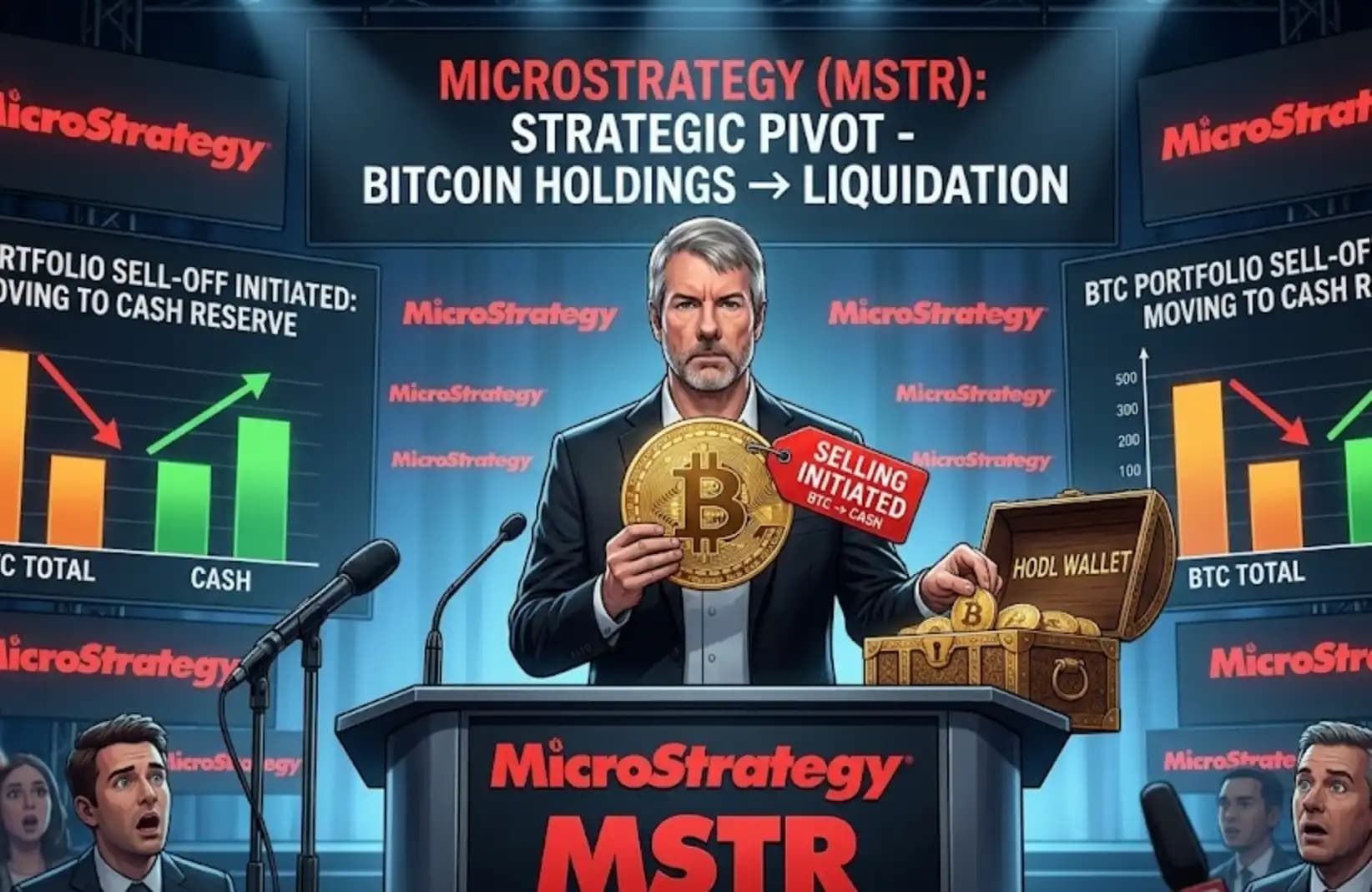
Renowned trader Lightcrypto hadn't spoken for a year, and when he finally did, it was like a bombshell. He said that the company with the largest Bitcoin holding, Strategy, has started selling coins.
According to the address he provided, 491 Bitcoins were sold. Based on a coin price around $60,000, this amount is less than $29 million. Considering Strategy's approximately 847,000 BTC holdings, this amount is negligible.
Of course, some people say that the behavior of this address does not align with the logic of Strategy's publicly known addresses and is highly likely not associated with Strategy. However, Lightcrypto is quite famous for identifying addresses, and a considerable number of people indeed believe him.
The possibility of a sell-off does exist because Strategy has just announced their new selling channel. On June 29, Strategy disclosed the "Digital Asset Corporate Framework," where the board authorized the company to sell up to $1.25 billion in BTC to supplement dollar reserves, pay preferred stock dividends and debt interest, repurchase preferred stock, and buy back MSTR common stock.
What we need to consider next is if the 491 coins have indeed been sold, what does it mean for the Bitcoin market and Strategy's stock mechanism respectively?
Are 491 BTC Significant?
Let's look at the scale.

From the spot market perspective, 491 BTC is quite small. It represents only about 0.058% of Strategy's total holdings. If Strategy's holdings are envisioned as a 100-liter water tank, 491 coins would be like scooping out 58 milliliters from it.
Therefore, if the market is only concerned about "selling pressure," 491 coins are not the focus.
The real comparison lies with two other transactions. At the end of May, Strategy sold 32 BTC, approximately $2.5 million. That sale seemed more like a one-off operation to meet demands related to preferred stock distributions. A month later, the company formalized selling coins in the framework, authorizing a maximum of $1.25 billion, which, at $60,000 per coin, could cover roughly 20,000 BTC.
In other words, if the 491 coins transaction is confirmed, it does not mean "Strategy is dumping." It is more like the beginning of this pipeline dripping.
Why Would They Sell?
The answer lies within STRC.
STRC is a perpetual preferred stock of Strategy with a target face value of $100. Its buyers are not typical crypto players but income-focused funds looking for stable cash flow. The original story of this product was simple: investors buy STRC, Strategy takes the money to buy BTC, BTC backs the company's assets, and STRC continues to trade close to its face value.
The issue is that STRC has not always traded close to its face value.
On June 30, Yahoo Finance showed that the closing price of STRC was $84.86. At the same time, Strategy increased STRC's annualized dividend yield from July to 12%. This created an unattractive spread. The lower the price, the less the market believes, and the higher the company has to pay in dividends.
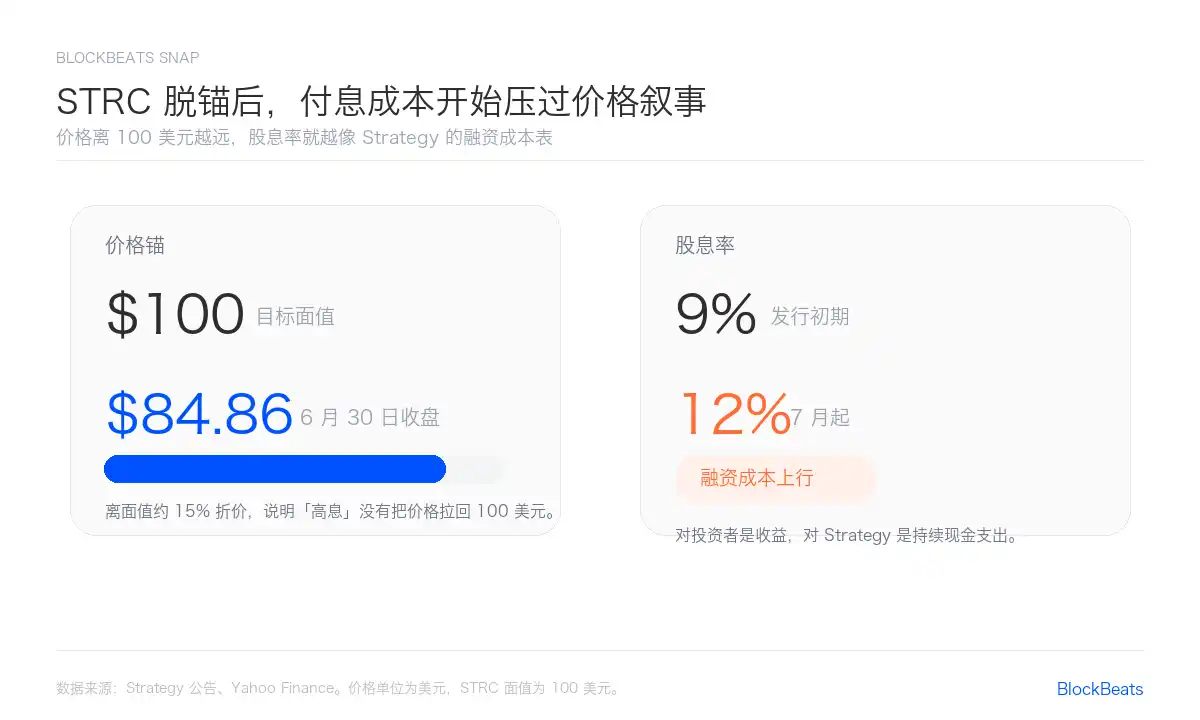
This 12% is not just the return for investors but also Strategy's cost.
According to an announcement by Strategy on June 29, the company's current annual preferred stock dividend and debt interest expenses amount to approximately $1.76 billion. In simpler terms, they need to prepare about $4.8 million per day to sustain this capital structure.
This is not to say that Strategy cannot afford it. The company disclosed a USD reserve of about $2.55 billion, which can cover about 17.4 months. But this explains why the coin selling framework emerged. Selling BTC is not to dump coins on the market but to provide cash to support this entire structure of stock and preferred stock.
Is Holding 491 Coins Good or Bad for MSTR?
This needs to be looked at in two layers.
In the short term, the market may see this as positive. After the framework was announced on June 29, MSTR pre-market rose by nearly 7%. This reaction is not contradictory. The market does not like uncontrolled selling pressure but prefers when companies clearly arrange their liquidity in advance.
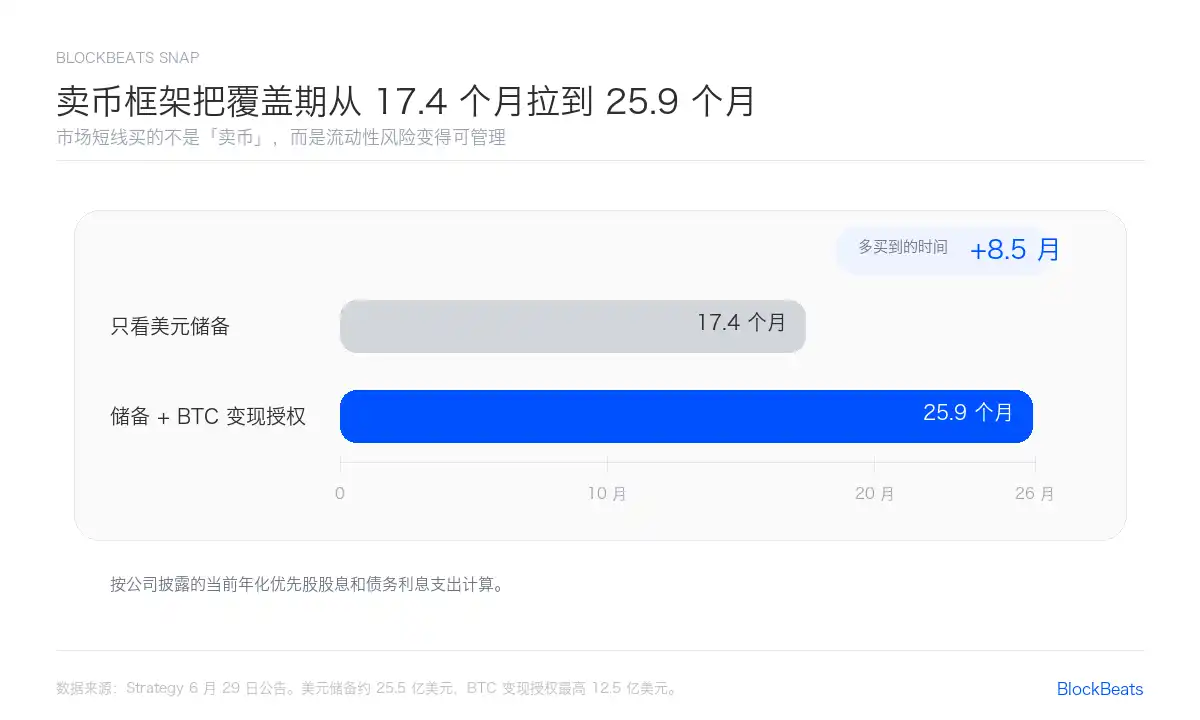
This chart explains why MSTR was able to rise at that time. With only USD reserves, Strategy’s coverage period is about 17.4 months. With the $1.25 billion BTC liquidation authorization, the coverage period extends to about 25.9 months.
The market is not buying “coin selling.”
The market is buying “at least no immediate trouble.”
However, in the medium term, this represents a downgrade in MSTR's valuation narrative. MSTR's strongest story in the past was a unilateral increase: financing, buying BTC, increasing per-share BTC holdings. Now there is an additional reverse action: selling BTC, replenishing reserves, paying dividends, and repurchasing discounted securities.
This may not necessarily be wrong, and may even be what a mature public company should do. But it will transform MSTR from being the "eternal marginal buyer" to the "occasional debt manager."
The key to the stock mechanism is mNAV, which is the multiple of MSTR's market value to its net asset value. When mNAV is above 1, the Strategy issues stock to buy BTC, and the market perceives this as increasing the per-share BTC holdings. However, once mNAV falls below 1, issuing more stock is like selling its Bitcoin at a discount.
At that point, selling BTC might actually become a cleaner form of financing.
For common stockholders, this may not immediately be a bad thing. If the company uses the proceeds from selling Bitcoin to repurchase discounted STRC, it can reduce future dividend pressure, benefiting common stockholders. But the market will pose a new question: if even the strongest buyer is selling Bitcoin, how much of a BTC premium should MSTR enjoy?
What Does This Mean for the BTC Market?
491 coins will not alter spot supply and demand.
However, it will alter traders' psychological charts. In the past, during market downturns, Strategy was often envisioned as the ultimate buyer. ETF outflows, miners selling, retail not buying, and whales dumping.
If the 491 coins are real, this narrative will experience a crack. Strategy may still be a long-term holder and may continue to buy. But it is no longer just an account with a buy key.
What's even more troubling is that the selling of Bitcoin and STRC are intertwined. As long as STRC remains below par value for an extended period, Strategy will have to choose between several options: increasing dividends, repurchasing discounted preferred shares, replenishing USD reserves, or utilizing BTC. Each option is not a disaster, but each will bring the "Bitcoin faith" back to cash flow.
If the 491 coins come to fruition, it will only be the first small note.
What really matters is whether the market will continue to view each small note as an exception in the future.
Recommended
Desk: Brent Crude Tops $110, Musk's Net Worth Drops 528.6 Billion in Four Days After Tesla Roadster Launch
Oct 17, 21:49
JST Fifth Buyback and Burn Successfully Concludes: Over 170 Million Tokens Worth Approximately $23.53 Million Burned, Buyback Mechanism Set for Comprehensive Upgrade
Oct 17, 20:10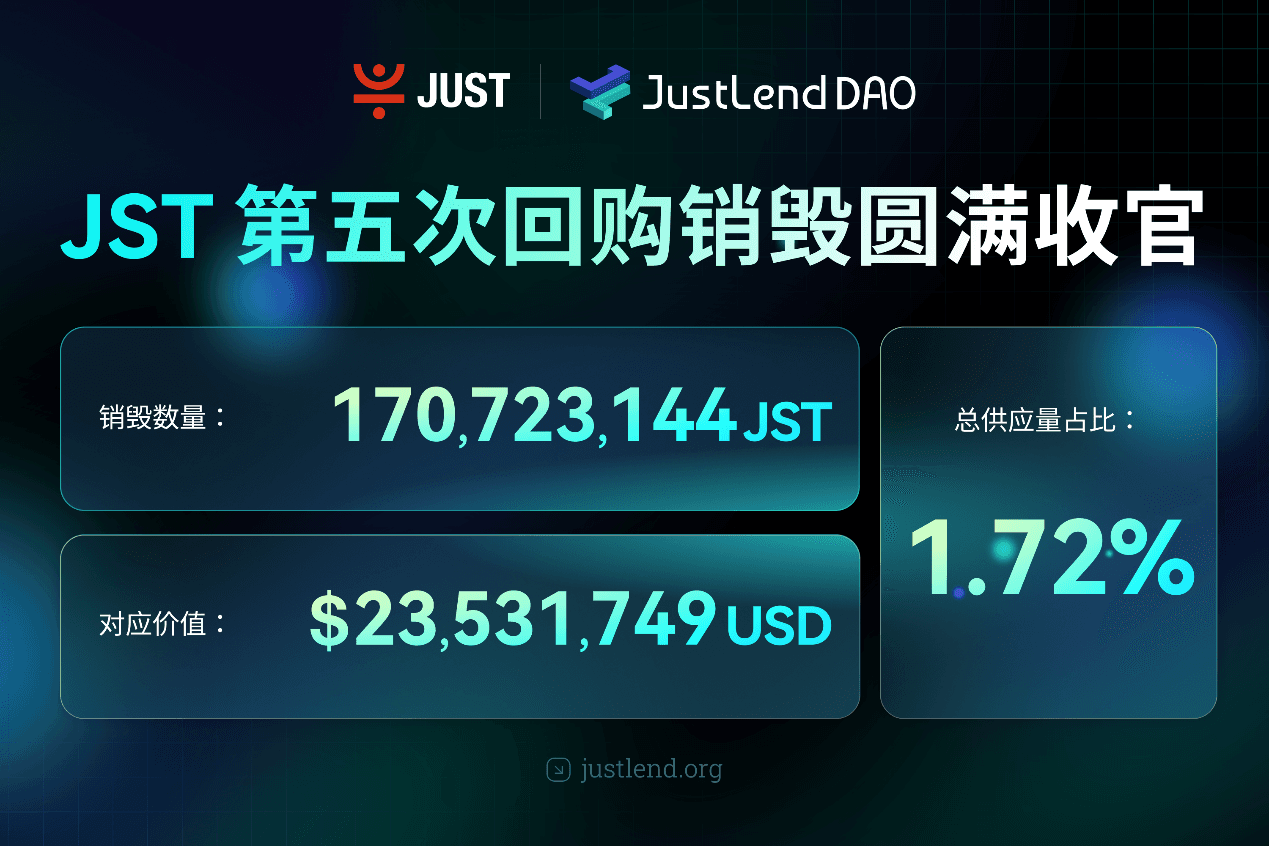
BitTorrent Brand Upgrade and Initial BTT Buyback & Burn Launch Simultaneously, Dual Engines Usher in New Era of Web3 Infrastructure
Oct 17, 20:00
Asia Market Daily: Japan's BOJ signals more rate hikes while Korea targets offshore perpetual platforms (2026/10/17)
Oct 17, 17:01Why did Papertrade backfire on you?
Oct 17, 17:01
The 'Strict Father' of Northern Myanmar: This Company Deploys 200,000 "AI Best Actors" to Strike Back Against Scammers
Oct 17, 15:34