Morgan Stanley Deciphers Iron Man: BiCS-10 Production Commences, Can the 32% Overhead Space Be Realized?

TL;DR
· Kioxia and SanDisk have initiated BiCS-10 production at Fab2/K2 in Kitakami, with 1Tb TLC samples now shipping.
· The BiCS-10 interface speed has increased to 4.8Gb/s, but mass production will still rely on BiCS-8 until March 2027.
· The target price is around 110,000 yen, implying approximately 32% upside potential, with risks related to customer certification, K2 ramp-up, and supply chain disruptions.
Kioxia and SanDisk announced on July 3 that they have started production of the 10th generation 3D Flash, BiCS-10, at the Fab2/K2 facility in Iwate, Japan. On the same day, Kioxia began shipping 1Tb TLC BiCS-10 samples, primarily targeting enterprise and data center SSDs.
This marks the beginning of the volume production ramp-up phase for Kioxia's AI data center storage roadmap, but it does not signal immediate profitability. The samples are used for customer functional validation, and mass production specifications may still be adjusted. Subsequent steps include enterprise SSD certification, product qualification, and the K2 facility ramp-up.
Morgan Stanley maintained an "Overweight" rating on Kioxia in its latest report. Based on a target price of around 110,000 yen and a July 3 stock price of 83,300 yen, this implies roughly 32% upside potential. The assessment is not banking on short-term mass production of BiCS-10 but rather on Kioxia's ability to translate faster interfaces, higher bit densities, and lower power consumption into AI data center SSD market share and improved cash flow.
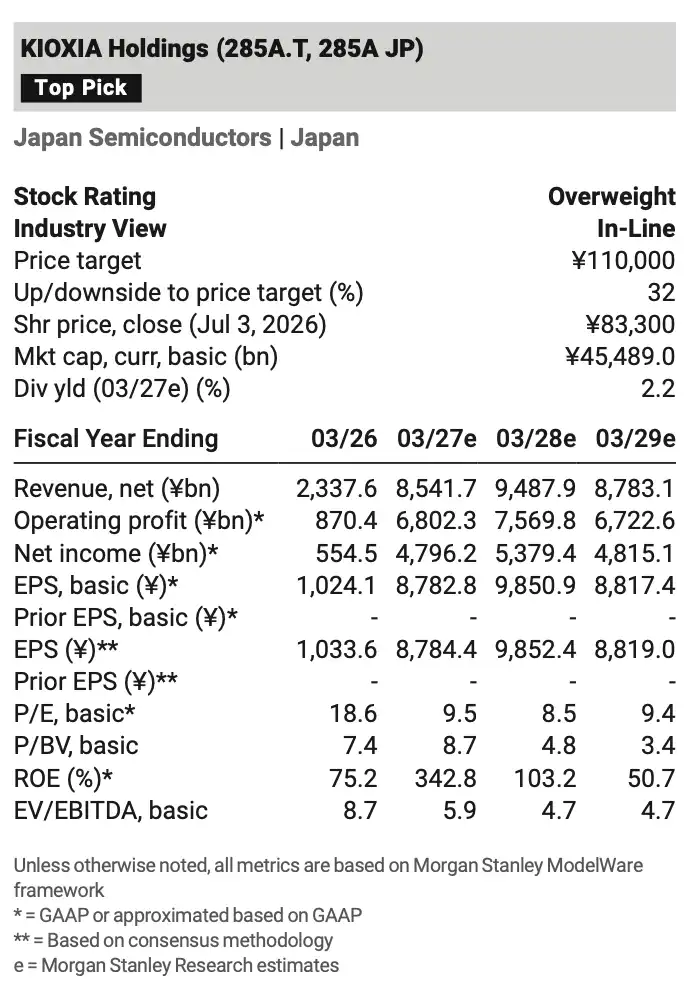
Financial forecasts indicate an estimated revenue of around 8.54 trillion yen for FY2027, and around 9.49 trillion yen for FY2028, with profit outlook tied to product structure upgrades.
The most direct change in BiCS-10 is the increase in NAND interface speed from BiCS-8's 3.6Gb/s to 4.8Gb/s, a gain of approximately 33%. For consumer storage, this metric may not be immediately evident; however, for enterprise SSDs and AI servers, interface speed impacts data throughput, latency, and cache efficiency.
The 1Tb TLC samples being shipped by Kioxia this time are aimed at enterprise and data center SSDs. In the 2026 Investor Day materials, the company positioned the CM Series as "High Bandwidth SSD with TLC Flash Memory," mentioning compatibility with NVIDIA CMX Server and optimized KV cache loading. This indicates that NAND in AI servers is not just about inexpensive high-capacity storage but also about taking on data caching and access tasks closer to the computational side.
BiCS-10 is still 332-layer 3D Flash. Compared to BiCS-8, the officially disclosed bit density has increased by 59%, write power efficiency has improved by 18%, and read power efficiency has improved by 30%. Bit density affects the output capacity per wafer, while power consumption affects data center operating costs. What cloud providers ultimately see is the cost per TB, SSD performance, and overall system power consumption.
However, leading in technical specifications does not equate to commercial readiness. Enterprise SSDs usually require a longer certification cycle, especially for high-performance, low-latency, and AI workload products. BiCS-10 has already started production and entered sample shipments, but to become a major shipping and profit driver, it still requires customer order confirmation.
What is easier to overlook is that Kioxia's future cost improvements over the next one to one and a half years will still primarily come from BiCS-8.
A Morgan Stanley model predicts that from 2026 to the first half of 2027, the company's output expansion and cost reduction per GB will still be primarily driven by BiCS-8. By the end of March 2027, BiCS Gen.8 is expected to account for over 80% of the production capacity in terms of GB. BiCS-10 is more like the starting point of a mid- to long-term product structure upgrade rather than an immediate catalyst for changing short-term financial reports.
This pace is not contradictory. The transition of a new generation of NAND technology from pilot production, sample shipments to mass adoption typically involves line conversion, yield ramp-up, customer validation, and product mix adjustments. The K2 factory began production in September 2025, previously producing 8th generation 3D Flash, and with the introduction of the 10th generation products, overall capacity will continue to expand. However, the profit and loss statement will have to wait for capacity utilization, yield, and customer orders to catch up.
Kioxia's mid- to long-term goal is to increase the sales share of data center and enterprise markets to over 60%. The significance of BiCS-10 lies here: If the new generation of NAND smoothly enters the high-end enterprise SSD market and increases its share in AI server storage, Kioxia's revenue structure will lean more towards the enterprise market.
Behind the approximately 32% upside potential is not just a bet on NAND price increases, but the combination of technological upgrades, increased data center SSD share, and improved free cash flow.
In terms of valuation, the target price is based on a free cash flow yield of approximately 10% for FY2028e, implying a P/E ratio of about 11 times. In the model, FY2027e revenue is approximately 8.54 trillion yen, further rising to around 9.49 trillion yen in FY2028e; basic EPS is approximately 8,782.8 yen and 9,850.9 yen, respectively. The premise here is that Kioxia can translate technological upgrades into better product pricing and cost structures amid demand growth and supply constraints.
The market is willing to give Katana a higher valuation, partly due to AI storage demand. Compared to consumer electronics and the traditional PC cycle, data center SSDs are driven more by cloud capital expenditure, AI cluster construction, and enterprise storage upgrades. If BiCS-10 enters the high-end enterprise SSD market, Katana's revenue quality and cycle volatility may improve.
However, this realization chain is very long. Technological parameters must first become products, products must pass customer certification, shipping must follow certification, and only then can revenue and profit be generated. Any delay in any link will affect the market's assessment of profitability after 2027.
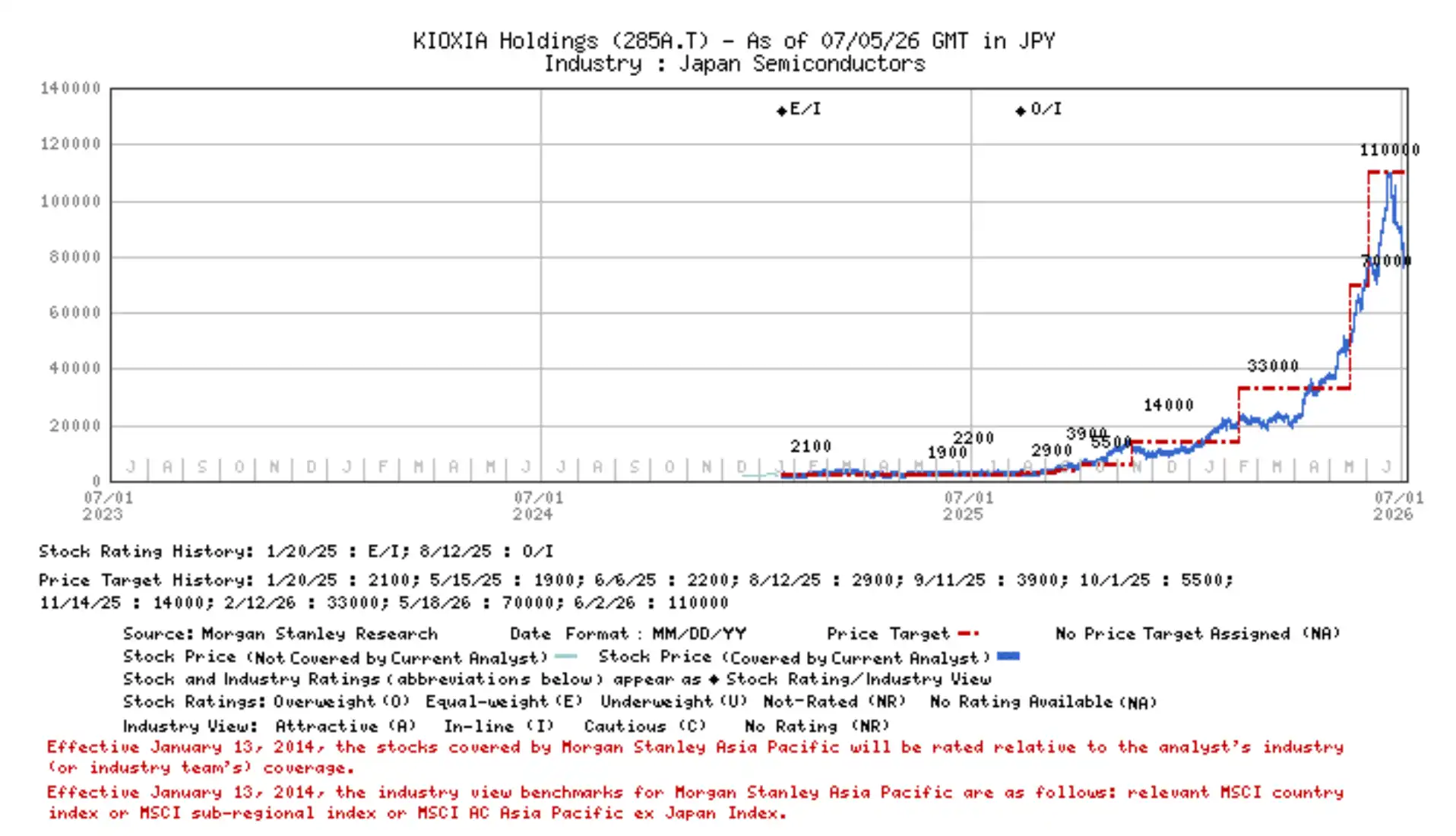
The stock price history chart shows Katana's stock price as of July 3, 2026, at about 83,300 Japanese Yen, overlaid with an "Overweight" rating.
The direction of BiCS-10 is relatively clear; the real uncertainty lies in execution.
The first is customer certification. For high-end enterprise SSDs to enter cloud service providers and data center customer ecosystems, they need to meet performance, stability, power consumption, and long-term supply requirements. Shipping samples is just the beginning; the certification timeline and order scale will determine when BiCS-10 will make a substantial revenue contribution.
The second is the ramp-up of the K2 factory. Switching to a new process typically impacts yield and cost curves. Even if the production line has started manufacturing, increasing production capacity will also take time. If the ramp-up is slower than expected, the unit cost advantage of BiCS-10 and the benefits of bit density will be delayed.
The third is industry supply. The expansion of NAND capacity by Chinese manufacturers may disrupt the global supply-demand balance, especially when demand recovery is slower than expected, the additional supply will depress prices and profit margins. Katana aims to increase the revenue share from AI SSDs and still faces changes in storage pricing cycles and competitive landscape.
Exchange rates are also a direct risk. Morgan Stanley's sensitivity analysis shows that for every 1 Japanese Yen appreciation against the US Dollar, Katana's annual operating profit would decrease by approximately 6 billion Japanese Yen. For storage manufacturers with global sales and reports in Japanese Yen, exchange rate fluctuations will amplify the uncertainty of profit forecasts.
BiCS-10 is more like a ticket for Katana to compete in the AI data center SSD market rather than a realized victory. Short-term financial reports still need to see an increase in the proportion of BiCS-8 and cost reduction. In the medium to long term, the focus is on BiCS-10 certification, K2 ramp-up, and enterprise SSD customer adoption. If these stages proceed smoothly, there is stronger support for about a 32% upside potential. If any of these stages are delayed, technological leadership will have to wait for confirmation in financial reports.
Recommended
Desk: Brent Crude Tops $110, Musk's Net Worth Drops 528.6 Billion in Four Days After Tesla Roadster Launch
Oct 17, 21:49
JST Fifth Buyback and Burn Successfully Concludes: Over 170 Million Tokens Worth Approximately $23.53 Million Burned, Buyback Mechanism Set for Comprehensive Upgrade
Oct 17, 20:10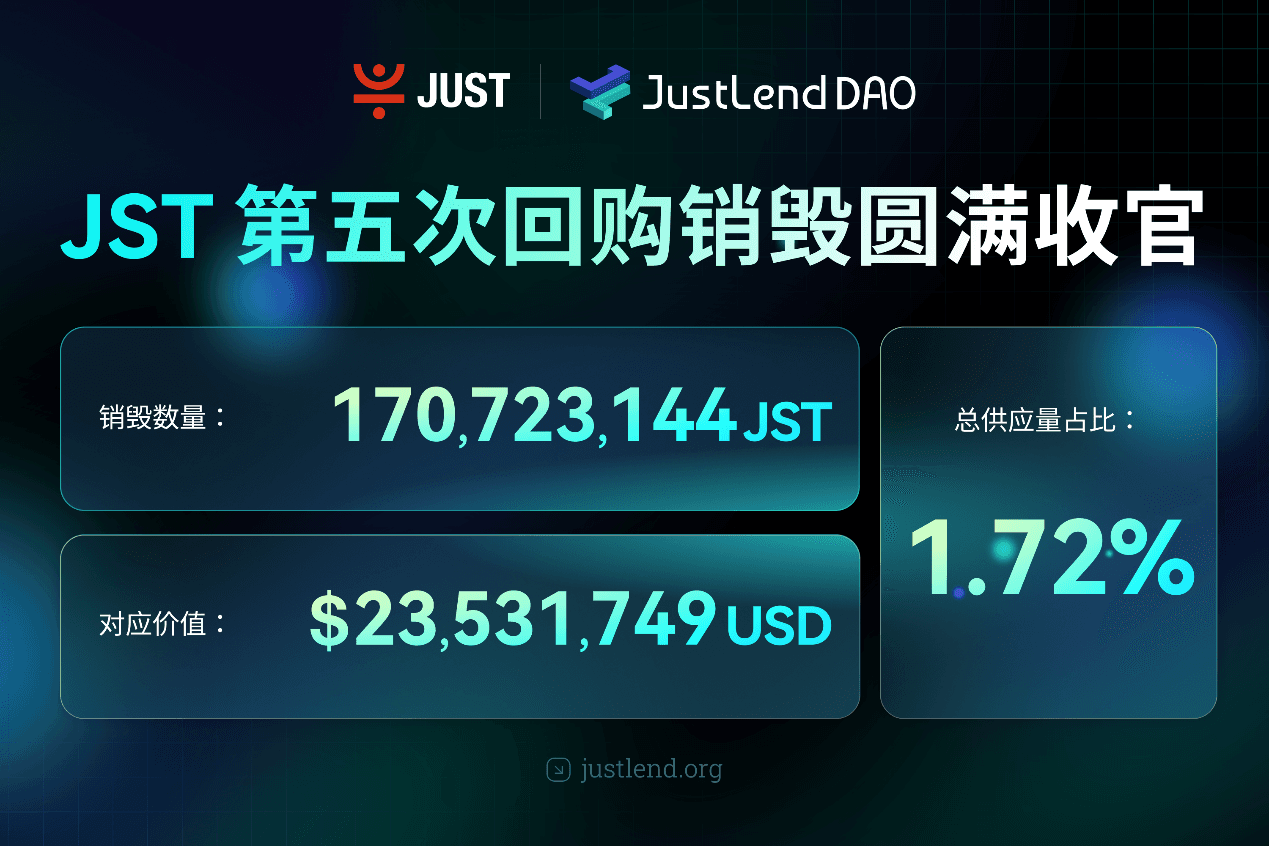
BitTorrent Brand Upgrade and Initial BTT Buyback & Burn Launch Simultaneously, Dual Engines Usher in New Era of Web3 Infrastructure
Oct 17, 20:00
Asia Market Daily: Japan's BOJ signals more rate hikes while Korea targets offshore perpetual platforms (2026/10/17)
Oct 17, 17:01Why did Papertrade backfire on you?
Oct 17, 17:01
The 'Strict Father' of Northern Myanmar: This Company Deploys 200,000 "AI Best Actors" to Strike Back Against Scammers
Oct 17, 15:34