
Morgan Stanley Analysis: Upward Revision of Memory Pricing Forecasts, but Short-Term Momentum May Weaken

TL;DR
· Morgan Stanley raises 3Q26 multi-category memory price forecast and warns of potential short-term weakening momentum in memory stocks.
· Under this report's scope, PC DRAM price increase expectation raised to 15-20%, with DRAM profit revision breadth approaching 89%.
· Samsung and SK Hynix are still supported by AI demand, but guidance, LTA, and capital expenditure stance will affect the continuation of the uptrend.
Morgan Stanley significantly raised its third-quarter memory price forecast in a research report released on July 7, but cautioned that memory stocks may face short-term pullback pressure.
This is not a turning point in the memory cycle. The report still maintains a "attractiveness" view of the South Korean tech industry, continuing to favor Samsung Electronics and SK Hynix, with an expected earnings growth of over 35-40% for the relevant companies in its model by 2027. The real reminder is that memory prices, profit expectations, and investor positions have all reached elevated levels, and stock prices may not necessarily continue to rise at the same pace as in the past few months in the short term.
The most direct figures are price forecasts. The report raised the 3Q26 PC DRAM blended ASP sequential growth rate expectation from the previous 3-8% to 15-20%, server DRAM to 13-18%, GDDR6 and GDDR7 to 15-20%, and enterprise SSD to 18-23%.
The directional judgment of public pricing agencies is also heating up. An article by TrendForce on July 3 stated that the 3Q26 DRAM market remains extremely tight, with contract price expected to rise by 13%-18% sequentially, and NAND Flash contract price expected to increase by 10%-15%. However, TrendForce also mentioned that server DRAM is still in short supply, but long-term supply agreements will slow down the price increases.
Prices are still rising, but the trading difficulty of memory stocks is increasing. In Morgan Stanley's report scope, the recent breadth of DRAM profit revisions has approached 89%, nearing historical highs. The memory market in the past two years, driven by AI capital expenditure, HBM, and server demand, has already priced in many positives into stock prices in advance.
This round of increases is widespread. In addition to PC DRAM, the price expectations for server DRAM, graphics DRAM, commodity DRAM, and enterprise SSD in 3Q26 have all been significantly raised. Among them, the 15-20% price increase in PC DRAM and graphics DRAM is the most easily captured price signal by the market. The 18-23% increase in enterprise SSD prices indicates that the price hike in storage is not only concentrated in AI server-related categories.
The problem lies here as well. The faster the price expectations rise, the more likely the stock price will enter a "good news sell-off" phase.
Memory stocks have not been immune to corrections in the past two years. According to Morgan Stanley data, since the inception of the Generative AI wave in November 2022, DRAM-related stocks have experienced three significant pullbacks, including profit-taking, specific event shocks, and weeks-long adjustments. Each correction has not interrupted the long-term trend driven by AI capital expenditure but has served as a reminder to investors that even in a strong cycle, there can be deep phase declines.
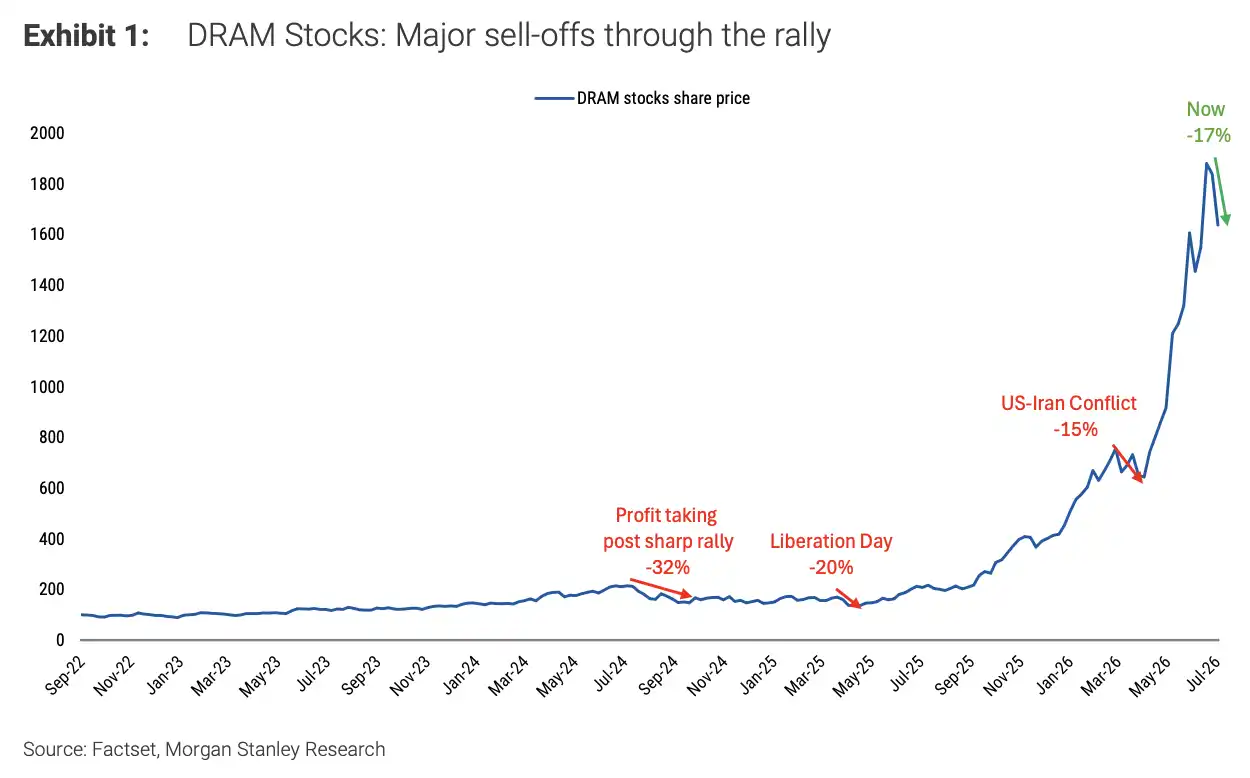
DRAM stock has seen three major pullbacks of approximately -25%, -25%, and -35% respectively, but has overall risen from the 2022 low to a new high in 2026.
Spot prices also support the price increase rationale. The report's price tracking shows that DRAM spot prices have rapidly risen since early 2025, and NAND spot prices have also recently rebounded significantly from the bottom, although contract prices have lagged, they are also trending upwards. In other words, the short-term pullback hints not because prices have worsened but because both prices and expectations have risen too quickly.
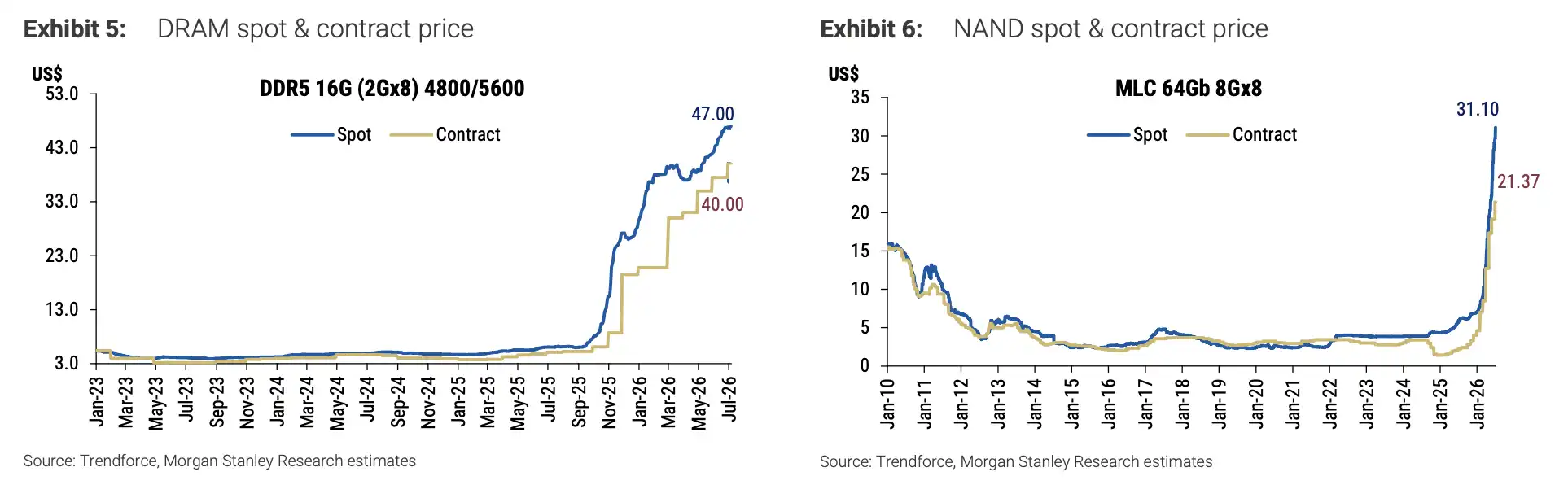
DDR5 16Gb spot price has risen to around $47, and MLC 64Gb NAND spot price has recently risen to $31.10.
For stocks, what is more critical than the price itself is how much upside potential is left in expectations.
The breadth of DRAM earnings revisions has recently reached about 89%, hovering near historical highs. This measure can be understood as an increasing number of analysts raising earnings forecasts. When most people have already revised earnings upwards, the difficulty of exceeding expectations further will increase.
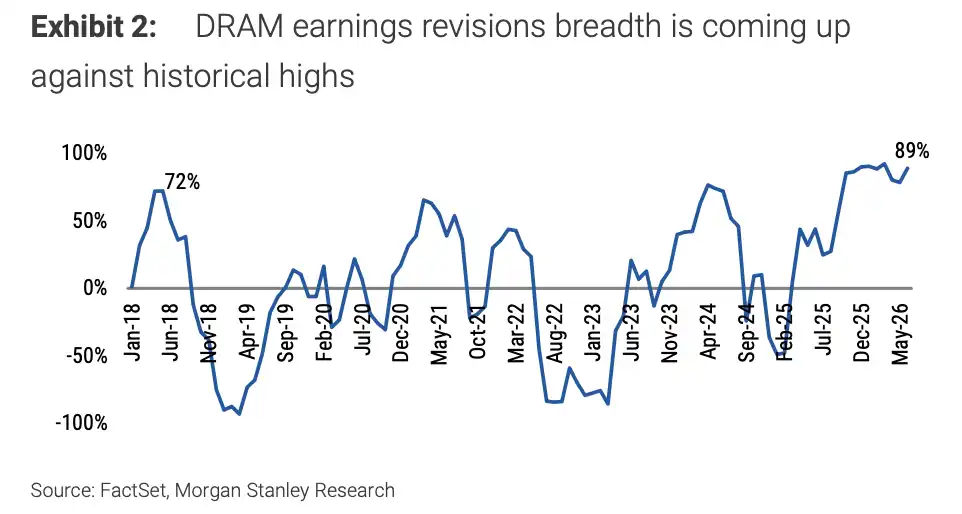
The breadth of DRAM earnings revisions has risen to about 89% since 2025, nearing historical peak levels.
This is also one of the reasons why short-term momentum may weaken. Memory stocks do not lack fundamental support but the price hike, earnings upgrades, crowded funds, and AI chain sentiment have all converged. Once the earnings guidance is not robust enough, the capital expenditure sentiment is not sufficiently positive, or the stock prices of large cloud companies come under pressure, the memory sector is more prone to amplified volatility.
Morgan Stanley still prefers DRAM and traditional memory where fund flow visibility and supply constraints are more pronounced, believing in their attractiveness over NAND and holding the most negative view on memory module manufacturers. This ranking indicates that the market is not simply betting on "all storage price increases," but rather questioning whether price increases can truly translate into profits.
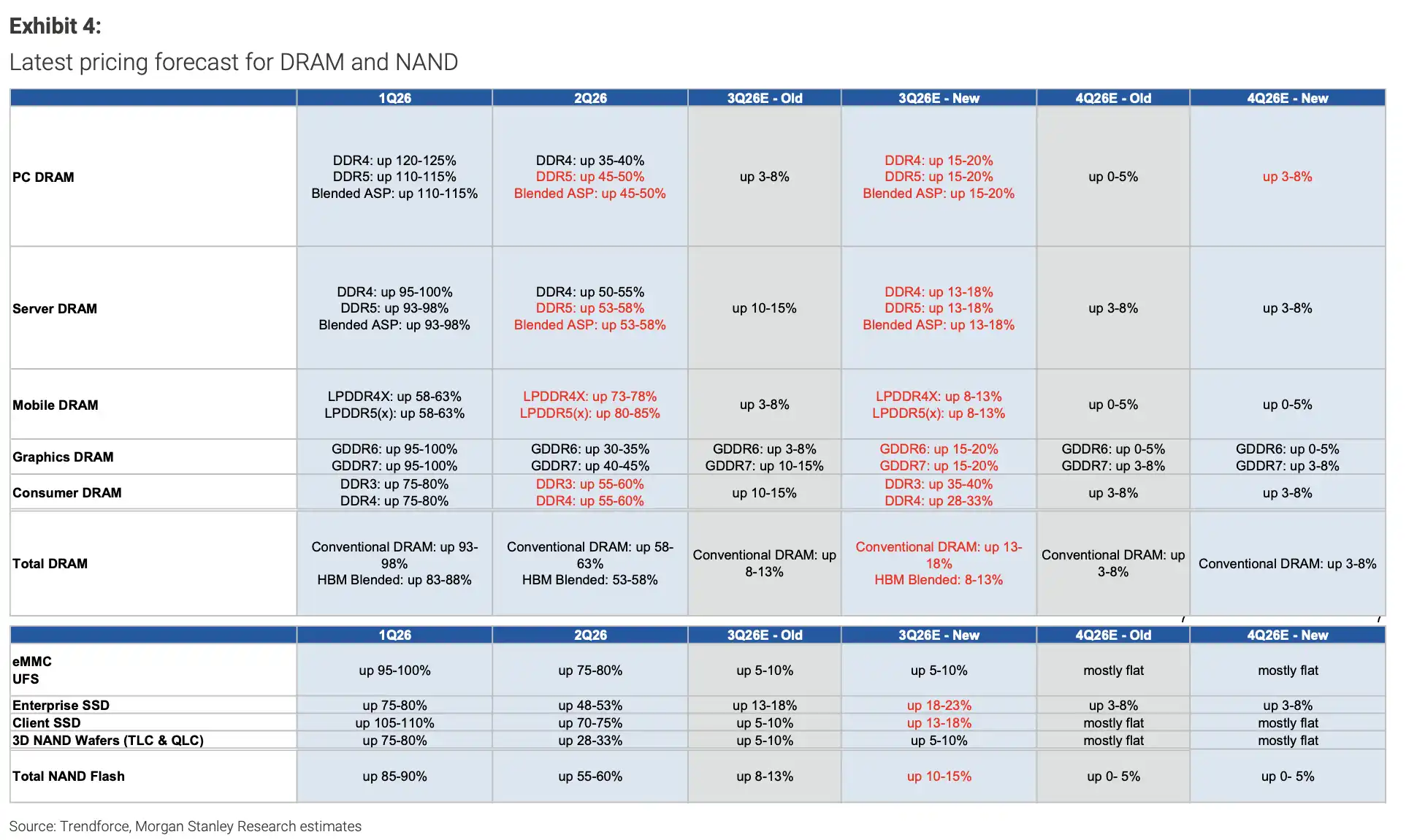
3Q26 PC DRAM price increase expectations raised from 3-8% to 15-20%, enterprise SSDs raised to 18-23%, with price predictions for various types of DRAM simultaneously raised.
The financial reports of South Korea's two memory giants will serve as a market validation window for the price hike logic.
Samsung Electronics has already released its 2Q26 performance guidance on July 7. The company expects sales of about 171 trillion Korean won, operating profit of about 89.4 trillion Korean won, with an operating profit range of 89.3 trillion to 89.5 trillion Korean won. For Samsung, the market is not only looking at quarterly profits but also focusing on the resilience of the memory business, progress in AI-related products, and whether the upward trend in traditional storage prices can continue to enhance profitability.
The timing of SK Hynix's financial report is still pending. According to the public market calendar, the company is expected to release its next financial report on July 29. As SK Hynix's position in HBM and AI server memory is more prominent, the market will be more sensitive to its third-quarter commodity memory prices, long-term supply agreements (LTA), and capital expenditure posture.
If management confirms that third-quarter commodity memory remains strong, LTAs are increasing, and capital expenditures are only moderately increasing, any short-term pullback may look more like a healthy adjustment. However, if the guidance is not strong enough, or if capital expenditure is interpreted as a sign of too rapid supply expansion, the market may reassess how long the memory price hike can continue.
LTAs themselves are not without risk. Historically, long-term agreements have not necessarily led to stock price increases; some agreements have been renegotiated, or have become constraints where customers are forced to take products when demand shifts. The market will not only look at "how many agreements are signed" but also at prices, terms, customer quality, and execution flexibility.
The long-term bullish logic still comes from AI, especially AI agents that can perform tasks, use tools, and interact continuously. Morgan Stanley forecasts in the report that by 2027, earnings growth of related companies is still expected to exceed 35-40%, which is why it does not equate short-term pullback risks with the end of the cycle.
However, the controversy surrounding AI demand is changing. Previously, the market was more focused on model training and the continued expansion of inference scale, driving up computing power and memory requirements. Now, some investors are starting to worry that after the third quarter, cloud providers may place more emphasis on token savings, inference efficiency, open-source low-cost models, and the profit margin pressure from chip inflation.
There is also a more sensitive issue: whether the largest AI spenders actually have sellable computing power, hinting at a possible temporary oversupply in the early stages of development. While this claim has not yet reached a definitive conclusion, it is enough to make the market more cautious ahead of the earnings reports of major cloud providers.
The divergence in this round of memory market sentiment lies not in whether AI demand will immediately disappear, but in whether price increases, profit upgrades, and customer capital expenditures can continue to strengthen in the same direction. If second-quarter AI supply chain reports remain favorable but third-quarter guidance begins to weaken, memory stocks may undergo a round of valuation and position adjustments.
The memory cycle is still set against the backdrop of AI capital spending, but short-term trading has shifted from "how much prices have risen" to "how long can the market continue to believe in these price increases." The performance communications of Samsung and SK Hynix, cloud provider capital expenditure statements, and LTA execution will determine whether this pullback is just a breather in the bull market or the beginning of a true slowdown in the upward trend.
Join the official Coincamps community:
Telegram: https://t.me/coin_camps
Recommended
Desk: Brent Crude Tops $110, Musk's Net Worth Drops 528.6 Billion in Four Days After Tesla Roadster Launch
Oct 17, 21:49
JST Fifth Buyback and Burn Successfully Concludes: Over 170 Million Tokens Worth Approximately $23.53 Million Burned, Buyback Mechanism Set for Comprehensive Upgrade
Oct 17, 20:10
BitTorrent Brand Upgrade and Initial BTT Buyback & Burn Launch Simultaneously, Dual Engines Usher in New Era of Web3 Infrastructure
Oct 17, 20:00
Asia Market Daily: Japan's BOJ signals more rate hikes while Korea targets offshore perpetual platforms (2026/10/17)
Oct 17, 17:01Why did Papertrade backfire on you?
Oct 17, 17:01
The 'Strict Father' of Northern Myanmar: This Company Deploys 200,000 "AI Best Actors" to Strike Back Against Scammers
Oct 17, 15:34