WAIC Real-Time Update | President Xi Jinping Announces Major AI Initiative in China

The 2026 World Artificial Intelligence Conference and Global AI Governance Summit (WAIC) was held in Shanghai from July 17 to 20 and officially opened today. President Xi Jinping attended the conference's opening ceremony and delivered a keynote speech.
This is the first time in the history of the World Artificial Intelligence Conference that the President attended and delivered a keynote speech, fully demonstrating the conference's high level of significance and influence. It also signals that artificial intelligence, as a core driver of a new round of technological revolution and industrial transformation, has been elevated to a national strategic height.
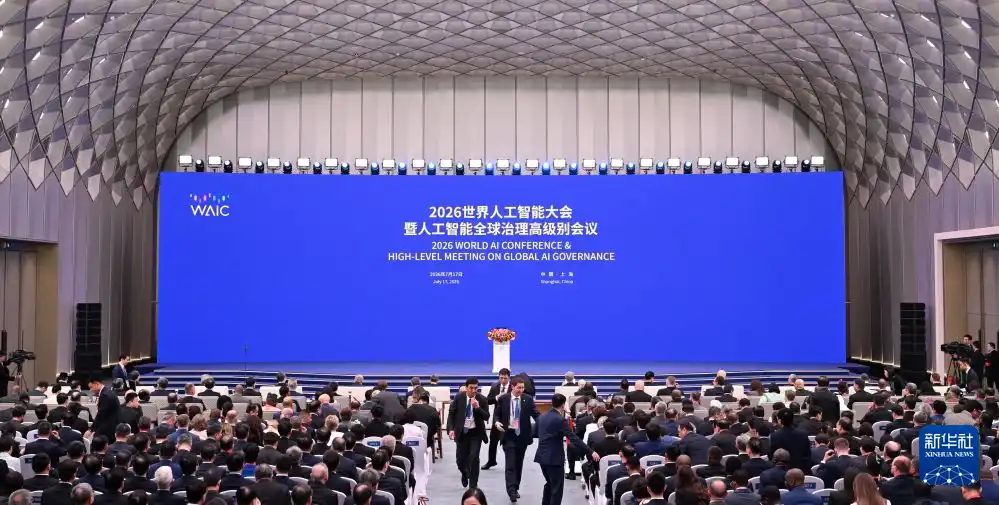
Today, President Xi Jinping attended the opening ceremony of the 2026 World Artificial Intelligence Conference and Global AI Governance Summit and mentioned in his keynote speech that the Chinese often say, "A single string cannot make music, a single tree cannot make a forest." The development of artificial intelligence should not be a solo performance by any country but should be a global symphony of cooperation, encouraging open source, openness, cooperation, and sharing, allowing AI to be used in various industries.
He also called for ensuring that AI is always under human control. Countries should establish legal regulations, technical monitoring, risk warning, and emergency response systems to prevent AI from being abused.
Xi Jinping also opposes the generalization of the concept of national security, placing one's national security above that of other countries. AI should also not harm the cultural characteristics of countries and the diversity of world civilization.
China will cooperate with countries in Asia, Africa, Latin America, and the BRICS countries to help developing countries build AI capabilities, avoiding AI from creating new global inequalities. The competition between China and the United States in AI is shifting from chips and models to open-source routes and global rules.
Today, Chinese President Xi Jinping attended the opening ceremony of the 2026 World Artificial Intelligence Conference and Global AI Governance Summit at the Shanghai World Expo Center and delivered a keynote speech.
Xi Jinping pointed out that with the joint efforts of all parties, the World AI Cooperation Organization was born in Shanghai. This is a significant move by China in response to the global call from the Global South and to unite the international community to actively promote the development and governance of artificial intelligence, marking a significant milestone in the history of AI development.
Xi Jinping announced that to further support global AI development and promote global AI capacity building, over the next 5 years, China will provide 5,000 AI-focused study and training opportunities for developing countries; establish International AI Application Cooperation Centers for ASEAN, the Arab League, the African Union, CELAC, SCO, and BRICS countries; promote the meteorological intelligent warning system "Mazu" to be implemented in 30 countries, watching over countless families and safeguarding peace across the world's oceans.
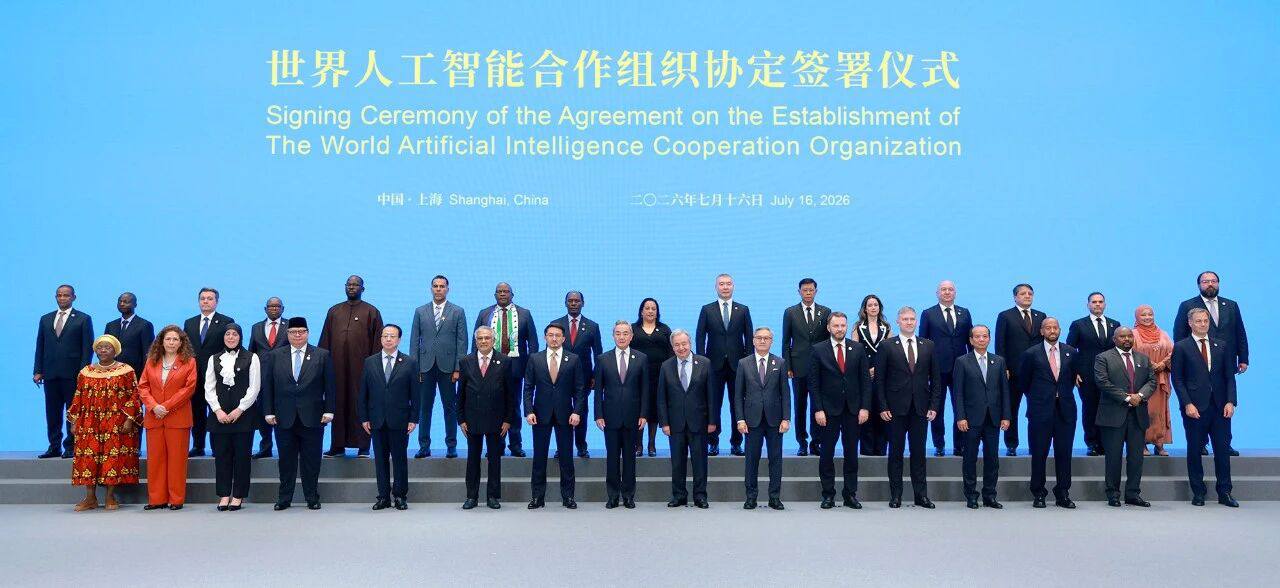
Today, 29 countries signed an agreement to establish the World Artificial Intelligence Cooperation Organization. This is an intergovernmental international organization headquartered in Shanghai.
Founding members include China, Russia, Brazil, Cuba, Serbia, and others. Among them are 10 African countries and 12 Asian countries.
The organization will promote international cooperation in AI, capacity building, and global governance. China proposed the establishment of this organization last year and has now officially received the support of the initial members.
China hopes to help lower the AI adoption threshold for global South countries through open-source models and technology training. The AI competition between China and the U.S. has also expanded from companies and products to international organizations and rule-making.
At the 2026 World Artificial Intelligence Conference, Fudan University Vice President Jiang Yugang, Zhiyuan Robotics Partner Yao Maoqing, Taishi Zhihang CEO Chen Yilun, and BrightSource CEO Jiang Xu engaged in a roundtable discussion on the world model. The guests unanimously agreed that the core of the world model lies in understanding the laws of the physical world's operation and predicting the next state or action, rather than just rendering images. It requires native integration of multi-modal fusion, physical laws, causal reasoning, and long-range prediction capabilities. The current major bottleneck lies in data—Chen Yilun pointed out that video data lacks key modalities such as force and touch. Ideal training data needs to meet three conditions: complete modalities, high-frequency interaction, and derived from real scenarios. Embodied intelligence requires complex operations or millions of hours of real interaction data; Yao Maoqing likened it to the hundred billion hours of training for large language models, estimating that the physical world may require "over a hundred million hours" of real data to master common sense physical prediction. At the architectural level, Jiang Xu pointed out that the current mainstream architecture conflates state prediction with action prediction, leading to a conflict between generation and understanding capabilities, making simultaneous optimization difficult.
In terms of implementation paths, all three guests view the manufacturing industry as the most certain scaled scenario in the next three years:
Yao Maoqing revealed that Zhiyuan Robotics has achieved a robotic formation operation on the production line for six days with a volume of sixty thousand items and a success rate of 99.99%;
Chen Yilun is betting on the manufacturing industry, citing reasons including high data concentration, clearly defined task completion standards, and the existence of a large amount of human demonstration data. Taishi Zhihang has cooperated with automakers to promote the deployment of a cluster of industrial embodied robots at the thousand-unit level and emphasized that China's manufacturing industry is the most concentrated globally, making it an ideal testbed for physical AI;
Jiang Xu believes Embodied Intelligence is an extension of multimodal large models. With the Internet already having 10 billion hours of video data suitable for pretraining, a leap in capability will first appear in daily scenarios such as home and office settings. However, commercialization needs to meet high fault tolerance conditions. Finding scenarios for large models is no easier than training the models themselves.
The consensus of the three parties is that we are still far from general Embodied Intelligence, and breakthroughs in specific scenarios are a necessary stage. The future competitive focus will shift from model architecture to the ability to obtain high-quality data and close the loop on scenario validation.
Alex Zavalonkov, Founder and CEO of British Silicon Intelligence, delivered a keynote speech at the 2026 World Artificial Intelligence Conference, systematically outlining the transformative role of AI in new drug development. Traditional new drug development usually takes 4 to 5 years from target identification to candidate compound. Relying solely on China's local R&D architecture and talent accumulation can already be about 2 years faster than the global average. With the addition of AI capabilities, this cycle can be further compressed to 9 to 12 months—a "miracle that AI overlaying Chinese-style architecture can achieve."
Alex recalled that his team first proved in a paper published in Nature in 2019 that reinforcement learning and AI could generate new molecules and successfully validate them in the lab within 46 days. The subsequent popularization of generative AI completely changed the R&D process. Open models like DeepSeek also allow scientists worldwide to use AI in public health and new drug development.
Alex disclosed that the company already has drugs in China entering Phase III clinical trials, covering targeted drugs for complex conditions and candidate drugs targeting both disease and aging concurrently. The research results have been published in multiple Nature series papers. He specifically mentioned the establishment of a robot-driven drug development factory in Jinqiao, Pudong, Shanghai, China, which was built from concept to facility within 18 months, setting multiple records. Currently, this "super-intelligent medicine" capability is being shared with other pharmaceutical companies to help them improve quality and efficiency in over 1,200 tasks required for new drug development.
At the end of his speech, Alex called for the establishment of an academic community to allow AI to benefit the world in an open manner, especially in public health and extending human longevity.
Wang Jian, academician of the Chinese Academy of Engineering and founder of Alibaba Cloud, stated at the 2026 World Artificial Intelligence Conference that the term "artificial intelligence" still lacks consensus to this day. AI is once again at a key juncture—scientific data will redefine the essence of artificial intelligence. Scientific data should be the "indigenous people" of the foundational model and should not rely solely on scientific paper texts. Wang criticized the current application of AI in research, which overly focuses on paper texts and code, without delving into the scientific data itself. He proposed that the core technology architecture for scientific foundational models is not vertical domain models but a fusion of text, code, and scientific data. The core task is to tokenize scientific data and embed it in the same model space as text and code.
At the end of his speech, Wang Jian summarized that AI is at a turning point—it is no longer a standalone technical field, but has become a fundamental tool for scientific research, much like mathematics. He predicted that in the next fifty years, AI's role in science will be equivalent to the role mathematics has played in the past few centuries. The key to the next stage of AI competition lies in the ability to integrate multimodal scientific data.
Xu Li, Chairman and CEO of SenseTime, delivered a keynote speech at the 2026 World Artificial Intelligence Conference, systematically expounding on the dual proposition of the inclusiveness and security of AI. Several AI applications that have already been market-validated—such as software development, content generation, and embodied intelligence—are undergoing a common evolutionary trajectory: transitioning from single-module tools aimed at professionals to long-task closed loops aimed at the general public. The most significant change in this process is the migration of users; the original target customers are no longer crucial, and the real customers are emerging naturally from the demand side. Xu Li emphasized that true AI inclusiveness does not replace humans but amplifies the boundary of each person's inherent capabilities.
Xu Li proposed that in terms of security governance, AI security should permeate three levels: product philosophy, model trajectory, and physical boundaries. Products should enhance rather than replace, nurture personal growth instead of dependency; models should ensure data security both in pre-training and post-training stages and implement multi-model cross-validation during use; embodied intelligence should gradually advance through sandboxing and scenario constraints.
Xu Li also suggested that as AI capabilities advance to the super-individual level, the true future unit of account will no longer be a Token but rather the price of task completion—Task Economics will drive AI from computing power consumption to value delivery, and the continued reduction in costs will further lower the inclusiveness threshold. Xu Li cited World Economic Forum data stating that by 2030, AI may eliminate 90 million jobs but create 170 million new professions, with super-individuals becoming the core of new occupational forms.
Recommended
Desk: Brent Crude Tops $110, Musk's Net Worth Drops 528.6 Billion in Four Days After Tesla Roadster Launch
Oct 17, 21:49
JST Fifth Buyback and Burn Successfully Concludes: Over 170 Million Tokens Worth Approximately $23.53 Million Burned, Buyback Mechanism Set for Comprehensive Upgrade
Oct 17, 20:10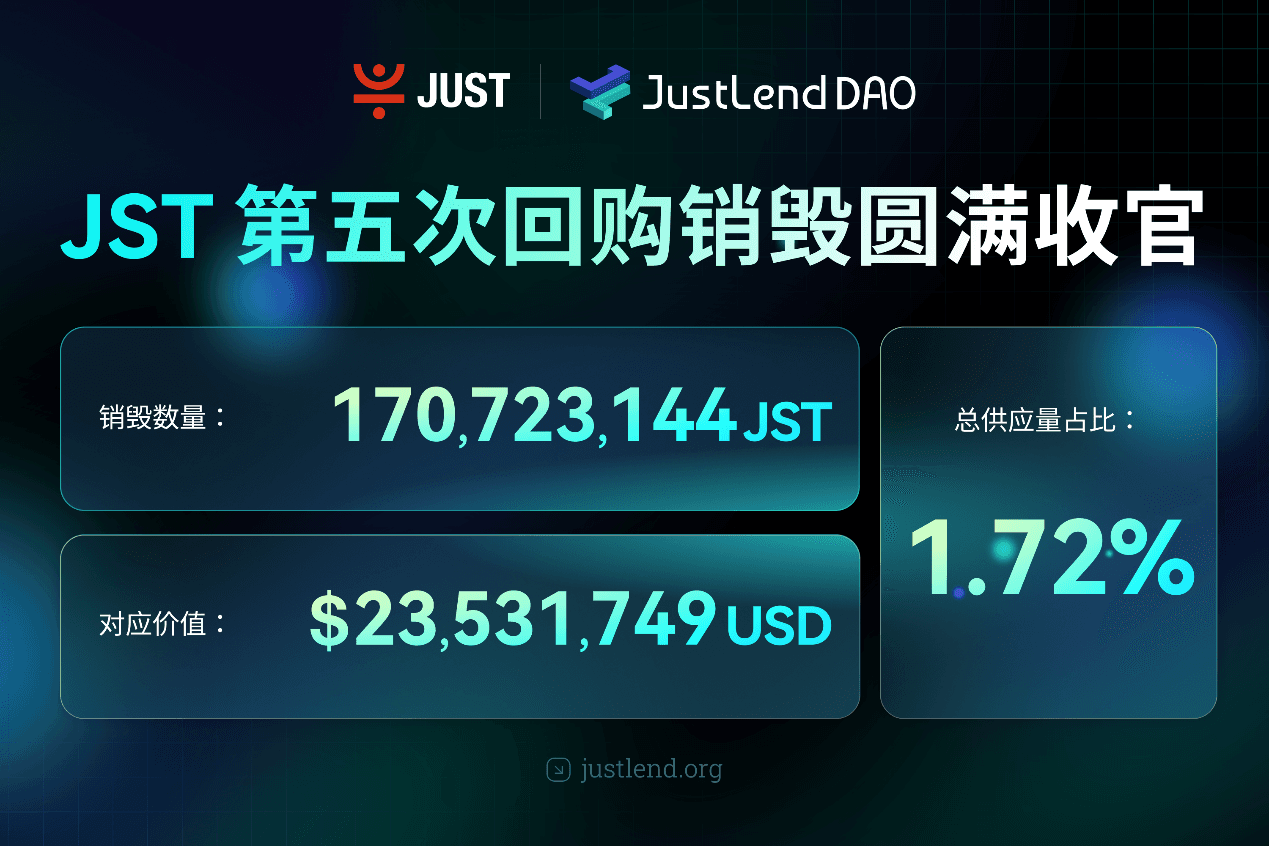
BitTorrent Brand Upgrade and Initial BTT Buyback & Burn Launch Simultaneously, Dual Engines Usher in New Era of Web3 Infrastructure
Oct 17, 20:00
Asia Market Daily: Japan's BOJ signals more rate hikes while Korea targets offshore perpetual platforms (2026/10/17)
Oct 17, 17:01Why did Papertrade backfire on you?
Oct 17, 17:01
The 'Strict Father' of Northern Myanmar: This Company Deploys 200,000 "AI Best Actors" to Strike Back Against Scammers
Oct 17, 15:34