After the high-profile release of Kimi K3, Revisiting the Landscape of Large AI Models in China and the US

If you were to place a bet on a poker game winner, never rush to place your bet in the early stages of the game.
1. Starting Hand, US Currently Holds the Advantage. Cutting-edge models, high-end chips, USD capital, cloud platforms, and global software access form the most organized hand for the US. If the cards were revealed today, the US would have a higher winning probability.
2. Card Updates Too Fast, Advantage is not Superiority. The lead window for big models is shifting from a stable lead to a constantly changing time difference. Kimi K3's partial edge in long-range code testing indicates that China's speed in card understanding, splitting, and recombination has significantly accelerated.
3. Computing power determines chip depth, algorithms redefine chip values. The US holds high-end chips, HBM, interconnects, CUDA, and super-large clusters, allowing for more opportunities for simultaneous betting and trial and error; China, unable to obtain as many high-value chips, seeks to increase the purchasing power of each chip.
4. The US Holds the Hole Cards, China Expands the Table. OpenAI and Anthropic aim to turn their leading capabilities into recurring "model rent"; Chinese manufacturers exchange low prices, open weights, and on-premises deployment for distribution rights, competing for "ecosystem rent" formed by cloud services, industrial deployment, and development standards.
5. Token price is just the bet amount, while unit task cost corresponds to the pot size. The checkmate is still far from cheap. The real competition lies in how much money is spent to complete the same task. The US defends key tasks with the highest failure costs, while China attempts to qualify a larger quantity of ordinary tasks to enter the pot.
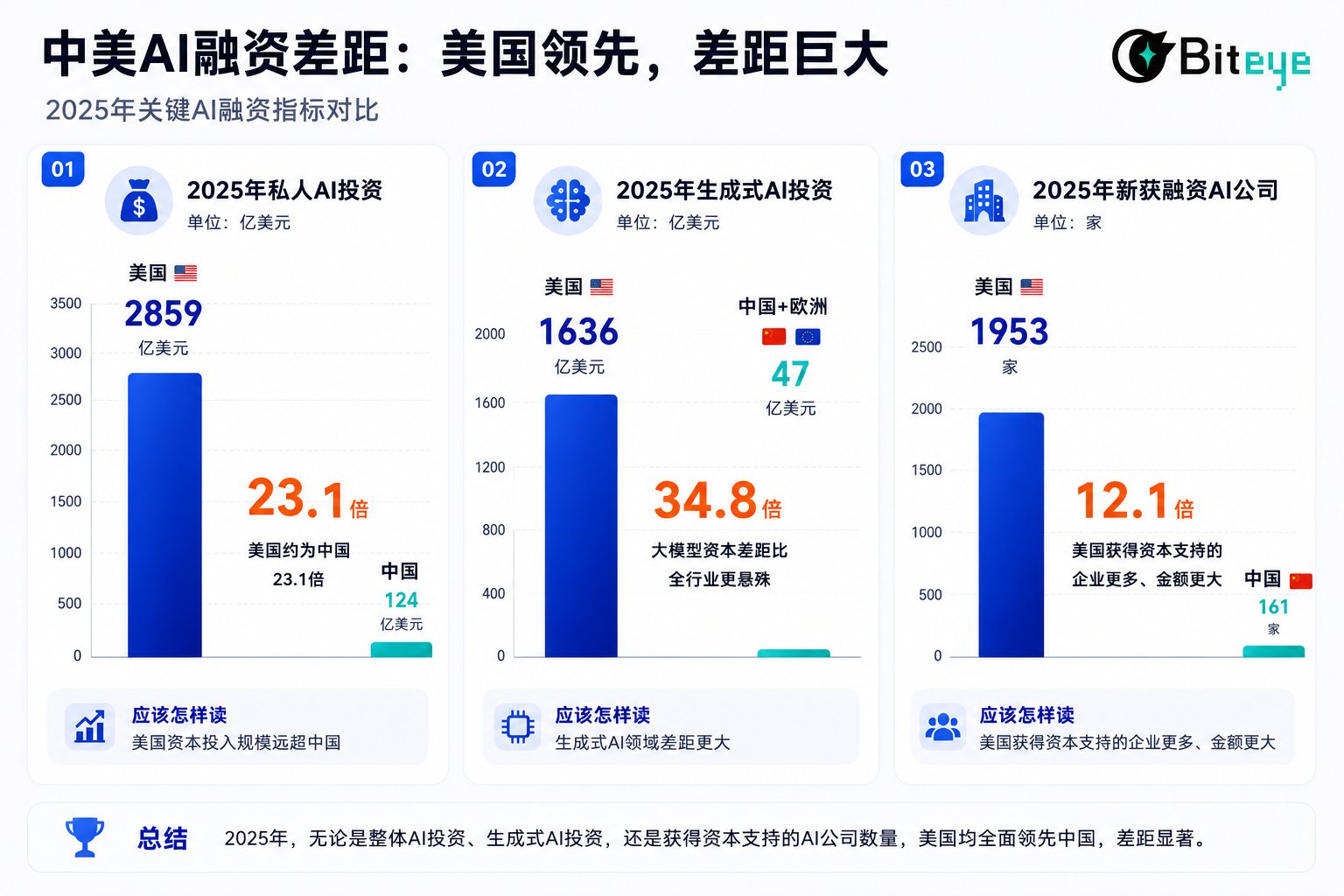
6. Capital Buys Both the Right to Trial and Error and Initiates the Countdown to Return. The scale of private AI investments in the US is significantly ahead, allowing for more diversified bets; China's capital is more dispersed and relies more on large firms, industrial capital, and policy forces. Both sides are not just burning money but also time borrowed from the future.
7. Having Various Scenarios Does Not Equate to Having a Winning Hand. China holds a business playbook with real wins and losses, but only the results of transactions, performance, quality inspection, and equipment operation that can flow back to training will transform industrial scale into model advantages.
8. Ultimately, we need to see who can control the drawdown and evade the table-flip variable. From job market fluctuations, fraud, privacy breaches, Agent misbehavior, capital bubbles, to upgrade lockdowns and even the early arrival of AGI, all of these could lead to a repricing of today's most valuable chips.
The light hangs low from the ceiling, casting a dim glow over the green felt table, leaving only chips, playing cards, and two pairs of unblinking eyes. The air is filled with the scent of coffee, stale smoke, server heat, and the hallucinatory aroma of freshly printed banknotes. It is the smell of someone ready to mortgage the future.
The dealer shuffles the cards with a bowed head, fingers clean, movements gentle. Time is always like this. It deals the cards for you but does not take responsibility for you.
Many have sat at the AI table before. Europe has come with regulatory documents, Japan and Korea have fought over positions in the chip supply chain, the Middle East has put stacks of energy and oil capital on the table. But as the blinds increase, those who can truly keep up with cutting-edge models, superclusters, and global gateways are mainly the United States and China.
In front of the United States, chips are stacked high like the Manhattan skyline. OpenAI, Anthropic, Google, and Meta shine brightly, unparalleled; Nvidia, cloud platforms, USD capital, and global software gateways are solidly grounded below. China's chips may not be as neatly arranged, but they are quickly growing thicker: DeepSeek, Qwen, Kimi, zhiPu, MiniMax, Jieyue, as well as the internet platforms, open-source communities, domestic chips, and vast application markets behind them, have become so substantial that opponents can no longer leisurely bet according to the old odds.
The dealer remains silent, flips over the cards, revealing in shimmering ink: Large Model.
When ChatGPT first emerged, it was indeed groundbreaking, but its initial introduction into users' lives was perhaps just a smarter Siri. People had it write poetry, generate stories, explain quantum mechanics, and seriously spew nonsense that was then shared as images. Just a few years later, that chatbox had inadvertently seeped into search, programming, office work, customer service, and research processes.
It genuinely began taking over work, or rather, productivity.
Whether playing Texas Hold'em or any other game, there is a very simple truth: Having a strong hand does not guarantee a win. Because having a strong hand is still a long way from forming a winning combination.
Holding an A and a K may seem intimidating, but if the flop is irrelevant, they are just two high cards for the moment. On the other hand, two seemingly insignificant low cards, once connected to the community cards, may unexpectedly form a straight.
The big picture is precisely this starting hand.
1. First, Assess the Hand: American Cards Lead, China Already at the Front
Various benchmarks measure different capabilities and cannot be directly combined into a single score. However, looking at several key rankings as of July 17, 2026, can still provide an overview of the current state of play.
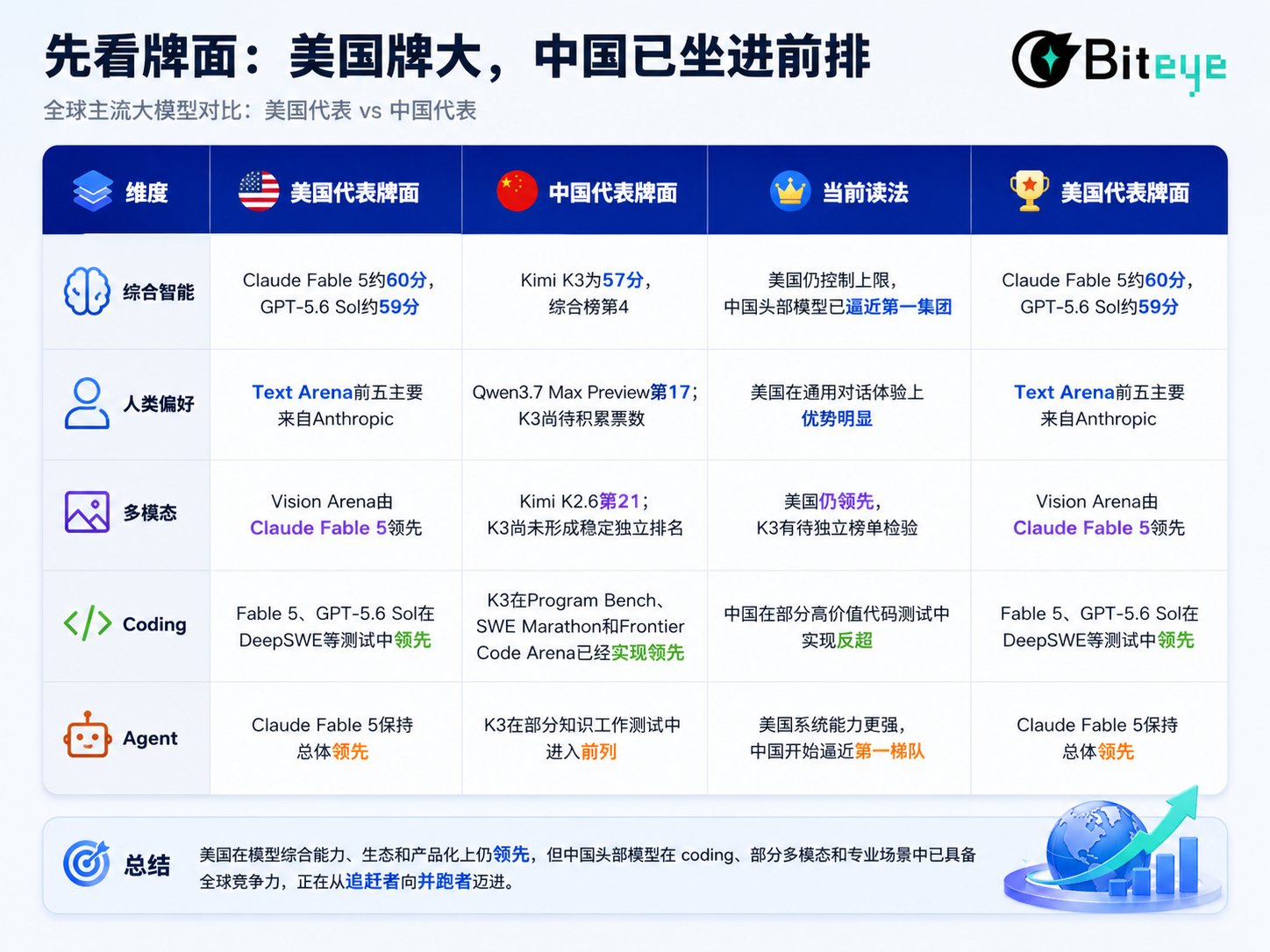
There are more big players now, but no single player can dominate the game.
If we only consider the strongest models, the U.S. still holds a better starting hand. Anthropic, OpenAI, Google, xAI, and Meta form a solid frontline of advanced models, taking turns leading in general reasoning, coding, multimodal tasks, and agent capabilities. The U.S.'s advantage is not that a particular company has temporarily surged to the top but the overall depth of cutting-edge model offerings.
However, today's release of Kimi K3 has significantly narrowed the gap between China and the highest-ranking models. In a third-party Artificial Analysis, K3 scored 57 points, ranking 4th on the comprehensive intelligence list, with only a two to three-point difference from Claude Fable 5 at around 60 points and GPT-5.6 Sol at around 59 points. Chinese models are now beginning to approach the global limit of comprehensive capabilities.
Coding is the ace up K3's sleeve. In public group tests, K3 scored 77.8 on Program Bench, slightly higher than Sol's 77.6; scored 42.0 on SWE Marathon, higher than Sol's 39.0; and achieved 88.3 on Terminal-Bench 2.1, closely trailing Sol's 88.8. In the Frontend Code Arena featuring user-blind selections, K3 topped the chart with 1679 points and ranked first in six out of seven frontend subfields.
The hand has thus been reshaped. The U.S. still holds the upper hand in comprehensive capabilities, general experience, and systematic agent capabilities. However, China is now able to secure several victories in the high-value public card of Coding.
The competition between cutting-edge AI models in China and the U.S. is shifting from a comprehensive catch-up to a partial tit-for-tat.
2. Game Pace: Delta is turning into Delta-T
Benchmarks still matter, but they are gradually mattering less.
The key is that they are increasingly only able to show us the snapshot of the table at this moment, making it hard to predict who will still be at the top weeks later.
When model iterations are slow, a lead often means a delta of six months or longer. Back then, a high ranking was not just a pretty report card but also indicated a wide enough moat of technology. In March 2026, according to the Stanford "2026 AI Index," the top U.S. models had squeezed into a narrow range of less than 25 Arena Elo points, with Qwen and DeepSeek also entering the frontier area. Since 2025, Chinese and American models have swapped positions multiple times, and by March 2026, the open performance gap between the top models of both sides was around 2.7%.
So, what benchmarks are losing is not the measuring ability but the predictive power of the endgame.
The phrase "China and the U.S. big models are only three months apart" emerged in this context. This doesn't mean that China is fixedly three months behind the U.S. in all aspects but that the competition between the two is shifting from a relatively stable "delta" to a fluctuating "delta-T." From the release of the specialized model K2.7 Code on June 12 to the launch of the flagship K3 on July 17, only 35 days had passed. Code, mathematics, multimodality, agents, and real-world product experiences each follow their own pace, sometimes separated by months, sometimes by mere weeks.
Further accelerating the catch-up is distillation. Student models do not need to see the parameters of teacher models; they just need to learn extensively from their answers, code solutions, and tool usage to potentially grasp part of the decision-making path more quickly, following the path already trodden by the other. Distillation itself is a common technique; the controversy lies in whether competitors are using another commercial model on a large scale without permission.
In June 2026, Anthropic wrote to U.S. senators, accusing operators associated with Alibaba and the Qwen team of engaging in about 28.8 million interactions with Claude using nearly 25,000 fake accounts, attempting to extract its agent reasoning, software engineering, and long-range task capabilities. The allegations, coming from Anthropic, should still be distinguished from independent investigative findings. However, it at least reveals one thing: U.S.-based front-line model companies are no longer treating just parameters, chips, and training code as strategic assets; even the answers generated by models are starting to be seen as potential leaks of capability.
The United States is still playing new cards more frequently, but China's speed of peeking, bluffing, and recombining is now much faster than before. The top rank has become a short-term maneuver rather than naturally equating to long-term advantage.
"The tree desires calm, but the wind will not cease; the card desires calm, but the heart will not rest."
A player may hold a better hand, but could still lose due to shallow chips, insufficient information, or a failure to understand the opponent's range; another player with a slightly weaker starting hand may slowly inch up their win rate as long as they can see more rounds at a lower cost.
Computing power, algorithms, data, and talent together determine this unrealized win rate. They decide how many paths an AI company can explore, the cost of trial and error, whether experience can be retained, and whether they can sit at the table again after the next round of model updates.
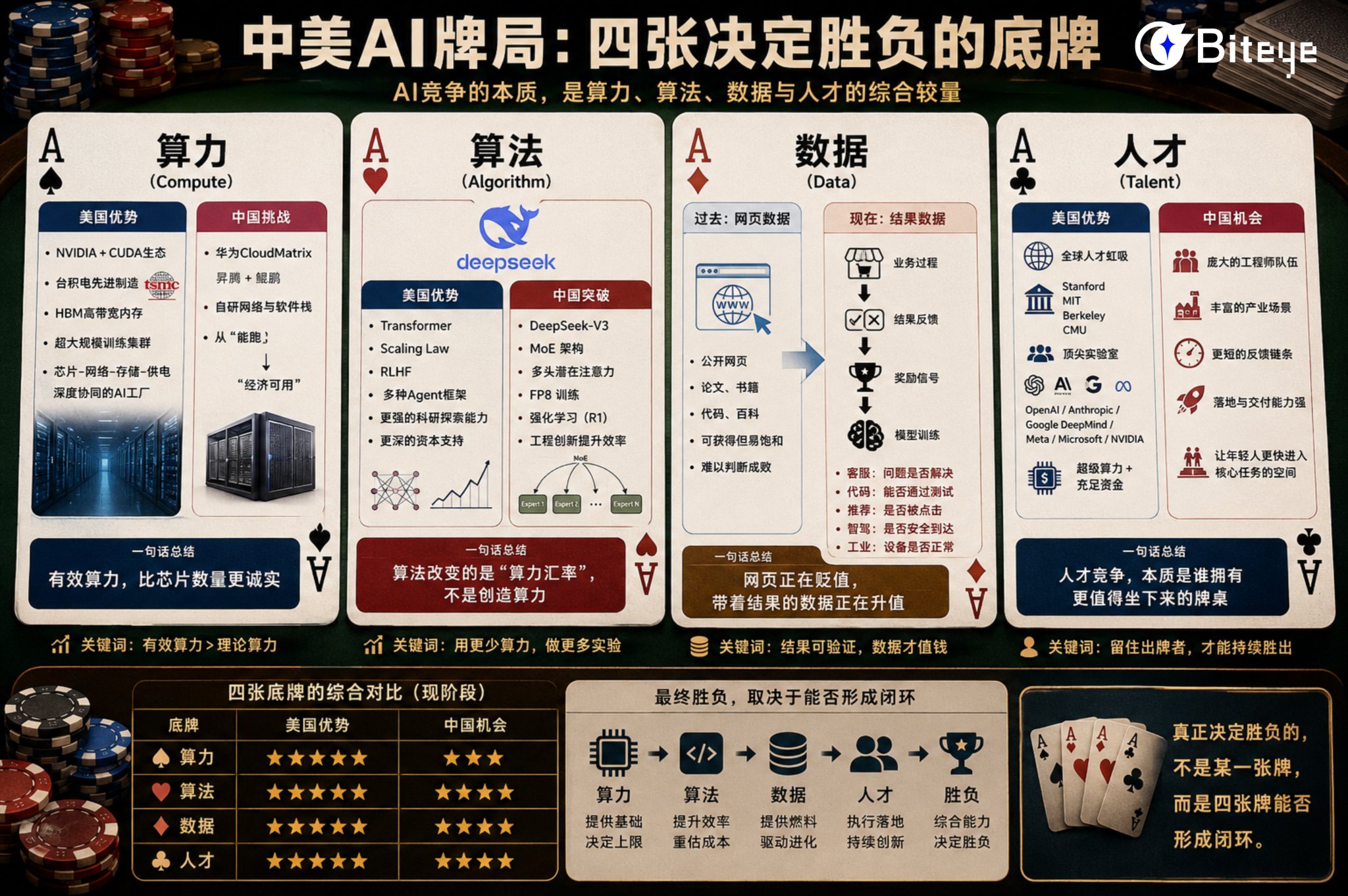
1. Computing Power: U.S. Controls the Highest Face Value, China Vies for Economic Feasibility
Compared to this fundamental hand, computing power is the United States' true trump card. A bad hand can be redeemed by the next community card, but if the chips are gone, it's challenging to stay at the table.
The United States holds the casting rights to high-end AI computing power: NVIDIA defines accelerators, interconnects, and software stacks, TSMC leads in advanced manufacturing, Japanese and Korean companies supply HBM, and cloud providers organize tens of thousands of chips into training clusters. Chips, networks, storage, power, and CUDA are intricately connected, and the cutting-edge competition is no longer about single-card performance comparisons but about whether an "AI factory" can integrate tens of thousands of chips into a cohesive whole.
China has surpassed the threshold of "having domestically produced AI chips." Huawei CloudMatrix integrates Ascend, Kunpeng, networking, and software into a unified system, used for DeepSeek model training and inference. The real challenge lies in transitioning from "can run" to "economically feasible": chips must be readily available, connections stable, and configurations flexible; model migration should not incur unacceptable engineering costs; running a ten-thousand-card cluster for a month should not be plagued by communication, fault, and compatibility issues most of the time.
Effective computing power is more honest than the number of chips. Theoretical computing power must undergo layers of degradation such as memory bandwidth, node communication, software operators, and fault tolerance and utilization rates. Writing ten thousand cards on paper is impressive, but the actual training capacity may be much lower than a simple multiplication would suggest. The U.S. advantage lies in the optimization around a single training need of chips, HBM, interconnects, and software; China's challenge is that as soon as one bottleneck is addressed, the issue may immediately shift to the next.
Once China clears the hurdle of "economic pragmatism," the U.S. can continuously leverage its chip advantage to model win rates; once crossed, export controls will still increase costs but make it difficult for China to walk away from the table.
2. Algorithm and Engineering: DeepSeek Re-annotates Chip Denominations
In Texas Hold'em, the more chips, the more advantage, of course. But if your opponent can erase two zeros from your 10,000-denomination chip, the purchasing power on the table will be recalculated.
China has once played a remarkable card, DeepSeek.
The DeepSeek-V3 technical report provided a rare breakdown: the final full training round took approximately 2.788 million H800 GPU hours. This number does not account for early-stage exploration, failed experiments, hardware procurement, and infrastructure, so the claim that "it only cost around $6 million to train the cutting-edge model" omitted a large part of the bill. However, it still shook the industry because it tore apart an old adage that many took for granted: there is no fixed exchange rate between model capability and computational input.
V3 adopted the MoE architecture, where each token only activates a subset of parameters; multi-head implicit attention compression cache, FP8 training to reduce computing and communication costs, load balancing to reduce expert idleness. R1 then pushed efficiency into the post-training phase: in tasks with verifiable mathematical, code, and other results, the model iteratively tries through reinforcement learning, replacing some expensive manual reasoning demonstrations with reward signals that can be automatically judged. In other words, DeepSeek did not magically acquire more chips; it made the chips work more efficiently.
The U.S. is still better at exploring new routes. Transformers, Scaling Law, RLHF, and various Agent frameworks, mostly were first pushed to the forefront by U.S. research institutions and companies; a deeper pool of capital also allows labs to bet on multiple unproven directions simultaneously. China has excelled more in reproduction, compression, and engineering optimization in the past. After DeepSeek, this boundary began to loosen: Chinese teams are no longer just making others' routes cheaper; they are also proposing methods significant enough to rewrite industry cost expectations.
However, algorithmic dividends will not permanently replace hardware. Papers will proliferate, leading models will also absorb the same tricks; efficiency gains will stimulate more calls, quickly consuming the saved computational power with new demands. Players have learned to bet more precisely, but blinds continue to rise.
Therefore, the strategic value of engineering efficiency for China lies more in being able to increase the number of experiments with limited computational power, shorten the validation cycle, and buy time for domestic hardware maturity.
3. Data: Data with Results is Appreciating, with the U.S. Currently in the Lead
A professional poker player's replay doesn't just note whether they got an A or a K. They must preserve the entire action: who bet first, how the flop was raised, how the public cards changed, what the opponent eventually revealed, and where their own judgment went wrong.
For a model, that's exactly what data is.
Early large models primarily learned language, knowledge, and code from the public internet, with the U.S. gaining a first-mover advantage through English webpages, GitHub, paper publications, and global digital platforms. As high-quality open-source data was repeatedly used, what has become truly scarce is not just text that the model hasn't read, but data with clear outcomes that can determine the success or failure of a task.
The value of a customer service conversation lies not only in what the service agent said, but also in whether the issue was resolved; the value of a code snippet lies not only in its appearance but also in whether it passes testing after modification. Data that does not point to a result is mostly just noise.
In early 2026, Alibaba trained a customized version of Agent Qoder, called Qwen-Coder, for programming tasks, incorporating real software tasks, product environments, and engineering rewards into the training. Alibaba disclosed that after iterations, the online code retention rate increased by 3.85%, tool anomaly rates decreased by 61.5%, and token consumption decreased by 14.5%. While the numbers come from the vendor and still require external validation, they highlighted the most expensive part of professional data: not the text itself, but a verifiable outcome behind the text.
The U.S. has a broader feedback loop. ChatGPT, Claude, Gemini, GitHub, and office suites connect global consumers, developers, and businesses, allowing model companies to observe where users are revising answers, which code programmers are retaining, and where Agents are failing.
China's opportunity lies in more intensive business processes. ByteDance's short videos and ads, Meituan's food delivery services, Alibaba's e-commerce and fulfillment, smart driving in new energy vehicles, quality inspections, and equipment operations in factories—all these processes come with real wins and losses.
What China truly lacks is high-quality complete gameplay data. A large amount of industry data is still siloed in different enterprise, departmental, and regional systems. Only when tasks can be standardized, outcomes can be verified, and data can flow under compliance conditions, will business traces become model assets. Having many scenarios is akin to having many raw materials; whether they can form a short chain of "model execution, real-world feedback, result reflow" will determine whether the next round of training receives nourishment or just an old deck of cards that cannot be inventoried in a warehouse.
4. Talent: China is the Talent Source, While the U.S. is the Talent Amplifier
In the previous rounds, the competition between China and the U.S. always seemed to be represented by individual tech companies. On the U.S. side, we have OpenAI, Anthropic, Google, Meta; and on the Chinese side, we have DeepMind, Zhipu, Dark Side of the Moon, Alibaba, ByteDance.
Tech companies release models, amass computing power, and compete for users, symbolizing their respective countries' continuous participation in the game. However, companies are ultimately just the carriers of great power competition in the business world. What truly determines which cards a company can read, which direction it dares to bet on, and whether it can sustain its lead is still the talent behind the organization.
Talent can be the researcher proposing a new architecture, the engineer building the training system, or the product team pushing the model to the market. If we expand the scope, it can also include universities, labs, and competition systems that continuously train and supply new talent for the entire large-scale model ecosystem.
The success of large models is often portrayed as the inspiration of a single scientist, which is a form of deification bias. Just like in professional poker, though one person is sitting at the table, behind the top player are coaches, solvers, hand databases, physical fitness management, and long-term financial strategies. A truly sustainable advantage and edge come not from a stroke of genius but from a comprehensive system of continuous review and correction.
AI companies are no different. Top researchers can make decisions on whether a certain path is worth pursuing, but behind them, hundreds of system engineers dedicate themselves to computing costs, handling failures, and turning a chance success into reproducible training and products.
The essence of talent competition between major powers lies in who can provide a more enticing seat at the table. Top researchers will choose a place with higher salaries, deeper computing power, stronger peers, more important problems, and a greater tolerance for failure. The U.S. has long attracted global talents precisely because of this "table selection".
A paradox of this table is that China is not lacking in talent. On the contrary, China is already one of the most crucial talent sources for top AI talent globally. The issue is that many talents, after their early training, ultimately plug into the U.S. amplifier.
The U.S.'s dominance in large-scale models is not the result of a closed self-sufficient system. It is more like a massive global talent centrifuge: it draws in the smartest young minds from China, India, Europe, and worldwide, funnels them into the U.S. doctoral system, then channels them into top labs at Stanford, MIT, Berkeley, CMU, and finally feeds them into companies like OpenAI, Anthropic, Google DeepMind, Meta, Microsoft, NVIDIA, and others.
Universities still provide methods, papers, and talent, but the entities truly capable of scaling methods to a thousand-node cluster, global product, and commercial revenue have increasingly shifted towards enterprises. The Stanford AI Index also shows that the entities releasing key cutting-edge models have become highly industrialized. Universities are responsible for inventing the playbook, while enterprises have taken control of the high-stakes poker table.
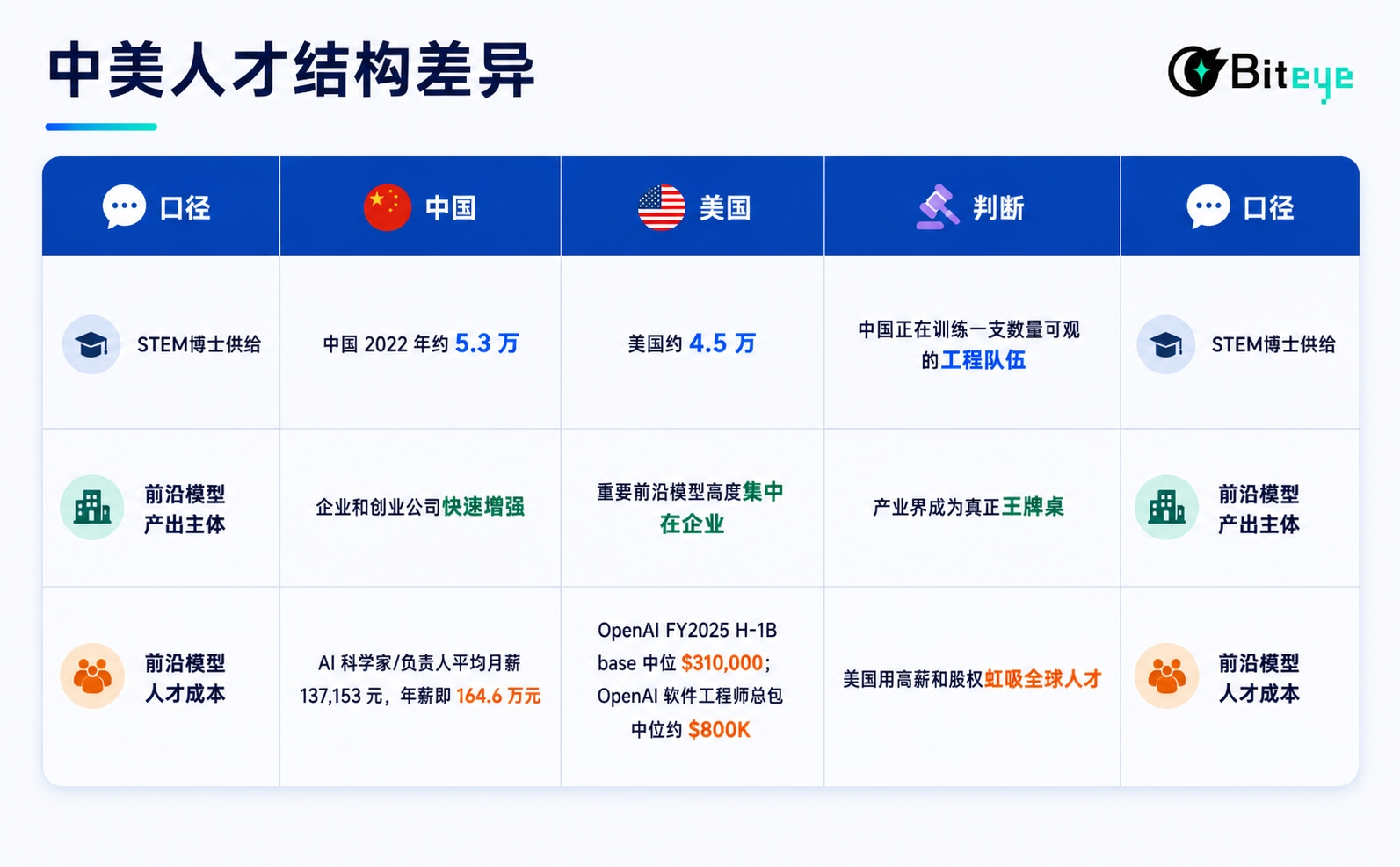
The Chinese game is not exactly the same. China's advantage lies in a larger pool of engineering talent, a shorter chain of command, and tasks with a higher industry site density.
The value of this engineering workforce only truly manifests once large models enter complex systems. Cutting-edge models require a few top scientists, but deploying the model requires hundreds or thousands of system engineers, data engineers, inference optimization engineers, chip adaptation engineers, and product teams. The U.S. excels at pushing a few top talents to the limits of their abilities, while China excels at embedding a large number of engineers into industrial sites. The former is suitable for pushing the boundaries of general capabilities, while the latter is suitable for rapid transformation, deployment, and delivery.
This is also the change that companies like DeepSeek, Dark Matter of the Moon, and others have brought to the Chinese large-model narrative. They have proven that Chinese companies can participate in the game with a different organizational structure: tighter teams, shorter feedback loops, stronger engineering compression capabilities, and a space that allows young people to quickly engage in core tasks.
Perhaps, the true outcome of the Sino-U.S. large-model game is not determined now, but depends on where the next generation of academic elites starting from Beijing, Shanghai, Guangzhou, and other places will consider their home turf. Will it be flying to Silicon Valley, accessing the U.S.'s super amplifier, or staying in China, at a newly expanding table, linking domestic models, chips, systems, and industrial scenes into a closed loop.
When model leadership advances from differentiation to temporal compression, the issue is no longer just "who plays a big card first," but whether this card can be transformed into a long-term advantage.
1. The U.S. Holding Back from Revealing Cards is to Establish Pricing Power
OpenAI, Anthropic, and Google reserve the strongest models for subscription products, APIs, and cloud platforms. Developers can call them, but cannot download full weights, freely modify, or deploy outside the platform.
Closed sourcing is primarily a pricing strategy.
Whenever OpenAI and Anthropic enter the open market, they will face the pricing logic of Silicon Valley and Wall Street. The capital markets are not going to pay for a benchmark top spot in the long run; they are more concerned about revenue, retention, gross margin, and bargaining power. Only by controlling access to the most advanced models can they charge for each call, each subscription user, and each enterprise contract, turning temporary leadership into a repeatable asset.
These two companies are bearing the heavy asset costs of chips, data centers, and energy but are aiming for the valuation of a software platform. If the weight is fully lifted, cloud providers and application companies can quickly host, package, and lower prices, turning the foundational model into a homogenized raw material. Trainers take on the heaviest risk, yet profits flow to computing power and access.
Therefore, what the United States is holding onto is not just technological secrets but also model rent. APIs, agent frameworks, enterprise permissions, data connections, and security audits all add a locking layer around the model. The deeper the customer integration, the higher the migration costs, and temporary leaders are more likely to break through the next reshuffling of the leaderboard.
2. China Openly Reveals Part of Its Hand to Gain Distribution Rights
Today, Xi Jinping proposed at the WAIC (World Artificial Intelligence Conference) to adhere to openness and win-win cooperation, encourage open-source initiatives, cooperation, and sharing, and listed helping global southern countries strengthen their capabilities and bridge the digital divide as a key direction of global AI governance. The chairman's statement released on the same day further suggested that a responsible approach should be taken to jointly build an open-source ecosystem, enhancing the accessibility of AI technology and services while respecting enterprises' autonomous choices and intellectual property protection.
Most Chinese model companies do not have global entry points like ChatGPT, Google, and Workspace. Therefore, locking large models within their own platforms may not necessarily yield high profits as in the Silicon Valley model.
Therefore, open weighting is primarily a distribution strategy.
DeepSeek, Qwen, GLM, and others are competing for developers with downloadable weights, low-price APIs, interface compatibility, and on-premises deployment. The newly released Kimi K3, in particular, takes this route to the extreme generosity: with a total of 2.8 trillion parameters, native support for vision, and a maximum context of 1 million tokens. The Dark Side of the Moon called it the first open 3T-level model and promised to release the full weights by July 27.
China allows others to take away this hand, observe and explore on their own, enabling more countries to have a set of technological options that do not have to rely entirely on American APIs. This is the logic of "rural surrounding the city": rather than first competing for the most expensive and closed central market, it enters scenarios with more quantity, tighter budgets, and data that is not willing to leave the domain using open weighting, low-price APIs, and hardware adaptation.
For many developing countries, what may be most important is not necessarily winning a few more points on the leaderboard. They are more concerned about whether the model can support local languages, if data must leave the country, if the price is affordable, if it can be deployed on local servers, and whether the vendor will abruptly cut off services due to geopolitical changes.
In his speech, Xi Jinping announced that in the next 5 years, China will provide 5,000 AI training slots for developing countries, establish an International AI Application Cooperation Center for ASEAN, the Arab League, the African Union, CELAC, the SCO, and BRICS countries, and promote the implementation of intelligent weather warning systems in 30 countries. The World Artificial Intelligence Organization was also founded in Shanghai.
Through these initiatives, China is building a three-tiered distribution system that complements each other.
The first layer is the model: Lowering the barrier to entry using open weights and affordable APIs.
The second layer is infrastructure: Meeting actual demands through cloud computing, domestic chips, on-premises deployment, and industry-specific solutions.
The third layer is the institutional network: Transforming a one-time model download into a longer-term technical relationship through training, cooperation centers, and international organizations.
Of course, openness can bring global attention and adoption but cannot rely on vast cloud businesses to automatically recoup costs. They must find revenue streams from official APIs, enterprise services, private deployments, and upper-layer products.
China needs to convert open weights into development standards within a predictable timeframe, transform development standards into cloud and application revenue, and then convert international adoption into a long-term ecosystem. Otherwise, the so-called distribution rights will only lead to temporary download numbers, rather than a business loop that can nurture the next generation of models.
3. The U.S. Seeks Model Rent, China Fights for Ecosystem Rent
The U.S. aims to collect model rents: leveraging top capabilities and platform lock-ins to ensure that calls, subscriptions, and enterprise contracts go through their own payment gateways continuously. China, on the other hand, is more inclined to compete for ecosystem rents: reducing the price of the model itself, using openness to attract developers, cloud workloads, enterprise deployments, and technical standards, then extracting value from a layer within.
Both approaches could fall into their pitfalls. Closed platforms fear narrowing capability gaps; if high walls do not have a significantly better supporting ability, they may transition from moats to toll booths. The open route is likely to receive applause but lose cash, with overseas cloud and app companies taking revenue while the original manufacturers bear the most expensive training costs.
China's approach must undergo a transformation: from open weights to development standards, from development standards to cloud and deployment revenue, and then gain the computing power and data required for the next generation of models from revenue and real tasks. The U.S. must also demonstrate that its leadership is deep enough within user workflows to become an irreplaceable layer of intelligence.
The U.S. is sticking to its proof: My card is rare enough to demand payment every time it is viewed.
China is betting on: As long as enough people use the same deck, diffusion itself will create bargaining power.
Pot odds answer a cold question: How much more must be paid to compete for the chips on the table? No matter how good the hand is, if the cost of each call is exorbitant, the capital will eventually burn out.
1. API Pricing: Just the First Bill
As of July 17, 2026, the public API prices for several representative models are as follows, in units of per million tokens. (Prices are subject to change at any time and do not represent long-term enterprise contract prices. Kimi K3's input price is calculated based on cache misses.)
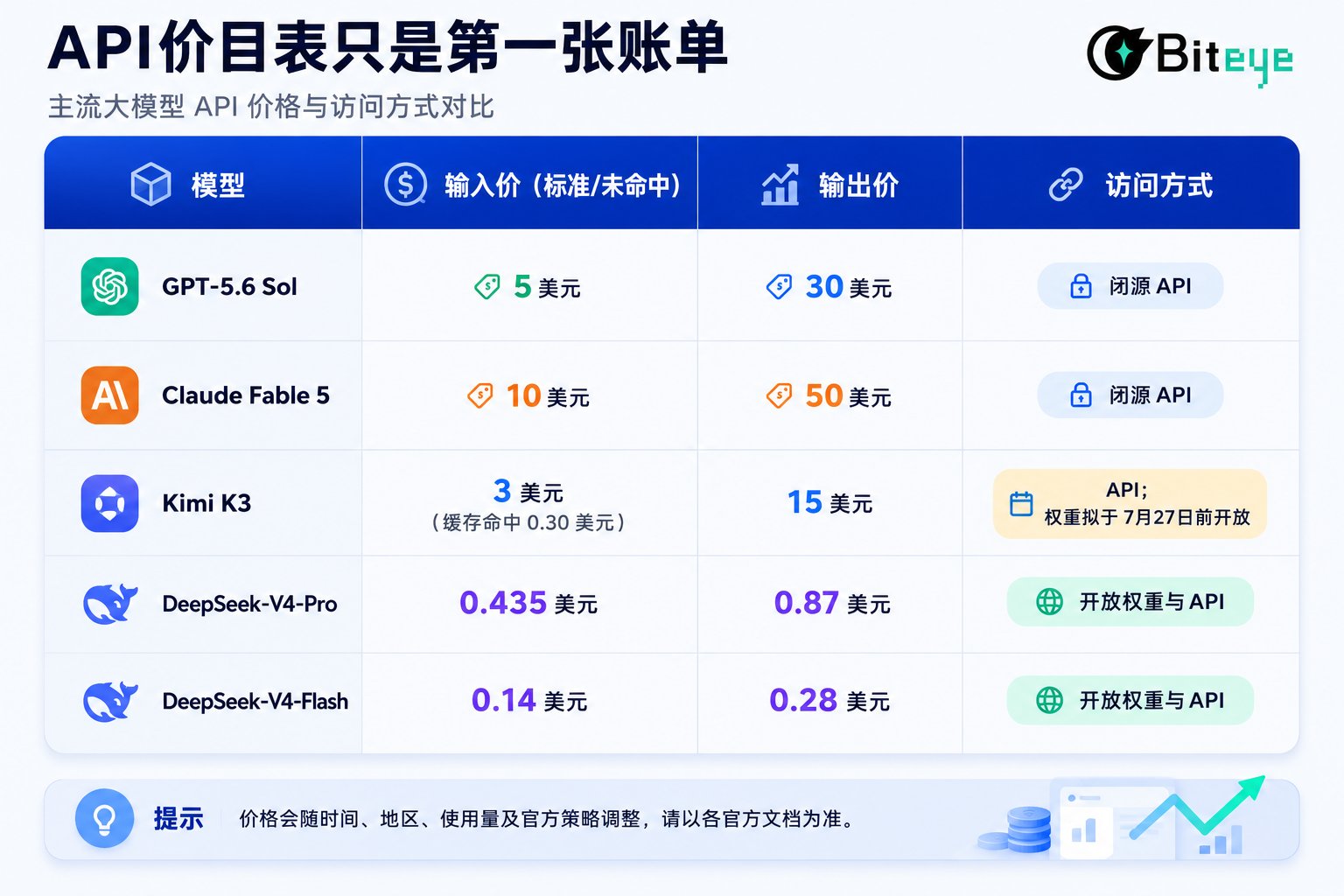
This table still shows the price advantage of domestic models, but it can no longer be summarized as "domestic models are all tens of times cheaper." DeepSeek continues to push low prices to the extreme, while Kimi K3 attempts to price up leveraging cutting-edge code capabilities and a context of 1 million tokens. The Chinese model's strategy is evolving from a single-price war to differentiation between low-price high-volume and high-end premium.
Things are not that simple, and neither is Token that generous.
An enterprise's complete bill should include tokens, tool invocation, failure retries, manual checks, and redundancy reserved for latency and stability. The price list only lists the first item, and once an error occurs, the enterprise has to foot the bill for all subsequent correction steps.
A truly fair comparison is not "how much for one million tokens," but rather how much money was finally debited from the account for completing the same task.
However, even then, low pricing is still a strong card. Customer service, abstracts, document processing, and bulk code reviews may be called hundreds of thousands of times a day, and the price difference per call will be rapidly magnified by scale. Cheapness means that startup teams dare to make mistakes, small and medium-sized enterprises can enter the market, and Agents also have the opportunity to move from the demo stage to daily work. China is trying to make more ordinary tasks eligible for the pool.
2. Capital Double-Edged Sword: Financing Scale Buys the Right to Experiment, but Also Initiates the Countdown to Returns
If we further put the four cutting-edge labs together, the difference in capital structure would be more obvious.
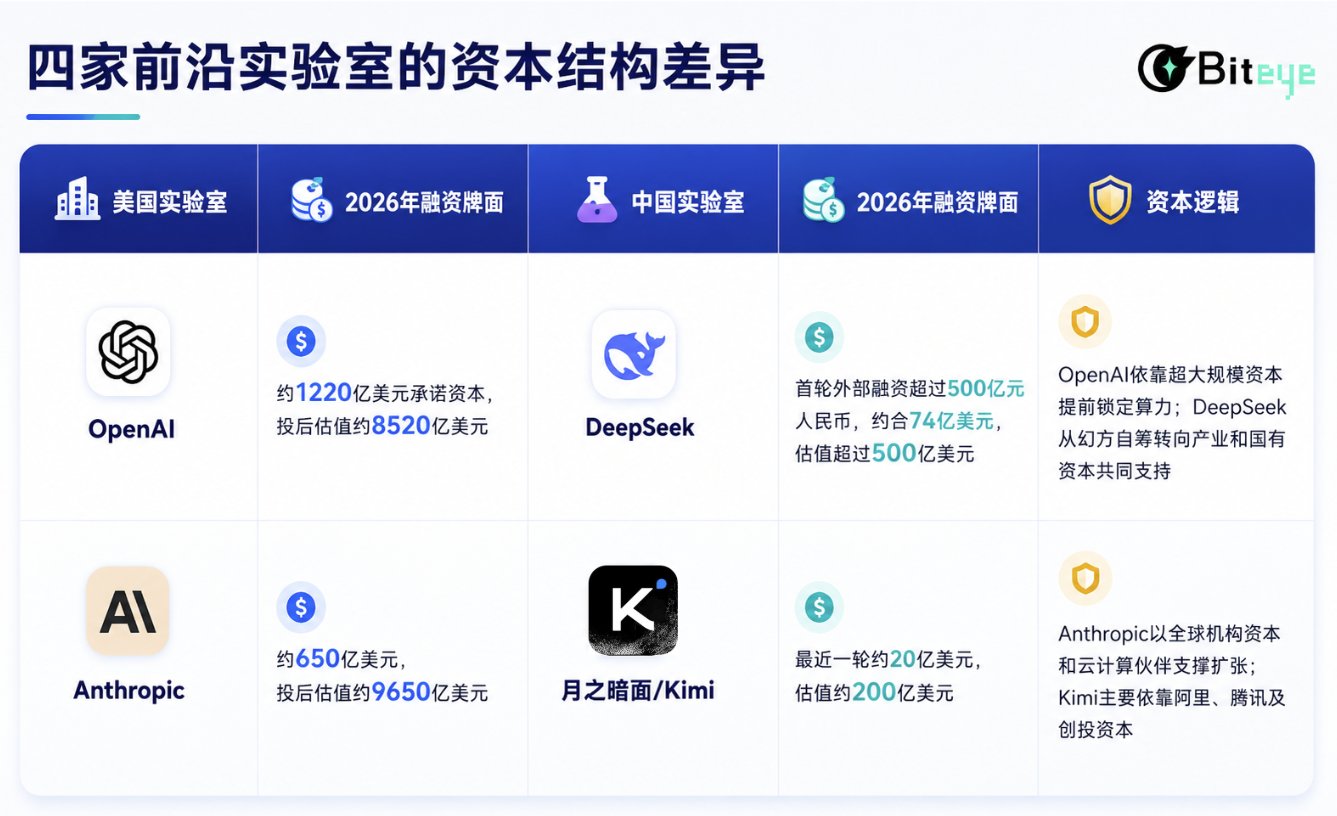
The scale of the funding is enough to demonstrate that a top U.S. laboratory could relocate the future budgets for chips, data centers, and talent to today in one go.
What is actually being backed by capital is the right to fail for Big Model companies. As long as the money is deep enough, it can run ten research paths simultaneously, let nine fail while the tenth one continues, and also lock in data center and power contracts before revenue materializes.
But all gifts of fate are secretly priced in the shadows. The more money, the louder the clock ticking for returns. Huge valuations, credit, and infrastructure commitments are all indebting future cash flows. OpenAI and Anthropic must turn their leadership in capabilities into subscriptions, APIs, and enterprise contracts, proving that they are shouldering heavy industrial costs but have the profit structure of a software platform. Capital has given them a deeper stake, while quietly writing down the date of profitability under the table.
China's capital structure is relatively more dispersed. Internet giants are supported by the cloud and consumer business, startups accept industry capital along with local and even central policy support, and public computing facilities take on some of the basic inputs. This enables key projects not to immediately halt due to short-term profit insufficiency, but it may also lead to duplicated construction, low utilization clusters, and projects accountable only to subsidies.
The risk in the U.S. is that there is enough hot money to easily capitalize on yet-to-be-validated demand early. The risk in China is that hot money is not concentrated enough, and cutting-edge research may be forced to shift to short-term delivery when long-term investment is most needed. The former must prove that high-priced models can cover huge investments, while the latter must prove that low prices and openness are not permanent subsidies, but can be exchanged for cloud revenue, enterprise deployment, and industrial efficiency.
In this round of poker, what both sides burn through is not just money; the most precious thing borrowed is time from the future.
3. Power-Constrained Strategy Space: China's Infrastructure Depth
Training is a concentrated burst load, while search, office work, and Agent reasoning are round-the-clock loads. When the model is called billions of times, electricity prices, grid connections, cooling, and chip utilization all become part of the cost of each task.
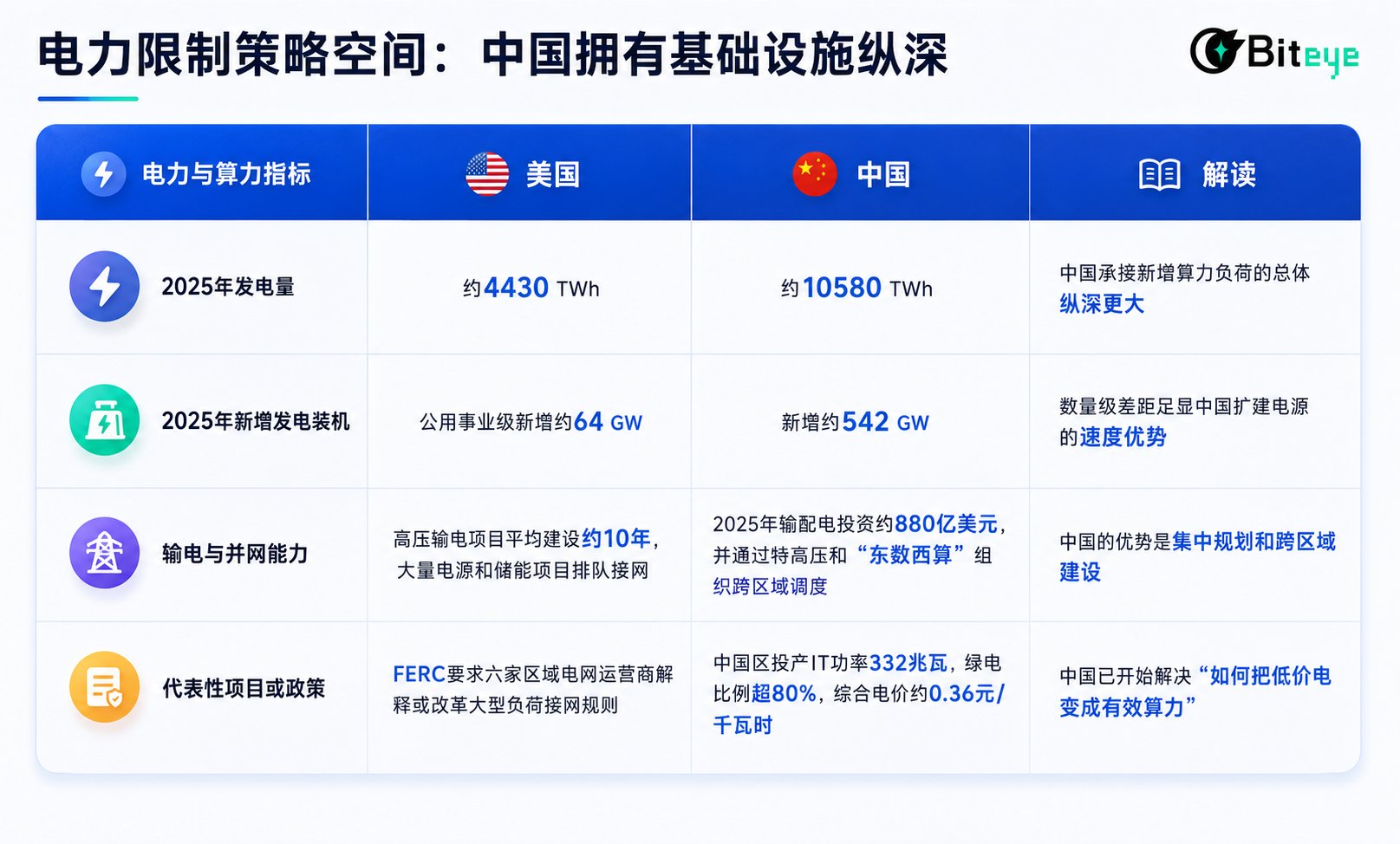
China's advantage in energy infrastructure is, first and foremost, its scale.
As an "infrastructure maniac," China has a larger power system and is continuously building wind power, photovoltaics, energy storage, nuclear power, and interregional power transmission networks. When the construction of data centers required by Big Models brings new large-scale loads, China evidently has a greater depth of supply and stronger engineering expansion capabilities.
The key issue in the United States is that while capital and chips are ready to go, the grid cannot be expanded through a simple software update. Research from the US Department of Energy shows that on average, it takes about 10 years for a high-voltage transmission project to be developed, approved, and completed, with a typical range of 5 to 17 years. The average time from applying to connect to the grid for power projects has also increased from about 2 years in 2008 to about 5 years in 2023.
In June 2026, the US Federal Energy Regulatory Commission further required six regional grid operators to explain or reform the rules for connecting large loads to the grid. The decentralized nature of the federal system means that approval for regional transmission lines is slow, equipment delivery cycles for transformers are long, and different states, power generators, grid operators, and data centers must repeatedly negotiate who bears the costs.
In contrast, the China Mobile Ningxia Zhongwei Data Center Park, which will be fully operational in 2026, has a cumulative IT power capacity of 332 megawatts, with a computational scale exceeding 100 EFLOPS and a renewable energy ratio of over 80%. The overall electricity price is around 0.36 RMB per kilowatt-hour. The significance of this project lies not only in its low electricity price but also in the fact that power, grid infrastructure, energy storage, and data centers can be built simultaneously, directly converting energy resources into computing power.
Therefore, in terms of energy infrastructure, China's advantage is even more pronounced than benchmarks suggest. The International Energy Agency predicts that global data center electricity usage will increase from around 485 TWh in 2025 to about 950 TWh in 2030. The US and China will contribute nearly 80% of this growth. As competition shifts from model training to billions of continuous inferences, China's energy infrastructure advantage will become even more critical: while training can wait for a cluster schedule, inference services need to receive stable, low-cost electricity continuously throughout the year.
However, the energy advantage ultimately needs to be translated through chip efficiency, software optimization, and cluster utilization. If cheap electricity is consumed by inefficient chips and idle data centers, it cannot automatically translate into low-cost intelligence. What truly needs to be compared is how much electricity, chip depreciation, and manual operation are required to complete a million real tasks.
Whoever can first achieve a lower unit task cost will be more capable of dragging this competition into a long-term war of attrition. In this regard, China's national system may have the upper hand.
4. What China Needs to Leap Forward Is a Cost Loop
When you stack APIs, capital, and energy together, the winner is often simply determined by who has more money. The United States can indeed use high investment to push the upper limit of the model and then recoup the costs through global subscriptions, cloud services, and enterprise software; meanwhile, China is trying to reduce the access threshold through engineering optimization, low-cost models, and infrastructure, aiming to find revenue and data through large-scale usage.
The risk of the China route is that each link is constantly under pricing pressure, with no room left for sufficient profit. If low-priced API only brings in call volume, if open weight only brings in download volume, if local data centers only have construction scale, the sum of the three may still result in a huge loss. The risk of the U.S. route, on the other hand, is that each link can command a high price, but the cost is so high that a significant capability gap must be continuously maintained.
The current pot odds still favor the U.S. because it can sell its technological lead to the world's most expensive customers. However, once the model's capabilities gradually converge, the importance of unit task costs will quickly increase, and China's low prices, electricity, and engineering efficiency will also stand out.
The premise is that these advantages will eventually converge into the same cash flow, rather than leaving behind three separate but lonely account books.
Holding the best hand doesn't automatically push the chips to the center. Technological superiority is only realized when users continue to use it, companies are willing to pay for it, tasks leave behind verifiable results. The real pot of the LLM competition only consists of four things: revenue, entry points, feedback data, and workflows reorganized by the model.
1. The U.S. Takes an Early Lead in Entry Points, China is Closer to Transactions
First, ChatGPT changed people's habits of seeking answers, then entered writing, research, coding, and enterprise workspaces; Google embedded Gemini in search, Workspace, and Cloud; Anthropic relies on Claude and Claude Code to enter knowledge work and software development. American model companies already have browsers, office suites, code repositories, and global cloud platforms behind them.
Entry points are advantages that are harder to catch up with than rankings. Once an enterprise has set up identity, permissions, data, and procurement correctly, switching models is no longer just a name change; it requires dismantling part of the workflow. Signals data published by OpenAI shows that on average, users' daily message count increased by about 50% six months after registration, the variety of tasks attempted doubled, and non-English-speaking users accounted for more than half of active users.
Chinese platforms are further away from the global office entry point but closer to specific transactions. Alibaba integrates Qwen into the catalogs of tens of billions of products on Taobao and Tmall, allowing users to compare, place orders, track logistics, and handle after-sales in conversations. The model connects not only web pages but also merchants, orders, and fulfillment systems. Whether a user has placed an order, whether a recommendation has been accepted, and whether logistics and after-sales are completed, each step has a result.
Generalized U.S. models first occupy the user entry point and then connect to external services; Chinese super platforms can put the model into a transaction loop from day one. The former has stronger global distribution, while the latter is closely tied to more dense behavioral feedback.
2. Coding is the First High-Value Testing Ground
Coding was the first to achieve stable monetization because the outcomes were easily verifiable: whether the patch was accepted, if the project could be compiled, if the tests passed, if bugs were fixed, which large models were effective—all of these were clear.
In the field of coding, the United States initially held the neatest hand: GitHub, Microsoft, OpenAI, Anthropic, and a large number of development tools controlled the global code entry points, and leading models have long been ahead in handling complex repository tasks. The Kimi K3 introduced a new gap in model capabilities. Based on monthly dark-web evaluations, it exceeded GPT-5.6 Sol and Claude Fable 5 in Program Bench and SWE Marathon, lagged behind GPT-5.6 Sol by only 0.5 points in Terminal-Bench 2.1, and demonstrated long-range execution capabilities in certain GPU kernel optimization, compiler development, and chip design tasks. However, winning a few evaluations with the model does not mean taking over the development environment. Kimi Code and open weights are being distributed, and China still needs to catch up with the user base, toolchains, and feedback loops accumulated by GitHub, Codex, and Claude Code.
The code has already revealed the shape of the future market: the most powerful models handle complex tasks, while budget models are responsible for autocompletion, testing, and batch reviews. Companies will ultimately switch between closed-source cloud and on-premises models based on difficulty and sensitivity. The one who eventually captures the value may not necessarily be a particular model, but perhaps the system that knows when to use which model.
Whoever controls the development environment can make model adjustments more quickly. Whether the code is kept or rolled back, at which step a test failed, and how developers make changes will all become part of the playbook for the next round of training.
3. To C Agent: A Stealth Ace in the Battle for User Mindshare
If the comparison of cutting-edge models is about the face value, then what To C Agents vie for is who can turn model capabilities into the subconscious actions of millions of users.
When someone wants to search for information, organize files, create presentations, plan a trip, or solve a work problem, who do they open first?
Currently, the most representative entities in the United States are OpenAI and Anthropic.
ChatGPT has already established the strongest AI-native brand mindshare. OpenAI has further divided this into two paths: ChatGPT Work (CodeX) is responsible for research, documents, spreadsheets, presentations, and other end-to-end deliveries. Users can go from posing a question to receiving a finished product without leaving ChatGPT.
The Anthropic mindshare is relatively narrow but deep, and more valuable. In terms of disclosed annual revenue, it even briefly surpassed OpenAI. Claude Code has become the preferred choice for many developers handling complex projects; Claude Cowork extends the same modus operandi to researchers, analysts, and other knowledge workers, allowing Claude to directly interact with local files, desktop applications, and multi-step tasks.
The U.S. is establishing a very clear product understanding: when faced with a complex task, there is no need to first think about which software to open—just hand it over to the Agent.
However, China did not originally take this path.
Initially, Chinese companies tried to fit the Agent into the scenes where they excelled.
Alibaba integrated Q&A into the 4 billion items on Taobao and Tmall. Users can search, compare, place orders, track logistics, and handle after-sales inquiries in conversations. Q&A relies on Alibaba's existing 20+ years of operations covering the entire transaction chain, including products, merchants, payments, logistics, and after-sales.
ByteDance focused its efforts on content creation. Seedance 2.0 allows ordinary users to control comprehensive audiovisual creation with text, images, audio, and video, fully integrated into the content distribution network composed of Douyin, Toutiao, JIANYING, and the creator ecosystem.
Meituan's "XiaoTuan," based on LongCat, has deeply penetrated lifestyle scenarios such as dining, entertainment, travel, and medical consultations. During the 2026 Labor Day holiday, Meituan announced that "XiaoTuan" served over a billion people. Compared to a general-purpose Agent, Meituan not only possesses answers but also merchant information, reviews, locations, inventory, fulfillment, and transaction outcomes.
As a result, To-C Agents in China and the U.S. have taken two different expansion paths—the U.S. extends outward from an AI-native entry point, while China encircles inward from existing scenarios.
The risk of the Chinese approach lies in cognitive dissonance—opening Q&A for shopping, Douyin for content creation, and WorkBuddy for office tasks is inherently chaotic. The scenarios are deep, but the entry points remain scattered. China has many well-positioned tables, but has yet to produce a super-entrance like ChatGPT, capable of consolidating all user mindshare under a single umbrella.
Now, Chinese tech giants are increasingly realizing this and starting to emulate the proven U.S. universal Agent model, transforming chat boxes into workspaces.
Tencent's WorkBuddy is now able to start from a single command and complete tasks such as data organization, data analysis, document preparation, and content creation; Kimi's Universal Agent, Kimi Claw, and Xiaomi's MiMo Claw are also attempting to take over files, tools, and long-range tasks. What they are doing is becoming increasingly similar to ChatGPT Work and Claude Cowork: users only set the goal, and the Agent is responsible for breaking down the steps, invoking tools, and finally delivering the finished product.
Because holding a good hand can only win one round, but seizing the user's default entry point can "cheat" to turn every subsequent use case into training experience, thereby "cheating" to see all the cards.
Texas has never been a game of only winning. No matter how strong a player is, they will also receive bad hands, be narrowly overtaken in low-probability situations when making the right decisions, and witness a huge pot being pushed to the other side.
What truly distinguishes a professional player from a casual player is not that the former never incurs losses, but that they can control drawdown, avoid emotional outbursts, and prevent the loss of the previous round from ruining judgment in the next round.
AI competition is the same. While models can increase productivity, they can also reduce employment; lowering content costs can also amplify fraud and deepfakes; once integrated into enterprise systems, they can enhance efficiency but may also spread a single mistake to payments, code, and critical data.
1. Regulatory Decisions Determine Pool Entry Scope
The U.S. is closer to a wide-ranging playing style. Companies first release products, and then boundaries are defined by the market, courts, state legislation, and regulatory bodies. This approach gives companies more opportunities to experiment but also means that some copyright, privacy, and product harm will be borne by society first and corrected afterwards.
China emphasizes predefining boundaries. Filing records, content governance, platform responsibilities, and industry pilots can reduce obvious risks and facilitate the formation of unified standards. However, if the boundaries are blurred, companies and regions may escalate measures layer by layer to avoid responsibility, turning stop-loss into premature folding.
The U.S. tolerates higher volatility in exchange for more experimentation; China lowers the probability of losing control in exchange for a more stable progression. A truly sophisticated system is not always loose or always tight but knows when to expand the scope and when to pull back the chips.
2. Employment Impact Determines How Much Drawdown Society Can Withstand
LLMs first affect jobs that involve a high proportion of language and information processing: customer service, translation, administration, content creation, basic programming, legal research, and some analysis. The International Labour Organization estimates that globally about a quarter of jobs are exposed to some degree of generative AI impact, but those at the highest exposure level represent about 3.3% of employment. This is more like tasks being restructured rather than entire professions disappearing neatly.
The danger does not lie in the disappearance of certain jobs, but in the speed of change surpassing society's ability to reallocate jobs, income, and security. While companies can adopt AI in a matter of months, workers may need years to reskill; the economy may continue to grow, yet some individuals are on the brink of bankruptcy.
The U.S. labor market is more flexible, allowing companies to restructure roles, but the cost often falls on individuals and families. China, through vocational education, industrial policies, and coordinated large-scale training, faces the challenge of a larger labor force and higher stability requirements.
Excellent risk management does not guarantee zero drawdowns, but ensures that a single drawdown does not prevent one from re-entering the game.
3. The Most Dangerous Thing Is Not Losing, But Tilt
Tilt is when a player, after experiencing a string of bad luck, loses rationality, starts chasing losses, increases bets, and abandons their original effective strategy. Society may also tilt back and forth between technological fervor and regulatory panic.
If AI continues to bring scams, fake content, job insecurity, and privacy breaches, the public's curiosity will turn into distrust. While companies may still believe that the next generation of models can solve everything, society may demand comprehensive restrictions due to severe incidents. The former scenario is prone to creating a bubble, while the latter may give up long-term gains due to short-term losses.
Societal maturity and acceptance do not require everyone to remain optimistic, but rather for the public to understand technological boundaries, possess the right to information, exit, and appeal. Risk governance should not only focus on what the model "says," but also question what it "is allowed to do": when an agent executes a transaction, modifies code, or calls a critical system, processes must include principles of least privilege, dual authorization, log audits, and liability for incidents.
True resilience lies in maintaining judgment, controlling drawdowns, and adjusting strategies after a failure, ensuring that losses from a portion of the population do not turn technological progress into bad debt that no one is willing to continue to bear.
All the previous comparisons imply one assumption: the game will continue according to the current rules. Models will iteratively improve, computational power will remain scarce, capital will keep flowing in, the supply chain will function, and society will be willing to tolerate fluctuations.
Reality may not unfold as expected.
The turning point of a technological revolution often does not involve raising, calling, or folding at the table but rather a variable suddenly altering the value of chips, rewriting rules, or even overturning the table.
1. Early Arrival of AGI. If a system can stably complete long-term scientific research, programming, and engineering design, and substantially participate in the development of next-generation models, a lead of just a few months could snowball into an insurmountable gap. In the short term, this favors the United States, with cutting-edge labs, top-tier chips, and cloud platforms; however, whether the capabilities leak, replicate, and distill will determine if the advantage can be monopolized.
2. Has the Compute Bottleneck Been Broken? If new architecture, low-precision computing, or specialized chips reduce the required computation by an order of magnitude, part of the U.S. megacluster's advantage will be repriced; if long-chain inference and Agent continue to consume more tokens, chips, energy, cloud, and capital will further consolidate.
3. Has Blockade Escalated, and Has the Supply Chain Been Disrupted? If the U.S. continues to expand restrictions to cloud compute, HBM, equipment maintenance, model access, and talent collaboration, short-term costs in China will rise significantly. However, the longer the blockade, the less China will consider U.S. supply as a reliable base. More extreme geopolitical conflicts will simultaneously impact the U.S. design alliance and the Chinese manufacturing market, shifting the competition from who innovates faster to who has thicker inventory and more substitute capacity.
4. Will the AI Bubble Burst? If the cost savings from Agent are not enough to cover the model bill, the capital market will reprice based on cash flow and profit. The bubble bursting will not make LLM disappear, but it will clear out participants who rely on valuation, subsidies, and low utilization facilities.
5. Will AI Unemployment Trigger Social Backlash? Society does not have to wait for mass unemployment to react. As long as entry-level positions decrease, career pathways narrow, productivity gains mainly flow to platforms and capital, automation approval, job protection, and new distribution policies may come early.
6. Will the Open Model Change Power Structures? If the open weights continue to push the gap to "good enough for most tasks," power will shift from a few labs to cloud platforms, app companies, and data-sovereign states. However, openness does not inherently belong to China; the real test is who can convert the download volume into toolchains, standards, revenue, and next-gen training resources.
7. Will a Major Security Incident Cause Regulatory Slamming on the Brakes? Once a high-stakes Agent causes a serious financial, medical, network, or infrastructure incident, model licenses, liability insurance, and deployment approvals could quickly tighten. Security could also become an industry tool, redrawing the market boundaries for foreign models, data, and compute.
These variables will not line up in queue. Blockade may accelerate domestic chip production, open models may reduce costs but also amplify abuse, bubble bursting may delay AGI, or it may drive resources towards fewer companies. Job disruption and security incidents could also wake up the regulators of both nations on the same night.
When history truly turns a corner, the action and stillness often come from beyond the ongoing poker game.
It will suddenly devalue the most valuable chip and open up an unforeseen path for the originally disadvantaged party.
The United States still holds the bigger hole card. It controls cutting-edge models, high-end chips, capital, and global access. If it were to reveal its hand now, its odds of winning would still be higher. China, on the other hand, is changing its way of playing: using algorithms to relabel chip denominations, opening up the table with openness, seeking a card sequence with real wins and losses in industrial scenarios, and attempting to turn cost advantages into a self-reinforcing cycle.
This competition will continue to consume electricity, capital, talent, and societal patience until one party truly establishes a closed loop of capability, income, data, and computing power, or until both sides realize that the cost of winning this game has become too high to resemble victory.
The dealer did not rush, only resting their hand on the deck. A faint whisper could be heard from outside, very light, like a piece of bad news that had not yet made its way into the financial report.
No one at the table stood up.
References
1. Stanford HAI: 2026 AI Index Full Report https://hai.stanford.edu/ai-index/2026-ai-index-report
2. Artificial Analysis: Intelligence Index https://artificialanalysis.ai/
3. Arena: Text Arena Leaderboard https://arena.ai/leaderboard/text
4. Arena: Code Arena Leaderboard https://arena.ai/leaderboard/code
5. Arena: Vision Arena Leaderboard https://arena.ai/leaderboard/vision/overall
6. Arena: Agent Arena Leaderboard https://arena.ai/leaderboard/agent
7. OpenAI: GPT-5.6 Release Notes https://openai.com/index/gpt-5-6/
8. Kimi: Kimi K3 Tech Blog, Full Review, and API Pricing https://www.kimi.com/blog/kimi-k3
9. DeepSWE: Long-range Software Engineering Benchmark Leaderboard https://deepswe.datacurve.ai/
10. SWE-bench-Live: Ongoing Software Engineering Benchmark https://swe-bench-live.github.io/
11. The Japan Times: Anthropic Allegations of Alibaba Distillation Behavior https://www.japantimes.co.jp/business/2026/06/25/companies/anthropic-alibaba-illegal-access/
12. Reuters: Anthropic Allegations of Alibaba's Extraction of Claude Capability https://www.investing.com/news/stock-market-news/anthropic-says-alibaba-illicitly-extracted-claude-ai-model-capabilities-4759021
13. OSWorld 2.0: Long-range Computer Operation Agent Benchmark https://osworld-v2.xlang.ai/
14. NVIDIA: Vera Rubin Platform Mass Production Announcement https://nvidianews.nvidia.com/news/vera-rubin-full-production-agentic-ai-factory
15. Huawei CloudMatrix 384 System Paper https://arxiv.org/abs/2506.12708
16. Associated Press: DeepSeek V4 and Ascend Compatibility Report https://apnews.com/article/1ae6228c4928ddbb43f984e9b38f49dd
17. Research on MoE and Multimodal Deployment in Ascend Production Environment https://arxiv.org/abs/2607.08215
18. DeepSeek-V3 Technical Report https://arxiv.org/abs/2412.19437
19. DeepSeek-R1 Paper https://arxiv.org/abs/2501.12948
20. Alibaba Cloud: Qoder Training Case and Qwen Application Data https://www.alibabacloud.com/blog/602859
21. MacroPolo: The Global AI Talent Tracker 2.0 https://macropolo.org/digital-projects/the-global-ai-talent-tracker/
22. National Science Board: Sino-U.S. STEM Talent and PhD Education Data https://ncses.nsf.gov/pubs/nsbsep20261/stem-talent-education-training-and-workforce-2
23. South China Morning Post: DeepSeek Expansion Report https://www.scmp.com/tech/big-tech/article/3358394/deepseek-hiring-spree-chinese-ai-firm-seeks-newcomers-it-pursues-agi
24. DeepSeek: DeepSeek-V4 Release Notes https://api-docs.deepseek.com/news/news260424/
25. Alibaba Cloud: Qwen Open Model Ecosystem Data https://www.alibabacloud.com/blog/603042
26. OpenAI: GPT-5.6 Sol Model and API Pricing https://developers.openai.com/api/docs/models/gpt-5.6-sol
27. Anthropic: Claude Fable Model and API Pricing https://www.anthropic.com/claude/fable
28. DeepSeek: API Pricing Details https://api-docs.deepseek.com/quick_start/pricing/
29. OpenAI: 2026 Financing Statement https://openai.com/index/accelerating-the-next-phase-ai/
30. Anthropic: Series H Financing Statement https://www.anthropic.com/news/series-h
31. TechCrunch: Moonshot AI Financing Report https://techcrunch.com/2026/05/07/chinas-moonshot-ai-raises-2b-at-20b-valuation-as-demand-for-open-source-ai-skyrockets/
32. Investing.com: DeepSeek First External Financing Report https://www.investing.com/news/economy-news/deepseek-could-be-valued-at-up-to-50-billion-in-first-fundraising-sources-say-4663090
33. Reuters: Bank of America Extends $520 Million Loan to OpenAI Source Ahead of IPO https://www.reuters.com/legal/transactional/bofa-extends-first-520-million-loan-openai-ahead-ipo-source-says-2026-07-08/
34. International Energy Agency: Energy and AI Report https://www.iea.org/reports/energy-and-ai
35. International Energy Agency: Key Issues on Energy and AI Report https://www.iea.org/reports/key-questions-on-energy-and-ai/executive-summary
36. Federal Energy Regulatory Commission: Large Load Grid Integration Reform Effort https://www.ferc.gov/news-events/news/ferc-launches-aggressive-targeted-action-speed-large-load-integration
37. Northwest Regulatory Bureau of the National Energy Administration: Ningxia Zhongwei Data Center B Park Information https://xbj.nea.gov.cn/dtyw/hyxx/202606/t20260626_303639.html
38. OpenAI: Enterprise AI Usage Report https://openai.com/business/guides-and-resources/the-state-of-enterprise-ai-2025-report/
39. OpenAI Signals: Global Expansion Data on ChatGPT https://openai.com/index/how-chatgpt-adoption-has-expanded/
40. Alibaba: Qwen Integration into Taobao and Tmall Product Systems https://www.alibabagroup.com/en-US/document-1991231293551017984
41. Google Cloud: Gemini Enterprise Platform Description https://cloud.google.com/blog/products/ai-machine-learning/the-new-gemini-enterprise-one-platform-for-agent-development
42. Alibaba: May 2026 Financial Report and Cloud Business Description https://www.alibabagroup.com/en-US/document-1991364841188622336
43. Cyberspace Administration Office: "Regulations on the Identification of AI-generated Synthetic Content" https://www.cac.gov.cn/2025-03/14/c_1743654684782215.htm
44. International Labour Organization: Generative AI and Jobs https://www.ilo.org/publications/generative-ai-and-jobs-refined-global-index-occupational-exposure
45. International Labour Organization: Research on AI Exposure for Workers in Different Development Stages https://live.ilo.org/event/workers-exposure-ai-across-development-stages-2025-11-27
46. Five-Country Cyber Security Agency: Prudent Adoption Guide for Agent Service https://www.ncsc.govt.nz/protect-your-organisation/careful-adoption-of-agentic-ai-services/
47. Anthropic: Claude Fable 5 Redeployment Notes https://www.anthropic.com/news/redeploying-fable-5
48. U.S. Department of Commerce Bureau of Industry and Security: Advanced Computing Licensing Guidelines for May 31, 2026 https://media.bis.gov/media/documents/bis-guidance-may-31-2026.pdf
Recommended
Desk: Brent Crude Tops $110, Musk's Net Worth Drops 528.6 Billion in Four Days After Tesla Roadster Launch
Oct 17, 21:49
JST Fifth Buyback and Burn Successfully Concludes: Over 170 Million Tokens Worth Approximately $23.53 Million Burned, Buyback Mechanism Set for Comprehensive Upgrade
Oct 17, 20:10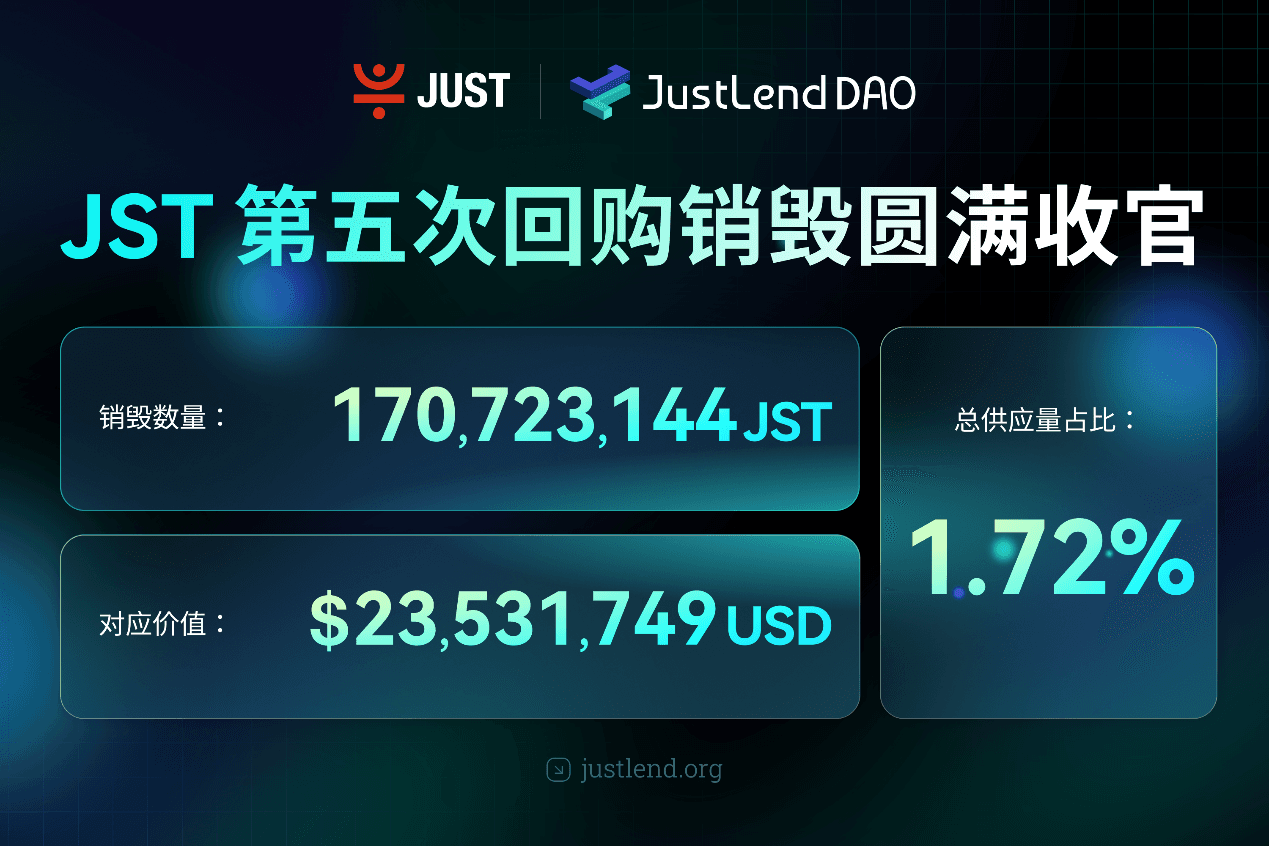
BitTorrent Brand Upgrade and Initial BTT Buyback & Burn Launch Simultaneously, Dual Engines Usher in New Era of Web3 Infrastructure
Oct 17, 20:00
Asia Market Daily: Japan's BOJ signals more rate hikes while Korea targets offshore perpetual platforms (2026/10/17)
Oct 17, 17:01Why did Papertrade backfire on you?
Oct 17, 17:01
The 'Strict Father' of Northern Myanmar: This Company Deploys 200,000 "AI Best Actors" to Strike Back Against Scammers
Oct 17, 15:34