The UK National Grid Invests in US Power Company, How Scary Can AI Electricity Demand Be
TL;DR
· BNEF forecasts that the power demand of U.S. data centers could reach 106GW by 2035.
· New York State halts some permits for mega data centers, and the market is starting to trade power access constraints.
· Related assets: utilities, nuclear energy, grid equipment, copper, data center REIT.
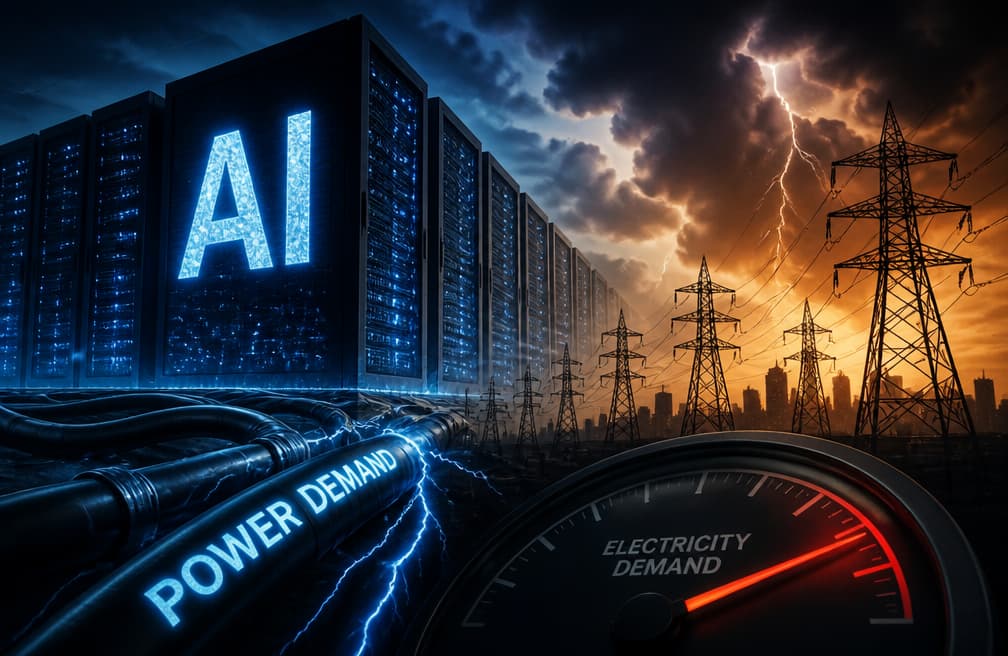
In recent months, the discussion around U.S. AI infrastructure has expanded from chip supply to power access. BNEF has raised its data center electricity usage forecast, National Grid Ventures is investing in large-scale load power projects in the U.S., and New York State has paused state environmental permits for some new mega data centers.
These three clues point to the same issue: whether AI companies can still obtain land, cooling, water, grid access, and long-term power supply as planned after buying GPUs.
For investors, data centers are no longer just a capital expenditure item for tech companies. The electricity usage of large data center campuses may be comparable to that of a small city. As long as AI training and inference continue to expand, utilities, gas, nuclear energy, grid equipment, copper, and data center REITs will all be part of the AI pricing chain.
Revised Electricity Forecast, Strain on Grid Nodes
In its report at the end of 2025, BNEF forecasts that the power demand of U.S. data centers could reach 106GW by 2035, a 36% increase from its forecast 7 months ago. This is not the realized electricity consumption but a market reference for future demand.
The 106GW can be understood as the level of long-term full-load supply of a group of large power plants. What's more troublesome is that these loads will not be evenly distributed across the U.S. but concentrated in a few data center states and grid regions.
BNEF also forecasts that the data center capacity in the PJM grid area could reach 31GW by 2030. PJM covers multiple states in the eastern U.S. and is one of the electricity markets where data centers and industrial loads are concentrated. As load concentration grows, the issue shifts from whether the national power generation is sufficient to whether local nodes can handle it.
This explains why electricity forecasts impact asset pricing. Buying GPUs is just the first step for AI companies. Bringing data centers online also requires power supply, transformers, transmission lines, backup power, and long-term power purchase agreements. Compared to servers, grid access and permits are more challenging to replicate quickly.
Electricity Capital Begins Binding AI Load
National Grid Ventures announced on July 1 that it has acquired a 35% stake in Joulent for $1.75 billion, participating in a major U.S. grid-scale electricity infrastructure project. This transaction signals traditional electricity capital's shift towards viewing AI data centers as long-term load assets.
Joulent's inaugural project, Project Kilby, located in West Texas, is a 2.67GW complementary power facility with Chevron holding a 50% stake. The project is planned to power a Microsoft-operated data center through a 20-year power purchase agreement and is set to commence power delivery in 2028.
The focus is not on a particular power route winning out but rather on data centers transitioning from "waiting in line for power" to "locking in power ahead of time." Long-term power purchase agreements and self-generation are becoming prerequisites for computing capacity expansion.
The logic behind self-generation is straightforward. If data centers continue to draw power from the public grid, the expansion costs may be passed on to all users. By having the project entity build its own power source or sign long-term contracts, it can enhance power supply certainty and more easily demonstrate to regulators that it will not encroach on residential electricity.
However, risks remain. Gas projects face fuel price and emission pressures, nuclear projects face regulatory and construction timelines, and grid expansion is constrained by transformers, transmission lines, and local permits. Capital binding power sources in advance indicates that demand is being taken seriously and that bottlenecks are specific enough.
New York Puts Cost Allocation at the Forefront
New York Governor Kathy Hochul signed an executive order on July 14 to halt state environmental permits for new large data centers for up to one year. More precisely, the suspension applies to incomplete related permit applications that have not yet been fully approved, not all data center constructions.
The state government's reasons include protecting consumers, the environment, the grid, and the community, while focusing on water resources and electricity cost impacts. This has placed clear constraints on the AI electricity narrative: data centers can expand, but they cannot pass on grid upgrades, water resource pressures, and resident electricity rate hikes to local communities.
New York State also stated that the Energize NY program will require data centers to pay higher energy costs or provide their own power, considering grid acceleration funds and specific clean power mandates. This is not merely opposition to AI but a demand for high-energy consumption projects to internalize the true costs.
This will alter the competitive landscape for data center operators and REITs. Previously, the market valued land, leases, customer quality, and financing capabilities. Now, it also considers whether a project can secure electricity, pass permitting, and demonstrate that it will not raise resident electricity prices.
New York may not represent the entire United States. However, if high-demand areas like Virginia, Georgia, and Texas also face similar pressure, the timeline for AI infrastructure expansion will shift from "who can buy chips first" to "who can obtain local permits and verifiable power supply first."
Nuclear Power Provides Long-Term Options
The Trump administration's 2025 initiative to advance advanced reactors, AI data centers, and federal site deployments has brought nuclear power back into the AI power narrative. For data centers, nuclear power's appeal lies in its stability, low carbon emissions, and long-term power supply.
Companies such as Oklo, X-Energy, Aalo Atomics, Valar Atomics, and Helion have attracted market attention, stemming from this vision. Investors are seeking a more reliable power solution than the traditional grid and more stable than intermittent renewable energy sources.
However, policy support does not guarantee commercial delivery. Traditional nuclear power plants have long construction periods, and advanced reactors face challenges such as regulation, supply chain issues, fuel availability, financing, and public acceptance. Even with expedited approvals, these reactors cannot deliver tens of gigawatts of power to data centers in the short term.
Therefore, nuclear power is more like a long-term priced option. It can explain why nuclear power companies, uranium, engineering services, and grid equipment are part of the AI trading chain, but it cannot prove that the AI power bottleneck has a definite solution. Equating policy acceleration directly to order fulfillment is a major risk in this narrative.
Cost Landing Determines Market Slope
Whether AI power trading can transition from a thematic market to a performance market depends on two variables: whether data centers can reliably access electricity as planned and whether additional costs can be clearly allocated.
If self-generation and long-term power purchase agreements can be implemented at scale, utilities, grid equipment suppliers, natural gas providers, and certain nuclear assets will have a clearer anchor for orders. AI companies can also achieve mining expansion certainty by accepting higher electricity costs.
If local moratoriums spread or residential electricity price pressures become a political issue, the pace of data center construction may slow down. The bottleneck may not necessarily be the AI demand itself but rather the site selection, grid connection, and profitability assumptions of high-power-consuming projects.
The essence of this narrative is not "AI definitely faces a power shortage" or "nuclear power immediately solves the problem." A more tradable judgment is that AI expansion is transforming the power system into a new pricing anchor. Those who can prove they bring electricity are more likely to convert their computing power needs into revenue and valuation.
Recommended
Desk: Brent Crude Tops $110, Musk's Net Worth Drops 528.6 Billion in Four Days After Tesla Roadster Launch
Oct 17, 21:49
JST Fifth Buyback and Burn Successfully Concludes: Over 170 Million Tokens Worth Approximately $23.53 Million Burned, Buyback Mechanism Set for Comprehensive Upgrade
Oct 17, 20:10
BitTorrent Brand Upgrade and Initial BTT Buyback & Burn Launch Simultaneously, Dual Engines Usher in New Era of Web3 Infrastructure
Oct 17, 20:00
Asia Market Daily: Japan's BOJ signals more rate hikes while Korea targets offshore perpetual platforms (2026/10/17)
Oct 17, 17:01Why did Papertrade backfire on you?
Oct 17, 17:01
The 'Strict Father' of Northern Myanmar: This Company Deploys 200,000 "AI Best Actors" to Strike Back Against Scammers
Oct 17, 15:34