4 hours, 118 answers, Liang Wenefeng responds to everything in internal communication
DeepSeek recently completed its first round of external financing since its establishment. The total amount raised in this round exceeded 50 billion RMB (approximately $7.4 billion), with a pre-investment valuation of about 367.5 billion RMB (approximately $54.3 billion). In the investor lineup, DeepSeek founder Wenfeng Liang personally invested 20 billion RMB, Tencent invested 10 billion RMB, CATL invested 5 billion RMB, NetEase, JD.com, and IDG Capital each invested 3 billion RMB, and the National Artificial Intelligence Industry Investment Fund invested 1 billion RMB.
Prior to this, Wenfeng Liang had proposed the principle of "no financing, no IPO, no commercialization." This large-scale financing marks DeepSeek's formal entry into the capital market and has drawn widespread attention from the industry to its commercialization path and technological vision.
During a recent investor conference, Wenfeng Liang elaborated on DeepSeek's organizational culture, open-source logic, technological roadmap, and views on industry competition.
Below is a transcript of Wenfeng Liang's speech during the nearly 4-hour conference obtained by Tencent Technology, organized by topic, totaling 118 points. The text has been edited slightly while striving to maintain the original meaning as much as possible.
1. When we started this company, our original intention was not to think about how much money we would eventually make, to go to the capital market, to IPO, or whatnot. The initial dozens of people had never thought about this. If they had, they would not have come.
2. We embarked on this endeavor with great goodwill towards the world. We believe this is something useful for humanity, something beyond money. Our starting point, our vision, and the vision we have maintained to this day have not been pursued in a way that maximizes commercial interests.
3. Managing a large company does not rely on your rules and regulations; it relies on vision. Vision is not a slogan on the wall; vision is how you act, not what you say—it's about how you actually operate.
4. We are not organized; we are vision-driven, organized around a vision. We do not operate based on "What KPIs do I need to achieve, no assessments," only the vision.
5. This vision is not even documented; it's not written down. We have never written anything about this vision. This vision is in our way of doing things, our attitude towards the world.
6. We don't have many other advantages; we don't have any special abilities, we are not richer than others, and our employees are not better than those of other companies. Actually, not at all. When we started this company two years ago, we didn't have much money, many resources, much fame, or any appeal; we are just a group of very ordinary people.
7. The more restrained you are, the easier it may be to achieve, or at least that has been verified so far and is currently justifiable. Otherwise, there is no way to explain how we were able to achieve this: we had no weapons, started from a very low point, had very few resources, and our people were actually just a random group of ordinary individuals.
8. AI is such a massive thing, with huge benefits. We are very restrained, knowing that if we can achieve it, the benefits will ultimately be significant. Even if you distribute a small portion, the benefits will be substantial. Therefore, there is no need to consider which part of these benefits to take or how to take them. I believe there is no need to consider this because the benefits are already significant enough.
9. Last Chinese New Year, we suddenly had a lot of users, but we did not try to retain these users, capitalize on them, or seek to seize commercial interests by monetizing these users. We did not try to grab users or make money, but instead, we worked very hard to provide good user service.
10. We do not have the idea of becoming the next super app, competing with anyone, becoming the next ByteDance, or becoming the next Tencent. I think the opportunities in AGI ahead should be very significant. The opportunities in AGI ahead will always be very significant.
11. Restraint is a strategy. It is about sometimes being able to give up some things to gain more in return. Not open-sourcing is the same; it can also be seen as our pressure, or it can be seen as our concession.
12. This kind of restraint, I understand, in the long run, can increase our probability of achieving AGI. When considering something, I have no doubt that AGI will have significant commercial value. So, based on this, what I prioritize is not how I can increase my share or how I can take more share, but how I can increase the probability of our success.
13. We have always been very restrained and unwilling to compete with any internet giants or small companies. I hope I can empower them or assist everyone in doing this, hoping to help everyone do this.
14. I think that by holding this attitude before, we did not lose anything, and in fact, we may have even gained something in return. It may seem counterintuitive, but it is indeed the case.
15. Our goal is AGI, but we have always been commercializing, which is why we have C-end users and B-end revenue. From historical experience, this strategy has been successful.
16. If you can describe a problem very clearly, give it complete context and instructions, then it has surpassed humans. But there is a premise here: you give it complete context and complete instructions.
17. AI cannot replace your employees. But if AI has the ability of continuous learning, just like your employees, after two months of learning in the company, it can replace everyone in the world, so what we are lacking for the next step is continuous learning.
18. The development of AI can be understood as a staircase. The staircase we took last year was the Chain of Thought. Because we found that through the Chain of Thought, we can elevate intelligence to a higher level.
19. This year's staircase is the Agent, because we found that using the Agent approach, even more things can be done, its scope of ability will be larger, and its upper limit of intelligence will be higher. Agent needs to use CoT, and CoT also needs the previous staircase, which is the language model, so none of the steps are wasted.
20. After the Agent, we believe the problem to solve should be continuous learning, how to enable the model to learn continuously, not that you have to give it intense training, it should be able to learn continuously for a long time like a human.
21. After continuous learning, we may reach a singularity. This singularity is when the model can learn continuously, it can already do everything a human can do. It can develop its own version, conduct self-research, then develop its next version, and advance the previous artificial intelligence model.
22. This singularity is not a sudden event, it is also a gradual process. This process may also be a long gradient, not a sudden change. However, habitually, we all think it may be a singularity.
23. This is our speculation, this is the timetable we think is: first solve learning to learn, then reach that intelligent singularity, the self-iterative singularity, and then it is Embodied Intelligence. After Embodied Intelligence, it enters the real world, can do household chores for you, can take care of you in old age.
24. If we first solve continuous learning, then solve that self-iterative singularity, then solve Embodied Intelligence, this journey will be smooth. Because later on, you can use the earlier technology to help develop the later technology.
25. We only focus on the mainline of AGI. The field of AI is very broad, there are many things we think are not on this mainline, such as 3D, video generation, I think they may not have much to do with the mainline of intelligence, and we will not pursue them.
26. Video generation was very popular from the beginning, as if it was a must-do, and if you didn't do it, you wouldn't be considered an AI company. So I was very puzzled because, if you think about it carefully, it actually has nothing to do with the intelligent roadmap.
27. Commercially, it's a good business. It's a good business commercially. But this has nothing to do with intelligence. We won't do it because it's good for business; we will only do it because it's something on the intelligent roadmap.
28. From our perspective, world modeling and intelligence are not the most important things at this stage. The most important thing is AI training and how to achieve continuous learning after AI training. This is our company's judgment, and of course, every company has its own judgment.
29. We now believe more in a narrative that AI can accelerate AI research. In other words, it's not linear because you can use AI to accelerate your own research, so it may be nonlinear in the end.
30. I think embodiment is definitely necessary, ultimately embodiment. Because for a normal person, their needs are not a computer, right? Because for a normal person, they eat, drink, have fun, clothe themselves, and live; they don't need a computer. What they need is... so they still need embodied intelligence to address specific human needs.
31. What do we hope AGI can do? It can help me iterate on the next version of the model, just like iterating on the next version of the model. If there is embodiment, what we hope it can also do is to let it iterate on the next version of embodiment, to create the next version of the robot.
32. The core capability of the next-generation model must have the ability for continuous learning; only then can it be called the next-generation model. Before that, what we can do is reduce costs, improve effectiveness, and increase speed. But for a breakthrough, it should have continuous learning.
33. The current Agent's ability is limited because it cannot continuously learn; it cannot effectively learn continuously. If we can first complete continuous learning, the ability of AI is very strong, and it can greatly enhance the efficiency of our own research.
34. Once continuous learning is achieved, general intelligence may become very easy, and using it will be easy. So I say this is a result that we are more hopeful to see; we are more effortless, and we can relax. Otherwise, if you want to artificially achieve general intelligence now, it is a tiring and laborious task, data-intensive, labor-intensive, and not cost-effective.
35. The insight from our previous experience is that the AGI vision is very powerful. This talent advantage does not mean that my people are smarter than others, but rather how I organize these talents, how I motivate them, and then how we collaborate.
36. Bringing smart people together does not automatically mean they can cooperate, naturally have a strong passion to pursue a goal, and complete it, so you need a vision.
37. Our core interest is to maintain team stability. This is our biggest core interest, and it can even be considered the only core interest. As long as I can maintain team stability, I will definitely achieve AGI, it's that simple.
38. Money is definitely not an issue, resources are not an issue, and other elements are easy to obtain. For us, there is only one core interest, only one that cannot be compromised: we must maintain team stability.
39. This is also a very big challenge we are facing, or I think it is the biggest risk. Of course, this risk has been greatly alleviated with our recent financing round. Because everyone received quite a lot of options, the amount is still quite substantial.
40. In terms of team stability, as long as the most important and oldest employees can stay stable, then others are less likely to leave. Even if others have fewer options, less income, they will not leave. Because they are not solely motivated by money, everyone hopes to work in an environment where AGI can be achieved.
41. Everything else is a matter of time, at most it will make us half a year late, a year late, but it will still be achievable. We definitely do not lack money, we definitely do not lack resources, these are actually not lacking.
42. The main gap between us and the United States lies in resources, and the gap in talent is not very significant. There is almost no gap in talent, because it is the same group of people, possibly Chinese. When Chinese people go abroad, some stay in the country, some stay abroad, and some go abroad; it is not that only smart people go abroad, that's not the case.
43. Talent is not the bottleneck, resources are the biggest bottleneck. Resources first affect talent development, because of the lack of computing power, we have fewer opportunities to conduct experiments, so overall our talent is lagging behind compared to the United States. The gap in talent is fundamentally due to the gap in computing power.
44. The shortage of AI talent is also temporary, and we have already seen a significant easing. Because AI talent is truly not lacking, every company will quickly develop talent, and talent development is very fast.
45. Currently, there are quite a few companies in China engaged in modeling, maybe too many. In the U.S., there may only be three, but in China, there are too many entities doing foundational modeling. In the end, there will definitely not be a need for so many people to do foundational modeling; there will definitely be consolidation.
46. The management of our company actually follows two approaches: one is top-down, and the other is bottom-up. Bottom-up means that each person can do what they want, without anyone supervising them, and without any KPIs.
47. Generally, we hope that employees have half of their time unallocated, where they can do whatever they want. This is within the scope of research, allowing them to explore on their own, focusing on what they believe is important without any preconditions.
48. We generally do not work overtime much. There are two reasons for this. First, research requires a relatively relaxed environment. If you are under too much pressure, you cannot conduct research. Since you are supposed to have an interest in the topic, you should be thinking about these issues in your spare time. Therefore, it has to be in a rather relaxed environment for you to explore successfully.
49. The second reason is that we are very focused. Being very focused means that we have very few tasks to do. If I don't have many tasks, I don't need to work overtime. This coherence is consistent with the previous restraint.
50. Our company is fundamentally based on consensus. I do not make all decisions alone; instead, I seek consensus. My authority and influence within the company are based on consensus.
51. This decision-making mechanism is actually a consensus-seeking mechanism. This does not mean that if I can drive something, it must be by consensus for me to move forward and then promote it.
52. With the increase in personnel, we will make this adjustment. We should make this adjustment soon because I am already making this adjustment. If we don't make this adjustment, many things will not be able to move forward. Indeed, many departments should have an organizational structure.
53. How many GPUs do we need? Definitely, the more, the better now. Within our affordability range, more GPUs are definitely better, there is no doubt about it. So our current strategy is to buy as many GPUs as we can at a reasonable price.
54. In fact, it is very difficult to spend so much money. It is very hard to buy so many GPUs, and the prices are also high. We cannot just spend a very high price to buy them; we must ensure that the price is reasonable. If we can spend 20 billion this year, then our procurement department has done an excellent job.
55. The biggest gap between us and the United States lies in resources. On one hand, we cannot even purchase domestic mining resources, and on the other hand, our capital investment is less than that of the United States. We have a significant shortfall in terms of capital investment, with talent salaries representing a low proportion of it. You see, their salaries may amount to a billion U.S. dollars, but when you calculate it, the salaries of talent still account for a very small proportion, with the majority going to computing power.
56. All the differences we see, including talent differences, model capability differences, and application differences, can be attributed to differences in computing power resources.
57. The gap between us and the United States may be that we are lagging behind the U.S. by 12 months, maybe 12 to 18 months behind, or say 6 to 12 months. In simple terms, we are two years behind the United States, and we only use one-twentieth of the U.S. computing power to accomplish the same task.
58. This narrative is about being one to two years behind but using only one-twentieth of their computing power. So in the future, we want to revise this narrative to use a fraction of their computing power but compress the timeline even further, to 6 months, 3 months. I think that is a goal.
59. Scaling, we believe in Scaling. Certainly, the larger the scale, the better the results, unlocking more functionality. What actually hinders our Scaling is computing power, not that we do not want to scale, but we lack the necessary computing power to do so.
60. We train such large models not because I think such a large model is sufficient, but because I happen to have this many resources. I calculate based on my resources, what size of model I can accept, what size of model I can train, it is calculated this way, not that the model is sufficient.
61. When Silicon Valley talks about reaching the end of Scaling, that is for Silicon Valley; for Chinese people, we are far from that, we simply have not scaled to that extent. This scaling includes data scaling, model scaling, and then training costs.
62. NVIDIA's CUDA moat is rapidly being eroded. On one hand, now that we have AI, building this ecosystem is much easier than before because AI can code.
63. The market for compute cards is now larger than that of gaming cards; there is no reason for these two to still be coupled. The trend now is that they will no longer be coupled in the future. So, whether it's Huawei or NVIDIA themselves, specialized chips will be the future, not the previous ones.
64. The substitution of domestic AI chips now has a historic opportunity. We believe that within the next year, we will see one thing being verified: there is absolutely no issue with the domestic chip ecosystem. What was previously seen as problematic, considered unaffordable and difficult to use, I think in the future, within a year, we will be able to reverse this perception, or reality will reverse these.
65. There are no issues with the hardware and ecosystem of domestic AI chips, the only problem is insufficient production capacity. There are no barriers for domestic card adaptation, and Nvidia cannot hold back. If I can buy Nvidia cards in a normal commercial environment, then it is relatively difficult for domestic substitution; but in a situation where Nvidia cards are unavailable, everyone is forced to use domestic chips.
66. When training with V3, it still uses Nvidia cards, but it no longer relies on Nvidia's ecosystem. V3 uses Nvidia cards, but does not use Nvidia's ecosystem anymore. Instead, we first developed an advanced compiler called TileLang, and then based on the TileLang ecosystem to complete all other tasks, which almost eliminates reliance on Nvidia's ecosystem.
67. I am quite optimistic about domestic computing power. I think in this regard, Nvidia is digging its own grave. Huawei's super node, Huawei's 950 super node, in terms of performance and price, can directly replace Nvidia's GB200, GB300.
68. Four Huawei cards outperform one Nvidia card.
69. The gap between us and the United States in chips, I believe there will no longer be a gap in the ecosystem in the future, but in terms of chips, it will be four times plus two years.
70. We are mainly cooperating with Huawei now. Huawei adapts on their own, but we will participate in this ecosystem and be deeply involved in Huawei's ecosystem. Huawei's issue is still insufficient production capacity.
71. I don't believe that we will still be constrained by production capacity five years from now. It is definitely a constraint now, and I think it may still be a constraint on production capacity this year, next year, and the year after. However, five years from now, it may not necessarily be a constraint. I am still quite optimistic.
72. The final gap in the effectiveness of various models should be seen as a comprehensive issue. When comparing model effectiveness, it must be compared at the same cost, which is what makes it meaningful. Just as you compare two cars, it is also necessary to compare cars at the same price point.
73. Will Anthropic surpass OpenAI in the long term? I don't think this is long-term, it is definitely a phase. In the future, OpenAI and Google will most likely continue to rise interchangeably.
74. When it comes to the global division of labor in AI, Chinese companies are likely to play a role mainly in terms of volume. Logically, our production capacity is the largest, including chips, where our production capacity is likely the highest, and we have the most electricity.
75. Chinese people tend to make this product the cheapest, and then focus on the effectiveness. After all, many foreign products, including those from China and the United States, do not have much difference. In the future, AI may be the same, but AI produced in China may be priced more affordably. This affordability may be a systemic low, similar to how other industries offer cheaper services in China.
76. The ultimate difference should be in three aspects: cost, time, and user experience. Apart from these, there may not be much difference.
77. Cost is definitely a differentiator. I think cost is perhaps the primary distinction. The second is time—when you can achieve something. If you are early by a few months or late by a few months, it makes a difference.
78. OpenAI initially thought it could really dominate the world, but in reality, it will encounter many challengers. When it encounters challenges, it will not be as easy. The United States will face challenges, and in the future, it may also face challenges from China because Chinese people are willing to take less but can still provide you with the service.
79. Those who take more will be defeated by those who take less. Even if you don't actually take more, if your vision is to take more, you will be defeated by someone whose vision is to take less. In reality, no one has actually made money; it's just a vision. If your vision is to take more, you have already lost, and you will face greater difficulties.
80. For us, it's not about making the most profit or pricing for maximum return, but about earning a reasonable return. This is an explanation. I believe in this, I'm not trying to justify it because there's no need for justification.
81. I think in many experiential aspects, we may be able to outperform the United States. In terms of products, our product capabilities may not necessarily be inferior to the United States. Costs should also be lower than in the United States, so China will still be competitive.
82. Cost is easy to understand because they don't have to do it, so they don't develop this capability. They certainly do not value this as much as we do. We can consider it a very important matter, but for them, it's not important.
83. A large model may not consider just two large companies or two small companies; maybe it's already enough. The difference is only in two things: time and cost. So, it's unlikely that any one company will make a killing. Those who control costs well will earn a bit more, and those who don't control costs well will earn a bit less, that's all.
84. About half of our company may think that OpenAI is better, while the other half thinks differently. In fact, Anthropic has the first-mover advantage, but this advantage should diminish soon, as it is not a sustainable one. All three companies are very strong, with Anthropic being the most efficient among them, spending the least amount of money and resources.
85. We have been continuously working on multimodal layouts. It is crucial for our products and for our end-user products. However, in terms of AI capabilities, it is a component, not the main focus.
86. We are likely to introduce relevant models in our V4 and subsequent versions to support native multimodality. However, for us, multimodality is a component of AI, not the AI itself.
87. As for the scaling of language models, I currently do not see a limit. The current level of intelligence, whether ours or that of the United States, has not hit a ceiling.
88. Many of us internally believe that our models should first and foremost be useful to ourselves. This is the fastest way to achieve AGI. When our tools are useful to us, it may mean they are useful to others as well, but our priority is to ensure they are useful to us first.
89. The goal of the models we develop is not primarily for universal use but for our own use. Once it is useful to us, it accelerates the development of the next version of the model.
90. We call this "Touching the Prize." The barrier to entry is low, and anyone can try, but what one can achieve through it, I may not know if it's about talent or something else. Therefore, we do not need to allocate resources here. The key difference between us and other companies is that we take time to discuss and think about this issue, considering it as an important matter.
91. Our API pricing aims for a reasonable profit margin, which is approximately equivalent to buying a batch of equipment from the market and recouping the cost in ten months. I believe this is a fair profit margin.
92. If profit maximization is the goal, the price should be set higher. Within this price range, user demand is inelastic; doubling or halving the price does not significantly affect token consumption.
93. Initially, we were concerned about high demand for one of our models, so we set the price relatively high, which the team was not happy about. Later, I reduced the price to a quarter of the original, and everyone was pleased.
94. The upper limit of To-Business (To B) should still be demand. In the context of the current generation of AGI and AI technology, the demand for To B should be limited. It will grow rapidly, but it is not an infinite thing and is ultimately constrained by demand, not computing power.
95. I now feel that if something can be done, then it should be done. For example, if I can have B-side revenue of billions of dollars this year, coupled with our C-side users, then this already forms a certain business foundation. If by next year our B-side has revenue, and if this demand can further increase, the company is not far from net profit, and may even have achieved net profit.
96. In the worst-case scenario, selling APIs may even support a publicly listed company. If, for example, there is no new progress in technology behind us, and our technology is frozen here, then in the end, we will fully focus on selling APIs and providing these services, which I think would be sufficient.
97. Given the current situation, I think the most reasonable approach should be to fully develop a general-purpose agent, with other agents such as financial and medical professionals having lower priority. Coding should take precedence because a Coding Agent can achieve a lot and there are many vertical agents. At this stage, we believe the most important thing is still the Coding Agent.
98. I think that low cost is primarily a result. Our model has indeed been moving towards a lower-cost model architecture, which is related to our vision. We also have many cost-saving algorithms that can further reduce costs.
99. Another reason for the cost reduction is that the lower the cost, the more extensive models I can train, and the more extensive models I can afford. With the same computing power, in a situation where computing power is limited, if my computational efficiency is higher, I can afford larger models.
100. I think we will open source, and our strongest models will likely be open sourced as well. Because I don't see any benefits to closed sourcing; I don't see any inherent benefits. Byte's model is closed source, what are the benefits? I don't see any benefits.
101. Even if the model is open source, and you tell everyone everything, the barrier to entry is still very high. It's very difficult for others to use it; secondly, for them to use it, the costs must be very low, which is also very difficult and not that easy.
102. Open sourcing will not affect revenue. I believe that open sourcing has no impact on our business model.
103. I am not worried at all about others deploying our model and then competing with us. We actually hope they can deploy it. We strive to assist the open-source community as much as possible in deploying our model.
104. When interacting with the outside world, our attitude is: we only focus on AGI. When engaging with the outside world, we are very willing to assist and help anyone, even our competitors, including Alibaba, Zhipu, and the Dark Side of the Moon, to do better. Because we do not lose anything, as we were originally open-source.
105. Is the open-source model we provide the same as the one we deploy ourselves? Yes, it is the same. We will not open-source a subpar model and then use a better model when we deploy it ourselves; they are the same.
106. Data should almost be equivalent to half of the model. There is also an issue with labeled data. Concerning data annotation, it is related to our capital investment. With the structure of our capital investment, we cannot afford the cost of annotating so much high-quality data due to its high cost.
107. The cost of data annotation in the U.S. is no different from the cost in China. China does not have a cost advantage in data labeling, especially in labeling high-end data, making it difficult for us to invest in data labeling like the U.S. This path is challenging in China because data labeling is very expensive, whether outsourced or done in-house, it is very challenging for us.
108. Now we are basically taking a two-pronged approach. It does not mean we cannot label at all, but because some data labeling costs are low, while some are high, we first label the low-cost ones.
109. You could also say that now half of our company is labeling data. Half of the core researchers, the most important people, half are labeling data. We are focused on data labeling. At this stage, solving the AI problem relies on data labeling.
110. I think the bottleneck of high-quality data annotation is time; it just takes time. Because for OpenAI, for foreign countries, for Anthropic, they are all earlier, have more capital, and more GPUs.
111. The illusion problem of large models significantly affects user experience. The illusion problem can be solved through a method, but this is a long-term issue. The illusion problem can be seen as one that can be addressed and improved through better post-training.
112. First of all, we do not have a model to imitate. Every step is based on the actual situation, seeking truth from facts, making decisions based on the actual situation, and finding out what we should do. So it is a product of the times, or a response to the reality. It is not a result of imitation.
113. We are explicitly aiming for commercialization. In the end, we still need to survive. After all, we are a company, and the government will not give me a penny.
114. Essentially, we are still a company. It's just that we are considering what money to make, when to make money, how much money to make, and how to make money. We have trade-offs. Many companies have done great things because they have a pursuit beyond profit. That pursuit not only does not affect its commercialization in the end, but actually enables it to commercialize better.
115. As for our partners, our financing was carefully chosen. First of all, I think the interests are quite aligned. It is with those who align most with our interests, are not hostile to us, or most hope that we can succeed. Not everyone wants us to succeed because we have harmed the interests of many others.
116. AI now lacks the ability for continuous learning, not taste and intuition. AI's taste and intuition are not a problem. If you ask it to write an article, I don't think its taste and intuition will be an issue.
117. We hope to focus on only one thing. I think AI is a big deal, and I don't need to...I'll just focus on one thing. If we focus, and I believe the business benefits here are large enough, as in the AI era, many trillion-dollar companies will emerge, I think we will be one of them.
118. We hope to support more people, but we don't have that much energy. We have the intention, and there is no conflict of interest, but whether we actually do it is another matter. At least there is no conflict of interest here, and we hope for a win-win cooperation.
Recommended
Desk: Brent Crude Tops $110, Musk's Net Worth Drops 528.6 Billion in Four Days After Tesla Roadster Launch
Oct 17, 21:49
JST Fifth Buyback and Burn Successfully Concludes: Over 170 Million Tokens Worth Approximately $23.53 Million Burned, Buyback Mechanism Set for Comprehensive Upgrade
Oct 17, 20:10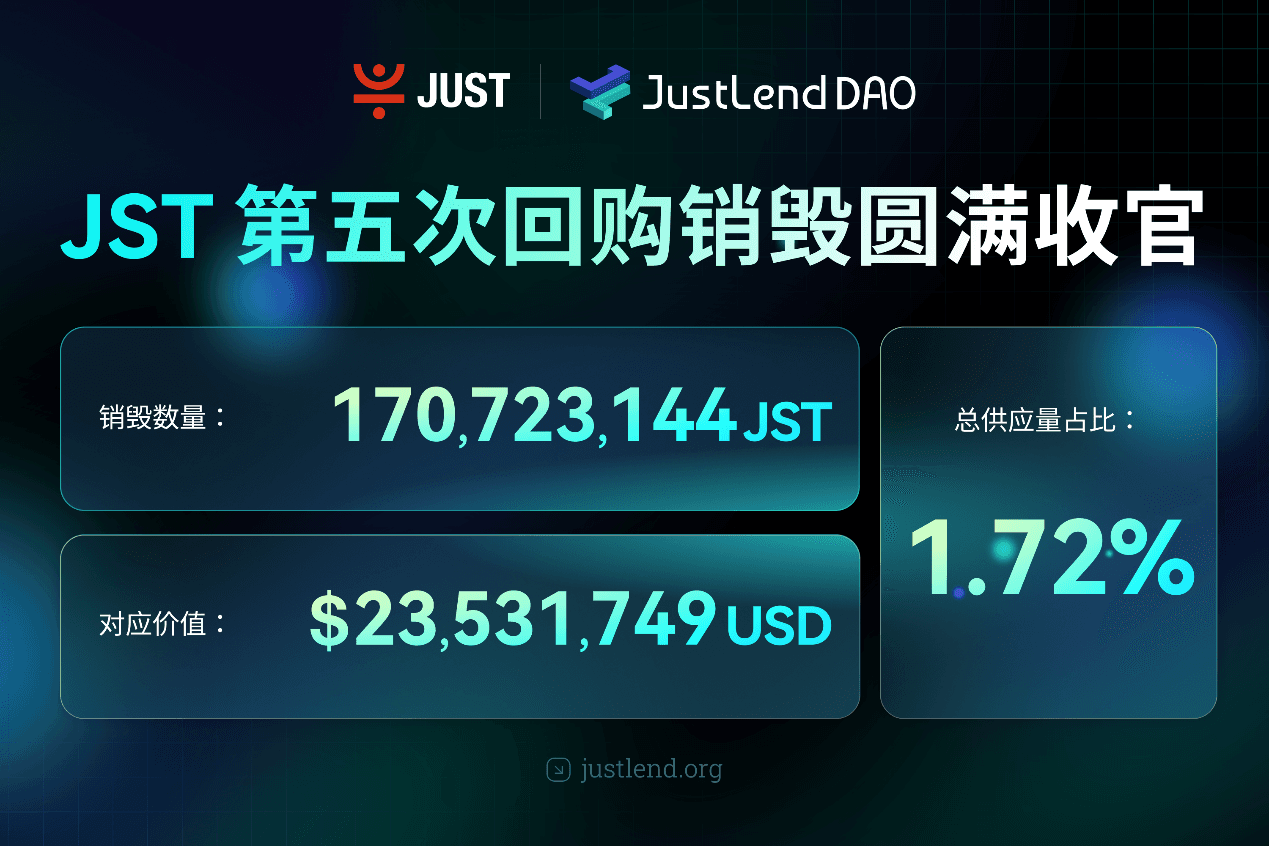
BitTorrent Brand Upgrade and Initial BTT Buyback & Burn Launch Simultaneously, Dual Engines Usher in New Era of Web3 Infrastructure
Oct 17, 20:00
Asia Market Daily: Japan's BOJ signals more rate hikes while Korea targets offshore perpetual platforms (2026/10/17)
Oct 17, 17:01Why did Papertrade backfire on you?
Oct 17, 17:01
The 'Strict Father' of Northern Myanmar: This Company Deploys 200,000 "AI Best Actors" to Strike Back Against Scammers
Oct 17, 15:34