
Newly crowned Fields Medalist Wang Hong has also dabbled in AI?

Huh? The newly crowned Fields Medalist Wang Hong has also dabbled in AI?

With NeurIPS 2026 scores about to be released, netizens have discovered that Professor Wang Hong published a paper at NeurIPS 2019.
And it wasn't just in name; it was a genuine joint first authorship.
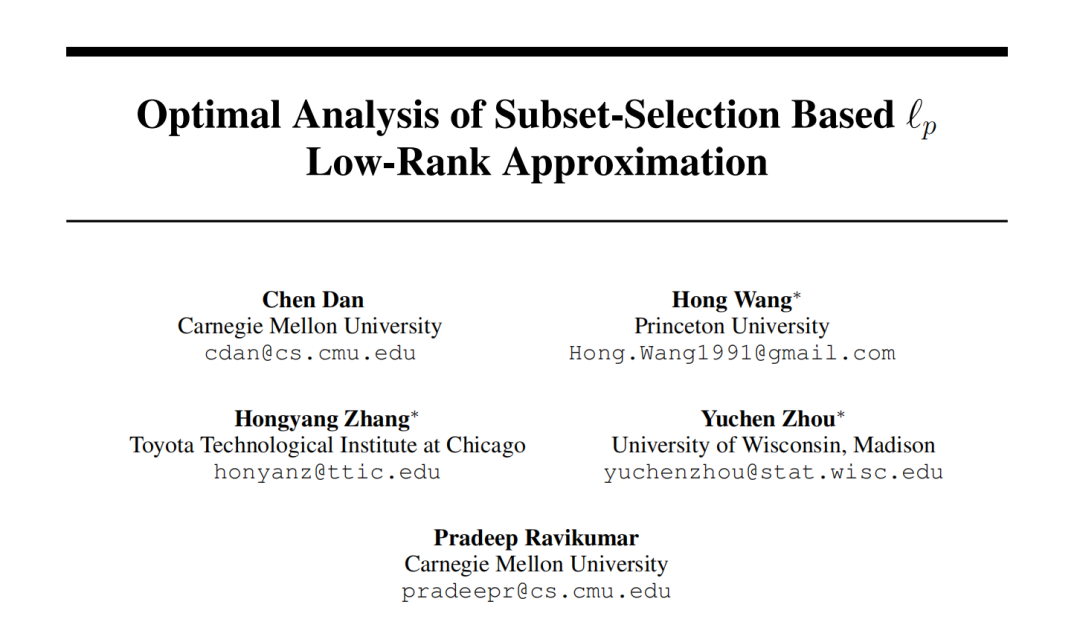
So the question arises: why would a pure mathematician publish a paper at a top AI conference?
After a thorough read-through, our conclusion is that this is a prime example of mathematical theory + machine learning.
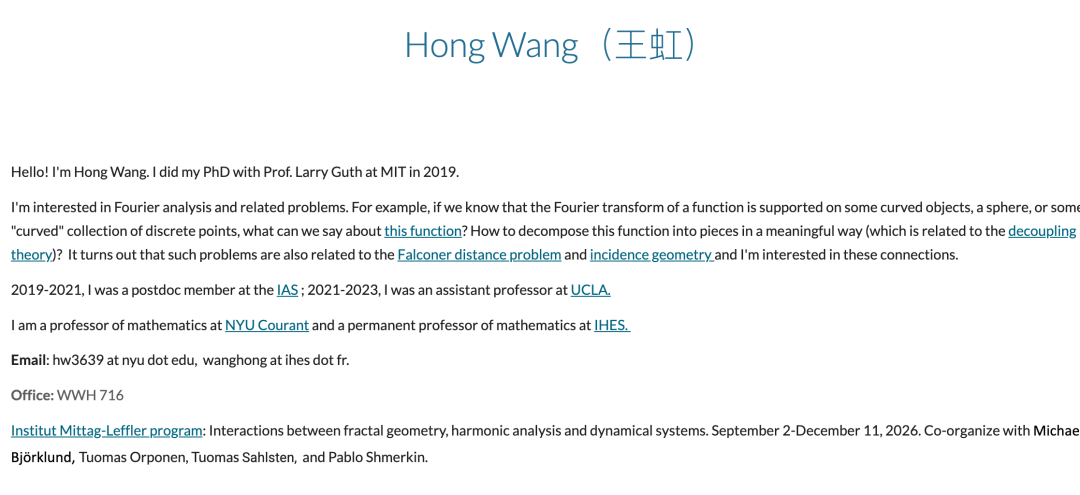
Interestingly, among the nearly 40 papers and preprints listed on Wang Hong's personal webpage, almost every paper is accompanied by a full link.
Except for this paper, which is an exception.
Wang Hong's Venture into AI
This paper delves into a fundamental task in machine learning and data analysis: low-rank matrix approximation.
In simple terms, real-world data can often be organized into a matrix, but these matrices are usually very large, making direct storage and processing costs extremely high.
Low-rank approximation aims to represent the original matrix as accurately as possible using a simpler, lower-rank structure.
The commonly used approximation algorithm nowadays is Column Subset Selection (CSS).
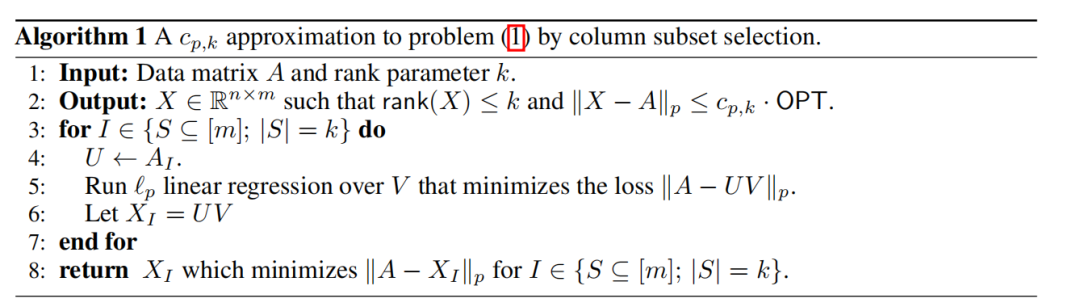
The concept behind it is actually quite intuitive.
Faced with a data matrix containing a large number of columns, instead of directly computing an entirely new low-rank matrix, the idea is to pick out a few representative columns from the original matrix and then use the subspace they span to approximate the entire matrix.
Since the columns selected by CSS come directly from the original data, they are easier to interpret than the abstract vectors obtained from a regular matrix decomposition. Additionally, this method can reduce storage and computational costs, making it suitable for handling large-scale data.
Prior research has shown that for a general low-rank approximation, the approximation ratio bound of the CSS algorithm is approximately O(k+1).
Here, k refers to the rank of the target matrix, where a larger k allows for a larger worst-case error theoretically.
Wang Hong et al.'s work further advances this bound:
· When 1≤p≤2, the approximation ratio is (k+1)^(1/p);
· When p≥2, the approximation ratio is (k+1)^(1−1/p).
Compared to the previous unified O(k+1) result, this bound is significantly tighter, restricting the algorithm rigorously, with the worst-case result only slightly worse than the optimal solution.
Furthermore, for the case of p≥2, the paper also constructs the corresponding lower bound, proving their results are precise to within a constant factor of 1.
In other words, this paper provides an almost optimal theoretical answer.
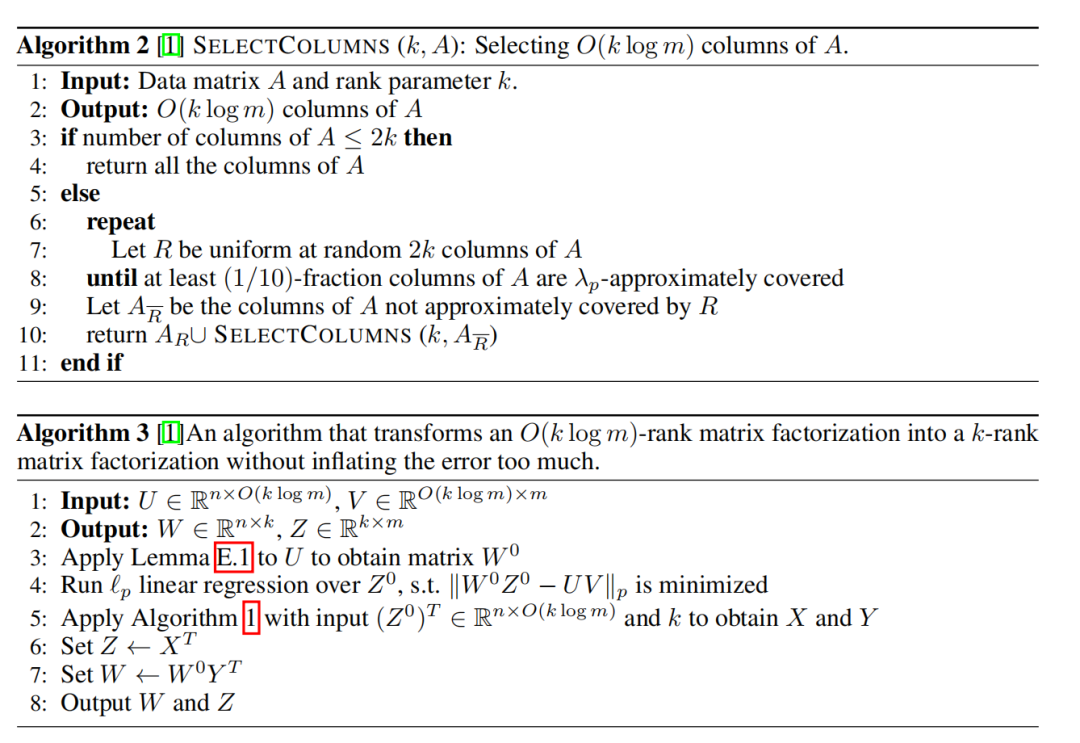
The most crucial part of this paper, which also best reflects Wang Hong's mathematical background, is their use of the classic tool from harmonic analysis, Riesz–Thorin Interpolation Theorem.
Typically, to prove a set of algorithms holds for all p values, a complex analysis needs to be conducted for each different p.
For certain endpoint cases, such as p=1, p=2, and p=∞, it is relatively easy to handle.
Then, after mastering these endpoint results, the Riesz–Thorin Interpolation Theorem can "interpolate" the conclusions for all intermediate p values.
Specifically, the paper first proves the three special cases of p=1, 2, ∞, and then deduces the approximation bounds across the entire range through interpolation theory.
Indeed, this set of tools is a classic method in harmonic analysis and operator theory but was not the most commonly used technique by theoretical computer science researchers at that time.
The NeurIPS reviewers that year also noticed this.
The reviewers ultimately recognized the primary technical innovation of this paper as introducing the Riesz–Thorin theorem into the computer field, with the Meta Review concluding it as a very well-argued paper.
In today's context, this paper actually provides a very typical interdisciplinary case, where the challenge of machine learning may find a breakthrough in pure mathematics.
NeurIPS 2026 Scores Coming Soon
Fast forward to the present, the NeurIPS review mechanism is undergoing a significant adjustment.
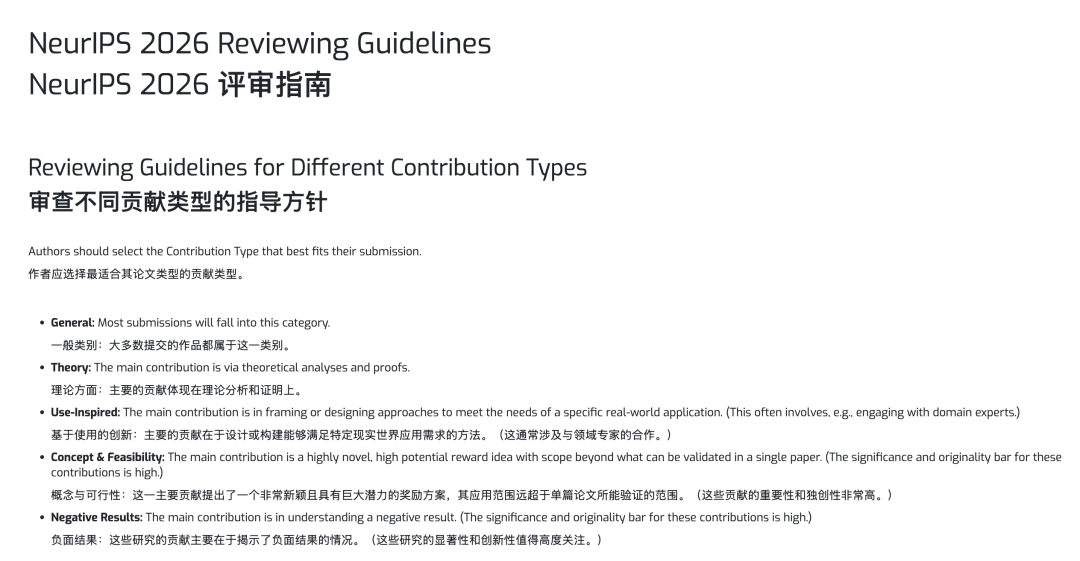
NeurIPS 2026 requires authors to select the most suitable contribution type from five categories when submitting a paper: General, Theory, Use-Inspired, Concept & Feasibility, and Negative Results.
Without a doubt, Wang Hong's 2019 paper falls under the Theory category.
According to the latest review guidelines of NeurIPS 2026, theoretical papers are first evaluated for mathematical rigor and correctness. Proofs, lemmas, and overall logic must hold, so theoretical papers do not need to be overlooked for lack of experiments.
At the same time, NeurIPS 2026 explicitly states that theoretical contributions can be independently established, and the purpose of designing a new algorithm is not necessarily to outperform the latest application models or the SOTA on the largest dataset.
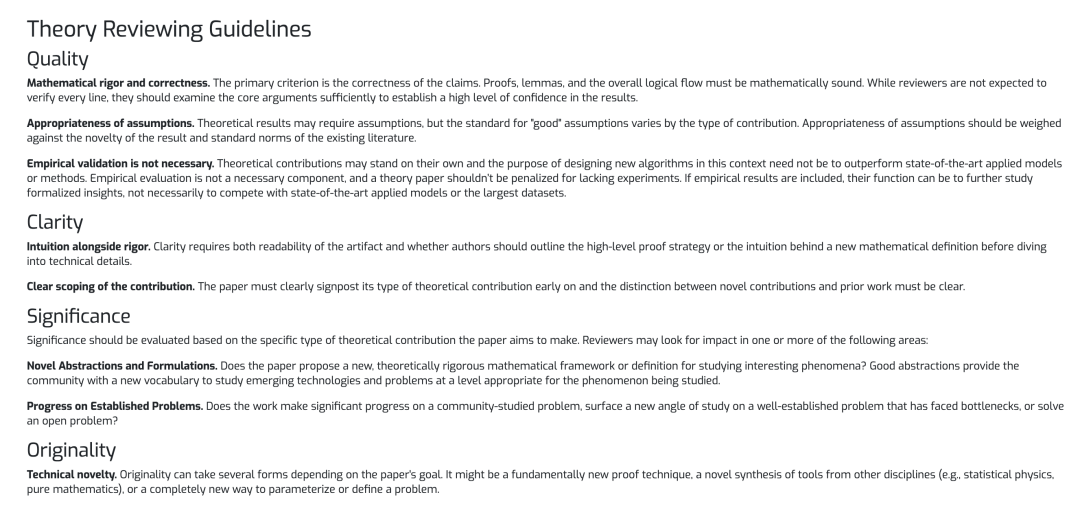
In terms of originality, one can also introduce new proof tools from other disciplines or innovatively integrate existing tools.
And this is almost a precise description of Wang Hong's paper.
They did not propose a neural network architecture in today's sense, nor did they train a model with a huge number of parameters; instead, they introduced the interpolation theorem from harmonic analysis into low-rank approximation to solve the boundary problem of approximation algorithms.
In the 2026 review framework, it remains a very standard NeurIPS theoretical paper.
It also illustrates that NeurIPS is not synonymous with a neural network model release conference; providing new understandings of existing methods, discovering new properties, and establishing tighter theoretical boundaries are equally valuable original contributions.
As for the boundary between mathematics and AI, it has never been as clear-cut as imagined.
Fields Medalist Can Publish at NeurIPS, Math Language Can Also Find True Generalization for AI.
Reference Links:
[1]https://proceedings.neurips.cc/paper_files/paper/2019/file/80a8155eb153025ea1d513d0b2c4b675-Paper.pdf
[2]https://neurips.cc/Conferences/2026/ReviewerGuidelines
[3]https://sites.google.com/view/hongwang/home
[4]http://xhslink.cn/o/8oQ3gm7qaxu
Recommended
Desk: Brent Crude Tops $110, Musk's Net Worth Drops 528.6 Billion in Four Days After Tesla Roadster Launch
Oct 17, 21:49
JST Fifth Buyback and Burn Successfully Concludes: Over 170 Million Tokens Worth Approximately $23.53 Million Burned, Buyback Mechanism Set for Comprehensive Upgrade
Oct 17, 20:10
BitTorrent Brand Upgrade and Initial BTT Buyback & Burn Launch Simultaneously, Dual Engines Usher in New Era of Web3 Infrastructure
Oct 17, 20:00
Asia Market Daily: Japan's BOJ signals more rate hikes while Korea targets offshore perpetual platforms (2026/10/17)
Oct 17, 17:01Why did Papertrade backfire on you?
Oct 17, 17:01
The 'Strict Father' of Northern Myanmar: This Company Deploys 200,000 "AI Best Actors" to Strike Back Against Scammers
Oct 17, 15:34