Uniswap's New Play-to-Earn Mechanism "Token Pools": Utilizing Burn for Protocol Revenue Sharing, 11 Chains Already Live
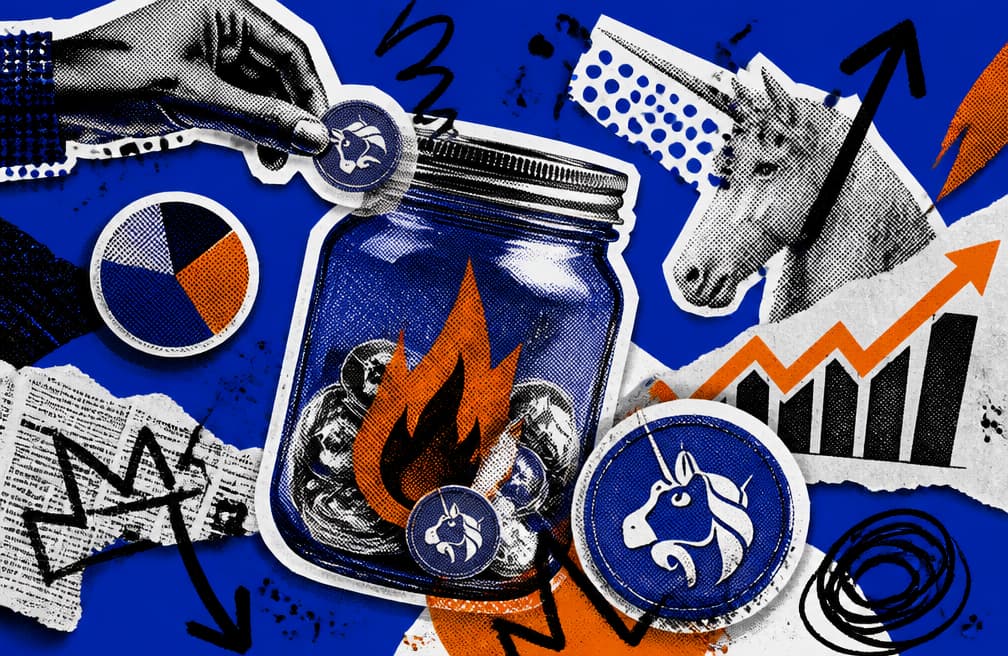
DeepTech Summary: Uniswap has transformed burning from a symbolic gesture into a toll booth. Its "Token Jar" mechanism mandates that anyone looking to take home protocol fee revenue must first burn UNI. This play has launched on 11 chains, with Robinhood Chain's $3.75 billion daily trading volume driving daily burns to a record 186,000 UNI.
Uniswap's "Token Jar" is a smart contract that collects on-chain fee income from Uniswap, only releasing it when someone burns UNI to unlock.
The mechanism went live post the December 25, 2025, "UNIfication" vote, resolving Uniswap's long-standing "fee switch" debate in DeFi.
Robinhood Chain launched on July 1, with Uniswap as its native trading platform, catapulting Uniswap's trading volumes and speeding up new fee-related proposals.
UNIfication brought a new level of coordination among Uniswap Labs, liquidity providers, governance, and the UNI token, embodying a built-in burn mechanism.
Robinhood Chain, launched early this month, quickly witnessed significant on-chain activity. Among the biggest winners amidst all this is Uniswap, seeing an explosive surge in trading volume on Robinhood Chain.
The trading volume on Uniswap has delivered significant revenue and revealed a recent intriguing shift: how Uniswap has linked its token and protocol income through the UNIfication proposal, which is what we are focusing on today.
Uniswap's Token Jar
Uniswap has recently devised a rather unique mechanism to provide value to its token, unprecedented in the field. It has pioneered a novel way to burn its own token, involving what they call the "Token Jar," merely a smart contract where a certain percentage of Uniswap's revenue is collected.
Token burning is usually straightforward: you destroy a portion of the supply, assuming demand for the token remains unchanged with a reduced supply, the price should increase.
This is akin to a company buying back its own stock. We introduced the basic concept of token buybacks in an article last year, where we cited the example of Aave spending $1 million weekly to conduct buybacks and burns of its token.
Most projects attempt to tie their revenue to tokenomics to drive token price appreciation. The typical approach is to send revenue to a governance body, which then decides how much should be allocated to its own buyback and burn mechanism.
Uniswap has taken this idea a step further, completely upending the entire mechanism. Burning is no longer something decided on a quarterly basis by a governance body; it is now integrated into how people actually earn rewards on the protocol, all through their Token Jar!
As I mentioned at the beginning, the Token Jar is an immutable on-chain contract, one deployed per chain, quietly accumulating a portion of every transaction fee generated by Uniswap. The key is that no one can extract from it for free. The only way to claim its contents is by burning UNI through a second contract named "Firepit."
The burning works by calling the Firepit's "release()" function and specifying which fee currency you want to withdraw from the jar as a reward. Anyone can trigger it at any time, as long as they are willing to burn UNI to do so.
As Uniswap succinctly puts it: "Every Uniswap trade generates protocol fees. These fees accumulate in the jar. Anyone can burn them, permanently removing UNI from circulation." You can see this on their website at tokenjar.xyz.
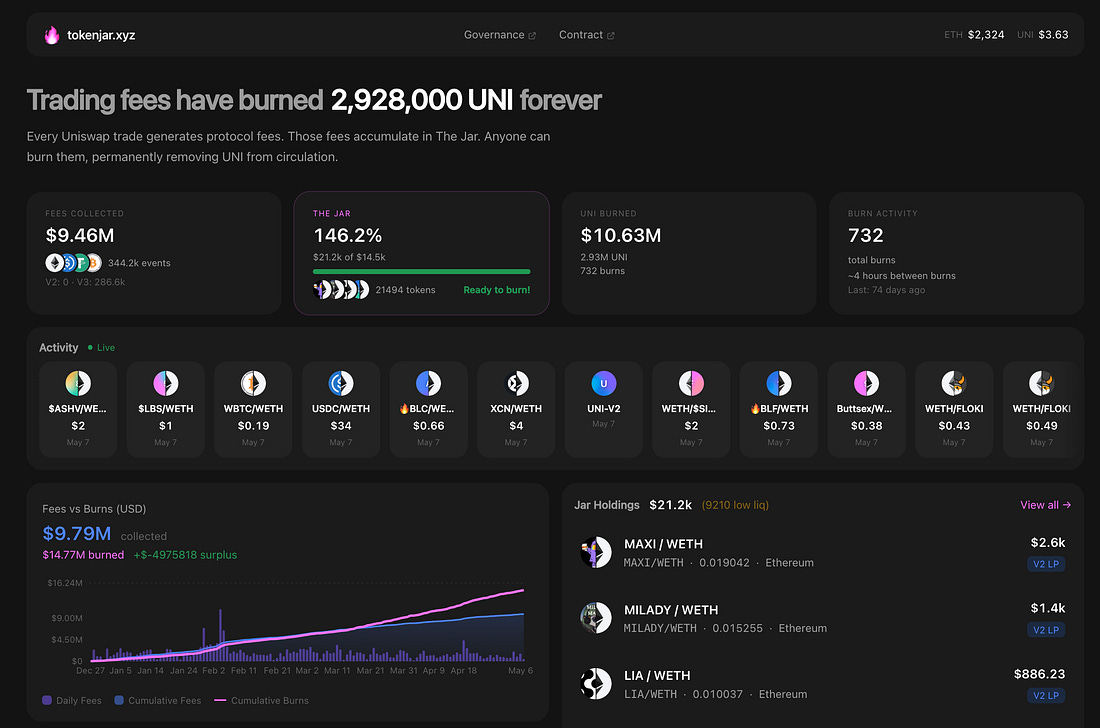
Image: Uniswap Token Jar (The Jar) data panel, displaying the amount of UNI permanently burned and the fee/burn trend. Source: tokenjar.xyz
Uniswap has integrated token burning into the process of claiming income from the Token Jar, making it a core mechanism rather than having a governance body make symbolic purchases on the open market to reduce supply, as most projects do.
UNIfication
The "Fee Switch," whereby the Uniswap protocol should retain a portion of the transaction fee instead of routing all fees to liquidity providers, has been one of the longest-standing debates in DeFi. It has remained unresolved over the years.
Uniswap founder Hayden Adams finally broached the issue forcefully through a proposal called UNIfication. It bundled three things into a single vote: enabling protocol fees; a one-time burning of 1 billion UNI from the treasury; and merging the Uniswap Foundation into Uniswap Labs under a unified legal structure.
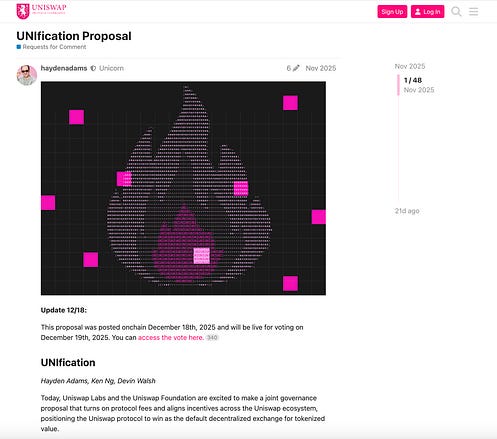
Image: UNIfication Governance Proposal Page. Source: Uniswap Governance
The vote concluded on December 25, 2025. It passed with 125,342,017 UNI in favor and only 742 against, easily surpassing the required threshold of 40 million delegates.
The burning of 1 billion UNI, valued at approximately $5.96 billion at the time, was positioned as a retroactive correction, estimating how much the protocol should have earned if fees had been enabled since Uniswap's inception.
The fee split itself varies by version. Uniswap v2's fixed 0.3% fee changed to 0.25% for LPs and 0.05% for the protocol. Uniswap v3 adopted a tiered fee structure based on LP revenue, with a 25% fee for low-fee pools and a 16.7% fee for high-volatility pools. They are leaving v4 to be addressed later.
On the same day, Uniswap Labs zeroed its own interface fee. This fee used to generate approximately $125 million in annual revenue, so this was not just a small gesture. Instead, the governance entity will now directly allocate a fixed budget to Uniswap Labs, 20 million UNI annually, currently around $75 million, distributed quarterly from the treasury starting in January 2026.
The developers who built Uniswap receive compensation in tokens being burnt, aligning their incentives with everyone else as the protocol's usage and burn drive up the value of UNI. They boldly shifted from a guaranteed fee revenue to an incentive aligned with all UNI holders.
Robinhood Chain Adding Fuel to the Fire
Robinhood launched its own chain, called Robinhood Chain, on July 1st earlier this month, which is a permissionless layer 2 built on the Arbitrum stack.
Image: Tweet from Robinhood Crypto announcing the mainnet launch of Robinhood Chain. Source: @RobinhoodCrypto
The chain did not start from scratch to build its own DeFi building blocks but instead launched in collaboration with Uniswap and Chainlink as day one partners. Uniswap defaults as the chain's native trading platform, described as the primary venue for its trades.
In such a short time, Uniswap's deployment on the Robinhood Chain has already handled over $6 billion in cumulative exchange volume. On July 10th, it briefly surpassed Hyperliquid in daily DEX volume, trading $375 million in a 24-hour period.
While indeed much of the activity driving it is concentrated on WETH pairs and memecoin speculation, these are still very impressive figures, and the impact on Uniswap fees is evident.
The trading volume on Robinhood Chain has been significant, and it is just getting started. You can expect to see more volume on Uniswap as the promised tokenized stocks on the chain begin trading in bulk!
New Proposals
Protocol fees have been live on 11 chains: Ethereum, Base, Arbitrum, Polygon, Optimism, BNB Chain, among others. However, Robinhood Chain is not one of them, at least not yet. To address the high volume of transactions brought by Robinhood Chain, two new Uniswap proposals were initiated on July 19th.
Proposal #99 seeks to extend the same v2 and v3 fee structure specifically to Robinhood Chain. Proposal #100, on the other hand, simultaneously activates the new fee system for Uniswap v4 on seven chains: Ethereum, Base, Arbitrum, Optimism, Polygon, BNB Chain, and Robinhood Chain.
Once these two initial proposals pass, the subsequent vote, v4 Part 2, will extend v4 fees to an additional five chains.
Hayden Adams stated, "Based on current transaction volume, particularly from Robinhood, we anticipate a significant impact on UNI burning. Even without the Robinhood Chain added yet, the existing system burned a record 186,000 UNI in a single day last month."
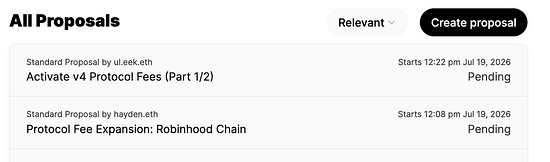
Image: Two new proposals on the Uniswap governance platform—Activate v4 Protocol Fees and Protocol Fee Expansion: Robinhood Chain. Source: Uniswap Governance
Why It Matters
The most interesting part of all of this is the loop it creates underneath. The more chains adopt Uniswap, the more volume flows through it, the more fees go into the token jar, the more UNI gets burned, and once fees are turned on for a chain, all of this can occur without a new governance vote.
This loop is not guaranteed to be positive. When UNIfication was first passed, experienced LPs warned that protocol fees would compress margins, and some experts predicted LPs would migrate and exit the ecosystem entirely. This hasn't happened yet, but the competitive landscape will need to be watched.
Nevertheless, the transformation of the view on the UNI token is hard to ignore. UNI has long been criticized as a governance token that didn't truly claim any value from the value flowing through the protocol.
However, UNI now boasts one of the most interesting and novel mechanisms in the space, with their token jar leading the charge in meaningful tokenomics, keeping everyone in the ecosystem aligned toward token growth. It's exciting to see how it unfolds!
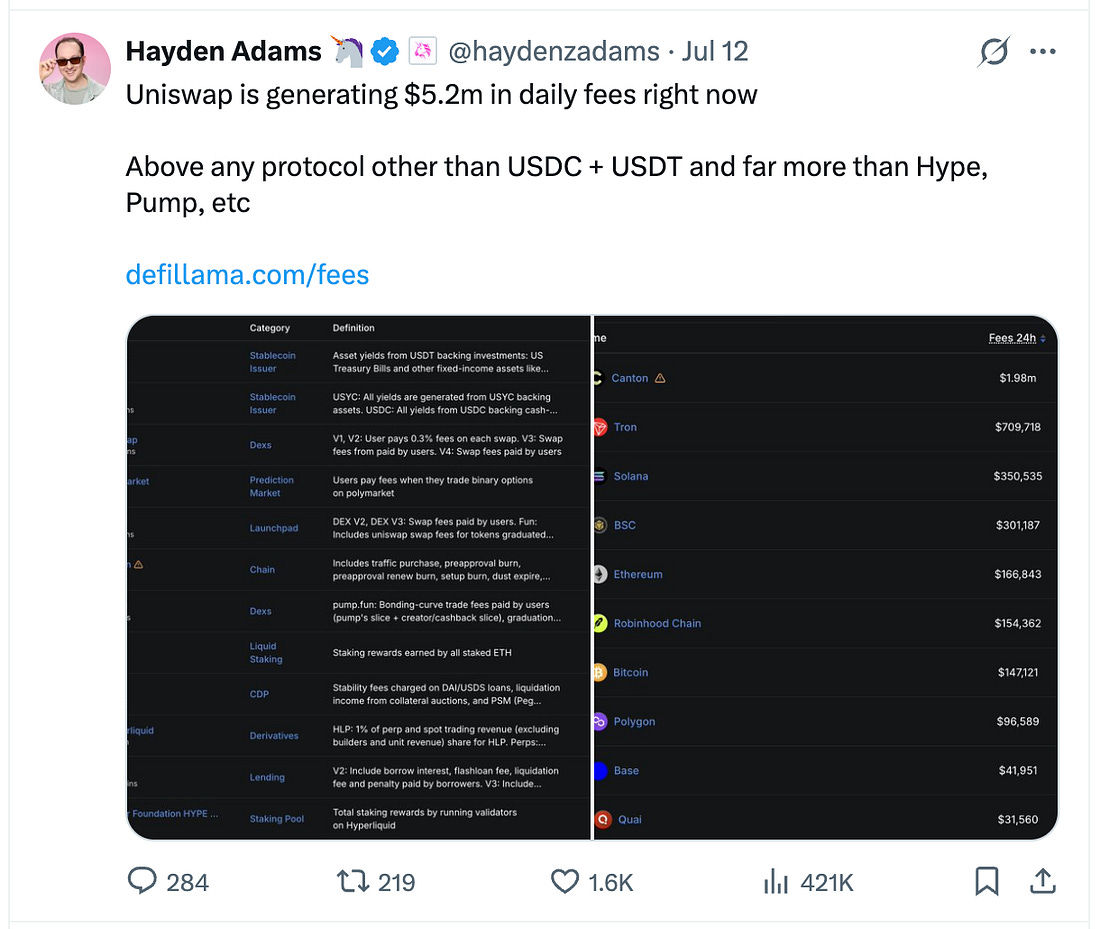
Image: Uniswap protocol's daily fee revenue of around $5.2 million, ranking first among all protocols excluding stablecoins. Source: DefiLlama
Recommended
Desk: Brent Crude Tops $110, Musk's Net Worth Drops 528.6 Billion in Four Days After Tesla Roadster Launch
Oct 17, 21:49
JST Fifth Buyback and Burn Successfully Concludes: Over 170 Million Tokens Worth Approximately $23.53 Million Burned, Buyback Mechanism Set for Comprehensive Upgrade
Oct 17, 20:10
BitTorrent Brand Upgrade and Initial BTT Buyback & Burn Launch Simultaneously, Dual Engines Usher in New Era of Web3 Infrastructure
Oct 17, 20:00
Asia Market Daily: Japan's BOJ signals more rate hikes while Korea targets offshore perpetual platforms (2026/10/17)
Oct 17, 17:01Why did Papertrade backfire on you?
Oct 17, 17:01
The 'Strict Father' of Northern Myanmar: This Company Deploys 200,000 "AI Best Actors" to Strike Back Against Scammers
Oct 17, 15:34