$250 billion collateralized, NVIDIA begins offering customer credit endorsements
A GPU's business deal is usually nearing its end when it ships. The customer places an order, the supplier delivers, and the revenue goes into the financial report. However, the latest report surrounding the U.S.-based AI company OpenAI's Ohio data center tells a different story. According to The Wall Street Journal and Bloomberg, NVIDIA is in discussions to provide a guarantee for financing OpenAI's computing power lease. After the chips are sold, the supplier may also need to endorse whether the customer can pay rent long-term.
The report mentions a guarantee amount of around $250 billion and project sizes like 10GW. These have not been cross-checked in public documents by NVIDIA, OpenAI, or the project financing parties, so they cannot be treated as finalized terms. However, the most interesting aspect of this rumor does not lie in whether a certain number is big enough. A guarantee implies that a chipmaker may have moved from being a "seller of shovels" to sitting at the same table as customers raising funds to build mining facilities.
Why would this happen to NVIDIA? First, let's see where it currently stands.
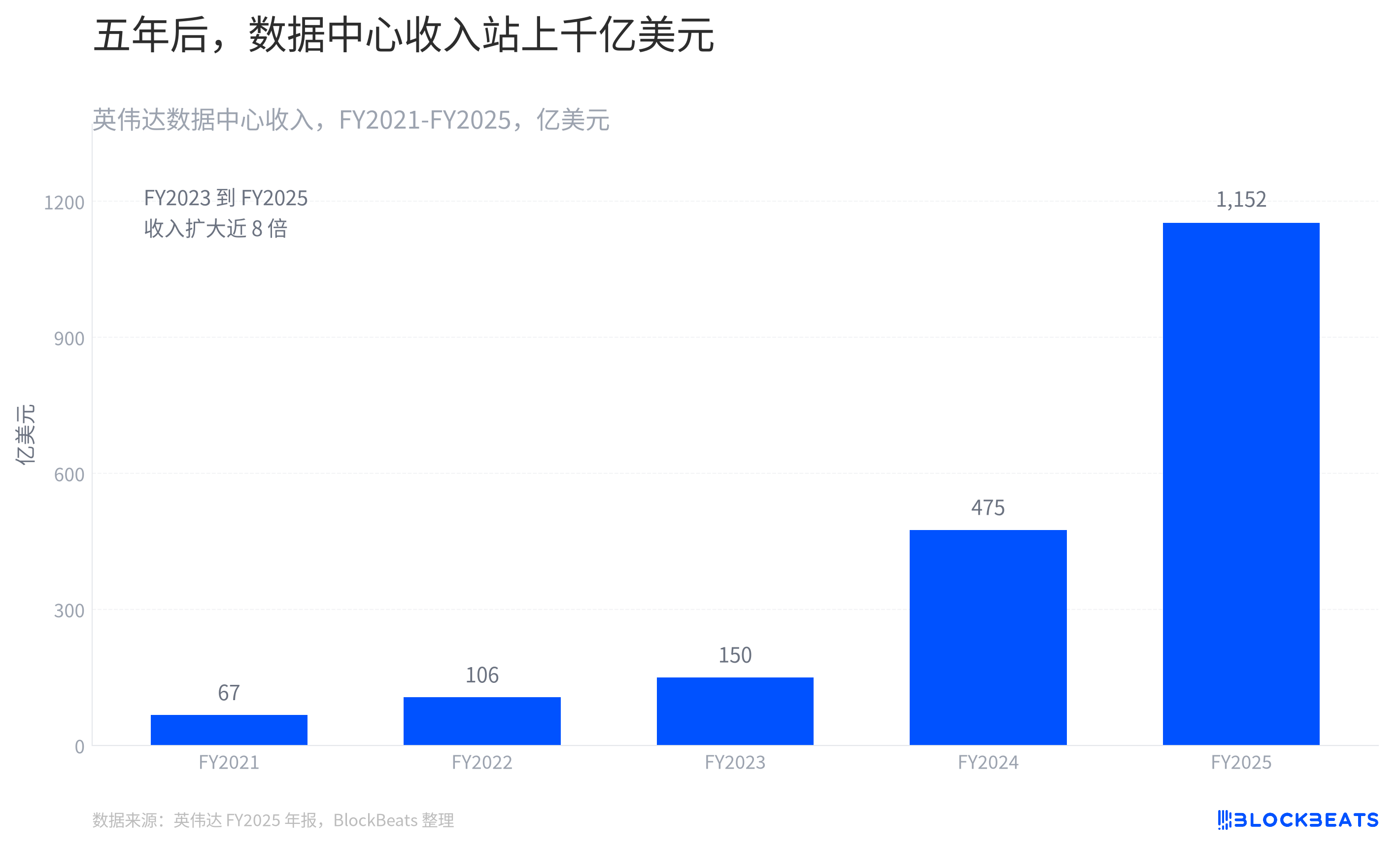
According to NVIDIA's FY2025 annual report, data center revenue increased from $6.7 billion to $115.2 billion over five fiscal years. The slope on the graph is more intriguing than the conclusion. FY2023 was still a relatively gentle step, but the following two years suddenly became an almost vertical wall. For a company that originally sold computing hardware, this is akin to the most crucial customer base transitioning to a different procurement method in an extremely short period.
Previously, cloud providers budgeted for quarterly server refreshes. Now, AI model companies are looking for a continuous and long-running computing power setup. A data center is not just about buying more server racks; it's more like building a power plant first and then deciding what applications to run inside. Equipment procurement is just the initial step; land, power, buildings, and debt leasing all need to be settled within the same project.
NVIDIA doesn't need to build data centers itself, yet it is being drawn into this chain. If a customer cannot obtain financing, a GPU order is merely a letter of intent. If the customer secures financing, there is certainty in system delivery and service revenue for the next several years. The guarantee here is not charity but a credit tool to transform demand from "want to buy" to "can buy." However, once the tool is used, risk will also flow back along the same chain.
So, how is this different from the previous rounds of large-scale AI procurement? The difference lies in the shift of the project's narrative unit.
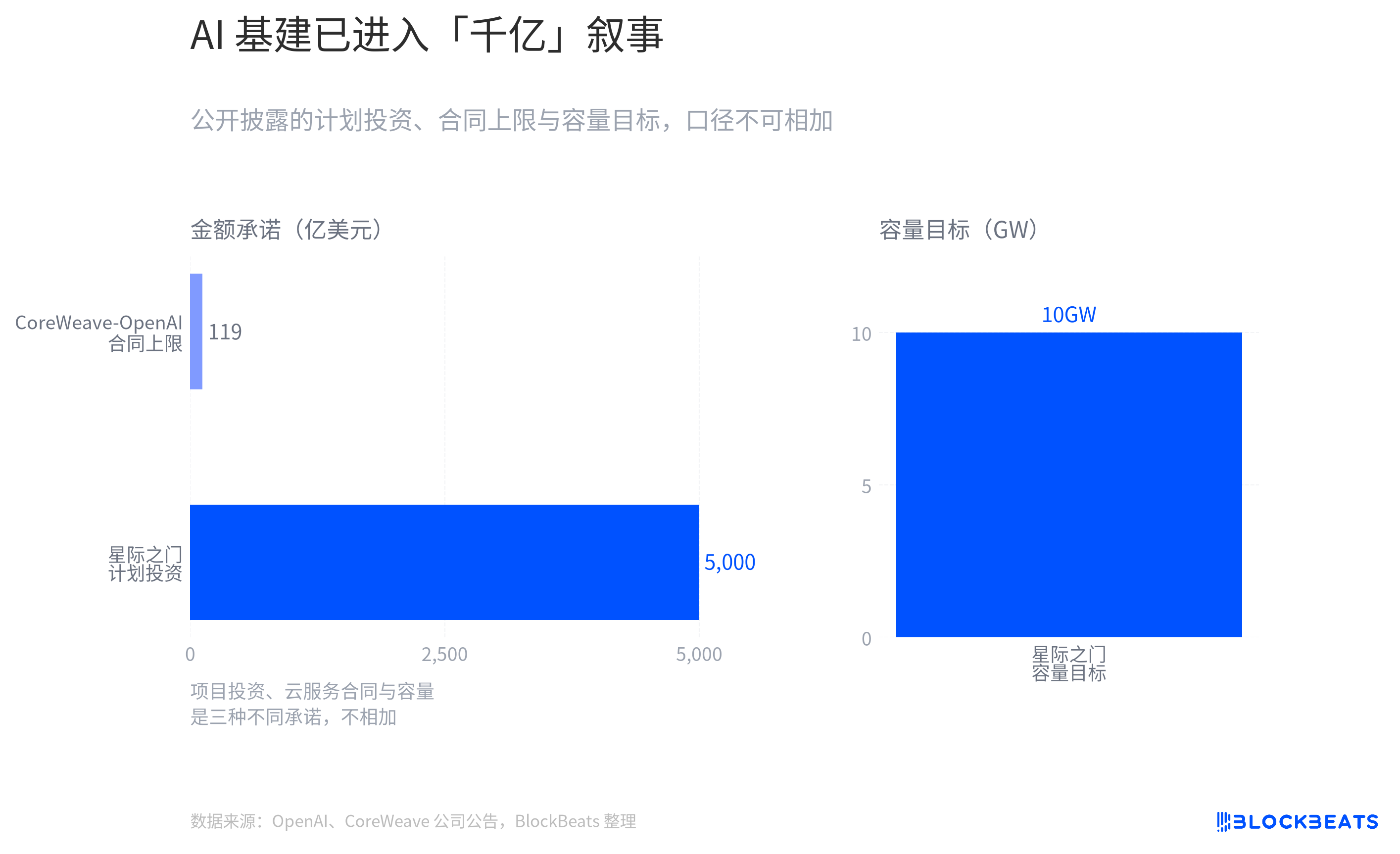
When OpenAI announced its "Stargate" plan in 2025, they stated a potential investment of up to $500 billion over the next four years, with a capacity goal of 10GW. On the other hand, according to the GPU cloud services provider CoreWeave, their cloud service contract with OpenAI could reach up to $11.9 billion. These two figures cannot be added together—one represents planned investment, the other is a service contract ceiling, and the third is power capacity. Placing them on the same graph is not for a grand total but to understand that the language of transactions has moved beyond single servers and annual purchases.
This is like building a railway. While railcar orders are important, what truly determines whether the railway can operate is who provides the initial funding to lay the tracks, who commits to continuously buying tickets, and who covers the gap when passenger traffic is low. For AI data centers, GPUs are the most visible railcars, but it is power and financing that determine if this train can depart the station.
Therefore, when the news mentions the word "guarantee," the market should not simply interpret it as NVIDIA making another sale. It is more like the supplier telling the funding party that they are willing to embed their judgment of downstream demand into the credit relationship. For model companies in urgent need of scaling compute power, this can lower the financing threshold. For equipment lessors and lenders, this adds another layer of a willing risk-sharing party.
Where will the risk ultimately lie? Many may assume that as long as model companies continue to grow, the entire chain will be fine. However, large-scale infrastructure projects are most afraid not of selling slightly fewer services in a month but of having long leases, depreciation cycles, and debt maturities already in motion while demand does not materialize at the expected pace.
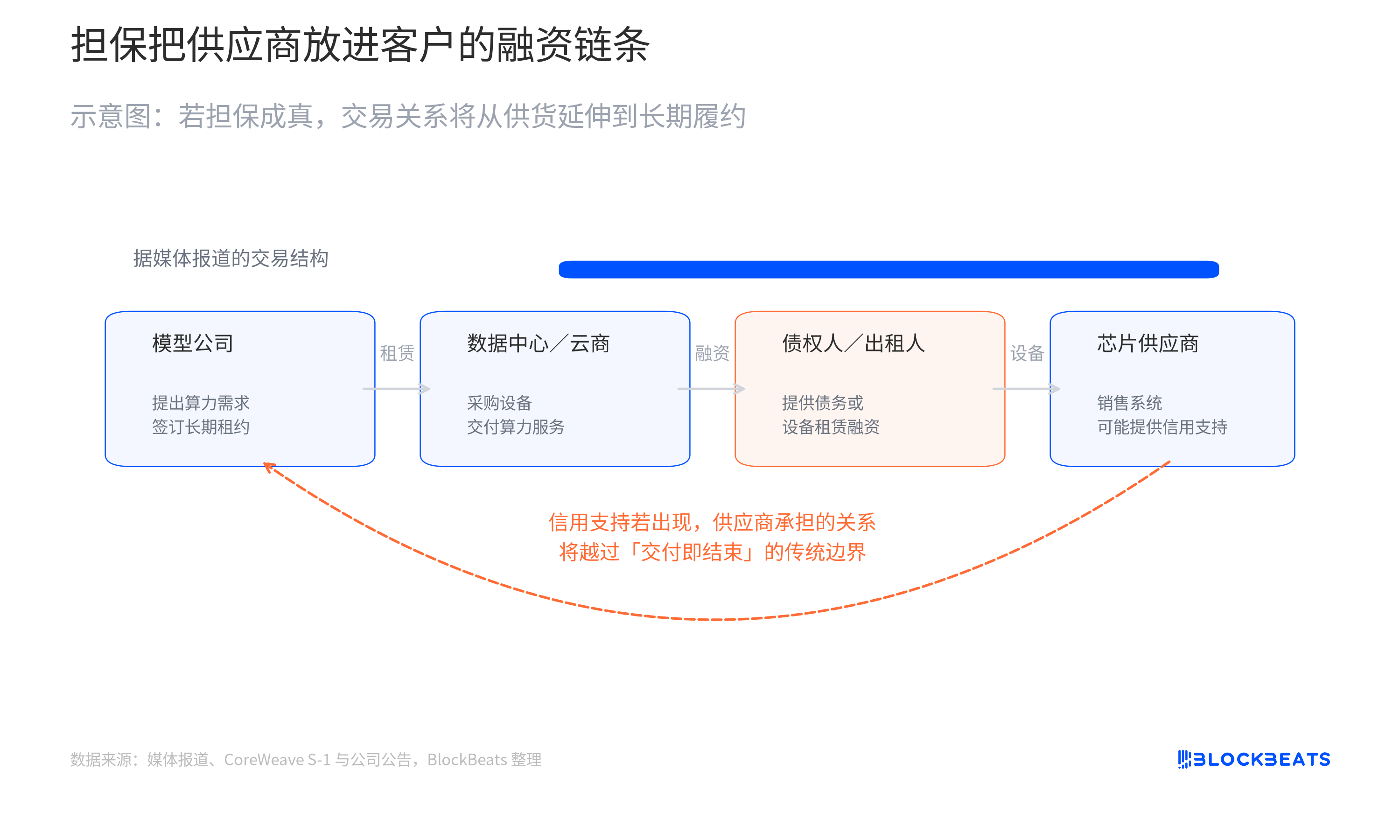
This diagram breaks down a compute transaction into four positions. The model company needs compute power, the data center or cloud provider buys equipment and delivers services, creditors or lessors provide financing, and chip suppliers deliver the systems. In a traditional supply relationship, the supplier's main risks are focused on delivery and payment. If credit support is incorporated into the contract, the relationship extends to lease performance, equipment residual value, and even project refinancing.
This is not an abstract financial lesson. CoreWeave's S-1 filing shows that Microsoft once contributed 62% of its revenue for 2024. When customer concentration is high, the financing capability of cloud service providers becomes intertwined with the performance capability of a few large customers. For upstream suppliers, what they most desire is stable long-term demand. However, when they provide credit backing for this stability, part of the uncertainty originally absorbed downstream may also be brought back up the supply chain.
Therefore, what this rumor truly changes is not who will buy tens of thousands more GPUs but that AI infrastructure is transforming an "order" into a long-term contract spanning equipment, leasing, and credit. While chip deliveries may cease, credit relationships may not necessarily end at that moment.
Recommended
Desk: Brent Crude Tops $110, Musk's Net Worth Drops 528.6 Billion in Four Days After Tesla Roadster Launch
Oct 17, 21:49
JST Fifth Buyback and Burn Successfully Concludes: Over 170 Million Tokens Worth Approximately $23.53 Million Burned, Buyback Mechanism Set for Comprehensive Upgrade
Oct 17, 20:10
BitTorrent Brand Upgrade and Initial BTT Buyback & Burn Launch Simultaneously, Dual Engines Usher in New Era of Web3 Infrastructure
Oct 17, 20:00
Asia Market Daily: Japan's BOJ signals more rate hikes while Korea targets offshore perpetual platforms (2026/10/17)
Oct 17, 17:01Why did Papertrade backfire on you?
Oct 17, 17:01
The 'Strict Father' of Northern Myanmar: This Company Deploys 200,000 "AI Best Actors" to Strike Back Against Scammers
Oct 17, 15:34