Citi Insights: AI Starts to “Eat” NAND, Storage Upside Cycle Not Over Yet

TL;DR
· Citigroup's report on July 24 concludes that low NAND and DRAM inventory continues to support the storage upcycle.
· AI Agent is driving up KV Cache demand, CMX and near-GPU SSD are starting to consume more NAND.
· Samsung and SK Hynix continue to benefit from the favorable storage environment, but weakening consumer demand, expansion, and HBM certification will impact the pace.
In its global semiconductor report released on July 24, Citigroup assessed that the storage upcycle is not yet over. The key indicator is not smartphone demand, but rather that NAND and DRAM inventories are significantly below normal levels, with AI servers still expanding their demand for KV Cache and near-GPU storage.
This directly addresses recent market concerns about the peak of the storage cycle. The controversy mainly stems from two sources: first, the weakening demand for Chinese smartphones, which may drag down consumer-grade NAND prices; second, the market is worried that NAND channel inventories are starting to rise, indicating that the storage price hike is nearing its end.
In the report titled "Global Semiconductors: Reality Check: Memory Upcycle Intact on Tight Inventories and Strong KV Cache Demand," Citigroup combines supplier, cloud provider, and channel inventories for analysis. The conclusion is that the current storage supply chain has not yet entered a typical loose state.
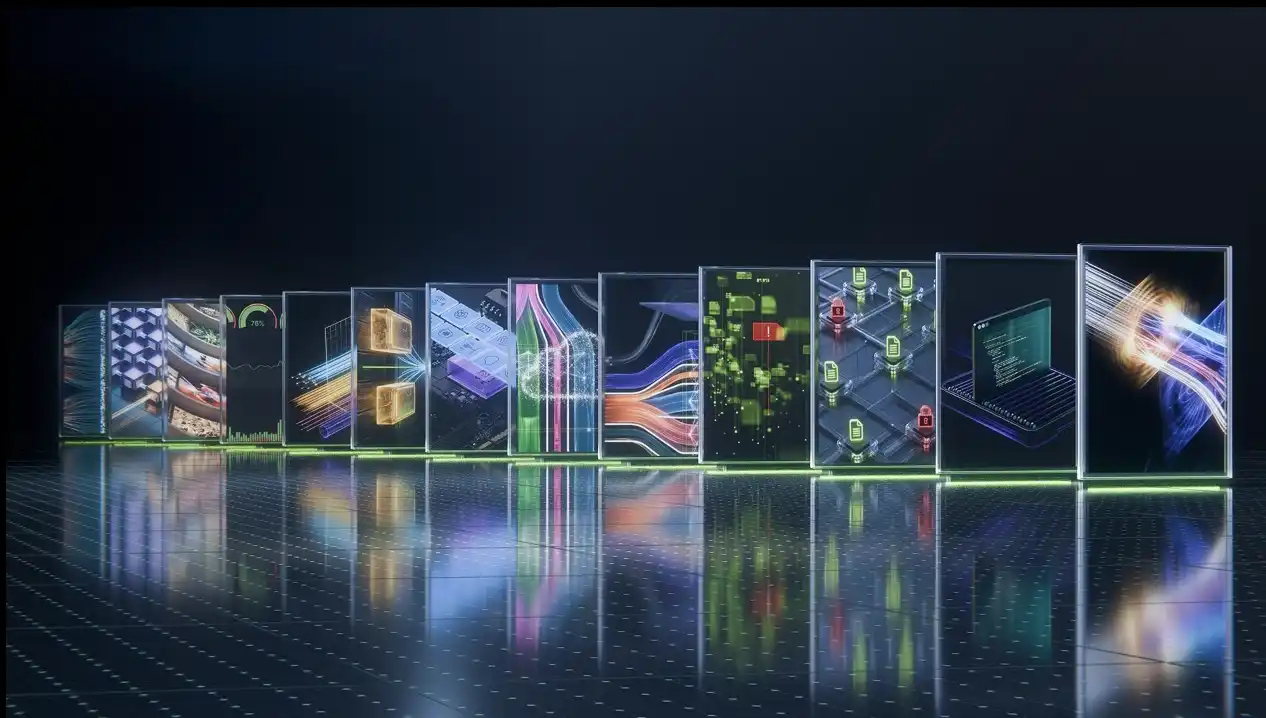
NVIDIA CMX is using BlueField-4 and NVMe SSD to build the KV Cache storage layer, and AI Agent is channeling more inference demands to NAND.NAND Supplier Inventory at Only 2.6 Weeks, Normal Level around 5 Weeks
The most crucial figure is the NAND inventory.
Citigroup estimates that in the third quarter of 2026, NAND supplier inventory is only 2.6 weeks, significantly below the normal level of about 5 weeks; major cloud provider NAND inventory is about 3 weeks, below the normal level of around 7 weeks; and channel inventory is about 5 weeks, while the normal level is around 15 weeks.
This indicates that even with signs of weakening on the consumer end, the entire NAND chain is not relaxed. Low supplier inventory restricts manufacturers from rapidly releasing inventory; low cloud provider inventory indicates that AI and data center customers may still continue to replenish stock; and low channel inventory also reduces the possibility of channel dumping suppressing prices.
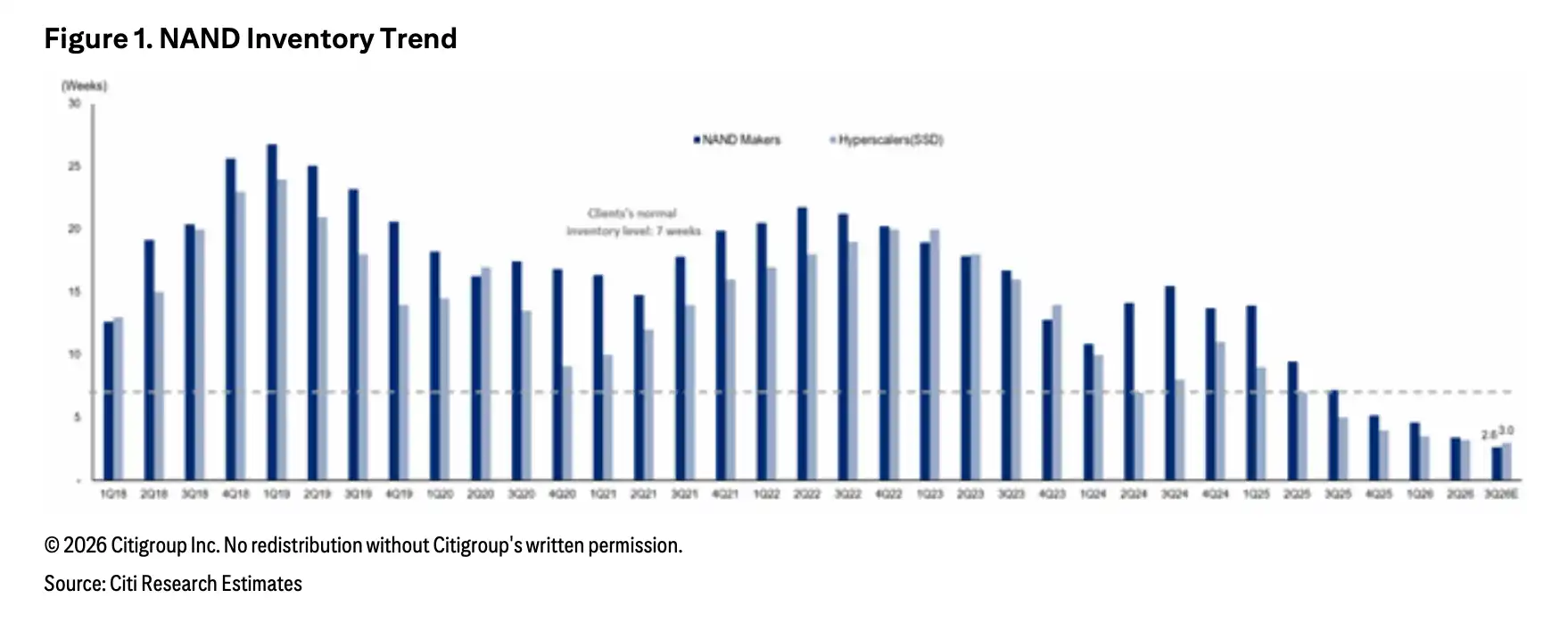
NAND supplier inventory at 2.6 weeks, cloud vendor at 3 weeks, and channel at 5 weeks, all below normal levels.
The situation is similar for DRAM. DRAM supplier inventory is around 2.7 weeks, below the normal level of about 5 weeks; cloud vendor DRAM inventory is around 2.5 weeks, below the normal level of about 7 weeks; channel inventory is around 4 weeks, with a normal level of about 15 weeks.
This set of data weakens the argument that "a downturn in demand driven solely by smartphones could reverse the cycle." At least from an inventory perspective, both DRAM and NAND have not yet returned to an oversupply situation.
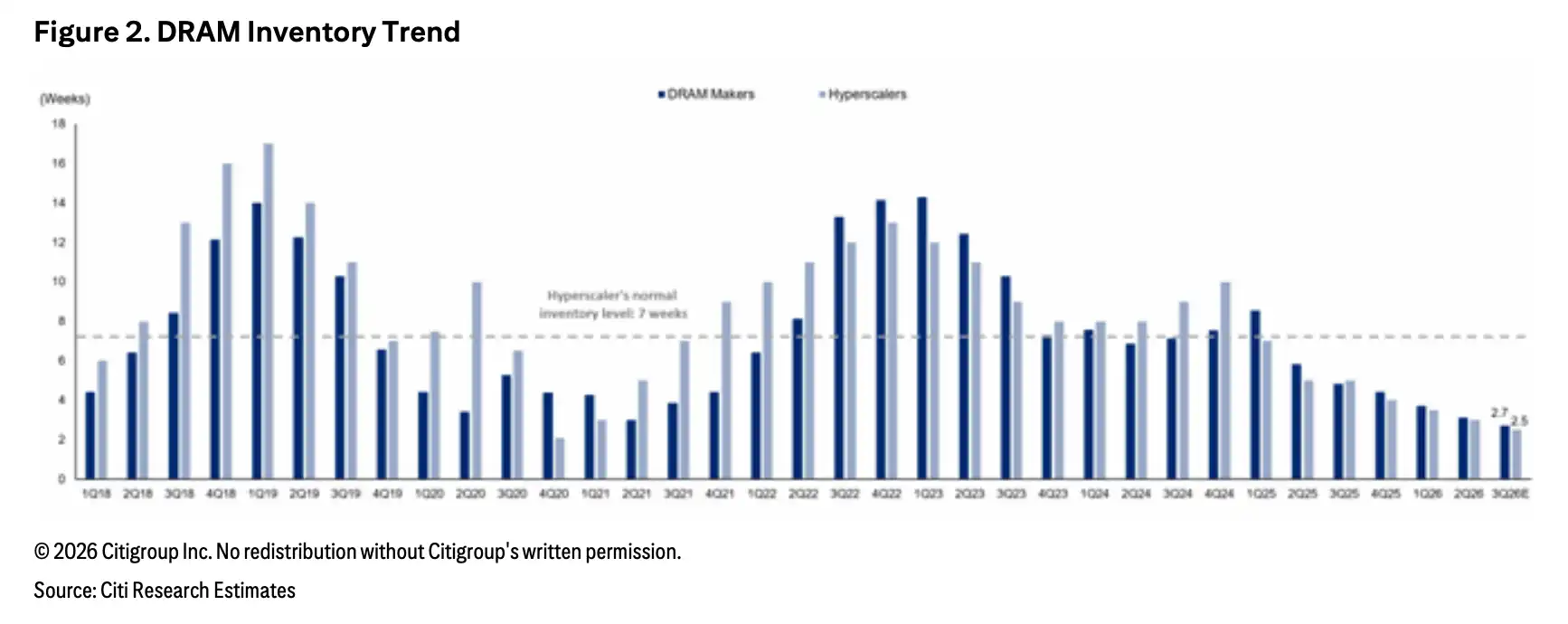
DRAM supplier inventory at 2.7 weeks, cloud vendor at 2.5 weeks, and channel at 4 weeks, all at low levels.AI Servers Begin Consuming More NAND, Driving Up Rubin System SSD Demand
What sets this storage upcycle apart from the traditional consumer electronics cycle is the emergence of new NAND demand from AI servers.
Citi highlighted two main directions: CMX and QLC SSDs. CMX corresponds to what NVIDIA refers to as the Context Memory Storage Platform, driven by BlueField-4 to provide pod-level context and KV Cache storage layer; QLC SSDs are more used for high-capacity storage near GPUs to enhance AI computing efficiency.
KV Cache can be simplistically understood as "context cache" in large model inference. The more frequent the AI agent use, the longer the task chain, and the more complex the context, the more the system needs to store intermediate states and historical information to avoid redundant computation. Inference not only consumes GPU computing power but also raises memory and storage demands.
A more straightforward assumption comes from NVIDIA's next-generation Vera Rubin platform. Based on Citi's industry calculation, if Rubin server systems running CMX adopt 16TB TLC SSDs, each system's SSD capacity can reach 1,152TB. NVIDIA's official statement is more conservative, saying that each GPU pod provides PB-level shared capacity, and it has not confirmed that all Rubin systems will use this fixed configuration.
This number explains why AI demand will reshape the NAND market. In the past, NAND was more influenced by the rhythm of smartphones, PCs, and consumer electronics; now, AI servers are also becoming significant buyers of high-capacity SSDs. As long as AI clusters continue to expand, storage demand will no longer be just a function of the consumer end.
According to Citigroup's estimate, the NAND demand brought by CMX will reach 34.6 billion and 115.2 billion 8Gb equivalent units in 2026 and 2027, respectively, accounting for 2.8% and 9.3% of global NAND demand. This is a model assumption, not company guidance, but a nearly one-tenth share by 2027 is already enough to affect supply-demand balance.
The market's concerns about weakening Chinese smartphone demand are not unfounded. Smartphones are still one of the key end markets for NAND, and if shipments fall below expectations, consumer-grade NAND prices will face pressure.
However, current inventory levels are low, providing little cushion for demand fluctuations. Citigroup mentioned that the supply-demand adequacy of DRAM and NAND suppliers has dropped from 70% to 50%. The surplus capacity in the hands of suppliers to cover demand is decreasing, not increasing.
In this scenario, weak smartphone demand is more likely to slow down price increases rather than directly change the direction of the cycle. As long as cloud providers and AI servers continue to make purchases, low inventory levels will amplify the impact of additional demand on prices.
It is also necessary to differentiate between two types of NAND demand: consumer-grade NAND is more influenced by smartphones and PCs, while enterprise SSDs and AI-related SSDs are more influenced by data center construction, GPU cluster expansion, and model inference requirements. The market was previously concerned about the former, but Citigroup emphasizes that the latter is still strengthening.
This is also the reason why the report continues to be bullish on Korean storage stocks. Publicly disclosed references show that Citigroup has raised its target price for Samsung Electronics to KRW 530,000 and maintains a buy rating; SK Hynix similarly maintains a buy rating, with a previously reported target price of KRW 3,100,000 by Citigroup.
The individual stock target price is not the most critical part of this report. The real theme is that the market is concerned about the peak of the storage cycle, but inventory data and AI storage demand provide evidence to the contrary.
Citigroup's conclusion does not mean that storage prices will only rise and not fall.
For Samsung, primary risks include delays in HBM shipment approval or certification to key customers, weaker-than-expected PC sales, lower-than-expected NAND demand, aggressive investments by competitors in the storage or foundry sector, and a significant appreciation of the Korean won eroding profits.
For SK Hynix, the risks are concentrated on a downturn in DRAM demand, NAND demand weaker than expected, and global consumer weakening.
These risks indicate that AI demand has not completely eliminated the cyclicality of the storage industry. Storage is still an industry driven by capital expenditure, inventory, and end-demand. If competitors ramp up production quickly or if consumer electronics demand further deteriorates, supply-demand tension may be alleviated.
At least according to the inventory numbers provided in this report, the market's concerns about a "peak of the cycle" are still lacking inventory support. NAND suppliers at 2.6 weeks of supply, DRAM suppliers at 2.7 weeks of supply, and cloud players' inventory levels also below normal, the supply chain has not yet reached a typical oversupply situation.
The current state is closer to this: noise on the consumer side, AI side still ordering, and the inventory side still tight. As long as these three conditions do not show a significant reversal, it is challenging to simply assess the storage cycle based on a traditional mobile phone cycle.
Recommended
Desk: Brent Crude Tops $110, Musk's Net Worth Drops 528.6 Billion in Four Days After Tesla Roadster Launch
Oct 17, 21:49
JST Fifth Buyback and Burn Successfully Concludes: Over 170 Million Tokens Worth Approximately $23.53 Million Burned, Buyback Mechanism Set for Comprehensive Upgrade
Oct 17, 20:10
BitTorrent Brand Upgrade and Initial BTT Buyback & Burn Launch Simultaneously, Dual Engines Usher in New Era of Web3 Infrastructure
Oct 17, 20:00
Asia Market Daily: Japan's BOJ signals more rate hikes while Korea targets offshore perpetual platforms (2026/10/17)
Oct 17, 17:01Why did Papertrade backfire on you?
Oct 17, 17:01
The 'Strict Father' of Northern Myanmar: This Company Deploys 200,000 "AI Best Actors" to Strike Back Against Scammers
Oct 17, 15:34