Moonshot Conversation Hackathon Champions Team: Penta Being Open-Sourced, Self-Evolution, and the Path to Waitlist Validation

In 1961, Unimate was deployed on an assembly line at General Motors in the United States. In earlier concepts, the operator could walk around with a mechanical gripper first, the machine would memorize the positions, and then replicate the actions. The earliest lesson industrial robots learned was not to interpret the world but to repeat a motion reliably enough.
Over sixty years later, at the embodied intelligence hackathon of the Moon Exploration Plan, the LoopMaster team tried to transfer this idea to a retail store. A robot consisting of an omnidirectional wheelbase, a lifting mechanism, dual robotic arms, and a front tray was envisioned by them as a "vending robot" capable of moving between shelves and customers. The store manager or staff would first use teleoperation, voice commands, and minimal teaching to help it recognize containers, shelves, and retrieval paths; the machine would then pick up, deliver, restock, and document each interaction.
This robot has not yet operated long-term in a real store; the team only conducted tests at the competition venue, leaving behind hundreds of records. The path to achieving a two-year payback, a 40% reduction in sales costs, and deploying a data-first, iterative end-to-end model is still being explored by the team. They are still some distance away from a real store ledger.
However, this team possesses a rare honesty. They discuss Agent Loop and admit that the moat has not been clearly defined yet; they talk about the imagination of machines completely replacing human labor, but also acknowledge that the ability for companionship, warmth, and handling exceptions between humans is currently beyond what can be entrusted to machines.
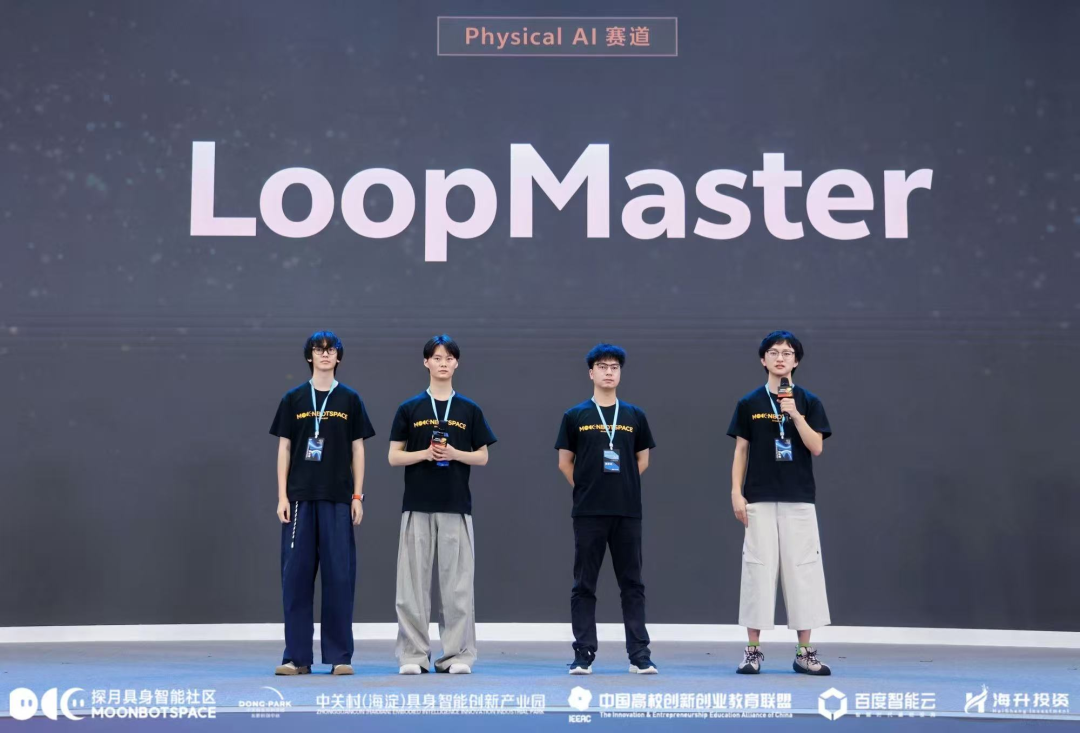
Team presenting at the roadshow
A Group of Individuals who had Previously Met Online, Experiencing their First Offline Ideation Collision
The four core members of LoopMaster include someone creating embodied intelligence content on Bilibili, a Ph.D. researcher in robotics and human-computer interaction, and someone transitioning from automotive product design to independent design.
They mentioned that what brought them together was their collaboration online over the past two years. Algorithms, ontology, data, low-cost robotic arms, product aesthetics – everyone entered through a different door, gradually realizing which gaps others could fill. Some of them met for the first time only at the hackathon venue, but the team had known each other for much longer.
動察 Beating: Please introduce yourselves and what you are currently working on.
Xie Jun: My name is Xie Jun. I am currently a second-year graduate student at Northeastern University, and I also create content related to Embodied Intelligence on Bilibili. I am currently mainly involved in the startup incubation of LoopMaster.
Zou Yanwen: My name is Zou Yanwen, and I am currently a Ph.D. student at Shanghai Jiao Tong University in cooperation with the Smart Innovation Program. My main focus is on Embodied Operation and Human-Machine Interaction for Embodied Intelligence.
Li Pengdong: I am Li Pengdong, a second-year graduate student at Taiyuan University of Science and Technology, and I also create content related to Embodiment on Bilibili. By the end of 2024, I was one of the early implementers of ALOHA and created an open-source tutorial for the process. Later, I developed several robots, and finally built a dual-arm lift robot, striving to make it completely open source to enable students with limited budgets to replicate it.
Xu Xinhao: I am the team's designer. I previously worked in product design at a car company, but later started working on Xiaohongshu (Red) and my own brand, offering design services. I am now an independent designer.
Dynamic Insight Beating: Did you team up because of this hackathon? Are you now ready to start a formal business together, or are you still juggling your own affairs?
Xie Jun: We have known each other much longer than just this hackathon, almost about two years. In the early days, there was a lot of online collaboration, with everyone working on Embodied Intelligence-related projects. I first met Pengdong when I was posting videos on Bilibili, and I have always been interested in Xinhao's design work. Yanwen was in the United States studying but was also working on related content.
Not everyone in the team had met offline early on. Some met for the first time at the hackathon, but this team was not put together at the last minute. In the past, we have always exchanged ideas on algorithms, ontology design, and data, and have worked on DIY kits and early-stage products, some of which have been sold. To manage simple external business affairs, we have also set up a few small companies.
Our previous status was more like a geek's lab or studio, not yet a complete startup company. Now, Pengdong, Xinhao, and I plan to continue working with Control Union to move the project towards a direction that can truly be implemented. Yanwen is still studying and will not be coming out full-time for now.
Dynamic Insight Beating: Before the hackathon, you had already spent about two years on R&D and some commercialization attempts. How did you navigate through this period?
Xie Jun: When we first met, we were all students who had just entered or were in the early stages of our academic journey. Initially, we were just a group of Embodied Intelligence enthusiasts, discussing how to approach algorithms, ontology design, and data. Later on, we had DIY kits and some early products that we sold, gradually transitioning into external business and small company formats.
So before the hackathon, we weren't a complete startup team yet; we were more like a group of people who had been working on things and meeting online. The competition just allowed all this accumulation to come together for the first time in the same place.
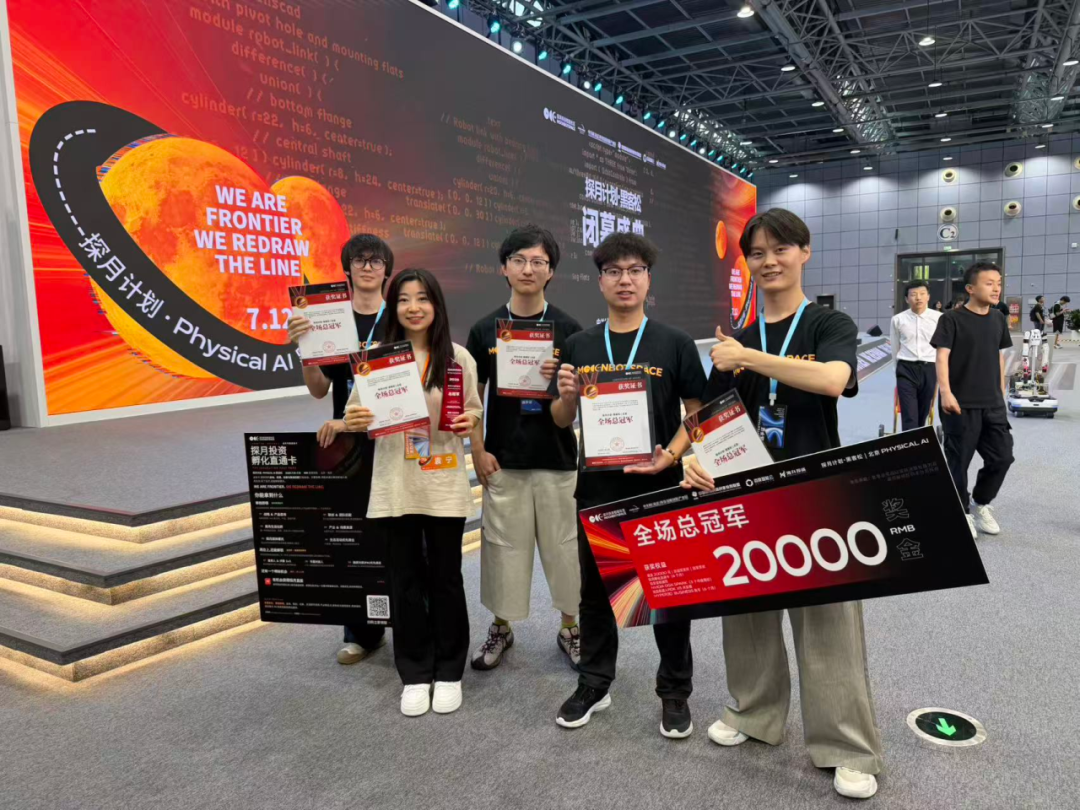
Team Members Group Photo
Insight Beating: Why Could LoopMaster Win First Place in the Lunar Exploration Smart Hackathon? What did these 48 hours really test?
Xie Jun: First of all, it was the accumulation of the past two to three years in smart embodiment. The robot's ontology, control, algorithms, and data were not developed starting from the competition. The robot form and retail scenario of LoopMaster were proposed and implemented on-site, but being able to develop it in a short time relied on the long-term cognition and technical accumulation prior to this.
During the competition, we combined the ontology, smart embodiment cognition, robot control experience, and algorithm thinking to create this collision and spark.
Zou Yanwen: The hackathon tested comprehensively. Internally, the team needed clear division of work, and each person's tasks needed to be solid. Technically, you had to quickly put together something that originally only existed in your mind. With little sleep, high intensity, people enter a very special working state. This is also why many people enjoy hackathons.
It's not just about technology. In the end, you must package things into a product and create a demo that can be shown to businesses and for practical application. You need to judge the presentation effect and have a sense of what needs to be accomplished at each time point within the 48 hours. This time, we cooperated quite well in terms of division of work, project pace, and final pitch.
Insight Beating: What is the biggest difference between Hardware Hackathons and Software Hackathons?
Zou Yanwen: In software hackathons, many people can just set up their computer environment and start working directly; what they do is mostly geared towards the final deliverable. Hardware is different; many unexpected issues unrelated to the project itself can arise on-site.
On the first day, we encountered a network connection issue that took a lot of time to resolve. Someone may accidentally burn a board, and someone may have to temporarily switch to a new one; the on-site robotic arms and robot platforms may also malfunction. The same goes for our platform. Dealing with real-world hardware, you will constantly encounter unforeseen events that were not part of the initial plan. They may not necessarily be related to the problem the project aims to solve, but they will consume your most valuable time.
5th Generation Robot and the Removed Waist Joint
The LoopMaster on the competition field is not a robot that was created out of thin air in 48 hours. Li Pengdong said they have been working on this type of robot for two years, and the latest version is the fifth generation. The previous generations of robots encountered many issues. The load, accuracy, backlash, and lifespan of the servos, a wire pulled too hard, a failure that emerged after adding a new feature, all could make a seemingly agile robot come to a halt.
One of the most interesting trade-offs was when they first gave the robot a "waist," but then removed the waist joint in the fifth generation. The waist joint could expand the robot's desktop workspace, allowing the robot to reach further. However, they also wanted to make the product simpler, more stable, and easier to replicate, so they accepted a regression in the mechanical structure.
Dynamic Beating: If a store places an order today, what will it actually receive? What can the robot do in the store?
Xie Jun: The product we envision is a robot with an omnidirectional wheel chassis, a lifting mechanism, dual robotic arms, and a front tray. When the store owner takes it back, they can use relatively simple remote control or natural language commands to make it familiar with the store's warehouse, shelves, and item locations.
In a retail scenario, it mainly handles tasks such as grabbing and delivering orders after a customer places an order, as well as restocking and placing items on shelves. The front tray can hold some items in advance, and the robot can also use it as a transfer station between picking and delivering.
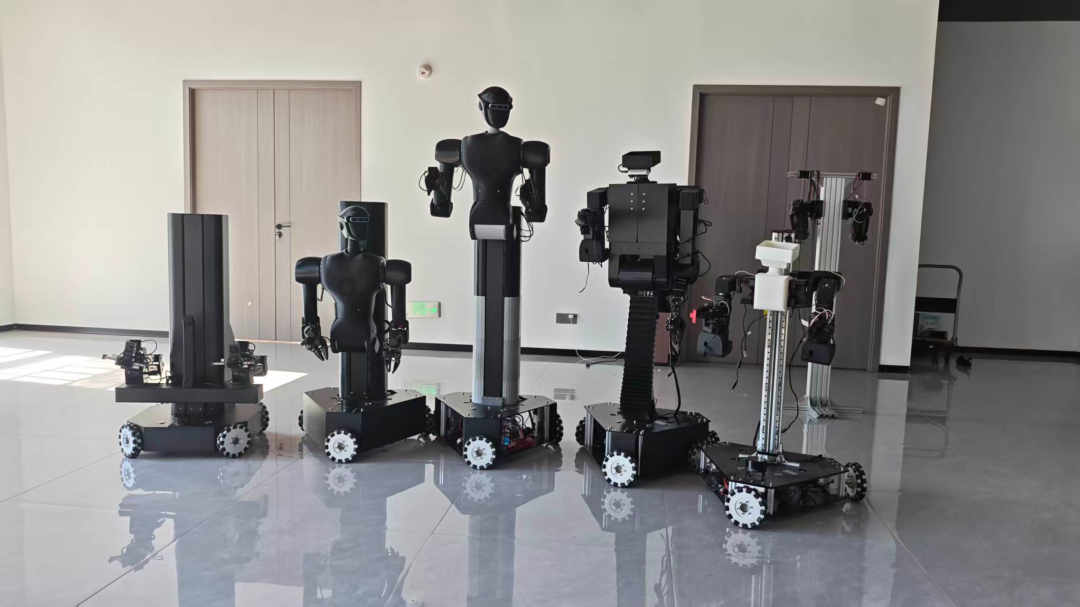
A robot iterated five versions in two years (from right to left)
Dynamic Beating: Has it been tested in real stores or simulated stores?
Xie Jun: Not yet. We have tested it at the competition venue and have hundreds of records.
The theme of this hackathon is to create something from scratch in 48 hours. Based on the existing wheeled dual-arm chassis, we conceived retail scenarios, application methods, and algorithm frameworks on-site. So, how users will use it and how the product will be implemented are still very preliminary.
Dynamic Beating: What metrics will be used to judge if it meets expectations?
Xie Jun: It will be done in stages. First, stabilize the main body, including the motors, wiring harness, and overall functionality. Then, ensure the stability of the Agent control framework. Further down the line is the issue of self-evolutionary learning. Only after each aspect is stable will we discuss formal commercialization.
Interview: Evolution of MotionEye: How has this fifth-generation robot evolved from its initial concept to today? What changes have you made to your understanding of the product?
Li Pengdong: The first four generations mainly used servo motors, which are also known as servos. They are more responsive in control, and the drive and structure are relatively simple, but they have limited load capacity.
Later, we made a version with a three-wheel omnidirectional chassis, added a lifting column, and dual arms. After completion, we found that its working range on the desktop was very small, roughly the size of a computer, and it couldn't reach further away. We then made a version with a waist to expand the working space on the desktop.
Next, we changed the structure, which originally relied heavily on 3D printed parts, to a sheet metal-based mainframe, improving stability. However, the more features we added, the more issues arose. For example, if the wiring harness is slightly pulled, the entire robot may pause its task; the body became heavier, reducing the payload capacity. The fifth generation ultimately switched to joint motor modules, more metal parts, and a simpler structure. We reinforced where needed and removed unnecessary parts, hoping to find a balance between performance, cost, mass production, and reproducibility.
Xie Jun: Starting from the end of 2023, we used servos to create a low-cost, high-performance physical intelligent system. In practice, servos have limitations in stability, backlash, accuracy, and lifespan. After switching to joint motor modules, both cost-effectiveness and stability have been significantly improved.
Interview: Was there a specific feature in the iterations that you particularly wanted to keep but had to eventually remove?
Li Pengdong: The waist joint is the most direct example. The fourth generation already had a waist, and we initially wanted to keep it in the fifth generation. However, to simplify the structure, we decided to remove it. Although it may seem like a step back in mechanical structure, we actually prioritized reliability.
Interview: Why was this machine made completely open-source? What is the current cost and price positioning?
Li Pengdong: The main body is completely open-source, and anyone can view the BOM (Bill of Materials). According to our initial estimate, if users machine some parts themselves, purchase standard parts, and complete assembly and debugging, the cost is approximately 30,000 RMB.
If users want to receive a semi-finished product or directly get a robot that is already calibrated, because it is fully open-source, we expect the price to be below 50,000 RMB, around 40,000 RMB. This pricing is primarily for the main body and research and development purposes. We want students and developers in the community with limited budgets to be able to participate, without being blocked by the high cost of the main body.
Dynamic Inquiry Beating: After a customer purchases a machine, will there be any subscription service or other hidden costs?
Li Pengdong: Currently, we do not see subscription services as a clear business model. The unmanned vending robot developed in 48 hours this time is initially just a demo.
In the future, if we truly enter unmanned retail or specific retail scenarios, we will design a charging method based on the corresponding scenario. We haven't thought that far ahead for now.
Dynamic Inquiry Beating: Why did open source become an advantage for your award this time?
Xie Jun: This may also be a key reason we won the award. After full open-sourcing, with the underlying libraries, code, and drivers all open, the Agent can access this content, making development smoother. It makes hardware development somewhat closer to pure software development, with the underlying code being readable and callable, reducing the resistance to on-site iteration.
For us, open source is not just a technical choice. We hope that more students, professionals, and people from other industries can participate in embodied intelligence in a relatively low-cost way.
Small-Scale Demonstration, Not Small-Scale Training
LoopMaster repeatedly mentioned "small-scale demonstration" in the interview. The common small-scale demonstration takes a person's operation trajectory as supervised data, inputs it into imitation learning or visual-linguistic action models for training, and finally lets the model infer. What the team is talking about regarding small-scale demonstration is somewhat different.
What they have to deal with is a relatively structured store space. The containers' positions are relatively fixed, and the grasping actions for a row of products are similar. They first record a trajectory for the robot, move the base to a different position, and the robotic arm may still be able to reuse a similar action. They first encapsulate similar tasks into skills and hand them over to the Agent for scheduling.
The logic of this route is also easily understood. Without deployment, there is no real data; without real data, subsequent training of end-to-end models is impossible. They first allow a not-so-smart but functional system to enter the field and then gradually grow the data.
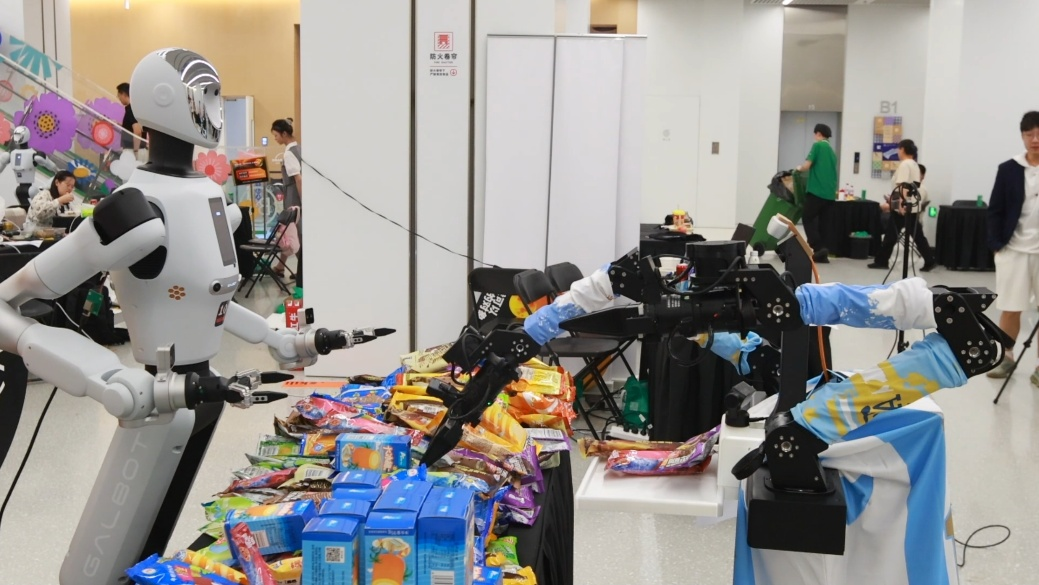
Cyber Salesman, Restocking Demo
Dynamic Inquiry Beating: What is the difference between your "small-scale demonstration" and the common small-scale demonstration in embodied intelligence?
Zou Yanwen: Our version of small-scale demonstration is different from learning-based small-scale demonstrations. In traditional imitation learning, people use a few expert trajectories as supervision signals, input them into networks like ACT or VLA for training, obtain a neural network, and then use it for inference.
We are currently recording trajectories, but these trajectories are not used directly for training. For example, the shelves in a supermarket are relatively structured. After a teaching trajectory is recorded for a row of shelves, when picking the first item in this row, the robot moves from a certain position; when picking the second item, the base shifts slightly, and the robotic arm can still complete the action along a similar trajectory.
For now, we are not pursuing generalization in continuous space. Instead, in a discrete space, we organize relatively fixed positions into a structured procedure and encapsulate similar actions into skills for the Agent to schedule.
Dynamic Observation Beating: Will this make it difficult for the robot to adapt to different types of offline stores?
Dr. Zou Yanwen: There will be boundaries. However, I believe that the end-to-end models seen at the current stage also face this issue. They also need to collect data in specific scenarios, then undergo retraining and iteration. Changes in lighting conditions or swapping a bag of Lays chips for a bottle of Pepsi will introduce variations.
What we want to do is first get things running with the Agent framework. It may seem less elegant, but once deployed, the interactions between users and robots will themselves become data for this scenario. These expert trajectories can still support the iteration of end-to-end models.
Dynamic Observation Beating: Who will teach the robot? Why is it necessary to have an Agent self-evolution loop?
Dr. Zou Yanwen: It is not possible to deploy engineers to every store. Only store managers and employees who can learn to teach robots in their own environment, much like learning to use an electric fan, can potentially collect new data in real scenarios.
Natural language interaction and the Agent Loop are designed for this purpose. Our vision is to minimize the human intervention required, allowing the Agent to reflect, adjust, and schedule different skills to complete tasks. This is still a framework being refined, not a proven answer on a large scale.
Dynamic Observation Beating: The introduction mentions "iterating sales behavior based on sales metrics." Does this mean that the robot, apart from doing manual labor, also has to take on a sales task?
Dr. Zou Yanwen: The sales metrics mentioned here do not imply that the robot has to engage in sales. In a retail chain, supply chain management is already crucial, and there is sales data in the backend. Once the robot is involved in front-end labor, the store's sales data, peak-hour foot traffic, shelf display, and restocking logs will all become part of its understanding of the site.
This data can be sent back to the backend for supply chain and display optimization, reducing stockouts and waste near the expiration date. It still represents frontend work, just records collected during the work process that can enter the closed-loop of store operation.
40% of the Account, and the Matters Left to Humans in the Store
When robots enter the retail scene, the easiest thing to calculate is wages. LoopMaster has provided an estimation of "40% reduction in sales costs," but the team also acknowledges that this number is based on the expectation that a robot is stable enough to operate with minimal human intervention in the long term.
More challenging to calculate is the human factor. Currently, they intend to assign tasks such as stocking, picking, and replenishment to robots; in the more distant future, they do not rule out the possibility of robots replacing more human labor. However, when it comes to interpersonal communication, they also believe that this is an area where humans cannot be replaced by machines.
Dongcha Beating: How Was the Figure of "40% Reduction in Sales Costs" Calculated?
Xie Jun: Our calculation compares the purchase cost of a robot, daily token costs, electricity costs, and minimal maintenance costs with the salaries of two employees. Calculated based on a two-year payback period, the result shows a reduction of approximately 40% in traditional store sales labor costs.
Dongcha Beating: Do the Costs of Maintenance, Repair, and Human Intervention that Store Managers and Staff Cannot Solve Factor into It?
Xie Jun: The premise of this figure is that the final product achieves the expected stability. Before true commercialization, we need to solve issues related to motors, wiring, obstacle avoidance, and jamming, reaching a benchmark of long-term continuous operation without human intervention before discussing such calculations.
Maintenance will certainly exist. In case of severe breakdowns, on-site engineering intervention or repairs may be necessary. If the structure is modular enough and sufficiently simple, we can also provide repair tutorials. In the future, if there are enough robot deployments, repair services akin to fixing phones or computers may emerge. We hope to minimize maintenance costs as much as possible.
Dongcha Beating: In an ideal retail store, what tasks will humans and robots respectively undertake?
Zou Yanwen: It will be a step-by-step process. The first step will undoubtedly involve stocking. Later on, this can be expanded to picking from the warehouse, partial interaction with customers, or integrating different robotic and AI capabilities. Further down the line, based on the context and sales metrics already established by the store, some operational management assistance will be provided.
Insight Beating: When a Regular Customer Walks into a Robot-Run Store, What Is Their Journey of the Heart? Will They Trust It?
Xie Jun: At first, they may find it novel and fun, and may not immediately trust it. But if every store has a robot in the future, people will gradually get used to it.
We already see scenarios where robots are selling ice cream. They may also establish their own brand. For example, a fully robotic restaurant where drinks and snacks are all made by robots. If the products are delicious and unique, and cannot be found elsewhere, customers may not only see it as a substitute for human labor.
From the operator's perspective, robots may also have advantages in terms of hygiene, personnel costs, and inventory management. They can help stores reduce unnecessary food expiration and waste.
Insight Beating: Do You Agree that "Replacing Labor" is the Most Direct Business Logic for Robots? Which tasks still require human intervention?
Xie Jun: The interaction between people, smooth companionship, and warmth are still challenging for current robots to provide.
In the long term, if robots are controllable enough and their AI is smart enough, complete substitution of human labor is not an unrealistic expectation. However, in some sensitive scenarios, progress may be slower.
Insight Beating: Both the model and ontology are updated quickly. If a merchant buys a robot expecting a two-year return on investment, will they face hardware depreciation and obsolescence in the second year?
Xie Jun: Hardware obsolescence is inevitable, just like computers and phones are replaced after a few years. We do not promise that a robot can work healthily for 30 years; a more realistic target is 5 to 10 years.
Short-term updates within one or two years will bring depreciation. Therefore, when designing the product, we will try to make components like joint motors and structural parts reusable for the next generation. We prefer the brain to be updated more frequently than the body. Software can be upgraded online, possibly with a new version every few weeks or several versions in a month; the body will strive to remain universal for a longer period.
Using the YunTree G1 as an example, Xie Jun believes that a common body form may still be valuable one to two years later. For LoopMaster, they hope that the earliest sold robots do not have to be replaced entirely with every algorithm update.
First Place the Body in the Store, Then Discuss the Moat
Unlike many entrepreneurial teams who often talk about "grand narratives," LoopMaster's response is more sincere. Xie Jun directly states that what they can currently articulate is a low-cost body, a refining Agent self-evolution framework, and a path they hope to take to enter real scenarios earlier than end-to-end solutions and accumulate data.
The team members are all post-2000s, and they acknowledge their lack of experience in complex offline supply chains and B2B business. While a competition can showcase a prototype, true retail deployment involves challenges such as procurement, after-sales service, customer decision-making, reliability, supply chain, and funding. Everything takes more time than a pitch.
Interview Excerpt: Facing Mature Big Companies and Robot Manufacturers, What Do You Consider Your Moat to Be?
Xie Jun: At the current stage, our advantages are, first, a low cost base. Second, this relatively new Agent self-evolution framework. Third, if we can be the first to enter a real-life scenario, we can obtain data on real machine operation, user interaction, and the commercialization process earlier.
However, as for a specific commercialization moat, we have not fully figured it out yet. We hope to first develop these capabilities and then find truly valuable aspects during deployment.
Interview Excerpt: Being Post-2000s, Dealing with Offline Stores, Supply Chains, and Consumer Scenarios, Do You Lack Experience? What Challenges Have You Encountered?
Xie Jun: Yes. At the current stage, the team members are all post-2000s, lacking experience in commercialization and B2B. If we are to truly commercialize later on, we may need to bring in experienced commercialization partners and learn from people in the industry who have done these things.
Interview Excerpt: In the Future, Will the Emerging Players in Offline Scenarios Be General Humanoid Robots or Task-Specific Designed Robots?
Xie Jun: I think both will exist. General humanoid robots are applicable to more scenarios, but in terms of energy consumption, complexity, and stability, they may not necessarily be better than specialized robots. Humanoids will have a stronger aesthetic appeal.
For scenarios like unmanned stores, a semi-humanoid system with mobility and upper body operation capabilities may already suffice. There's no need to carry all the complexity just to look human.
Interview Excerpt: What Is the Timeline for the Next Steps of Product Landing, Financing, and Expansion?
Xie Jun: After the competition, we had in-depth discussions and cooperation with Tan Yue. The ontology, as a laboratory and research tool, will progress relatively quickly. We expect some orders to come in within the next month.
However, the timeline for the actual deployment in specific commercial scenarios is currently uncertain. The team is still working on project coordination, as well as seeking resources, investment, and industry advice to continue iterating on the commercialization path.
Don't Turn Every Company into a New Lab
When asked about bubbles, Zou Yanwen felt that the current Embodied Intelligence bubble is more severe than the big language model bubble. He said that at least someone is already paying subscription fees for big language models, while many learning-based robots in embodied operations have not truly entered practical scenarios. If we calculate based on market sales rates, the bubble is actually larger.
At this stage, research on embodied intelligence is certainly important, but he believes that we really don't need so many Neo Labs. Each company must answer a simpler question: which scenario does it work in, and can that scenario support its transition to greater capabilities.
The team eventually brought the discussion back to open source. The ontology developed over the past two years is open to students and developers, and they also hope that people with design, artistic, and Chinese language and literature backgrounds will participate. Embodied intelligence will not only emerge in model papers and funding news; it also needs to be installed, taught, repaired, and interact with specific people in a specific store.
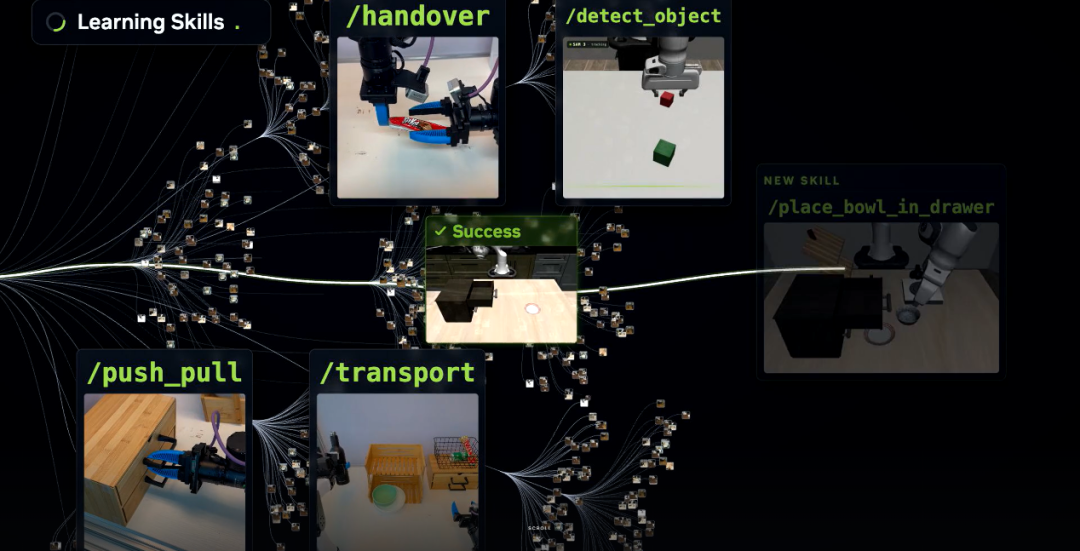
Skills Self-evolution
Dynamic Observation Beating: What do you think are the most likely bubbles to emerge in embodied intelligence next?
Zou Yanwen: I don't think its bubble is smaller than that of big language models. At least someone is already paying subscription fees for big language models. In embodied operations, many learning-based robots have not truly entered practical scenarios. If we calculate based on market sales rates, the denominator is very small, so the bubble may actually be larger.
In the near future, everyone may expect stronger capabilities to emerge with end-to-end strategies after data accumulation. But we must be cautious not to turn every company into a Neo Lab. Every startup team must clearly define its application scenario and whether that scenario can support its transition to the desired end-to-end capability.
Dynamic Observation Beating: Why do you say that the industry's current focus on embodied intelligence is somewhat inadequate?
Zou Yanwen: Traditional robots already have complex modules such as perception, decision-making, and control, each of which is a separate research direction. Today, when discussing world models, VLA, or low-level strategies, people often only look at a few building blocks in a tower of blocks.
These issues are certainly important, but if we want robots to truly land in practical applications, both the ontology and algorithms need to continue to iterate, commercial-grade components need to be selected, Agent Loops need to be constructed, and learning-based and non-learning-based methods both need to be implemented. Low-level strategies may grow larger in the future, even swallowing other modules, but for now, the most urgent task is to first build the entire building.
Dynam Beat: Why do you insist on open source and what kind of people do you hope to enter this industry?
Xie Jun: Pengdong and we spent two years on Self-Ontology, and we are still willing to open source it because we hope to attract more students, practitioners, and people from other industries to participate. With the help of AI and Agent programming, some people without a deep technical background can also quickly use robots and engage in exploration.
Now, many Embodied Intelligence Demos are somewhat homogenized. The industry needs new ideas. People in art and Chinese language and literature may bring a different understanding than those with a purely technical background. We said at the hackathon roadshow that we hope even non-tech-savvy small business owners can also use robots at a lower cost, allowing them to take on some of the work of sales clerks. This is the original intention of our open source and lowering the threshold.
We also thank the Lunar Exploration for giving the team a demonstration and collaboration opportunity. We hope the project can continue to move forward, and we also hope that the entire industry can bring forth more new perspectives, new paradigms, and scenes that truly solve problems.
Dynam Beat: How do you view today's VC entry into universities, encouraging students and professors to start businesses, and the so-called Neo Lab trend?
Zou Yanwen: I am not sure if it can be simply said to be a good thing or a bad thing. One reality is that the university system finds it difficult to absorb the amount of funds and computing power that deep learning research requires. For some professors, going out to start a business, collaborating with companies, or creating organizations similar to Neo Labs may be a way to access resources.
However, this may also lead to overvaluation in the secondary market and raising a large amount in the first round. Perhaps some research indeed requires a lot of money, but it may not necessarily require so many people. How a research organization obtains resources and how a company is priced in the market are ultimately not the same question.
First, Draw the Floor
The 2016 movie "The Founder" tells the story of how McDonald's went from a restaurant to a franchise. At the beginning of the film, milkshake machine salesman Ray Kroc meets the McDonald brothers in San Bernardino, California. The brothers explain their "Speedee Service System" to him, and then on an empty lot, they use chalk to draw the kitchen, the serving counter, the fryer, and the positions where employees turn, making the employees simulate ordering, bagging, and delivering over and over again. Until this assembly line becomes smoother and smoother.
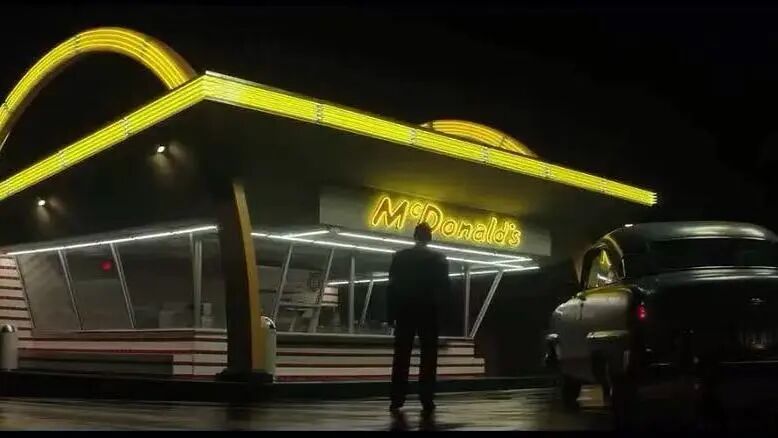
Frame from "The Founder" movie
First, someone remembered who always took the long route in a store, who would bump into whom when picking up food, and which action would make customers wait an extra half minute. Then came the blueprint, compressing the experiences of many into a set of actions that later people could follow.
In The Great Entrepreneur, what followed was another story. After turning a set of processes into a replicable business, who owned the standard, who owned the location, and who owned that brand, the issue was no longer just about the kitchen.
Of course, LoopMaster is far from this step. It has not yet completed real-world store deployment, and the commercial moat is still to be validated. However, this precisely gave weight to the somewhat unsatisfactory answers in the interviews. How data accumulates, who takes responsibility for errors, how sales metrics are not deceived by promotions and foot traffic, how much time the first store is willing to dedicate to learning—these are not trivial issues that disappear naturally once the machine is brought into the store.
LoopMaster now has hundreds of test records from competition venues, an open BOM table, a waist joint cut from the fifth-generation body, and a set of Agents in waiting for inspection. It is one floor away from a real store. Someone has to draw the lines there first.
Recommended
Desk: Brent Crude Tops $110, Musk's Net Worth Drops 528.6 Billion in Four Days After Tesla Roadster Launch
Oct 17, 21:49
JST Fifth Buyback and Burn Successfully Concludes: Over 170 Million Tokens Worth Approximately $23.53 Million Burned, Buyback Mechanism Set for Comprehensive Upgrade
Oct 17, 20:10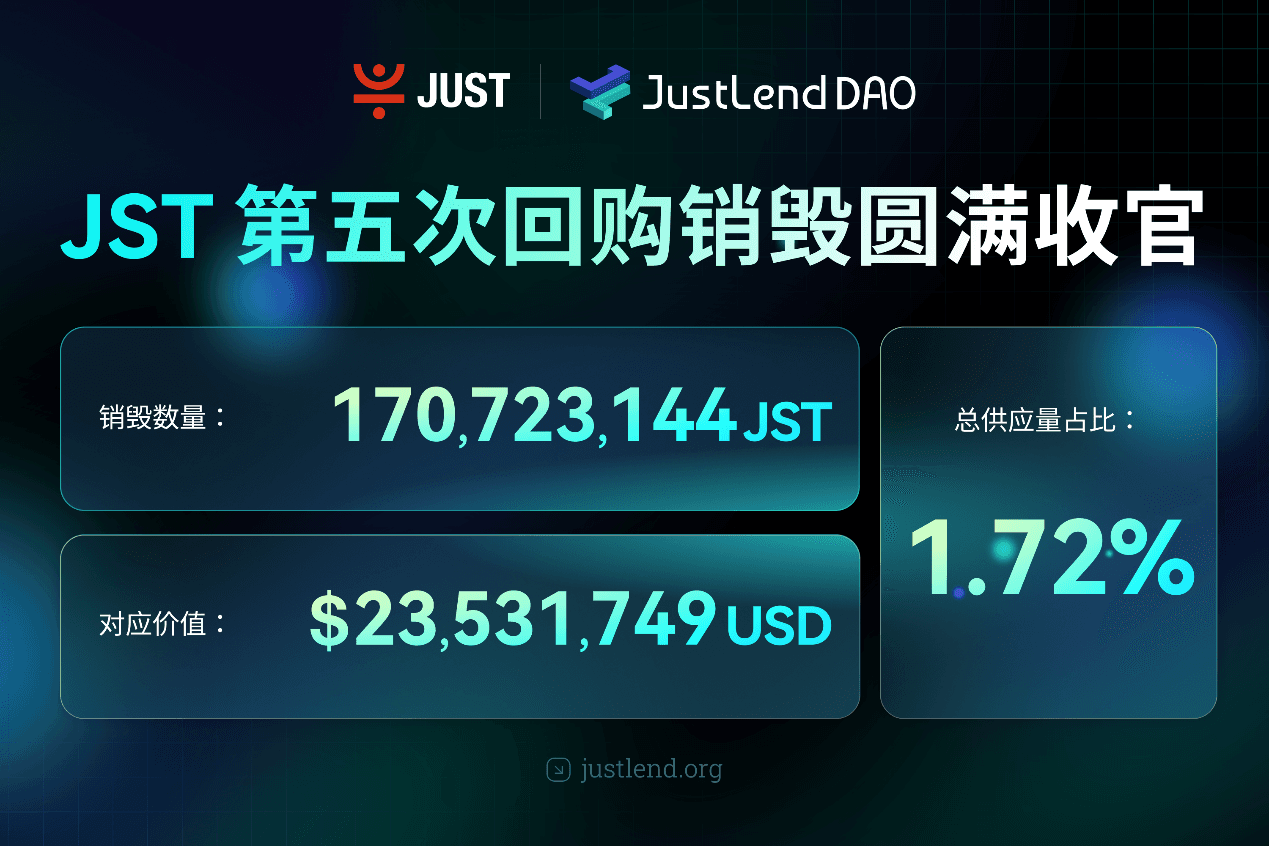
BitTorrent Brand Upgrade and Initial BTT Buyback & Burn Launch Simultaneously, Dual Engines Usher in New Era of Web3 Infrastructure
Oct 17, 20:00
Asia Market Daily: Japan's BOJ signals more rate hikes while Korea targets offshore perpetual platforms (2026/10/17)
Oct 17, 17:01Why did Papertrade backfire on you?
Oct 17, 17:01
The 'Strict Father' of Northern Myanmar: This Company Deploys 200,000 "AI Best Actors" to Strike Back Against Scammers
Oct 17, 15:34