A Decade of Running Together Yields Trillion-Yuan Return: Hefei ChangXin Emerges as the Biggest Winner of Growthstar's IPO
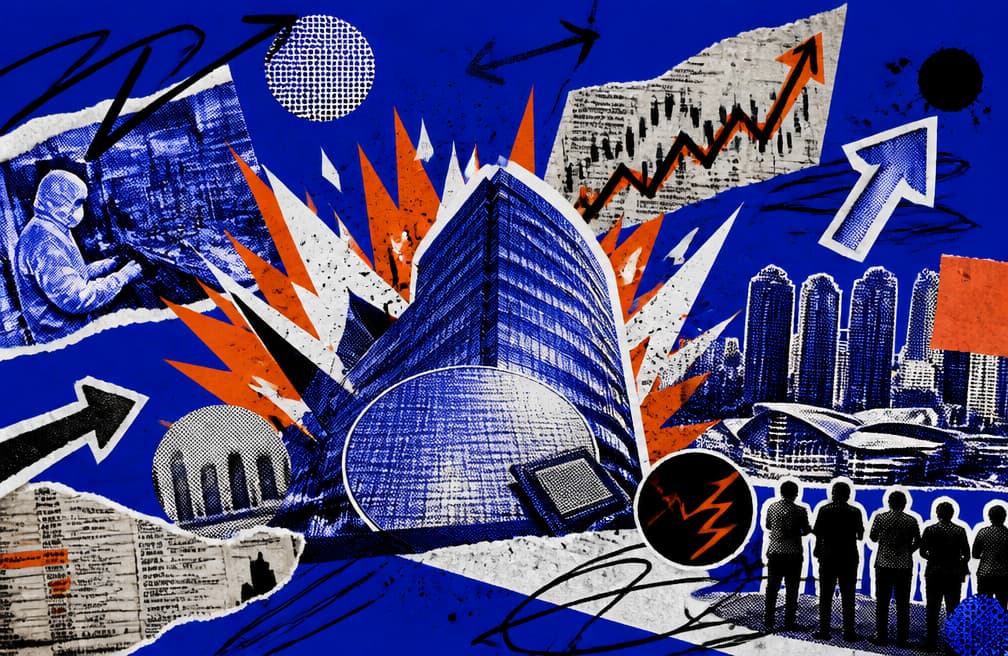
A city that bet on an "impossible to complete" project, suffered losses for ten consecutive years, burned through a total of 36.6 billion, and finally received a trillion-dollar return—this is not fiction, this is Hefei.
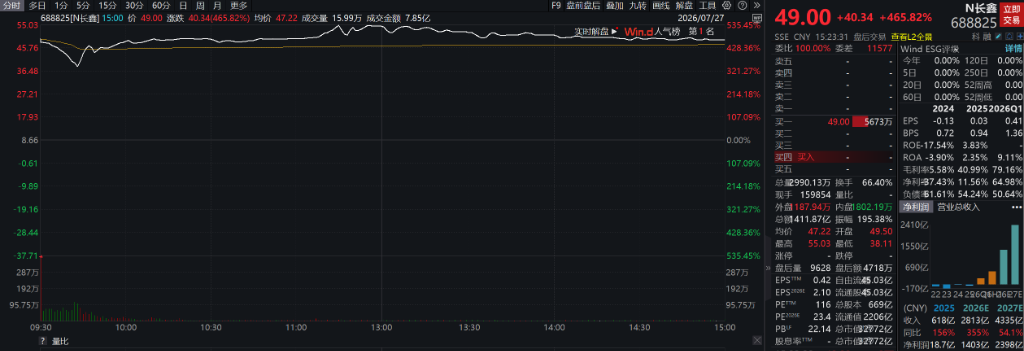
On July 27, 2026, Changxin Technology (688825) officially landed on the Sci-Tech Innovation Board, closing at 49 yuan, a staggering 465.82% increase from the IPO price. With a market value exceeding 3.2 trillion yuan, surpassing Industrial and Commercial Bank of China, it claimed the title of the A-share market leader. This Chinese top and global fourth-largest DRAM chip manufacturer, after a full decade since its establishment, now stands in the spotlight of the capital market.
And behind this company, standing steadfastly for a decade, is a city that is now quietly settling a historic bill. Calculated based on Hefei's state-owned asset system's approximately 36.79% shareholding, the corresponding book value has exceeded 12 trillion yuan. With the substantial market value increment brought by Changxin Technology, Hefei's A-share total market value has surpassed 4 trillion yuan, ranking second in A-share market value in the Yangtze River Delta region—a "bold gamble" from a provincial capital city in central China, inscribing the most stunning footnote in China's industrial investment history.
Twenty Years of One Man's Persistence
To understand why Hefei dared to invest, one must first understand the man, Zhu Yiming.
Zhu Yiming, born in Yancheng, Jiangsu, was admitted to Tsinghua University in 1989. After obtaining a master's degree, he went to the U.S. for further studies, focusing on semiconductors at Stony Brook University, State University of New York. After graduation, he entered Silicon Valley and served as a project manager at a memory chip company.
There, he saw an alarming fact: memory chips are the most consumed and standardized semiconductor category, serving as the "staple food" of nearly all electronic devices, yet Chinese players were long absent from this track.
In 2004, he made a destiny-changing decision—resigning to start a business in China. With a startup capital of $920,000, pooled together by several Tsinghua alumni, he founded what would later become Zhaoyi Innovation. After the Chinese New Year in 2005, in a bare two-story room in Tsinghua Science Park, he embarked on his journey. Instead of directly challenging giants like Samsung and Micron, he entered the NOR Flash "leftover material" market, laying the foundation. In 2016, Zhaoyi Innovation successfully went public.
But Zhu Yiming's ambition extended far beyond this. He once said, "If we liken the computer to a crown, the CPU is the jewel on the crown, and the memory is the base of the crown." "Whoever leads in memory technology can dominate the entire integrated circuit industry."
Building the Chinese version of "Samsung Electronics" has been his ultimate goal since day one of entrepreneurship.
Opportunity knocked in 2016.
Taking on the "hopeless situation" that others dared not touch, Hefei accepted the challenge
At that time, the global DRAM market was dominated by three giants—Samsung, SK Hynix, and Micron—holding 96% of the market share, while China had almost zero independent production capacity. The DRAM industry had high requirements for funding, talent, and technology. Its strong cyclical nature led to extreme price fluctuations, making losses an almost inevitable "entry fee" into the industry.
Back then, Hefei was not well-endowed. But Hefei made a decision—to forge ahead.
This was the strategic project later named "Project 506": a total investment of about 150 billion yuan in the Changxin 12-inch memory wafer manufacturing base. The first phase had a total investment of 18 billion yuan, with Hefei's industrial investment accounting for 14.4 billion yuan, a high 80% share. This figure in 2016 was equivalent to staking it all.
Even more commendable was Hefei's choice to "truly run alongside."
During the darkest moments of Changxin Technology's consecutive annual losses, accumulating more than 36.6 billion yuan in losses, Hefei's state-owned assets did not retreat, did not withdraw investments. In fact, when other investors exited at the end of 2024, Hefei even voluntarily put up nearly 2 billion yuan to take over the old shares. A person in charge of Hefei Industrial Investment once summed up the essence of this logic in a straightforward manner:
"For weak links in the chip and other industrial chains, the probability of achieving a capital return in the short term is very low. It must involve large capital, long cycles, and even span several cycles to eventually realize value investment."
This was not a gamble but a profound understanding of industrial rules by a city and a clear judgment of national strategic needs.
From Zero to One: The Perilous History of Chinese DRAM Development
The path Changxin has taken has been far more perilous than the outside world imagined.
During the same period as Changxin's establishment, Fujian Jinhua, due to being sued by Micron for stealing trade secrets, saw its investment of hundreds of billions halted on the eve of mass production. Changxin chose a different path—through legal negotiations, at the cost of "hundreds of millions of U.S. dollars," it acquired over 10 million DRAM technical documents, 2.8TB of core data, and a large number of Infineon DRAM technology patents from the bankrupt German memory giant Qimonda.
In 2018, Zhu Yiming made a decision that shocked the capital market: he resigned from his position as General Manager of Zhaoyi Innovation, fully dedicated himself to becoming the Chairman and CEO of Changxin Technology, and made a solemn vow—not to take a single cent of salary or bonus until the project became profitable.
A year later, in September 2019, Changxin Technology launched its self-designed and produced 8Gb DDR4 chip, marking a historic breakthrough for the Chinese mainland DRAM industry "from zero to one."
However, "from zero to one" was just the beginning. The real test arrived in 2023.
That year, the global DRAM prices plummeted by over 40%, with a decline in smartphone and PC shipments, leading the industry into a deep downturn. The three giants, leveraging their cost advantages, implemented a "counter-cyclical" strategy to maintain high shipments and further squeeze out new players.
Changxin continued to sell at a loss, but despite incurring massive losses, it accelerated the development of the 1x nanometer process, broke through the key technology barriers for DDR5 mass production. The company suffered a loss of 16.34 billion yuan that year, setting a new record for losses since its establishment, with a total accumulated loss of 36.65 billion yuan over the past decade.
Any other business entity, faced with this report card, would have exited long ago.
But Hefei did not. In the darkest moments of Changxin's consecutive annual losses, Hefei's state-owned assets chose time and time again to increase investment, provide resources, and offer support.
It was in this year that the Standing Committee of the Hefei People's Congress reviewed and approved a proposal for capital increase and expansion. By the end of 2024, Country Garden Ventures exited, and a Hefei state-owned asset platform stepped up to take over nearly 2 billion yuan of old shares without any hesitation.
Behind this, Hefei established a institutionalized fault-tolerant mechanism: project approval required deliberation by the People's Congress Financial and Economic Committee, major decisions required a vote by the Standing Committee, as long as the due diligence was compliant and procedures were followed, even if the project ultimately incurred losses, the decision-makers would not be held personally responsible. It is reported that Hefei has never disciplined any unit or individual for failed industrial investments.
It is this "loss-tolerant" institutional guarantee that allowed Hefei, while other cities hesitated, to truly become a patient capital.
Earning $400 million a day, filling a decade of losses in one quarter
The turning point quietly arrived in 2025.
The demand for AI computing power completely ignited a storage supercycle. An AI server's DRAM usage is 3 to 5 times that of a traditional server, and Samsung, SK Hynix, and Micron have all shifted their capacity to higher-profit HBM, significantly widening the supply gap for conventional DRAM.
Changxin Technology has just completed the product iteration from DDR4 to DDR5, with the capacity utilization of its three 12-inch wafer fabs steadily increasing from 85% to 95%. With surging demand, supply constraints, and capacity expansion, the triple benefits have achieved a textbook-perfect "Davis Double-click."
By 2025, Changxin Technology achieved annual profitability for the first time, with a net profit attributable to the parent company of $1.875 billion.
In the first quarter of 2026, the revenue reached $50.8 billion, with a net profit attributable to the parent company of $24.762 billion, a year-on-year growth of 1688%. This translates to a daily profit of nearly $400 million. At this rate, in less than half a year, Changxin has almost wiped out all the losses of the previous decade.
At this moment, the initial $14.4 billion investment in Hefei, along with continuous follow-up investments over the next ten years, has finally realized its value.
Beyond Trillion-Dollar Unrealized Gains: Industrial Transformation of a City
The visible $1 trillion is just the tip of the iceberg in the returns to Hefei.
Ten years ago, the suburban area of northwest Hefei where the Changxin plant is located was still a mixture of farmland and wasteland. Today, huge gray-and-white factory buildings spread horizontally for hundreds of meters, with dense silver air ducts, corridors, and industrial pipelines interweaving in mid-air; around the factory, research and development buildings, employee apartments, canteens, commercial centers, fast-food restaurants, and supermarkets have successively opened, jokingly referred to as "Changxin CBD."
By the end of 2025, the total number of Changxin Technology employees had reached 19,300, with over 6,000 of them being R&D personnel, mostly between 25 and 35 years old, with the majority holding a master's degree or above. These young, highly-educated, and high-spending employees are fundamentally changing the consumption structure and urban quality of the surrounding area.
The changes at the industrial chain level are even more profound.
Relying on the leading role of Changxin Technology, Hefei has already gathered more than 450 integrated circuit enterprises, forming a complete industry chain from design, manufacturing to packaging and testing, becoming one of the few cities in the country with a complete IC industry chain. In 2016, the output value of the Hefei IC industry chain was only about $18 billion. By 2025, this number had reached $151.4 billion, a 7.4-fold increase.
Of particular note is the industrial synergy effect. Changxin's memory chips, BOE's panels, NIO and BYD's new energy vehicles together form the industrial landmark of "Chip-Screen-Vehicle Alliance" in Hefei, creating a mutually supportive, deeply integrated industrial ecosystem—Jinghe Integrated Circuit manufactures display driver chips for BOE, Jiefatech supplies automotive-grade MCU chips to BYD and NIO, and the internal circulation of the industry chain is accelerating.
The "Hefei Model": Why Others Can't Learn It
After Changxin Technology went public, the outside world once again turned its attention to the "Hefei Model." In fact, about 50 research teams visit Hefei every month, writing millions of words of research reports, but have never been able to incubate a truly replicable example.
Hefei itself is also clear: this model has four prerequisites, and none can be lacking.
Strong Financial Foundation. In 2008, Hefei invested 6 billion in BOE, equivalent to 20% of that year's fiscal revenue. The Changxin project has borne a cumulative loss pressure of 36.6 billion over ten years. Without corresponding fiscal space shifting, this question simply cannot be answered.
Robust Error-Tolerant Mechanism. Hefei took the lead nationally in establishing a "due diligence and non-liability" system, where project decisions, as long as the procedures are compliant and the due diligence is in place, even in the event of a loss, the decision-makers do not bear personal responsibility. The local government has never disciplined any unit or individual for investment failures, providing the institutional confidence to "dare to invest."
Accurate Industry Judgment. Every time Hefei makes a move, it occurs at the industry's coldest moment—BOE during a global panel industry downturn, NIO when the stock price fell to $1 and 18 cities shut their doors, Changxin in the absence of Chinese players in the global DRAM market. This countercyclical layout is based on a systematic judgment of industry trends over many years, rather than chasing trends.
Wide Policy Window. Hefei caught China's manufacturing industry's golden decade shift from low-end to mid-to-high-end, with a real and urgent demand for domestic substitution. As pointed out by the Guojin Macro Song Xuetao team, Changxin "caught up" with the triple overlay of domestic substitution, storage security, and AI demand expansion, which in itself illustrates the forward-looking nature of national strategic planning.
The Paradigm Shift of Chinese Urban Development
Behind Changxin Technology's listing, a more macro proposition is emerging: apart from land finance, urban development needs a new engine.
Hefei's path provides an answer: Use state-owned assets as early-stage capital, then use the capital market to scale up, building a system that can consistently produce successful companies. During the peak period of real estate from 2015 to 2021, the total sum of land transfer fees in Hefei was approximately 551.6 billion yuan; while just Changxin Technology alone, the unrealized gains on the balance sheet from Hefei's state-owned holdings have reached nearly 1 trillion yuan.
This is not just a story of Hefei, but a paradigm shift in the competitive logic of Chinese cities: from “investment promotion” to “industry incubation,” from “relying on land for fiscal revenue” to “relying on equity for fiscal revenue,” from “relocating a single large enterprise” to “building up a thriving ecosystem.”
The IPO ceremony of Chaohua Tech is the final presentation of Hefei's decade-long patient capital accumulation, and it poses an unavoidable question to many other cities.
Recommended
Desk: Brent Crude Tops $110, Musk's Net Worth Drops 528.6 Billion in Four Days After Tesla Roadster Launch
Oct 17, 21:49
JST Fifth Buyback and Burn Successfully Concludes: Over 170 Million Tokens Worth Approximately $23.53 Million Burned, Buyback Mechanism Set for Comprehensive Upgrade
Oct 17, 20:10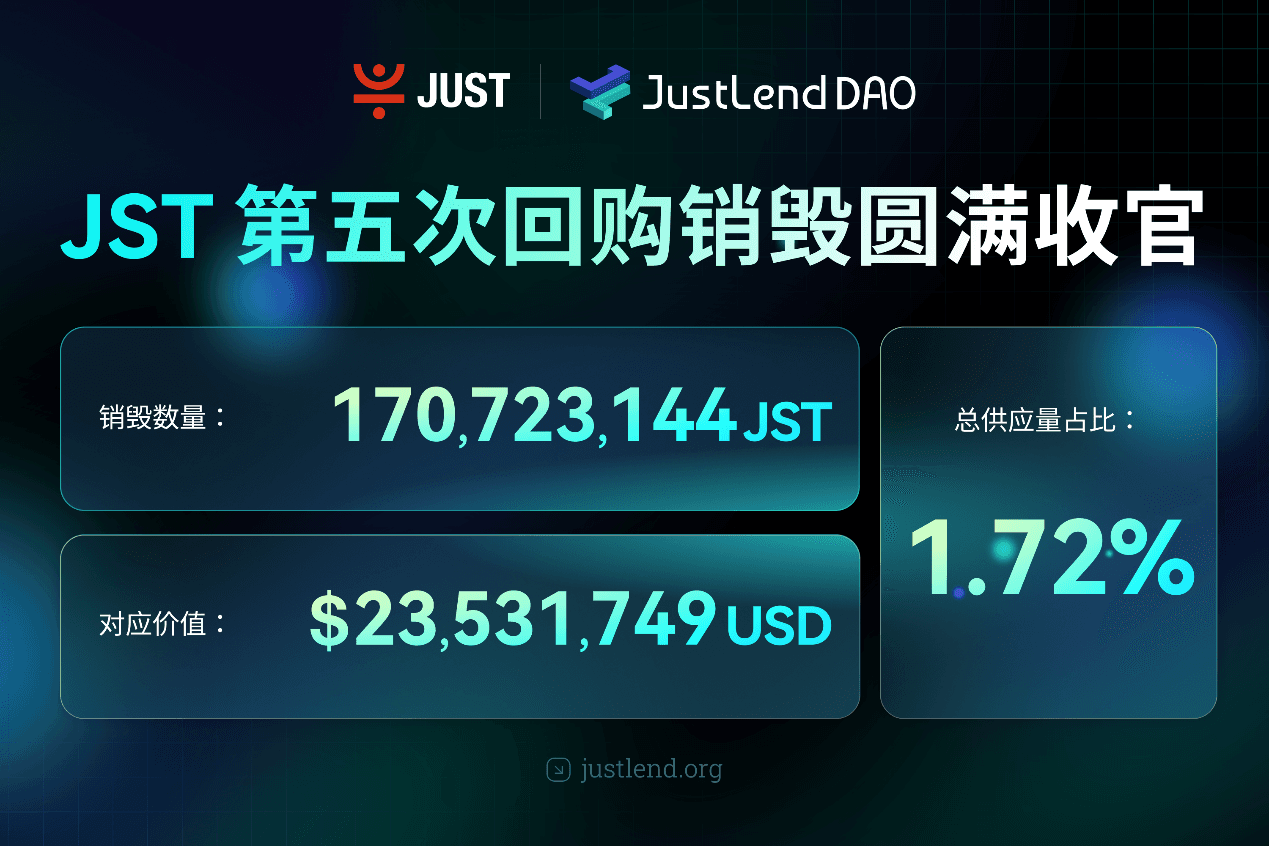
BitTorrent Brand Upgrade and Initial BTT Buyback & Burn Launch Simultaneously, Dual Engines Usher in New Era of Web3 Infrastructure
Oct 17, 20:00
Asia Market Daily: Japan's BOJ signals more rate hikes while Korea targets offshore perpetual platforms (2026/10/17)
Oct 17, 17:01Why did Papertrade backfire on you?
Oct 17, 17:01
The 'Strict Father' of Northern Myanmar: This Company Deploys 200,000 "AI Best Actors" to Strike Back Against Scammers
Oct 17, 15:34