U.S. Treasuries Pressure Powell: Hawkish Talk Not Enough, Market Wants Rate Hike
The U.S. Treasury market is sending a clear signal to Fed Chair Powell: A tough stance against inflation is far from enough to appease investors.
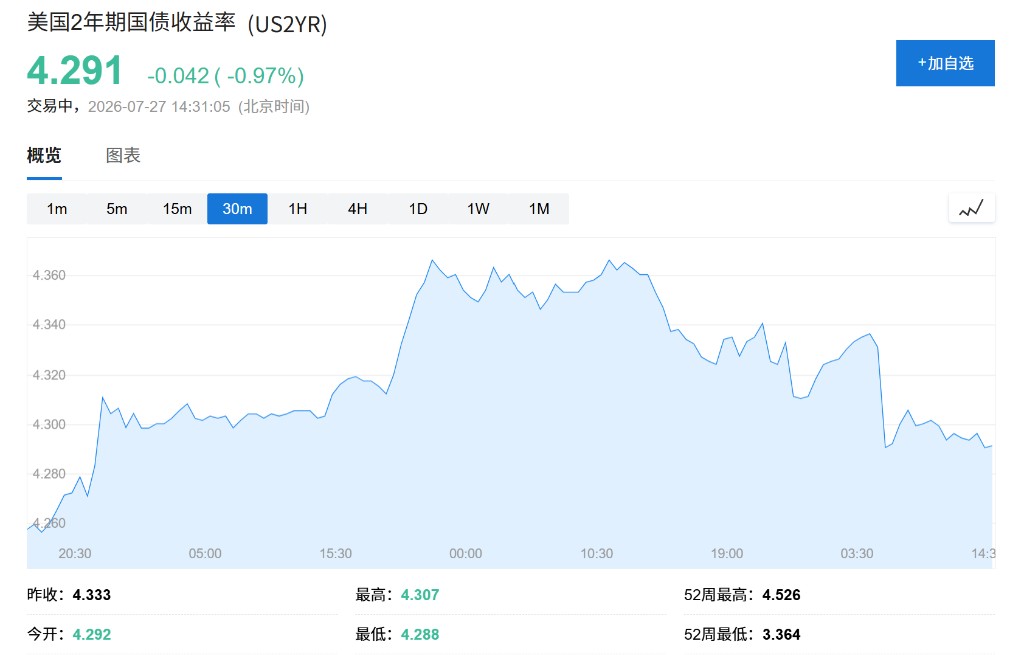
The July escalation of the US-Iran latest round of military conflict caught Wall Street off guard, with international oil prices briefly surpassing $100 per barrel and once again triggering a large-scale sell-off in the $30 trillion U.S. Treasury market. The benchmark 10-year Treasury yield has risen more than 30 basis points since the end of June, approaching 4.678%, nearing a near-decade high. At the same time, the 2-year Treasury yield, most sensitive to monetary policy, has also climbed to around 4.328%, surpassing the Fed's current 3.75% rate ceiling, reflecting the market's strong expectations for a rate hike.
On Wednesday, the Fed will announce this policy decision. According to the CME FedWatch Tool, as of last Friday, the market expected a 62% probability of keeping rates unchanged at this meeting, but the probability of a rate hike has surged from about 13% a week ago to around 38%.
"This shows how concerned the market is about inflation, and also how worried the market is about whether the Fed can be consistent in its words and actions." said Gennadiy Goldberg, head of US rate strategy at TD Securities, referring to Powell's series of public statements about pushing inflation back to the 2% target.
Oil Price Shock Adds to Bond Market Pressure, U.S. Treasury Yields Approach Decade High
The US-Iran conflict was the direct catalyst for this round of rising Treasury yields. The surge in oil prices heightened market concerns about a comeback in inflation, prompting traders to massively sell US Treasuries. According to GasBuddy data, the average prices of gasoline and diesel in the US have recently surpassed $4 per gallon and $5.20 per gallon, respectively.
After Powell's first press conference as Fed Chair in June, the US Treasury market briefly rebounded, but this uptrend quickly dissipated. The 30-year Treasury yield stubbornly stayed above 5%, causing significant losses to investors who had previously bet on long bonds.
David Rosenberg, founder and president of Rosenberg Research & Associates, wrote in a report last Friday: "We did not anticipate this latest chapter of the US-Iran conflict, which is a complex factor for any duration asset at present." He also pointed out that the issuance of tech-related corporate bonds continues to expand, putting pressure on the US Treasury market. Rosenberg stated that he has adjusted his portfolio, shifting the underperforming long positions in 30-year US Treasuries to short-term US Treasuries.
Paul Christopher, Global Head of Investment Strategy at Wells Fargo Investment Institute, said, "The Federal Reserve needs to heed this signal. Uncertainty is accumulating, and bond market investors are demanding appropriate compensation."
Rate Hike Window Debate: The Dilemma of Policy Action Cost and Timing
The Federal Reserve is not entirely unified internally. It is reported that some members of the interest rate decision committee are inclined to use rate hikes to curb inflation. However, the issue lies in the fact that the timing of any rate hike action is extremely sensitive.
Inflation itself erodes the real value of fixed-income assets, and rate hikes will further depress bond prices, acting as a drag on other financial assets such as stocks. Meanwhile, Barclays analysts expect the U.S. 2026 fiscal deficit to be around $2 trillion, with continued large-scale issuance of U.S. Treasuries being a key avenue to fill the gap, indicating that the short-term pressure on the bond market supply is unlikely to ease.
Furthermore, the massive borrowing in the technology industry is also amplifying the pressure on the bond market. Large technology companies, represented by "super-sized cloud computing giants," are competitively issuing corporate bonds to support the construction of artificial intelligence infrastructure, driving up the overall market's borrowing costs. Moody's Investors Service predicted in a report last Wednesday that the capital expenditure of these super-sized cloud computing giants will be close to $1 trillion in 2027, further soaring from nearly $800 billion this year, and warned that "increasing capital expenditure, rising leverage, and off-balance sheet commitments" will threaten the credit quality of this group.
Stock Market Faces Another Sharp Decline, Led by Tech Stocks
The shadow of high-interest rate expectations also hangs over the stock market. Last week, semiconductor stocks led the decline, with the Philadelphia Semiconductor Index falling by more than 4% in a single week. The Dow Jones Industrial Average fell by 0.4% for the week, the S&P 500 Index dropped by 0.6%, and the Nasdaq Composite Index plummeted by as much as 2.1%. The Nasdaq index has fallen by a cumulative 7.8% from its record high set in early June.
Higher interest rate levels often suppress corporate and consumer spending, dragging down economic growth and eroding corporate profit expectations. Wells Fargo's Christopher suggested that investors may want to wait for the end of this round of tech stock rotation, at which point there may be a "better entry point," and advised that "holding a certain amount of cash reserves may not be a bad idea."
Recommended
Desk: Brent Crude Tops $110, Musk's Net Worth Drops 528.6 Billion in Four Days After Tesla Roadster Launch
Oct 17, 21:49
JST Fifth Buyback and Burn Successfully Concludes: Over 170 Million Tokens Worth Approximately $23.53 Million Burned, Buyback Mechanism Set for Comprehensive Upgrade
Oct 17, 20:10
BitTorrent Brand Upgrade and Initial BTT Buyback & Burn Launch Simultaneously, Dual Engines Usher in New Era of Web3 Infrastructure
Oct 17, 20:00
Asia Market Daily: Japan's BOJ signals more rate hikes while Korea targets offshore perpetual platforms (2026/10/17)
Oct 17, 17:01Why did Papertrade backfire on you?
Oct 17, 17:01
The 'Strict Father' of Northern Myanmar: This Company Deploys 200,000 "AI Best Actors" to Strike Back Against Scammers
Oct 17, 15:34