NVIDIA's Credit Default Rate Surges, Is the AI Debt Bubble About to Burst?
TL;DR
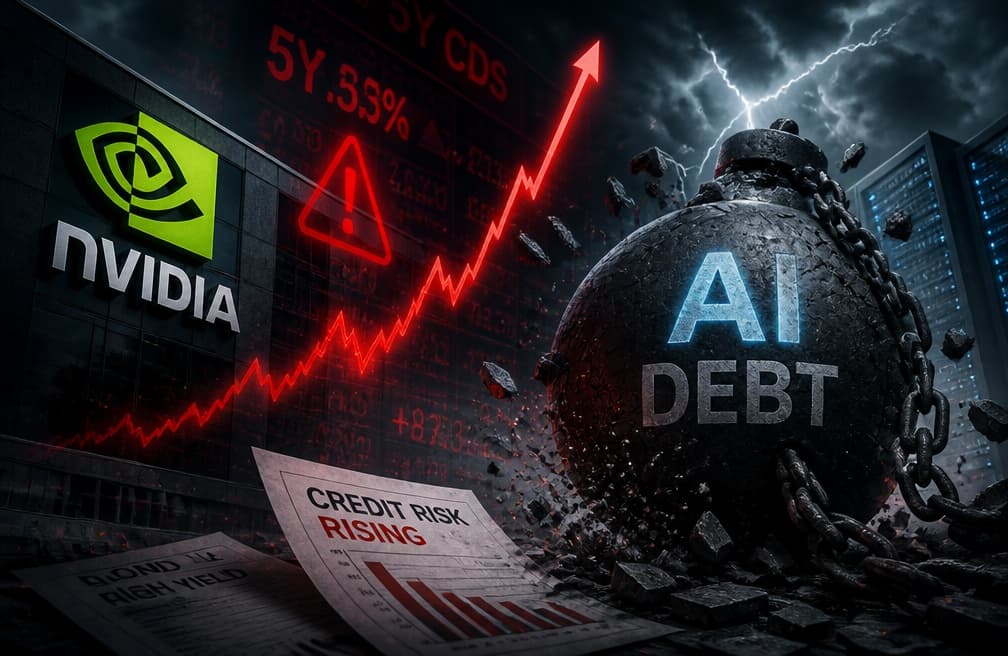
· Nvidia's 5-year CDS saw a midday spike on July 27 as credit investors began reevaluating AI infrastructure-related potential liabilities.
· Oracle's 5-year CDS, at around 1.25% during the same period, was higher than Nvidia's, indicating that the credit market has priced in the risk of AI cloud infrastructure expansion.
· Collateral and partnership frameworks can lock in forward demand and may also transfer customer financing risk back to Nvidia.
· Reference entities: Nvidia (NVDA), Oracle (ORCL), SK Hynix, Broadcom (AVGO), TSMC, Microsoft (MSFT), Amazon (AMZN).
According to Bloomberg citing ICE Data Services, Nvidia's 5-year default protection cost reached a high of approximately 0.82% in intraday trading on July 27, rising around 14 basis points in a single day, marking the largest daily increase since active trading began in November 2025 for this contract.
CDS can be understood as "default insurance" for company debt. A price increase does not mean the market believes Nvidia will default immediately but represents credit investors demanding higher risk compensation. For a company that was just upgraded to AA by S&P Global in June and still has a strong cash flow, the absolute level is not high, but the signal is worth noting.
On the same line, Oracle has been an earlier reference point for the credit market to observe AI infrastructure financing pressures. According to Bloomberg citing ICE Data Services, Oracle's 5-year CDS was around 1.25% during the same period, significantly higher than Nvidia's. While the two companies have different ratings, balance sheets, and business models, they both point to the same issue: the larger the AI data center orders, the more the credit market is concerned about who bears the risk of building and leasing this capacity.
What triggered this reassessment for Nvidia were two pieces of AI infrastructure news. One was that Nvidia was reportedly in discussions with OpenAI and SoftBank-related projects for up to $250 billion in financing guarantees. The other was the announcement by the SK Group and Nvidia of a $500 billion-plus AI plan and collaboration direction.
Equity investors are quick to see demand extension. The credit market, on the other hand, asks a different question first: If customer financing falls behind, who will provide credit for this round of AI infrastructure expansion?
The Credit Market is Testing Risk Allocation
For the past two years, the market has been accustomed to explaining Nvidia through demand. Cloud providers, AI companies, sovereign wealth funds are all buying GPUs, supply is tight, margins are high, and cash flow is strong. In this framework, the larger the customer's capital expenditure, the higher Nvidia's order visibility.
However, as AI data centers scale up, the question will shift from "is there demand" to "who can secure financing for electricity, land, servers, and chips first." If end-user cash flow has not yet materialized, vendors helping customers with financing may become a way to accelerate orders.
This is also why Oracle's CDS level has significance. It is not a GPU supplier but a cloud infrastructure and database company. However, the market's focus in recent years on its AI cloud expansion, data center construction, and customer concentration has been reflected in credit pricing. Oracle's 5-year CDS is around 1.25%, indicating that credit investors' risk premium requirement for this type of AI infrastructure exposure is higher than Nvidia's current level.
This does not mean that Oracle or Nvidia have an immediate default risk. CDS trading reflects marginal risk reassessment. For Oracle, the market is looking at the impact of cloud infrastructure expansion on liabilities, capital expenditures, and cash flow; for Nvidia, the market is assessing whether the originally light-asset, high-cash-flow chip supplier will partially bear customer-side financing risk due to guarantees or cooperative arrangements.
Credit investors are not looking at a growth story but at the payback order in extreme scenarios. Potential collateral, lease support, repurchase commitments, or other off-balance-sheet arrangements may not enter the debt item in the short term but could become real obligations when project cash flows are insufficient.
Therefore, the recent CDS spike trade is not about "Nvidia default probability surging." More accurately, the market is starting to reprice some orders that were originally seen as high-quality demand into tail risks.
Oracle's Reference: AI Cloud Orders Also Carry Credit Pricing
Bringing Oracle into this discussion is not because it shares the same obligations as Nvidia but because it shows the market that AI infrastructure expansion is no longer just a revenue story in the equity market but also a balance sheet story in the credit market.
The core narrative of Oracle is the growth in AI cloud infrastructure demand. Data center, computing power leasing, cloud service contracts, and large customer demand will enhance revenue visibility; however, on the other hand, such expansion usually requires upfront construction involving data centers, power supply, servers, networking, and long-term procurement arrangements. There is a time gap between revenue realization and capital expenditure, and the credit market will price this time gap in advance.
Therefore, the level of around 1.25% for Oracle's 5-year CDS can serve as a point of observation for the credit cost of AI infrastructure. It is higher than Nvidia's around 0.82%, reflecting not which of the two companies has a stronger business but how the credit market prices the differences in asset-liability structure, debt burden, and capital expenditure intensity.
This also explains why even though Nvidia's CDS is not at a high absolute level, a single-day jump still attracts attention. Nvidia has been seen in the past as in the closest position to the "shovel seller" in the AI cycle: receiving payment first, high gross margin, strong cash flow, and relatively low balance sheet pressure. However, if an increasing number of AI infrastructure projects require suppliers, cloud providers, energy companies, and financial institutions to jointly design financing structures, Nvidia's credit risk boundaries will be reconsidered.
In other words, Oracle's CDS has already been telling the market: the growth of AI cloud infrastructure is not free. The spike in Nvidia's CDS, on the other hand, raises another question: should chip suppliers also bear part of the credit cost for their customers' infrastructure expansion?
$250 billion Guarantee Still a Negotiating Variable
The most easily misunderstood point is to simply add the $250 billion guarantee and the $500 billion cooperation plan, and then write that Nvidia has assumed $750 billion in debt. These two matters are not of the same nature.
According to media reports, Nvidia is in talks to provide a maximum of $250 billion financing guarantee for OpenAI to lease SoftBank-affiliated data centers. The project involves the Ohio Pike County Portsmouth Site, in which SB Energy under SoftBank is involved, as mentioned in the Department of Energy's March announcement, planning to build 10GW of additional power generation and serve 10GW of data centers.
This is still in the early stages of negotiation. The terms, trigger conditions, guarantee limits, and accounting treatment are not yet finalized, and it cannot be written that Nvidia has already signed or assumed debt.
In plain language, a guarantee means that if the lessee cannot pay in the future, the guarantor may have to assume some responsibility. It does not mean that $250 billion is lent out today, but it will prompt investors to ask: Is Nvidia merely selling chips, or is it starting to use its own credit to help customers buy chips?
This issue will affect the valuation method. As long as Nvidia remains a high-margin chip supplier, the market will give it a "sell-shovel-to-miners" premium. If it starts taking on customer project financing risk, the quality of orders will depend on the terms, not just the scale.
SK Collaboration Resembles an Industrial Expansion Framework
The SK aspect needs a closer look. The more cautiously stated version is that SK Group and Nvidia announced a collaboration exceeding $500 billion in scale, including SK Hynix's next-gen memory collaboration, SK Telecom's 2GW data center, and more in the AI infrastructure space.
Such collaborations can strengthen Nvidia's position in the Korean AI infrastructure and memory supply chain. High-bandwidth memory is a key enabler for AI chip scaling, and SK Hynix is a core supplier. For equity investors, this represents a deepening of Nvidia's ecosystem ties.
However, it should not be automatically construed as a formal procurement contract, nor should it be directly understood as Nvidia guaranteeing SK's $500 billion plan. Collaboration plans, supply directions, data center construction, and financing responsibilities are commitments at different levels.
What the credit market needs to look at is the legal strength. What is merely a collaboration framework, what will turn into procurement commitments, what will become financing guarantees, and what needs to be disclosed in financial reports as contingencies or liabilities. The larger the number, the more crucial the terms.
Seller Financing Analogy Enters Pricing
In this discussion, a frequently mentioned analogy is the seller financing in the 1990s telecom equipment cycle. Equipment vendors helped finance the purchase of their products by the operators to sell more equipment. During the boom period, it seemed like a win-win — faster customer deployment and revenue growth for the vendors.
The risk is that if customer business revenues are slower to materialize than expected, the vendor will not only lose orders but may also bear financing losses. Revenue growth and credit risk will be on the same chain.
Nvidia cannot be mechanically fit into this historical template. It is not a second-tier equipment vendor from that era; GPUs still hold a pivotal position in AI training and inference, with stronger bargaining power, cash flow, and ecosystem control. The current CDS absolute levels also remain within the range understandable for investment-grade companies.
The situation with Oracle also cannot be simply mapped to the seller financing template. It is more like one of the hosts in the AI cloud infrastructure expansion: it needs to first build and secure computing power, then wait for customer demand to translate into sustained cash flow. The credit market pricing Oracle's CDS higher is essentially requiring it to pay a risk premium for its heavier infrastructure role.
However, this analogy highlights a shift: as the industry moves from supply shortage to large-scale capital expenditure, investors cannot just ask who can sell more chips, but also who is providing the credit for expansion.
Terms Disclosure Determines Valuation Anchor
For NVDA shareholders, this event is not yet a balance sheet crisis, but a change in the valuation anchor. The market is shifting from "how big are the orders" to "what conditions are needed for the orders to be fulfilled."
Oracle's CDS price provides a reality check: as the AI infrastructure narrative aligns with higher capital investment, longer payback periods, and a more complex customer structure, the credit market demands compensation ahead of the equity narrative. Nvidia currently boasts a stronger cash position and lower absolute CDS levels, but the market is already testing whether it will move from "selling chips" to "providing credit support for chip demand."
If subsequent disclosures show that the collateral size is limited, trigger conditions are stringent, project cash flows are clear, and the SK partnership gradually transforms into real orders, then this CDS reaction may just be an early pricing of opaque terms. The equity market may still interpret it as the cost of locking in demand.
Conversely, if similar arrangements continue to emerge, collateral size expands, project repayment relies on a longer-term AI commercialization, and financial disclosures remain opaque, the market will continue to depress the valuation assumption of "risk-free chip selling." At that point, Nvidia's issue will no longer be about the existence of demand, but about how much credit support is needed to fulfill that demand.
The variables that can change the assessment will hinge on specific terms: whether collateral is signed, if limits are set, when triggers occur, how disclosures are made, whether rating agencies reassess, and whether the data centers slated for launch between 2027 and 2028 can generate sufficient cash flow. Once information is available, the market can determine whether this CDS upheaval is short-term noise or an early warning of the AI infrastructure financing cycle.
Recommended
Desk: Brent Crude Tops $110, Musk's Net Worth Drops 528.6 Billion in Four Days After Tesla Roadster Launch
Oct 17, 21:49
JST Fifth Buyback and Burn Successfully Concludes: Over 170 Million Tokens Worth Approximately $23.53 Million Burned, Buyback Mechanism Set for Comprehensive Upgrade
Oct 17, 20:10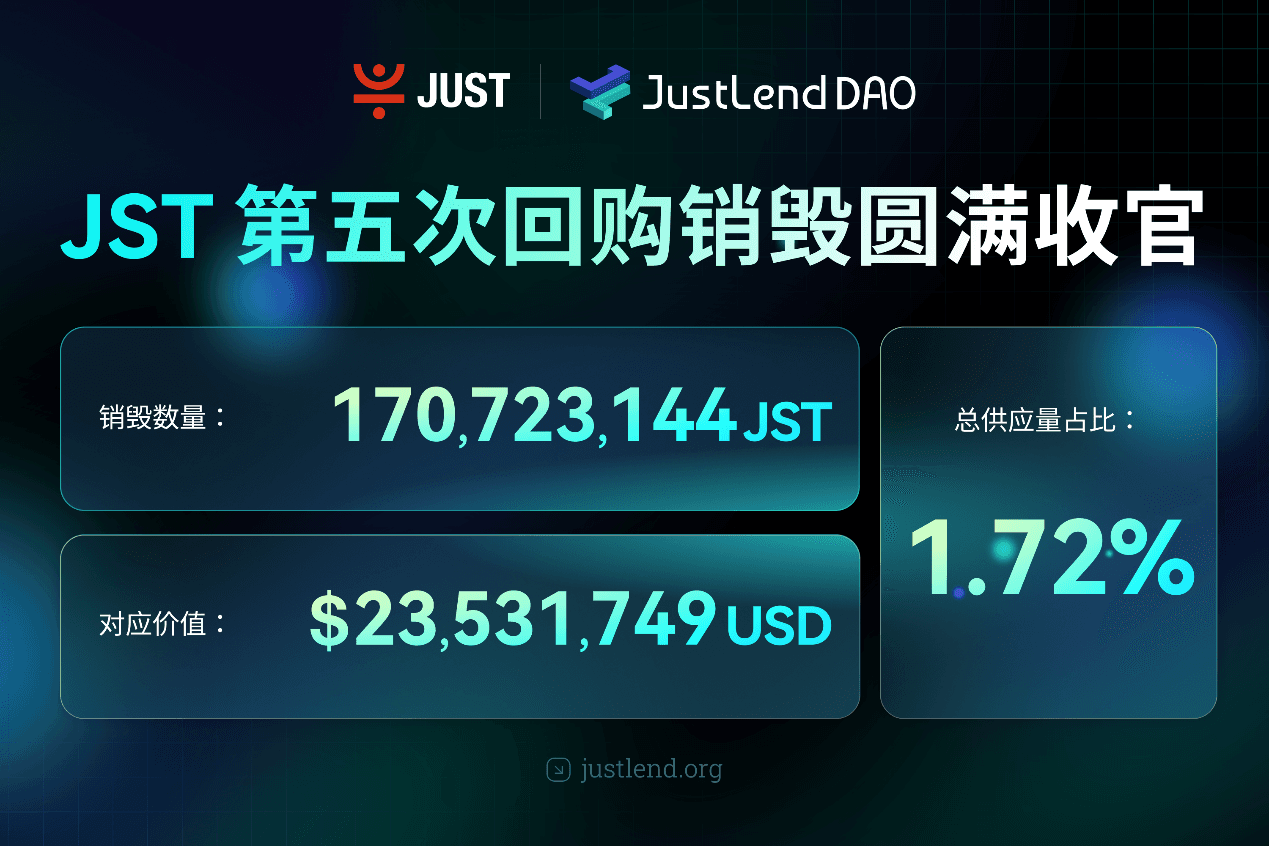
BitTorrent Brand Upgrade and Initial BTT Buyback & Burn Launch Simultaneously, Dual Engines Usher in New Era of Web3 Infrastructure
Oct 17, 20:00
Asia Market Daily: Japan's BOJ signals more rate hikes while Korea targets offshore perpetual platforms (2026/10/17)
Oct 17, 17:01Why did Papertrade backfire on you?
Oct 17, 17:01
The 'Strict Father' of Northern Myanmar: This Company Deploys 200,000 "AI Best Actors" to Strike Back Against Scammers
Oct 17, 15:34