IOSG: From Hot Storage to Cold Memory, Decentralized Storage in the Era of AI Storage Boom

Recently, the "First Domestic Storage Stock" ChangXin Storage officially landed on the Growth Enterprise Market (GEM), exploding by an astonishing 500% and causing a sensation in the market. Although the storage sector has been experiencing turbulence due to recent pullbacks, AI storage is still being crazily revalued in the current tech narrative wave. At the same time, decentralized storage in the Web3 space has fallen into a long period of silence and loss. Why is there such a stark difference in market performance under the same "storage" name? The fundamental answer lies in the thorough divergence of underlying value functions.
The revaluation of storage in the AI era is essentially a carnival about "hot data efficiency," serving the ultimate maximization of computing power utilization and commercialization; while decentralized storage upholds the value proposition of "trust in cold data," defending data fairness, censorship resistance, and the long-term memory of human civilization. The former is an efficiency system for hot data, the latter is a trust system for cold data. The current capital market undoubtedly firmly stands on the side of "efficiency," but human civilization still ultimately needs an immutable memory foundation. The long-term value of trusted cold storage has never disappeared; it is only dormant in the shadows of the cycle, waiting to be revalued by the era.
Why Storage Has Once Again Become the Focus of the AI Industry Chain
In the traditional IT era, storage was a "capacity business." Enterprise CIOs were concerned with unit capacity costs, disk reliability, disaster recovery plans, archiving strategies, and equipment refresh cycles lasting 3–5 years. Storage was seen as an accessory following server purchases.
This round of storage frenzy is not a traditional cyclical recovery, but a revaluation of AI's data flow capabilities. In the era of large models, storage logic has transformed from "capacity-first" to "efficiency-first," focusing on GPU saturation rates, Checkpoint writes, and RAG ultra-low latency, among other extreme metrics. This marks the transition of storage value from being the "final resting place of data" to the "high-speed gateway for data to enter computation."
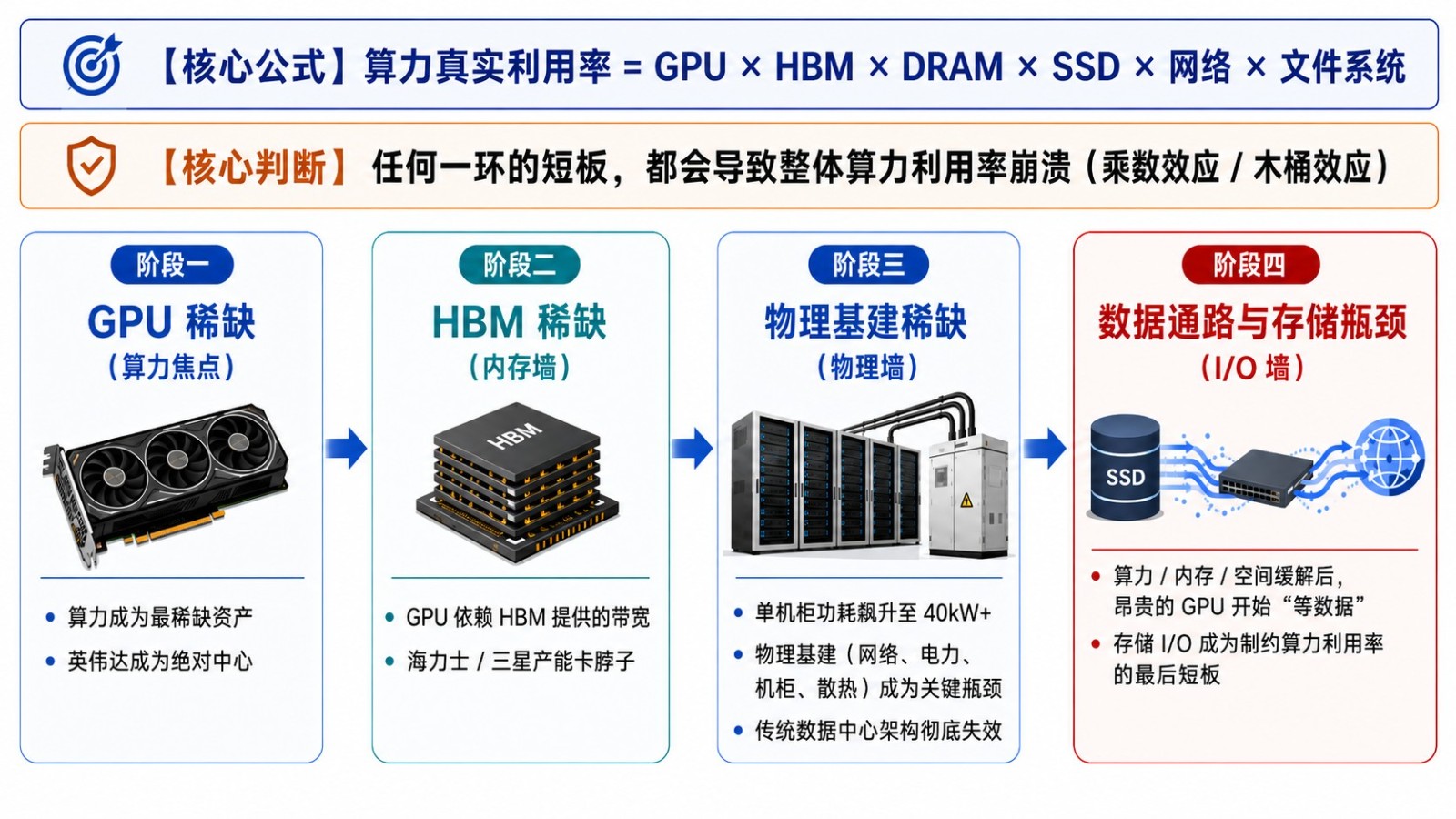
The evolution of AI infrastructure's resource bottlenecks is essentially a battle to fill the gaps in a "bucket effect." The true utilization rate of computing power is not a linear sum of individual assets but a demanding multiplier effect: Real computing power utilization = GPU × HBM × DRAM × SSD × Network × File System. A bottleneck in any part will cause a collapse in overall computing power utilization. In the AI era, storage has for the first time shifted from a "cost center" to an "efficiency engine." This is the fundamental logic behind the revaluation of storage.
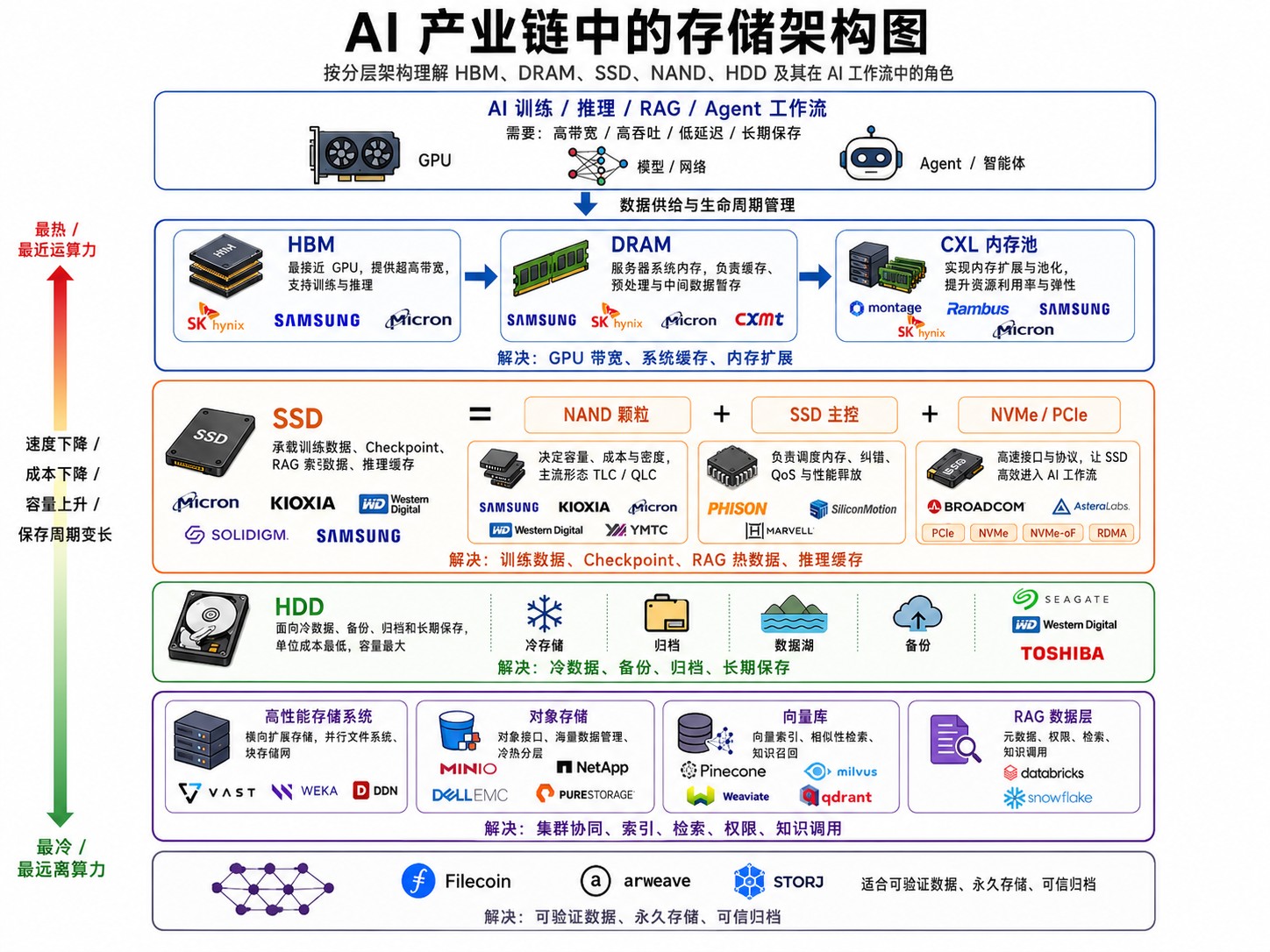
AI Storage Architecture Landscape: From HBM Bandwidth Core to Data Lake Foundation
AI storage is by no means a simple hardware stack, but a tightly coupled, hierarchically scheduled complex system. In this system, industrial value and capital focus are highly concentrated on HBM, enterprise SSDs, SSD controllers, NVMe/CXL protocols, and high-performance storage systems. To clearly break down its value flow, we divide the AI storage architecture into four core levels from top to bottom:
· Computational Near-Memory Layer (Bandwidth Core): Dominated by HBM, supplemented by DRAM and CXL memory pooling technology. This layer is directly attached to the GPU/CPU package or bus, aiming to break the "memory wall" and is the first gateway to determining whether computing power can be fully unleashed.
· High-Speed Persistent Storage Layer (IO Hub): The core logic consists of enterprise SSD = NAND chips + SSD controller + NVMe/PCIe data path. This layer handles high-frequency Checkpoint writes, massive training set loading, and RAG hot data caching, representing the most distinct persistent storage increment in AI data centers.
· Low-Cost High-Capacity Storage Layer (Capacity Foundation): Comprising HDDs, cold storage, and data lake archiving systems. Faced with exponentially expanding multimodal raw data, historical logs, and regulatory backups, this layer still provides an irreplaceable TCO (Total Cost of Ownership) advantage.
· AI Storage Systems and Data Software (Scheduling Brain): Including high-performance parallel file systems, distributed object storage, vector databases, and RAG data governance layer. What AI truly consumes is not raw hardware but data availability efficiently organized, indexed, and permissioned by the software stack.
· As an ecological extension, decentralized storage is not directly involved in the millisecond-level race for AI hot data but instead anchors public dataset attestation, AI training data provenance, and long-term cold memory archiving, establishing its unique ecological position as a "trustworthy cold layer."
HBM: The "Bandwidth Core" Closest to Computing Power in the AI Storage Chain
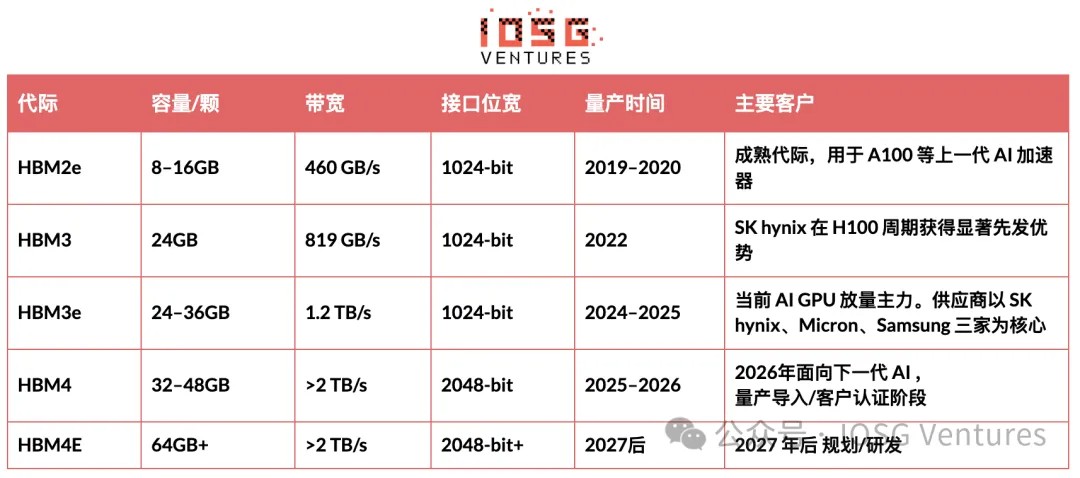
High Bandwidth Memory (HBM) is not traditional storage but a high-bandwidth memory layer near the GPU. Its core mission is not to store data but to continuously "feed" data to computing power at a very high bandwidth. HBM is the segment in the AI storage chain closest to computing power, with the highest determinism, directly determining whether the GPU can be "well-fed," making it the current most critical supply chain bottleneck.
The HBM core architecture is based on "3D DRAM stacking + 2.5D advanced packaging": leveraging TSV vertical stacking and CoWoS heterogeneous integration to achieve ultimate compression of the storage-compute distance, enabling a leap in bandwidth at the differential level. Its industry barrier is not just DRAM design, but rather a systems engineering of DRAM processes, TSV, ultra-thin stacking, packaging, thermal management, testing, and customer certification. Any yield defect in any link will result in the entire HBM stack being scrapped.
Currently, only SK Hynix, Samsung, and Micron are able to stably mass-produce, establishing a triple moat of top-tier DRAM processes, packaging capabilities, and NVIDIA/AMD customer certification.
DRAM and CXL: System Memory Foundation and Memory Pooling Engine
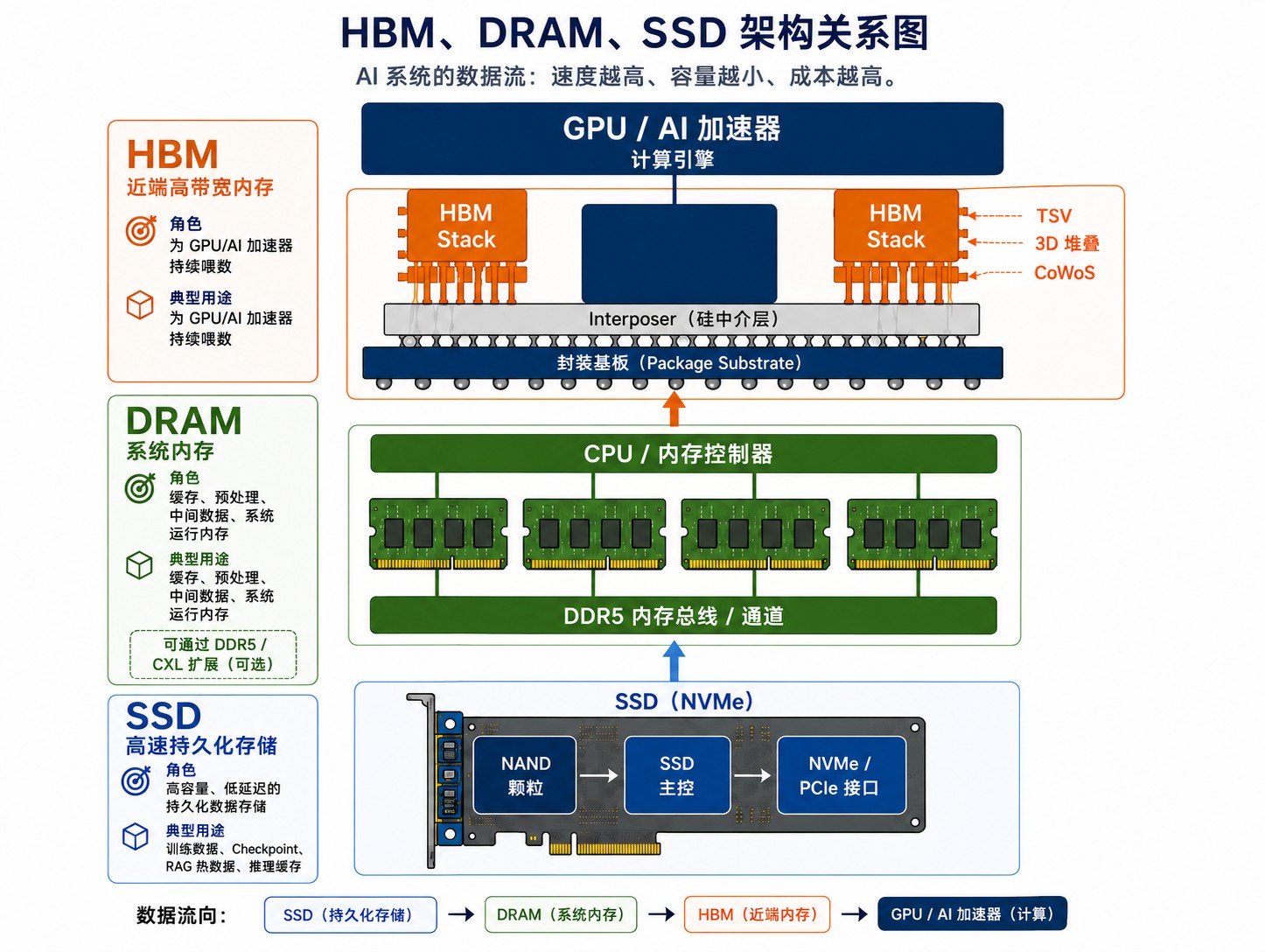
HBM addresses the GPU's near-end bandwidth limit, DRAM solidifies the server's system memory foundation, and CXL attempts to break through physical boundaries, restructuring the organization of data center memory resources.
· DRAM: It mainly carries CPU-side cache, data preprocessing, intermediate state buffering, and system operation, serving as the most basic system memory layer in servers. The global DRAM market is highly concentrated among the three giants SK Hynix, Samsung, and Micron; ChangXin Memory Technologies (CXMT) is a core variable in China's domestically produced DRAM substitution.
· CXL (Compute Express Link): It is a new-generation cache coherence interconnect protocol for data centers, aiming to break through the limitations of traditional DIMM slots, local memory capacity, and the siloed nature of server memory resources, driving the evolution of memory architecture towards expansion, pooling, and sharing. Currently, CXL is still in the early stage of transitioning from platform support to large-scale deployment, with high long-term architectural value; key companies include Astera Labs and Cosemi Technologies.
Enterprise SSD: Data Hub Built on NAND, Controller, and NVMe
Enterprise SSD is the core high-throughput persistent increment of AI data centers, providing extremely high throughput, ultra-low latency, and stable QoS, continuously "feeding" data to the GPU, spanning the entire lifecycle from training data loading, checkpoint writing, RAG retrieval, inference caching, to log backflow, among others.
In AI storage architecture, SSD is not standalone hardware but a highly integrated system that can be distilled into an industry formula: Enterprise SSD = NAND Flash + SSD Controller + NVMe/PCIe Data Path. The three layers represent independent segments of the industry chain:
· NAND Flash (Raw Material Layer): Determines storage density and unit cost, with the controller handling performance optimization and lifespan management. Companies represented include Samsung, SK hynix (Solidigm), Micron, Kioxia, Western Digital, and YMTC.
· SSD Controller (Performance Empowerment Layer): Determines performance optimization, data error correction, QoS stability, and wear leveling. Companies represented include Phison (Fison), Silicon Motion (SiliconMotion), Marvell, and Maxio (Maxio).
· NVMe/PCIe (Data Path Layer): Determines the data transfer efficiency from storage to computation. Combined with GPUDirect Storage technology, it reduces CPU memory bounce buffer and CPU involvement, significantly alleviating I/O bottlenecks. Companies represented include Broadcom, Marvell, and Astera Labs.
HDD / Cold Storage / Archive: Low-Cost Foundation of the AI Data Lake
AI will not eliminate HDDs. With the demand for multi-modal large models for video and image data, as well as the exponential growth of enterprise-compliant logs and historical datasets, the need for low-cost cold data storage is synchronously surging. In the AI storage architecture, SSD and HDD collaborate in a tiered manner based on business value: SSD handles hot data and high throughput, while HDD manages low cost and long-term retention. Companies represented include Seagate, Western Digital, and Toshiba.
AI Storage Software Stack: The Scheduling Hub of Data Availability
AI truly consumes not raw disks but the "data services" meticulously organized by the software stack. This architecture transforms underlying hardware into knowledge assets that AI can directly access, divided into four layers:
· High-Performance Storage System (Feeding System): Core-focused on concurrent throughput and low latency, it uses parallel file systems to address GPU cluster "data starvation" issues, ensuring rapid training and inference flow. Companies represented include VAST Data, Weka, and Pure Storage.
· Object Storage (Raw Data Lake): Built on Object, Key, and Metadata management, it stores massive amounts of unstructured data. It prioritizes low cost and cloud-native features over ultra-low latency, establishing a capacity foundation. Representative Company: AWS S3
· Vector Database (Semantic Index Layer): The vector database is responsible for storing, indexing, and retrieving vectors generated by embedding models, allowing AI to accurately locate relevant content from a vast amount of knowledge. Representative Companies: Pinecone, Milvus
· RAG Data Layer (Knowledge Retrieval Layer): Going beyond single-point retrieval, it covers data slicing, cleansing, access control, and citation tracing to ensure that enterprise data can be securely, accurately, and traceably retrieved by large models. Representative Company: Databricks
From AI Hot Storage to Decentralized Cold Memory: Maximizing Efficiency vs Maximizing Trust
AI storage is an efficiency-driven system, with its value function focusing on maximizing computational output. HBM bandwidth determines whether GPUs can be fully utilized, SSD throughput determines the efficiency of dataset and checkpoint read/write operations, and low latency is crucial for real-time RAG and inference experiences. These metrics ultimately converge into GPU utilization and per-Token cost, directly impacting the business success or failure of AI applications. The ultimate goal of AI storage is not preservation, but acceleration, serving productivity.
On the other hand, the value function of decentralized storage is fundamentally different. It questions whether the data will still exist ten years later, whether it has been tampered with, and whether it can withstand single-point audits. Through cryptographic proofs and a distributed network, it builds an open-access and permanently stored public data foundation. Its ultimate goal is to uphold the absolute truth and sovereign independence of data, serving fairness, anti-censorship needs, and the memory of civilization.
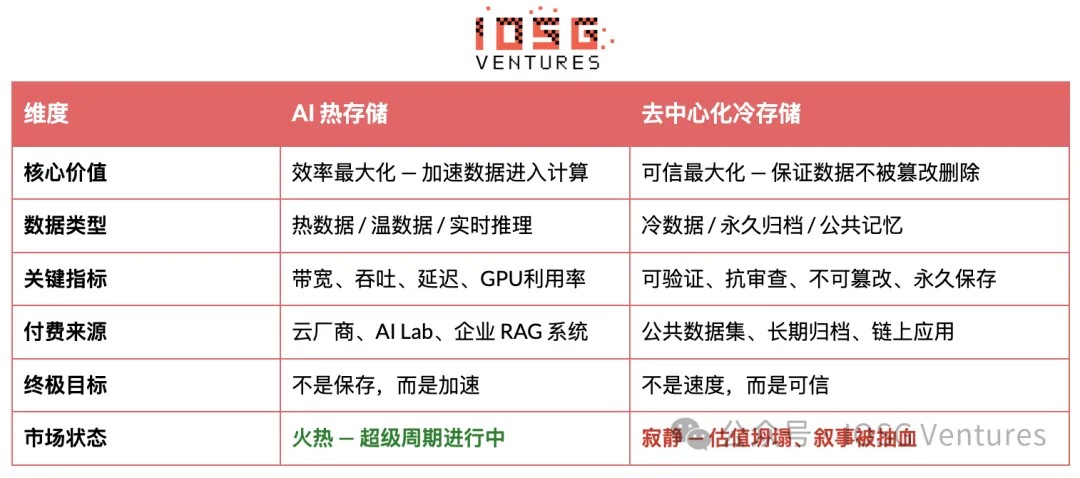
AI storage is the "hot storage" that provides fuel for future productivity, while decentralized storage is the "cold memory" that preserves the irremovable history of humanity. The former serves efficiency, pursuing ultimate speed; the latter serves trust, safeguarding silent memories. The former determines how fast models run, while the latter determines whether memories will be deleted. Currently, market mechanisms reward efficiency in productivity, placing AI storage at the forefront, while decentralized storage seems to be experiencing a valuation collapse and a narrative bloodletting silence.
Vision and Reality of Decentralized Storage
The decentralized storage space is crowded, but based on industry sentiment and ecosystem development, the core representatives have always been Filecoin and Arweave. Although both belong to "decentralized storage," their underlying architectural philosophies are almost two completely different paths—where the former approaches AWS-like elasticity through market-driven contracts, the latter approaches the eternity of a library through a one-time social contract.
· Filecoin: It has built the most complete verifiable economic system through PoRep and PoSt. Rather than continuing to compete with AWS on consumer-level cloud storage, Filecoin should pivot towards AI data provenance, public dataset hosting, and compliance archiving to provide a verifiable chain for model audit and copyright proof. The inevitable path is to package it as an S3-compatible API with support for fiat payments, upgrading from a "cheap storage market" to a "verifiable computing infrastructure."
· Arweave: With the narrative of "pay once, store forever," Arweave, through Blockweave and the SPoRA mechanism, incentivizes miners to store and quickly access as much historical data as possible, especially scarce data. Its ideal position is as the foundation of human public memory—preserving human rights records, evidence of war crimes, cultural classics, archiving legal and financial history, providing AI agents with permanently accessible long-term memory. Arweave's value lies not in speed but in its ability to carry the civilization's memory through epochs.
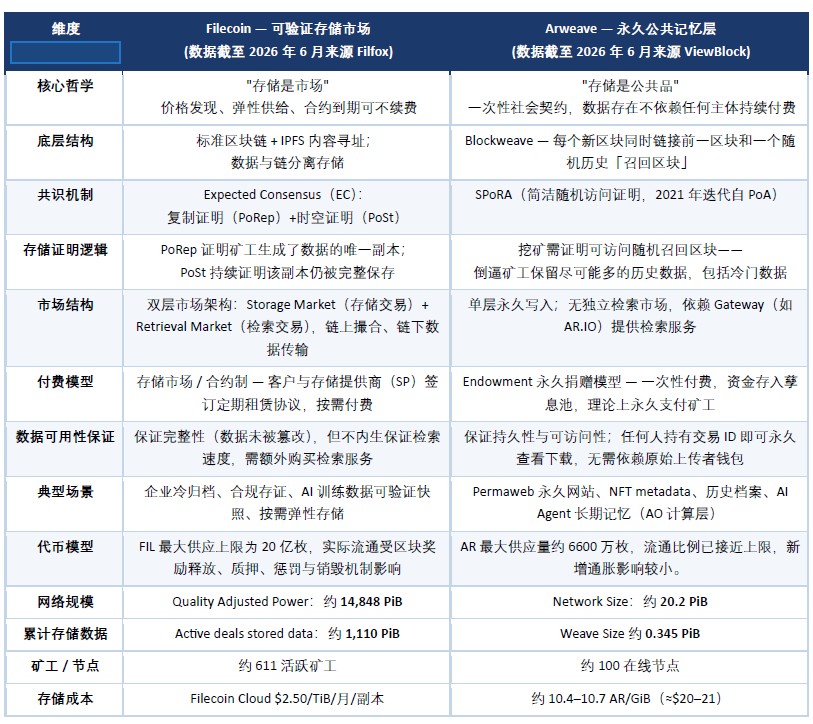
The dilemma of decentralized storage projects like Filecoin and Arweave lies not in a misguided value proposition but in the long-term misalignment of productization, retrieval experience, real needs, and token incentives. This reveals a significant gap from geeky ideals to mainstream commercial applications:
· Supply-Demand Incentive Misalignment: Early networks represented by Filecoin rapidly expanded through tokens but failed to build a strong enough demand-side payment requirement, resulting in massive capacity but insufficient utilization and payment conversion. Rewarding "I can store" instead of "I need to store."
· Lack of Enterprise-Grade Service Capability: The barrier of AWS is not the hard drive but the "data operating system" composed of APIs, SLAs, permission management, compliance audits, and technical support. Enterprises purchase for "peace of mind" rather than an experimental infrastructure requiring self-management of keys and node selection.
· Retrieval Experience Shortcomings: "Storing in" does not equate to "reliably and low-latency retrieving out." Node distribution, complex topology, and lack of unified SLA make it challenging to support AI hot data workflows, making it more suitable for trusted cold archiving and data provenance.
· Privacy Compliance Challenges: Enterprise private data cannot be easily written to a public immutable ledger; the right to be forgotten inherently conflicts with permanence and immutability. Decentralized storage is more suitable for public data and long-term archiving, rather than indiscriminately handling core private data.
· Tokenomics Boom and Bust Cycle: The bull market financialization masks underlying demand, while the bear market sees miner ROI decline, exposing commercialization weaknesses. Tokens can kickstart supply but cannot organically generate demand and sustainable revenue.
On the other hand, other decentralized storage projects tend to focus on specific ecosystems or niche tracks: Storj/Sia, spanning industry mindset across cycles and having weaker Web3 narrative impact compared to Filecoin/Arweave; BNB Greenfield/Walrus tied to BNB or SUI-specific public chain ecosystems; Celestia/EigenDA fall under the Data Availability (DA) layer, catering to Rollup transaction confirmation rather than long-term archiving; 0G and other AI/DA hybrid narrative projects attempt to integrate storage, data availability, computation, and AI agent settlement into an AI-native modular infrastructure, but their real demand, developer adoption, and commercialization loop are yet to be validated.
The Future Opportunities of Decentralized Storage: Efficiency and Trustworthy Long-Term Pendulum
During the period of technological dividend explosion, capital fervently pursued efficiency, with assets like GPUs and HBM commanding a premium. Decentralized storage advocating for "trust and fairness" was naturally marginalized. However, the pendulum of history will not swing indefinitely towards efficiency. Events such as the unreasonable bans and content removal by super platforms, AI copyright litigation outbreak prompting data source validation, geopolitical conflicts triggering data sovereignty disputes, public archive disappearances due to data monopolies, and regulatory pressure on model training data compliance audits could all be brewing a reevaluation of the pricing of "trustworthy storage." The future opportunities of decentralized storage still have the chance to demonstrate unique value in the following directions:
· AI Data Provenance: Building "data lineage proof" using cryptographic evidence to address regulatory and audit pressures.
· Public Datasets and Civilization Archives: Anchoring curated archives and cultural heritage to construct irreplaceable and undeletable memories.
· Trusted Archiving and Compliance Evidence: Achieving trustworthy self-certification through Hash evidence to provide high-level digital notarization.
· ZK/TEE/DID Technology Integration: Resolving privacy tensions, upgrading from a single "storage protocol" to a "trusted data infrastructure".
· Stealth Product Roadmap: Providing S3-compatible API and fiat billing, allowing users to directly purchase "trusted archive" services.
AI storage and decentralized storage, one pursuing ultimate efficiency to provide fuel for our journey into the future; the other defending silent memory, guarding our right to look back at the past. The current market overwhelmingly rewards efficiency, rendering decentralized storage silent and even collapsing; but as the AI era further amplifies the vulnerabilities of data monopolies, copyright disputes, and historical memory, decentralized storage may see a value reassessment in the form of "trusted cold storage". Memories that cannot be easily erased by platforms, companies, or any single power may transition from idealistic romance, from edge beliefs to essential infrastructure.
Recommended
Desk: Brent Crude Tops $110, Musk's Net Worth Drops 528.6 Billion in Four Days After Tesla Roadster Launch
Oct 17, 21:49
JST Fifth Buyback and Burn Successfully Concludes: Over 170 Million Tokens Worth Approximately $23.53 Million Burned, Buyback Mechanism Set for Comprehensive Upgrade
Oct 17, 20:10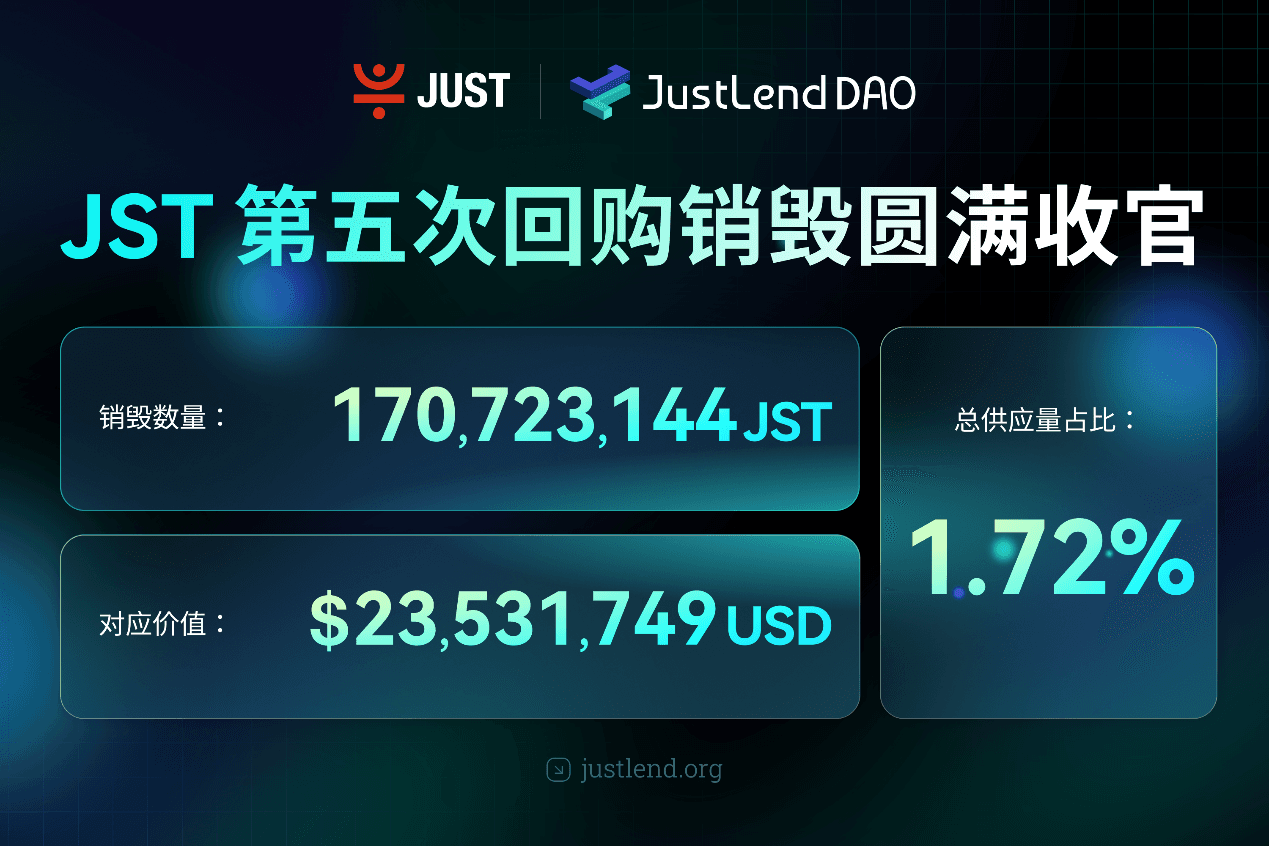
BitTorrent Brand Upgrade and Initial BTT Buyback & Burn Launch Simultaneously, Dual Engines Usher in New Era of Web3 Infrastructure
Oct 17, 20:00
Asia Market Daily: Japan's BOJ signals more rate hikes while Korea targets offshore perpetual platforms (2026/10/17)
Oct 17, 17:01Why did Papertrade backfire on you?
Oct 17, 17:01
The 'Strict Father' of Northern Myanmar: This Company Deploys 200,000 "AI Best Actors" to Strike Back Against Scammers
Oct 17, 15:34