Cliffside Building: The Debt Google Metas Dare Not Disclose

In August 2025, someone registered seven companies in Delaware, all with the word Beignet in their names.
Beignet, a French donut, is a common fried dough pastry found on the streets of New Orleans, generously coated with powdered sugar that always seems to end up on your clothes when you pick one up.
No matter how many pairs of glasses you put on, you will not see the connection between this pastry and AI.
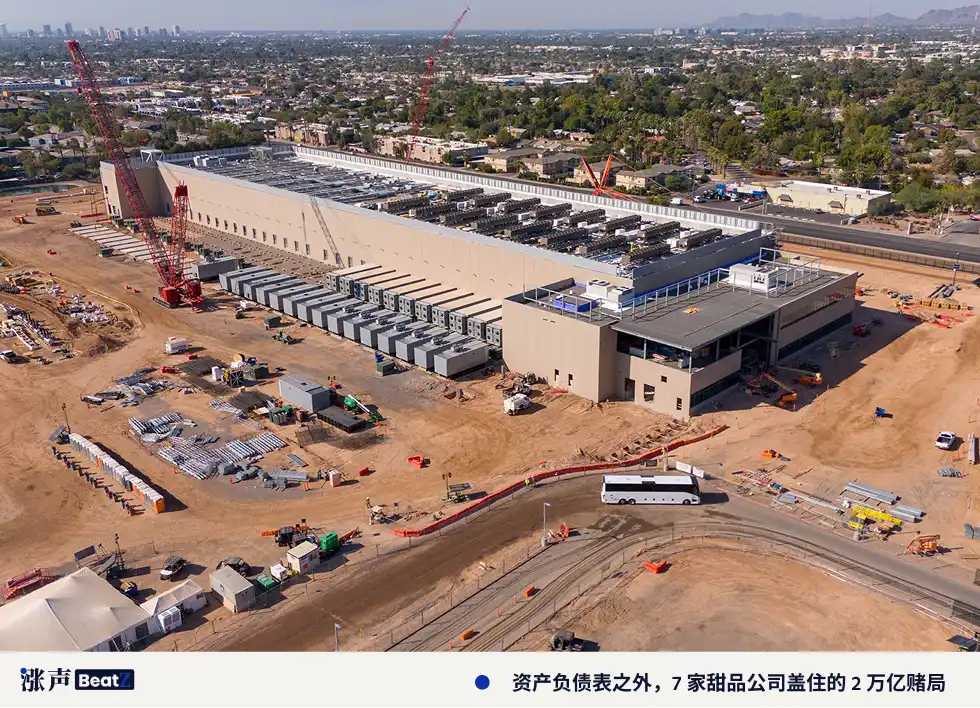
A month after the Beignet companies emerged, Meta built a data center in Louisiana named Hyperion, occupying an area equivalent to four Central Parks in New York City.
To construct this massive data center, Meta borrowed a total of $27.3 billion.
However, if you carefully examine Meta's financial statements, you will find that the only related record on its balance sheet is a $2.37 billion investment linked to this project.
The remaining over $20 billion in debt has vanished.
This is not an isolated case.
On July 22, Nikkei reported that U.S. tech giants hid up to $16.5 trillion in debt in invisible places, exceeding their disclosed liabilities of $13.5 trillion on their balance sheets.
We reviewed the filings of these five companies submitted to the SEC and found the reality to be even more exaggerated than the report.
On July 23, the day after the initial report, Google's parent company Alphabet filed its quarterly report. Its purchase commitments surged from $332.4 billion three months ago to $811 billion. A year ago, this figure was $62.1 billion.
A thirteenfold increase in a year. This adjustment raised the Nikkei-reported $16.5 trillion to $21.3 trillion.
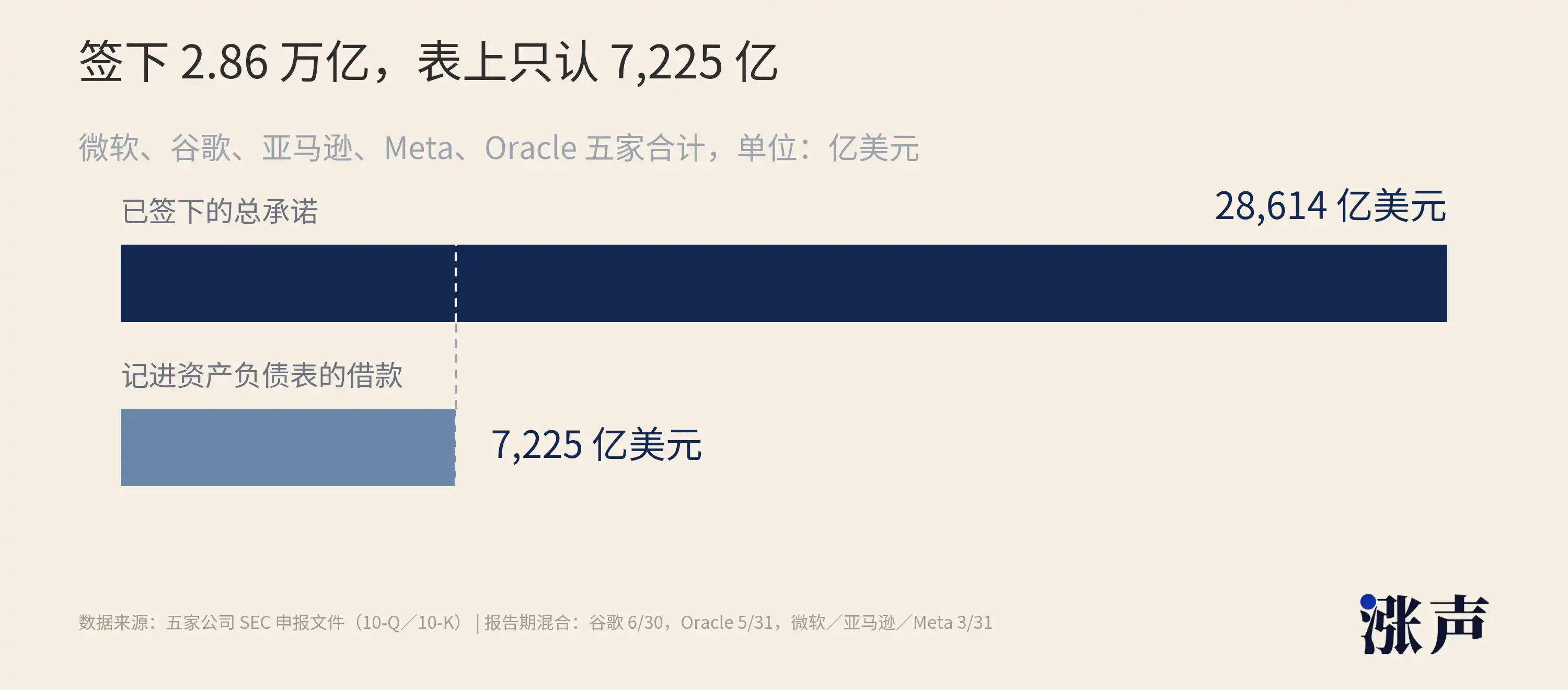
Over the past year, the debt incurred by Microsoft, Google, Amazon, Meta, and Oracle on data centers rose from $710.8 billion a year ago to $1.55 trillion. If we also consider GPU and other hardware procurement and construction contracts, it increased from $1.02 trillion to $2.86 trillion. Almost doubled in a year.
Yet, only one-fourth of this final figure is actually reflected on their balance sheets. $21.3 trillion of "data center debt" has disappeared from the tech giants' balance sheets.
Where Did These Debts Go?
The Bank for International Settlements has long noticed this phenomenon. In a quarterly report from March 2026, it gave a name to this practice: Shadow Borrowing. The report stated that these arrangements, while economically similar to debt, mostly stay off the company's balance sheet.
In the annual report three months later, the Bank for International Settlements uncommonly grouped the AI bubble and circular financing together with sovereign debt as the primary risks to the global financial system.
A review of the various filings of five companies reveals at least five different methods: SPVs, credit derivative swaps, lease financing, residual value guarantees, and unleased lease agreements.
And the people behind creating these shadow debts are turning this into an entirely new business.
Tech Giants collectively "Return to Poverty"
Over the past two decades, tech giants have been the most comfortable type of company in the U.S. capital markets. They make money, have cash on hand, and buy back their own shares.
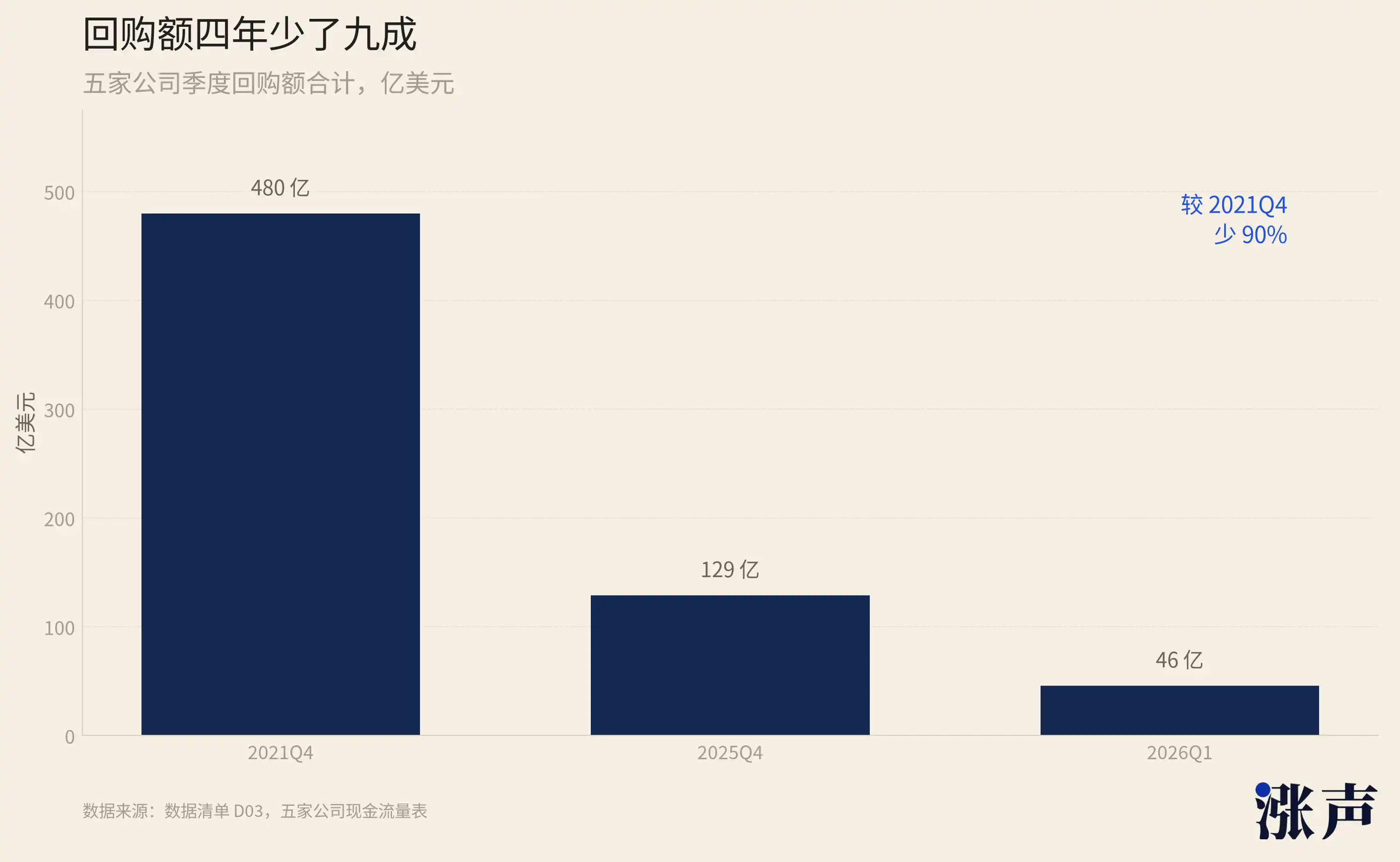
In the fourth quarter of 2021, Microsoft, Google, Amazon, Meta, and Oracle collectively repurchased $480 billion, with Meta alone spending $200 billion. With such a large amount of money, shareholders need not worry about them running out of cash.
However, in the first quarter of 2026, the total buybacks of these five companies instantly dropped to $46 billion.
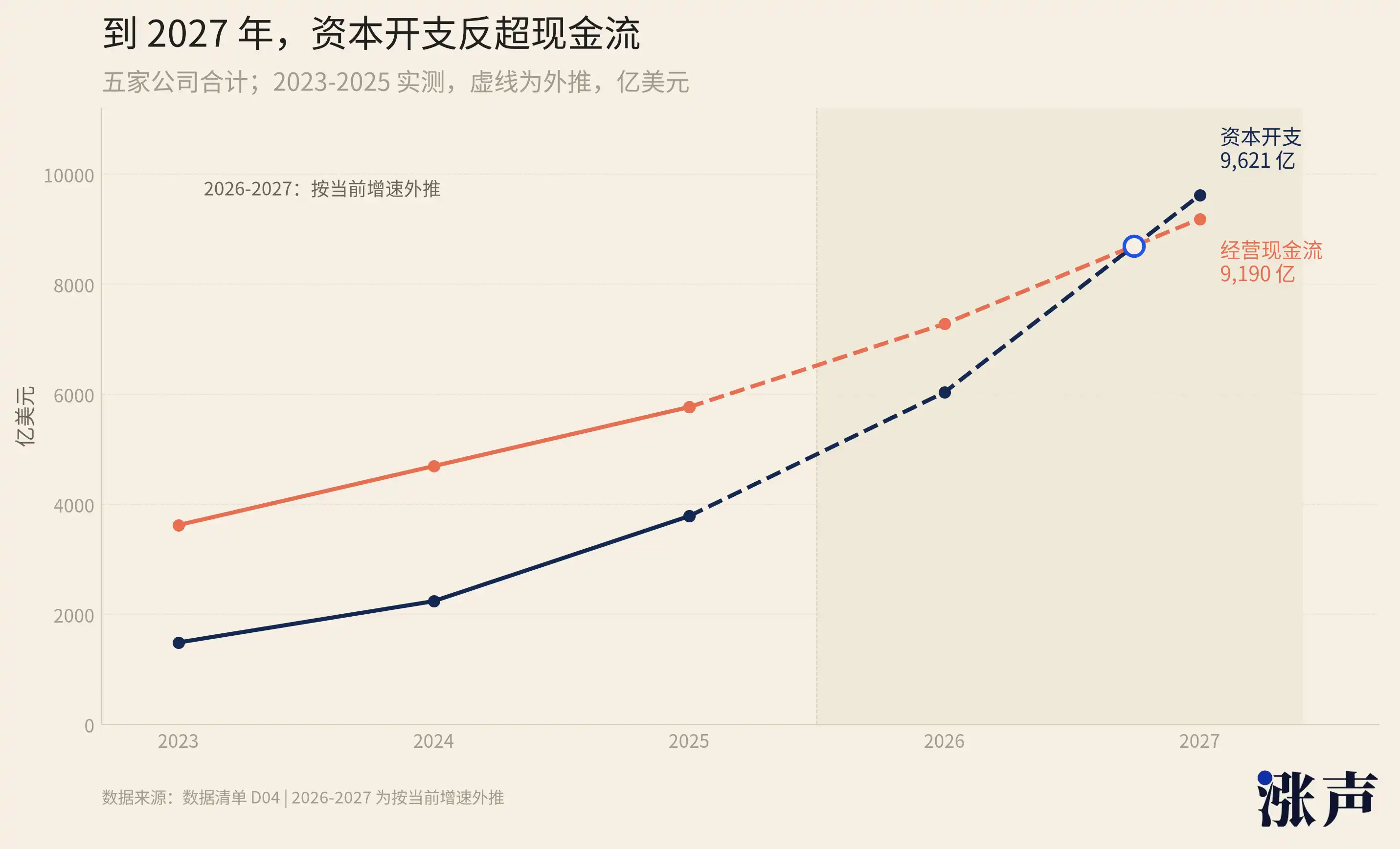
Over the past two years, tech companies' capital expenditures in AI have more than doubled, yet the growth in operating cash flow is less than sixty percent. At this growth rate, by mid-2027, tech giants will collectively "return to poverty" and revert to the era of losses.
Morgan Stanley has calculated that by 2028, tech companies will need to spend about $2.9 trillion on AI, but they can only generate around $1.4 trillion internally. The remaining $1.5 trillion has to be sourced from outside the cash flow.
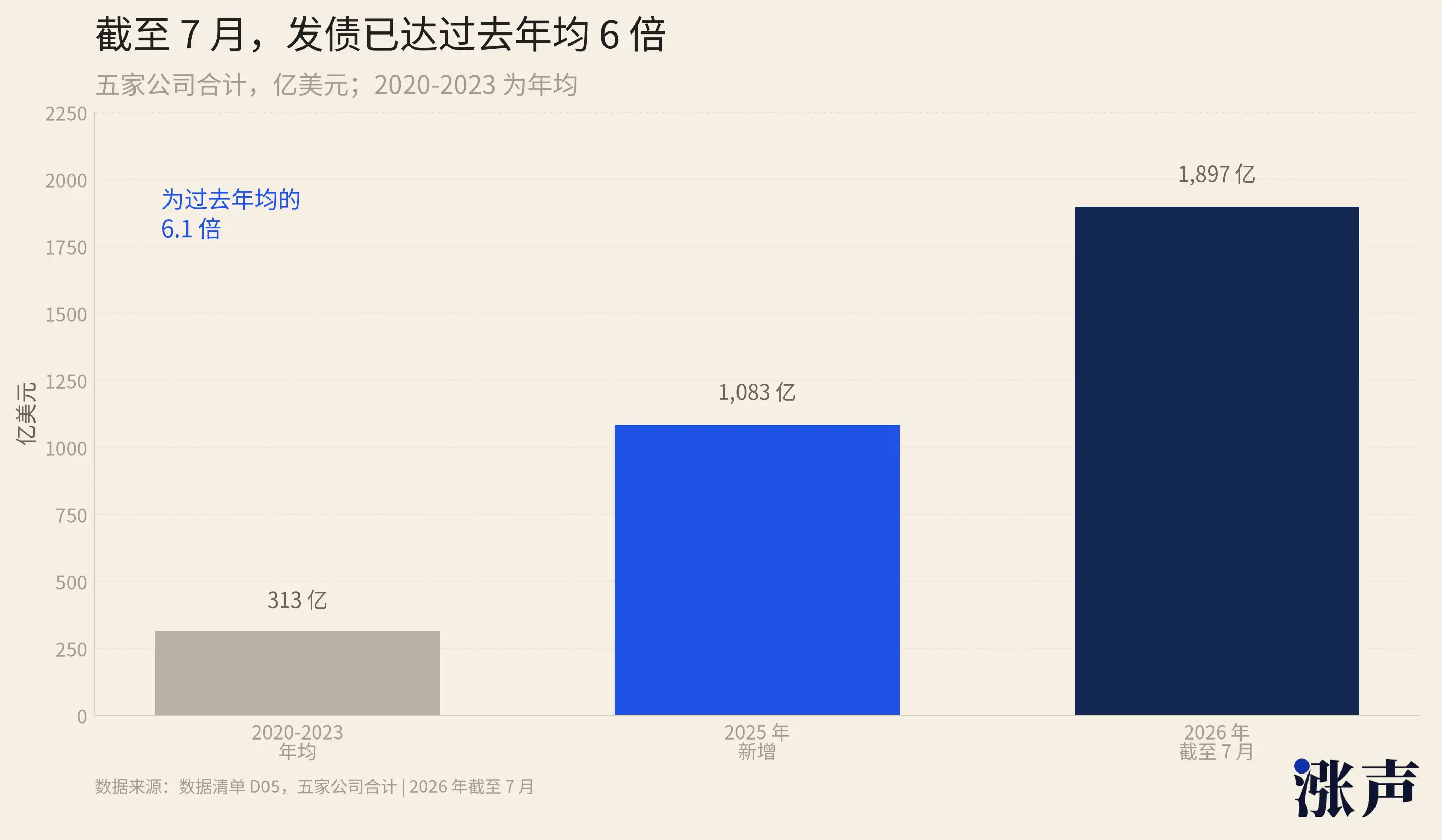
So, they started borrowing. From 2020 to 2023, the five companies averaged about $31.3 billion in debt issuance each year. By July 2026, this number had risen to $189.7 billion, six times the previous average level.
A massive amount of corporate debt is starting to strain the market. Over the past nine months, the oversubscription ratio for Amazon bonds has been decreasing. In November 2025, it was at 5.3 times, but by July 2026, it had dropped to only 1.6 times.
The issuance price has also become more expensive. In the entire investment-grade bond market this year, on average, new bonds were sold at a premium of 4 basis points. However, for Amazon's July issuance, it required a premium of 18 to 21 basis points.
Google and Oracle took it to the extreme by directly raising money through stock offerings. After raising nearly $80 billion, they introduced a total of $600 billion in ATM share issuance plans.
Financial media collectively complained that tech giants have broken the "implicit agreement" with investors. In the past, when the market bought these companies' stocks, they were assuming they were getting companies with net cash, low debt, and continuous buybacks. Now, these companies are issuing significant amounts of debt and have to halt buybacks.
However, the real trouble is reflected in the balance sheets of these giants.
The more debt on the balance sheet, the more cautious rating agencies are, and the fewer people are willing to buy the debt. Among the top five, Oracle was the first to hit this wall. Its capital spending jumped from $21.2 billion to $55.7 billion within a year. In July 2026, S&P downgraded it from BBB to BBB−, just one notch above junk status. If it is downgraded by one more level, global insurance companies and pension funds will be required by regulations to sell Oracle's bonds.
So these giants not only need more money, but they also need money that is more discreet, longer-term, and less onerous. And this kind of money is simply not available in the public markets.
After the SaaS "Malfunction," Wall Street Is Also Seeking New Opportunities
Just as tech companies are worrying about money, on the other side of Wall Street, some are seeking a way out.
In the first half of 2026, a fund under Blue Owl received redemption requests close to 40% for two consecutive quarters, but only managed to fulfill just over 10%. The company's stock price dropped from $24 to $9.
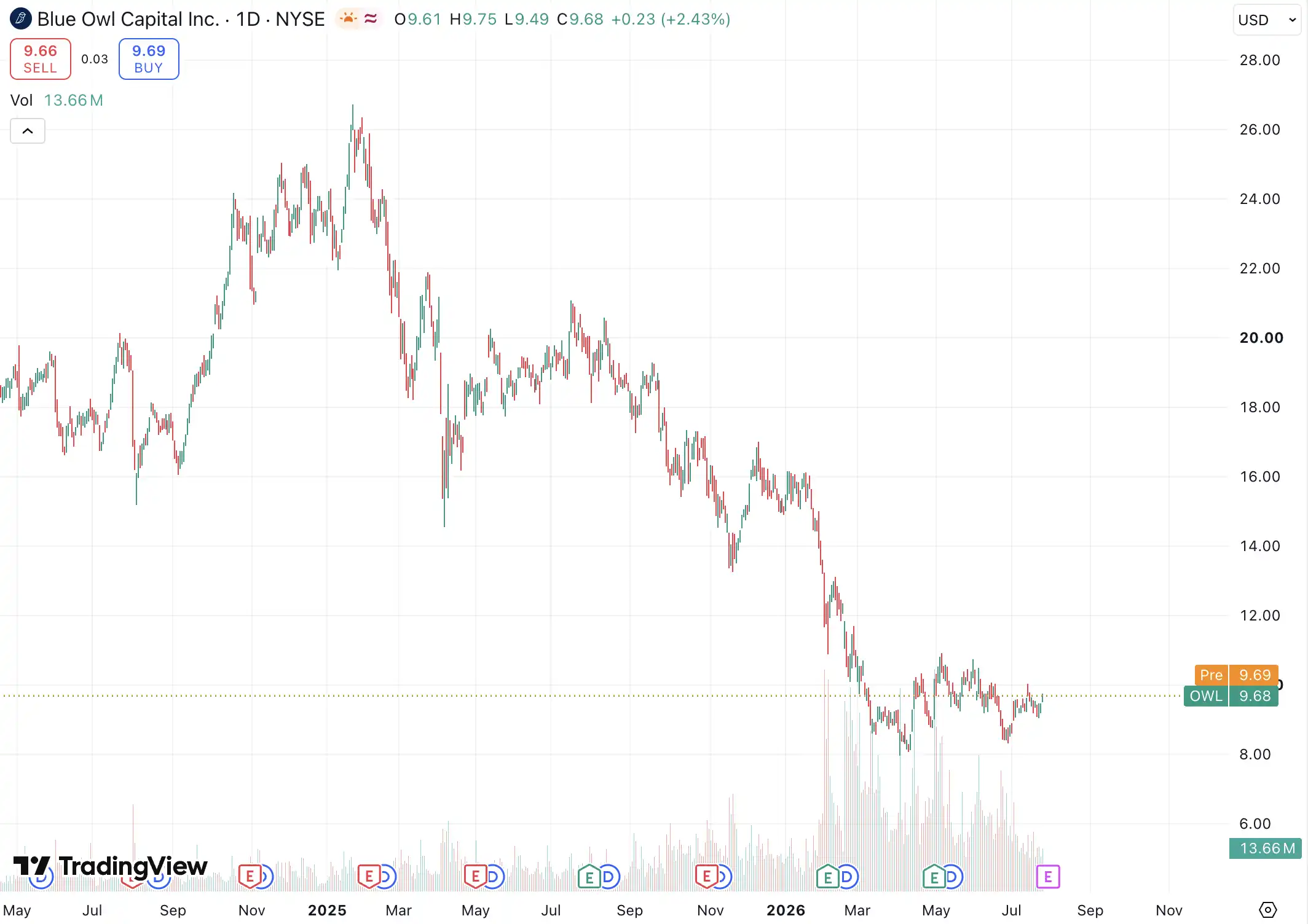
Blue Owl is one of the world's largest private credit firms, managing over $310 billion in assets. The fund facing redemption pressure specializes in the software sector, with software loans accounting for over 60%.
Ironically, in 2026, the least desirable asset on Wall Street is software loans.
From the peak in October 2025, software stocks have dropped by nearly 40%. The market's explanation is straightforward: AI will kill software. In the past, investors were willing to give software companies high valuations because customers renewed annually, and it seemed like revenue could keep growing along the contracts. Now, whether customers will renew has suddenly become a question.
However, in reality, the fundamentals of the software company are not that bad. The revenue growth of Microsoft 365 subscription business has increased from 15% to 19%, and the revenue growth of software companies like ServiceNow, Salesforce, and Snowflake has accelerated for five consecutive quarters. Gartner has also raised its global software spending forecast.
But in the financial world, confidence is often more important than fundamentals.
In a shareholder letter, Blue Owl acknowledged that market concerns about AI impacting software companies have significantly influenced how investors view software credit exposure.
Wall Street is in desperate need of a new narrative to get investors back on board. And that narrative is the data center.
Software lending bets on whether customers will renew next year. Data center lending bets on whether AI companies will need computing power. The former question is becoming increasingly difficult to answer, while the latter question seems almost unnecessary to answer. The stronger the AI, the more valuable the data center.
Now, data center lending is the hottest business on Wall Street. In December 2025, Blue Owl rejected Oracle's data center project in Michigan for not meeting underwriting standards. However, Pacific Investment Management quickly snatched up this deal at a higher price. Situations like this, where bids are competing, occur almost every month on Wall Street.
On one side, you have tech giants with more money than they know what to do with, and on the other side, asset management institutions with nowhere to invest their money. So, they strike a deal.
Their first masterpiece is Beignet, the dessert mentioned at the beginning.
How Did Meta Hide $28 Billion of Debt in a Pastry?
The Hyperion hyperscale data center in Louisiana, constructed with Meta's involvement, was initially registered under Laidley LLC. It operates the campus and also holds a fifteen-year power supply contract with the local utility company.
Laidley belongs to Project Beignet Holdings, a joint venture. The ownership of the data center resides here.
The majority shareholder of the joint venture is Beignet Investor. $27.3 billion in bonds were issued from its hands.
The debt is not placed on the company that owns the data center, but on its shareholders.
One level up, there is the Beignet Pledgor. Pledgor, in English, refers to the pledger. It wholly owns Beignet Investor, which in turn pledges all its shares to a trustee.
This allows the creditors to have a very straightforward collateral. In case of trouble, the trustee does not need to first assess a data center in Louisiana, sell a data center, or go through a lengthy lawsuit. They can simply enforce the shares per the contract. The campus is still operational, the lease is still running, and there is a new rent collector.
Above Beignet Pledgor, there are four more companies, one of which is called Beignet Net Lease Aggregator. At the very top is a net lease real estate trust named OSNL, under the Blue Owl umbrella, along with co-investors who contributed.
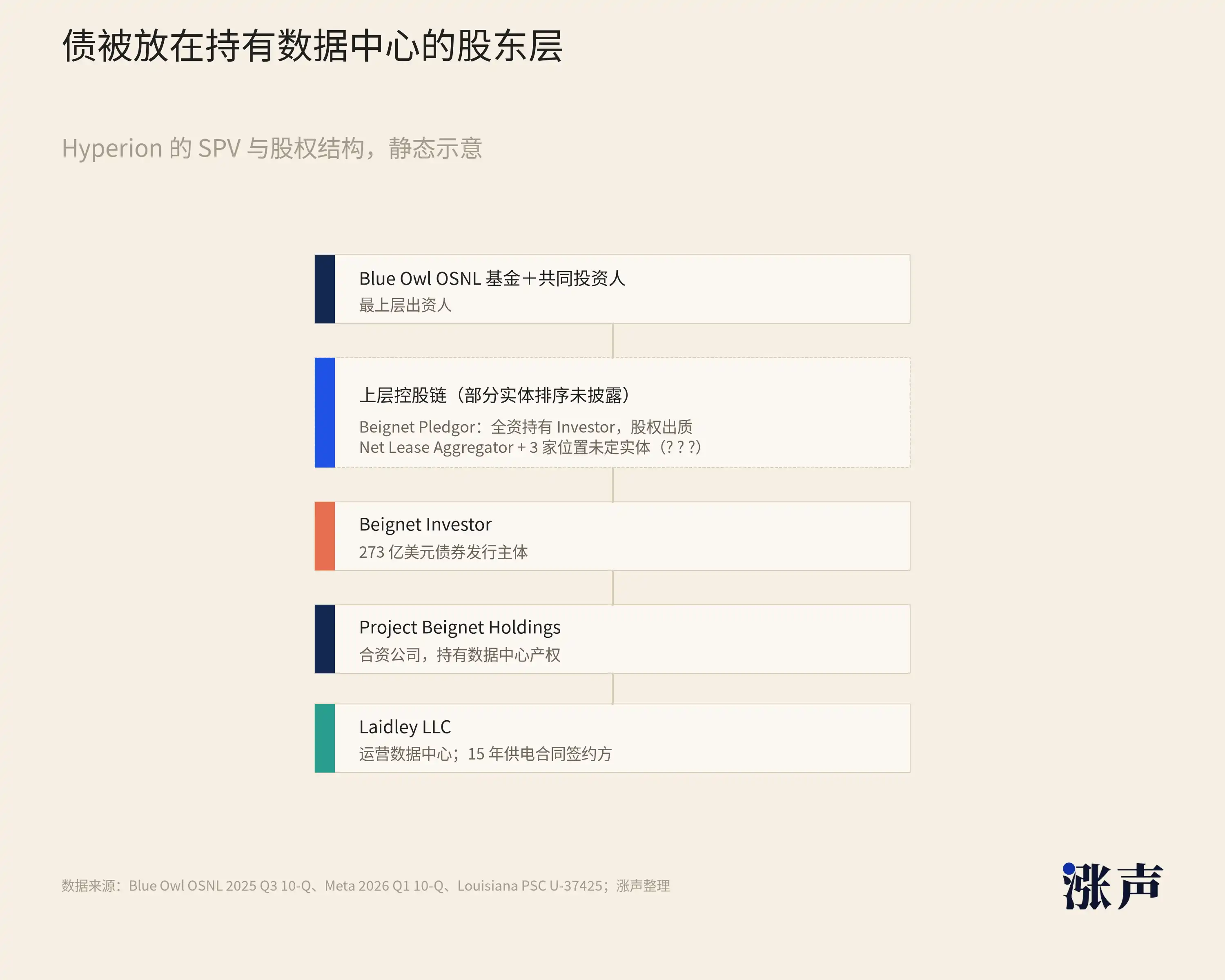
All seven companies are registered in Delaware. Local LLCs are not required to disclose members and ownership percentages.
The $27.3 billion debt was also not publicly issued. It went through the 144A channel, sold only to qualified institutional investors, without filing a public prospectus. To review the transaction terms, one must first sign a confidentiality agreement. It remains a perpetual 144A offering and will not convert to publicly registered bonds.
In the SEC's full-text search system, searching for "Beignet" resulted in only one descriptive hit, which was in Blue Owl's quarterly report in the subsequent events footnote. By the time the annual report was filed, it and "Meta," along with the name of the county where the project is located, had disappeared, leaving only a line item for "net lease data centers."
This is already enough to make one's head spin, but it is merely a legal separation.
SPVs are nothing new. The real estate and infrastructure industries have used them for decades, and accounting standards have long recognized that people would push debt off-balance sheet this way, so they set two thresholds. Whether an entity should be consolidated into a company's financial statements depends not only on the ownership percentage but also on who can control the most critical operating activities, who bears the majority of the losses, and who receives the majority of the gains.
Meta is Hyperion's sole tenant, providing funding, credit, and overseeing construction and property management. By these standards, this debt should logically be consolidated into its own financial statements.
However, they retained 20%.
Blue Owl's OSNL fund and the co-investors, through Beignet Pledgor and four other holding companies, own Beignet Investor 100%. Beignet Investor, in turn, holds an 80% stake in a joint venture. Meta holds the remaining 20%.
80 and 20 are the two numbers that repeatedly appear in this story.
Meta's statement in the financial report is that the company does not have the power to dominate activities that most affect the performance of joint ventures, and therefore is not the primary beneficiary and is not consolidated. Joint ventures are not included in Meta's financial statements, and the $27.3 billion debt naturally is not included either.
The account has not disappeared. It has just been relocated.
Sale-Leaseback, the "Debt Repayment Art" of Silicon Valley Giants
The fact that the debt is not on Meta's books does not mean Meta is not paying.
Meta owns a leasing company called Pelican Leap. It has signed a four-year lease with Laidley. Starting in 2029, Pelican Leap will pay rent to Laidley every month. The money goes from Laidley to the joint venture, then to Beignet Investor, and is then used to repay the bondholders' principal and interest.
After going in a big circle, the rent still comes from Meta's pocket.
The $27.3 billion bond carries an interest rate of 6.581%, matures in May 2049, and is amortized using the straight-line method. It does not wait until 2049 to repay the principal like a regular corporate bond. It chips away a little bit each time, slowly over twenty-four years.
It's more like a mortgage.
The total rent Meta has to pay in the first four years is $12.3 billion, averaging $3.08 billion per year. This amount conveniently covers the principal and interest due that year, with the extra 12% left for the equity contributors.
The real drama starts from the lease term.
The bond has a term of twenty-four years. The initial lease term is only four years. Starting in 2029, there is an option to renew attached, which can be extended for up to twenty years. By 2033, Meta theoretically could choose not to renew and simply walk away.
So what about the remaining $20+ billion?
The answer lies on another page of the lease. In addition to the monthly rent, Meta has provided residual value guarantees, with a cap of around $28 billion, slightly higher than the debt itself, decreasing over time. If Meta does not renew the lease, Meta will make up the difference if the park's value falls below this threshold.
Putting $28 billion and $27.3 billion together, it's hard not to draw connections between the two.
So what the bond truly relies on is not just the building, nor just the machinery inside.
It relies on Meta's credit.
This also explains the rating. Standard & Poor’s rates this bond as A+, while Meta itself is rated AA−. The rating agency did not price the bond based on a building that is yet to be operational, but instead lowered Meta's credit rating by one notch.
Meta provides the money, the credit, is responsible for operations, and is the sole tenant, yet in the financial statements, it states that it is not the primary beneficiary.
This clean balance sheet does not come cheap. If Meta were to issue bonds with the same term in the public market, the cost would be around 5.5%. Through this structure, the cost rises to 6.581%. With the same amount of money, they pay close to $300 million in interest in a little over a year.
Those willing to spend this much money are obviously not just buying a building.
In July 2026, a second similar project arrived, named Sopaipilla, also a type of deep-fried pastry common in the American Southwest. The project is located in El Paso, Texas, with an initial bond issuance size of $12 billion, also with an 80/20 split. The difference is that 80% has been switched from Blue Owl to BlackRock.
Meta has given two internal code names to the next-generation large model, one is Avocado, the other is Mango. The financial side's naming is clearly more appetizing.
Meta's structure is the most sophisticated, but it is not the only approach.
Microsoft did not shell out, nor did it allow its book debt to increase significantly. In the past two years, its total debt has decreased from $44.9 billion to $40.3 billion. However, during the same period, finance lease liabilities increased from $27.1 billion to $62.9 billion, more than doubled, surpassing the total debt by over $20 billion.
Indeed, $62.9 billion is on Microsoft's balance sheet, but it is not listed under "debt," instead split into "other current liabilities" and "other long-term liabilities." It remains discreet from the most prominent line.
The meaning of finance leases is quite straightforward as well. It is nominally a lease but is essentially a lease-to-own arrangement. The lease term covers most of the asset's usable life, so from an accounting perspective, it is equivalent to ownership with installment payments. Thus, it must be fully recorded as a liability but does not need to be reported in the debt section.
Google does not even shell out. It provides payment guarantees for data centers built by others to help them secure financing. Google left a crucial sentence in the financial statements. In the event of default by the other party, Google reserves the right to take over the underlying lease.
These guarantees are accounted for as credit derivatives. The notional size increased from $16.9 billion to $43.8 billion within half a year, with the amount that actually enters the balance sheet being the guarantee's valuation on that day, $815 million, which is less than two percent of the notional size.
Amazon seems the most straightforward. In March 2026, it issued over $50 billion in bonds to finance its own buildings. It also has $106.3 billion in leases, similar to Oracle, that have not yet hit the balance sheet.
Oracle's approach is simpler; it signs contracts. The $260 billion in leases are mostly data center-related, with durations of fifteen to nineteen years, and leasing won't commence until the 2027 fiscal year. Before that, these lease debts won't appear on the balance sheet.
Meta uses joint ventures. Microsoft uses financing leases. Google provides credit guarantees for projects. Amazon and Oracle opt for signing leases first.
Paths differ, but everyone is focused on the same line.
By roughly splitting the future payment obligations of a company into three layers, you can see that line. The first layer is money already borrowed, such as bonds, notes, loans—money received, debt on the balance sheet. The second layer consists of liabilities formed after goods, services, or assets have been received or started to be used, including rent already paid. The third layer is commitments from signed contracts for services and assets not yet delivered or activated, typically disclosed in financial report footnotes.
Between the second and third layers lies the boundary of the balance sheet.
Accounting doesn't ask if you intend to repay money in the future; it only asks if you've received something now. If you've received money, goods, or a usable building, accounts should reflect that. If the goods haven't arrived yet, liabilities may not need to be reported yet.
That's the whole story. Don't buy a building outright; sign a lease. Don't let the lease start today; wait a few years.
Leases also have nuances. Financing leases hit the books but are hidden within other liabilities; Microsoft's $62.9 billion is in this layer. Operating leases also hit the books but only a small portion goes into the present value of lease payments; Meta's leases fall into this category. Leases not yet commenced do not hit the balance sheet at all; Oracle's $260 billion and Amazon's $106.3 billion sit on the outermost layer.
The act of building is slowly being rewritten as leasing.
Adding up the figures from these five companies, the money already borrowed amounts to $445.8 billion. The leases signed but not yet on the balance sheet total $831 billion, nearly twice as much. When factoring in procurement and construction commitments, the total reaches $21.3 trillion.
This is the magnified version of that initial couple of hundred billion.
5 Years Ago, Wall Street Set Its Sights on the Data Center Business
If the story stops here, it's easy to see it as a new invention spurred by the AI boom.
Actually, no.
Let's rewind to 2021. Global data center M&A volume reached $49 billion, setting a record at the time. In 2022, it was $48 billion, with 187 transactions, and 91% of the money came from private equity. Out of the top twelve largest deals that year, ten were acquired by private equity.
Blackstone bought the data center operator QTS for about $10 billion. KKR and GIP acquired CyrusOne for $15 billion. DigitalBridge and IFM purchased Switch for $11 billion. The average deal size increased from $80 million in 2018 to $235 million in 2022.
What they wanted to buy was not servers.
It was land. It was buildings. It was the incoming power.
In 2023, with the interest rate hike, global data center M&A volume shrank to $26 billion. In 2024, it surged to $73 billion, surpassing all previous records. 2025 set a new high. From early 2024 to now, in 575 transactions totaling $151 billion, 84% of the money came from private equity.
Because the tenants were good and the contracts were long.
Data centers burn money, and operators often cannot fund the construction themselves, so they have to find partners. Yet, those moving in are the highest-credit cloud giants, signing contracts lasting a dozen years at a time. For infrastructure funds, pension funds, and sovereign wealth funds seeking stable returns around the globe, this is not just a tech business; it is more like a fully powered rental property.
Even Hyperion's equity structure had been used by the market long before.
In December 2023, Blackstone and Digital Realty set up a $7 billion development joint venture. Blackstone held 80%, and Digital Realty held 20%. In October 2024, Equinix, the Singapore government investment corporation, and a Canadian pension fund established a joint venture of over $15 billion, with Equinix retaining 25%.
Blackstone's 80 and Digital Realty's 20, then look at Blue Owl's 80 and Meta's 20, there is hardly any difference.
The structure had been set before AI. The assets were there. Long-term tenants were there. Even the proportions were there. The only thing missing was who would put up the increasingly substantial amount of money.
Logically, it should be the banks' turn.
The banking sector took a step back in 2023. Following the collapse of Silicon Valley Bank, the U.S. regulatory agency presented a draft of the "Basel III Endgame" capital rule in July of the same year. For long-term, large-scale, and highly customized loans, banks will be required to hold more of their own capital.
The data center hits on three key words: long, large, and non-standard.
Banks have started to deleverage, with private equity stepping in to fill the void. Behind the scenes are insurance annuities and pension funds, aligning the duration of the funds with twenty-year leases.
This handover is particularly crucial for private credit. Over the past decade, the biggest narrative has been software, with software loans growing from less than $80 billion in 2015 to over $500 billion by the end of 2025, accounting for 19% of all direct loans. AI-related loans have surged from nearly zero to over $200 billion, increasing their share from under 1% to almost 8%, mainly occurring in recent years.
The proportion of private credit funds investing in AI-related sectors has risen from 5% a decade ago to 20%. In terms of transaction volume, AI-related deals now account for 34%, compared to an average of only 17% in the previous five years. 144A private placement bonds in the data center sector, which were virtually nonexistent by the end of 2025, have now grown to over $40 billion. Over the next three years, AI infrastructure projects are expected to take away $800 billion from private credit.
While software took a decade to accumulate its volume, AI aims to catch up in less than three years.
Whether private equity can hold onto this position remains to be seen. In March 2026, the requirements of the "Basel III Endgame" were significantly relaxed. The risk weight for corporate loans has been reduced, and the capital allocation for private equity fund investments has reverted to four times the amount in the draft. Regulators estimate that this change will release over $10 trillion in additional lending capacity for banks. JPMorgan Chase has already earmarked $50 billion in direct lending.
The banks are preparing to make a comeback.
Subprime in the AI Era?
Now, the market has given these shadow loans a new name: "Subprime in the AI Era."
Prior to the 2008 financial crisis, everyone assumed that home prices would always rise. Today, there are two new "assumptions."
The first assumption is that data centers will be completed on time. The International Monetary Fund estimates that 60% of planned data centers have not broken ground, yet related debts have already been issued. Hyperion is expected to be completed around 2029, with Oracle's $26 billion lease set to commence in the 2027 fiscal year, and the Sopaipilla campus aiming for operation by 2028.
Second, once the building is completed, the machines inside are still valuable.
Hyperion's bond will not mature until 2049, twenty-four years from now. The graphics cards in the project are usually depreciated over 5 to 6 years on a tech company's balance sheet. Short sellers believe the actual lifespan is only two to three years. In the second-hand market, the H100 can only be sold at 45% of the original price by the third year.
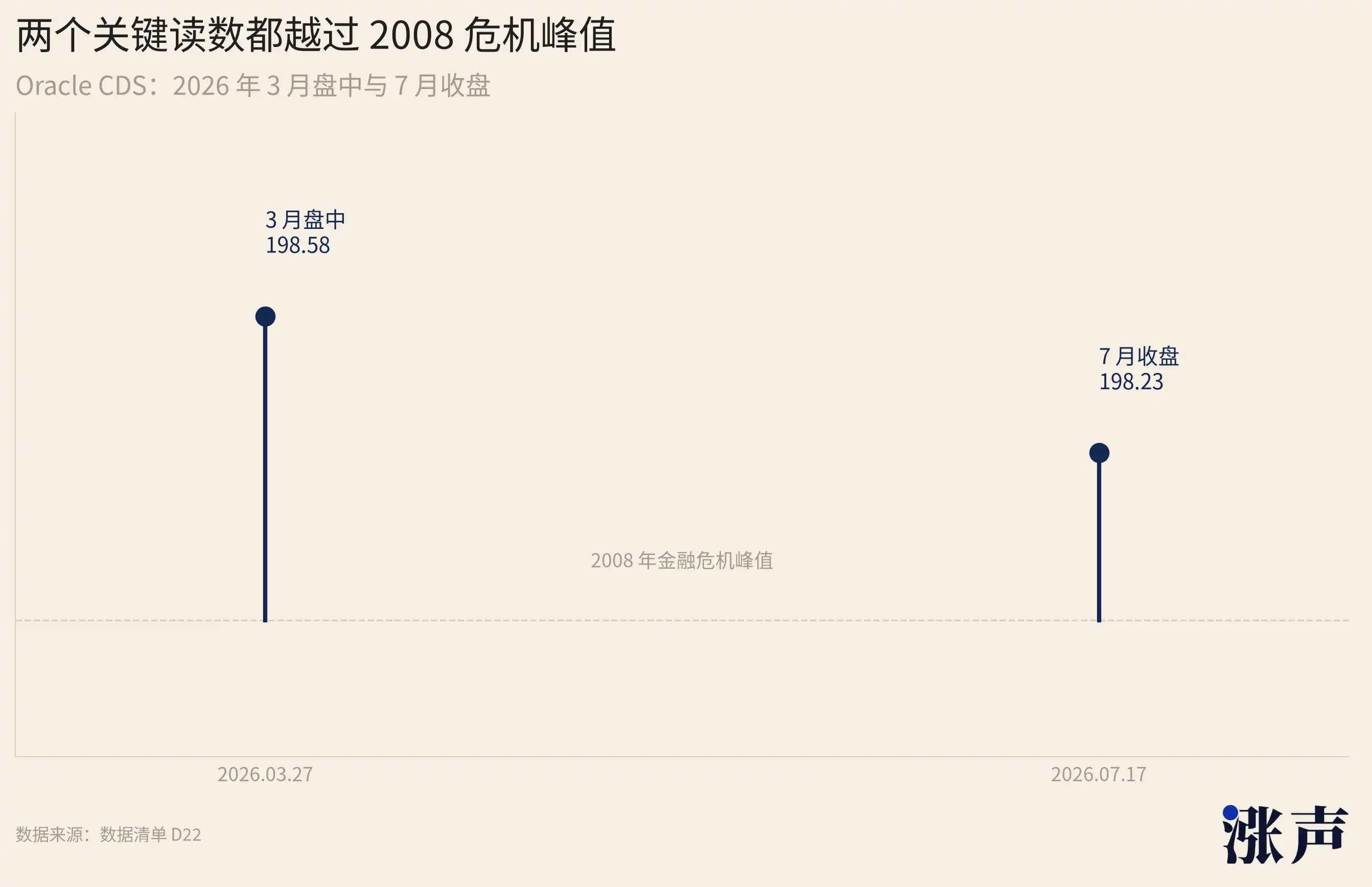
The market has been trying to assess this unease. The price of buying default insurance on a corporate bond reflects the market's view on default risk. Oracle's CDS price exceeded the peak of the 2008 financial crisis in March 2026, reaching a new record four months later.
Today's valuation is not backed by a stable, rent-paying building but by a series of events yet to occur. The completion of the building on schedule, the timely connection of power supply, the utilization of computing power, the machines not aging too fast over the twenty-four years of repayment, and tenants renewing their leases...
The fund itself has also started to leverage. In the second quarter of 2026, investors requested to redeem $15.6 billion but only received $5.9 billion. In the same quarter, Apollo, BlackRock, Ares, and Blue Owl successively tapped the debt market for financing.
Existing investors cannot exit, yet the fund continues to borrow new money.
However, in the subprime mortgage crisis, the borrowers who could not repay their home loans were ordinary families. Whereas now, the borrowers are the highest-rated companies globally. So, can they maintain their credit and commitments?
Recommended
Desk: Brent Crude Tops $110, Musk's Net Worth Drops 528.6 Billion in Four Days After Tesla Roadster Launch
Oct 17, 21:49
JST Fifth Buyback and Burn Successfully Concludes: Over 170 Million Tokens Worth Approximately $23.53 Million Burned, Buyback Mechanism Set for Comprehensive Upgrade
Oct 17, 20:10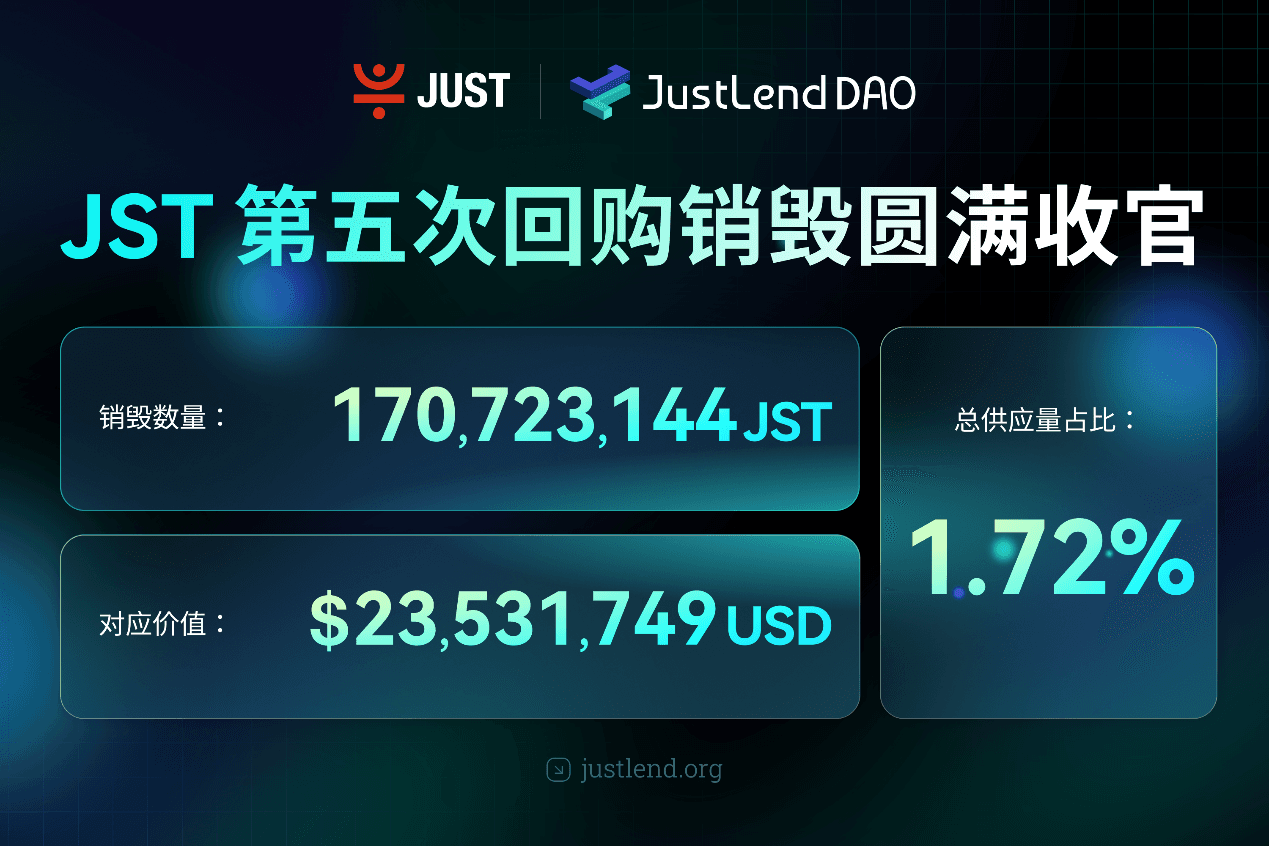
BitTorrent Brand Upgrade and Initial BTT Buyback & Burn Launch Simultaneously, Dual Engines Usher in New Era of Web3 Infrastructure
Oct 17, 20:00
Asia Market Daily: Japan's BOJ signals more rate hikes while Korea targets offshore perpetual platforms (2026/10/17)
Oct 17, 17:01Why did Papertrade backfire on you?
Oct 17, 17:01
The 'Strict Father' of Northern Myanmar: This Company Deploys 200,000 "AI Best Actors" to Strike Back Against Scammers
Oct 17, 15:34