Meta's free cash flow is now less than $800 million, not enough to buy two days' worth of servers

After the U.S. stock market closed on July 29th, Meta released its second-quarter 2026 financial report. Revenue was $60.8 billion, a 28% year-over-year increase, exceeding market expectations by several billion. In the same filing, net profit was $15.8 billion, a 14% year-over-year decrease, with earnings per share of $6.18, approximately 14% below consensus estimates. The stock price dropped 8% to 10% in after-hours trading, with different numbers reported at different times.
Most reports focused on the operating profit margin, which decreased from 43% in the same period last year to 31%. While this decline is indeed significant, it is not the most critical number in this financial report. The most critical figure is found in the last few lines of the cash flow statement: free cash flow of $7.84 billion.
For a company with quarterly revenue of $60.8 billion, the free cash generated in this quarter is not even enough to buy the company two days' worth of servers.
The bar graph below shows the current quarter's bar almost touching the horizontal axis. The free cash flow for the previous quarter was $12.386 billion, and for the same period last year, it was $8.549 billion, representing a 93.7% quarter-over-quarter decline.
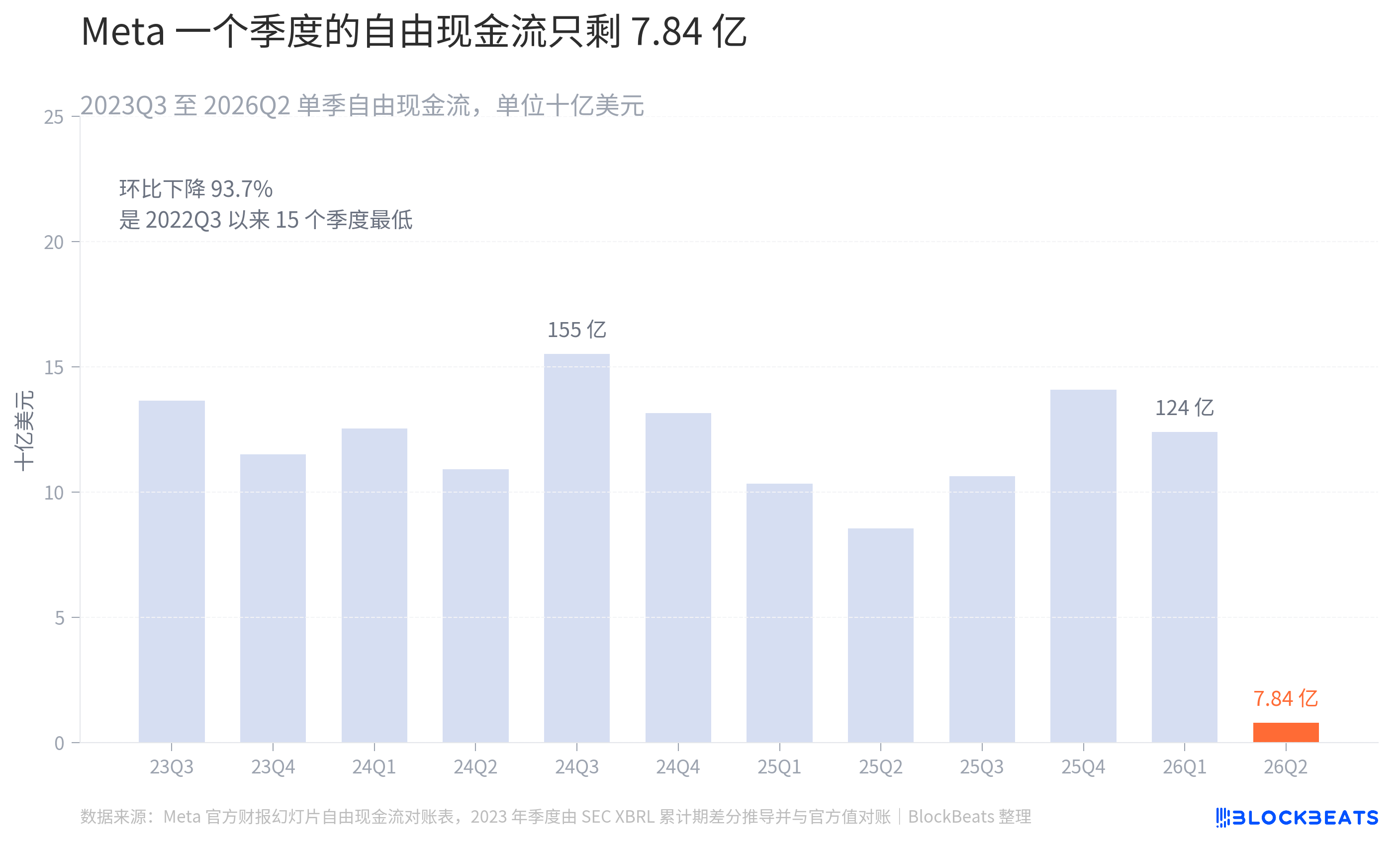
It is essential to clarify that $7.84 billion is not Meta's historically lowest quarter. Referring back to the SEC's XBRL data, the third quarter of 2022 had only $1.54 billion, and the second quarter of 2020 had $5.13 billion. To be precise, $7.84 billion is the lowest value in 15 quarters since the third quarter of 2022.
The reason for this decline is evident. Operating cash flow for this quarter was $31.862 billion, still growing, but capital expenditures for the quarter were $31.078 billion, an 82.7% year-over-year increase. This marks the first quarter in Meta's history with capital expenditures exceeding $30 billion, accounting for 51.1% of revenue, compared to 35.8% a year ago.
The cash earned and the cash spent almost offset each other, leaving behind the $7.84 billion.
Approximately half.
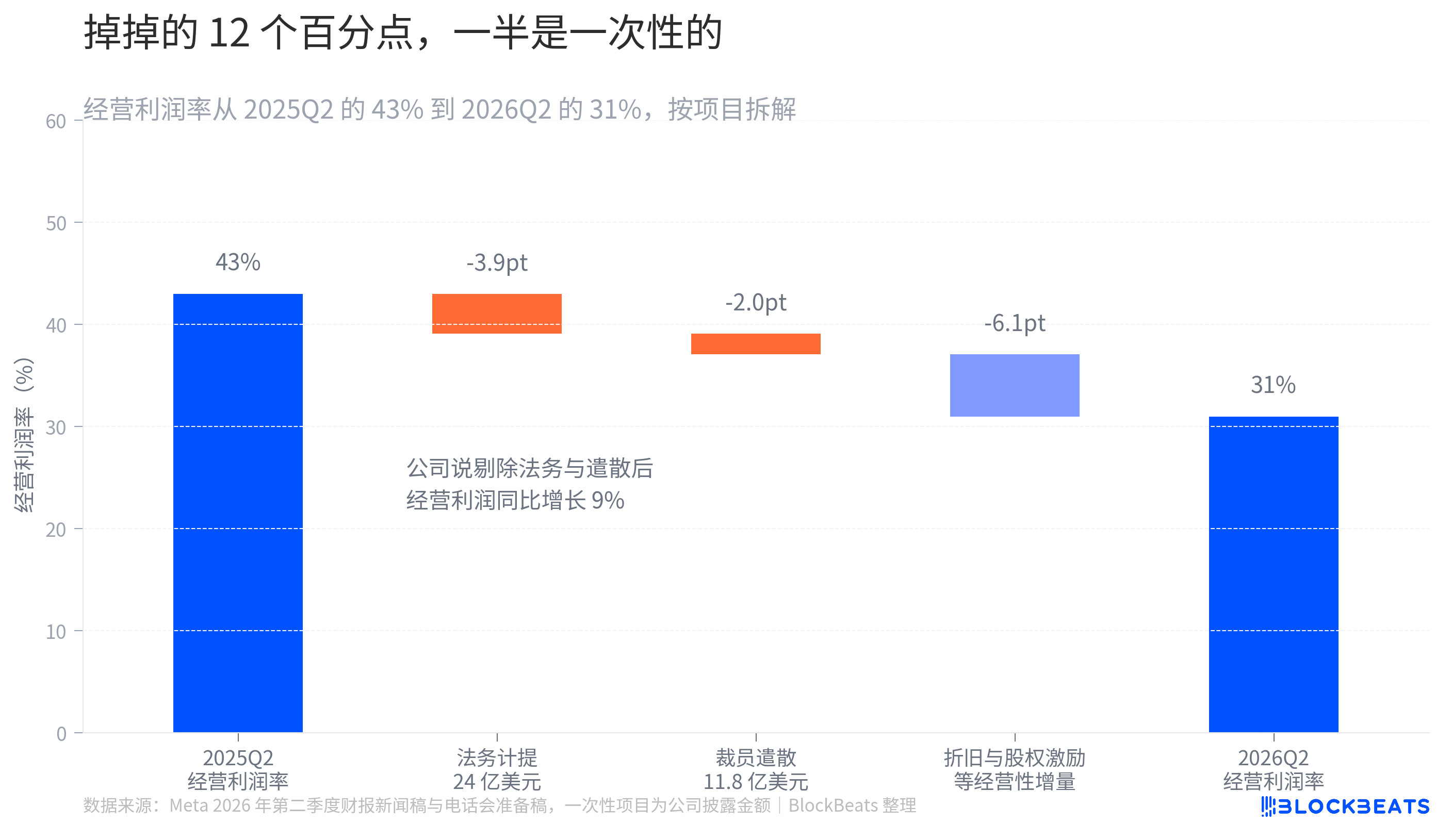
The financial report press release clearly listed two one-time items. One was a $2.4 billion legal provision recorded in general and administrative expenses, leading to a 110.6% year-over-year increase in this category. The other was a $1.18 billion severance expense related to the May layoffs. Together, these two items amount to $3.58 billion, which, based on this quarter's revenue, roughly dragged the profit margin down by 5.9 percentage points.
Chief Financial Officer Susan Lee provided the corresponding caliber in the earnings call script, stating that excluding these two items, second-quarter operating profit increased by 9% year over year.
The remaining half was not one-off. Research and development expenses were $21.656 billion, a 67.3% year-over-year increase, spending an additional $8.714 billion compared to the same quarter last year, the largest source of expense surge. Depreciation and amortization were $6.356 billion, a 46.4% year-over-year increase, increasing from 9.1% to 10.5% of revenue. Equity incentive expenses were $7.658 billion, a 58.4% year-over-year increase. Susan Lee attributed the expense growth to four items: employee compensation, infrastructure costs, legal-related costs, and "third-party AI token costs."
The last item is a new term introduced in this earnings report. Meta is buying reasoning from external sources.
There is also a detail that is easily misinterpreted. The financial report disclosed an employee headcount of 75,472, a 1% year-over-year decrease. However, the press release simultaneously stated that this number still includes approximately 8,000 employees affected by the May layoffs, most of whom will not be removed from the headcount until the end of the third quarter. The costs of the layoffs have already been reflected in this quarter's income statement, but the effects of the layoffs have not yet been realized.
Not in Reality Labs.
Reality Labs reported revenue of $431 million this quarter, operating at a loss of $4.619 billion, compared to a $4.530 billion loss in the same period last year, with the loss expanding by only 2%. This department has been the focus of the profit margin narrative for the past two years, and this time it remained relatively stable.
The real decline occurred in the core business. Family of Apps' operating profit was $23.394 billion, a 6.3% year-over-year decrease, with the corresponding segment margin dropping from 53.0% in the same period last year to 38.8%. The combined caliber dropped by 12 percentage points, with the core business layer dropping by 14 percentage points.
The advertising itself was not problematic. Advertising revenue was $59.363 billion, a 27% year-over-year increase, with ad impressions up by 14% and the average ad price up by 12%. Susan Lee provided a specific set of product numbers in the script, stating that the update to the ad ranking model increased Facebook's ad clicks by 8.3% and conversion rates by 15.7%. The annualized revenue run rate of the Advantage+ automated delivery tool exceeded $75 billion.
Monetization efficiency is improving, profit margins are declining, and sandwiched in between is the cost of computing power.
This quarter, there were $0 in stock buybacks. Year-to-date buybacks also amounted to $0. In the same period last year, these figures were $10.167 billion and $22.921 billion, respectively. Meta has ceased buybacks.
On the same cash flow statement, there was a net inflow of $24.91 billion from debt issuance, compared to $0 in the same period last year. This corresponds to a $25 billion six-tranche unsecured senior note issuance completed on May 4, with the longest tranche maturing in 2066 and a coupon of 6.45%. Bloomberg reported on this debt issuance on April 30 with the headline "Meta Launches Up to $25 Billion Bond Sale After Surge in AI Capital Expenditure."
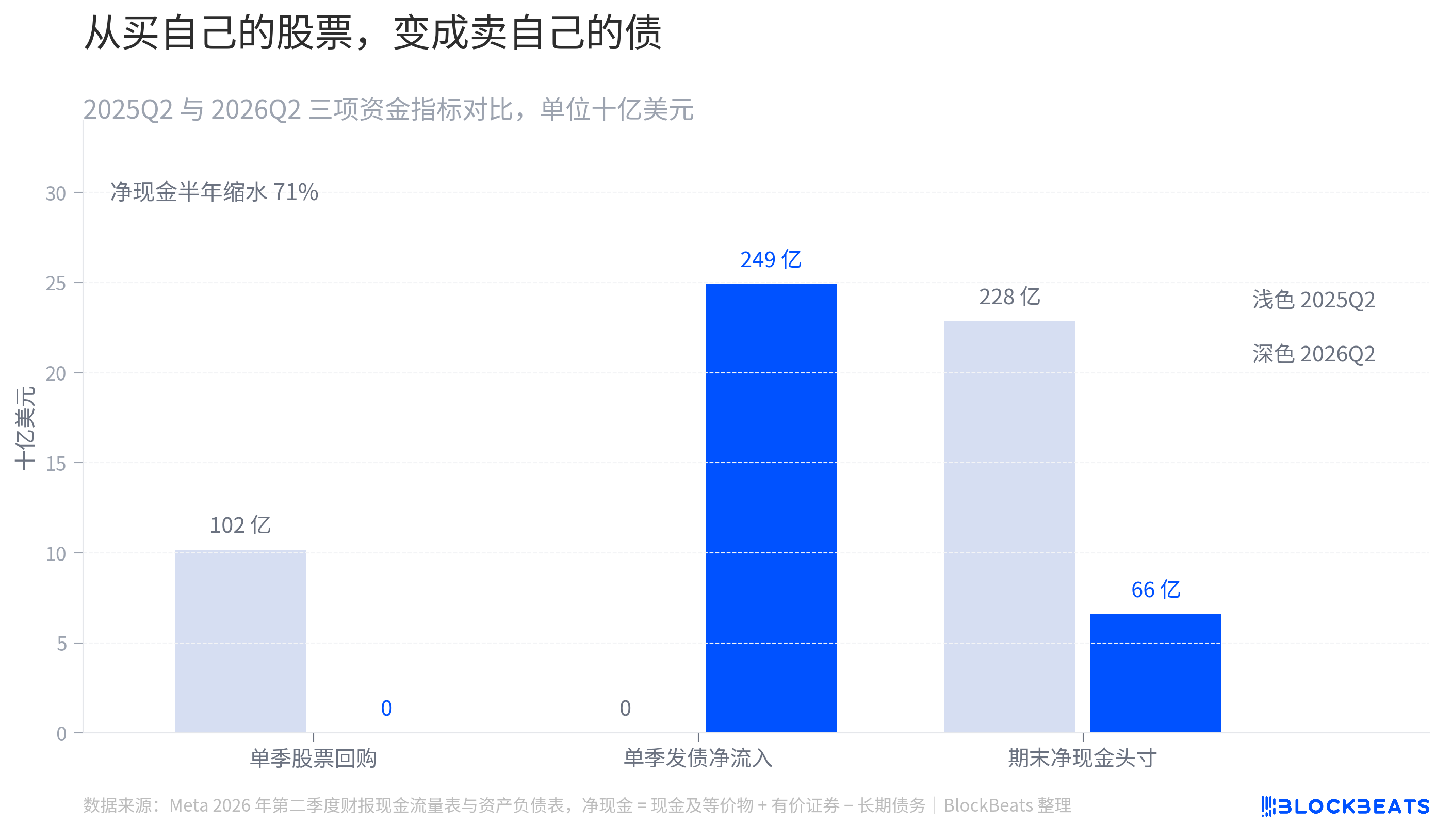
Combining these two events, the end-of-period net cash position declined from $22.848 billion at the end of 2025 to $6.596 billion, a 71% half-year decrease. Long-term debt increased from $58.744 billion to $83.664 billion.
There is another item on the balance sheet that has not been explained. Restricted cash included in "Other Assets" surged from $1.662 billion in the same period last year to $13.107 billion, a 7.9x increase. The official purpose has not been disclosed, and the 10-Q for this quarter has not yet been filed, so we must wait for that document.
A day before the earnings report, on July 28, Meta announced a strategic joint venture with the world's largest asset manager, BlackRock, to build a 1-gigawatt data center in El Paso, Texas. According to the official press release, the total development cost is approximately $14 billion, with BlackRock-affiliated funds holding an 80% stake and Meta holding 20%. Meta has leased the entire campus, with an initial term of 4 years and 4 renewal options, up to 20 years, and has provided residual value guarantees.
In a prepared remarks document for the earnings call, Mark Zuckerberg lumped this development under a new label, stating, "As part of Meta Compute, we announced our new strategic joint venture with BlackRock yesterday."
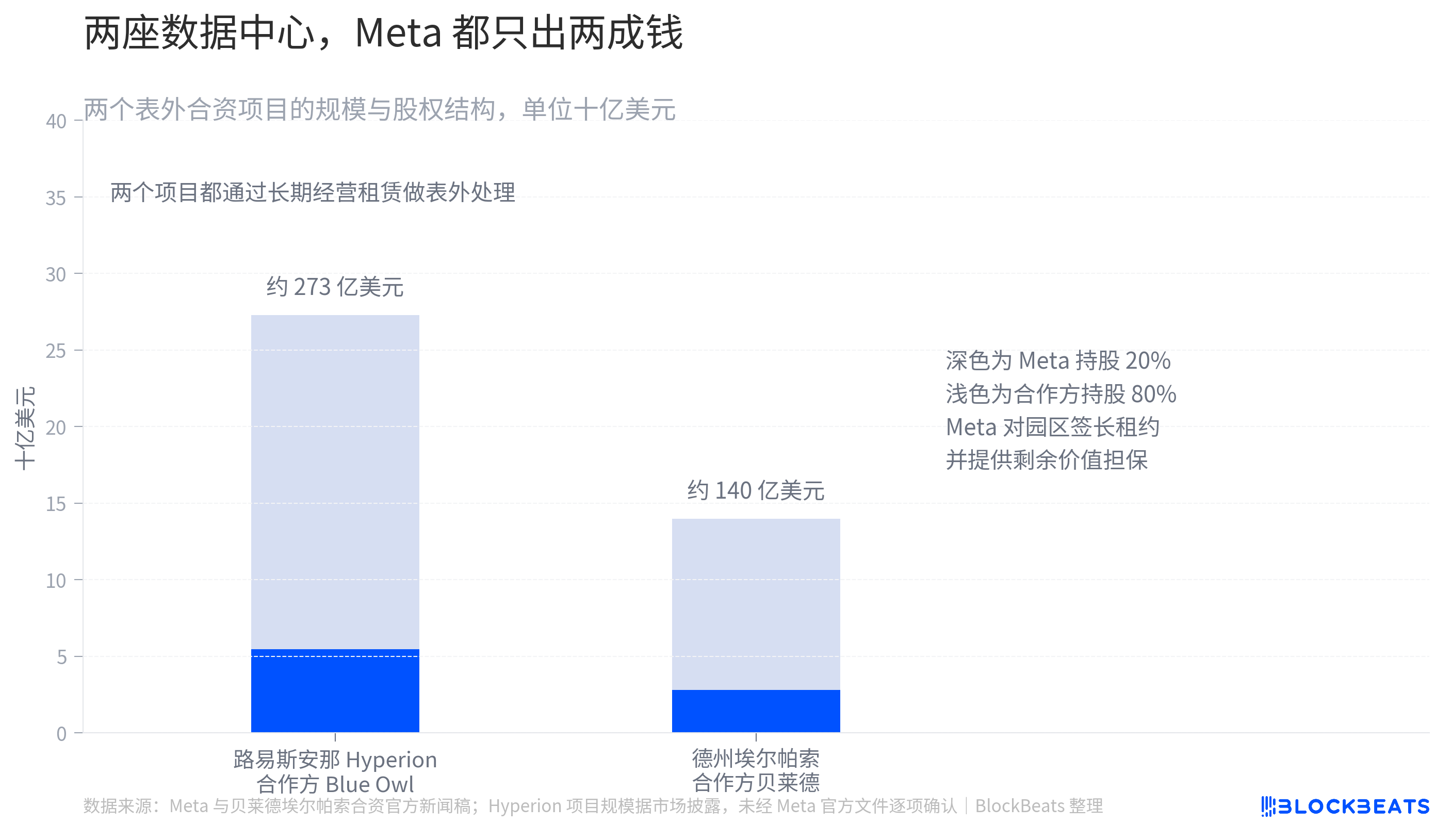
This is not the first time. The Louisiana Hyperion project in October 2025 followed a similar structure, with approximately $27.294 billion in bonds issued, 80% held by funds managed by Blue Owl and 20% by Meta. Meta similarly leased back the property and provided residual value guarantees. These precise terms have yet to be individually confirmed through official Meta filings.
The structure's effect is that the data center is built to order, the computing power is used as needed, but the project company is not included in Meta's consolidated financial statements, and Meta pays rent instead of capital expenditures. Susan Lee explained it clearly in the draft, stating that the strength of the balance sheet allows the company to "attract capital from the broader market to supplement the cash flow generated by the business."
Following this logic and looking at the full-year 2026 capital expenditure guidance of $130 billion to $145 billion, $50.918 billion has already been spent in the first half of the year. This range only accounts for a portion included in the consolidated financial statements.
Regarding the 2027 capital expenditures, Susan Lee only mentioned in the draft, "Our current plan is to maximize capacity in 2026 and 2027." During the Q&A session, she explicitly refused to provide numbers, stating, "We are not providing specific outlook for 2027 capital expenditures at this time, as infrastructure planning remains highly dynamic."
During the same week, Google's CFO, Annette Ashkenazy, stated that spending in 2027 would "increase significantly." Microsoft only mentioned "year-over-year growth." None of the three companies provided specific figures.
According to Fortune's report on July 26, Brad Warden, senior portfolio manager at Nomura Asset Management, commented on these companies, saying, "They now look cheap, but looking forward to the potential disruption, they are presumed guilty."
Meta's revenue growth rate this quarter is 28%, and for the price it pays for this growth, some of it is already not included in its own capital expenditure figures.
Recommended
Desk: Brent Crude Tops $110, Musk's Net Worth Drops 528.6 Billion in Four Days After Tesla Roadster Launch
Oct 17, 21:49
JST Fifth Buyback and Burn Successfully Concludes: Over 170 Million Tokens Worth Approximately $23.53 Million Burned, Buyback Mechanism Set for Comprehensive Upgrade
Oct 17, 20:10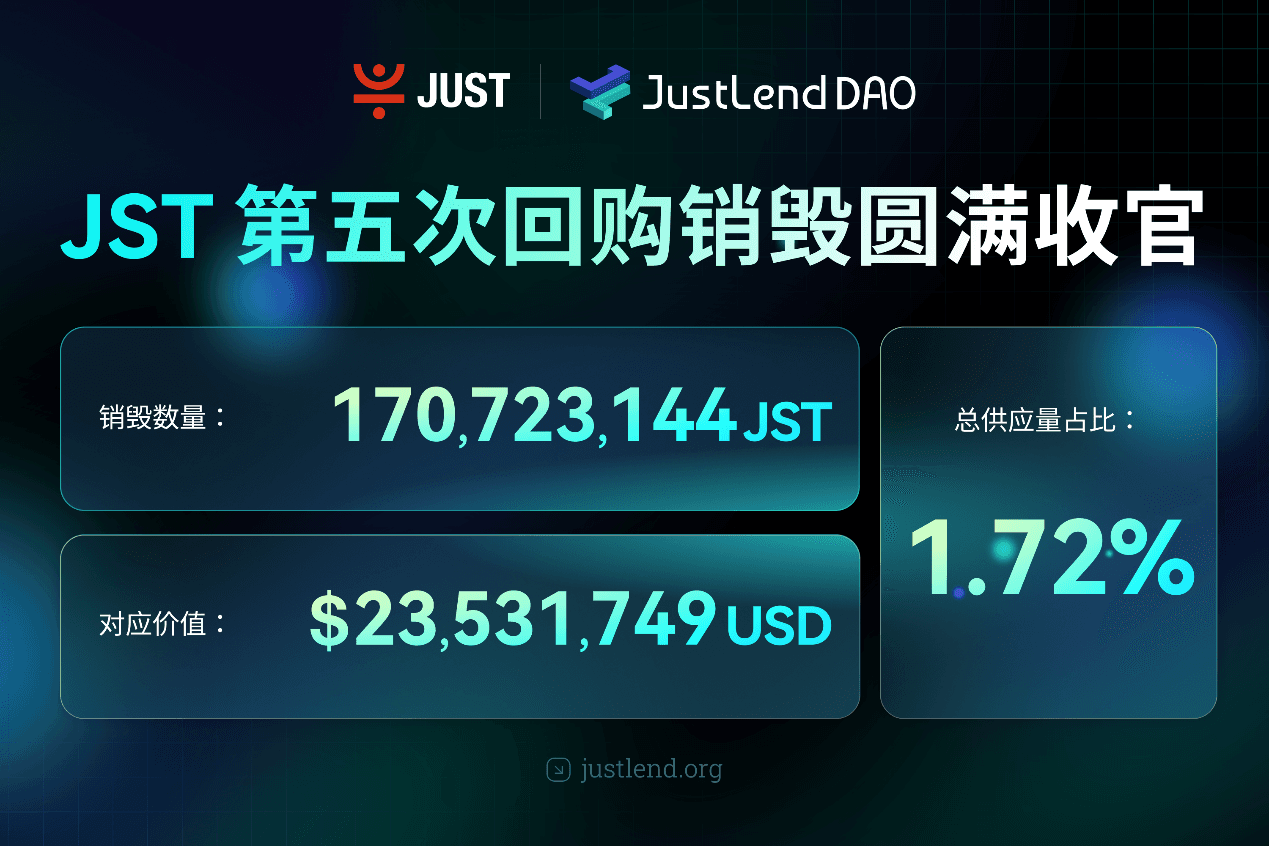
BitTorrent Brand Upgrade and Initial BTT Buyback & Burn Launch Simultaneously, Dual Engines Usher in New Era of Web3 Infrastructure
Oct 17, 20:00
Asia Market Daily: Japan's BOJ signals more rate hikes while Korea targets offshore perpetual platforms (2026/10/17)
Oct 17, 17:01Why did Papertrade backfire on you?
Oct 17, 17:01
The 'Strict Father' of Northern Myanmar: This Company Deploys 200,000 "AI Best Actors" to Strike Back Against Scammers
Oct 17, 15:34