The only company that saw its stock price rise after the financial report was Microsoft. What is supporting its stock price?

After the U.S. stock market closed on July 29, Microsoft released its Q4 FY2026 earnings report. The revenue was $90 billion, an 18% year-over-year increase. The growth rate of Azure and other cloud services increased from 40% in the previous quarter to 43%. In the prepared remarks for the earnings call, CEO Satya Nadella added a line he hadn't had the opportunity to say before, stating that Azure's full-year revenue "exceeded $100 billion," a 41% growth. This is the first time this business has crossed the $100 billion threshold.
Within the first few minutes after the earnings report was released, the stock price increased by less than 3% in after-hours trading. By the end of the earnings call, the increase had expanded to around 8%. The stock price briefly rose from the closing price of $390.54 to over $422. There were no new revenue figures announced during the call; instead, CFO Amy Hood mentioned a capital expenditure guidance. She stated that the capital expenditure for the calendar year 2026 is estimated to be around $175 billion. Three months ago, under the same criteria, this figure was $190 billion.
Over the past three months, the market has adopted the rule that "for every additional dollar cloud providers spend, a dollar is deducted from their valuation" as the default. Jason Lemire, Chief Investment Officer of Bold Wealth Partners, was blunt before the earnings report week, stating, "It used to be the more they spent, the better, now it's the less they spend, the better." So when Microsoft changed the $190 billion figure to $175 billion, the market almost instinctively breathed a sigh of relief.
Was that $15 billion saved?
No.
In the same statement, Hood added that after this adjustment, the "investment expectations themselves remain unchanged." She also explained the source of the difference. Starting from FY2027, Microsoft is extending the depreciation period of data centers and office buildings from 15 years to 25 years. While this action is depreciation-related, it incidentally changes the classification of leases. With the extended period, more newly signed data center leases will shift from finance leases to operating leases, with only finance leases included in capital expenditures.
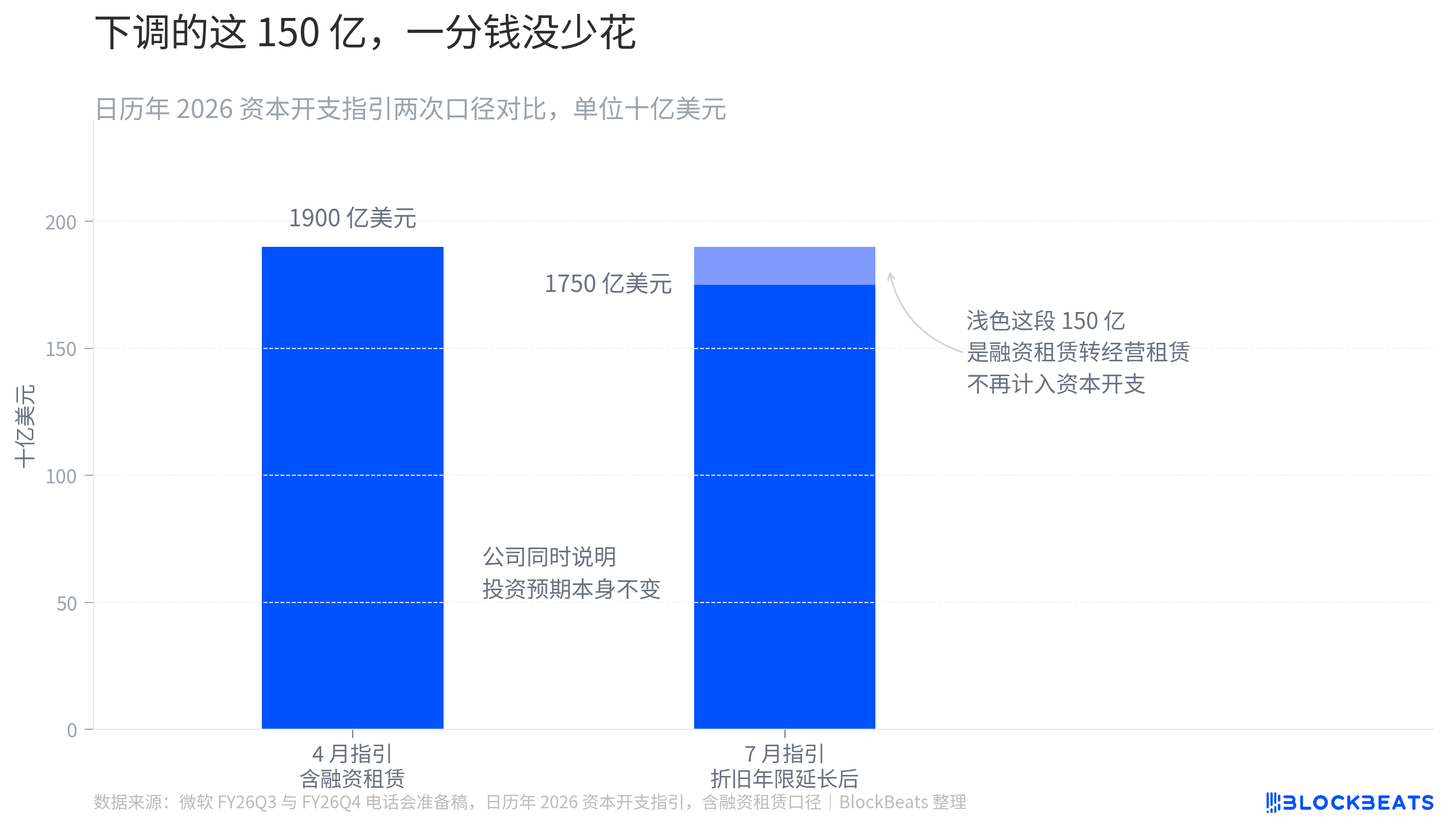
The lighter section on the chart is the part that has been removed from the reporting framework. The money still needs to be paid, and the data centers still need to be built. It's just that they will now appear in the profit and loss statement under rent, rather than in the cash flow statement under capital expenditures. In its FY2026 10-K, Microsoft provided a supporting figure in the lease footnote, stating that, as of the end of June, there were $329.1 billion in lease commitments not yet commenced, which will gradually commence from FY2027 to FY2033, mainly for data centers.
The change in the depreciation period was only mentioned in the prepared remarks for the earnings call. It was not mentioned in the press release, and the 10-K does not contain the term "25 years"; the accounting policy in that document still states building at 5 to 15 years.
Has Capital Expenditure Really Slowed Down?
Not at all.
According to Microsoft's own verbal guidance on the call, including finance leases, capital expenditure for the quarter was $41.0 billion, a 70% year-over-year increase. In the same quarter two years ago, it was $19.0 billion. For the entire 2026 fiscal year, it reached $145.3 billion, 2.6 times that of the 2024 fiscal year. The company's guidance for the next quarter is "over $50.0 billion."
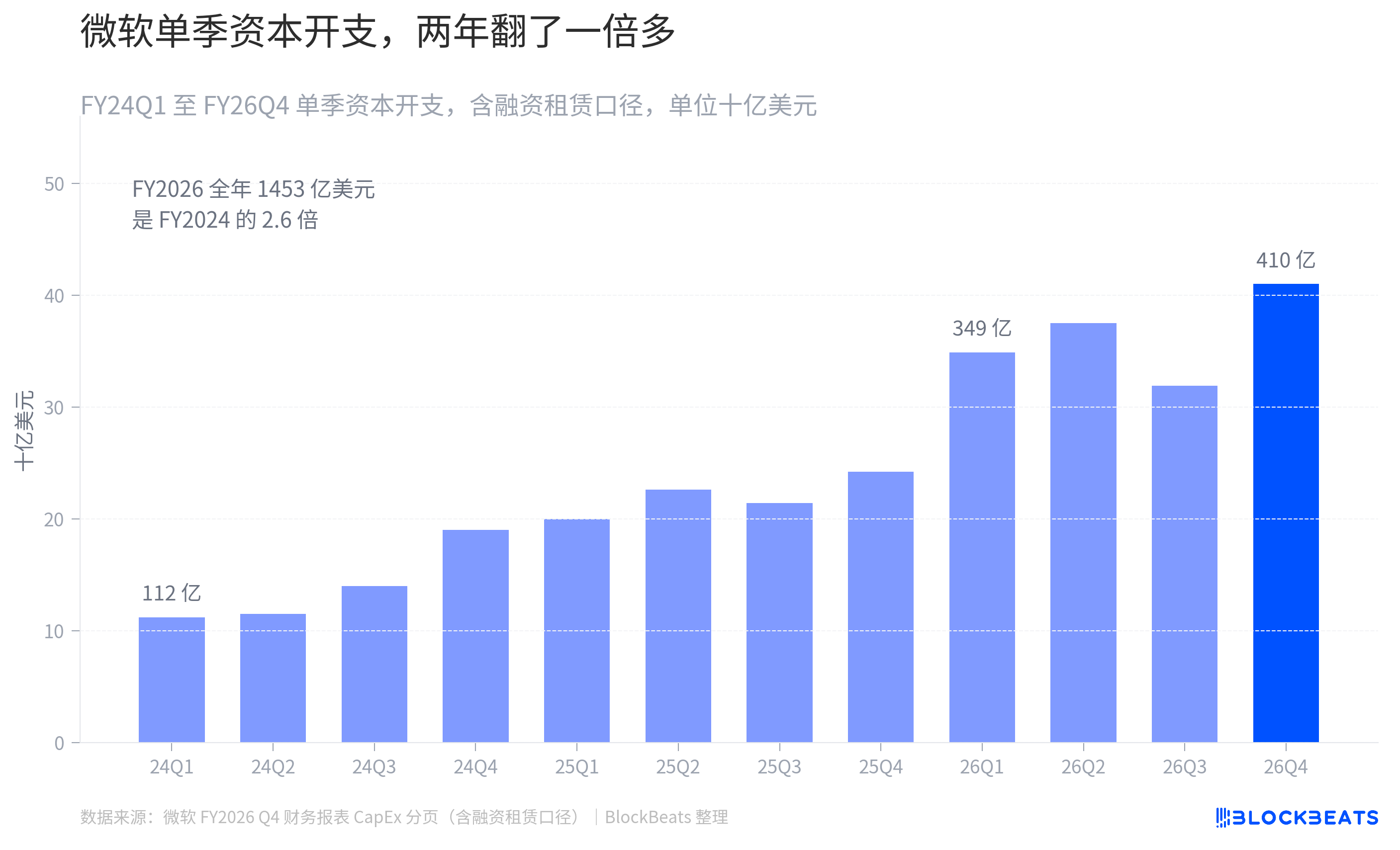
There is a trap here. Reports on the earnings day mentioned, "Capital expenditure for the quarter was $35.8 billion, below the market expectation of $36.1 billion," using the line from the cash flow statement "Purchases of property and equipment," which excludes finance leases. Both metrics are correct, with the difference of $5.6 billion in finance leases for the quarter. In the future, whenever you see Microsoft's capital expenditure figure, the first question should be whether it includes finance leases, which is more useful than asking about the number itself.
Regarding the 2027 fiscal year, the company only made three statements. Capital expenditure will increase year-over-year, exceeding $50.0 billion in the first quarter, and free cash flow is expected to remain positive. The widely circulated $255.0 to $260.0 billion is not the company's guidance but the sell-side consensus before the earnings report, incorrectly reported by some media as guidance.
Can the $678.0 Billion Order Backlog Support These Investments?
Microsoft reported a 84% year-over-year growth in the commercial remaining performance obligation balance to $678.0 billion. This figure has been singled out in many reports as evidence of AI demand. It indeed serves as evidence, but the structure is softer than it appears.
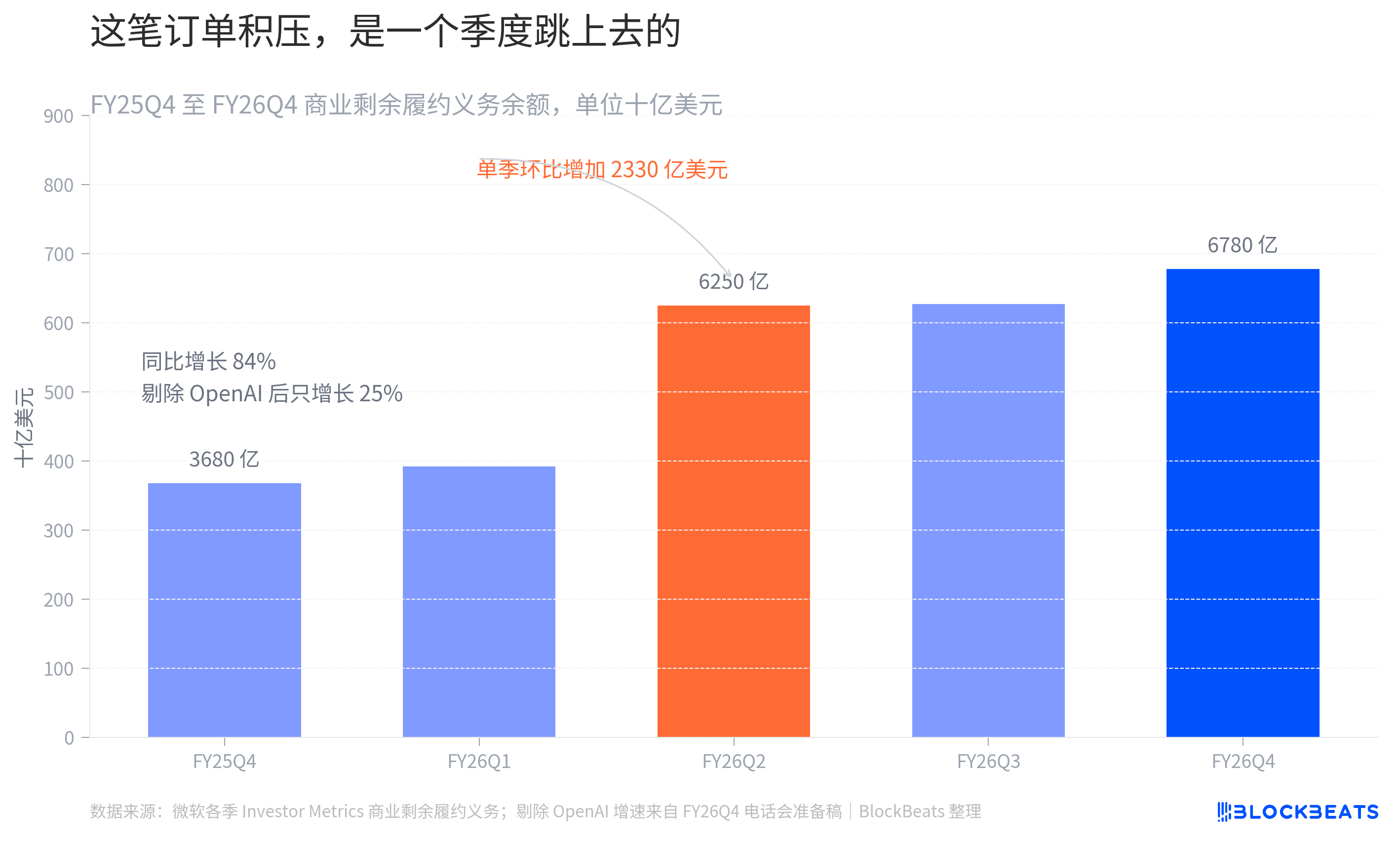
The bar on the chart didn't grow gradually; it jumped in a single quarter in the second quarter of the 2026 fiscal year, with a $233.0 billion sequential increase, corresponding to the contract with OpenAI. Hood provided another metric on the call, showing a 25% year-over-year growth excluding OpenAI. The same pattern applies to commercial bookings, with reported growth of 10%, but an 18% growth when excluding the OpenAI impact.
The term is also crucial. Based on the 10-K and call's metrics, the weighted average recognition term for these backlog orders is around 2.3 years, with only 30% to be recognized in the next 12 months. The remaining 70% is deferred beyond a year, and this portion's year-over-year growth rate is 112%. In other words, the $678.0 billion is more like a check to be cashed over several years, with the money for the data centers and GPUs due this year.
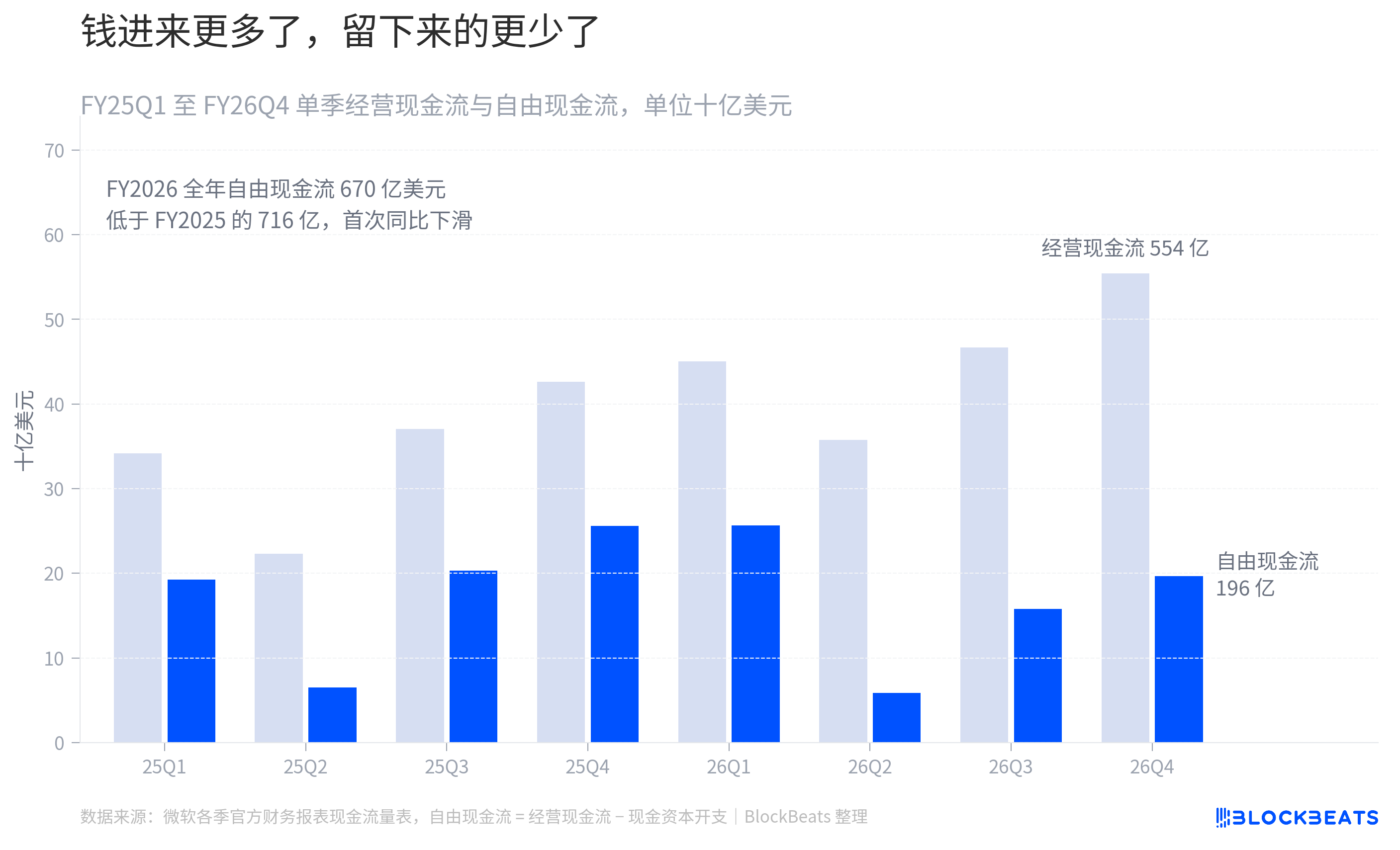
This quarter's operating cash flow was $55.4 billion, a 30% year-over-year increase, reaching a historical high. Free cash flow was $19.6 billion, a 23% year-over-year decrease. Looking at the full year, the 2026 fiscal year's free cash flow was $67 billion, lower than the previous fiscal year's $71.6 billion. This marks the first year-over-year decline in annual free cash flow for Microsoft since entering this AI investment cycle.
Depreciation has started to impact the income statement. According to the 10-K's fixed assets footnote, depreciation expense for the 2026 fiscal year was $34.3 billion, compared to $15.2 billion two years ago. The gross margin of Microsoft Cloud decreased from 68% a year ago to 65% this quarter, marking a continuous decline over the past four quarters. This trend is more significant than capital expenditure because capital expenditure can be manipulated through accounting methods, while depreciation is recognized annually once assets are put into use.
An Unexpected Direction
Microsoft's non-GAAP earnings per share this quarter were $4.74, lower than the GAAP EPS of $4.81. This is contrary to the direction of most companies, as Microsoft's non-GAAP definition excludes the impact of the OpenAI equity method, which amounted to a net income of $4.963 billion in the 2026 fiscal year. As per the 10-K disclosure, this income primarily resulted from dilution gains due to Microsoft's reduced ownership during the OpenAI restructuring in October 2025, rather than from operational gains. In the previous fiscal year, the same line item showed a net loss of $3.62 billion.
The same footnote also reveals a less conspicuous figure. Microsoft's revenue from the OpenAI commercial agreement in the 2026 fiscal year was $24.1 billion, with an accounts receivable of $6 billion from OpenAI at the end of the period. Microsoft currently holds about 25% equity in OpenAI, calculated on a fully diluted basis.
This quarter, Microsoft demonstrated its ability to monetize its computing power. When the market acknowledged this with an 8% increase, what it recognized was Microsoft reallocating a portion of its computing power expenditure from the capital expenditure line.
Recommended
Desk: Brent Crude Tops $110, Musk's Net Worth Drops 528.6 Billion in Four Days After Tesla Roadster Launch
Oct 17, 21:49
JST Fifth Buyback and Burn Successfully Concludes: Over 170 Million Tokens Worth Approximately $23.53 Million Burned, Buyback Mechanism Set for Comprehensive Upgrade
Oct 17, 20:10
BitTorrent Brand Upgrade and Initial BTT Buyback & Burn Launch Simultaneously, Dual Engines Usher in New Era of Web3 Infrastructure
Oct 17, 20:00
Asia Market Daily: Japan's BOJ signals more rate hikes while Korea targets offshore perpetual platforms (2026/10/17)
Oct 17, 17:01Why did Papertrade backfire on you?
Oct 17, 17:01
The 'Strict Father' of Northern Myanmar: This Company Deploys 200,000 "AI Best Actors" to Strike Back Against Scammers
Oct 17, 15:34