Qualcomm and Arm Tumble in Unison: The Bill for Rising Memory Prices Has Finally Arrived at the Mobile Chip Companies
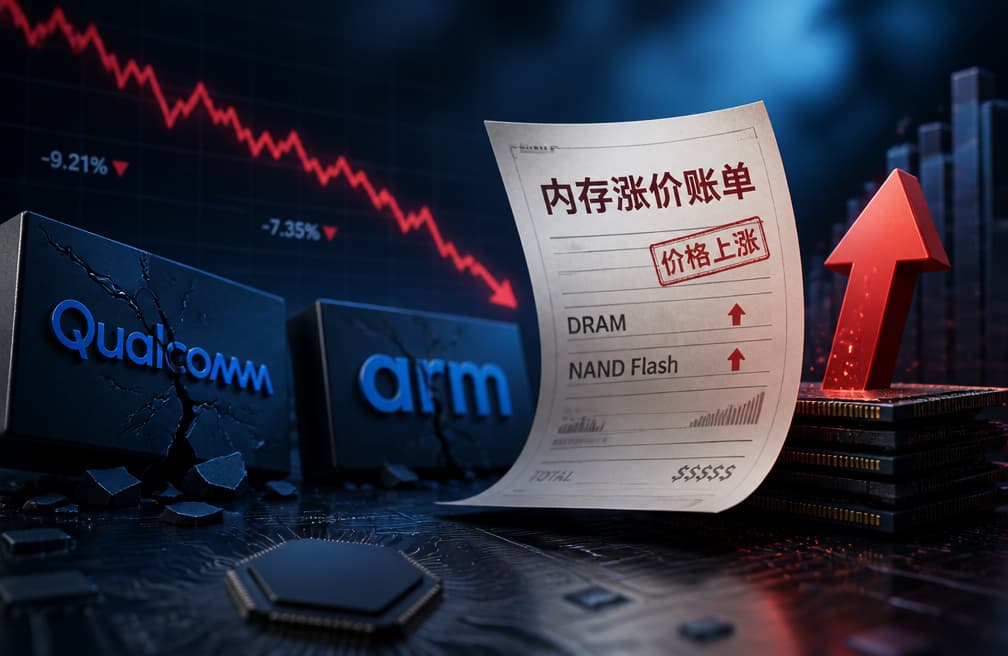
After the U.S. stock market closed on July 29, both Qualcomm and Arm released their earnings reports.
Let's start with Qualcomm. Its revenue was $9.947 billion, exceeding the consensus estimate of $9.67 billion. However, its non-GAAP earnings per share were $2.21, below the expected $2.23. More importantly, the guidance for the next quarter is revenue of $9.7 billion to $10.5 billion and earnings per share of $2.05 to $2.25. According to Reuters' data, the market consensus was earnings per share of $2.36, meaning Qualcomm's upper guidance limit is still below expectations. This is not an "earnings beat"; it's revenue beating, profit slightly missing, and guidance significantly missing.
Now, onto Arm. Its shareholder letter was positive, with revenue of $1.289 billion and adjusted earnings per share of $0.45, both beating expectations, along with better-than-expected guidance for the next quarter. The stock price initially dropped by 8.11% on that day, during the normal trading period before the earnings report was released. After the report came out, the stock price hardly moved, and after the conference call concluded, it dropped by 7% to 8% in after-hours trading. A Bloomberg news article still carried the phrase "even beating expectations didn't impress investors" in its URL, but the displayed headline had already been changed to "Mobile Slowdown Overshadows Data Center Growth, Arm Falls."
What happened in between? Both companies mentioned the same word in their earnings reports: memory.
Mobile Decline, Automotive Revival
In Qualcomm's official earnings presentation, there was a dedicated page about the Android smartphone business. It stated that due to memory price increases and supply constraints, it is expected that the revenue from Android smartphones in Qualcomm CDMA Technologies (QCT) for fiscal year 2026 will decline by approximately 20% year-over-year, dragging down earnings per share by over $1.50 for the full year. Qualcomm also announced a price increase on products effective September 1 to pass through the rising input costs.
This page is the most direct evidence in both earnings reports. The memory price increase resulted in a record operating profit of 8.949 trillion South Korean won for Samsung, while for Qualcomm, it translated into a specific bill of $1.50 per share.
You can also see it in the gross margin. Qualcomm's GAAP gross margin this quarter was 53.1%, compared to 55.6% in the same period last year. According to the conference call transcript, the management described the QCT gross margin as "slightly below our historical range" due to the rise in memory and input costs.
The revenue from the Mobile business this quarter was $5.086 billion, a 20% year-over-year decline. The Automotive business was $1.588 billion, a 61% year-over-year increase, marking 23 consecutive quarters of double-digit growth. The distance between the two bars on the chart is rapidly narrowing, with automotive quarterly revenue approaching one-third of the mobile revenue.
There is also a longer-term issue on the phone side. Official presentation materials stated that due to supply constraints, the decline in Apple product revenue will accelerate from the fourth quarter, with "our modem share on upcoming iPhones expected to be significantly below the previous estimate of 20%." According to a transcript of the call, Chief Financial Officer Akash Palkhiwala said Apple's revenue will drop by about 50% from the September quarter to the December quarter.
CEO Cristiano Amon gave a more memorable line on the call, reportedly saying, "We are essentially substituting Apple with the data center." The official wording is more cautious, with the presentation materials stating that the year-over-year increment in non-phone revenue for fiscal 2027 will substitute all Apple product revenue from fiscal 2026.
The data center line is currently a timeline. The revenue trajectory given by the company is around $300 million for fiscal 2026, $5 billion for fiscal 2027, and over $15 billion for fiscal 2029. Within the $5 billion of fiscal 2027, there are custom chips for two mega-scale customers, each contributing over $1 billion. One of them has already been announced; Meta has signed a strategic agreement with Qualcomm for a multi-generational CPU roadmap, with the first Dragonfly C1000 expected to start production in the second half of 2028.
Seaport Global analyst Jay Goldberg's assessment, as reported by Reuters, was not as kind. He said Qualcomm "is seeing Android share shift away from its side and has already lost almost all remaining share from Apple."
Arm's Conference Call Takes a Wrong Turn
Arm's shareholder letter included some impressive figures. Data center royalty revenue more than doubled year-over-year, marking a second consecutive quarter of doubling. The Neoverse architecture has surpassed 1.5 billion cores shipped, with the latest 500 million cores taking only 9 months, whereas the first billion cores took 6 years. The shareholder letter also referenced IDC data, stating that Arm's architecture is accelerating server platform spending, nearly doubling in the past two quarters and surpassing the x86 platform.
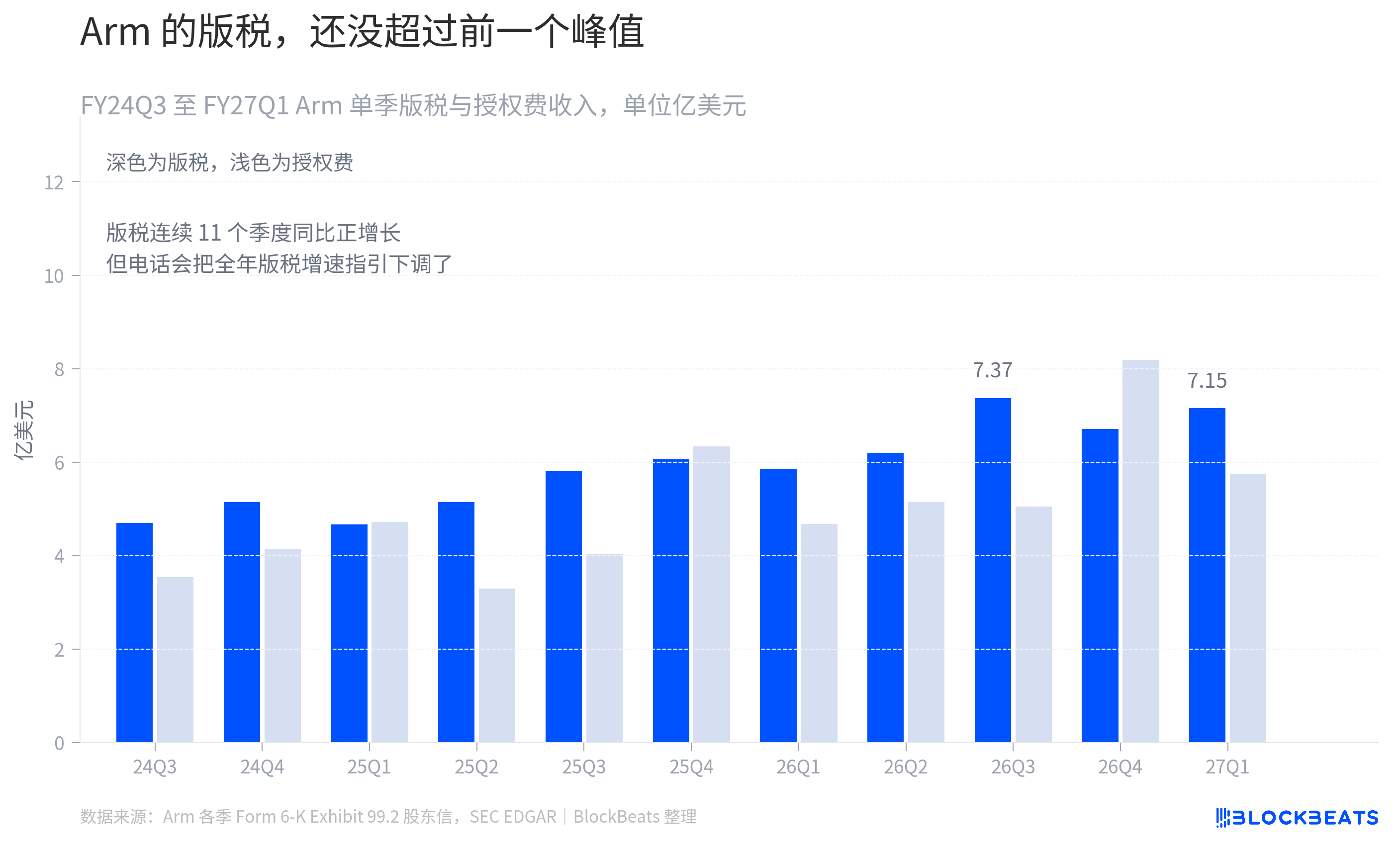
The dark line on the graph tells another story. This quarter's royalty revenue was $715 million, a 22% year-over-year increase, but it did not surpass the $737 million from the third quarter of fiscal 2026. That was the peak quarter for Arm's royalty revenue. The licensing fee column has always seen significant fluctuations, with year-over-year growth rates fluctuating between -15% and +72%. The market always looks at that smooth upward trending line of royalty revenue, and this line did not hit a new high this quarter.
What really caused the stock price to fall was a downward revision during the earnings call. According to the call's transcript, Arm lowered its full-year royalty growth guidance from around 20% to the high teens, citing weak smartphone market demand and high memory prices, and anticipating a double-digit decline in the smartphone market. In the guidance for the next quarter, licensing revenue is expected to grow by about 30% year-over-year, while royalties are only in the low teens.
Why No Stock Price Increase Despite Beating Expectations?
As of the close on July 29th, Arm's forward P/E ratio was 103.66x, while Qualcomm's was 15.22x, a difference of 6.8x. Another notable comparison is Arm's forward P/E ratio being 5.4x higher than NVIDIA's at 19.07x, despite NVIDIA's trailing twelve months revenue of $253.49 billion being 49x that of Arm's.
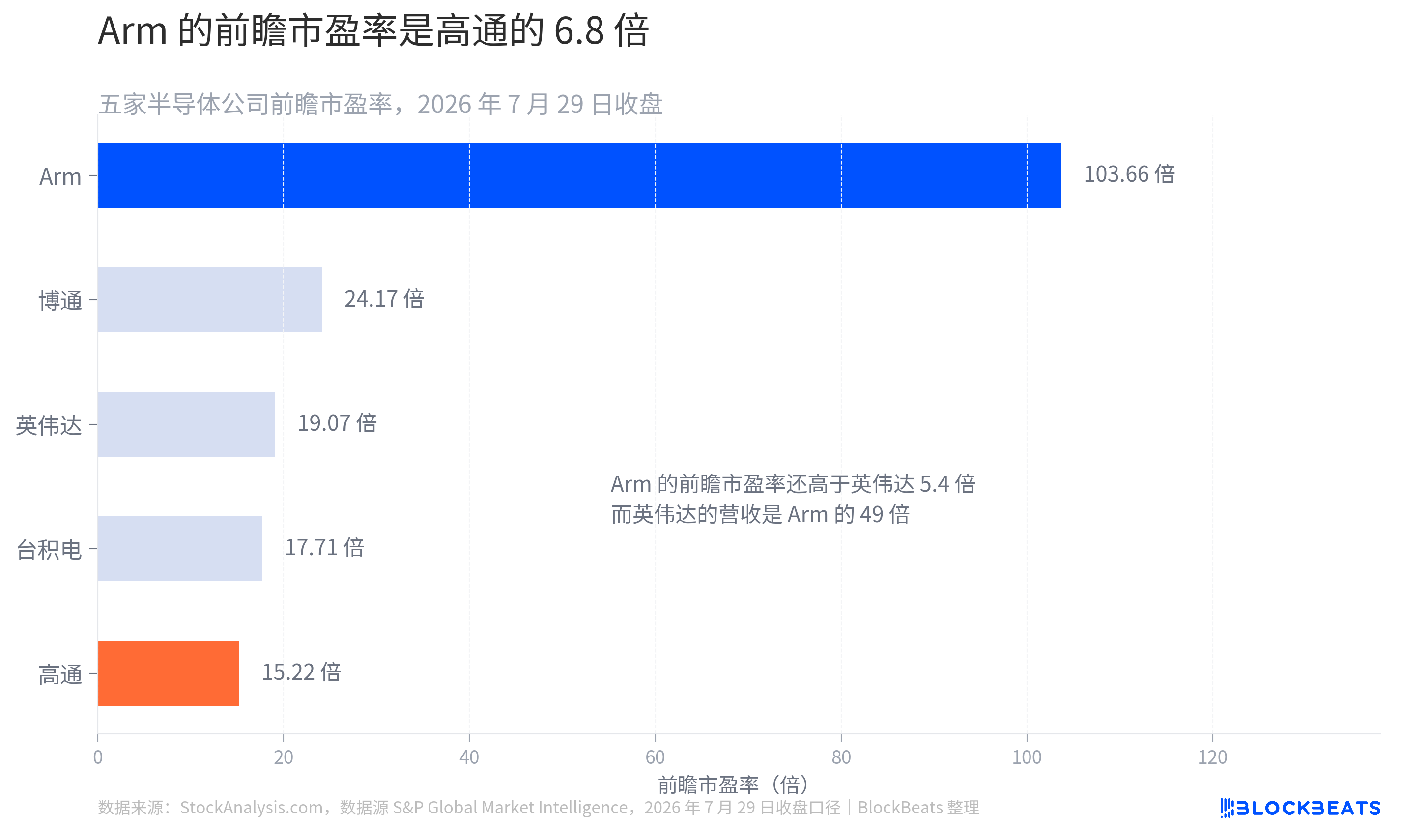
TechTimes explained this phenomenon well in an analysis post-earnings, stating that at a forward P/E ratio of 100 to 120, "a clean beat is no longer capable of driving the stock price up." This statement describes a common occurrence, not exclusive to Arm. When valuations have priced in growth for several years ahead, the role of the earnings report shifts from providing surprises to confirming assumptions, and any unmet expectations are magnified.
There is another variable that most reports missed. It has been reported that the Federal Trade Commission in the U.S. launched a formal antitrust probe against Arm starting in May 2026, to investigate whether it will weaken or refuse to offer CPU architecture licenses to competitors after introducing its in-house AGI CPU, with parallel investigations by the Korean and EU commissions. If regulators ultimately demand nondiscriminatory pricing, Arm's long-term model with $250 billion in revenue by FY 2031 would require a reassessment of profit margin assumptions.
There has been progress this quarter on Arm's in-house chip. Shareholder communications stated that the demand for AGI CPUs exceeded $2 billion, spanning fiscal years 2027 and 2028, doubling the $1 billion opportunity disclosed in the previous quarter, with new clients including many from the U.S. and China. Jefferies' estimates to Reuters are more optimistic than the company's own, suggesting this business could reach $18 billion by FY 2031, higher than Arm's $15 billion target.
Not Just About These Two Companies
According to statistics, the Philadelphia Semiconductor Index fell 18.2% in July, despite doubling in the first half of this year. In July, 19 tech stocks, mostly semiconductor stocks, dropped by over 25%, with seven still showing triple-digit gains for the year.
The arrangement of these points in the chart is very clear: the biggest losers in July were basically the ones that had seen the biggest gains so far this year. SanDisk dropped 40.4% in July but is still up 471% year-to-date. Micron dropped 26.5% in July but is up 197% this year. ARM dropped 36.6% in July but is up 105.7% for the year.
Qualcomm was the exception. It dropped 15.75% in July and is down 8.99% year-to-date. It is not part of the overvalued group because it does not have a squeezable AI premium. Thirty-six analysts have a Hold rating on it with an average target price of $220.57, representing a 40% upside. Forty analysts have a Buy rating on ARM.
On the same day, two other earnings reports can be compared. Microsoft reported revenue of $90 billion with Azure growing at 43%; its stock briefly rose about 8% after hours. Meta reported revenue of $60.8 billion with 28% growth, but a decline in net income, leading to an 8% to 10% after-hours drop. Samsung's operating profit hit a historical high, and its stock price remained relatively unchanged that day.
The rise in memory prices allowed Samsung to earn what NVIDIA makes in a quarter, while on the other side of the same ledger, Qualcomm and ARM each had a turn in the earnings report.
Recommended
Desk: Brent Crude Tops $110, Musk's Net Worth Drops 528.6 Billion in Four Days After Tesla Roadster Launch
Oct 17, 21:49
JST Fifth Buyback and Burn Successfully Concludes: Over 170 Million Tokens Worth Approximately $23.53 Million Burned, Buyback Mechanism Set for Comprehensive Upgrade
Oct 17, 20:10
BitTorrent Brand Upgrade and Initial BTT Buyback & Burn Launch Simultaneously, Dual Engines Usher in New Era of Web3 Infrastructure
Oct 17, 20:00
Asia Market Daily: Japan's BOJ signals more rate hikes while Korea targets offshore perpetual platforms (2026/10/17)
Oct 17, 17:01Why did Papertrade backfire on you?
Oct 17, 17:01
The 'Strict Father' of Northern Myanmar: This Company Deploys 200,000 "AI Best Actors" to Strike Back Against Scammers
Oct 17, 15:34