In June quarter of the world's most valuable tech company, Apple's revenue surpassed $100 billion for the first time
On July 30, Apple disclosed its latest quarterly earnings. The company's revenue reached $109.4 billion for the first time, which Apple referred to as its strongest June quarter ever. According to the company's press release, iPhone, Mac, and Services all set records for the same period.
What is truly worth dissecting are two diverging growth rates. While revenue increased by 16.4% year over year, EPS grew by 28.7%. The former indicates that Apple sold more, while the latter also included a tariff refund. According to Apple's performance press release issued on the same day, this refund was separately detailed in the gross margin and earnings per share explanations.
How the Hundred Billion Threshold Was Crossed
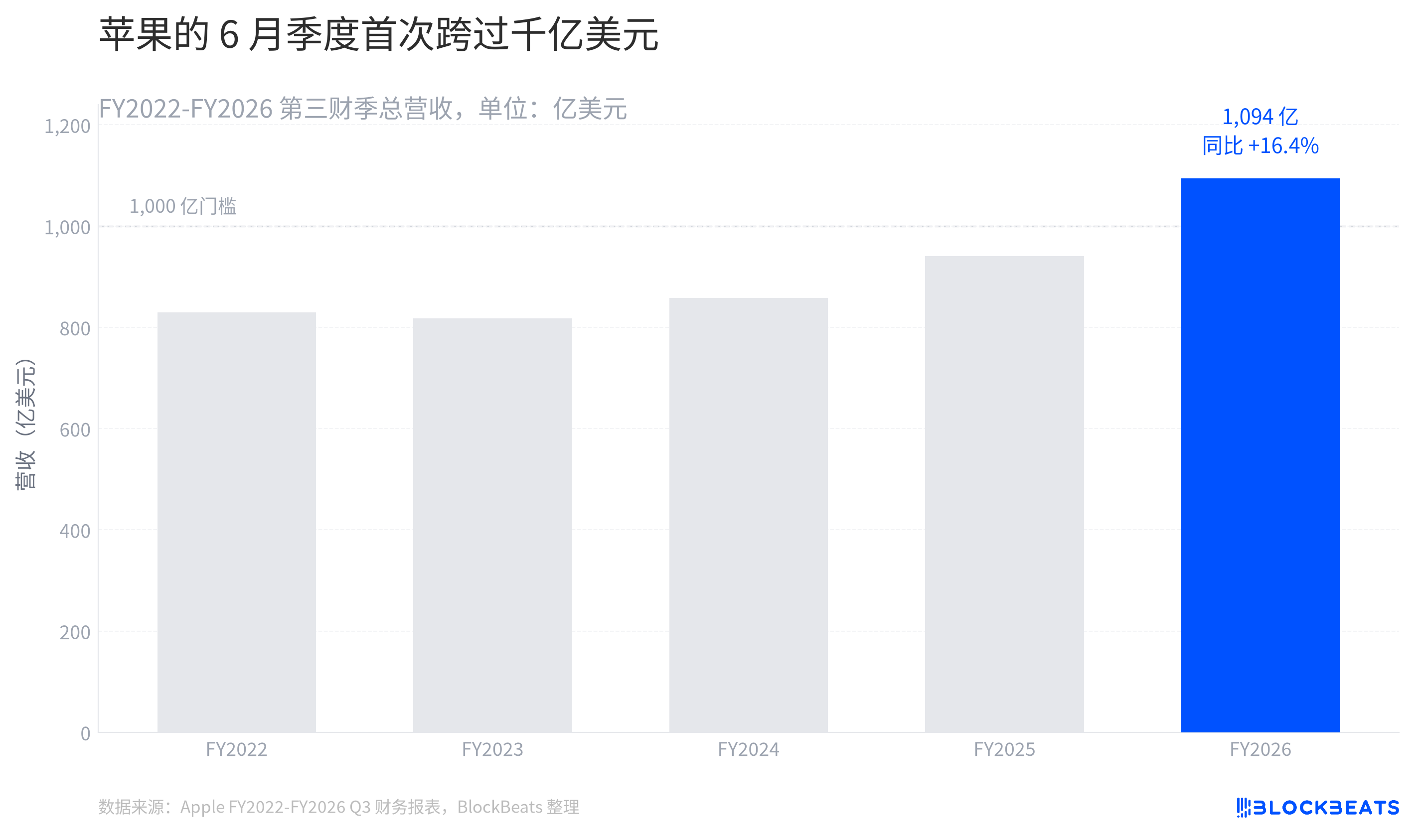
The last blue bar in the graph shows a noticeable gap from the previous four June quarters. Apple did not reach this point by following a straight upward trajectory. The prior-year FY2023 revenue for the same period had experienced a slight decline before accelerating year by year. According to Apple's combined quarterly financial statements, this quarter's growth rate was the fastest among these five comparable periods.
As per Apple's FY2026 Q3 report, the significance of $109.4 billion is not just about crossing a round number threshold. It elevated Apple's quarter that is most commonly associated with a "new product drought" to a scale nearing a traditional peak season. This scale, in itself, has altered people's intuition about the position of the June quarter in Apple's fiscal year.
The revenue surge was not limited to a single market. Apple's regional breakdown indicates double-digit growth in all five regions. Europe contributed the largest absolute increase, while the Greater China region tied with Europe for the highest year-over-year growth rate. Looking at these regions collectively, Apple's growth this quarter had a broader scope compared to relying solely on the Americas market.
Who Drove the Incrementality to iPhone
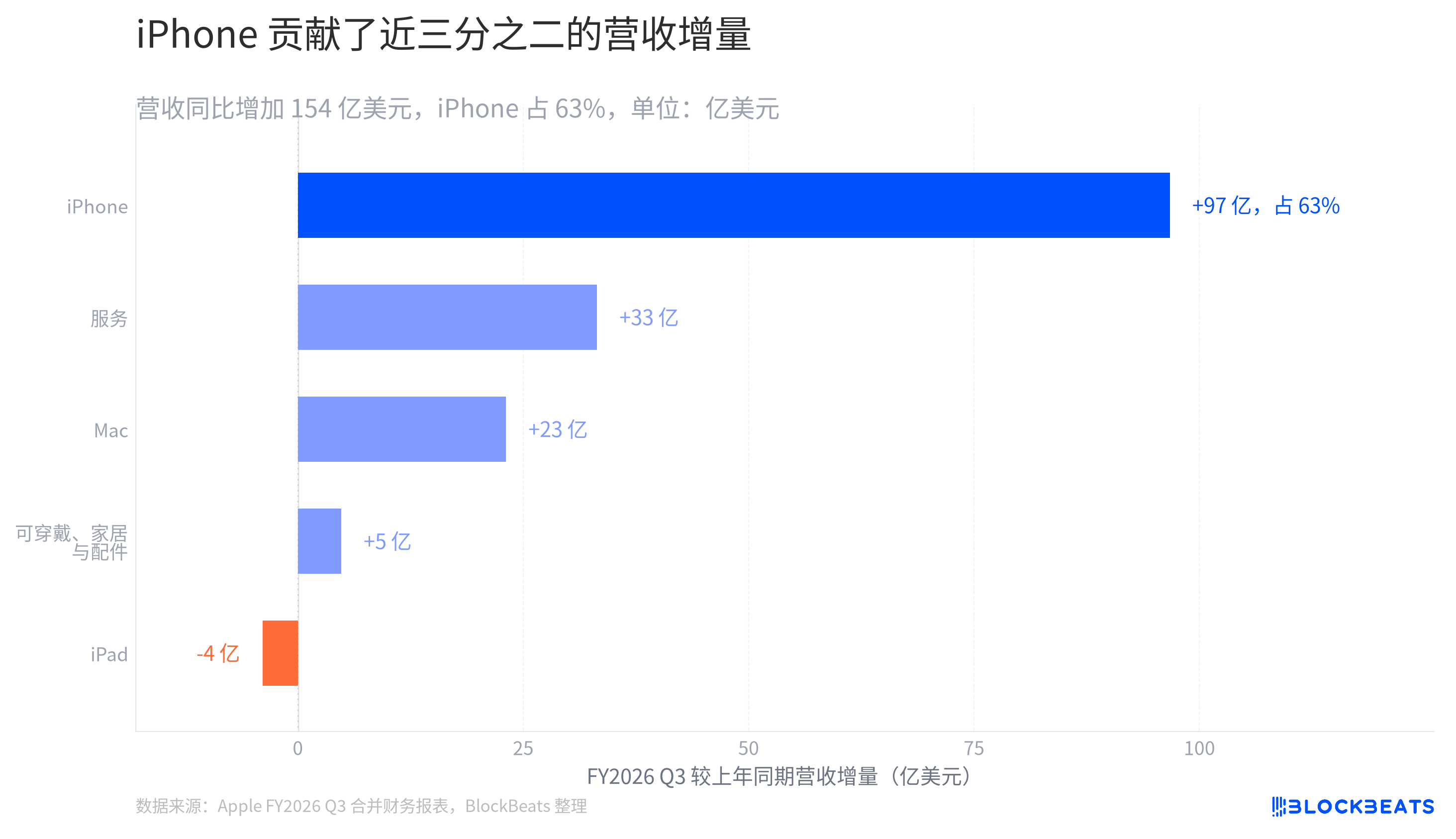
According to Apple's consolidated financial statements for this quarter, the company generated an additional $15.4 billion in revenue compared to the same period last year. The iPhone alone accounted for nearly two-thirds of this amount, represented by the longest blue bar in the graph. This explains why the pace of this quarter's financial report was faster than the June quarters of the past few years.
Services and Mac did not fade into the background either. The incremental revenue from the former ranked second, followed closely by the latter. iPad was the only category that saw a decline. The visual formed by several horizontal bars is straightforward—this quarter, Apple did not rely on a single product category to drive the numbers up; it's just that the iPhone's propulsion was exceptionally strong.
This distinction is crucial. If the growth were solely propped up by the Services segment, readers would perceive a company gradually dampening hardware volatility. The current combination resembles two engines accelerating simultaneously, with hardware providing an extended runway for acceleration, while the Services segment continues to fill the high-margin portion. According to Apple's earnings report, iPhone, Mac, and Services all set new June quarter records this season.
In addition to the product breakdown, the regional breakdown provides further explanation. According to Apple's regional breakdown this quarter, Europe saw the highest absolute revenue growth, while Greater China experienced a 22.4% year-over-year revenue increase. The changes in these two markets did not alter the fact that the iPhone remains the largest source of growth, but it diversified the answer to the question of "where is the growth coming from."
Services Have Beefed Up the Revenue Per Dollar
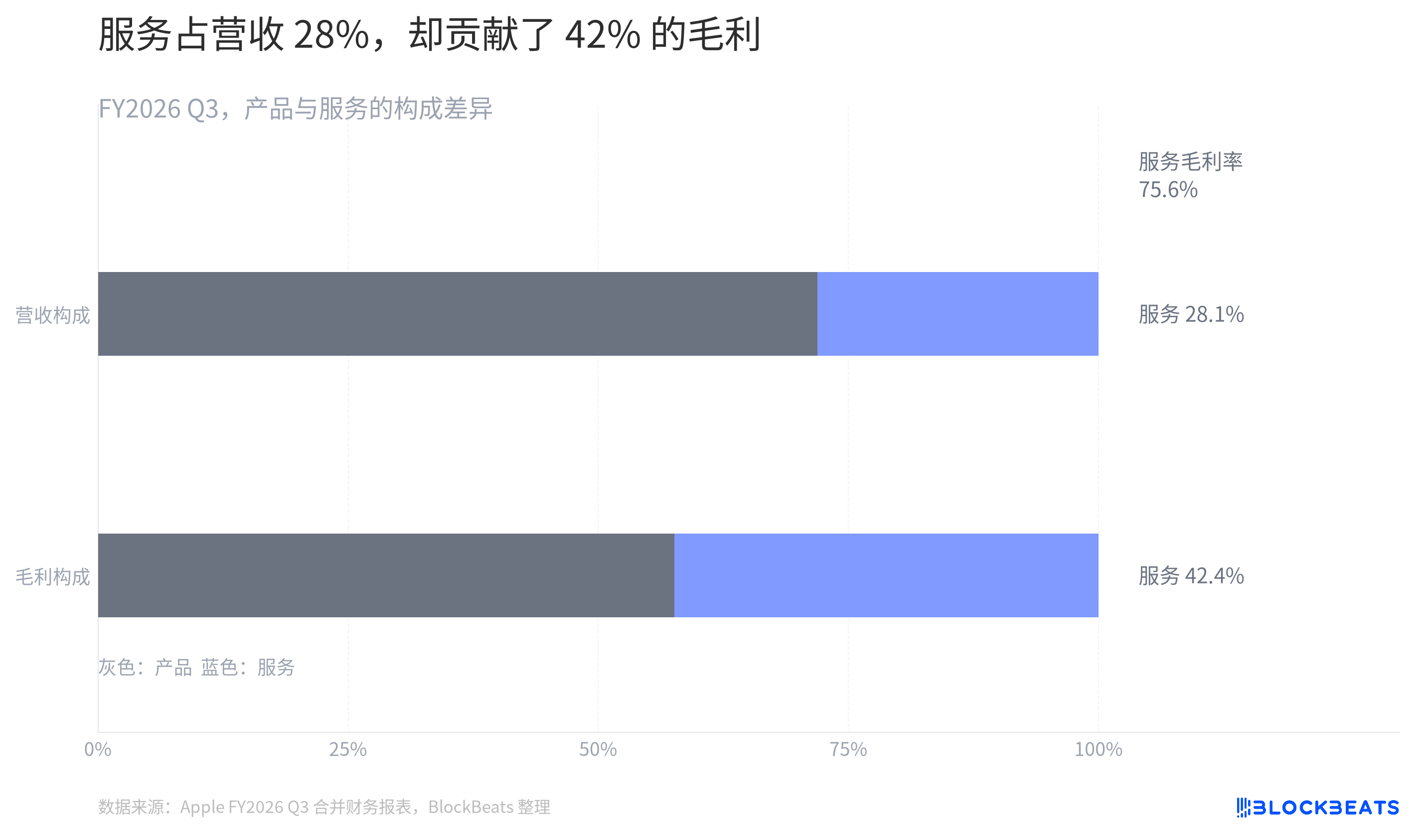
Apple's consolidated financial statements contain a detail that is often overlooked in news headlines. They separate the sales costs of products and services. This way, the gross margin beyond revenue can also be scrutinized.
According to Apple's financial report this quarter, although services only accounted for 28.1% of the company's revenue, they contributed 42.4% of the gross profit. In simple terms, for every one hundred dollars of revenue Apple generates, services make up less than thirty percent, but they leave behind almost half of the gross profit.
The gross profit margin for the services business is 75.6%, while for the product business, it is 40.1%. The former acts like a thick base plate, so even when more devices are sold, this base plate continues to support the entire company. This structure also explains why service revenue did not achieve the largest incremental revenue but remains an integral part of interpreting financial reports. According to Apple's consolidated financial statements, both of these percentages are derived by subtracting their respective revenues and sales costs.
The majority of the incremental gross profit this quarter still came from the product business. According to Apple's consolidated financial statements, it contributed 77.2% of the incremental gross profit. This, coupled with the resurgence of iPhone and Mac as shown in the previous chart, indicates that services did not take over the hardware's role; instead, it allowed the profit margin left behind when hardware is scaled up to be more substantial.
How That Refund Altered the Profit Curve
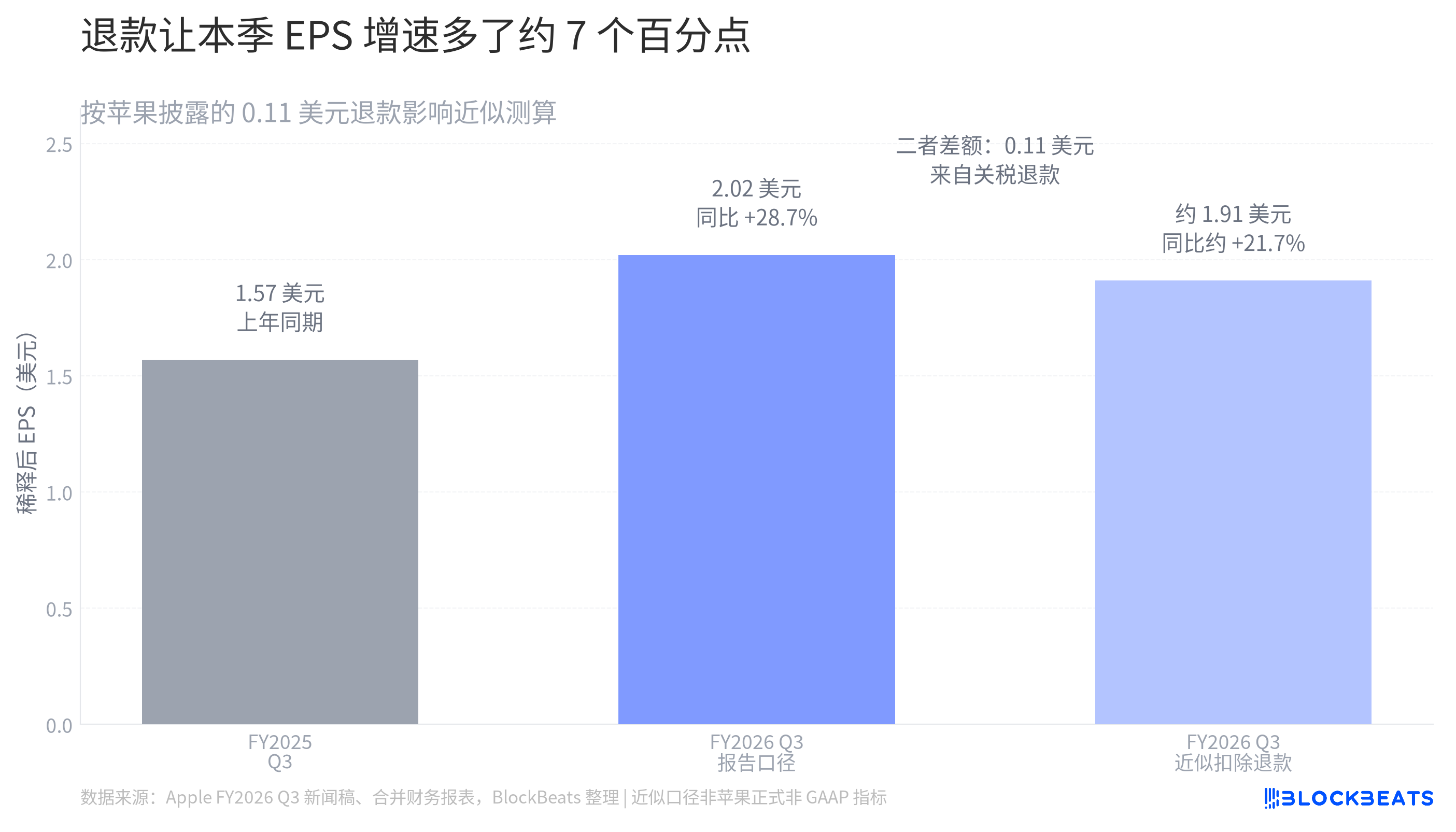
Apple disclosed in the press release that the tariff refund had a positive impact of approximately 2 percentage points on the gross margin for the quarter and increased EPS by $0.11. While this detail may not be the most prominent figure in the financial report, it is significant enough to change the interpretation of profit growth rate.
Approximating the impact as disclosed by Apple, the year-over-year EPS growth rate for this quarter is approximately 21.7%. The difference between the reporting calibers and this approximate caliber is about 7 percentage points. The light blue bars in the chart are not Apple's disclosed non-GAAP measures but simply extract the refund impact provided in the press release from the reported figures.
This breakdown did not diminish Apple's operational performance. Even after considering the refund, EPS still outpaced revenue growth. It merely separates two aspects: one being the growth driven by iPhone, Mac, and services collectively, and the other being the slope added to the profit curve by a one-time refund.
The outline of Apple's financial report is now clear: the rebound in hardware sales has rekindled growth, services have made each dollar of revenue more lucrative, and a refund has served as a reminder that the slope of profit needs to be examined carefully.
Recommended
Desk: Brent Crude Tops $110, Musk's Net Worth Drops 528.6 Billion in Four Days After Tesla Roadster Launch
Oct 17, 21:49
JST Fifth Buyback and Burn Successfully Concludes: Over 170 Million Tokens Worth Approximately $23.53 Million Burned, Buyback Mechanism Set for Comprehensive Upgrade
Oct 17, 20:10
BitTorrent Brand Upgrade and Initial BTT Buyback & Burn Launch Simultaneously, Dual Engines Usher in New Era of Web3 Infrastructure
Oct 17, 20:00
Asia Market Daily: Japan's BOJ signals more rate hikes while Korea targets offshore perpetual platforms (2026/10/17)
Oct 17, 17:01Why did Papertrade backfire on you?
Oct 17, 17:01
The 'Strict Father' of Northern Myanmar: This Company Deploys 200,000 "AI Best Actors" to Strike Back Against Scammers
Oct 17, 15:34