24-Year-Old 'AI Prophet' Falls from Grace as Fund Dies at Age 2

On July 29, Leopold Aschenbrenner sold the fund's publicly traded positions.
Much of the previously held stocks, longs, shorts, and options were packaged and sold to Citadel, led by Ken Griffin. The seller had just experienced the fund's most brutal month in history, while the buyer manages around $700 billion in assets and has taken over more than one such bad book in the past two decades.
Leopold is 24 years old this year. Two years ago, he wrote a 165-page report titled "Situational Awareness," deducing the AI craze from chips, computational power, electricity all the way to AGI and national competition. After the article spread, the tech community started calling him the "Prophet of the AI Era." He then raised a fund based on this analysis, starting from $225 million. Twenty months later, the fund's size had exceeded $200 billion, with a cumulative return of over 1000% since its inception.
By June 30 this year, the fund's annual net return was still at 439%, and the asset size had once reached $45 billion. In just two years, a 24-year-old had walked a path that many fund managers couldn't reach in a lifetime.
Then came the nightmare of July.
In a month, the Nasdaq 100 fell by about 10%, the Philadelphia Semiconductor Index fell by 25%, and the Korean market retreated by over 30% from its peak. The batch of AI infrastructure stocks heavily held by Leopold plummeted even more, with Nebius, SanDisk, Bloom Energy, and CoreWeave all seeing monthly declines of over 30%, and SanDisk halving from its July peak.
Sources told CNBC that when the fund's position was heaviest, the leverage could be close to four times. For every dollar the market fell, it would be a deeper cut to the fund's net worth.
Six days ago, Leopold was still writing in a letter to investors that this was the best buying opportunity since early 2025. Six days later, he sold all of these "best buying opportunities" to someone else.
He did not suddenly change his AI judgment, but his account no longer had the qualifications to wait.
What Citadel did was precisely this kind of business. In 2006, Amaranth lost about $6 billion in natural gas trading, and Citadel and JPMorgan took over its energy portfolio, quickly completing the hedge. The following year, Sowood Capital lost nearly half of its principal in the credit market. Citadel's people stayed up all night, completed the deal at 3:30 in the morning, and took over another batch of forced-sell assets.
Ken Griffin doesn't need to prove the other party wrong about the direction. What he is looking for are those who may have been heading in the right direction but can no longer sustain the position financially.
This time, it's Leopold's turn.
Publicly, at least $5 billion has been lost
The exact amount of Leopold's losses has not been publicly disclosed.
The fund's actual portfolio includes U.S. stocks, overseas positions, shorts, options, over-the-counter swaps, and private equity holdings like Anthropic. The 13F only reveals a portion of the U.S. public market, while details such as financing costs, whole trade discounts, and margin shortfalls on prime broker accounts are known only to him and a few brokers.
But just this public portion is frightening enough.
We have compiled, based on the fund's latest 13F filed on May 15, a list of 27 long positions in U.S. common stocks disclosed as of the end of the first quarter. Assuming these stocks were not adjusted for holdings after July, we recalculated their market value using the closing prices on June 30, July 29, and the opening price on July 30.
On June 30, these 27 stocks were valued at around $12.205 billion. By the close of July 29, the value had dropped to $6.661 billion, a decrease of $5.543 billion in one month. Following a rebound in the U.S. stock market the next day, the portfolio's value recovered to $7.505 billion. Even considering the post-rebound prices, the book loss still amounted to $4.7 billion.
This calculation does not include options, shorts, overseas positions, or SK Hynix. It is also unknown whether Leopold's fund adjusted its positions in July. This figure calculates how much would have been lost in July if those disclosed common stock holdings from the end of the first quarter were held unchanged.
The answer lies between $4.7 billion and $5.5 billion.
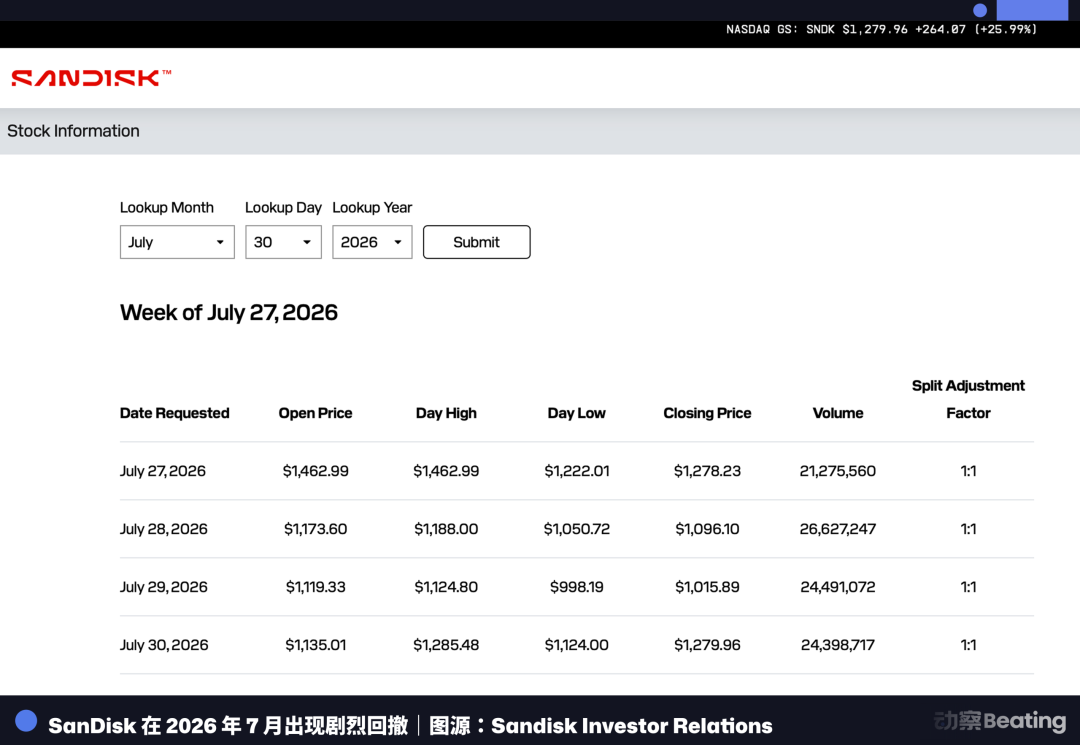
What's even more devastating is that almost all of the losses are concentrated in eight stocks. Based on the opening prices on July 30, SanDisk lost approximately $1.298 billion, Nebius about $1.294 billion, Bloom Energy about $0.755 billion, Sharon AI about $0.318 billion, CoreWeave about $0.224 billion, Applied Digital about $0.160 billion, IREN about $0.155 billion, and Core Scientific about $0.148 billion.
The top eight positions accounted for $4.352 billion, representing 93% of the total loss in value. The remaining nineteen positions together caused losses that were less than half of Bloom Energy's.
What does $4.352 billion represent? If a person were to spend $10,000 a day, it would take over 1,200 years. This is just the amount that eight stocks lost in one month.
Originally a 27-line holdings table, only the top eight lines truly determined the fate of the fund. The names at the back made the portfolio look somewhat rational, but the positions at the front were Leopold's convictions.
Insurance Didn't Hold Up
When the May 13F was disclosed, there was a rumor circulating that Leopold had turned bearish on AI.
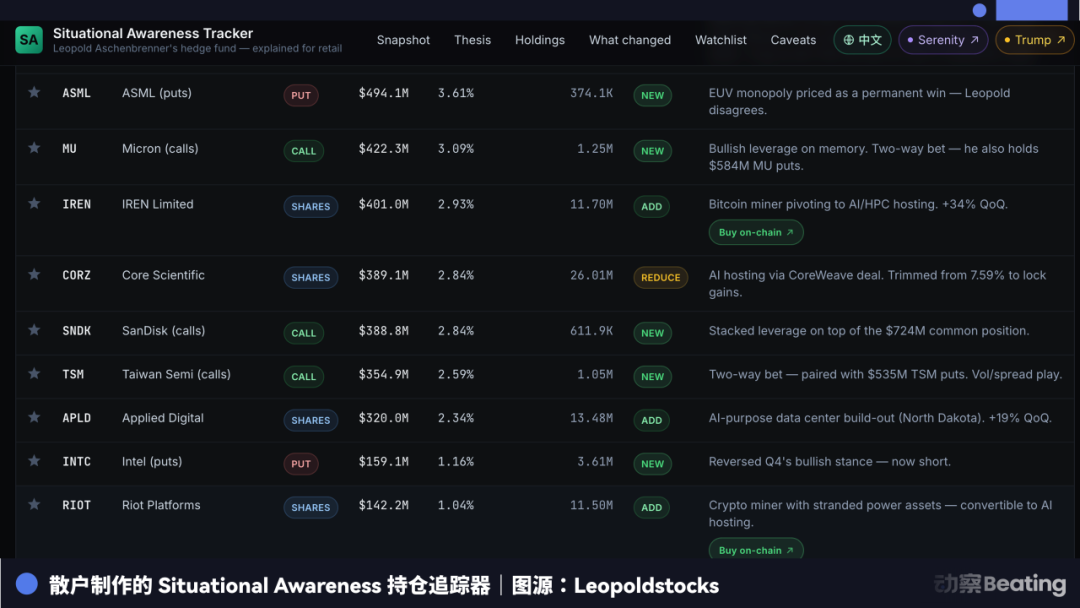
The reason was the appearance of a large number of put options in his portfolio. The puts disclosed in the first quarter corresponded to a notional amount of $8.459 billion, with the two largest positions, one on a semiconductor ETF, around $20.4 billion, and the other on NVIDIA, around $15.7 billion. In contrast, the notional amount of call options was approximately $1.362 billion.
At first glance, a fund manager known for being bullish on AI suddenly using tens of billions to short the semiconductor industry did seem like a reversal.
However, the 13F does not reveal the strike price, expiration date, or how these options are paired with other positions. It only shows the market a disassembled puzzle. Once the entire set of trades is put together, Leopold's idea becomes clear—he still heavily bets on AI infrastructure and hedges against a sudden market decline by using semiconductor and index puts, then shorts traditional software companies, betting that AI will gradually erode SaaS profits and pricing power.
This is a fairly complete structure.
If chips fall, the puts make money; if AI infrastructure rises, the long positions make money; as AI continues to evolve, traditional software comes under pressure, shorts also make money. The three directions seem to complement each other, all ultimately leading to the same conclusion—Leopold believes that future money will flow from software to chips, storage, power, and data centers.
The July market did not unfold as he had hoped.
Leopold had focused on insuring the Semiconductor ETF, NVIDIA, AMD, Micron, and Oracle, but the biggest issues came from Nebius, SanDisk, Bloom Energy, Sharon AI, and CoreWeave. The semiconductor insurance did work, but it couldn't prevent losses on the neocloud, power, and data center side. The calls on SanDisk and Micron continued to decline, offsetting some of the gains from the puts.
Meanwhile, funds were withdrawn from the most crowded AI trades, with some of it flowing back into previously beaten-down software stocks. Leopold's long positions were tumbling while short positions began to rise, and the insurance meant to provide a floor did not hold.
If we extremely crudely assume that option positions remained unchanged throughout July, all contracts had an effective Delta of 1, then as of the opening on July 30, puts may have contributed approximately $2.554 billion in gains, calls lost about $1.341 billion, resulting in a net gain of about $1.212 billion from the options side. Combined with the approximately $4.7 billion drop in equities, the net adverse change in the publicly visible portion still remains close to $3.5 billion.
This figure cannot be taken as the true loss of the fund. The nominal amount measures how much of the underlying asset the contracts control and does not equate to how much money was spent on purchasing the options; a deep out-of-the-money option can control billions of dollars of stock, with the premium being only a small part of it.
However, the problem is now very clear. Leopold designed insurance and also anticipated a market decline. What he did not anticipate was that some of his heaviest positions would all drop together, and the insurance happened not to kick in.
Complex hedging can eliminate many small risks but may not necessarily correct the big call that underpinned the entire portfolio.
Four-Times Levered Margin Call
Let's take another look at Leopold's four-times leverage.
First, let's explain the four-times leverage. Suppose a fund has $100 in capital, borrows another $300, and buys a total of $400 in assets. After the assets drop by 25%, the $400 becomes $300, the loan is repaid by selling the assets, and the capital is precisely reduced to zero. Of course, the broker will not sit there waiting for the fund to lose everything; as the assets begin to fall, they will demand additional margin.
As the stock price falls, the value of the collateral shrinks; when the collateral shrinks, the broker demands more cash from the fund; if the fund cannot produce cash, it can only sell stocks; massive selling continues to drive the stock price down, with new margin calls following shortly.
Leopold's problem gets a little trickier. While his public stocks can be sold anytime, private assets like Anthropic cannot be liquidated on the same day. The cheaper he perceives it to be, the less willing he is to sell; the less willing to sell, the more cash his account needs; however, as the market panics, outside money becomes more cautious, and the time provided by the broker gets shorter.
On July 24, in a letter to investors, Leopold admitted that the fund had incurred losses, especially in the Asian markets. However, in the same letter, he still referred to the time as the best buying opportunity since the beginning of 2025, opened the investment window for August 1, and listed Anthropic's potential IPO as a catalyst for the second half of the year.
Leopold needed investors to believe that the price was already cheap enough, but the broker was only concerned with how much the collateral was worth today. One person was telling a story about 2030, while another was checking if they could top up the margin before four in the afternoon.
Over the next few days, he tried every method he could think of. The fund contacted existing investors and lenders, as well as directly marketed the assets in the portfolio to some LPs. Some described these contacts as somewhat scattered, sounding a bit rushed, and not part of a new planned fundraising round. Bank of America, Goldman Sachs, and JPMorgan also started helping to sell this long-short portfolio, either to allow the fund to deleverage in an orderly manner or to meet the broker's cash requirements first.
But in the end, it was too late.
Leopold did not publicly default, and creditors did not take over the fund. Private equity assets, including Anthropic, remained on the books, and legally the fund did not shut down. It's just that the publicly traded market fund that had produced a 1000% return, prompting the entire market to wait for its 13F filing every quarter, came to an end on July 29.
He may not necessarily no longer believe in those companies; he just lost the position to keep believing.
The direction is determined by the fund manager, and how far it can go is determined by those who put up the money. In the end, what matters most in the market is often not who sees farthest but who can endure until the end.
It's always the good swimmers who drown.
Hundreds Saw the Future, And Then?
Leopold, born in Germany, graduated from Columbia University at the age of 19 and was the class representative. Later, he joined OpenAI's Superalignment Team. In April 2024, OpenAI dismissed him for "improper disclosure of information." According to Leopold himself, he had written an internal memo warning that the company's existing security measures could not withstand foreign influence and had submitted the document to the board.
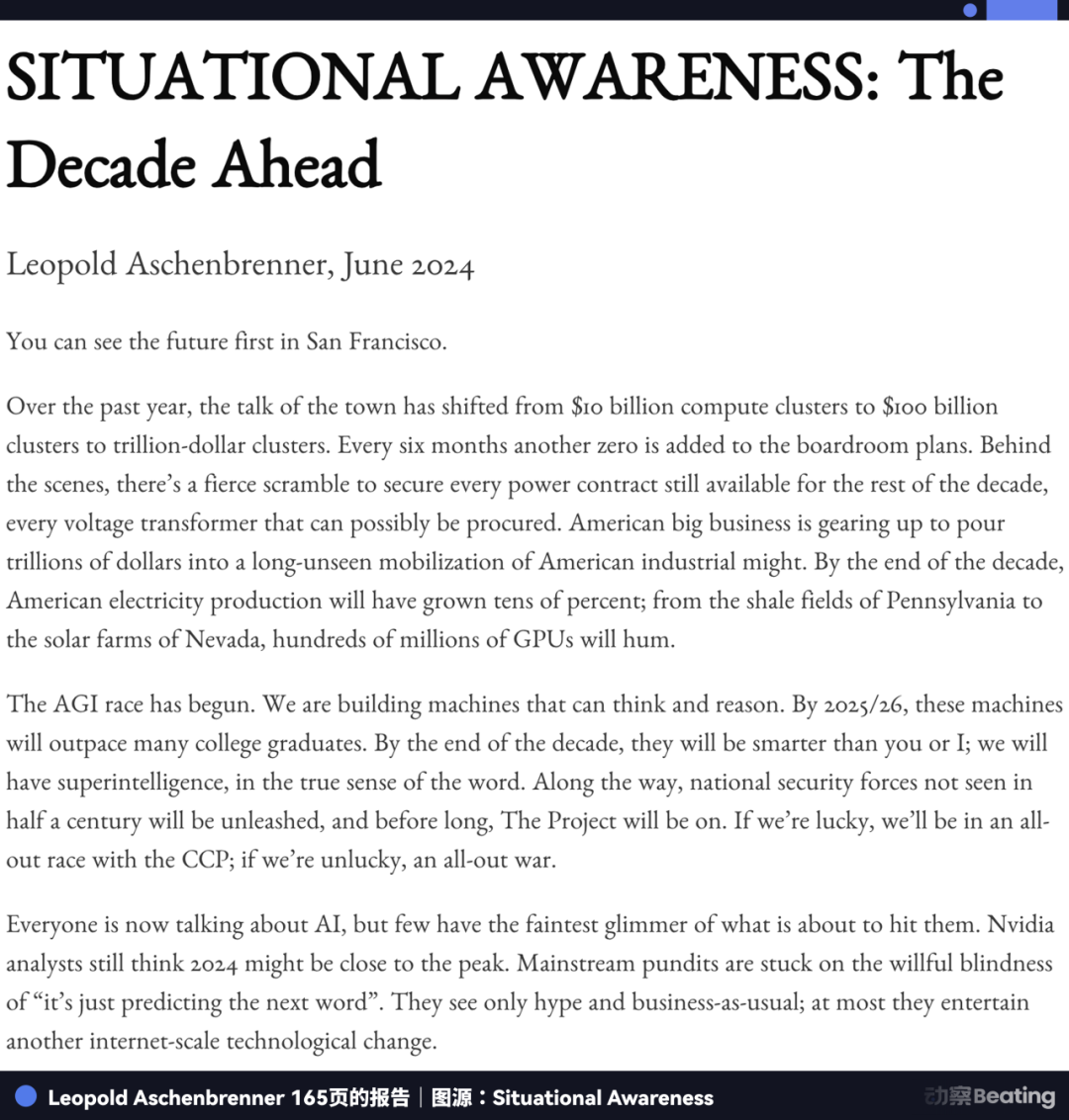
Two months later, his work "Situational Awareness" was released online.
The 165-page report predicted that AGI might arrive around 2027, the model's capabilities would rapidly surpass a certain threshold, and computing power, advanced fabrication processes, electricity, and data centers would become real bottlenecks. Ultimately, the U.S. government would deeply intervene, turning cutting-edge AI into part of national security and geopolitical competition.
Trump's daughter once praised it publicly, venture capital firms used it as pitch material, and even those who opposed Leopold often had to read it first. The report began by stating that only a few hundred people truly understood the current situation, most of whom were concentrated in San Francisco and a few cutting-edge labs.
Leopold included himself in that.
The statement was arrogant, but it almost explained all his subsequent trades. If only a few hundred people in the world knew what the future held, diversification seemed unnecessary. Diversification was for those who feared being wrong. For someone certain they held the answer, diversification only diluted opportunity.
Leverage was also redefined as not just greed but even efficiency. Windows always closed; more would eventually decipher the same logic. Once consensus formed, the fattest part of the returns evaporated. If you were years ahead of the market, the only question remaining was how much to bet.
So Leopold chose not to become a traditional VC. He believed AGI would rewrite the global economy. Only an open market with sufficient size and liquidity could fully express this conviction. Stripe's Collison brothers, Nat Friedman, and Daniel Gross became early backers, willing to fund a twenty-something-year-old, effectively voting for this narrative.
Leopold's path was far more intricate than simply "buying Nvidia." He traced the AI supply chain, seeking out the next bottleneck, from chips to advanced processes, from advanced processes to memory and networking. After servers moved into data centers, power, cooling, and grid metrics became essential. Bitcoin mines already held the keys to land and power and could potentially transition into AI compute hubs.
As a result, his portfolio included Micron, SanDisk, CoreWeave, Nebius, Bloom Energy, IREN, Core Scientific, and Applied Digital. Anthropic, on the other hand, was a direct bet on model companies in the private market.
By 2025, the market rewarded him immensely. The fund returned approximately 47% in the first half of the year and another 270% in the first five months of 2026. By the end of June, the annual return surged to 439%. Eventually, he transcended being merely a fund manager. Every time the 13F was disclosed, social platforms dissected his positions line by line to emulate his trades.
A 165-page report helped him raise billions of dollars and provided a comprehensive explanation for every concentration and leverage addition. The more money he made, the more the report resembled the truth. The more the report resembled the truth, the less the portfolio needed room for surprises.
After he sold, the stock price went up
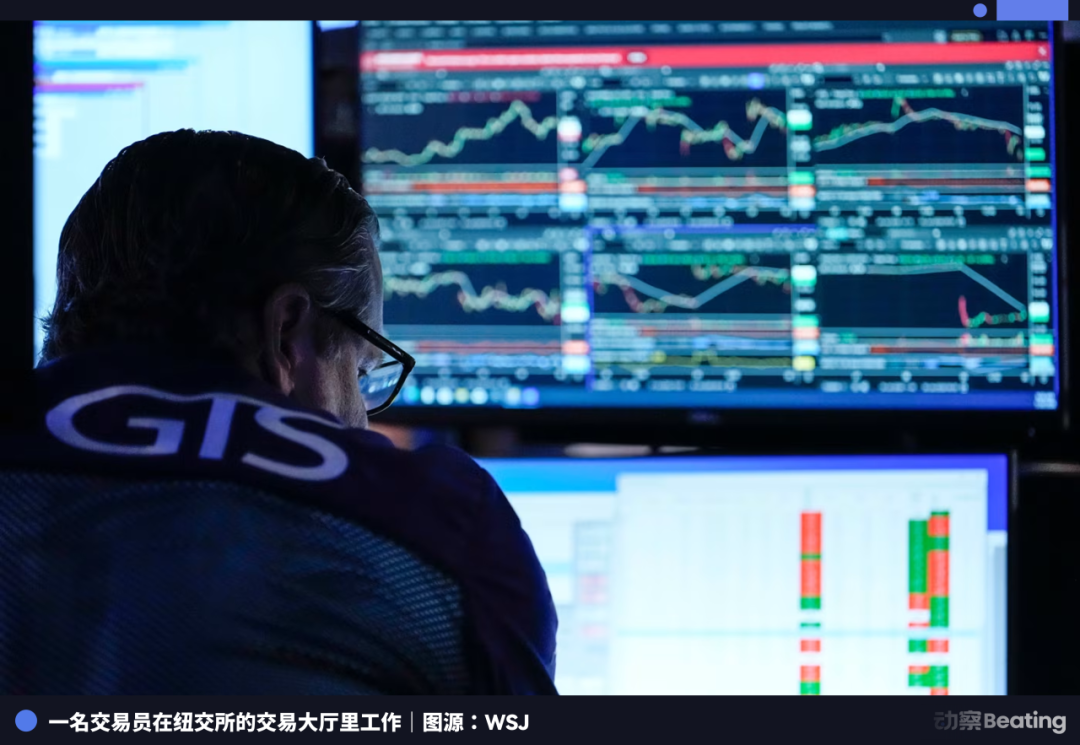
On July 29, the Federal Reserve decided to keep interest rates unchanged, and the US stock market continued to decline, with the Nasdaq completing its sixth consecutive day of losses. On this day, Leopold also completed a transaction by transferring the entire open market portfolio to Citadel.
The next day, the market rebounded.
The Nasdaq Composite Index rose by 2.8%, the Nasdaq 100 rose by 3.4%, and the Philadelphia Semiconductor Index saw an intraday increase of over 7%, marking the largest one-day gain since April 2025. Microsoft surged by 16% in a single day, adding approximately $450 billion to its market value, setting a new record for the largest single-day market value gain by a company.
The reason given by the market happened to be exactly what Leopold had been talking about for the past two years. Microsoft's massive capital expenditure on AI is translating into revenue and profit, and on the evening of the announcement of its results, Amazon also showed accelerated cloud revenue for the fifth consecutive quarter. By July 31, stock index futures in Japan, South Korea, and Australia were all up.
The stocks he had previously heavily invested in also made a comeback. SanDisk rose by about 23%, Nebius by about 12%, and CoreWeave by about 8%.
The most ironic assessment came from JPMorgan. Just the day before, they were telling clients that the actions of hedge funds selling off technology, chip, and storage stocks to reduce leverage may have already reached the end, and the deleveraging had been completed faster than the market expected.
Leopold himself was the leverage that was removed.
Of course, this does not prove that he sold at the lowest point. The outside world does not know at what price the entire portfolio actually traded, nor how much of a discount Citadel received. A one-day rebound also does not prove that July has become history, as the market could still continue to fall.
The industry direction Leopold bet on may still hold true, with Microsoft and Amazon even immediately presenting new evidence; the only issue is that when this evidence emerged, he no longer owned that batch of stocks.
The apprentice buys, the master sells. This time, the person deciding the selling time was not Leopold or his research team, but the margin account.
In "The Old Man and the Sea," Santiago caught the largest marlin of his life. The fish was so large that it couldn't fit on the boat and had to be tied to the side of the boat and dragged back. The old man caught a fish large enough, but he rowed too far out. The journey back was too long, and batch after batch of sharks caught up. By the time he got back to shore, only the skeleton of the marlin on the line was left, eaten by the sharks.
Leopold may indeed have seen the impact of AI on chips, electricity, data centers, and software earlier than most people, and that fish may be even bigger than imagined. But the leverage of four times is like a group of sharks on the return journey.
Leverage does not alter a person's long-term judgment; it only continues to shorten how long the "long term" really is.
At the beginning of "Situational Awareness," it is written that only a few hundred people globally truly see the situation. This may still hold true today, but seeing the future is one ability, while seizing the future is another.
Leopold may still see 2030.
It's just that the fish is now tied to Ken Griffin's boat.
-END-
Recommended
Desk: Brent Crude Tops $110, Musk's Net Worth Drops 528.6 Billion in Four Days After Tesla Roadster Launch
Oct 17, 21:49
JST Fifth Buyback and Burn Successfully Concludes: Over 170 Million Tokens Worth Approximately $23.53 Million Burned, Buyback Mechanism Set for Comprehensive Upgrade
Oct 17, 20:10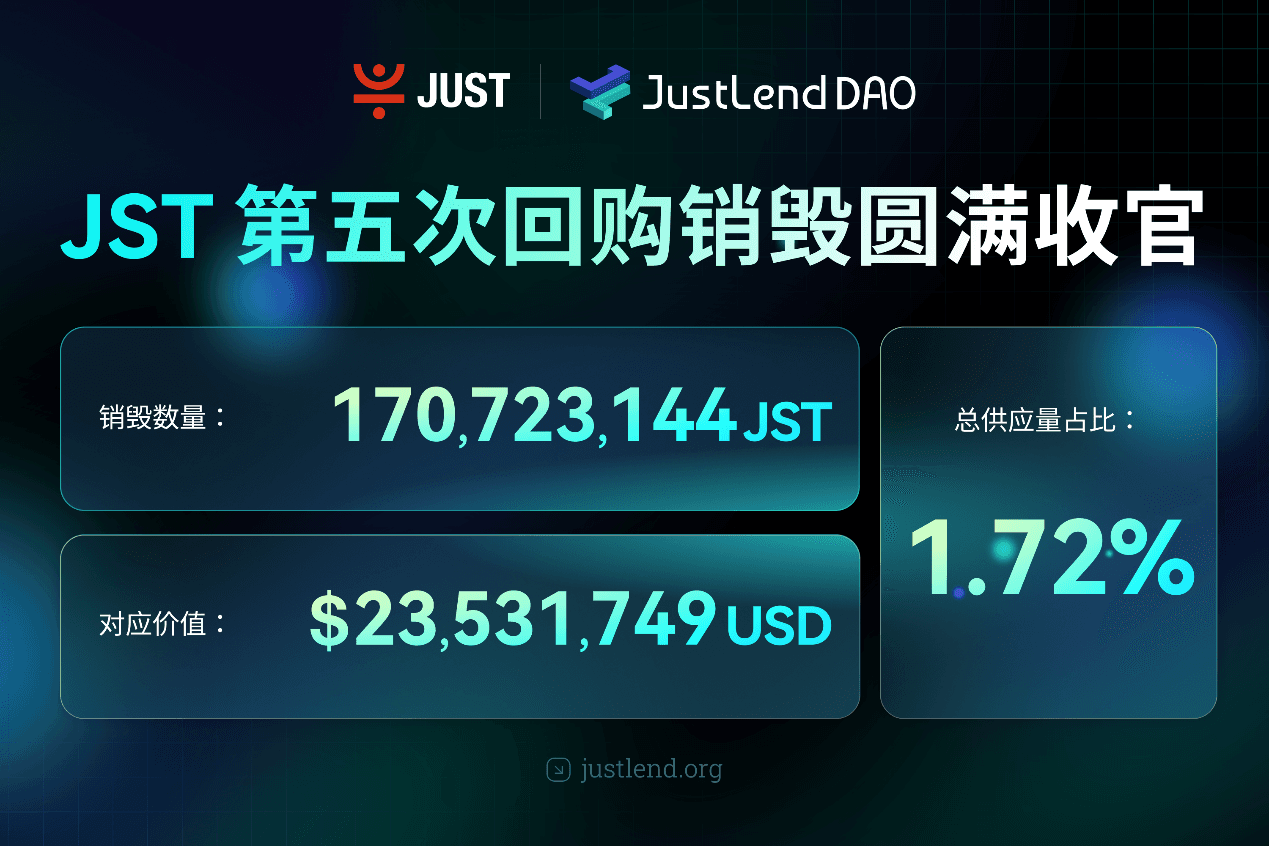
BitTorrent Brand Upgrade and Initial BTT Buyback & Burn Launch Simultaneously, Dual Engines Usher in New Era of Web3 Infrastructure
Oct 17, 20:00
Asia Market Daily: Japan's BOJ signals more rate hikes while Korea targets offshore perpetual platforms (2026/10/17)
Oct 17, 17:01Why did Papertrade backfire on you?
Oct 17, 17:01
The 'Strict Father' of Northern Myanmar: This Company Deploys 200,000 "AI Best Actors" to Strike Back Against Scammers
Oct 17, 15:34