Is HYPE's Continued Price Drop Due to Rumors of TradeXYZ Going Solo?
As TradeXYZ continues to expand its business and maintains over 90% market share in the Hyperliquid HIP-3 market, the community has recently heated discussions about the possibility of TradeXYZ breaking away from Hyperliquid and independently building its own trading platform.
Former Messari researcher Sam posted on X platform, stating that as an investor bullish on HYPE due to the outbreak of the RWA perpetual contract market, one should ask themselves three questions: first, if TradeXYZ leaves Hyperliquid and launches its own trading platform, where will users go to trade; second, the impact of TradeXYZ launching its own stock/token on HYPE's valuation; and third, how likely is it for the above two scenarios to occur.
The post garnered over 470,000 views in just a few days, and the rapid escalation of this discussion is fundamentally due to an increasing number of market participants realizing that in the partnership between TradeXYZ and Hyperliquid, the value contribution of both parties is changing, with TradeXYZ gradually accumulating stronger market influence and bargaining power compared to Hyperliquid.
In business partnerships, once one party gradually gains more resources and market dominance, and when there is a noticeable imbalance in the distribution of benefits, "betrayal" often occurs.
A recent example comes from the AI industry. Cursor was once the largest AI coding tool in the market, underlying which was Anthropic's Claude model. Initially, they had a partnership akin to "perfect partners," until Anthropic made a betrayal by launching Cursor's direct competitor, Claude Code. By mid-2026, the ARR of Claude Code officially surpassed Cursor, pushing it off the table.
The blockchain industry also has similar examples, where a single product usually outgrows its original infrastructure and builds its own chain ecosystem, such as Uniswap, dYdX, and more. Even in this cycle, the hottest project, Polymarket, has been rumored multiple times to detach from the existing Polygon infrastructure and instead build an independent infrastructure.
Returning to the current issue, what is the likelihood of TradeXYZ leaving Hyperliquid to establish its own platform? If this situation were to occur, what would be the impact on both Hyperliquid and TradeXYZ? Odaily Planet Daily will analyze briefly in this article.
Is Independence Inevitable?
There is a phenomenon in the blockchain industry where a project initially starts and grows on a certain public chain or infrastructure, but later, in pursuit of performance, control, underlying fee capture, or larger narrative fundraising, chooses to independently build its own infrastructure (L2 or standalone L1). TradeXYZ is indeed now large enough.
According to flowscan data, as of now, the total transaction volume of Hyperliquid's HIP-3 has exceeded $469.62 billion, with TradeXYZ contributing over $437.4 billion, accounting for 93%; as of the time of writing, the total OI of Hyperliquid's HIP-3 has reached $3.9 billion, with TradeXYZ contributing over $3.8 billion, accounting for 99.7%.
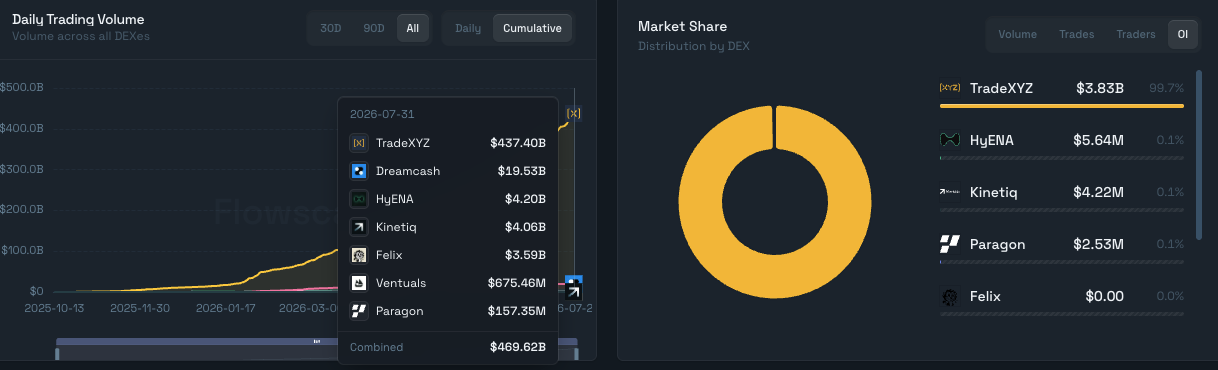
Total transaction volume of Hyperliquid's HIP-3, with TradeXYZ's share
The combined market share of the remaining few exchanges is less than 10%, and HIP-3 has already formed a significant Matthew effect. In this context, it is not an exaggeration to say that TradeXYZ completely controls Hyperliquid's HIP-3 market. The narrative premium brought to Hyperliquid by the on-chain RWA contracts is essentially the narrative premium brought to Hyperliquid by TradeXYZ.
From both a valuation and protocol revenue perspective, TradeXYZ is no longer dispensable for Hyperliquid, but rather plays a crucial role in supporting the market in the crypto market downturn and the contraction of trading volumes in crypto derivatives such as Bitcoin.
According to official data, the share of HIP-3 in Hyperliquid's total transaction volume has reached 71.92%, hitting a historical high, and based on TradeXYZ's dominant position in HIP-3, the traded volume contributed by TradeXYZ accounts for over 70% of Hyperliquid's total transaction volume; HIP-3 accounts for 36% of Hyperliquid's total OI, which also means that TradeXYZ's contributed OI accounts for over 35% of Hyperliquid's total OI.
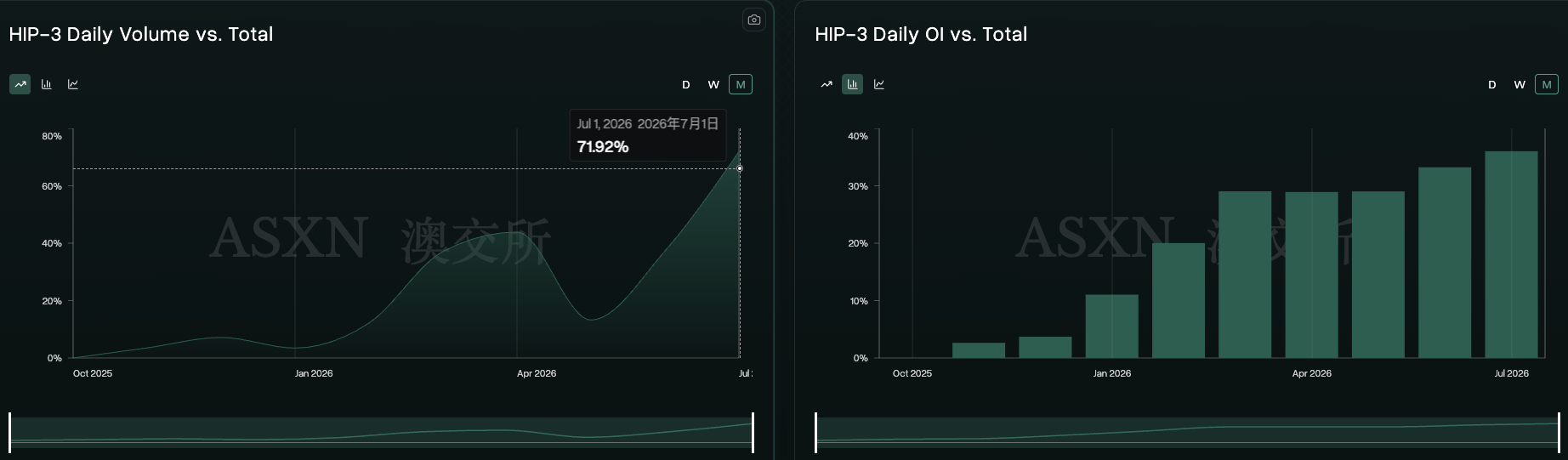
HIP-3's Share of Hyperliquid's Total Trading Volume and Total OI
Therefore, TradeXYZ has leveraged Hyperliquid's infrastructure to grow into a behemoth capable of influencing the traditional financial markets. Today, in its partnership with Hyperliquid, its leverage and influence are starting to take center stage. So, as the child grows up, should it stand on its own feet? What factor will trigger TradeXYZ to choose to build its own infrastructure?
Setting aside the intricate capital operation factors such as funding and token issuance, from a practical business perspective, if TradeXYZ were to truly stand on its own, the most likely reason would be to capture base layer fees.
In Hyperliquid's HIP-3 market, TradeXYZ and Hyperliquid split the trading fees 50/50, and since the standard trading fee for HIP-3 assets is twice the core perp market fee, Hyperliquid actually receives the same protocol fee from each HIP-3 trade as the core perp market.
According to statistics, as of the time of writing, TradeXYZ has generated total fee revenue close to $50 million. Following the revenue-sharing ratio stipulated by HIP-3, TradeXYZ can only take home a maximum of $25 million.
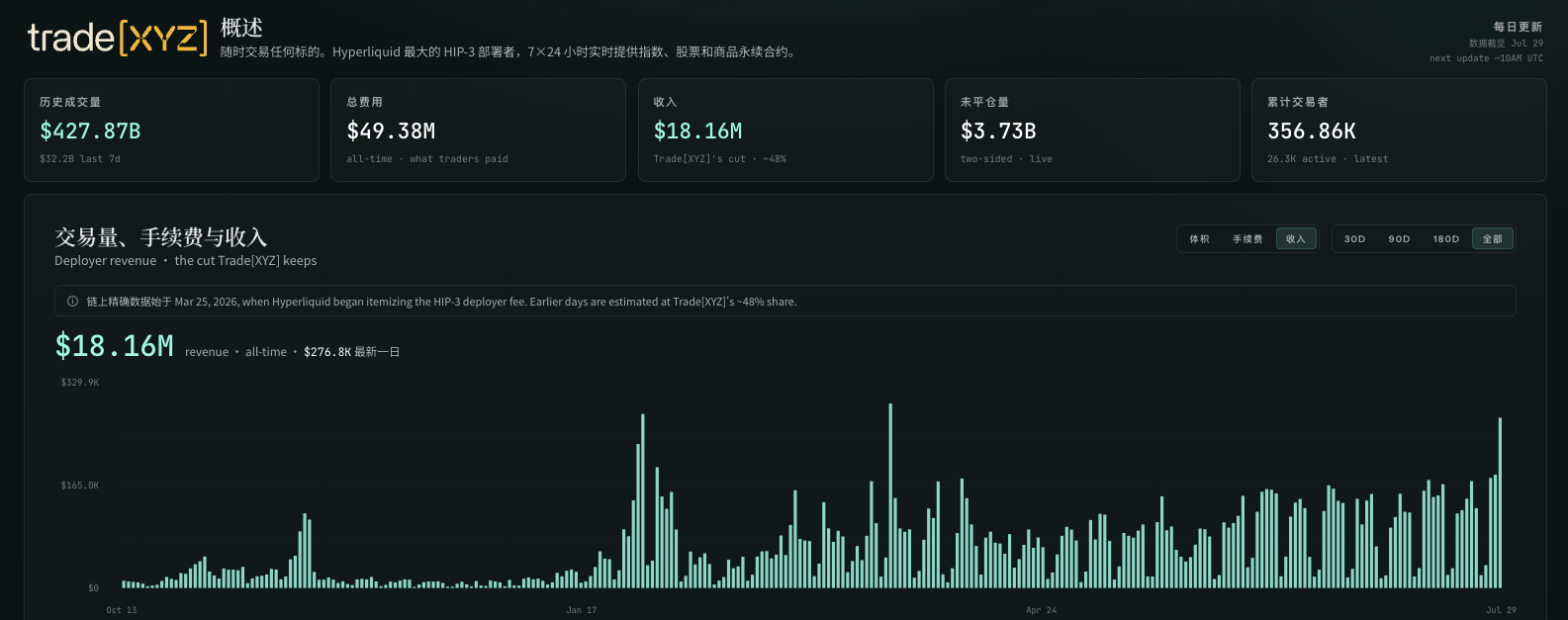
TradeXYZ's Generated Fees
It's hard to imagine a project that has generated over $400 billion in trading volume, yet its total revenue hasn't even reached one-thousandth of the total trading volume. Giving up nearly half of the revenue is unacceptable for most projects. With TradeXYZ's current leverage over Hyperliquid, it could also negotiate with Hyperliquid to change the profit-sharing ratio to seventy-thirty or higher. If ultimately unable to reach an agreement, TradeXYZ is likely to embark on the path of standing alone.
Why Won't TradeXYZ Leave?
Of course, for TradeXYZ, standing alone is both attractive and constraining.
The first constraining factor is Hyperliquid's powerful performance. All of TradeXYZ's perpetual contracts are deployed on Hyperliquid's HIP-3 platform, where the matching, order types, funding, clearing, and auto-deleveraging are all managed by HyperCore. Technically, TradeXYZ only manages the oracle price, mark price, external prices, and related components.
If TradeXYZ chooses to stand alone, they will need to build their own team to construct the underlying infrastructure. While this is not a big issue, building a Layer 1 with performance as powerful as Hyperliquid's in a short period is a challenge. Even TradeXYZ's founder, Shoku, has acknowledged the excellence of the Hyperliquid team. In March 2024, Shoku posted on the X platform, stating that he is unsure how Hyperliquid will ultimately perform in terms of TVL and trading volume, but he is fully confident in the quality and rigor of Hyperliquid's on-chain products and dApps, believing they have no rivals in the entire crypto space.
These rivals, of course, also include himself. If TradeXYZ's standalone infrastructure is not sufficient to compete with Hyperliquid, it will negatively impact their product experience and early price discovery narrative compared to the traditional financial markets.
The second constraining factor is that channels and distribution are also crucial. Why was Circle willing to hand over more than 50% of USDC's savings yield to Coinbase? The reason is that Coinbase has indeed made significant contributions to the market distribution and promotion of USDC. According to Coinbase's latest Q2 financial report, over 30% of circulating USDC is stored on Coinbase. Whoever controls the channels and distribution holds all the cards, and this rule applies equally between TradeXYZ and Hyperliquid.
Essentially, Hyperliquid's frontend is just one interface to access TradeXYZ's liquidity market, but it is not the only way. Users can currently directly access TradeXYZ's liquidity market through the TradeXYZ website, and the trading interface is highly similar to Hyperliquid's. To further facilitate users, accounts on TradeXYZ and Hyperliquid are interoperable. This means that by connecting the same wallet on the TradeXYZ website, if there is a balance on Hyperliquid, it can be used directly.
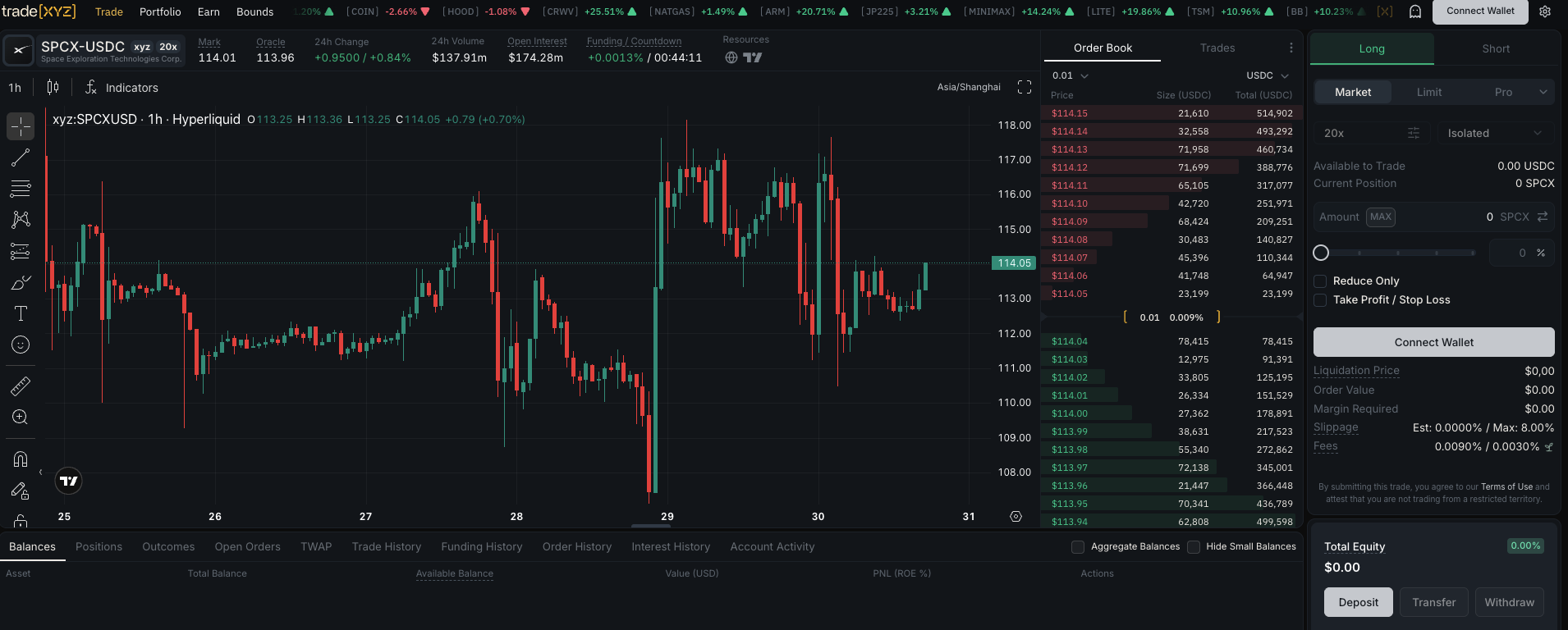
TradeXYZ's Own Trading Interface
However, even so, among TradeXYZ's over 350,000 trading users, the majority still access TradeXYZ's liquidity market through Hyperliquid's front end. This is a long-standing user habit that is not easy to change. There is even a certain percentage of trading users who cannot tell the difference between TradeXYZ and Hyperliquid, only trusting Hyperliquid's brand and passively choosing to trade TradeXYZ's products.
Therefore, Hyperliquid not only provides technical support to TradeXYZ but also serves as the main channel for TradeXYZ's liquidity distribution. The cost and time of building infrastructure can be calculated, but the value of losing the channel cannot be measured.
The third constraint is that the two project founders already trust each other completely, like "two peas in a pod." Solana's well-known KOL Ansem believes that the possibility of TradeXYZ standing on its own is almost zero. The reason is that he believes TradeXYZ and Hyperliquid are the two most compatible teams in the cryptocurrency field. "The two founders have no trace of greed, and they are both very smart. I believe they can choose a development path that is most beneficial to both teams."
This view is not unreasonable. Shoku was the earliest investor in Hyperliquid. As early as 2023, Shoku teamed up with Jeff and began contributing to the Hyperliquid ecosystem. In 2024, he developed Hyperliquid's Bitcoin cross-chain bridge Unit. He once revealed to a friend that Hyperliquid is one of the few exciting things in the crypto world.
Various signs show that Shoku highly appreciates Hyperliquid and Jeff. From a human perspective, the likelihood of a "betrayal" is low.
If TradeXYZ Stands on Its Own, It Will Result in a Lose-Lose Situation
If we want to delve deeper into this topic, this article should not end here. We should also discuss an extremely low-probability event: if TradeXYZ truly separates from Hyperliquid and stands on its own, what would be the outcome? The answer I propose is a lose-lose situation.
Given the current state of affairs, the situation is mutually beneficial for both TradeXYZ and Hyperliquid. If TradeXYZ were to split, significant uncertainty would harm both parties. While TradeXYZ can stand on its own after the split, Hyperliquid could support other HIP-3 market participants. However, this would transform their relationship from partners to competitors. The impact on Hyperliquid's revenue would be limited, as over 70% of its core revenue still comes from Perp, with HIP-3 markets contributing a small portion. The main concern would be the effect on Hyperliquid's valuation.
Firstly, after TradeXYZ's migration, Hyperliquid's total trading volume would decrease by over 50%, and the HYPE token could face a significant setback. Hyperliquid would no longer be the leading on-chain RWA perpetual contract trading platform but would be redefined as a crypto derivatives trading platform that has lost its main growth driver and narrative foundation.
TradeXYZ would also face challenges as its infrastructure and user habits would need to be built from scratch. The performance and channels mentioned earlier would be the primary constraints on TradeXYZ's development. Moreover, such a betrayal could likely spark public controversy, further damaging TradeXYZ's reputation.
Furthermore, TradeXYZ and Hyperliquid are not only competing with each other; there are other competitors in the entire RWA trading market. While Hyperliquid nurtures the new HIP-3 market, and TradeXYZ constructs its infrastructure, by the time they look back, the market gap may have already been filled by other competitors.
In conclusion, although TradeXYZ is becoming increasingly important to Hyperliquid, going independent is clearly not a rational move. Even if TradeXYZ seeks to enhance its profitability, the best approach may be to slowly shift the focus to its own issuance and user ownership while retaining the existing integration advantage with Hyperliquid.
Recommended
Desk: Brent Crude Tops $110, Musk's Net Worth Drops 528.6 Billion in Four Days After Tesla Roadster Launch
Oct 17, 21:49
JST Fifth Buyback and Burn Successfully Concludes: Over 170 Million Tokens Worth Approximately $23.53 Million Burned, Buyback Mechanism Set for Comprehensive Upgrade
Oct 17, 20:10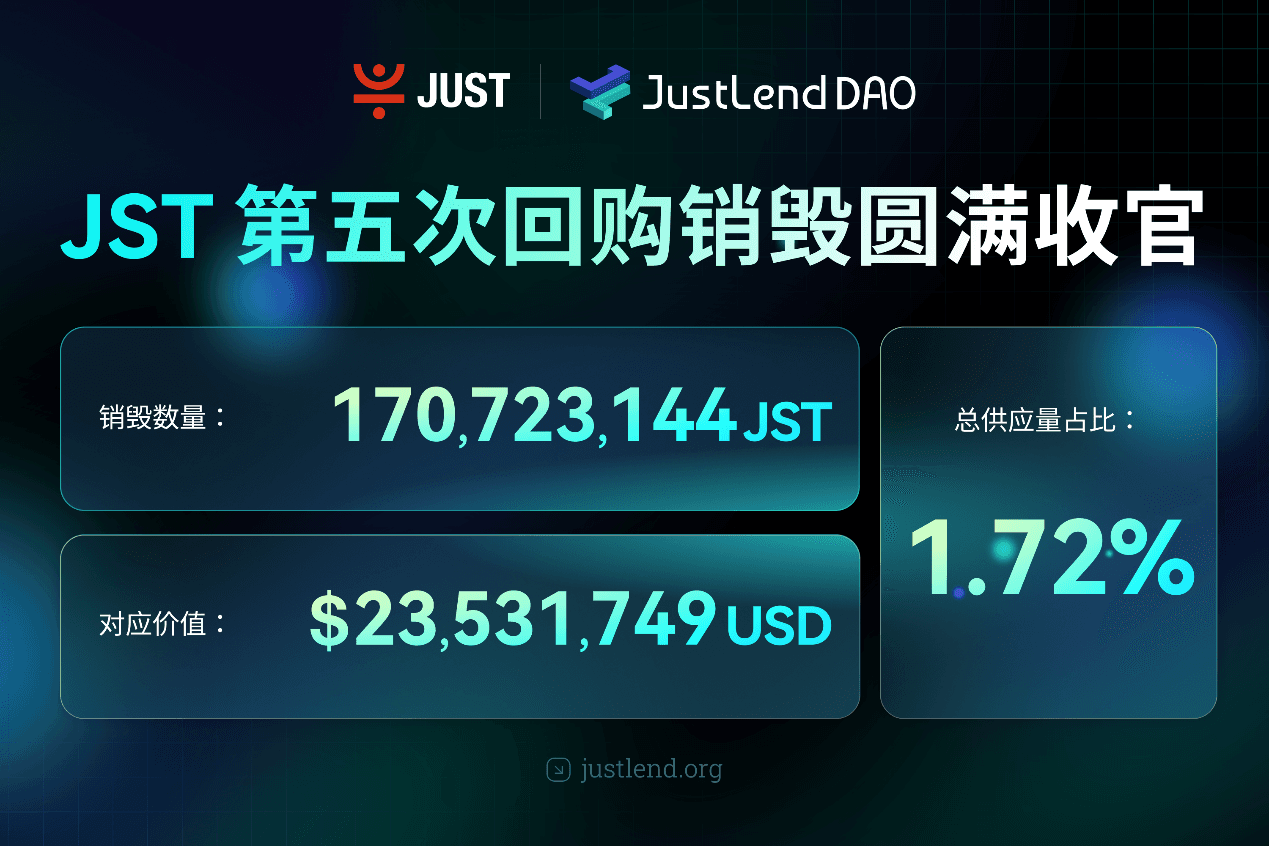
BitTorrent Brand Upgrade and Initial BTT Buyback & Burn Launch Simultaneously, Dual Engines Usher in New Era of Web3 Infrastructure
Oct 17, 20:00
Asia Market Daily: Japan's BOJ signals more rate hikes while Korea targets offshore perpetual platforms (2026/10/17)
Oct 17, 17:01Why did Papertrade backfire on you?
Oct 17, 17:01
The 'Strict Father' of Northern Myanmar: This Company Deploys 200,000 "AI Best Actors" to Strike Back Against Scammers
Oct 17, 15:34