For the first time since 1955, S&P 500 earnings are 14% above the long-term trend.

TL;DR
· A US Stock Earnings Revision Report states that the S&P 500 EPS is 14% above the 90-year trend channel, the first time since 1955.
· Publicly available FactSet data shows that the S&P 500 Q2 earnings growth rate is around 23% to 25%, not the previously reported 33.2%.
· Earnings growth is transitioning from large-cap tech stocks to more companies, but there are still divergences between industries, and the high earnings bar has increased the difficulty of meeting future earnings expectations.
The high valuation of US stocks is receiving stronger fundamental support: not only is corporate earnings continuing to grow, but analysts are also consistently raising future expectations.
A US Stock Earnings Revision Report that summarizes data from multiple institutions shows that the S&P 500 earnings per share has deviated from the trend channel based on over 90 years of historical data by approximately 14%, reaching such a high deviation for the first time since 1955. The report also notes that the proportion of companies beating earnings expectations, the magnitude of sales beats, and analyst earnings upgrades are at historically strong levels.
This set of data explains why US stocks can still find support despite high valuations. Over the past year, AI investing, interest rate expectations, and liquidity have collectively driven the rise of risk assets. As the index continues to climb, relying solely on narrative is no longer enough, and corporate profits must continue to grow to absorb higher valuations.
However, strong earnings also have a flip side: when profit levels are already significantly above the long-term trend, market expectations rise in tandem. Simply meeting forecasts may no longer be sufficient to drive stock prices higher; once revenue, profit margins, or future guidance fall below expectations, the pressure on high valuations will increase.
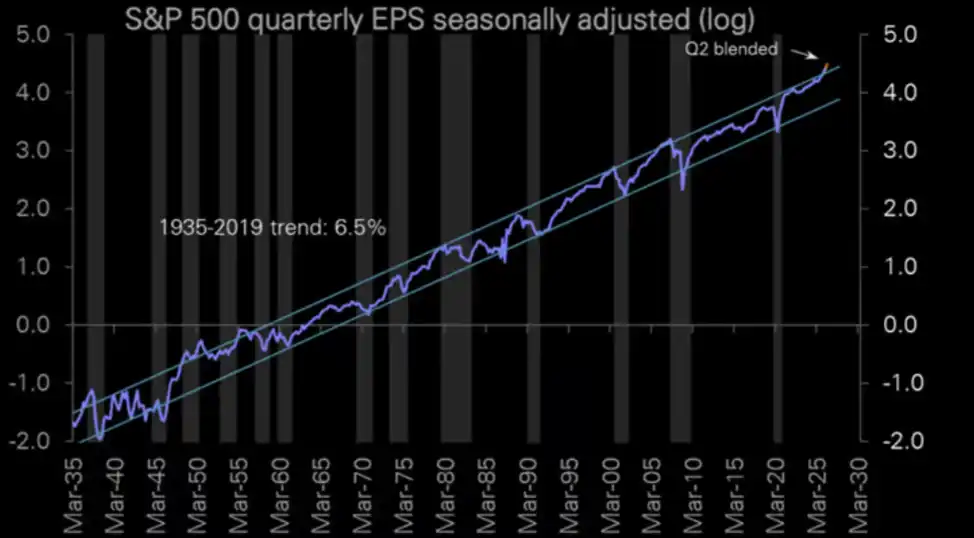
S&P 500 Quarterly EPS rises above long-term trend channel. The report states that it is 14% above the 90-year trend channel, the first time since 1955
The assessment of the current earnings strength in the report mainly comes from three aspects.
First, the S&P 500 EPS continues to rise in absolute terms and has clearly broken through the long-term trend range. According to calculations referenced in the report from Deutsche Bank, several quarters of strong earnings growth have pushed the S&P 500 EPS above the long-term trend channel by 14%.
Second, corporate actual performance is generally better than analyst forecasts. The report states that the S&P 500 earnings surprise ratio is near a historical high, and the overall sales surprise rate has also risen to nearly a five-year high.
Third, earnings expectations have not been cut as usual after the start of the earnings season, but instead continue to rise. The report shows that in July, analysts raised their bottom-up EPS estimate for the S&P 500 for the quarter by 0.3%. Historically, analysts usually downgrade their forecasts in the first month of the quarter to reflect more cautious management guidance and macro assumptions.
These signals collectively indicate that the current U.S. stock market is not purely being driven by valuation expansion. Corporate profits themselves are providing support, and actual performance continues to exceed previous expectations.
However, "strong earnings" does not mean that all data can be used interchangeably.
One striking figure provided in the report is that the S&P 500 second-quarter earnings growth reached 33.2%, a rare high in over 30 years, second only to the financial crisis and the special recovery period post-pandemic.
It is worth noting that in the publicly available data cited in this article, FactSet estimated on July 2nd that the S&P 500 second-quarter earnings would grow by 23.3%; Axios cited FactSet's estimate at 22.5%, while Bloomberg's estimate is around 25%. Therefore, a more accurate statement would be: based on public estimates, the S&P 500 second-quarter earnings growth rate is roughly in the range of 23% to 25%; the 33.2% in the report may have used different data points, sample sizes, or adjustments.
However, even based on the 23% to 25% estimates, the S&P 500 second-quarter earnings growth rate remains at a high level, and the profit side continues to provide fundamental support for the index.
The value of this earnings improvement lies not only in the high second-quarter figures but also in the simultaneous rise of actual performance and future expectations.
Typically, after corporates enter the earnings season, analysts gradually lower their forecasts based on company guidance, cost changes, and macro risks. But this earnings season has seen the opposite: actual earnings consistently surpassing expectations, followed by analysts further raising future EPS estimates.
The report cites data from Carson, stating that at the beginning of the year, the market expected the S&P 500 to achieve approximately 13% earnings growth by 2026; this expectation has now risen to nearly 28%. This number is best labeled as the institution-cited figure in the report, rather than a publicly agreed-upon market consensus.
The most important change is that the bullish sentiment in the U.S. stock market now relies not only on rate cut expectations, liquidity, or AI narratives, but also on earnings upgrades.
As long as corporate profits continue to exceed estimates and analysts keep raising future earnings expectations, high valuations may gradually be digested through profit growth. Conversely, once earnings revisions stop rising, the market will lose a key support, and valuation concerns will resurface.
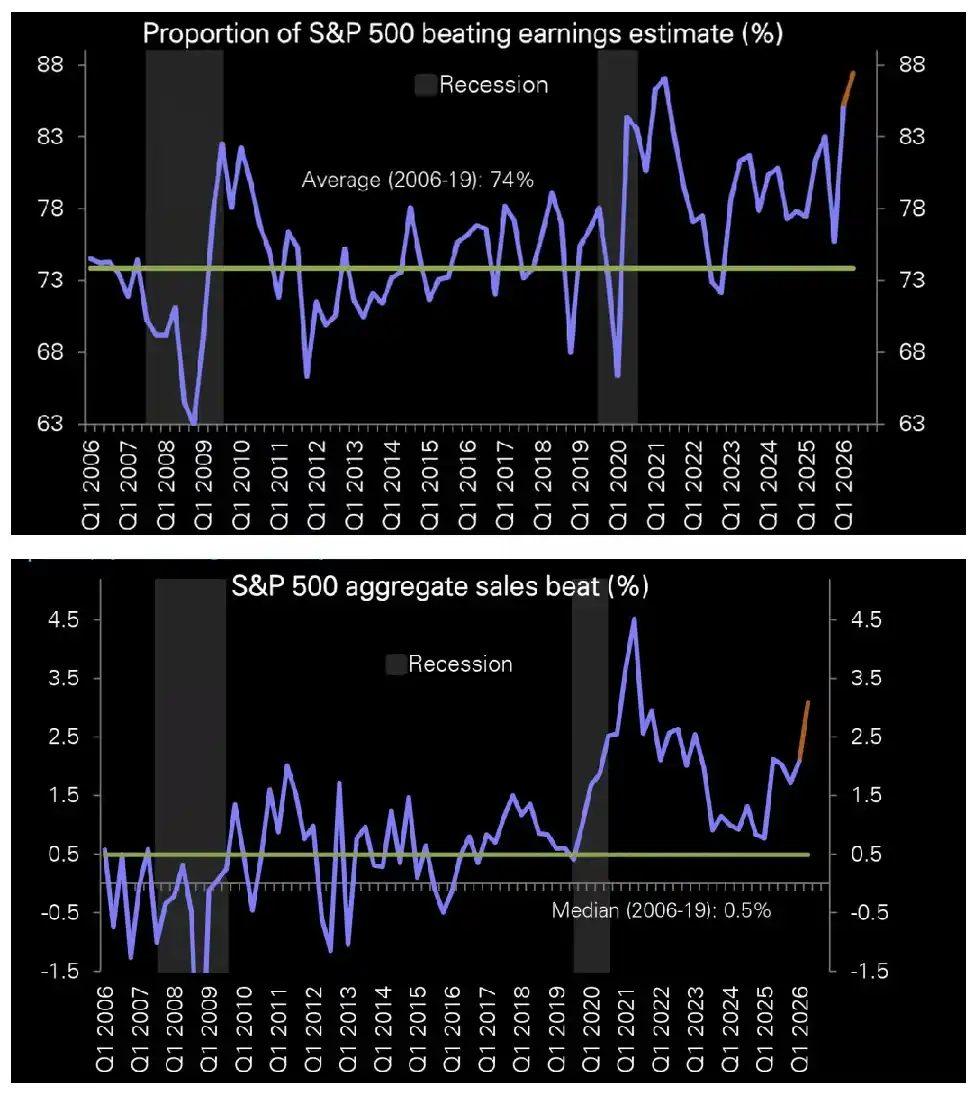
The proportion of S&P 500 companies beating earnings estimates has risen to a historical high, and the overall sales surprise magnitude has also reached a five-year high
Whether strong earnings can continue depends on whether growth has spread from a few large tech companies to a broader market.
FactSet's July 20th breakout data shows that the overall second-quarter blended earnings growth rate for the S&P 500 is 24.7%. Excluding the "seven giants," the earnings growth rate for the other 493 companies is 22.8%. This means that the index's earnings growth is not solely driven by a few mega-cap tech companies.
However, the influence of heavyweight stocks cannot be ignored. If we further exclude Micron and NVIDIA, the S&P 500's second-quarter earnings growth rate would fall to 16.8%. The report also notes that, after excluding star companies and their one-time gains, the median company's earnings growth in the S&P 500 is around 13.8%.
These numbers suggest a more balanced assessment: earnings growth has expanded, but large tech and semiconductor companies remain vital engines.
Data at the industry level should also be viewed with caution.
According to Deutsche Bank, all industries in the S&P 500 are expected to achieve positive growth for the second consecutive quarter, with 8 out of the 11 industries likely to see double-digit growth. Meanwhile, FactSet's July 2nd public data indicates that out of the 11 industries, 10 are expected to achieve year-over-year profit growth, with healthcare being the only industry expected to experience profit decline; on the revenue side, all 11 industries are expected to see year-over-year growth.
Therefore, it can be seen that earnings improvement has spread across most industries, but differentiation still exists among industries.
It is worth noting that revenue growth indicates that overall company sales are still expanding, but final profits will be affected by factors such as wages, raw materials, depreciation, product structure, pricing power, and one-time gains and losses. The ability to convert the same revenue growth into profit may vary significantly across different industries.
The true value of earnings diffusion lies in the widening profit base of the S&P 500, as the index is no longer solely reliant on a few tech giants. However, this is still not enough to prove that all companies and industries have entered a synchronized growth cycle.
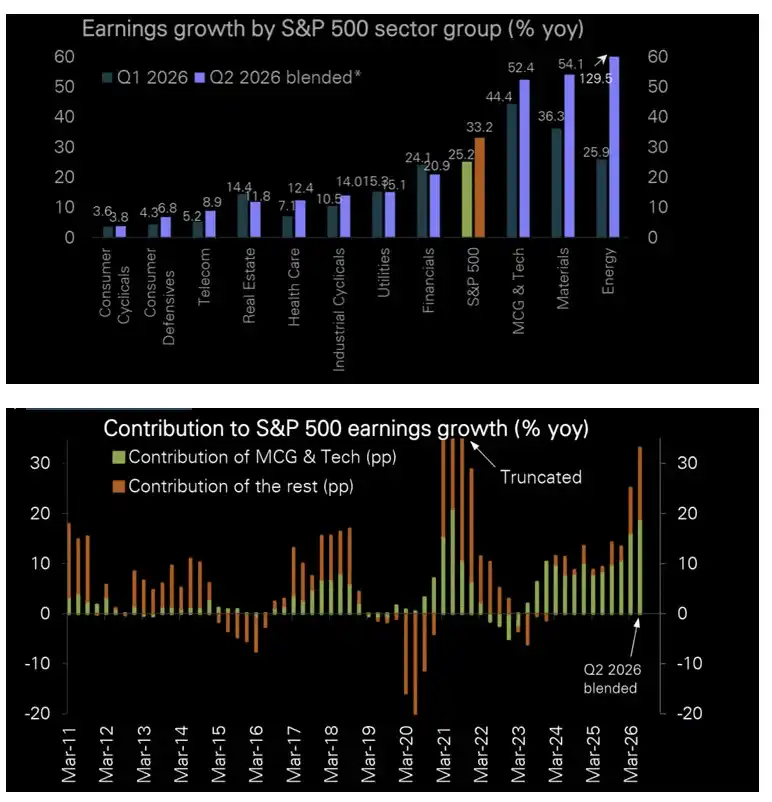
Based on the report, the majority of S&P 500 industries have seen accelerated profit growth, and companies outside of the tech and large-cap growth stocks are also contributing more to the index's profit growth.
Strong earnings can support valuations but can also create higher comparison benchmarks.
Based on the report's calculations, the S&P 500 EPS is now 14% above the 90-year trend channel. This does not mean that corporate earnings are about to peak or directly imply a market downturn; it indicates that the current profit level is significantly above the long-term trend, and future year-over-year growth will face stronger pressure from a high base.
When earnings expectations were raised from around 13% at the beginning of the year to close to 28%, the market had already priced in quite optimistic growth assumptions. Subsequently, companies are no longer just facing the question of "whether there is growth," but whether the growth rate can continue to outpace the continually revised forecasts.
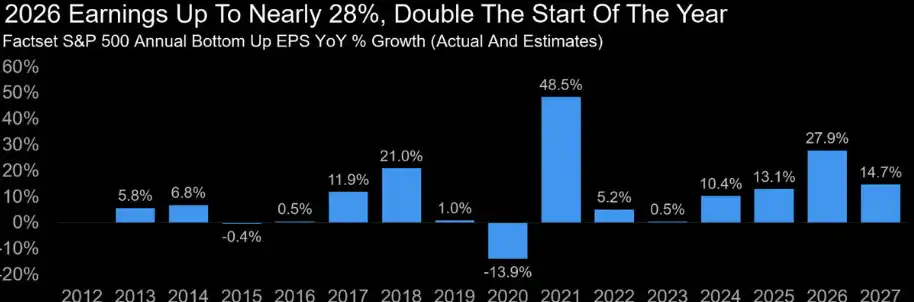
The report indicates that the full-year earnings growth forecast for the S&P 500 has increased from around 13% at the beginning of the year to close to 28%.
This also means that there may be a seemingly contradictory situation during earnings season: overall earnings remain robust, but individual stocks may not necessarily rise due to earnings growth.
The reason is that stock prices reflect the gap between actual results and market expectations. If the market has already anticipated a 20% company revenue growth, actual growth of 20% would only be considered meeting expectations; if profit margins, orders, or future guidance are slightly below what the market previously envisioned, the stock price could still fall.
High earnings also increase valuation sensitivity to negative news. Slowing sales growth, margin pressure from costs, AI capital expenditure returns lower than expected, or a more conservative outlook for the next quarter from management could all trigger more significant valuation adjustments.
Therefore, stronger earnings do not necessarily mean lower market risk. It means that the fundamental support is stronger, but it also means that investors' demands are higher.
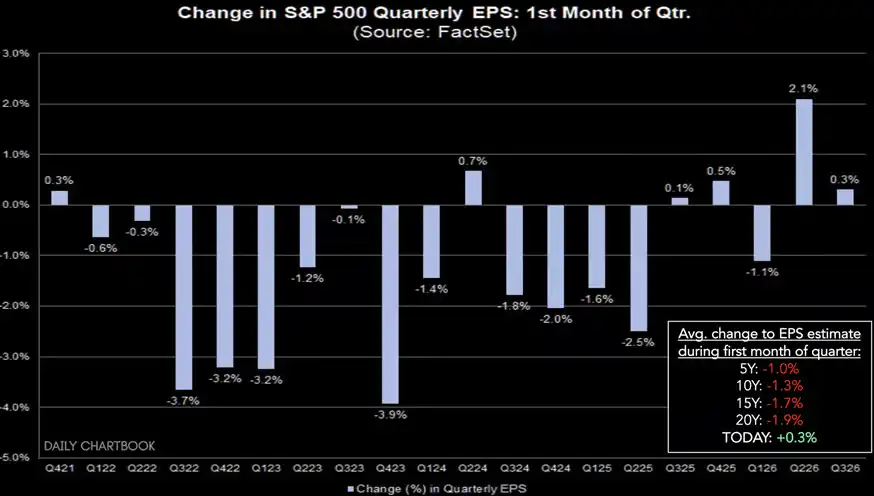
In July, analysts raised their S&P 500 quarterly EPS expectations by 0.3%; historically, analysts typically lower profit expectations in the first month of the quarter.
Next, evaluating whether U.S. stocks can continue to support the index will require monitoring four more specific variables.
First is revenue growth. While profit can be temporarily boosted through cost control, buybacks, or one-time gains, revenue better reflects whether demand is truly expanding. If sales growth starts to significantly slow down, the sustainability of profit growth will also be questioned.
Second is profit margin. The current profit growth is partly coming from the high-margin and scale effects of large tech companies. If wages, energy, depreciation, or financing costs rise, revenue growth may not necessarily translate proportionally into profit.
Third is the return on AI-related capital expenditures. Large tech companies are still investing heavily in building data centers, purchasing chips, and expanding cloud infrastructure. Investors need to see these expenses gradually convert into cloud revenue, software subscriptions, ad efficiency, or enterprise AI service revenue.
Fourth is the direction of earnings revisions. Whether analysts continue to raise EPS forecasts for 2026 and 2027 may be more important than the earnings growth rate of a single quarter. As long as expectations continue to be revised upwards, high valuations can still be supported; if earnings revisions peak or turn negative, the market's tolerance for valuation will quickly diminish.
Overall, the most positive signal from this round of U.S. corporate earnings is the simultaneous improvement in short-term performance, growth breadth, and future expectations. The index's rise relies not only on liquidity and AI themes but also on corporate profits providing support.
However, this support has already been built on abnormally high profit levels and market expectations.
The stronger the profits, the more reason there is to maintain valuations; the higher the expectations, the greater the cost of financial reporting errors. What will truly determine whether U.S. stocks can continue to rise is no longer whether companies can deliver a "decent" financial report, but whether revenue, profit margin, and future guidance can sustainably surpass the increasingly high market thresholds.
Recommended
Desk: Brent Crude Tops $110, Musk's Net Worth Drops 528.6 Billion in Four Days After Tesla Roadster Launch
Oct 17, 21:49
JST Fifth Buyback and Burn Successfully Concludes: Over 170 Million Tokens Worth Approximately $23.53 Million Burned, Buyback Mechanism Set for Comprehensive Upgrade
Oct 17, 20:10
BitTorrent Brand Upgrade and Initial BTT Buyback & Burn Launch Simultaneously, Dual Engines Usher in New Era of Web3 Infrastructure
Oct 17, 20:00
Asia Market Daily: Japan's BOJ signals more rate hikes while Korea targets offshore perpetual platforms (2026/10/17)
Oct 17, 17:01Why did Papertrade backfire on you?
Oct 17, 17:01
The 'Strict Father' of Northern Myanmar: This Company Deploys 200,000 "AI Best Actors" to Strike Back Against Scammers
Oct 17, 15:34