SpaceX's AI Ledger: Revenue Still Eyeing Starlink, Capex Now Eyeing AI

According to the company's second-quarter report, SpaceX completed its initial public offering (IPO) in June 2026. The subsequent post-IPO second-quarter report placed space, Link, and AI side by side in the public financial statements. In the past, people were used to discussing this company from the perspective of rocket launches and Starlink satellites. Now, the previously hidden trade-offs within the company have also been quantified.
Most eye-catching is the growth of AI. However, according to the company's second-quarter performance appendix, the AI division contributed 32.8% of the combined revenue but accounted for 86.2% of the capital expenditures for the quarter. Revenue and capital expenditures did not align, which is the most dissectible aspect of this financial report.
How SpaceX is Making Money Now
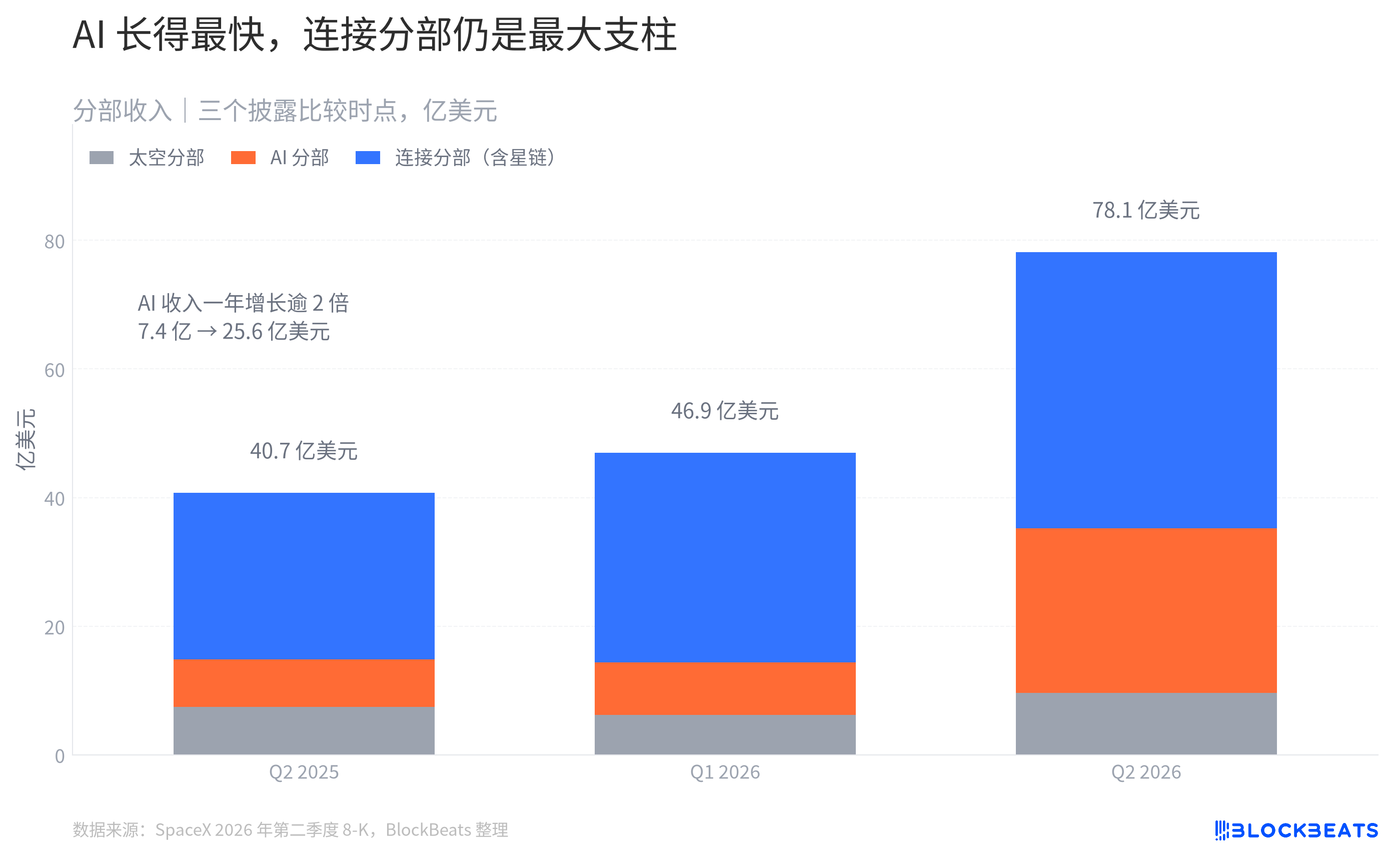
Looking at the income statement first, the conclusion is not mysterious. The Link division remains the largest revenue contributor for the quarter. According to the company's second-quarter performance appendix, it brought in $4.291 billion in revenue, while the AI division brought in $2.561 billion. This division includes Starlink's consumer, enterprise, and government-facing business, still supporting the thickest layer of revenue for the period.
Chart one only selected three disclosed comparative points and is not a continuous quarterly sequence. Nevertheless, the change in AI is still very intuitive. By the latest quarter, the orange portion has significantly thickened, while the Link division still occupies the largest blue area. The same company is running two businesses with different paces—one side is the larger-scale current Link service revenue, and the other side is the rapidly expanding AI business.
Here, we need to draw a boundary for the "AI division." According to the company's second-quarter performance appendix, Grok, X Platform, consumer and enterprise-focused AI solutions, and AI computing infrastructure are all placed in the same division. Therefore, the AI revenue on the chart cannot be directly equated to pure cloud service revenue; it also includes advertising revenue.
This changes the interpretation. If only focusing on the year-over-year growth rate of AI, it is easy to see it as a mature independent cloud service business. The financial report presented is more like a business basket that is in the process of merging and expanding. It has models, platforms, and ongoing AI infrastructure development.
Where the Money is Going
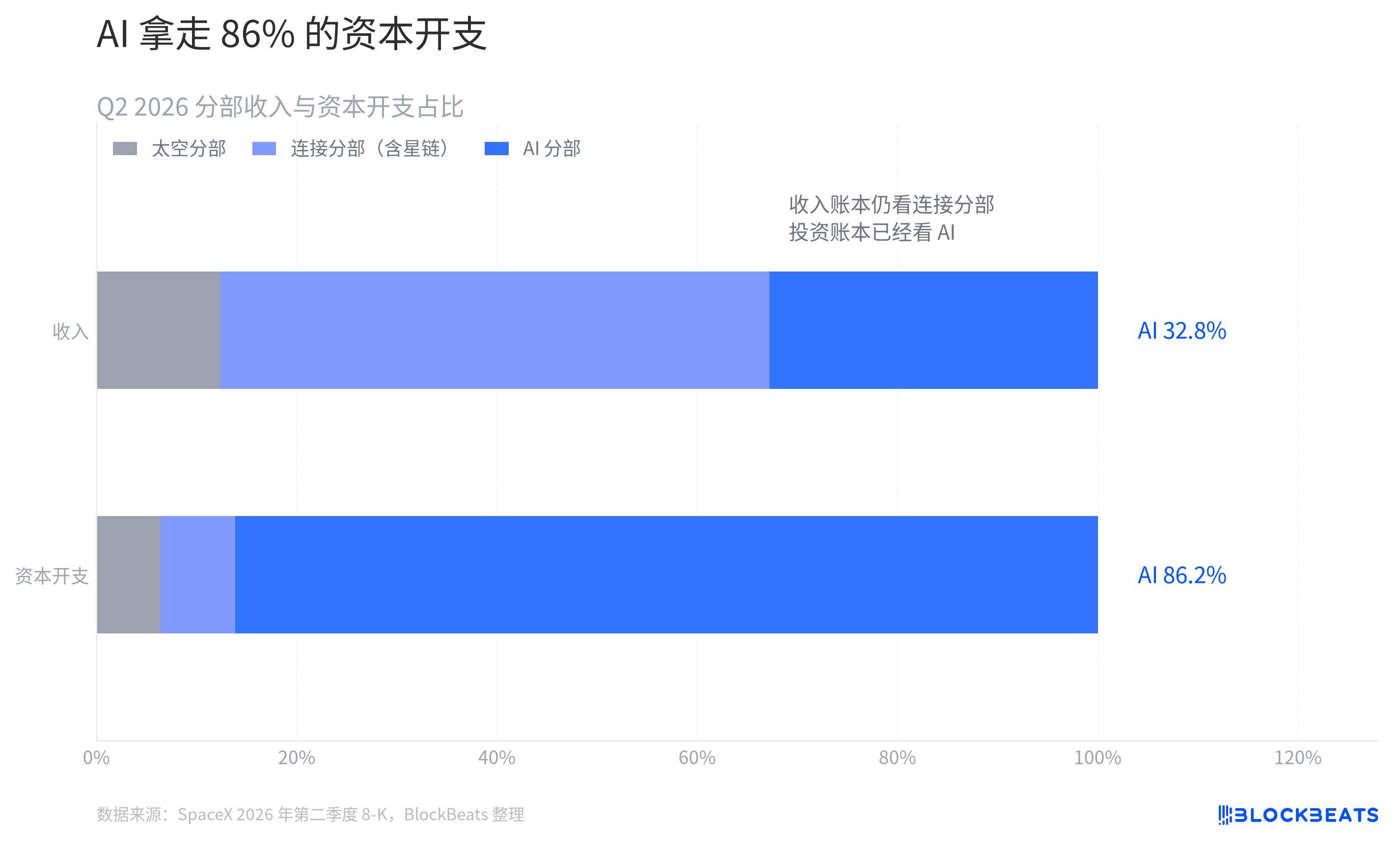
The income statement records services already sold, while capital expenditures show where the company is allocating its infrastructure. In chart two, the revenue share of AI has not yet caught up with the Link division, but the capital expenditure share has far surpassed it. According to the company's second-quarter performance appendix, AI accounts for 32.8% of revenue, while capital expenditures represent 86.2%.
Adding this contrast in terms of amounts will make it more tangible. According to the company's second-quarter performance supplement, the AI division's capital expenditure for the quarter was $15.828 billion, while the revenue for the quarter was $2.561 billion. This is like comparing the construction cost of a factory building with the current rent on the same sheet of paper, showing a significant difference in scale but not a direct correlation. The comparison here is between the division's capital expenditure and its current revenue, not the division's cash flow.
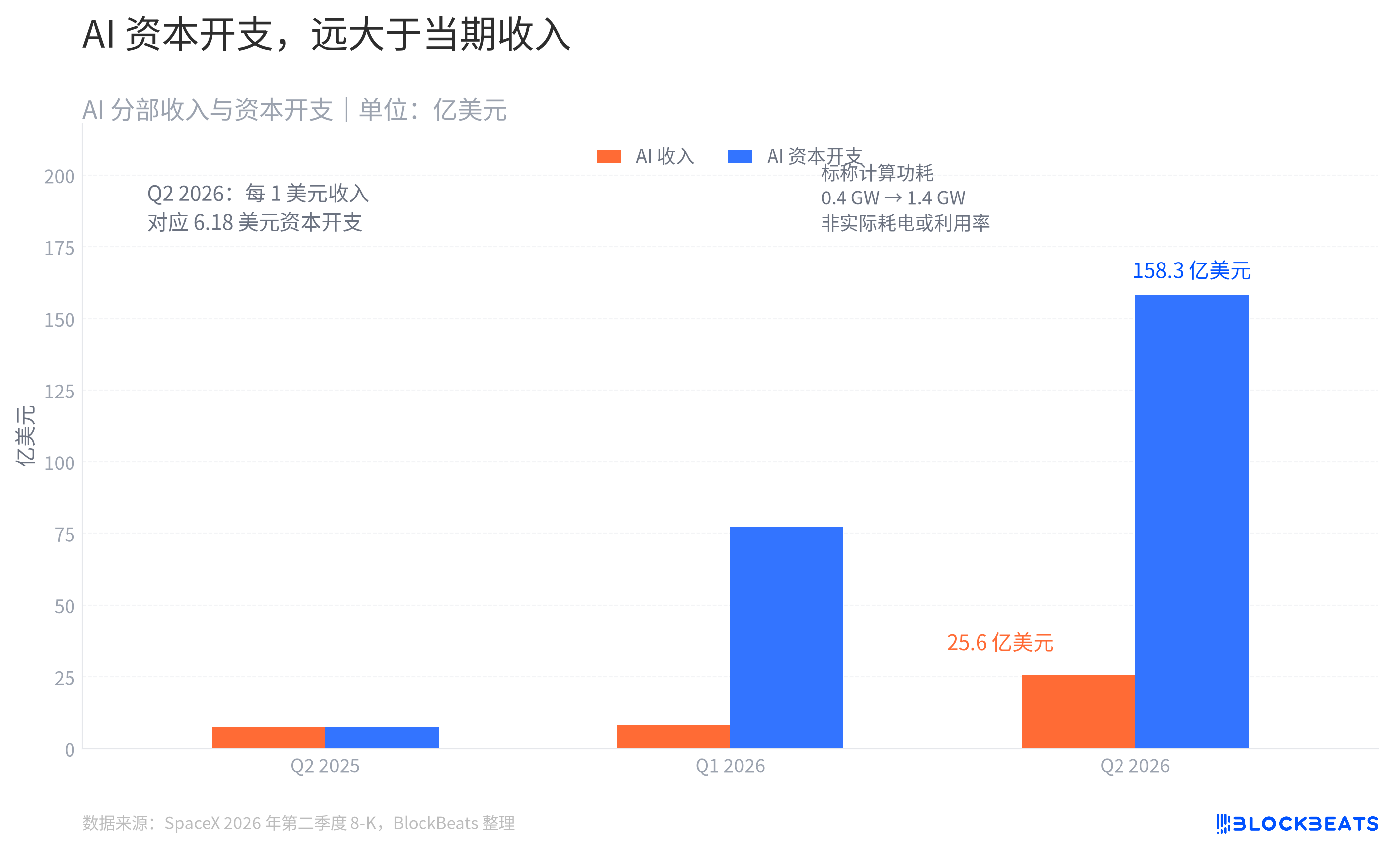
Chart Three places these two columns back into the context of three disclosure comparison points. In the latest quarter, for every $1 of AI revenue, there was $6.18 of capital expenditure, according to the company's second-quarter performance supplement. This is not a confirmation rate, nor can future profits be calculated based on this. It only indicates that the current revenue and the equipment, data centers, and related infrastructure allocated to AI are not currently on the same scale.
The company's disclosed nominal power consumption has also increased from 0.4GW in the same period a year ago to 1.4GW. According to the performance supplement's definition, this is calculated based on installed GPU power and total power consumption, and does not represent actual power consumption or utilization. This set of changes is like adding a lane to a new highway. What can be confirmed at the moment is that the road is widening, but the financial report does not disclose how many vehicles have traveled on each lane.
Another column on the same divisional table provides a more straightforward footnote to this expansion. According to the company's second-quarter performance supplement, the AI division still recorded a $1.257 billion operating loss for the quarter. Adjusted EBITDA can help observe the operating structure but cannot replace cash flow. Capital expenditure, adjusted EBITDA, and operating loss in the chart are of different natures and cannot be used interchangeably.
$14.1 Billion Contract Sales, How Much Incremental Revenue Does It Bring in Q2
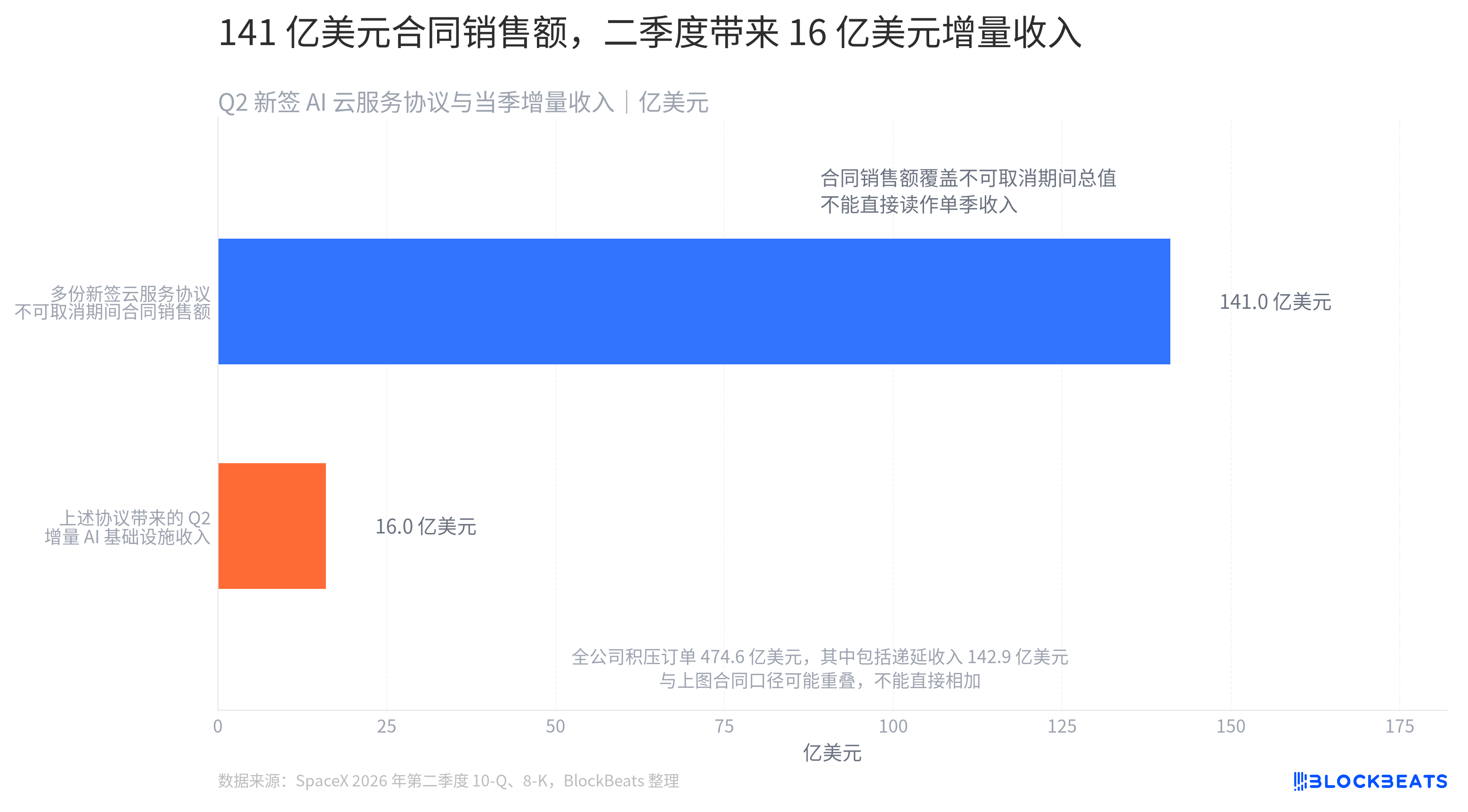
Most prominently highlighted in the financial report are multiple cloud service agreement totaling $14.1 billion in contract sales. According to the company's second-quarter performance supplement, these agreements brought in $1.6 billion of incremental AI infrastructure revenue for the quarter. The former represents the total value of the contracts, while the latter only indicates the incremental revenue from new agreements on AI infrastructure for the quarter.
This performance supplement does not separately disclose the total recognized revenue from these new agreements for the quarter. Therefore, these two figures cannot be used to calculate a recognition rate, nor can the difference be considered as unconfirmed revenue.
According to the company's second-quarter performance supplement, SpaceX has a specific definition for "contract sales." It covers the total value of contracts for non-cancelable periods, including the recognized revenue and related deferred revenue for the period, excluding future amounts that customers can cancel. Treating the total contract value as revenue for a quarter is akin to treating an entire year's lease contract as the landlord having already received the rent for today.
Another contract table for the entire company also needs to be reviewed separately. According to the company's second-quarter report, the ending backlog was $47.461 billion, with deferred revenue of $14.286 billion being only a part of it. Both figures may overlap with the contract sales of the cloud service agreement, and these cannot be added together as a separate contract pool.
The company anticipates that 56% of the backlog will be recognized within one year. As stated in the company's second-quarter report, this provides a time dimension to revenue, maintaining the gap between delivery and recognition. Orders piling up at the door do not mean that each one will pass through the revenue recognition counter in the same quarter.
SpaceX's new ledger has been divided into two pages. One page details the Link division's still-in-process current revenue, while the other page covers AI's capital expenditure allocation. Viewing these two pages separately, the contract sales amount appears more like the total price of an entire non-cancellable contract period rather than a quarterly revenue answer.
Recommended
Desk: Brent Crude Tops $110, Musk's Net Worth Drops 528.6 Billion in Four Days After Tesla Roadster Launch
Oct 17, 21:49
JST Fifth Buyback and Burn Successfully Concludes: Over 170 Million Tokens Worth Approximately $23.53 Million Burned, Buyback Mechanism Set for Comprehensive Upgrade
Oct 17, 20:10
BitTorrent Brand Upgrade and Initial BTT Buyback & Burn Launch Simultaneously, Dual Engines Usher in New Era of Web3 Infrastructure
Oct 17, 20:00
Asia Market Daily: Japan's BOJ signals more rate hikes while Korea targets offshore perpetual platforms (2026/10/17)
Oct 17, 17:01Why did Papertrade backfire on you?
Oct 17, 17:01
The 'Strict Father' of Northern Myanmar: This Company Deploys 200,000 "AI Best Actors" to Strike Back Against Scammers
Oct 17, 15:34