The Significance of CASHCAT on Bitstamp and the Mess-Up of Rugging
Yesterday morning, I still had a "very optimistic estimate" of the Robinhood Chain. After BSC regained most of the recent attention and liquidity, the Robinhood Chain has not always been in an absolutely passive beatdown situation:
- $CASHCAT rebounded from a low of $40 million market cap and re-surpassed a $100 million market cap
- Uniswap launched its own launchpad on the Robinhood Chain, marking the first time we have seen Uniswap do a launchpad, not on any other chain, but specifically choosing the Robinhood Chain
- $STONKBROKER, unaffected by the Robinhood market downturn, continued to hit new highs, surpassing a $50 million market cap even though its planned launchpad has not gone live
These three events allowed me to provide separate optimistic interpretations:
- $CASHCAT launching its own launchpad is not necessarily a positive development, because during the low point of the $40 million market cap, both positive and negative interpretations make sense. Looking at it positively, $CASHCAT can start with the launchpad and be compared to $BONK on Solana. Looking at it negatively, after the launch, no effective rebound can be seen from the daily K-line, making it unclear whether the launchpad is truly empowering or just for profit-taking. However, the rebound started on August 3rd and returned to the $100 million market cap threshold, at least indicating that the behind-the-scenes funds have not yet fled. The leader still has vitality, so we can expect a recovery in the Robinhood Chain market
- Despite there already being many launchpads on the Robinhood Chain, Uniswap entering the scene as a launchpad is quite different. We all know that launchpads are very profitable, and in today's market development, there is not too much technical difficulty in implementing them. But if Uniswap wants to enter the launchpad race to make a lot of money, why did it only create a launchpad on the Robinhood Chain? There is room for imagination in this decision
- There's not much to say about $STONKBROKER; its revenue data at this stage is very "weird." The launchpad has not yet gone live, the stock blind box feature (where you spend money to draw American stock tokens, similar to spending money to open Pokémon card packs with a chance of getting rare cards) has not yet been launched, and hardly anyone is using the Swap feature. However, NFTs and token "look-alikes" have been very lively, with the prices of both asset types rising simultaneously. This actually has some similarity to the logic behind $CASHCAT's rise and the overall optimistic outlook, indicating that there are still funds willing to accumulate on the Robinhood Chain
By yesterday afternoon, when $CASHCAT spot trading was launched on Bitstamp, it felt like the whole rationale needed to be rethought.
The title of this section is very straightforward. When this news came out, many players' initial reaction was to think that Bitstamp was just a small fry, merely acquired by Robinhood, and wouldn't stir up much of a storm.
We all know that Robinhood is a brokerage, but it's a very different kind of brokerage.
Robinhood's options, stock, and ETF business all follow the "PFOF model." Simply put, Robinhood is like a "livestream host," not making money from actually executing user orders but from selling order flow.
Take a look at Robinhood's official support page:
"When you buy and sell stocks, ETFs, and options, we'll send your order to market makers that often offer better prices than public exchanges. To compete with exchanges, market makers collaborating with us, as a brokerage, pay us rebates."
Users' trade orders are sent to market makers, who match the trades off-exchange and earn the spread. Market makers make money from users, Robinhood makes money from the rebates provided by market makers—this is Robinhood's business model.
Even for cryptocurrencies on the Robinhood main site (Robinhood App), the model is similar; users' orders are routed to market makers, who facilitate trades over-the-counter (OTC).
In June 2024, Robinhood and Bitstamp reached a preliminary acquisition agreement, with a price of $200 million. The acquisition was completed in June 2025. After this acquisition, although the cryptocurrency business on the Robinhood main platform still follows the "sell order flow" model, it added a new business line, finally owning its own cryptocurrency exchange.
This means that in the cryptocurrency market, Robinhood has truly started competing head-to-head with CEXs like Binance, OKX, and Coinbase. It is no longer "selling order flow" but now processes trade orders itself.
In 2022 and 2023, Bitstamp incurred losses of approximately 7.5 million euros and approximately 19.7 million euros, with revenue of only about $31 million in 2022 and even lower at about $8.7 million in 2023. Robinhood's $200 million acquisition of such a small exchange was more about valuing Bitstamp's regulatory advantages; it holds regulatory licenses from the EU, UK FCA, US NY BitLicense, Singapore MAS, and over 50 regulatory licenses globally.
Although this exchange may seem a bit "out of the way" compared to other exchanges in the crypto market, it's actually not small when compared to Robinhood's main crypto business:
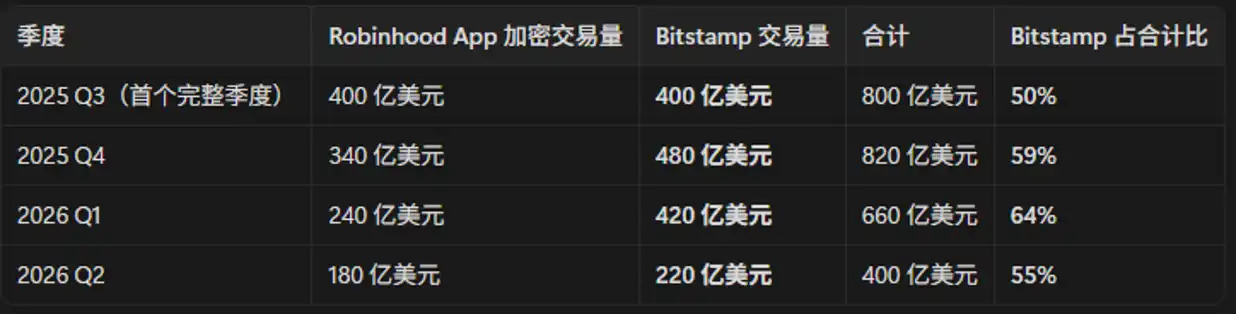
Going on this exchange gives a bit of a Binance Alpha -> Binance Futures/Spot vibe. If the coins on Robinhood's chain can be listed on Bitstamp, then the probability of being listed on Robinhood's main site will increase significantly.
Prior to this event, I was very worried that Robinhood's chain would not receive any more attention events in the short term. If Vlad no longer trash talks like Base at least, Robinhood's chain may soon be even worse than Base in the short term. The sudden occurrence of this event can greatly reverse market expectations:
Robinhood is really going to list tokens on its own chain, which has also opened up a new listing channel for the current market.
But what was unexpected is that what should have been a huge positive, at least for now, has all gone wrong.
Last night, when Robinhood's main site launched $CASHCAT, everyone was still immersed in the joy of a market cap of just over $100 million buying into Robinhood's "Binance life" not long ago, things started to go awry.
Logically, with such a huge positive catalyst, is it unreasonable to expect $CASHCAT to at least surpass its historical high by a long shot? But the result was that not only did it fail to reach its historical high market cap of under $250 million, after a sudden short-term spike in response to the news, $CASHCAT briefly touched a $210 million market cap and then started to drop.
Even the hard-fought $100 million market cap level couldn't be held. This candlestick on August 6th, with $103 million in trading volume, left behind such a long upper shadow:
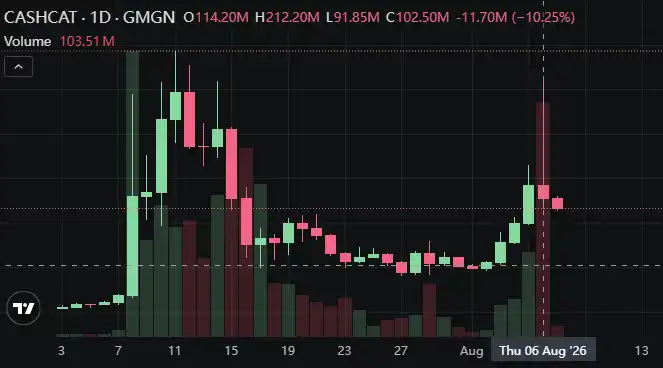
At this point, almost everyone has no doubts about the sharp rebound of the past few days—such a significant positive catalyst, such high trading volume, and the result is this candlestick chart. Do you believe there was no "wash trading"?
Such a trend is definitely a heavy blow to the players' confidence. Of course, it is too early to conclude that $CASHCAT is over. The next scenarios are nothing more than:
- Taking advantage of the decline to reshuffle the deck, readjust, and then reattempt to break the all-time high, with everyone following the same routine
- All positive news is priced in, leading to a bearish trend
- Vlad and Robinhood officials interact again, providing clearer support, causing drastic price volatility
This has messed up everything, to the point that one might even say that $CASHCAT should not have launched on the Robinhood main stage yesterday. There were too many "sell the news" traders, completely shattering the market's dreams. This card could have been slowly played out in the market, but instead, it was all revealed at once. Faced with the possible scenarios mentioned above, everything is unknown to market players. There is no space for coordinated efforts, only a fog of war in this gambling game.
The current awkward situation lies in the fact that if you believe the Robinhood Chain will usher in a grand market, there is no asset more certain than $CASHCAT. In the short term, its performance is the most direct indicator of the Robinhood Chain's market dynamics, especially since the current market is at a stage where not buying the leader results in significant losses. But with its current trajectory, should we be optimistic or pessimistic? What if there is really no follow-through?
The game revolving around $CASHCAT may become the hottest topic in the market for a while. If $CASHCAT can truly become a rare $1 billion market cap target in the market, then we may usher in a golden period—there will be many opportunities on the Robinhood Chain, and BSC, Solana, and others may also emerge with counterattacks, bringing forth many opportunities.
May the future be bright and prosperous.
Recommended
Desk: Brent Crude Tops $110, Musk's Net Worth Drops 528.6 Billion in Four Days After Tesla Roadster Launch
Oct 17, 21:49
JST Fifth Buyback and Burn Successfully Concludes: Over 170 Million Tokens Worth Approximately $23.53 Million Burned, Buyback Mechanism Set for Comprehensive Upgrade
Oct 17, 20:10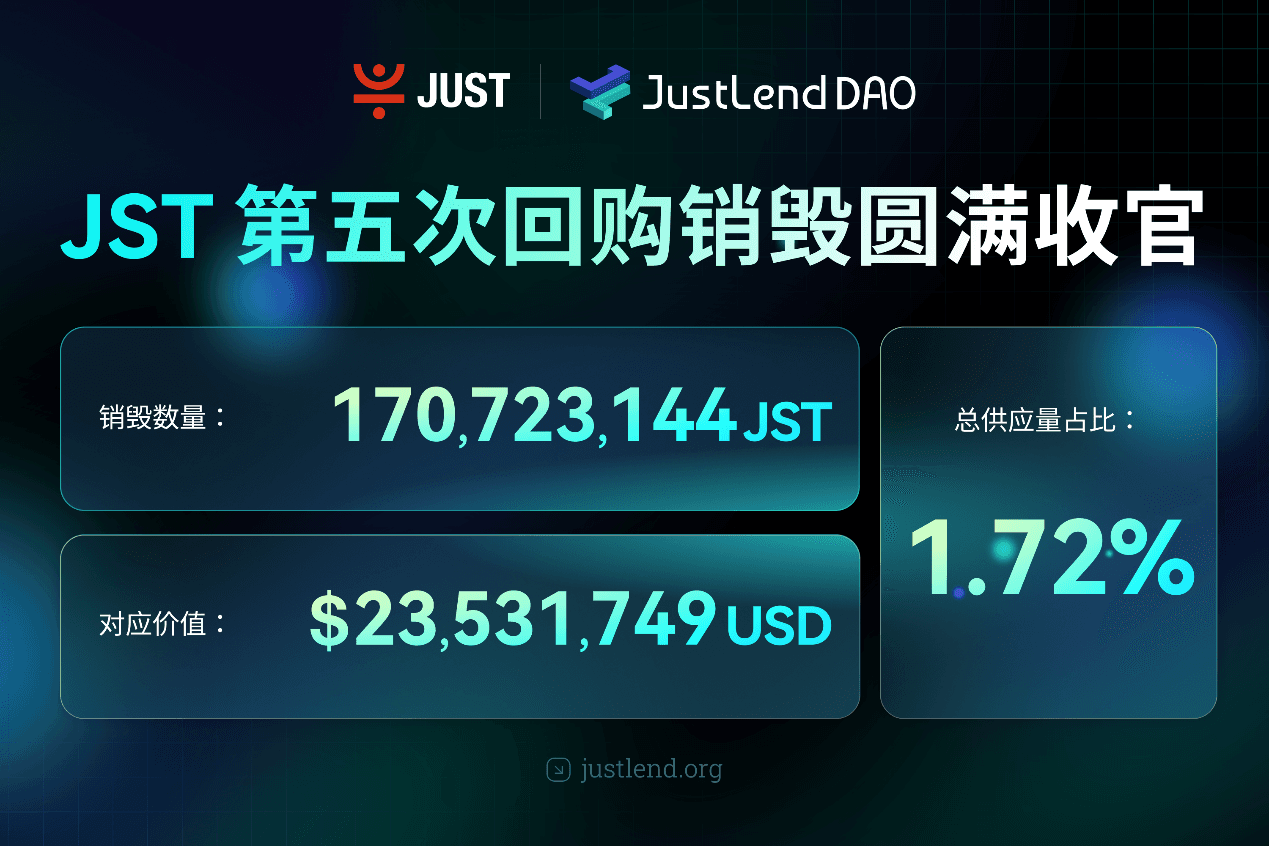
BitTorrent Brand Upgrade and Initial BTT Buyback & Burn Launch Simultaneously, Dual Engines Usher in New Era of Web3 Infrastructure
Oct 17, 20:00
Asia Market Daily: Japan's BOJ signals more rate hikes while Korea targets offshore perpetual platforms (2026/10/17)
Oct 17, 17:01Why did Papertrade backfire on you?
Oct 17, 17:01
The 'Strict Father' of Northern Myanmar: This Company Deploys 200,000 "AI Best Actors" to Strike Back Against Scammers
Oct 17, 15:34