Citigroup Analysis: Despite the stock price plummeting after the financial report, why is Citigroup still optimistic about Micron targeting $2,500?
TL;DR
·Citigroup initiates coverage of SanDisk with a "Buy" rating and a $2500 price target, representing an 85.1% upside from the August 5th closing price.
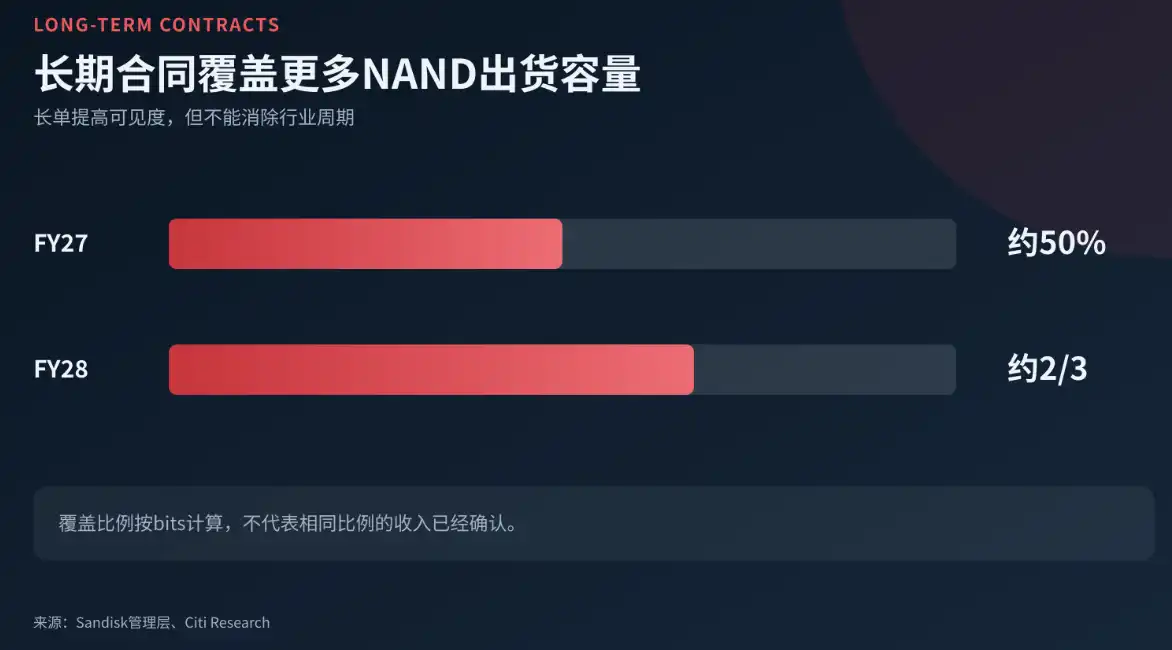
·Per management guidance provided to Citigroup, long-term contracts cover approximately 50% of FY27 and around two-thirds of FY28 NAND shipping capacity.
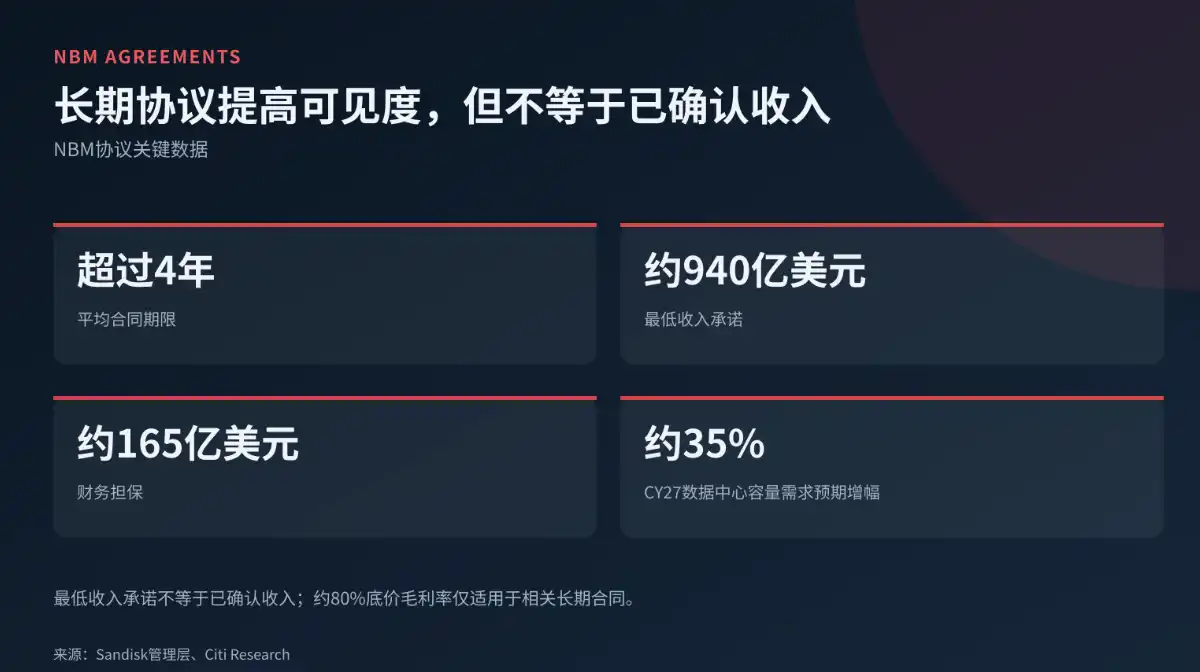
·The related contracts correspond to a minimum revenue commitment of about $94 billion, with a reported gross margin of around 80% when executed at the floor price.
·AI inference and cloud capex continue to drive demand for data center SSDs, but price hikes slowing down, capacity recovery, and industry competition remain key risks.
·Stock price declined after strong earnings report, indicating the market's focus has shifted to whether high growth and high margin can be sustained.
A management call-back report released by Citigroup on August 5th gave SanDisk a "Buy" rating with a target price of $2500. Based on the August 5th closing price of $1350.50 used in the report, this represents an expected stock price return of 85.1%.
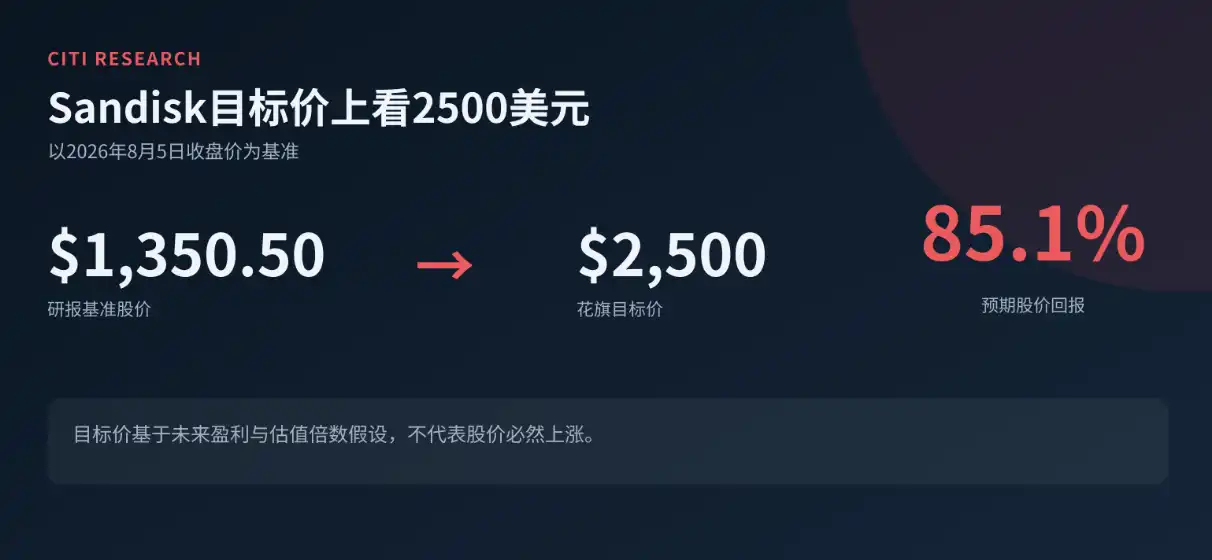
This target price does not imply that SanDisk's stock price will necessarily rise by 85%. It is built on Citigroup's assumptions about future earnings and valuation multiples, and the so-called "upside" will vary with market price changes.
In fact, despite SanDisk's strong earnings announcement, the stock price did not continue to rise. According to Reuters, the company's stock price fell by as much as 13.3% to $1178 on August 6th. Market concerns primarily revolved around the potential slowdown in NAND price increases and the company's guidance not meeting investors' previously elevated expectations.
What is truly noteworthy in this report is not just the $2500 price target, but Citigroup's attempt to redefine SanDisk: Can AI data center demand and long-term contracts enable it to achieve a valuation premium over the traditional NAND cycle stocks?
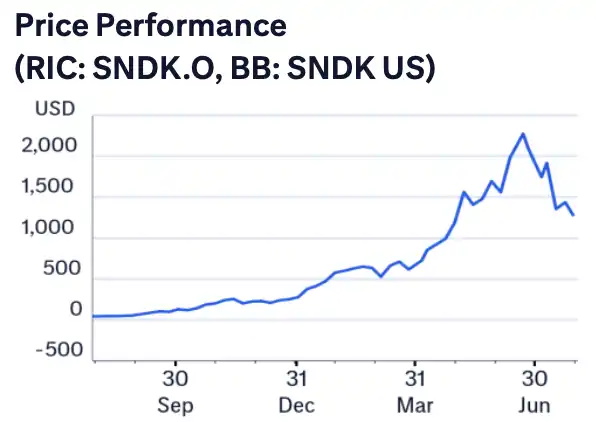
SanDisk stock performance compared to Citigroup's $2500 price target. Citigroup, using SanDisk's August 5th closing price of $1350.50 as a benchmark, provided a $2500 price target, representing an 85.1% expected stock price return. Source: Citi ResearchStrong Earnings, Yet Stock Price Plummets – Why?
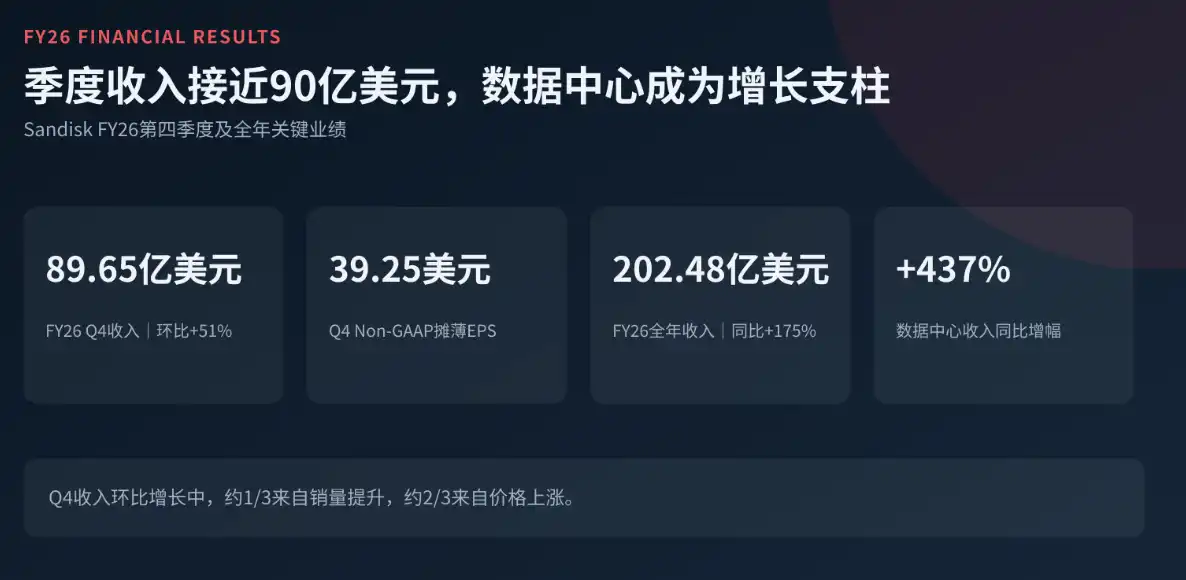
SanDisk reported revenue of $8.965 billion for Q4 FY26 on August 5th, a 51% increase QoQ; Non-GAAP diluted EPS was $39.25.
In FY26, the annual revenue was $20.248 billion, a year-over-year increase of 175%, with the data center business revenue experiencing a 437% YoY growth. The company expects Q1 FY27 revenue to be between $10.3 billion and $10.8 billion, with a Non-GAAP diluted EPS of $0.44 to $0.46.
These figures confirm that the data center has become a key growth pillar for SanDisk. The company stated that about one-third of the Q4 revenue growth came from increased sales volume, while two-thirds came from price increases. This implies that the current performance growth relies on data center demand, product portfolio improvements, and the strengthening NAND prices.
However, the stock price fell after the financial report, reflecting that the market threshold has been significantly raised. With SanDisk's stock price having risen sharply before, investors are no longer concerned about the growth of AI storage demand but instead about how long NAND prices can continue to rise and whether profit forecasts can be further revised upward.
While the revenue guidance for Q1 FY27 provided by the company remains strong, it did not meet the higher informal expectations of some investors. The slowing of price increases may lead the market to reassess the sustainability of the current high-profit margins.
The core rationale for Citigroup's bullishness on SanDisk is the company's so-called New Business Model (NBM) long-term agreements.
According to the caliber provided by the management to Citigroup in a post-earnings conference call, the long-term contracts already cover about 50% of SanDisk's bits for FY27 and about two-thirds of bits for FY28. Here, bits refer to NAND shipment capacity, not revenue share.
These contracts have an average term of over four years, corresponding to approximately a $94 billion minimum revenue commitment, with around $16.5 billion in financial guarantees.
The report did not disclose specific details on different customers' purchase volumes, price adjustment mechanisms, and guarantee trigger conditions. Therefore, the $94 billion cannot be directly understood as recognized accounting revenue; more accurately, it is stated that under the assumption of normal contract performance, the company has obtained a large-scale minimum revenue commitment.
SanDisk's official performance announcement indicates that since announcing five NBM agreements in the April earnings call, the company has signed an additional five agreements, including three new customer agreements and two extensions of existing agreements.
Long-term contracts are changing how investors view SanDisk. NAND has historically been a cyclical industry: rising prices and expanding profits during high demand, followed by potential oversupply due to capacity releases. The company's revenue and profits are easily influenced by quarterly prices, inventory, and customer purchasing patterns.
Long-term contracts cannot eliminate this cycle, but they can lock in some of the shipment volume and minimum price in advance, increasing the predictability of future revenue and cash flow.
Citi believes that this revenue visibility is sufficient to support SanDisk's valuation multiple higher than that of traditional NAND companies. The report uses a valuation of about 11 times CY27E EPS for SanDisk, higher than the median of around 8 times for Kioxia listed and the valuation range of about 6 to 8 times for the broader industry.
Citi's forecast lists SanDisk's FY27 EPS at $222.15 and FY28 EPS at $225.88. It should be noted that FY27 and CY27 are of different time references, so FY27's $222.15 EPS cannot be directly used to calculate the target price based on CY27 EPS used.
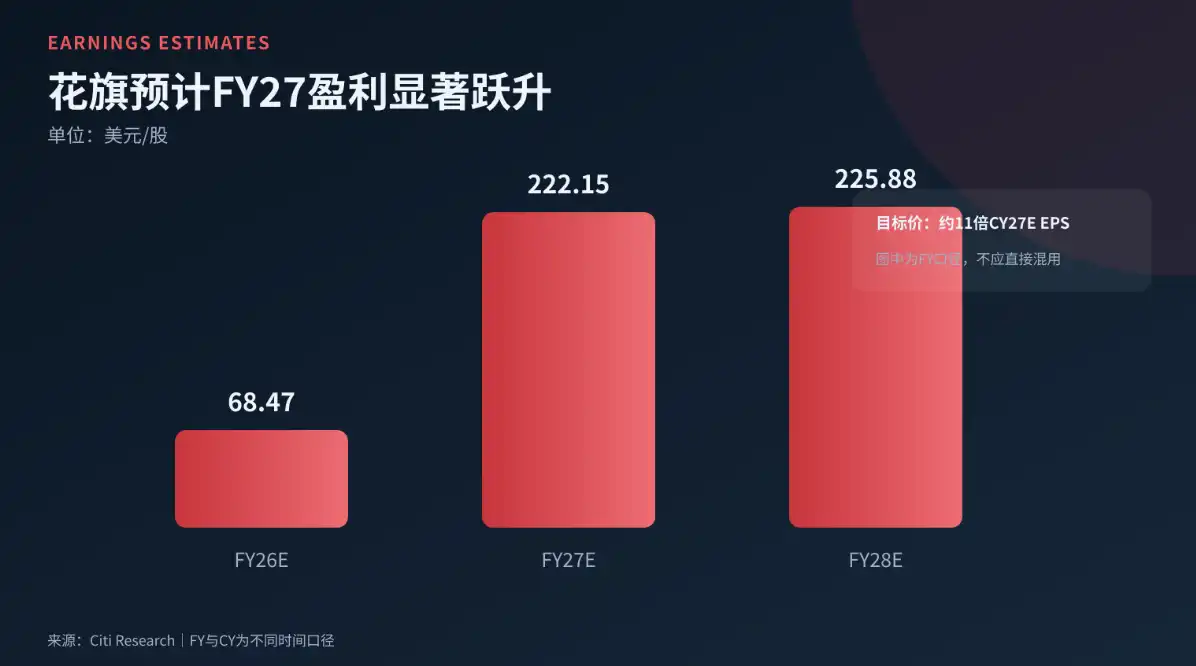
Citi's EPS forecast for SanDisk. Citi expects SanDisk's FY27 EPS to be $222.15 and FY28 EPS to be $225.88; its $2500 target price uses a valuation of about 11 times CY27E EPS, and CY and FY calibers should not be directly mixed. Source: Citi ResearchAI Inference Expansion, Data Centers Needing More Storage
SanDisk's NAND flash solutions cover SSDs, memory cards, USB drives, portable storage devices, and in-vehicle storage products, but the most focused product in the market currently is enterprise SSDs, especially those targeting cloud providers and data center clients.
The management told Citi that after signing initial agreements, hyperscale cloud providers are still expanding their NAND procurement commitments, with demand primarily being driven by the evolution of AI inference requirements and the increase in cloud capital spending.
AI infrastructure is not just about GPUs and HBMs. As the inference workload expands, data centers also need more storage devices to carry models and business data. The advantages of enterprise SSDs in access latency, energy consumption, and deployment density make NAND a beneficiary in the expansion of AI infrastructure.
The Citi report forecasts that CY27 data center storage capacity demand will grow by around 35%. This metric measures exabyte capacity demand, not sales. Actual revenue growth will also be influenced by NAND prices, product mix, and customer contract terms.
Management also indicated that there are currently no signs that customer struggles to obtain DRAM are slowing down NAND deployment. If cloud providers delay deployments due to shortages of DRAM, HBM, or other server components, the related NAND demand may also shift later; however, at least at the time of this call, SanDisk has not observed this scenario.
In addition to shipment volume, the pricing of long-term contracts is also a key reason Citigroup is bullish on SanDisk.
According to management's information to Citigroup, the gross margin of these long-term contracts at the floor price is approximately 80%; if market prices are above the contract floor price, profit margins could receive further support.
This number is impactful but must be confined to the realm of long-term contracts. It should not be construed as SanDisk achieving a permanent 80% gross margin across its entire business, nor does it mean all contracts will be executed at exactly the same price and cost structure.
SanDisk's overall gross margin for FY26 Q4 was 84.6%, with the company providing a gross margin guidance of 83% to 85% for FY27 Q1. Citigroup stated that this guidance reflects a rise in business mix and SSD component costs rather than a weakening NAND price.
The company's current inventory of around 170 days is also a variable to watch. Management stated that the higher inventory was proactively built as a fulfillment buffer to meet long-term contract commitments; the rising costs of SSD components like DRAM have also increased the inventory value.
Therefore, high inventory should not be simply equated to weak demand, but it is also not without risks. If the rate of NAND price increases continues to slow, the impact of inventory costs, contract pricing, and delivery cadence on profits could be magnified by the market.
On the supply side, challenges persist. SanDisk collaborates with Kioxia through Flash Ventures to jointly develop and produce NAND wafers. Documents filed with the SEC show that this joint arrangement currently extends to 2034, with SanDisk bearing about half of the fixed costs and corresponding capital investment.
This partnership provides a long-term supply foundation but does not mean that SanDisk has unlimited capacity immune to cost and industry cycle impacts.
Citigroup warns that if underutilized industry capacity is brought back online, supply and demand dynamics could shift to oversupply in a relatively short period; Chinese manufacturers' expansion, price competition, and deteriorating macroeconomic conditions could also affect enterprise SSD demand and profit margins.
Therefore, the $2500 price target is not truly a bet on the NAND cycle being obsolete, but rather on AI data center demand and long-term contracts being able to smooth out SanDisk's quarterly earnings volatility, leading to a valuation premium over traditional cyclical stocks.
Next, the market will need to watch four variables: the pace of achieving the $94 billion minimum revenue commitment, contract pricing adjustment mechanisms, the realization of data center capacity demand, and whether industry capacity will recover faster than demand.
Recommended
Desk: Brent Crude Tops $110, Musk's Net Worth Drops 528.6 Billion in Four Days After Tesla Roadster Launch
Oct 17, 21:49
JST Fifth Buyback and Burn Successfully Concludes: Over 170 Million Tokens Worth Approximately $23.53 Million Burned, Buyback Mechanism Set for Comprehensive Upgrade
Oct 17, 20:10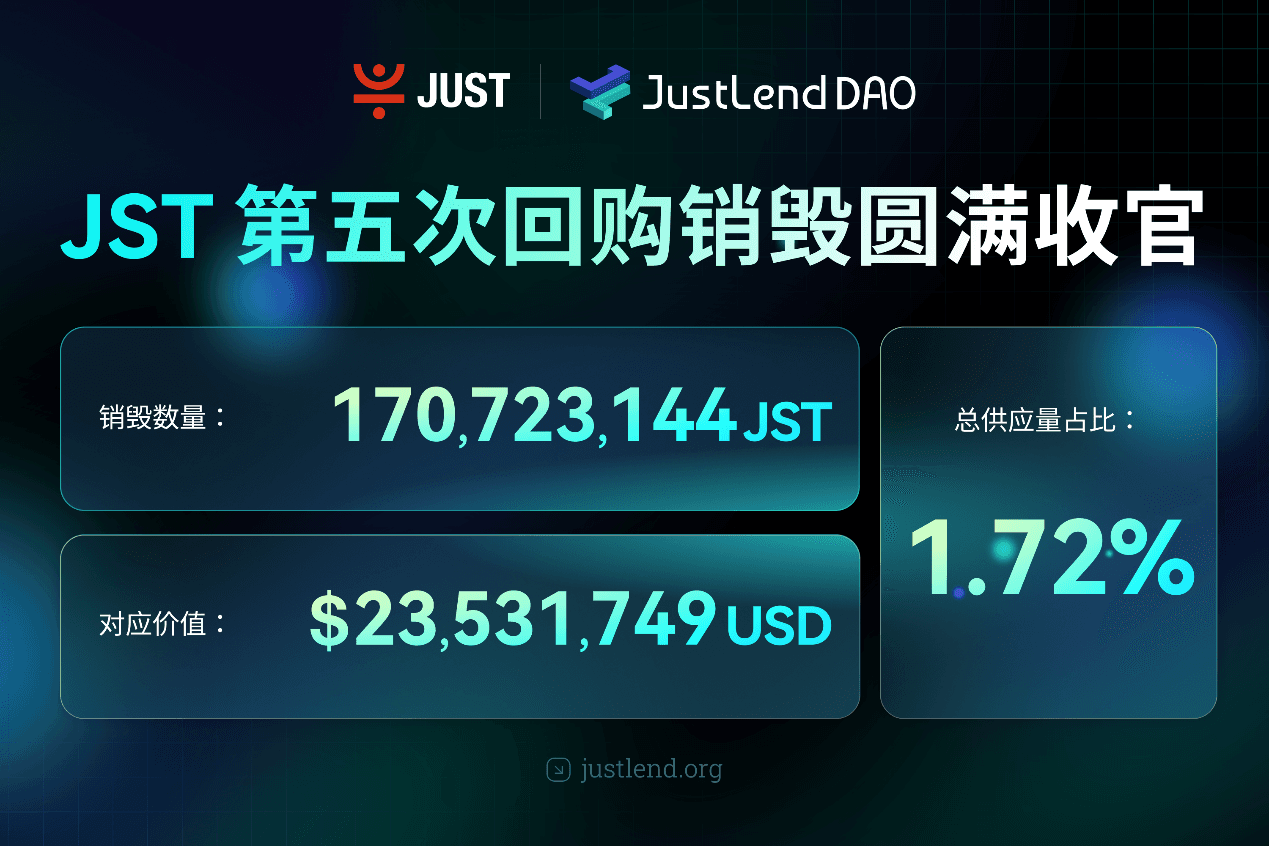
BitTorrent Brand Upgrade and Initial BTT Buyback & Burn Launch Simultaneously, Dual Engines Usher in New Era of Web3 Infrastructure
Oct 17, 20:00
Asia Market Daily: Japan's BOJ signals more rate hikes while Korea targets offshore perpetual platforms (2026/10/17)
Oct 17, 17:01Why did Papertrade backfire on you?
Oct 17, 17:01
The 'Strict Father' of Northern Myanmar: This Company Deploys 200,000 "AI Best Actors" to Strike Back Against Scammers
Oct 17, 15:34