Morgan Stanley Remains Bullish on Micron and Samsung, Q4 Storage Market Dynamics to Shift

TL;DR
·Morgan Stanley maintains an "Overweight" rating on SK Hynix and Samsung Electronics, with price targets of 2.6 million Korean Won and 381,000 Korean Won, respectively.
·Based on the stock prices used in the report, the two price targets represent potential upside of approximately 74% and 65%, but do not guarantee an increase in stock price.
·The report has revised the 2027 cloud capital expenditure growth rate forecast from 14% to 29%, with AI compute demand remaining a key structural support for the memory cycle.
·DRAM and NAND contract prices are still rising, but the sequential growth rate has eased from its peak; Morgan Stanley expects the industry to enter the later stage of the cycle in the fourth quarter of 2026.
·Long-term supply agreements can enhance order visibility, but cannot entirely eliminate cyclical fluctuations driven by price, demand, and incremental supply.
Morgan Stanley's Asian Tech report "Memory – A Small Wrinkle," released on August 6, continues to be optimistic about the Korean memory leaders, maintaining unchanged price targets for SK Hynix and Samsung Electronics. Specifically, the price target for SK Hynix is 2.6 million Korean Won, and the price target for Samsung Electronics common stock is 381,000 Korean Won. Based on the benchmark stock prices used in the report, they represent potential upside of about 74% and 65%, respectively.
Such high target upside does not mean that Morgan Stanley believes memory prices will continue to rise at the previous pace. On the contrary, the report has observed a narrowing of price increases, channel inventory recovery, and gradual entry of new capacity into the market, forecasting that the memory industry will enter the later stage of the cycle in the fourth quarter of 2026.
Morgan Stanley remains bullish, primarily relying on three clues: AI capital expenditure continues to rise, long-term supply agreements enhance earnings visibility, and the recent devaluation of memory stocks has already reflected some concerns about the cycle's peak.
Earnings forecasts also reflect this caution. Morgan Stanley has raised SK Hynix's expected EPS for 2026 by 13%, but the main reason is the inclusion of a one-time investment income of 63.27 trillion Korean Won in the second quarter; meanwhile, its 2026 operating profit forecast has been reduced by 7%. Samsung Electronics' 2026 EPS forecast has been cut by 10%, mainly reflecting weakness in consumer businesses such as smartphones.
The adjustments to the earnings forecasts for the two companies for 2027 to 2028 are relatively modest. According to the revised forecasts in the report, SK Hynix's EPS is expected to grow by around 25% in 2027, and Samsung Electronics is expected to grow by about 49%, roughly in line with the report's mentioned range of 25% to 50%.
During the previous round of the memory boom, the most direct driving force came from product price increases. AI server demand pushed up the demand for HBM, server DRAM, and enterprise SSDs, while capacity expansion temporarily lagged behind, leading to a sharp rise in DRAM and NAND prices.
Morgan Stanley cited TrendForce data, stating that the overall contract prices of DRAM and NAND had reached a peak increase of 96% and 88% respectively in the first quarter of 2026. It is expected that in the second quarter, they will continue to rise by 61% and 58% respectively. However, the forecast for the third quarter is expected to drop to 16% and 13%, and further decline to 6% and 3% in the fourth quarter.
The latest channel survey in the report shows that early transactions of DRAM contract prices in the third quarter increased by about 15% month-on-month, slightly lower than the previous expectation of 20%; while NAND contract prices increased by about 20%. The third-quarter contract price of PC DRAM is expected to rise by 15% to 20% compared to the second quarter, showing a significant narrowing from the 45% to 50% increase in the second quarter.
Therefore, a more accurate statement would be that the "memory prices have not yet peaked," but rather are still rising, albeit at a slower pace. Morgan Stanley predicts that by the fourth quarter of 2026, the industry will gradually transition to the late stage of the cycle. At that time, the operational leverage brought by prices will weaken, and the difficulty of achieving profits beyond expectations will increase.
It is important to note that the narrowing of price increases is not necessarily entirely due to supply improvements. The report points out that the slowdown in price hikes for some consumer-grade DRAM is because buyers are approaching their cost tolerance limit; meanwhile, demand from AI-related customers remains strong, and suppliers are still transitioning some consumer-grade capacity to enterprise SSDs and other products.
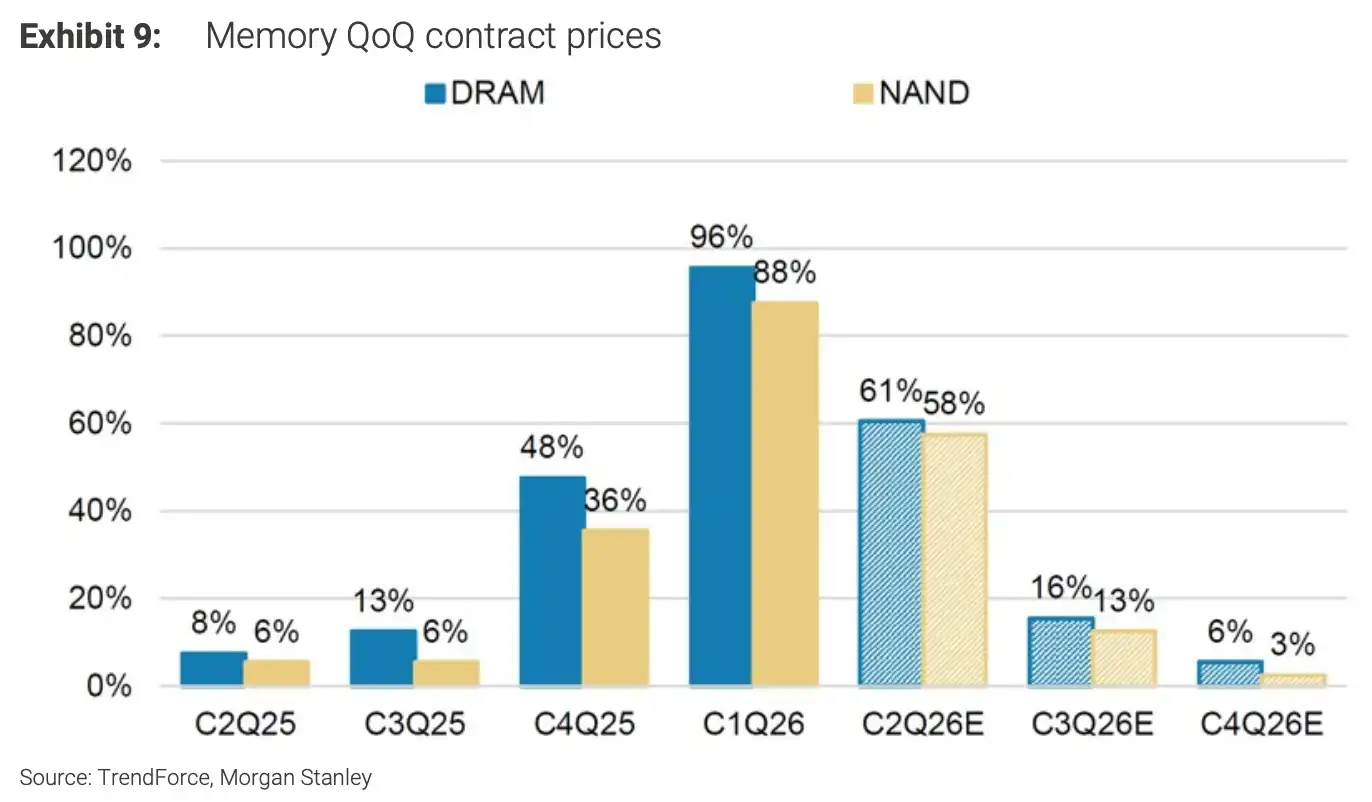
Memory contract price changes. The quarter-on-quarter price increase of DRAM and NAND contracts has gradually declined from its peak.AI Computing Power Still in Short Supply, Cloud Capex Continues to Rise
The first key theme supporting Morgan Stanley's continued bullish view is that the AI data center's computing power demand has not yet been fully met.
The report cites financial reports and management statements from four major U.S. cloud providers, stating that Alphabet and Microsoft's cloud computing demand still exceeds internal available capacity; Amazon expects that its capacity will remain insufficient to meet demand in 2026, with a significant portion of capacity already booked for 2027; Meta expects the industry's computing power supply to remain tight in the foreseeable future.
While this information does not prove that all AI investments will ultimately receive the expected returns, it at least indicates that major cloud providers have not significantly scaled back their infrastructure development. Therefore, Morgan Stanley's cloud capital expenditure tracking model has increased its year-on-year growth rate forecast for 2027 from 14% a month ago to 29%.
This is crucial for memory manufacturers. In addition to GPUs, AI servers also require HBM, server DRAM, and enterprise-grade SSDs. As long as cloud providers continue to expand their data centers, memory demand will not be solely determined by the traditional consumer electronics cycle such as PCs and smartphones.
However, "structural AI demand" and "cyclical price adjustments" can coexist. Morgan Stanley's core assessment is that AI demand may prolong the profit cycle for memory companies, but it will not make memory prices and inventory cycles completely disappear.
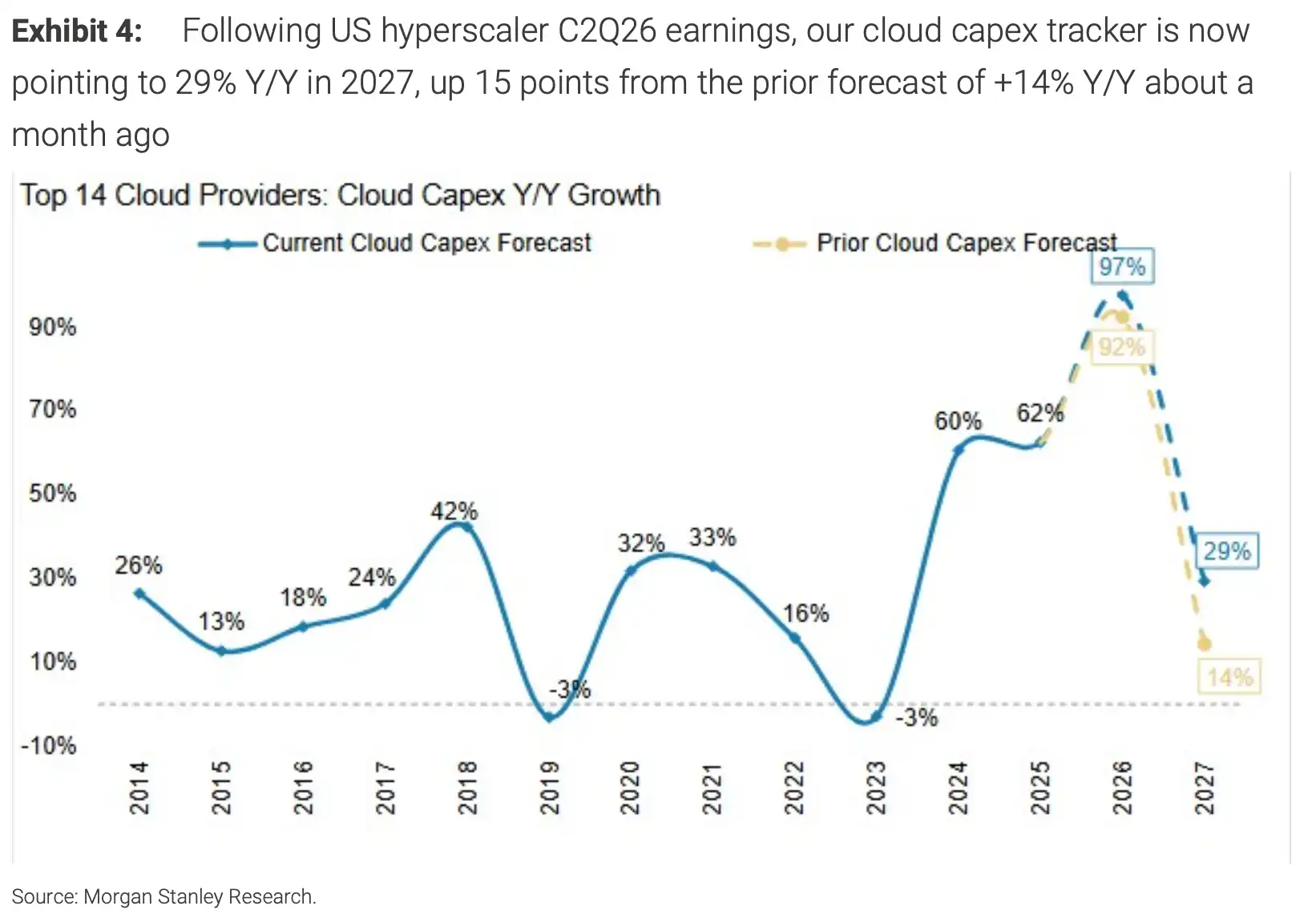
Cloud provider capital expenditure growth rate forecast. The graph shows that the 2027 cloud capital expenditure growth rate forecast has been revised up from 14% to 29%.LTAs Enhance Order Visibility but Cannot Completely Lock In Future Profits
The second pillar comes from long-term supply agreements, known as LTAs (Long-Term Agreements). Compared to traditional quarterly purchases, multi-year contracts can help suppliers confirm part of the demand in advance and use this information to plan capacity and capital expenditures.
SK hynix Official Q2 2026 Business Results Announcement indicates that the company has completed LTAs with approximately 10 key customers and is continuing negotiations with other customers. Morgan Stanley further relayed from the company's conference call that these agreements typically last about five years, but the terms and pricing mechanisms vary depending on the customer and product; some agreements include deposits, and prices are adjusted with market fluctuations.
SK hynix did not disclose the specific proportion of capacity or revenue covered by LTAs, stating only that it would keep the agreements at an "appropriate level," enhancing downside protection while retaining capacity for additional demand. Therefore, it is not appropriate to describe their LTAs as having already locked in a significant portion of future revenue.
The specific terms for Samsung Electronics mainly come from Morgan Stanley's summary of its second-quarter conference call. According to the report, Samsung plans to include 60% to 70% of its capacity in long-term agreements, has reached agreements with five global large data center customers, and has five others in the final negotiation stage. The agreements follow a rolling five-year structure, require customers to make prepayments, and set price floors for some mainstream products.
Potential customers listed in the research report such as AWS, Microsoft, Google, Meta, and Oracle are also clearly marked as media-reported and should not be written as confirmed transaction counterparts by Samsung.
The primary purpose of LTAs is to increase demand visibility, support capacity investments, and mitigate some price volatility, rather than fully lock in future profits. Contracts vary in terms of covered capacity, duration, price adjustment mechanisms, and default protection; if AI deployment slows down, product specifications change, or market prices experience significant adjustments, the protection provided by the agreements still has limits.
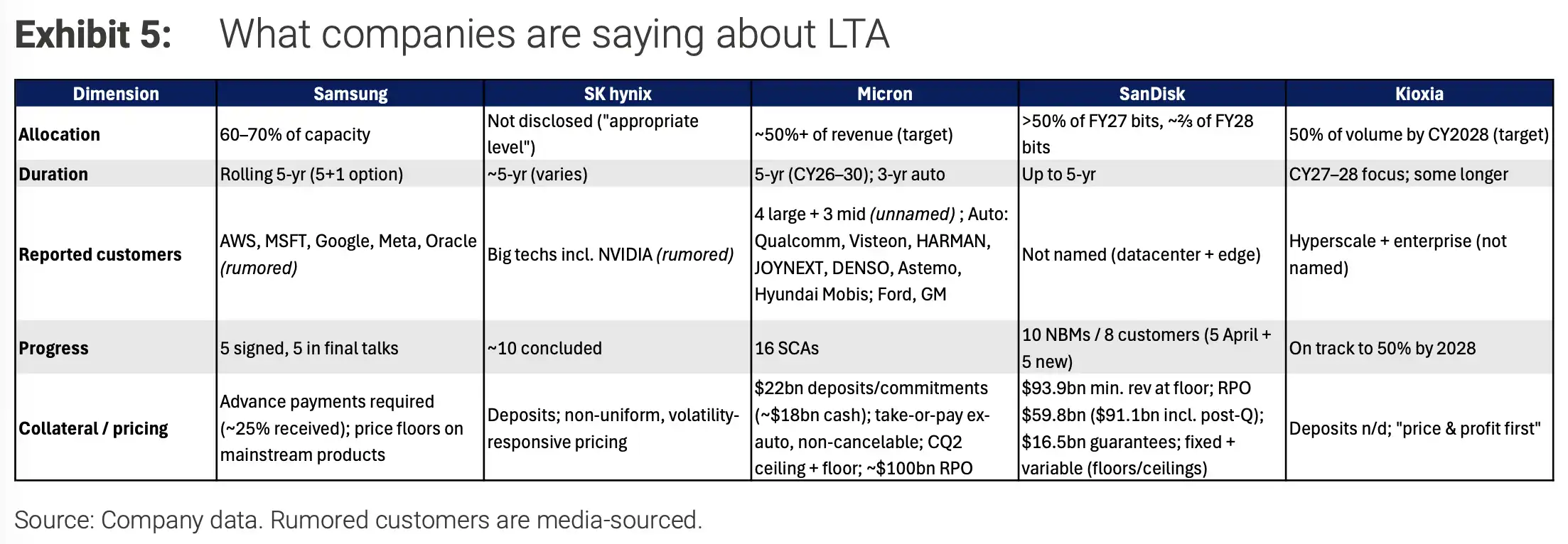
Key Memory Manufacturer LTAs Comparison. The chart compares the long-term agreement coverage, duration, and pricing arrangements of Samsung, SK Hynix, Micron, SanDisk, and Kioxia.
The market has started pricing in the slowdown of memory profit growth in advance. Morgan Stanley points out that the forward 12-month P/E ratio of DRAM-related stocks usually leads forward 12-month EPS by about two months, and recent valuations have significantly declined, reflecting investors pricing in the declining earnings growth.
This also explains why memory companies' earnings are currently strong, but stock prices may not necessarily continue to rise in tandem. Investors' focus is shifting from the existing profits in 2026 to the sustainability of 2027 and 2028: whether AI capital expenditure can continue to grow, whether LTAs can withstand a downturn, and whether prices can hold up after new capacity comes online.
High profits themselves also attract supply. Morgan Stanley points out that the current DRAM gross margin is close to 90%, historically at an unusually high level. If high returns stimulate leading manufacturers to accelerate capacity expansion or attract new entrants, the existing profit margin may revert to the long-term average.
A distinction needs to be made here: close to 90% is the reported DRAM gross margin discussed, while SK Hynix's 76% in Q2 2026 is the company's overall operating profit margin, which cannot be directly compared. SK Hynix officially disclosed that its Q2 2026 revenue was 79.3187 trillion Korean won, operating profit was 60.5426 trillion Korean won, and operating profit margin was 76%.
Chinese manufacturers' capacity expansion is also cited as a long-term risk. The report states that YMTC and CXMT's new supply may reduce the scarcity of some products; among them, YMTC's plans include supplying HBM in the Chinese market as early as 2027. This is Morgan Stanley's description of the company's roadmap, not an indication that Chinese HBM has already achieved mass production or can immediately replace Korean high-end products.
Furthermore, the report anticipates that major manufacturers will still have new capacity coming online from 2027 to 2028. If AI demand continues to grow rapidly, this additional supply may not immediately lead to oversupply; however, once cloud providers' capital expenditure slows down, the release of supply could accelerate price declines.
Therefore, the key assumption behind the ₩2.6 million target price is not an indefinite increase in memory prices, but rather the AI demand being able to extend the profit cycle, LTA reducing volatility, and the recent valuation pullback already factoring in a significant portion of the cyclical risk. What truly needs to be validated next is whether these long-term contracts can withstand a price downturn cycle once, and whether memory companies can still find new EPS growth drivers post-2028.
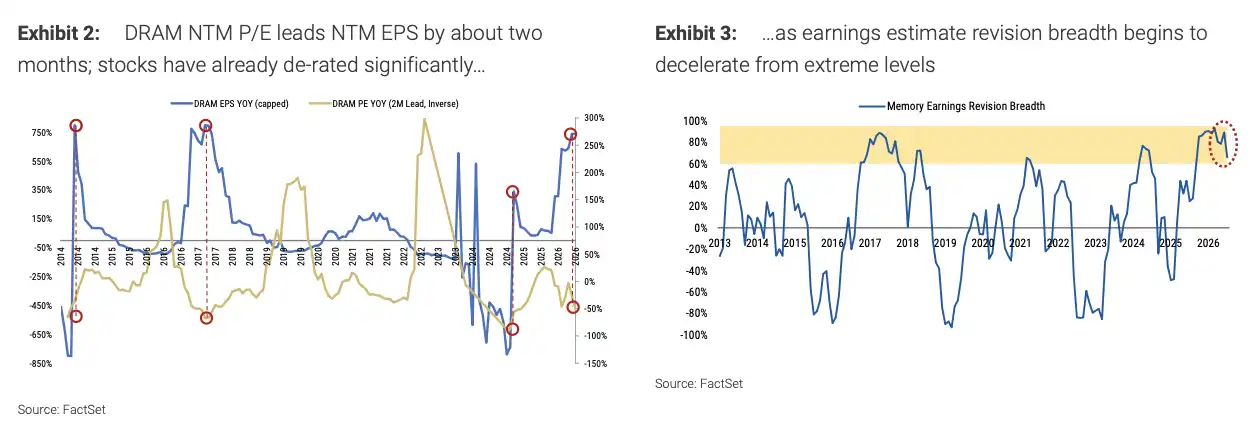
DRAM Valuation and Earnings Outlook. This chart reflects that valuation typically changes ahead of earnings expectations and should not be interpreted as a stable, mechanistic cause-and-effect relationship between the two.
Recommended
Desk: Brent Crude Tops $110, Musk's Net Worth Drops 528.6 Billion in Four Days After Tesla Roadster Launch
Oct 17, 21:49
JST Fifth Buyback and Burn Successfully Concludes: Over 170 Million Tokens Worth Approximately $23.53 Million Burned, Buyback Mechanism Set for Comprehensive Upgrade
Oct 17, 20:10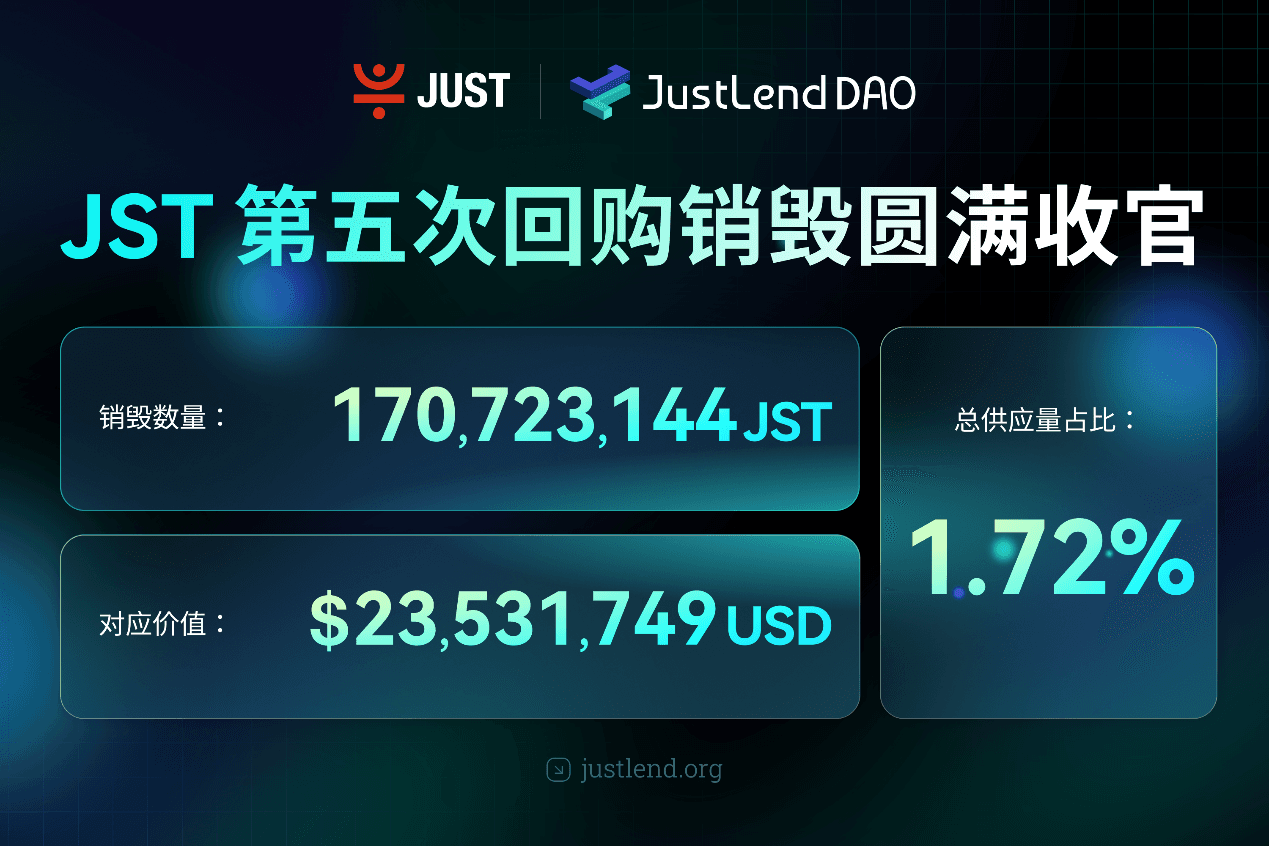
BitTorrent Brand Upgrade and Initial BTT Buyback & Burn Launch Simultaneously, Dual Engines Usher in New Era of Web3 Infrastructure
Oct 17, 20:00
Asia Market Daily: Japan's BOJ signals more rate hikes while Korea targets offshore perpetual platforms (2026/10/17)
Oct 17, 17:01Why did Papertrade backfire on you?
Oct 17, 17:01
The 'Strict Father' of Northern Myanmar: This Company Deploys 200,000 "AI Best Actors" to Strike Back Against Scammers
Oct 17, 15:34