Goldman Sachs Provides Ten Signals to Determine Where China's AI Sentiment Stands

TL;DR
· Goldman Sachs outlined ten signals to assess the progress of the Chinese AI deep tech correction from various dimensions such as price, valuation, leverage, investor positioning, policy, and fundamentals.
· Style reversal, retail investor cooling, increased buybacks, and the shift of the "National Team" to net buying indicate that some overheated sentiment has been released.
· However, A-share technology trading volume, financing, and institutional positioning remain highly concentrated, the momentum of AI deep tech profit forecast upgrades has also started to slow down, and a correction does not directly equate to a bottoming out.
After experiencing a rapid rise in the first half of the year, Chinese AI deep tech is now undergoing a round of emotional reassessment.
According to a China strategy report released by Goldman Sachs on August 9, in its defined Chinese AI stock universe, AI deep tech stocks saw an average 33% increase in the first half of the year. As global AI hardware transactions reversed, the Sci-Tech Innovation Board, the Growth Enterprise Market Index, and the CSI 1000 have retraced more than 20% from recent highs.
The question is whether this pullback is merely a short-term profit-taking or if it signifies a deeper transformation in AI trading.
Goldman Sachs did not just look at index declines but assessed the sentiment and correction cycle of Chinese AI deep tech from ten dimensions including return differentiation, market concentration, valuation, leverage, retail sentiment, institutional positioning, listed company behavior, policy, "National Team" funds, and profit forecasts.
The ten signals collectively point to a not-so-extreme answer: a significant portion of the previously accumulated speculative positions, overvalued assets, and leverage has been unwound. However, concentration risk in some positions still exists, and the momentum of fundamental upgrades is slowing down. The most crowded phase of the market may be over, but it is still premature to confirm that the adjustment is fully complete.
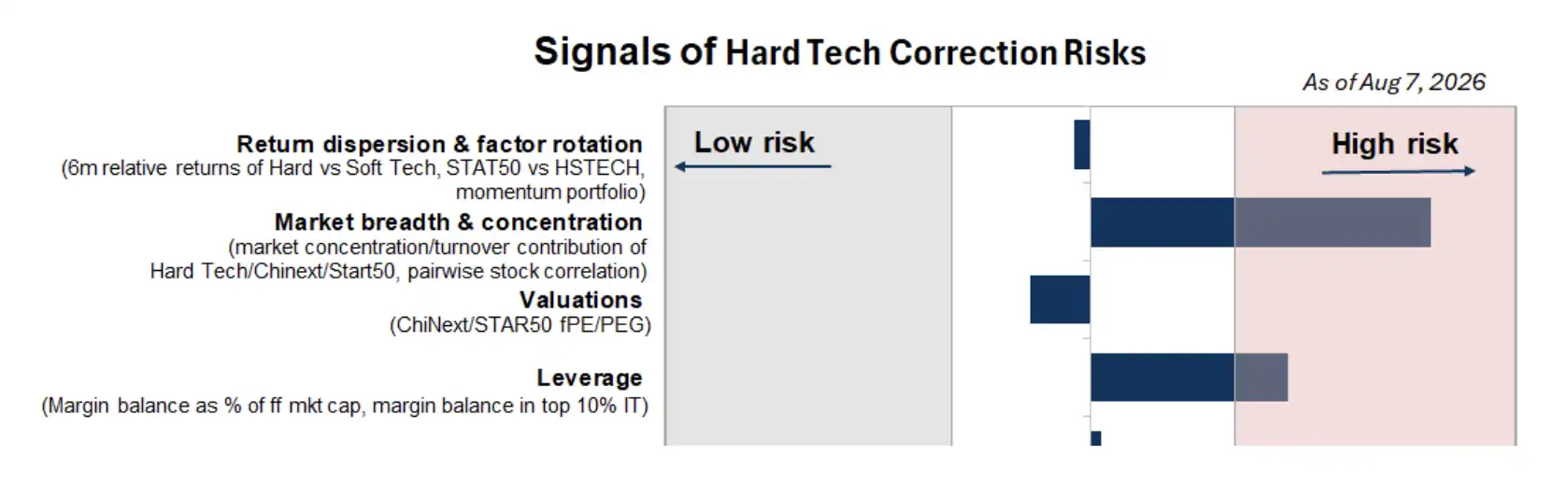
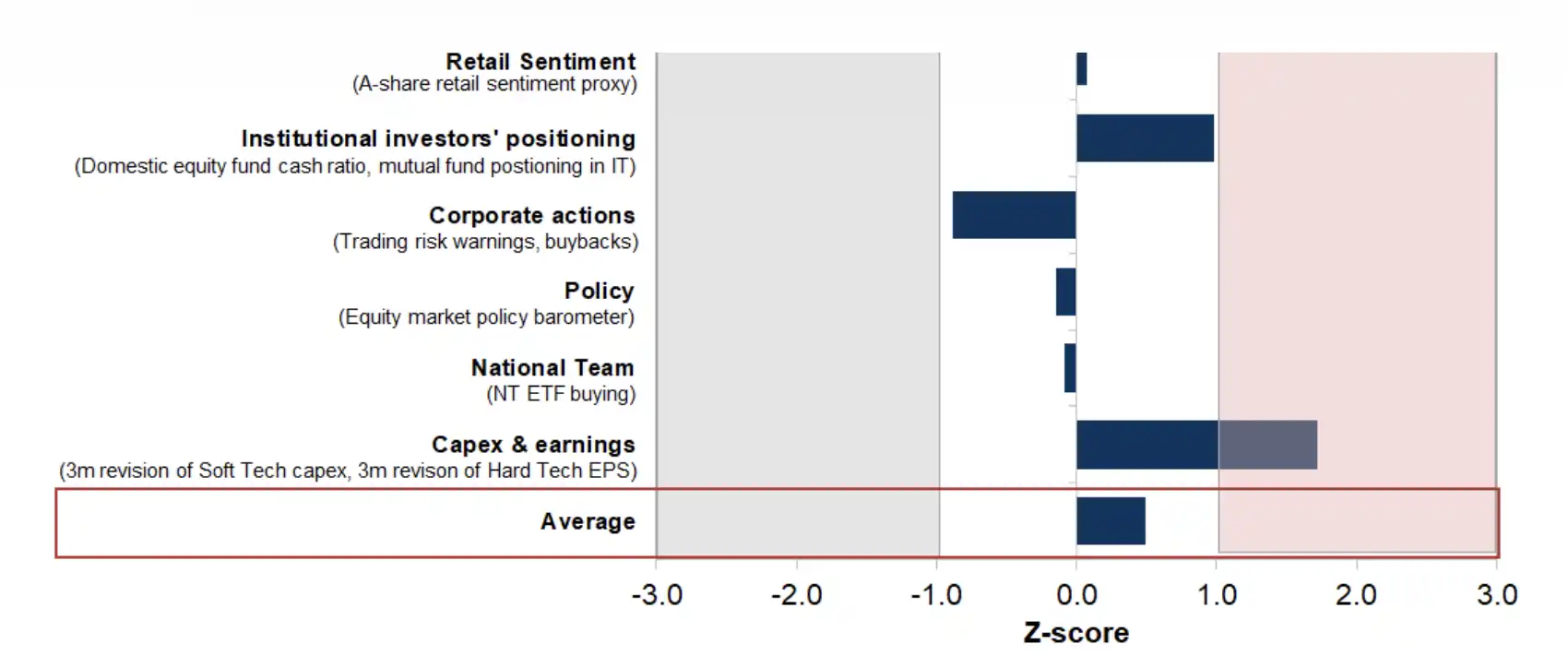
Goldman Sachs' summary of the ten indicators shows that the market breadth and concentration risk of Chinese AI deep tech are most pronounced, while leverage, institutional positioning, and profit revisions are still in elevated ranges; valuation, retail sentiment, corporate behavior, and policy signals have notably cooled down. Data as of August 7, 2026.
Signal One: Rapid Narrowing of Returns Gap Between Software and Hardware Technology
In the first half of the year, the most significant feature of Chinese AI trading was not the universal rise of all AI assets but the high concentration of funds in deep tech.
Goldman Sachs data shows that in the first half of this year, the performance gap between the Sci-Tech Innovation Board and the Hang Seng Tech Index exceeded 100 percentage points at one point, reminiscent of the high levels seen during the market dispersion surge in early 2021. Small-cap, high-growth, and momentum styles also became the primary drivers of the market at that time.
After entering July, these trends quickly reversed. With the global AI hardware transaction cooling down, the excess returns of hard technology, small-cap, and momentum factors saw a significant pullback, and the performance gap between soft technology and hard technology has returned to near long-term average levels.
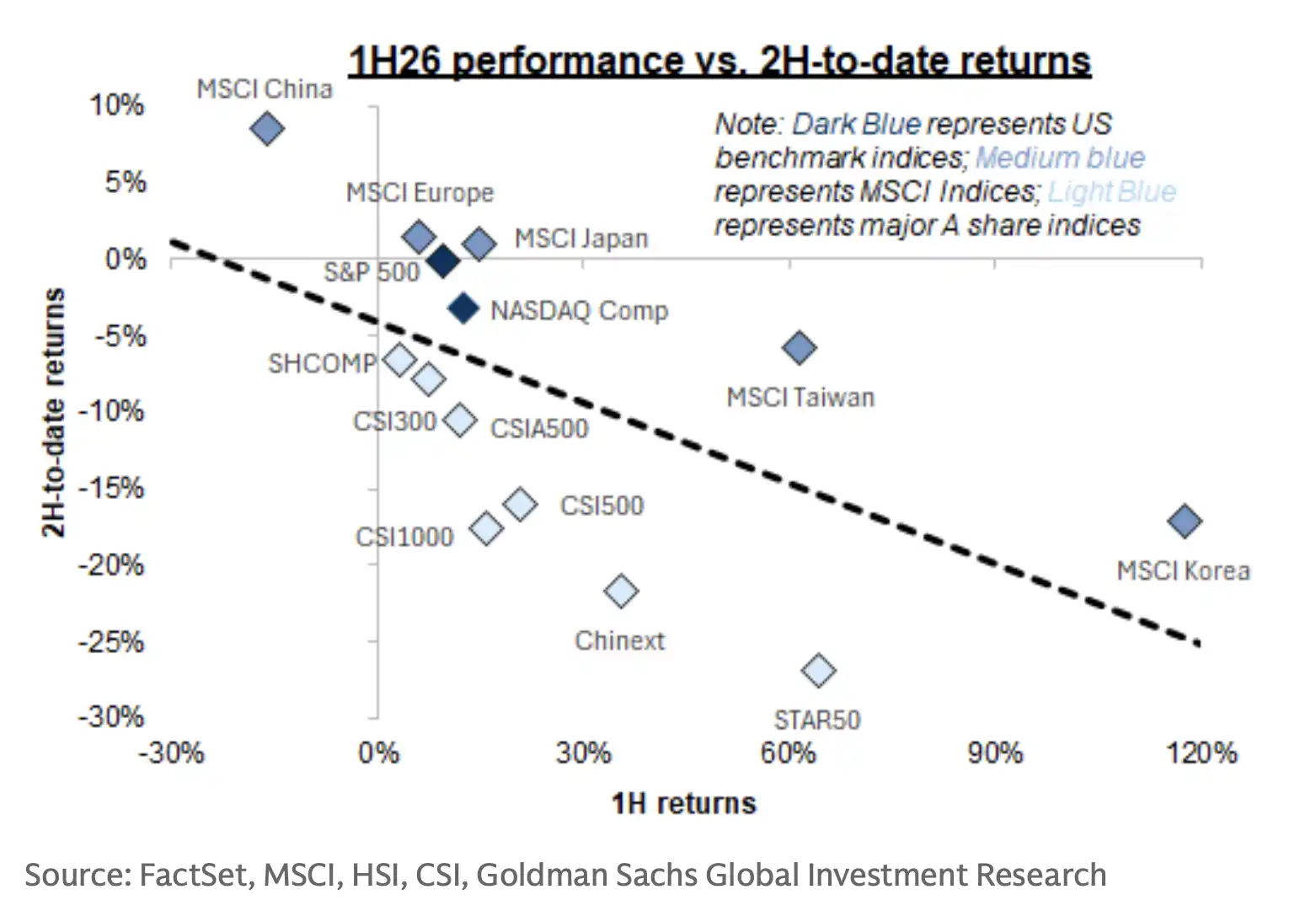
Previous leaders have now given back most of their first-half gains since July.
The adjustment in momentum and size factors has even entered a more extreme range. Goldman Sachs believes that based on price momentum, the rapid pullback and style rotation may be starting to ease.
This signal leans towards the positive side: the direction with the largest early gains and most crowded positions has already significantly cooled down. However, a slowdown in price declines does not mean that the relevant stocks have completed their sell-off.
Signal Two: The gains of the ChiNext 50 are still driven by a few stocks
The second signal comes from market breadth.
Goldman Sachs calculates that 90% of the ChiNext 50's gains since the beginning of the year have been contributed by the top 10 best-performing stocks. For comparison, this ratio was 23% at the beginning of 2021 and 46% in mid-2015 for the ChiNext Index.
Trading volume is also becoming concentrated towards a few. Currently, the technology sector, ChiNext Index, and ChiNext 50 account for 26%, 14%, and 6% of A-share cash turnover, respectively, all at relatively high levels in recent years.
At the same time, the correlation between individual stock returns in A-shares remains at near-low levels in recent years. Low correlation means that the market is not primarily trading in a broad-based manner around macro factors but is continuing to chase a few micro themes such as AI and technology.
This indicates that although the prices of hard technology stocks have retraced, AI remains the most important pricing cue in the market, and returns and turnover have not truly diversified. While sentiment has cooled, the trading structure remains concentrated.
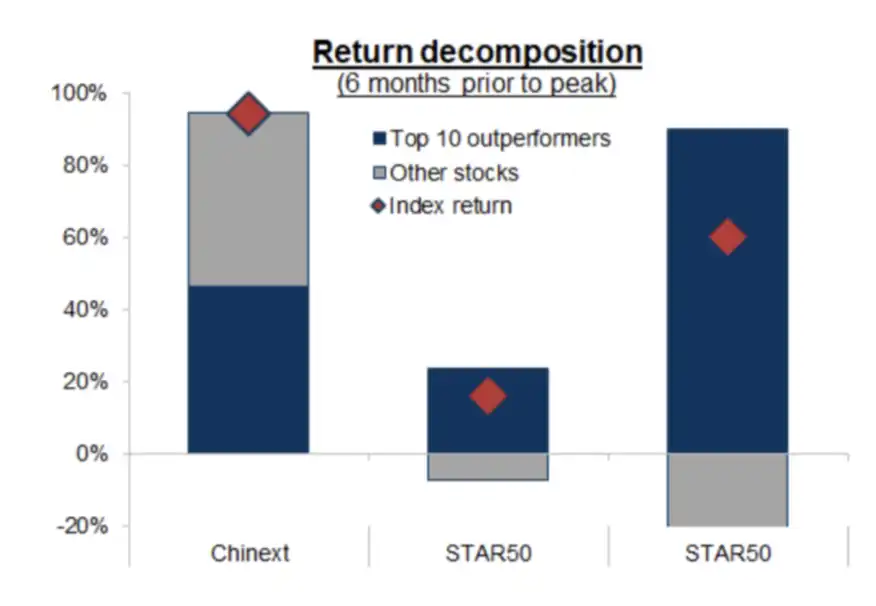
Approximately 90% of the ChiNext 50's gains since the beginning of the year have been contributed by the top 10 best-performing stocks, significantly higher than the 23% at the beginning of 2021 and 46% in mid-2015 for the ChiNext Index. The dominance of a few stocks in driving index gains indicates that the market breadth of AI hard technology trading remains inadequate.
Signal Three: Valuations have returned to the mean, but absolute prices remain elevated
Valuation is the third signal to judge whether sentiment has been fully unleashed.
At the June high, the ChiNext Index's forward P/E ratio, calculated by market capitalization, was around 26 times, while the median forward P/E ratio of the ChiNext 50 constituents was around 50 times. Following the subsequent price decline, the valuation multiples of A-share high-tech companies have dropped to near or below long-term average levels.
Considering earnings growth, the forward PEG ratio of these companies is also at a historical median or lower level. This implies that, purely from the perspective of valuation relative to their historical positions, some overheating has been digested.
However, the absolute valuation of the ChiNext 50 remains high. After a global adjustment in the AI sector, the valuation discount of Chinese AI concept stocks relative to their overseas peers has significantly narrowed, reducing the previous safety margin of "Chinese assets being cheaper for the same AI."
Therefore, the valuation signal is not indicating "already cheap" but rather "the most expensive time may have passed." The market will increasingly depend on earnings realization next, rather than relying solely on valuation expansion.
Signal 4: Financing Balance Declines, Yet Leverage Concentration Hits a New High
The financing balance is the most direct indicator to observe A-share margin trading.
According to Goldman Sachs data, the A-share financing balance has decreased from about 30 trillion yuan to about 26 trillion yuan, with the proportion of free float market value dropping from 6.0% to 5.5%. This indicates that some leveraged funds have exited.
However, both the financing balance and the financing ratio are still higher than historical norms. Goldman Sachs believes that if deleveraging continues, compared to the recent more pronounced deleveraging in the South Korean and Taiwanese markets, the deleveraging cycle in A-shares may still be in an earlier stage.
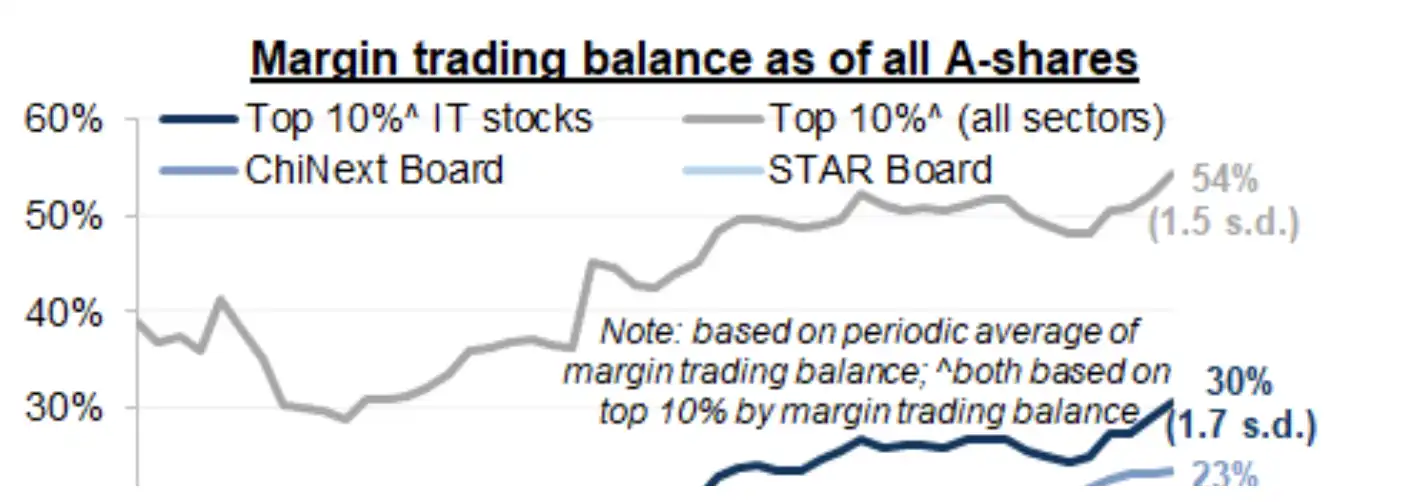
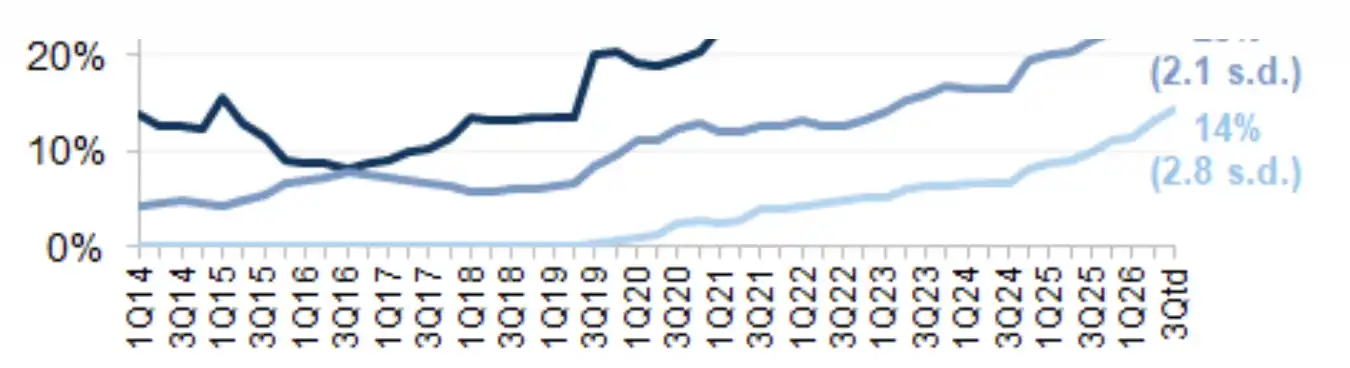
Although the A-share financing balance has retreated from its peak, leverage remains concentrated in the technology sector. According to Goldman Sachs' estimates, the top 10% of stocks with the highest financing balance account for approximately 30% of the total market financing balance, reaching a historical high, which could amplify local fluctuations further if high-tech stocks continue to decline.
It is even more important to note the distribution of leverage. As per Goldman Sachs' calculations, the top 10% of stocks with the highest financing balance currently account for about 30% of the total A-share financing balance, setting a new historical high, mainly concentrated in the AI high-tech sector.
This suggests that the overall market's leverage risk may be significantly lower than in 2015, but there is still structural pressure within the AI high-tech sector. If relevant stocks continue to decline, the concentrated financing positions may still magnify volatility.
Signal 5: Retail Investor Risk Appetite Cools from Overheated to Neutral
Goldman Sachs's fifth signal comes from retail investor sentiment.
Despite the increasing share of domestic public funds, pension funds, and insurance funds, retail investors still account for about 70% of the daily average trading volume of A-shares. Therefore, changes in retail investor sentiment will still directly affect short-term market volatility.
Goldman Sachs's retail investor sentiment index covers high-frequency indicators such as margin financing data, new account openings, IPO subscriptions, turnover rate, and stock allocation. The index has now dropped from being about 1 standard deviation above the one-year average a month ago to around 0 standard deviation.
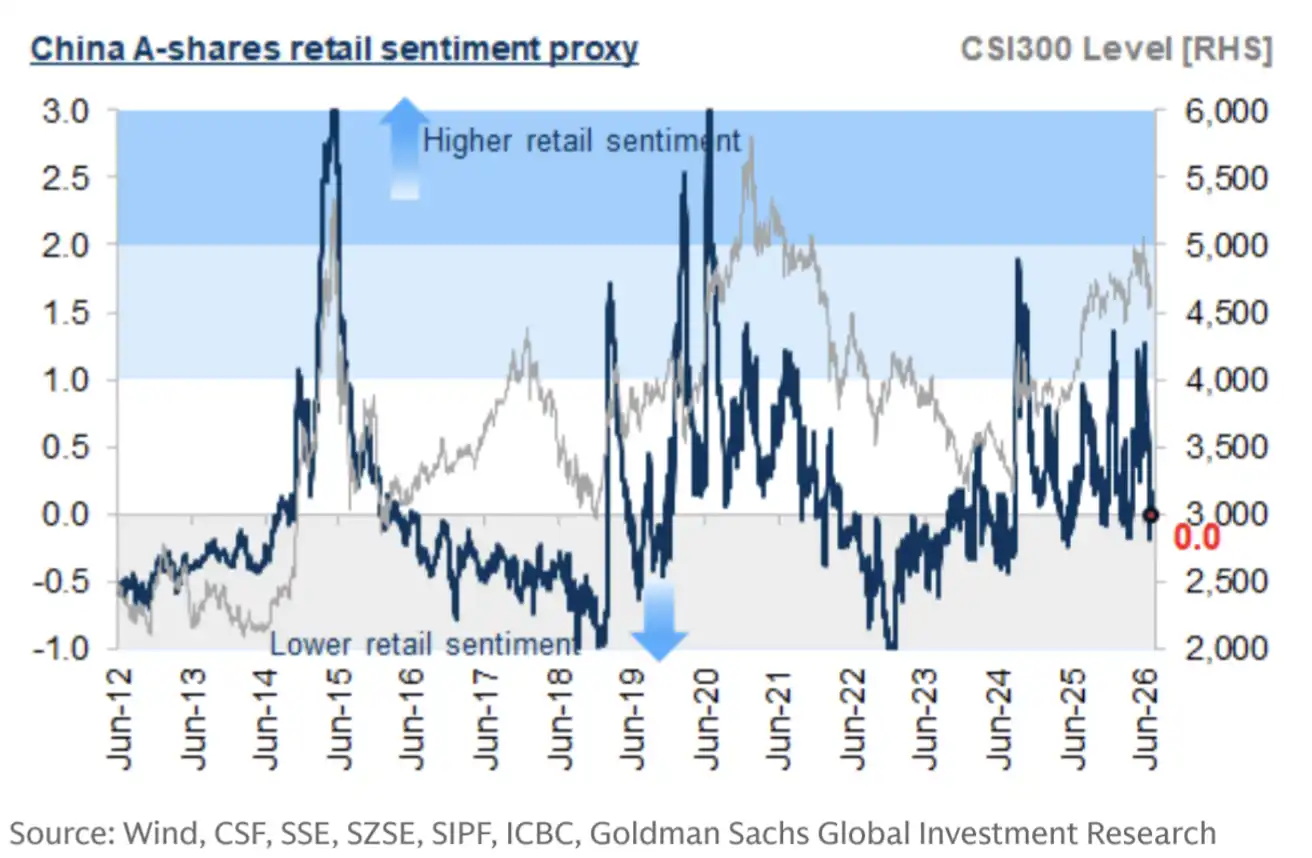
Goldman Sachs's A-share retail investor sentiment index has dropped from about 1 standard deviation above the average a month ago to around 0 standard deviation, indicating that the FOMO sentiment has rapidly faded. However, the current risk appetite has only returned to neutral to slightly subdued levels, and has not entered the extremely pessimistic range.
This means that A-share retail investor risk appetite has retreated from an overheated state to neutral or even slightly subdued.
The rapid cooling of retail investor sentiment is evidence that some speculative pressure has been released in this round of correction. However, 0 standard deviation does not represent extreme pessimism, nor is it a traditional "panic bottom." It only indicates that the FOMO heat has dissipated, but it does not prove that the market has completed the final round of sell-off.
Signal 6: Mutual Funds Slightly Reduce Positions, Tech Allocation Remains at Historical Highs
Institutional investors' behavior is more complex than that of retail investors.
Goldman Sachs data shows that the scale of domestic mutual fund management has reached nearly 40 trillion yuan, of which about 7 trillion yuan is allocated to stocks, accounting for 6.6% of A-share total market capitalization and 15% of free float market capitalization.
During the market correction, the cash ratio of equity mutual funds has increased slightly, indicating that fund managers have moderately reduced risk. However, their allocation and over-allocation to tech stocks such as semiconductors, hardware, and software remain at historical highs.
The risk reduction of systematic strategies may be more pronounced. The cash turnover and financing spread of small and medium-cap stocks have decreased, indicating that the activity of systematic investors such as quant funds has weakened, possibly undergoing a deeper deleveraging.
There is a clear differentiation within this signal: quant and short-term funds have already contracted, but traditional institutions have not significantly loosened their core positions in tech stocks. As long as institutional allocation remains high, AI hard tech is unlikely to be defined as a completely de-crowded trade.
Signal Seven: Increase in Buybacks, Decrease in Abnormal Trading Alerts
The behavior of listed companies often reflects insiders' judgment of valuation and risk more than market slogans.
Goldman Sachs observes corporate behavior from the angles of buybacks, trading alerts, and significant shareholder transactions. Calculated on a quarterly basis, A-share buybacks in the third quarter of 2026 have reached a multi-year high, with the announced number and amount of buyback transactions increasing by 35% and 59% year-on-year, respectively.
An increase in buybacks usually indicates that management believes the company's stock price is below intrinsic value, or at least is willing to invest cash at the current price to support shareholder returns.
Another change is that the stock price volatility warnings and trading risk alerts issued by listed companies increased significantly in June, just before the market correction, but have since dropped substantially. Significant shareholders and company executives' transactions have also shifted from net selling for most of the first half of the year to a more balanced state.
This set of signals overall tilts towards the positive: insiders' behavior is no longer inclined towards selling and signaling overheating in the late stages of an uptrend but is gradually shifting towards buybacks and reducing net selling.
Signal Eight: Policy Tightening Risk Retreats from Peak to Neutral
The sentiment cycle of the Chinese stock market is often influenced by policy changes.
The deleveraging in 2015 and the regulatory tightening that began at the end of 2020 have been important reasons for market reversals; conversely, explicit policy support has repeatedly driven strong rebounds in China's stock market.
Goldman Sachs uses a large language model to analyze public statements from regulatory agencies and policymakers, measuring the policy support and tightening risks faced by the stock market based on the frequency and intensity of the language used.
The model shows that policymakers' concerns about market overheating and the resulting risks of policy tightening reached a cyclical peak in the first quarter of 2026 and have since fallen back to a more neutral range.
This means that policies are currently neither a clear emotional booster nor a primary source of pressure for this round of adjustment. Compared to price, leverage, and earnings factors, policy signals are temporarily closer to neutral.
Signal Nine: National Team Shifts from Selling to Net Buying
The ninth signal comes from the National Team.
Goldman Sachs estimates that the broad "National Team" currently holds around 5 trillion yuan in A-share assets, equivalent to 5% of the total A-share market value. Historically, these funds usually counter-cyclically buy in times of market pressure and may sell into strength when the market rises and valuation attractiveness declines.
Goldman Sachs' tracking data shows that after the "national team" sold about 1.5 trillion yuan of A-shares in the previous 6 months, they have turned into net buyers in the past 3 weeks, purchasing over 140 billion yuan, including a small amount of CSI 50 ETF.
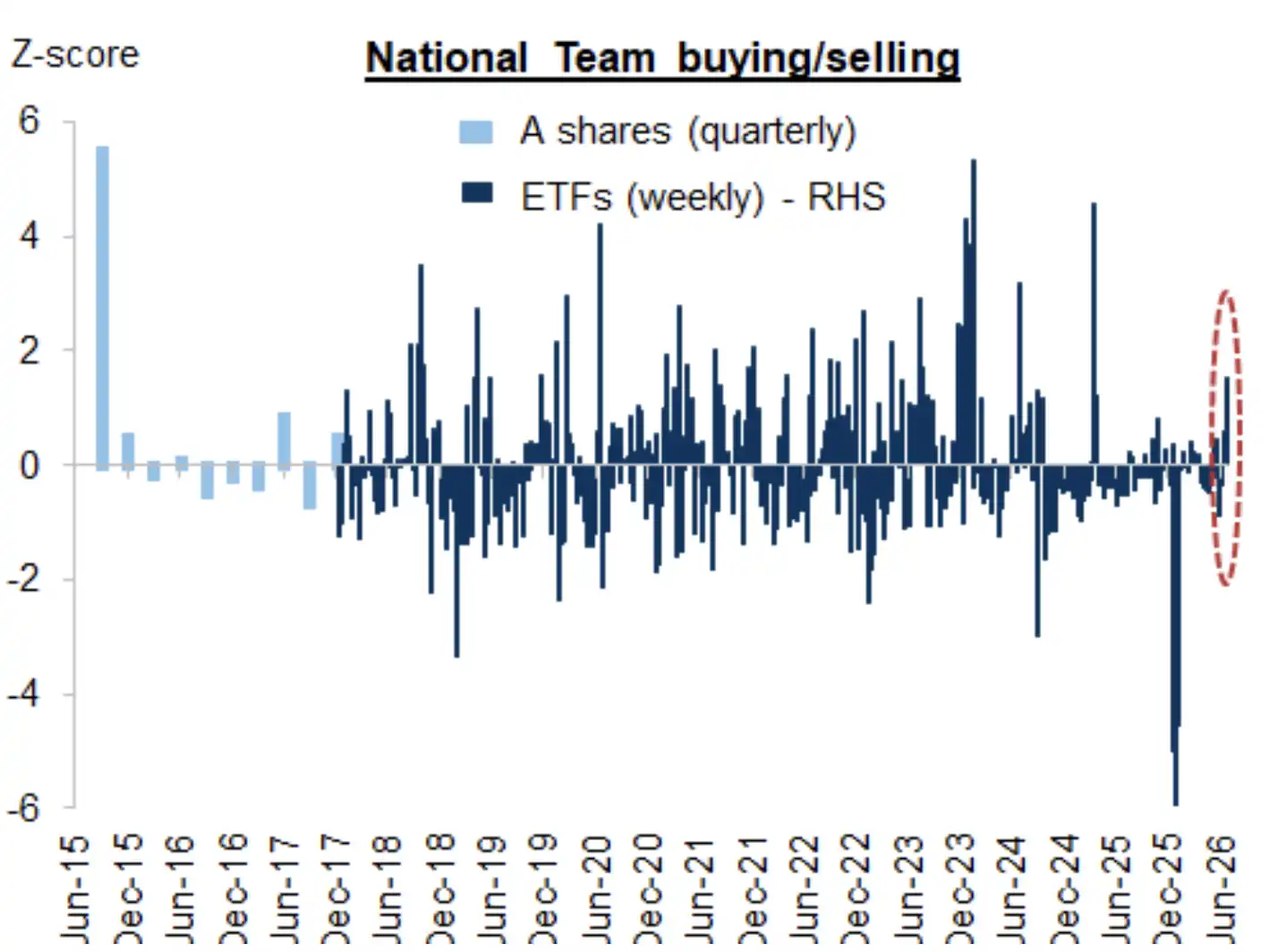
Goldman Sachs estimates that after selling about 1.5 trillion yuan of A-shares in the previous 6 months, the "national team" has turned into net buyers in the past 3 weeks, with net purchases exceeding 140 billion yuan, indicating a reemergence of market support. However, the report has not confirmed that the scale of this round of purchases has reached the historical threshold usually corresponding to a midterm bottom.
The shift of the "national team" from selling to buying indicates a change in the policy fund's perception of market risk, providing some downside support for the overall market.
However, this still does not directly confirm a midterm bottom. Goldman Sachs's historical backtesting shows that only when the "national team" weekly net buying scale exceeds 1.5 standard deviations, it is more likely to correspond to a midterm bottom in the market. The more definite conclusion at present is the reemergence of support rather than the market having unconditionally reached a bottom.
Signal Ten: Capital Expenditure Keeps Growing, but Marginal Change Is No Longer Accelerating
The final and most decisive signal determining how far the AI rally can go comes from capital expenditure and earnings forecasts.
Goldman Sachs expects that the AI spending by 9 major U.S. and Chinese hyperscale companies and cloud service providers could exceed $900 billion this year, further rising to $1.3 trillion next year, equivalent to 1.7% and 2.3% of the combined GDP of the U.S. and China, respectively.
These expenditures propagate along the global AI industry chain, covering South Korean storage chips, Taiwanese semiconductor foundries, Japanese semiconductor materials and equipment, as well as Chinese power, infrastructure, and technology companies.
Since the beginning of this year, the 2026 and 2027 capital expenditure forecasts for 8 listed mega-cap companies in the U.S. and China have been raised by 32% and 75%, respectively, driving a 12% and 22% upward revision in the 2026 and 2027 earnings forecasts for the Chinese hard technology sector.
This indicates that the rise in Chinese AI hard technology is not solely driven by sentiment and leverage but is indeed supported by capital expenditure and earnings growth.
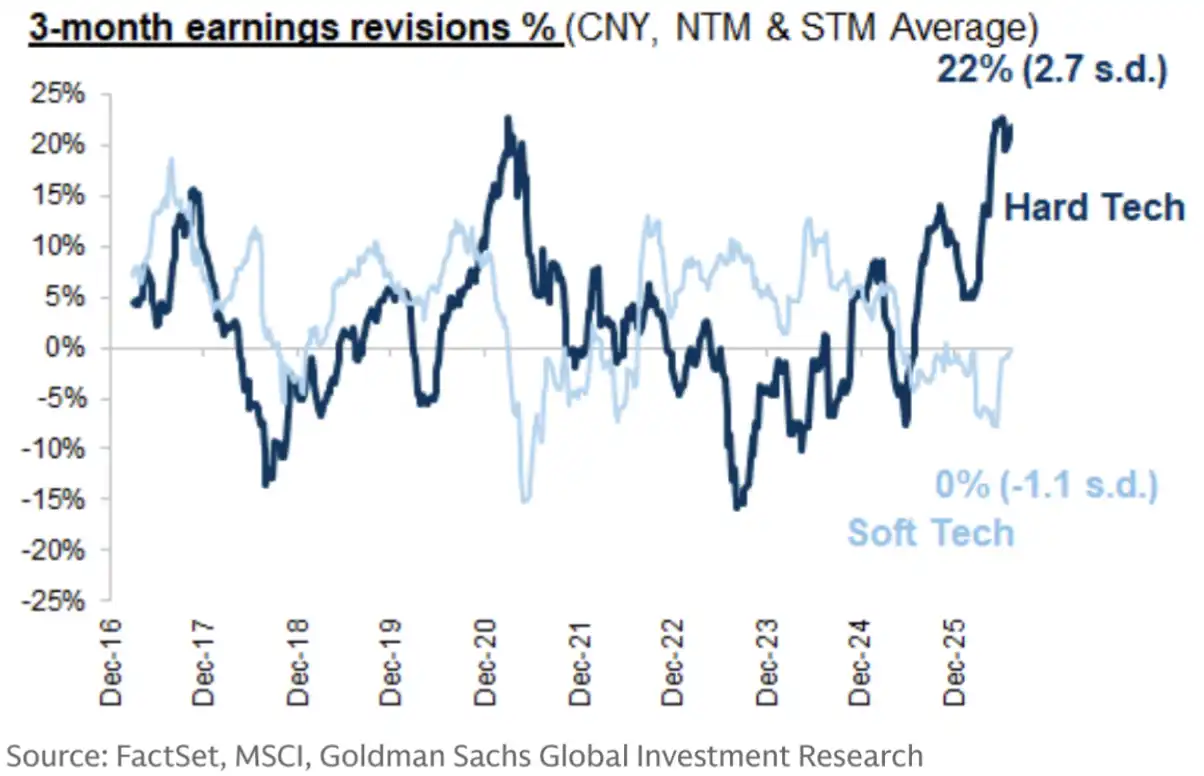
The upward revision in Chinese hard technology earnings forecasts is still significantly higher than that of soft technology, indicating that the AI rally is not entirely emotion-driven. However, Goldman Sachs believes that the earning upside momentum in hard technology may have peaked in the short term, while there is still cyclical improvement potential in the earnings revision for soft technology.
The issue lies in the fact that the upward revision pace of capital expenditure forecasts has slowed from its peak, and the momentum of profit forecast upgrades for Chinese hard-tech companies is showing signs of peaking at least in the short term. In contrast, there is still room for cyclical improvement in profit revision momentum for soft-tech.
Therefore, in the coming months, the key factors affecting AI sentiment will no longer be just how large capital expenditure is, but whether it can continue to exceed expectations, and whether cloud providers can provide a clearer AI monetization path.
Putting ten signals together, the current position of Chinese AI hard-tech is becoming clearer.
Positive-leaning signals include: the extreme earnings gap between hard-tech and soft-tech has narrowed, momentum and small-cap styles have undergone a rapid reversal, valuation has returned to near long-term averages, retail investor sentiment has fallen to neutral, public company buybacks have increased, significant shareholders' reduction has trended towards balance, and the "national team" has returned to net buying.
These changes indicate that a considerable amount of speculative positioning, overheated valuations, and leverage pressure accumulated in the first half of the year have been released.
However, cautious-leaning signals also exist: the absolute valuation of the ChiNext 50 index remains high, A-share technology trading and earnings concentration are at high levels, margin balance is still above historical norms, leverage concentration has hit new highs, and mutual fund allocation to tech stocks remains at historical highs.
The fundamentals lie somewhere in between. Global AI capital expenditure remains strong, hard-tech profit forecasts are being revised upward, but the momentum of capital expenditure and profit forecast upgrades has started to slow.
Therefore, Goldman Sachs still maintains an "overweight" rating on A-shares, with a long-term bullish view on AI hard-tech structurally, but short-term emphasis on rotation and diversified allocation. Their recommendations include gradually increasing allocation to selected Hong Kong-listed soft-tech stocks, policy beneficiaries, and domestically controllable directions, while focusing on profit upgrading stocks, IPOs, and cash returns from dividends and buybacks.
For investors, these ten signals do not simply indicate a "bottoming out of AI" or "the end of the AI trend," but rather a sentiment thermometer: the hottest period may have passed, the sharpest decline may have begun to slow, but concentration of positions and profit expectations still need to be digested further.
In the next phase, whether Chinese AI trading can heat up again will depend more on corporate earnings and AI monetization, rather than relying once again on valuation, leverage, and chasing sentiment.
Recommended
Desk: Brent Crude Tops $110, Musk's Net Worth Drops 528.6 Billion in Four Days After Tesla Roadster Launch
Oct 17, 21:49
JST Fifth Buyback and Burn Successfully Concludes: Over 170 Million Tokens Worth Approximately $23.53 Million Burned, Buyback Mechanism Set for Comprehensive Upgrade
Oct 17, 20:10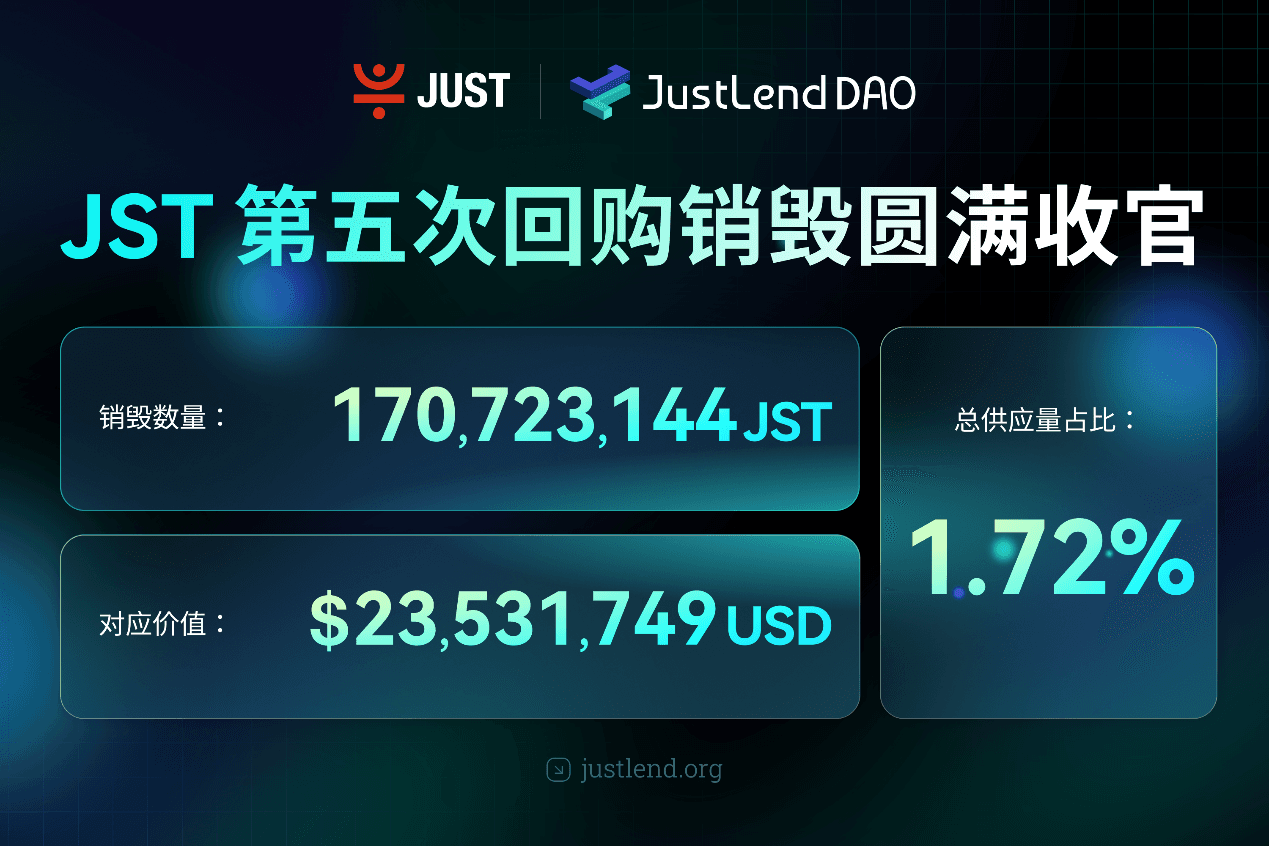
BitTorrent Brand Upgrade and Initial BTT Buyback & Burn Launch Simultaneously, Dual Engines Usher in New Era of Web3 Infrastructure
Oct 17, 20:00
Asia Market Daily: Japan's BOJ signals more rate hikes while Korea targets offshore perpetual platforms (2026/10/17)
Oct 17, 17:01Why did Papertrade backfire on you?
Oct 17, 17:01
The 'Strict Father' of Northern Myanmar: This Company Deploys 200,000 "AI Best Actors" to Strike Back Against Scammers
Oct 17, 15:34