How is Pump.fun killing meme coin trading?

Editor's note: In Q3 2026, 3.05 million Meme coins were issued on Pump.fun, with only 24 ever reaching a $10 million market cap. According to statistics from on-chain data research team Sparsity, Q4 2024 saw a similar issuance volume of 3.16 million, yet 207 reached the same market cap threshold. Issuance volume has returned to near the previous peak, but the number of coins per 100,000 issued that can rise to a $10 million market cap has dropped from about 6.5 to 0.8.
When the Meme coin market weakens, communities tend to point fingers at snipers, mass-issuance teams, and KOLs who pump and dump. Sparsity traced the problem one layer up to see where Pump.fun's revenue actually comes from. According to its statistics, about 95% of the platform's protocol revenue comes from coins still in the bonding curve phase or with a market cap below $250,000. The bonding curve is the pricing mechanism in a new coin's early issuance period, where buying and selling push the price up or down along preset rules. During this phase, every buy and sell incurs a 1.25% fee, of which 0.95% goes to the platform and 0.30% to the issuer. Even if the price stays flat, a buy-then-sell round costs about 2.5%. By coin age, about three-quarters of the platform's revenue comes from coins issued less than an hour ago.
This fee structure diverges the interests of the platform, issuers, and buyers. For the platform and issuers, a coin only needs someone buying and selling right after issuance to generate fees. For buyers, profitability still depends on someone later willing to take over at a higher price. Issuers can clone popular coins or launch dozens of coins at once, and as long as a few generate trading volume at open, there is revenue. Sparsity statistics show that the top 25 wallets by issuance volume collectively issued 761,000 coins, with fewer than 1% reaching the threshold to "graduate" from the bonding curve phase, yet these wallets cumulatively earned $128 million.
Pump incentives also amplified this divergence. Pump.fun once paid rewards based on the trading volume generated by pumps, and low-market-cap coins were more easily driven by concentrated buying. On October 10, the platform said it would factor whether copiers profit into reward criteria and reduce pump rewards for low-market-cap coins. But in the following three weeks, according to Sparsity statistics, among the top 20 pumpers by reward ranking, those mainly pushing low-market-cap coins saw their share of bonuses rise from 68% to 94%. Among 14 pumpers separately tracked by the author, the median price change of the pumped coins was up 6% one minute after posting, down 48% after one hour, and down 74% after one day. For each buyer, selling early makes sense. But when more and more people rush to sell, fewer are willing to take over and keep holding, making it harder for a new coin to survive its initial hype.
The article concludes by proposing a fixed-price fundraising concept. Buyers subscribe at the same price, with automatic refunds if the minimum fundraising amount is not met. Once fully raised, the contract establishes a liquidity pool, and the platform charges fees only upon full subscription. This can weaken the advantage of front-running at launch and reduce the platform's channel for profiting from failed batch issuances, but issues like splitting wallets to bypass limits and immediate dumping after listing still persist. What this concept can change is the timing of when the platform receives money. Today, even if a coin only survives for an hour, as long as buying and selling are frequent enough, the platform has already made money. Delaying fees until fundraising completion gives the platform a more direct incentive to care whether an issuance can attract enough buyers.
The following is the original text:
"The on-chain market is bad." "All KOLs are harvesting." "We are still worshipping those who use bundled transactions to snatch up tokens."
These problems are indeed prominent, but it makes little sense to seek the root cause at the very bottom of this system. The holding culture at the frontline of Meme coin trading has collapsed. No one is willing to hold coins anymore. Everyone mimics the traffic of hot coins, issuing dozens of types at once, using bundled transactions to snatch up tokens at launch, and then relying on shilling to farm rewards, because these actions make money. The problem lies higher up, with the platforms that control this market. The largest Meme coin launch platform is precisely the one paying for the behaviors everyone complains about, turning Meme coins into a market with infinite supply and constantly disappearing demand.
Now, everyone wants KOLs to be accountable for their shilling, which is good. But if the platform paying the shillers never has to answer for anything, holding only the shillers accountable is not enough.
In the past 30 days, among Meme coin launch platforms across all chains, pump.fun accounted for 92% of issuance and 84% of trading volume. In this market, it decides what makes money.
95% of its protocol revenue comes from trading tokens still in the bonding curve stage or with a market cap below $250,000. On the bonding curve, every buy and sell incurs a 1.25% fee, of which 0.95% goes to pump.fun and 0.30% to the creator. That means even if the price doesn't move at all, a round trip of buying and selling costs 2.5%.
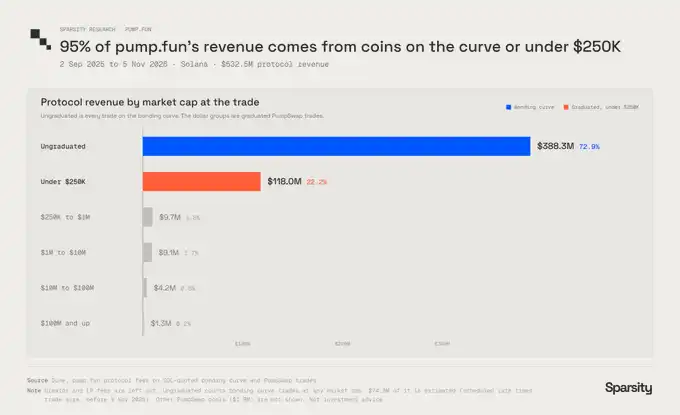
Protocol revenue contributed by bonding curve and low market cap tokens
Money is made when the token's market cap just reaches a few hundred thousand dollars; after that, it doesn't matter how the price moves.
By token issuance time, the same pattern holds. Three-quarters of this revenue comes from tokens less than an hour old, and 87% comes from tokens less than a day old.
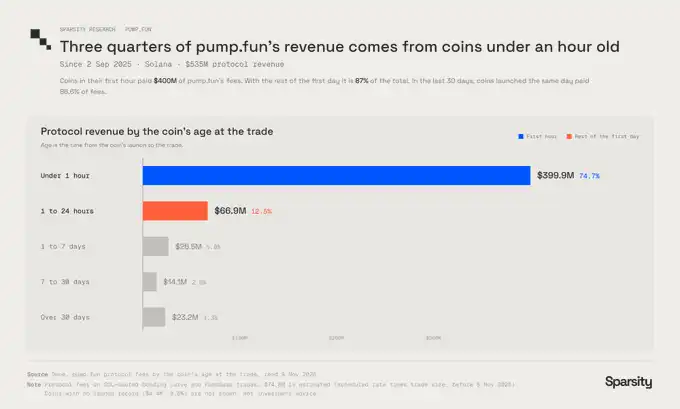
Revenue breakdown by token issuance time
In the first hour after a token is issued, pump.fun is already making money.
The coins that surge all the way up contribute almost negligible revenue. Among the batch of coins that rose the most, 15 tokens reached a combined market cap of $1.4 billion at their respective peaks, bringing pump.fun total revenue of about $1.5 million. In contrast, coins still trading on the bonding curve or with a market cap below $250,000 brought it $506 million. Simply put, 1,000 coins that stall out at a $20,000 market cap make it more money than one coin that reaches a $100 million market cap.
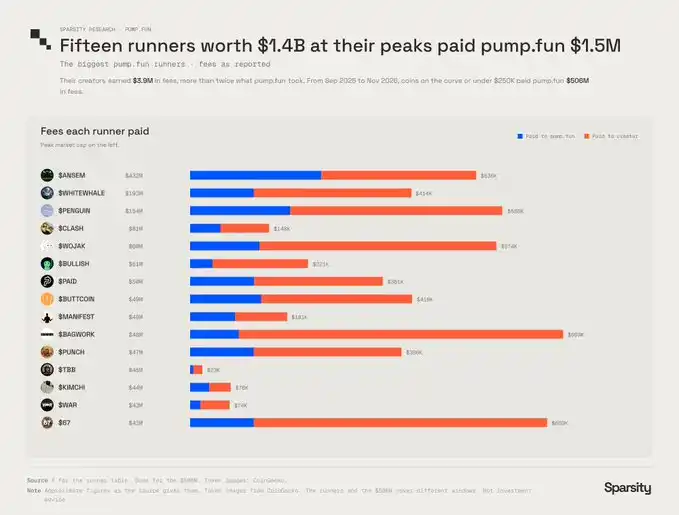
Comparison of fee revenue from top-performing coins versus small coins
The revenue contributed by these 15 big gainers is less than 0.33% of the revenue contributed by small coins.
So the platform's product design revolves around increasing token issuance volume. Every incentive on the platform drives issuance numbers higher, because the more that are issued, the more the platform earns.
Every behavior criticized on social media has a reason to exist on this platform. All four behaviors bring more transactions, and every transaction pays a fee to pump.fun.
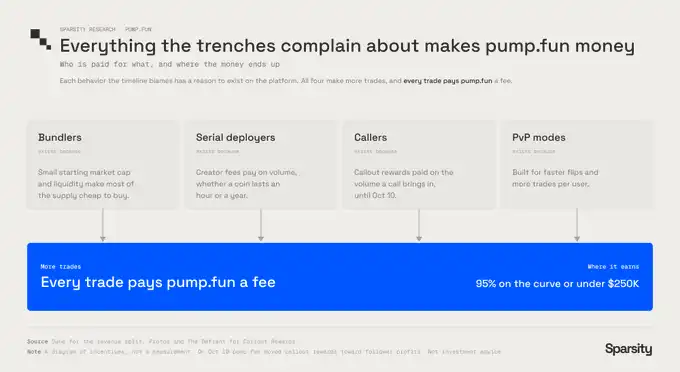
The relationship between the four behaviors and platform fees
Bundled sniping, mass token issuance, shilling, and PvP mode all ultimately bring the platform the same kind of fee.
Bundlers snipe in the opening block because it's cheap
Bundlers exist because a token's initial market cap and liquidity are both very small. By spreading a few SOL across dozens of wallets and buying together in the block when the token is issued, they can grab a large portion of the supply and then sell that stash to you, the later buyer. The lower the initial market cap, the cheaper this is—and the initial market cap is set by pump.fun.
Issuers mass-issue tokens because creator fees are paid on trading volume
The reason some people continuously launch tokens is because creator fee rewards are based on token issuance. Whether a token survives for an hour or a year, creators can earn 0.30% from every transaction. So the most cost-effective strategy is to launch as many tokens as possible, cash in on the fees from early trading volume, and then move on to the next one. The top 25 issuers by token volume have collectively launched 761,000 tokens, of which fewer than 1% "graduated" from the bonding curve stage, and they earned $128 million.
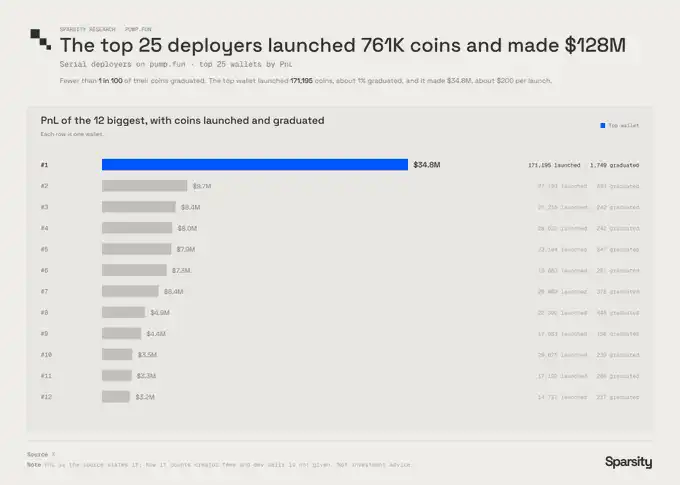
Issuance volume and revenue of top token-launching wallets
The No. 1 wallet launched 171,195 tokens, earning about $200 per token on average.
Mass token launches occasionally produce one or two big winners. The best-performing tokens from two wallets each reached market caps of $122 million and $327 million respectively. But producing a big winner is merely a byproduct of high trading volume—volume itself is the basis for getting paid.
Shillers push low-market-cap tokens because rewards are distributed by trading volume
Shilling rewards have given everyone a new reason to push tokens. The platform has turned shilling into a revenue stream. Since August, it has distributed $29.6 million in shilling rewards to 51,115 wallets, with rewards heavily concentrated. 10 wallets took 16%, while the median amount received by winners was $13.
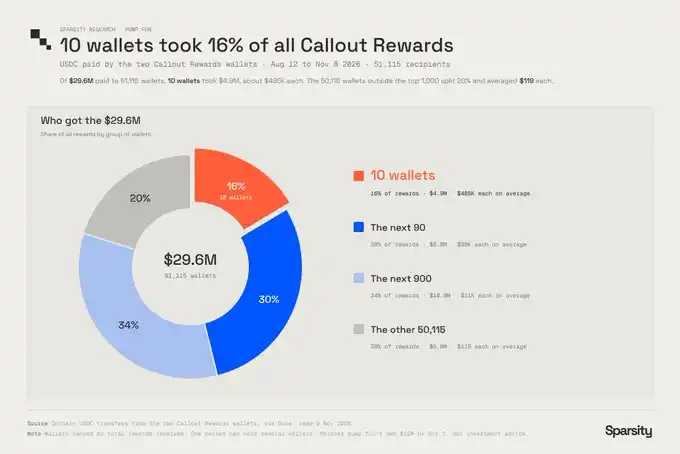
Distribution of shilling rewards
These 10 wallets received an average of about $485,000 each.
Rewards are distributed based on the trading volume generated by each shill, and the smallest tokens are the easiest to drive volume for. In August, among the top 50 highest-earning shillers, 40 shilled tokens with an average market cap below $100,000.
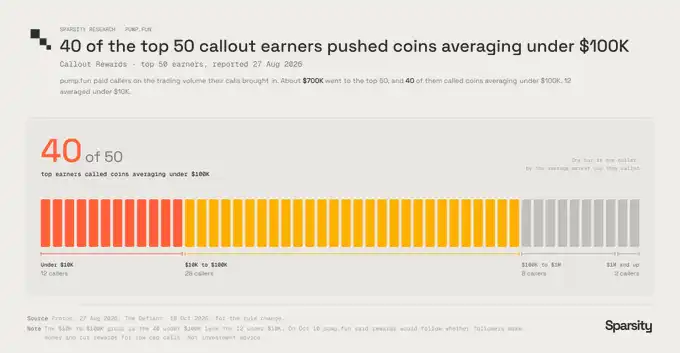
Average market cap of tokens promoted by top shillers
Among the top 50 shillers, 12 shilled tokens with an average market cap below $10,000.
pump.fun has heard this feedback. On October 10, the platform stated that future rewards will depend on whether copiers make money, and shilling rewards for low-market-cap tokens will also be reduced. In the following three weeks, among the bonuses received by the top 20, the share taken by shillers whose shilled tokens had a median market cap below $100,000 rose from 68% to 94%. Weekly bonus payouts also increased by 53%.
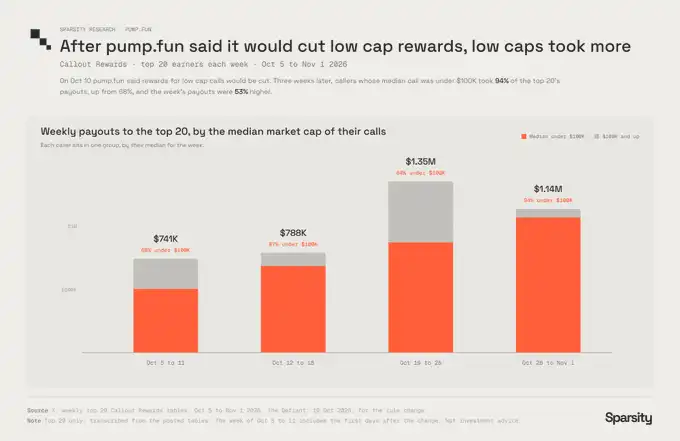
Call rewards and the share of low-market-cap calls before and after the rule change
After the rules changed, the total bonus pool increased, and the share going to low-market-cap callers rose as well.
Most of the cost is borne by copy traders. We tracked 14 callers, and the median market cap of the coins called by 10 of them was below $100,000. One day after the calls, these copy traders had lost a combined $926,000. Based on the median price change of the coins called, they rose 6% one minute after the call, fell 48% after one hour, and fell 74% after one day. Whether or not the coin price rises, the callers get paid.
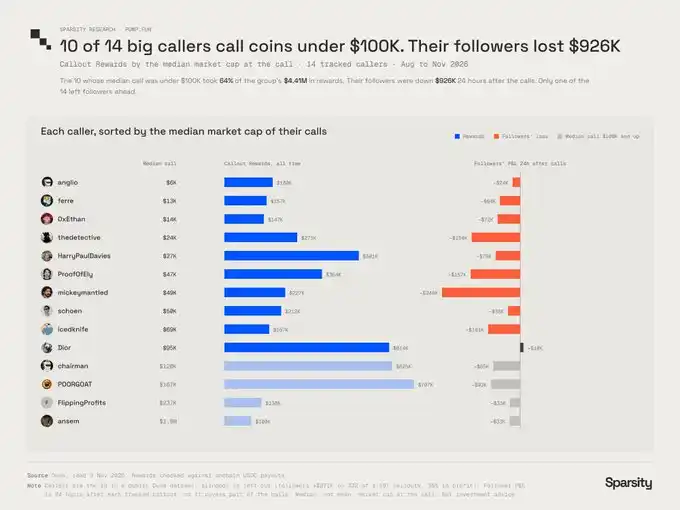
Copy-trading P&L for the 14 callers
Of the 14, only one had copy traders who were profitable overall, making $10,000.
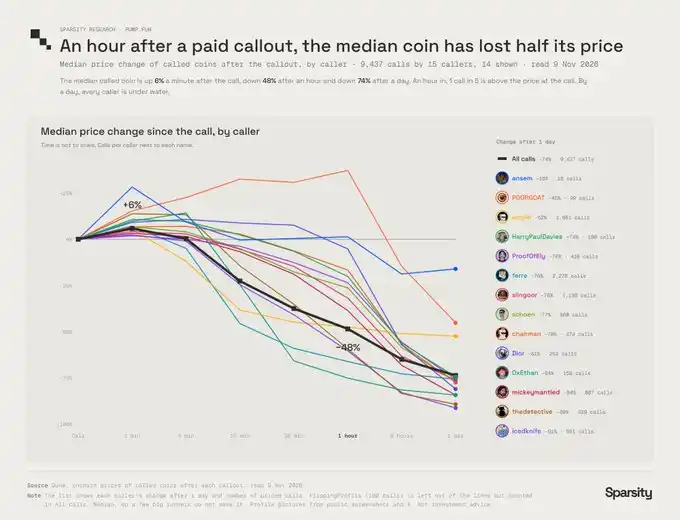
Performance of each caller's called coins one day after the call
For every single caller, the median price change of the coins they called was negative after one day.
Some ask why KOLs always push coins that lose their followers money. This is a big part of the reason. Someone is paying them to do it.
PvP mode gets every user to make a few more trades
PvP (player versus player) works because no new money comes in, and veterans make money off newcomers. These modes are designed precisely on that logic. Trade execution is faster, each user makes more trades, and every trade charges a fee. On June 30, pump.fun itself delisted one of these modes, the Tokenized Agent mode. The platform said at the time that there were too many ways to issue coins, causing "harmful player-versus-player" dynamics.
If these incentives last long enough, the market splits into two sides.
On the demand side, you rush in to buy coins and on average lose money. Only a tiny number of wallets make any decent money. On the supply side, you issue coins and get paid with almost no risk.
There is no barrier to becoming a supplier. You can issue a coin with one click, and you already know how to do it. In seconds you can make a clone of a hot coin, wash-trade to make it look like people are playing, and buy up hundreds or thousands of wallets with transaction histories. This playbook gets easier every month.
So we believe that people who might have been long-term holders will increasingly shift to the supply side. Issuing coins is profitable; holding coins is not. Every new player who figures this out becomes yet another coin issuer, competing for an ever-shrinking pool of buyers. That's how holding culture collapses. No one collectively decided to stop holding — the platform made holding a losing trade.
The results show up in the performance of these new coins. pump.fun's current coin issuance volume is roughly on par with the market's peak at the end of 2024. According to our statistics, 3.16 million coin types were issued in Q4 2024, of which 207 reached a market cap of $10 million. In Q3 2026, 3.05 million were issued, and only 24 reached that market cap.
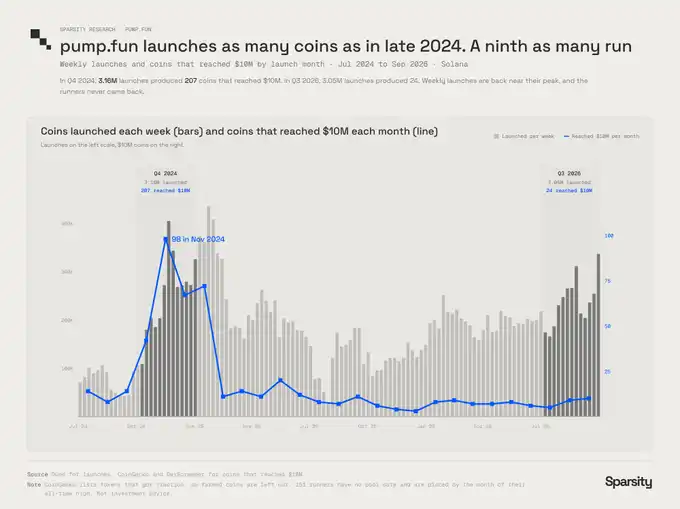
Weekly issuance volume vs. the proportion of coins that surge
Weekly issuance has once again exceeded 300,000 coin types. For every 100,000 coins issued, the number of breakout surge coins has dropped from 6.5 to 0.8.
Some will point out that trading volume on the bonding curve has been rising since June. That's true, but combining bonding curve and PumpSwap trading volume, it has fallen from roughly $25 billion to $30 billion per month in Q1 2026 to about $13.8 billion in October (bonding curve, PumpSwap). And pump.fun makes money from trading volume. Buyers make money from breakout surge coins, and the number of those coins is now only one-ninth of what it was.
The survival data tells the same story. pump.fun has issued a total of 24.4 million coin types, and only 312 still have a market cap above $100,000. That's roughly one in every 78,000 coins — 0.0013%.
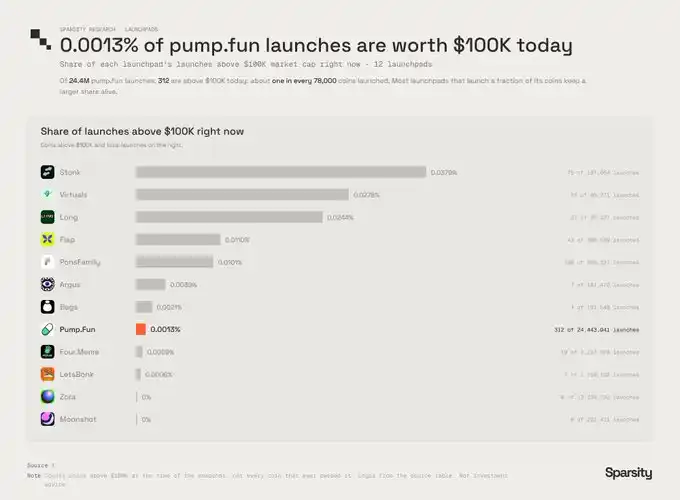
Comparison of token survival rates across launch platforms
Most launch platforms issue only a fraction of pump.fun's volume, but their token survival rates are higher.
This is the first market we know of where supply is growing so fast while demand is shrinking. If the platform weren't paying for this behavior, it would never have grown to this scale.
pump.fun built this system, but the trading volume that keeps it running is contributed by us. Every incentive mentioned in this article requires someone on the other side of the trade to generate revenue. Most of the time, that someone is us.
We Reward the Behavior We Complain About
We say the people bundling and sniping are the problem, then turn around and follow them, wondering how the next play will go. A developer forks a hot coin, takes the fees, and walks away, and someone posts a thread analyzing how clever the move was. A person calls 20 coins a day, and everyone follows him because he's always the first to call it—whether the copiers make money becomes secondary. Of the 14 callers tracked above, only 1 had copiers who were profitable overall. All copiers combined lost $926,000 one day after the calls.
We pay for all of this twice. Once with trading volume—pump.fun and creators make money from it. And once with attention—the next fork and the next call are both aimed at our attention.
Holding Is No Longer a Strategy
A year ago the play was to find a coin early, endure all the noise in between, and hold. Now, one day after a call, the median price change of the called coins is down 74%, so the only survivors are those who sold first. For each of us individually, this is rational, but everyone doing it is precisely what prevents anyone from catching a big runner. If no one is willing to hold a coin past the first hour, it can't reach a $10 million market cap. Yet three-quarters of pump.fun's revenue comes from that one hour.
What Happens If We Change Our Ways
Doing these things doesn't require pump.fun's consent. Hold the coins you genuinely believe in, and stop buying in and flipping out at the sight of a chart. Judge callers by whether their copiers made money, not by how often they post. Stop spreading forks and bundling snipes as clever plays. Give your volume to launchpads that can make money from coins that survive long-term. Any one of these alone won't change the whole incentive system. But every trade you don't contribute to this system is one less trade it profits from.
We're offering these ideas directionally; the specific designs still need engineers to work out. Each approach tries to direct money toward the phase after a token's first hour of issuance.
Raise the initial market cap, deepen initial liquidity, and let liquidity keep accumulating so the pool grows with trading volume.
Share fees with holders and liquidity providers (LPs) as well, and have creators' fee share unlock gradually based on how long the token survives.
Make call rewards depend on whether copiers hold. Pay callers based on whether copiers are still holding the coin days later and still profitable.
A similar approach could keep this market alive, and pump.fun has the ability to try. It holds approximately $2.84 billion in on-chain assets, and the entire process is in its hands. In the long run, a market that continuously produces big winners will make it more money than a market that continuously exhausts buyers. It chose to harvest because harvesting earns more today, but this approach cannot last.
Even so, it may not be enough. Such changes will raise costs for issuers. But the tools available to the supply side will always be stronger than those of the demand side, and this will not change.
All the above approaches are still built on the bonding curve. Going one step further, one could try removing the bonding curve.
In this model, everyone pays the same price. Without a bonding curve, there is no advantage to being the first transaction in a block, and sniper front-running loses its edge. Creators set a minimum and maximum fundraising amount. If the minimum is not reached within a specified time, such as 24 or 48 hours, the smart contract automatically refunds everyone, so a failed launch does not cost buyers their funds. Once the fundraising cap is reached, the contract creates a liquidity pool itself and burns or locks the LP tokens, so creators never touch the raised funds. Each wallet has a hard cap on its contribution, for example 1% of the total raise, so a single whale or bot cannot take half the token supply.
The platform only earns revenue when the raise is filled. The platform makes money from successfully launched tokens; even if 1,000 launches fail to fill, it earns nothing.
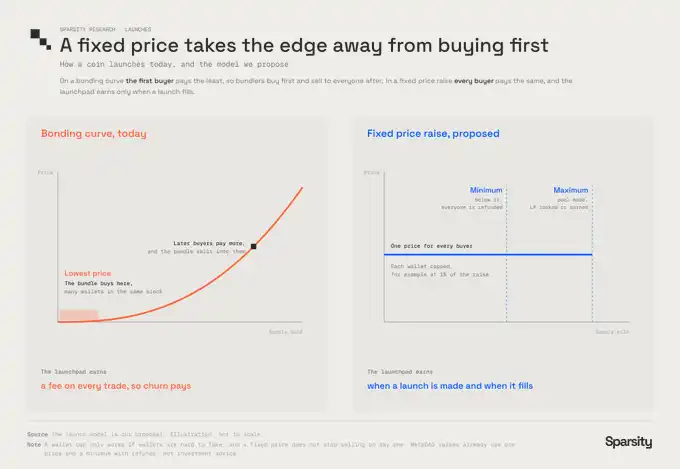
The platform shifts from charging a fee per transaction to charging after a raise is filled
The fee trigger for launch platforms shifts from every transaction to every filled raise.
This eliminates bundling at the start of the bonding curve, sniper front-running, and draining raised liquidity, and also removes the incentive to launch 50 tokens in a row, none of which fill, yet still profit.
This model has loopholes worth stating clearly. Per-wallet limits only work when wallets are hard to fake, and wallets with history are cheap now. Without some kind of anti-Sybil mechanism to prevent the same person from using multiple wallets, bundlers only need to spread buy orders across 100 wallets. A fixed price also does not stop someone from selling on day one. All it can do is make the starting line fairer.
Meme coins in their current form have run their course. We believe they won't come back until the token issuance model itself changes—for example, by adopting the approach above, where platforms profit when a coin successfully launches.
As long as a single launchpad can profit from every coin that ultimately goes to zero, the meme coin trading frontline will remain dormant, and holding these coins will still be a losing trade. New things will emerge, but they won't be meme coins, and they won't come anytime soon.
Nothing in this article constitutes investment advice. We do not hold $PUMP or any other tokens mentioned in the text. Data is as of November 9, 2026, and all figures are approximate. Please retrieve the underlying data for verification before use.
Join the official Coincamps community:
Telegram: https://t.me/coin_camps
Recommended
Without Jensen Huang, how much would Nvidia still be worth?
Nov 12, 15:59
Podcast Notes | Follow-Up Coverage Before the Jensen Huang Affair: Questions Over Circular Financing, Missteps in the China Export Controls, and the Succession Question
Nov 12, 15:56
MOIN Nium USDC Funding: Korea Payouts Go 24/7
Nov 12, 15:48
CoreWeave Reports Q3 Earnings First, Nebius Takes Over Tonight: How Much Cash Flow Can $133 Billion in Orders Generate?
Nov 12, 15:21
EBA Starts Supervising USDC: What Changes for Circle in the EU
Nov 12, 15:21
Wise vs Revolut in 2026: Fees, Rates and Limits Compared
Nov 12, 15:11