Dell's revenue doubles, traditional server shipments decline, why did revenue more than triple?

On November 24, Eastern Time, Dell Technologies released its earnings report, raised its full-year guidance, and its board approved an expansion of its share buyback program. During the Q&A session of the earnings call, a Goldman Sachs analyst asked about traditional server sales volume and pricing. Dell COO Jeff Clarke responded that server unit shipments declined.
But the earnings report paints a different picture. Dell's revenue for the quarter reached $54.937 billion, more than doubling year-over-year. In the same report, traditional server and networking revenue grew 235% year-over-year. AI server hot sales are easy to understand—but why, when fewer traditional servers were sold, could revenue for this business line still rise so fast?
Subtracting each business segment's revenue from the same period last year and adding up the increases and decreases, we can see that for every additional hundred dollars of Dell's new revenue, AI-optimized servers contributed nearly 60%, and traditional servers and networking contributed nearly 40%. The incremental amount from the latter alone is close to Dell's entire client business revenue for a quarter.
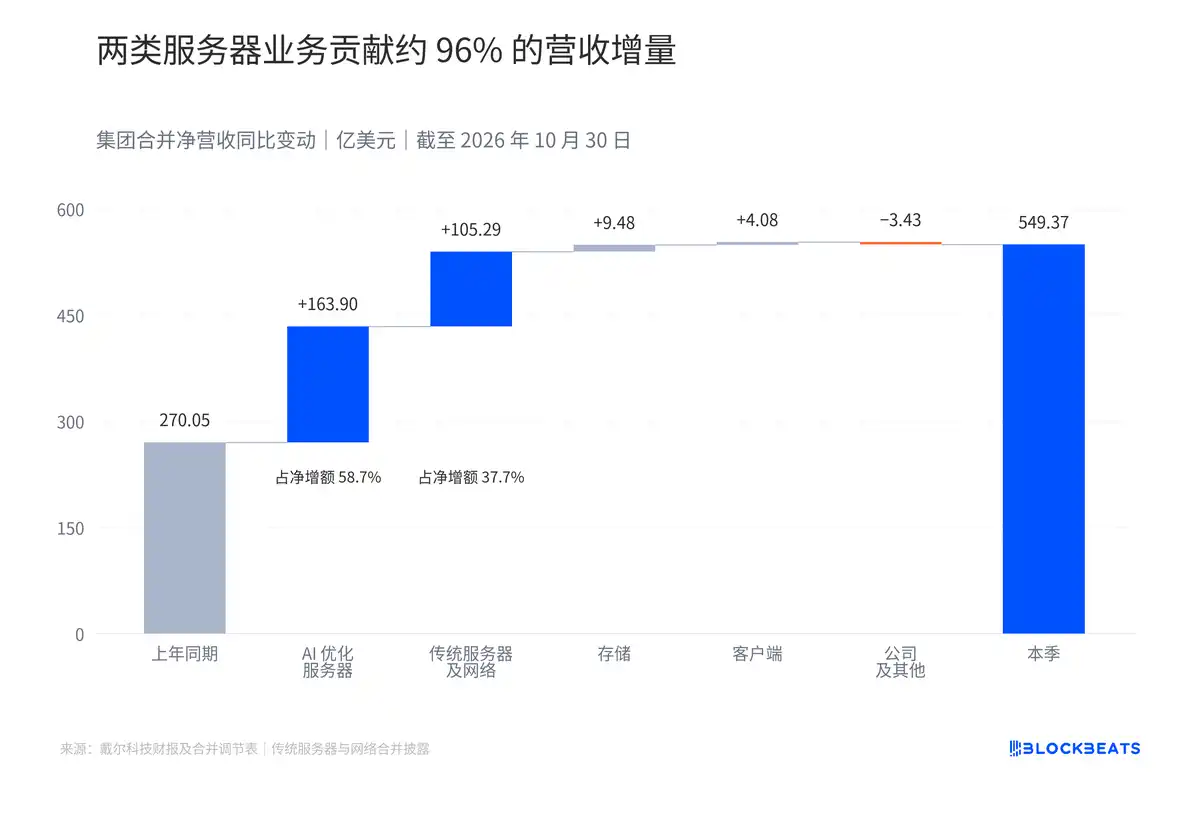
Business breakdown of Dell's year-over-year revenue increase
Dell's AI-optimized server revenue increased from $5.641 billion to $22.031 billion, nearly four times the year-ago period. This is already Dell's largest single revenue source for the quarter. Traditional servers and networking was the item with the largest revenue increase besides AI-optimized servers.
The clue Clarke gave in the Q&A is that each machine contains more. The servers Dell delivered this quarter had more processor cores per unit and were also equipped with more memory and storage. For enterprises needing to free up data center space and power capacity, replacing with a batch of new machines with higher configurations can consolidate work originally spread across more old machines. Enterprises can purchase fewer units, while each machine handles more work.
There is another side to the change in procurement configurations. Dell mentioned on the earnings call that demand for AI inference is also increasing, and some of that work requires CPU-centric servers. When enterprises add computing power, their procurement lists include both AI-optimized servers and general-purpose equipment responsible for other computing tasks. Some of the demand for traditional servers comes from these workloads.
Clarke also mentioned that component inflation has squeezed the low-priced entry-level server market. The earnings report discloses traditional servers and networking equipment together as one item, and Dell did not provide a separate unit decline percentage or average selling price. Higher configurations and pressure on low-priced models can explain why units and revenue may move in different directions, but it is not possible to calculate from this how much each contributed to the revenue increase.
Dell groups servers, networking, and storage into its Infrastructure Solutions Group, and commercial and consumer PCs into its Client Solutions Group. Looking at the two segments together, in the year-ago period infrastructure accounted for roughly $70 of every $100 in segment operating profit; this quarter it has exceeded $90.
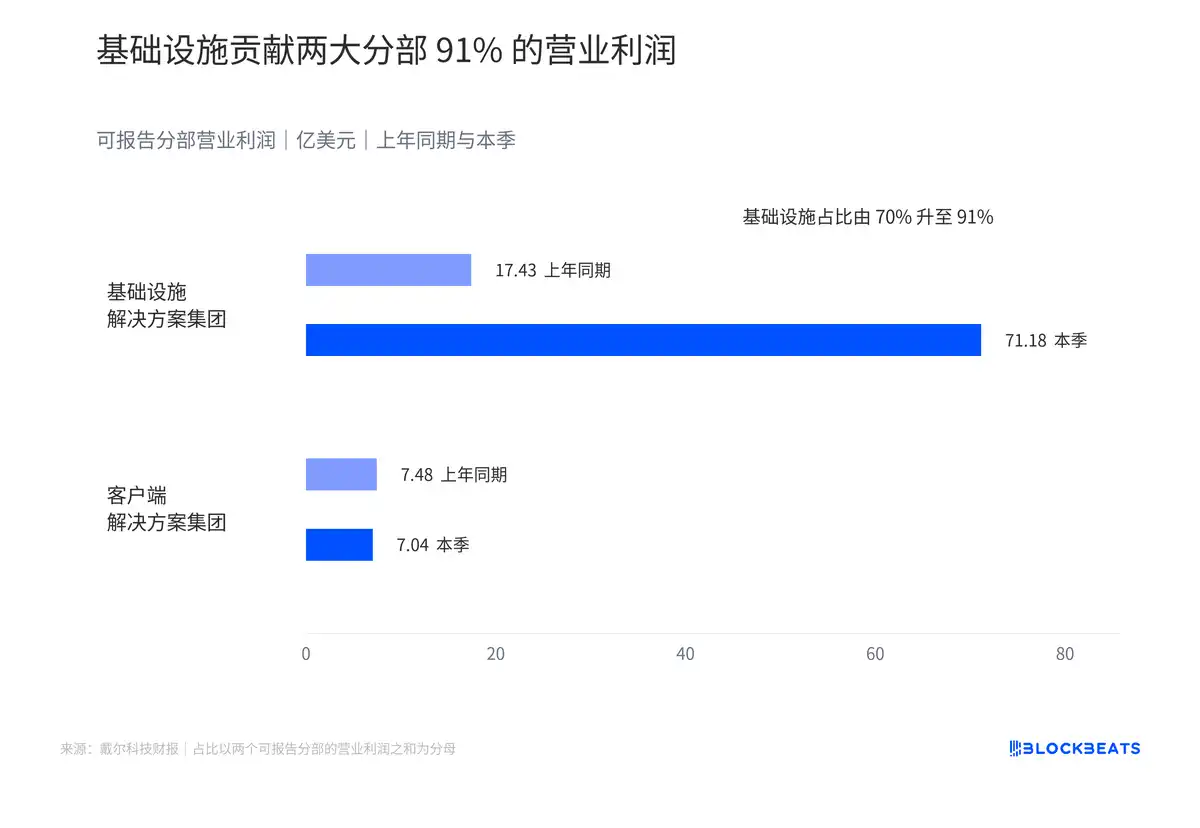
Dell Infrastructure and Client Segment Operating Profit Comparison
The infrastructure business's operating margin rose to 17%. The client business posted a combination of slight revenue growth and declining operating profit. On the earnings call, Dell said customers have recently prioritized budgets toward servers and storage, deferring some PC refreshes. When enterprises decide to free up budget to upgrade their data centers first, PC refreshes on the same procurement budget sheet may get pushed back.
This chart also answers an easily confused question. The infrastructure segment's margin covers traditional servers, networking, and storage; Dell does not separately break out operating profit for AI-optimized servers in its segment tables. CFO David Kennedy attributed part of the profitability improvement to expenses falling as a share of revenue as scale expanded, while still incorporating margin pressure from a rising mix of AI servers into full-year guidance.
Full-year revenue guidance was raised from $192 billion to $202 billion. Breaking down the raise, AI-optimized server guidance contributed 40%, with the rest from a net upward revision to other group revenue expectations. Under the new guidance, the infrastructure business continues to drive fiscal fourth-quarter revenue.
Dell also raised full-year adjusted diluted earnings per share guidance to $29.68. This quarter the metric came in at $9.45, already a company record.
Dell's AI orders booked this quarter were nearly three times the revenue recognized in that business for the quarter. The quarter-end backlog is a cross-quarter list of deliveries pending. The quarterly revenue in the chart can come from orders booked earlier, and the company has not disclosed conversion data by order cohort.
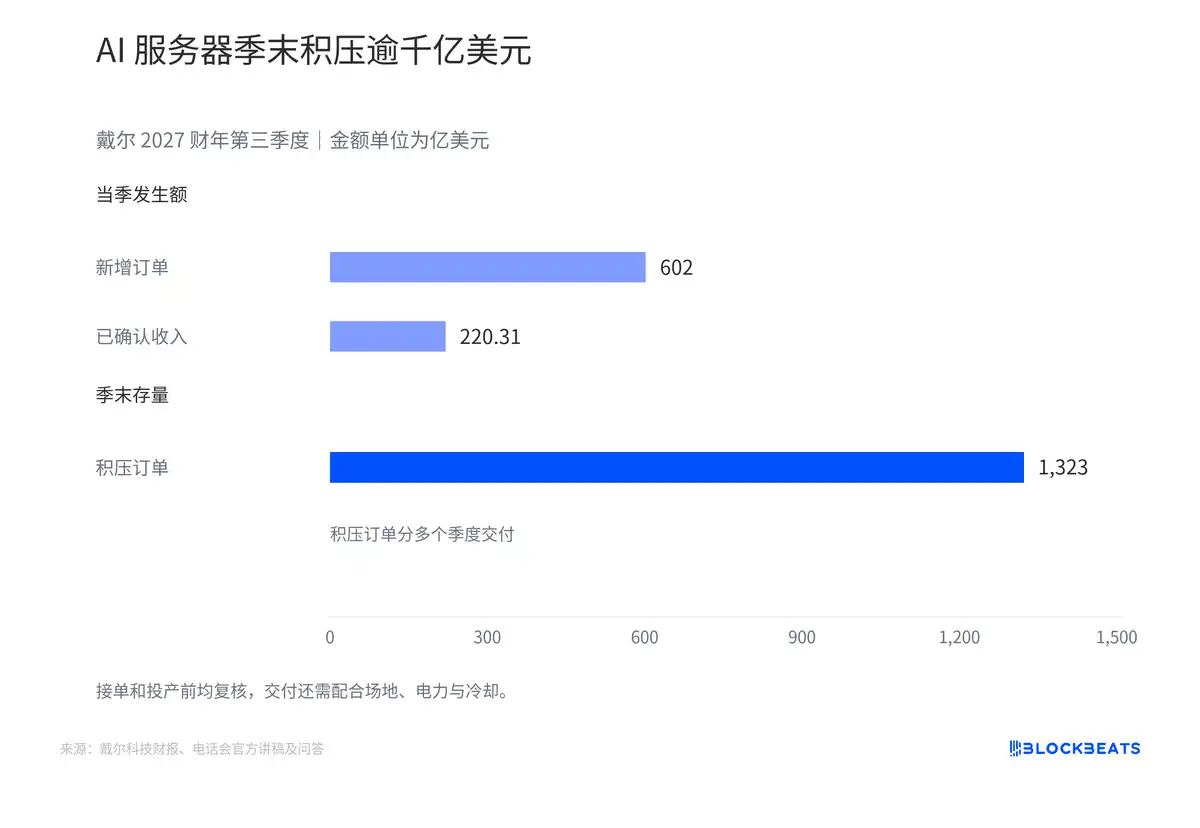
Dell AI Server Quarterly New Orders, Recognized Revenue, and Quarter-End Backlog
Asked by an analyst about data center delays, Clarke listed several conditions that must be confirmed before delivery. Has the customer's building been completed? Are power and cooling installed? Can the processors, memory, and optical modules the servers require arrive at the same time? Even if the racks are already scheduled into production, the receiving site must be ready to connect the equipment.
Dell will also review customer funds and end contracts when accepting purchase orders, and do it again before production begins. Kennedy said the company only provides short-term financing to some customers to bridge the gap from order placement to compute cluster going live. The company disclosed the total backlog, and management did not break out the scheduled delivery amount by quarter in the Q&A.
The earnings report disclosed another amount on the same day that is easily misread. Dell has returned about $4.9 billion to shareholders through buybacks and dividends this quarter. The $25 billion increase approved by the board this time is a Class C common stock repurchase authorization, and actual repurchases are recorded in each period as executed.
The AI racks on the backlog list have their own delivery timelines and must wait for customers' data centers to be ready to receive them.
Join the official Coincamps community:
Telegram: https://t.me/coin_camps
Recommended
The New York Times is degenerating into an incompetent media outlet.
Nov 25, 13:07
Wall Street Morning Brief: Huang's Comeback Rally Lasts a Day as Defensive Mood Builds; PCE Is Tonight's Big Test
Nov 25, 12:46Jensen Huang's First All-Hands Meeting After His Return: 11 Things He Addressed
Nov 25, 11:08HP's quarterly revenue reached $16 billion, so why is it still cautious about the new fiscal year?
Nov 25, 09:20
The Fear Trade
Nov 25, 04:47
Is Robinhood Gold Worth It in 2027? The $50 Fee, 3.6% Cash and Break-Even Math
Nov 25, 01:28