Agentic Banking: How AI Agents Get Their Own IBANs, Cards and Wallets
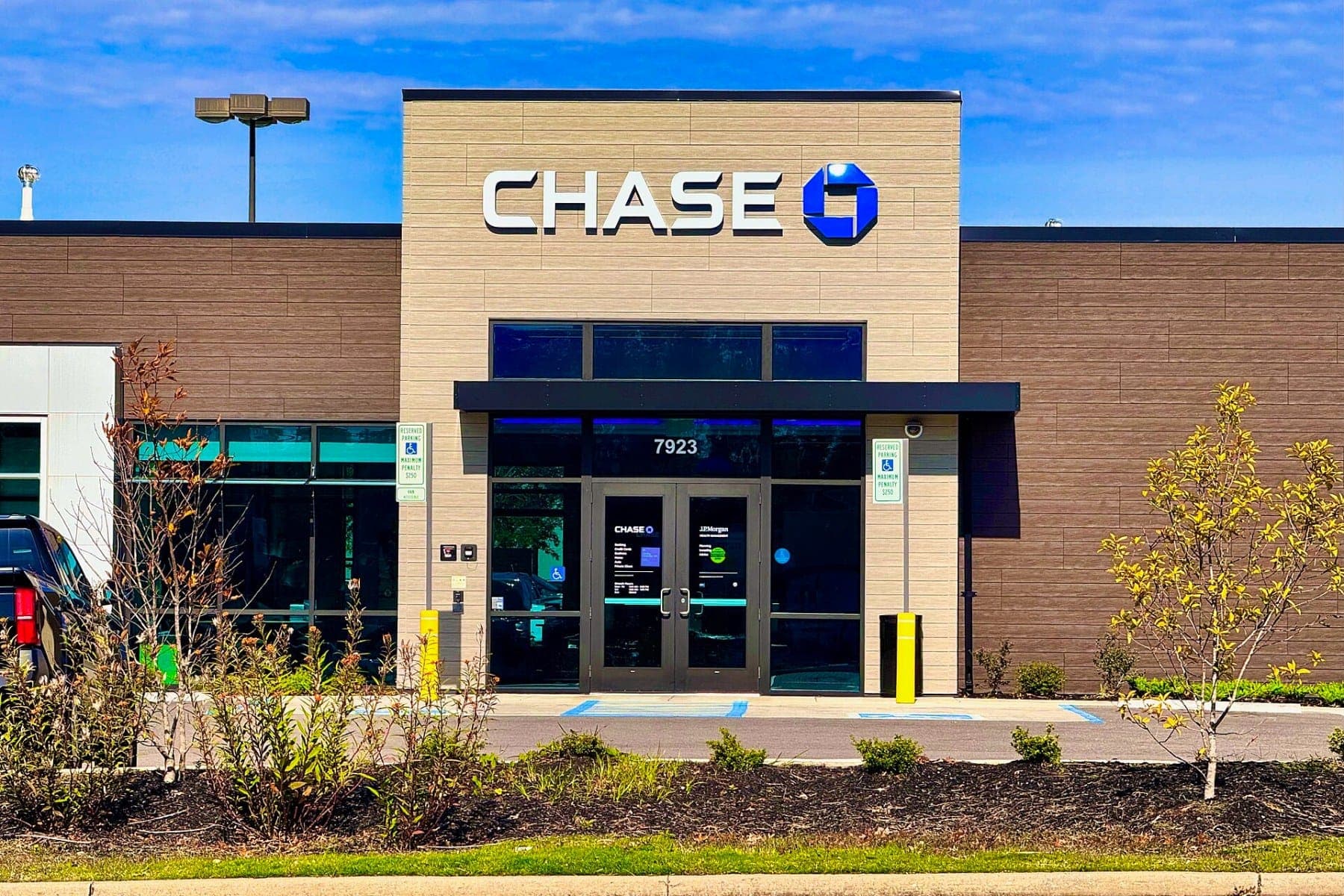
Only 23% of US consumers trust generative AI to handle payment transactions on their behalf, even though 72% have already used an AI assistant (Source: Visa).
We covers the payment rails that AI agents use, and the newest of them is not a protocol but a bank account built for the agent itself.
Until now, most AI agents paid with a card number or wallet the user handed over. That model is exactly what large banks are now blocking.
In November 2026, Wirex and Rain launched products that give each agent its own account, card and stablecoin balance, kept apart from the owner's money.
This guide explains what agentic banking is, why it is arriving now, how the main products work, how card networks and regulators see it, and what it means for stablecoins.
Key Takeaways
- Agentic banking gives an AI agent its own account, card and wallet.
- Wirex Navoka gives each agent an IBAN, debit card and USDC wallet.
- Rain Agent Vaults issue a scoped card for every agent purchase.
- Four large US banks moved to block credential-based AI agents in October.
- Liability for agent mistakes is still unsettled in the US and UK.
What Agentic Banking Means
Agentic payments describe any payment an AI agent makes. Agentic banking is a narrower idea: the agent gets its own financial account, funded by its owner, with rules the agent cannot change.
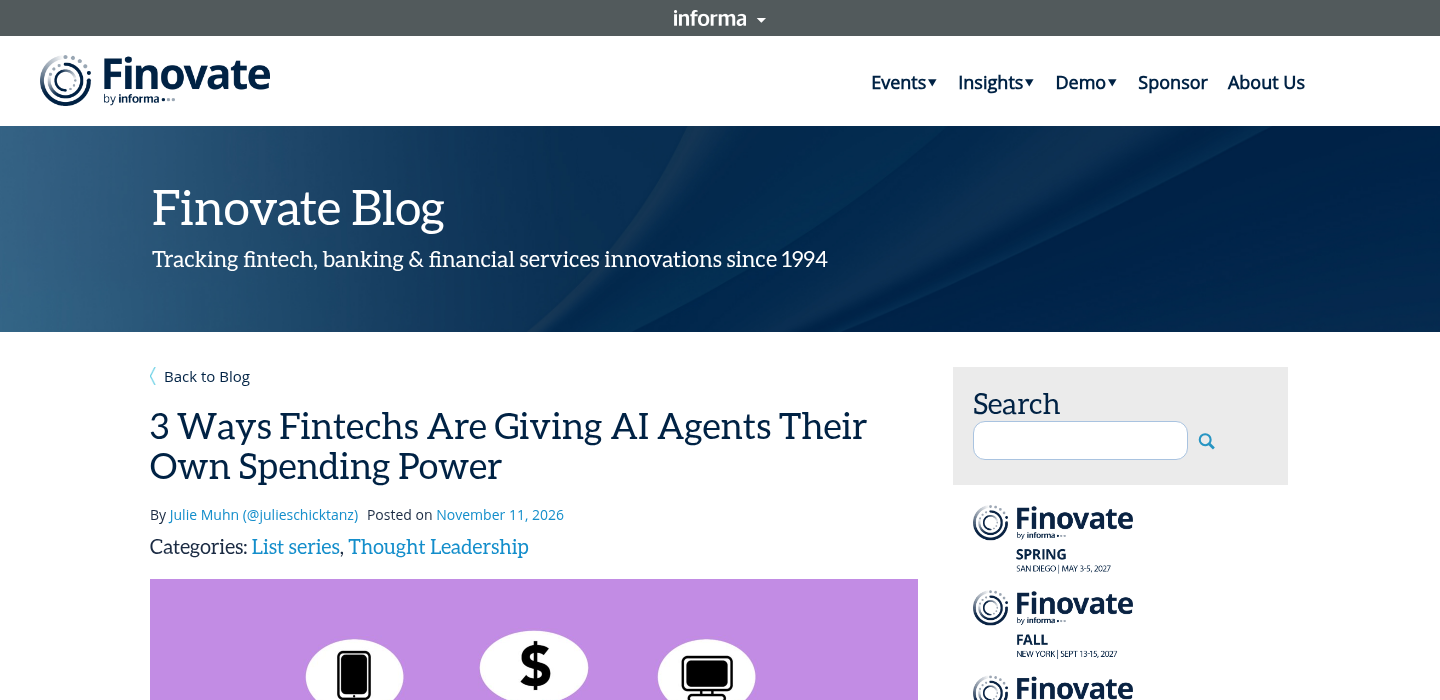
Fintechs have settled on three ways to give agents spending power: dedicated spending accounts and wallets, agent-specific virtual cards, and delegated payment authorization through card network tokens (Source: Finovate).
| Model | Example | Main rail |
|---|---|---|
| Own account | Wirex Navoka | IBAN and card |
| Funded vault | Rain Agent Vaults | Scoped cards |
| Agent wallet | Circle Agent Stack | USDC |
| Network token | Mastercard Agent Pay | Existing card |
The first three keep the agent away from the owner's main account. The fourth lets the agent use the owner's own card through a token that carries limits. For the card network side, see our comparison of Visa Intelligent Commerce and Mastercard Agent Pay.
Why Banks Are Pushing Agents Out
The timing is not a coincidence. Between 13 and 20 October 2026, JPMorgan Chase, Charles Schwab, Citigroup and Wells Fargo each moved to block or shift the risk of third-party AI agents that log in with a customer's own password (Source: Hunton Andrews Kurth).
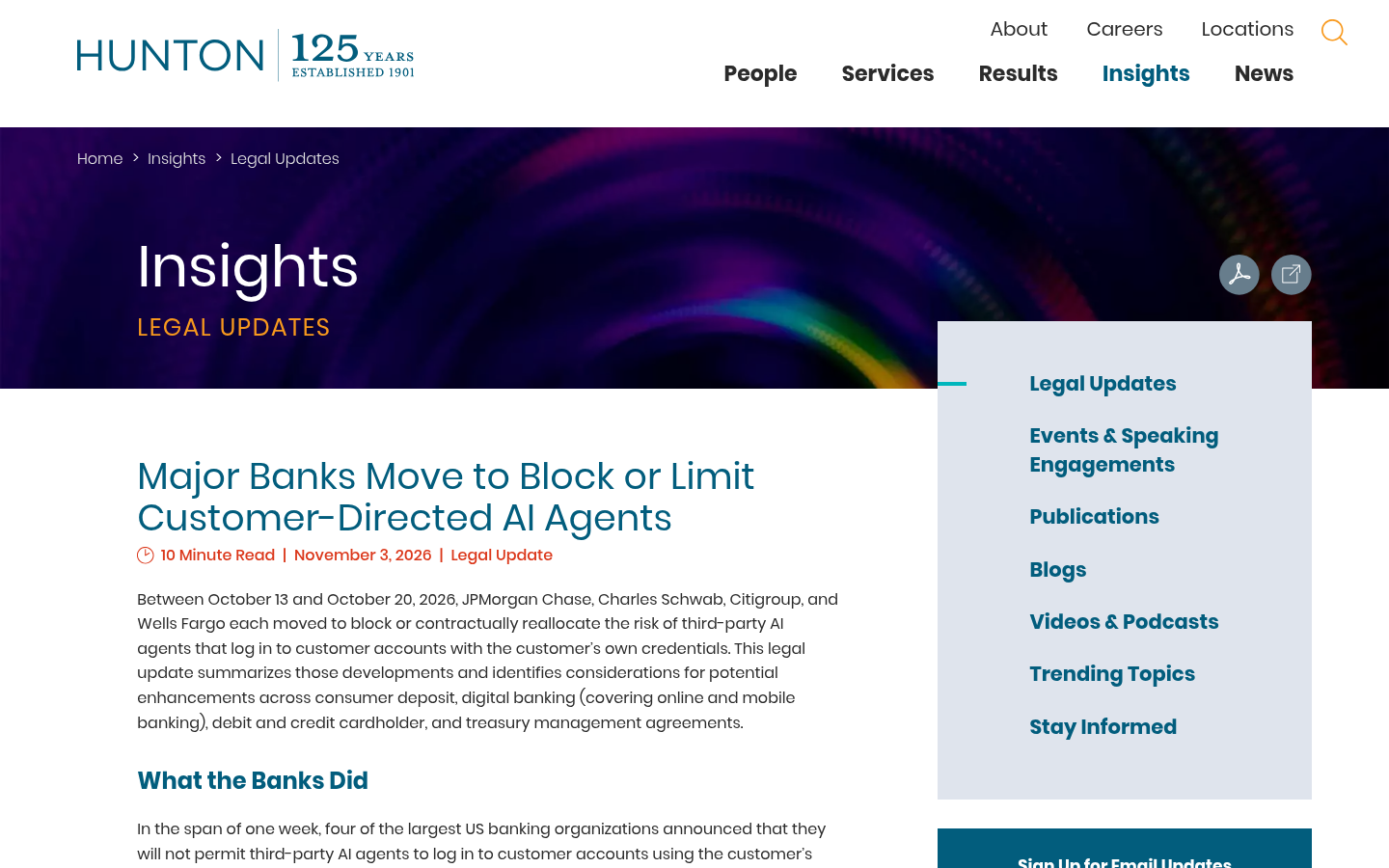
- JPMorgan Chase: No outside agents inside customer accounts, with read-only data still allowed through providers such as Plaid.
- Charles Schwab: Blocks agents that try to move client money 10 to 20 times a week, according to the same analysis.
- Citigroup: No third-party agents logging in or transacting on its digital platforms.
- Wells Fargo: Agents are allowed, but new terms from 24 November 2026 put the risk on the customer.
The banks' worries are security, fraud and deposit flight. An agent using a customer's password looks exactly like the customer, with no limits or audit trail of its own. The same analysis cites an estimate that agents sweeping idle balances into higher-yield products could cost banks $47 billion a year.
That leaves a gap. If agents cannot borrow the owner's login, they need money of their own. This links directly to the US open banking fight, where the rules for third-party access are still being rewritten.
Wirex Navoka: An Agent With Its Own IBAN and Card
Wirex launched Navoka on 12 November 2026 as an AI agent that pays from a dedicated bank account and card. Each agent has its own IBAN, debit card and USDC and EURC wallet, kept separate from the user's personal accounts (Source: PR Newswire).
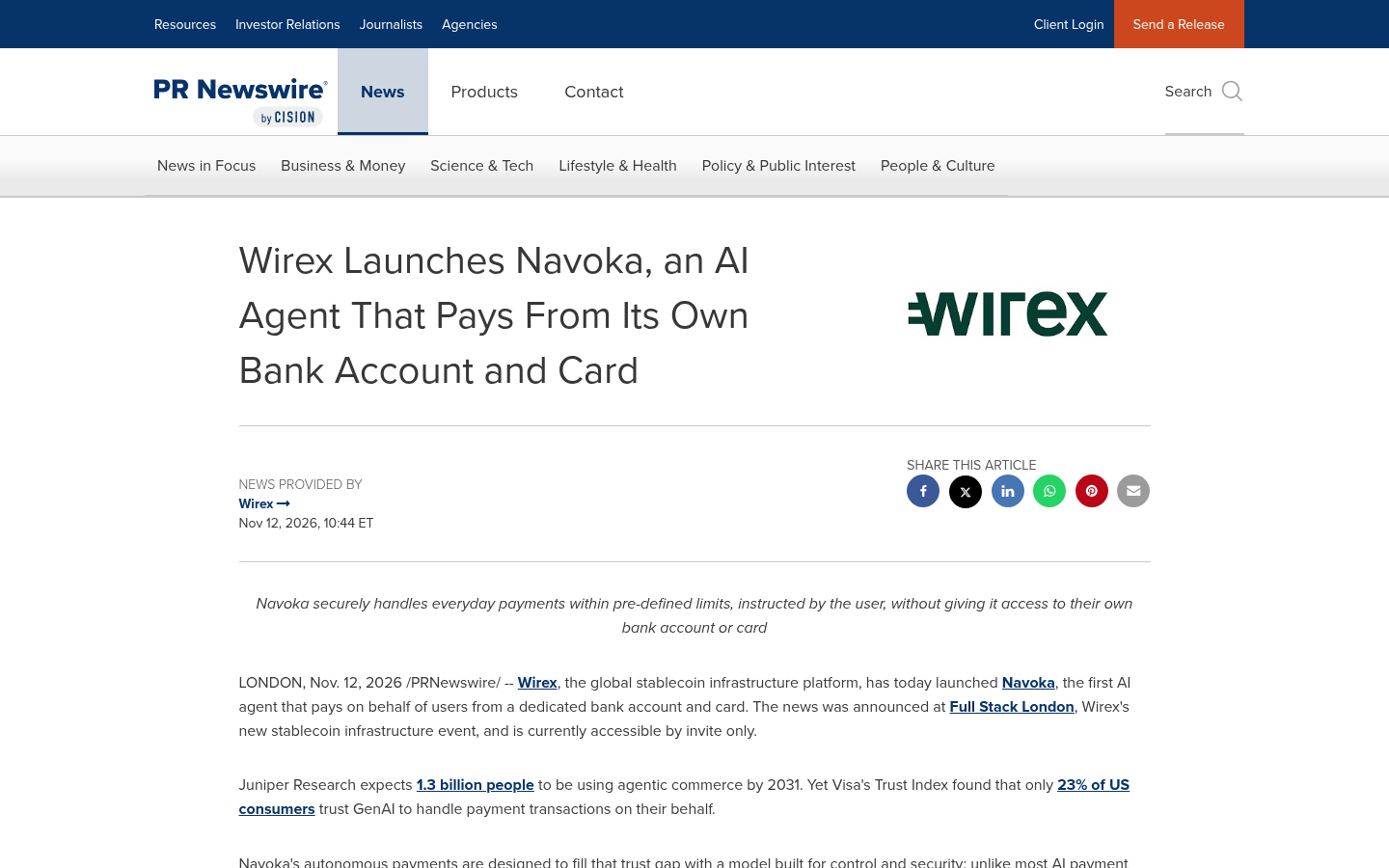
- Separate account: The user moves money into the agent's account and keeps the rest out of reach.
- Multi-currency: The agent can hold dollars, euros and pounds, plus USDC, EURC, BTC, ETH and SOL.
- Spending rules: Allowed merchants, limits, daily caps and country lists are checked every time the card is used, and the agent cannot change them.
- Kill switch and audit trail: The user can freeze the card, and every payment records which rule it ran under.
- Where it works: Through Telegram, with WhatsApp and iMessage to follow, or connected to ChatGPT, Claude or Grok.
Navoka is invite-only for now. Its pitch is simple: hand over the paying, not the bank details. The IBAN side builds on the same infrastructure covered in our guide to virtual IBAN providers for stablecoins.
Rain Agent Vaults: Funded Balances and Scoped Cards
Rain took a different route two days earlier. Its Agent Vaults, launched on 10 November 2026, let a company embed a funded balance inside its own agent, with a Rain-issued scoped card for each purchase. The cards work at 175 million merchant locations, and agents can send money to local bank accounts in more than 80 countries (Source: Rain).
- Funding: Bank transfer, card or stablecoins, with the money held as stablecoins underneath.
- Scoped cards: Each virtual Visa or Mastercard card has a fixed amount, merchant and expiry, and stops working after one approved purchase.
- Approvals: Anything outside the owner's rules is held for a human to approve, even if the money is in the vault.
- Branding: The vault sits inside the partner's app under the partner's name, with Rain invisible to the user.
The difference from Navoka is who owns the customer. Wirex sells a finished agent to the user. Rain sells the plumbing to companies that build their own agents.
Circle Agent Stack: USDC Wallets for Agents
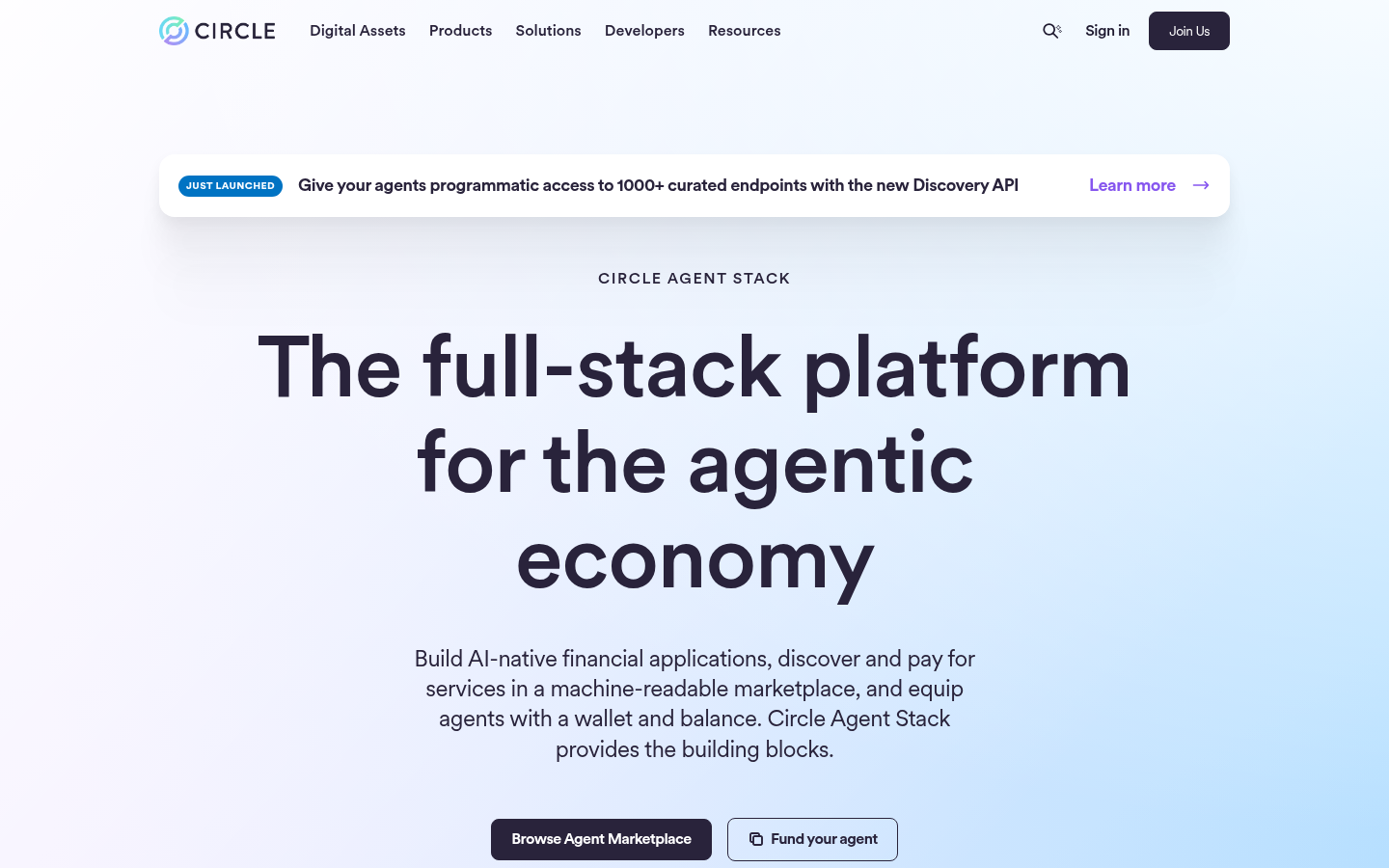
Circle's approach is stablecoin-first. Agent Stack, launched in May 2026, includes Agent Wallets that let agents hold and move USDC under human-set policies such as time-bound spending limits and address allowlists (Source: Circle).
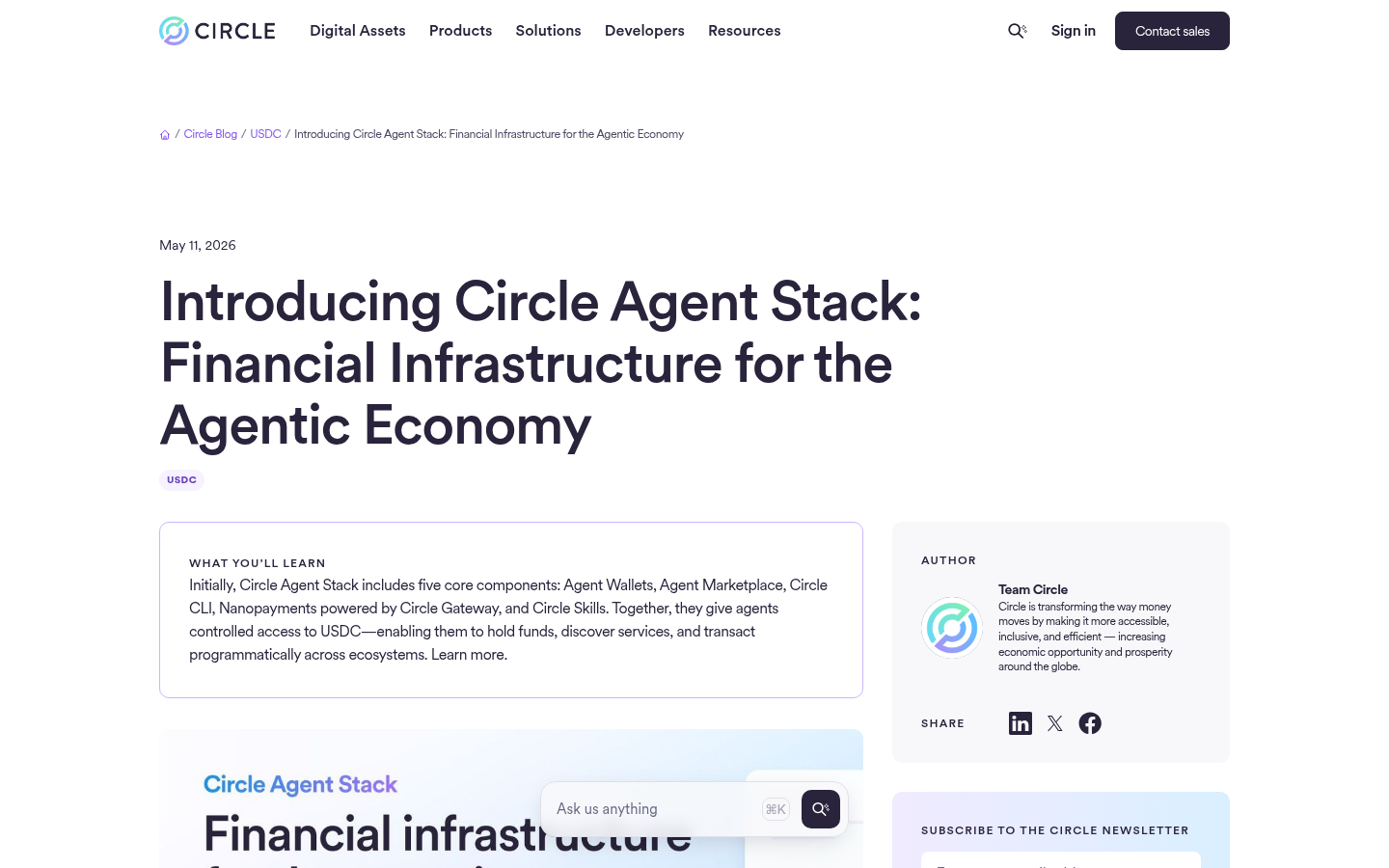
This model suits agents that pay other software, such as APIs and data services, rather than shops. Circle says USDC powers 99.8% of x402 transaction value, the pay-per-request standard many agents use (Source: Circle Agent Stack).
Our comparison of Coinbase AgentKit and Circle Agent Stack covers the developer side, and our ranking of agent wallet platforms lists the other options.
Card Networks Want Tokens, Not One-Off Cards
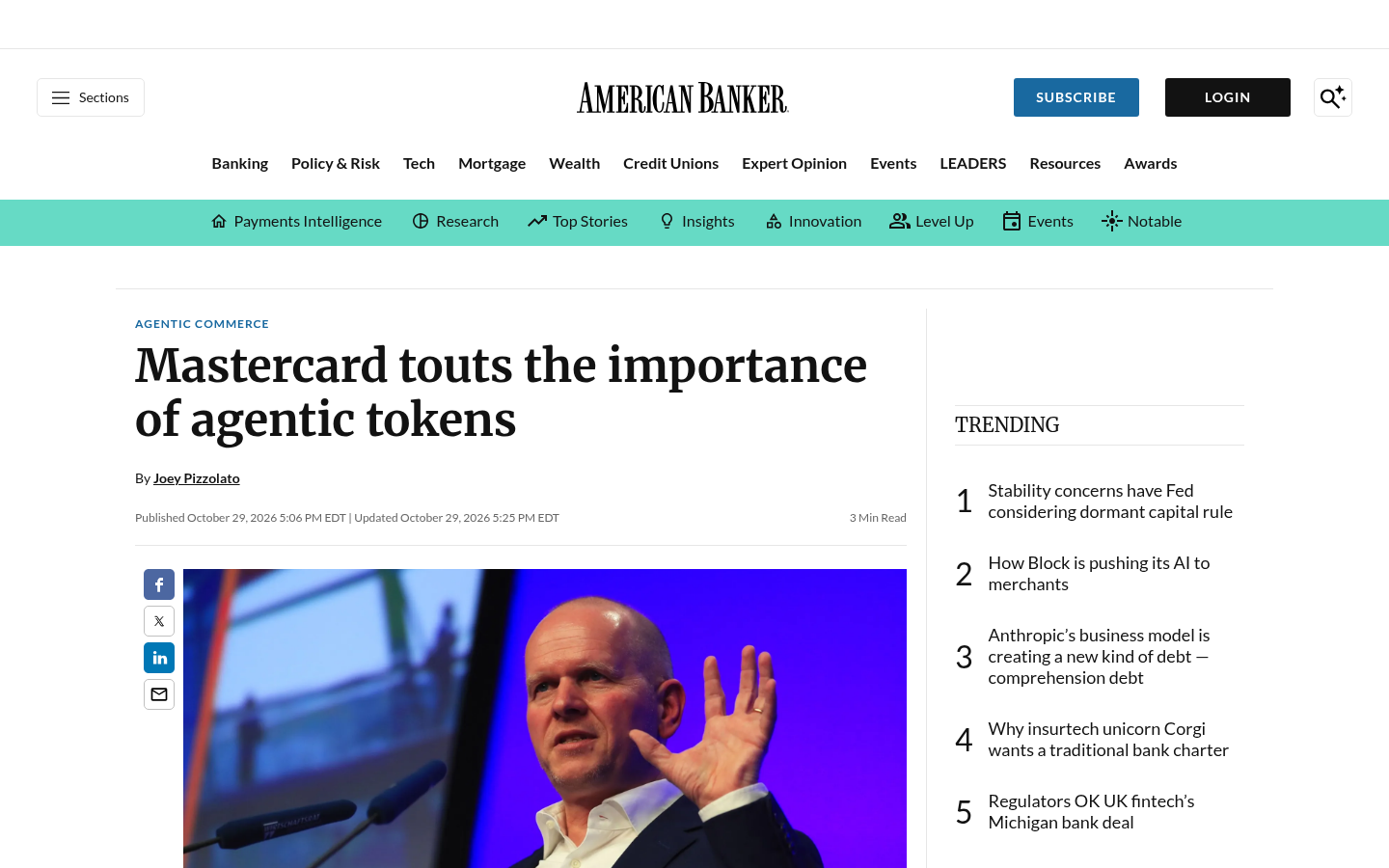
Not everyone agrees that agents need their own accounts. On Mastercard's third-quarter earnings call, CEO Michael Miebach said one-time virtual cards between agents and merchants are not a long-term solution, and Visa, Mastercard and American Express have argued that tokenization is the best way to capture consumer intent (Source: American Banker).
The network view is that an agent should use the owner's existing card through a token that carries spending limits and proof of consent. That is how OpenAI's checkout works, as our explainer on ChatGPT Wallet shows.
In practice the two models are merging. Rain says its scoped cards will also carry the Visa Intelligent Commerce and Mastercard Agent Pay credentials, so a vault card can signal consent the way the networks want.
Who Is Liable When the Agent Pays
Liability is the open question. In the UK, payment rules were written for payments a human authorizes one by one, and it is unclear whether losses fall on the user, the AI developer, the payment provider or the merchant when an agent spending a monthly budget makes a mistake (Source: Pinsent Masons).
- Authorization: A budget of £100 a month does not authorize any single payment, so the line for an unauthorised transaction is blurred.
- Authentication: Strong customer authentication assumes a human with a phone, a passcode or a fingerprint, which an agent cannot provide.
- Fraud: Prompt injection and fake listings can trick an agent into paying the wrong party.
In the US, Wells Fargo and JPMorgan have chosen contract terms that treat everything an agent does as authorized by the customer. Our guide on who is liable when an AI agent overspends walks through the scenarios.
A separate agent account limits the damage in all three cases. If the agent can only reach what is in its own balance, a bad decision costs that balance, not the owner's savings.
What It Means for Stablecoins
- Stablecoins sit underneath: Rain holds vault funds as stablecoins and settles card spend with the networks in stablecoins, while each Navoka agent has its own USDC and EURC wallet.
- Users do not have to touch them: The owner can top up from a bank account or card, and the agent spends by card or bank transfer.
- Machine payments stay on-chain: Pay-per-call API spending runs on USDC through x402, without a card at all.
- Treasury tools follow: Stripe lets agents send money from a financial account that can hold USDC, as covered in our piece on Stripe Treasury for Agents.
For stablecoin issuers, this is a new source of float. Every agent account that holds a buffer for future spending is a small, steady stablecoin balance.
What to Watch
- Navoka's wider launch: When Wirex opens it beyond invitations, and in which countries.
- Bank-built agents: Schwab and other banks are building their own agent tools instead of letting outside ones in.
- Network credentials: How fast issuers enable Visa Intelligent Commerce and Mastercard Agent Pay tokens.
- Regulation: UK payment reforms and any US guidance on authorization and liability for agent payments.
- US open banking: The rewritten Section 1033 rule could decide whether agents get a sanctioned way into bank accounts.
Conclusion
We tracks how money moves between people, apps and now AI agents, and agentic banking is the clearest sign yet that agents are becoming account holders in their own right.
Large US banks have shut the door on agents that borrow a customer's password, and fintechs have answered by giving agents their own IBANs, cards and stablecoin balances.
Wirex Navoka sells that as a finished product, Rain sells it as infrastructure, and Circle offers a USDC-native version for machine payments, while the card networks push tokens on existing cards.
The model limits what a bad agent decision can cost, but the rules on who pays for mistakes are still being written.
Read Next
These three guides go deeper on agent payments, card network tokens and the stablecoin wallets behind them.
- Best Apps to Buy Anthropic Shares in India (2026): 4 Platforms Compared on Fees and FX
- How to Convert USDT to TRY in Turkey (2026): 5 Ways Compared
- How to Convert USDT to PKR in Pakistan (2026): 4 Ways Compared
FAQs
1. What is agentic banking?
Agentic banking is a model in which an AI agent gets its own financial account, such as an IBAN, a debit card or a stablecoin wallet, funded by its owner. The agent can pay only from that balance and only within rules the owner sets.
2. Can an AI agent have its own bank account?
An AI agent can have its own bank account in practice, but the legal account holder is still the person or company behind it. Wirex Navoka, for example, gives each agent a separate IBAN and card that the user funds and controls, kept apart from the user's personal accounts.
3. Why are banks blocking AI agents?
Banks are blocking AI agents that log in with customer passwords because those agents look exactly like the customer and have no limits or audit trail of their own. JPMorgan, Schwab and Citi blocked them in October 2026, while Wells Fargo shifted the risk to customers.
4. How do AI agents pay with stablecoins?
AI agents pay with stablecoins either directly, using a USDC wallet and standards such as x402 for pay-per-call services, or indirectly, through cards and accounts that hold the balance as stablecoins underneath. Rain uses the second approach, while Wirex Navoka gives each agent both a card and a USDC and EURC wallet.
5. Who is liable if an AI agent makes a wrong payment?
Who is liable if an AI agent makes a wrong payment is not settled yet. Some US banks now treat every agent action as authorized by the customer, while UK regulators are reviewing how payment rules should split losses between users, providers and AI developers.
Disclaimer: This content is provided for informational purposes only and does not constitute legal, financial, or compliance advice. Product features, availability and regulatory positions cited here reflect publicly announced information as of November 2026 and are moving quickly. Figures come from company announcements and third-party research with differing methodologies and should be treated as directional signals rather than guaranteed outcomes.
Join the official Coincamps community:
Telegram: https://t.me/coin_camps
Recommended
Nvidia Officially Announces: Jensen Huang Reinstated as President, CEO and Board Member Effective Immediately
Nov 23, 22:32Nvidia Board Restores Jensen Huang as CEO Full Text: In the Best Interests of All
Nov 23, 22:20
On Bonding Curve and LP Incentives: Key Modules and Evolving Trends in New Token Liquidity Mechanisms
Nov 23, 22:09Nvidia's computing power moves south to Johor, alongside a 200-year history of Chinese immigrants landing in Southeast Asia
Nov 23, 21:37
BILL Alternatives (2026): What the TPG and Corpay Deal Means and Where to Switch
Nov 23, 21:31