
Intermex vs Western Union: Why the $500 Million Remittance Merger Went to Court

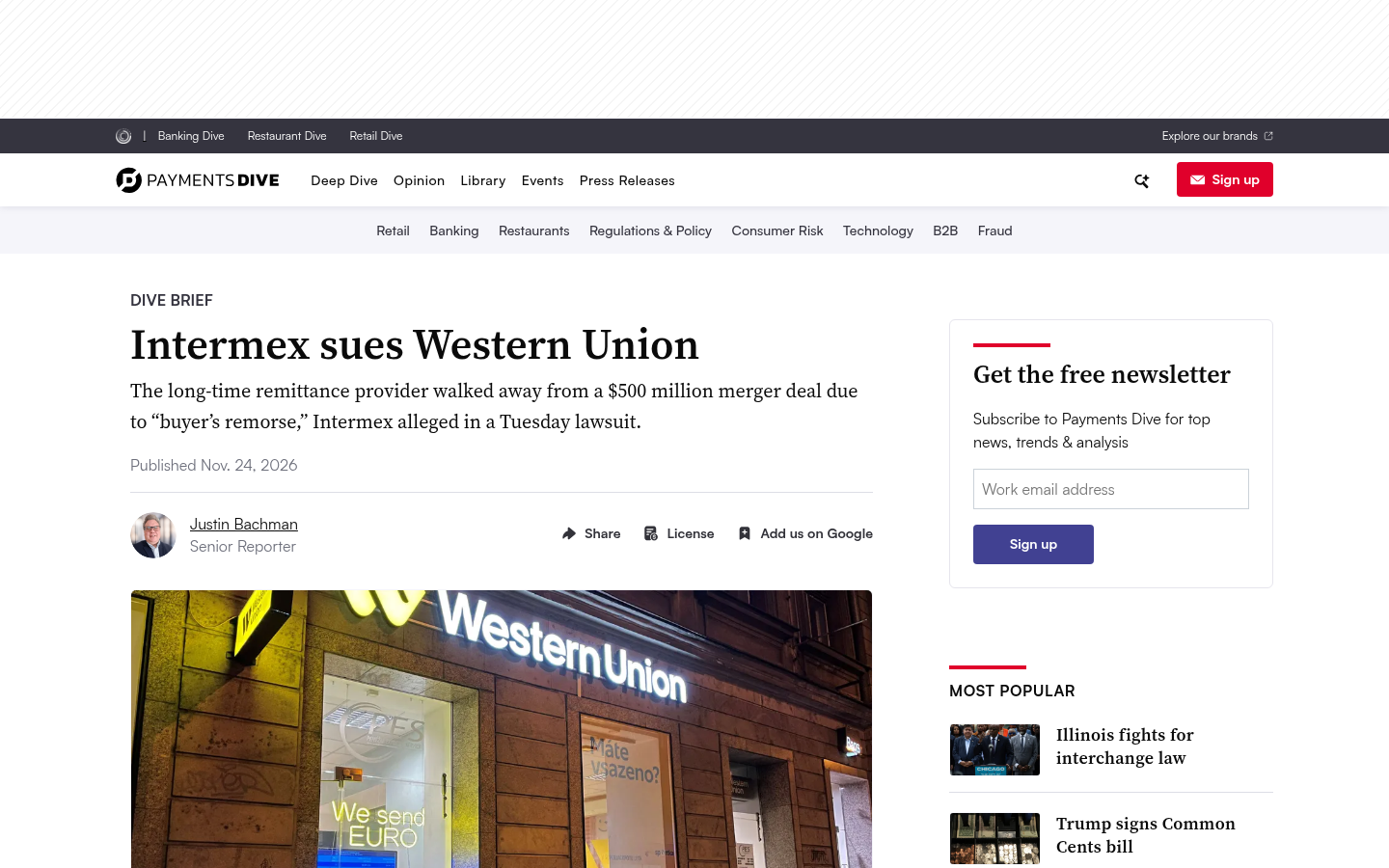
Intermex alleges in its 24 November 2026 lawsuit that Western Union gained at least $50 million in annual cost savings by studying Intermex during merger planning, then walked away from their roughly $500 million, $16-per-share deal without paying Intermex stockholders anything (Source: Payments Dive).

We follows how the remittance industry is changing, from new taxes to stablecoin rails, and the fight between Western Union and Intermex is the biggest remittance deal dispute of the year.
Western Union agreed in August 2025 to buy Intermex, a Miami-based money transfer company focused on Latin America and the Caribbean.
Fifteen months later, the deal is in the Delaware Court of Chancery, with each side blaming the other and a California regulator at the centre of the dispute.
This analysis explains what happened, what each side argues, why California mattered, what the case says about the remittance market, and what to watch next.
Key Takeaways
- Western Union agreed to buy Intermex for $16 per share in August 2025.
- It terminated the deal on 10 November 2026, the contract's outside date.
- California's DFPI approved the merger with conditions the same evening.
- Intermex sued in Delaware to force Western Union to close.
- Falling remittance volumes and a new US tax shaped the dispute.
The Deal in Brief
Western Union announced the roughly $500 million acquisition of International Money Express (Intermex) in August 2025, saying it would expand its US retail footprint, cut costs and speed up digital customer growth. Intermex, founded in 1994, sends money from the US and four other countries to about 60 nations through thousands of bank and retail locations.
| Date | Event |
|---|---|
| 10 Aug 2025 | Merger agreement signed |
| 11 Feb 2026 | California first approves |
| 14 Aug 2026 | California suspends approval |
| 14 Aug 2026 | New York approves |
| 10 Nov 2026 | Outside date and termination |
| 11 Nov 2026 | Intermex rejects termination |
| 24 Nov 2026 | Intermex files lawsuit |
Every other approval came through. Western Union said it had clearance from 54 states, territories and foreign countries, US merger clearance and change of control filings in the UK and Spain, leaving only California.
Western Union's Side
Western Union said California's Department of Financial Protection and Innovation (DFPI) delivered final conditions on the evening of 10 November 2026 that would have required material changes to its business model, its agent relationships and its long-term strategy. Its board decided to terminate, and under the agreement neither company owes the other a payment (Source: Western Union).
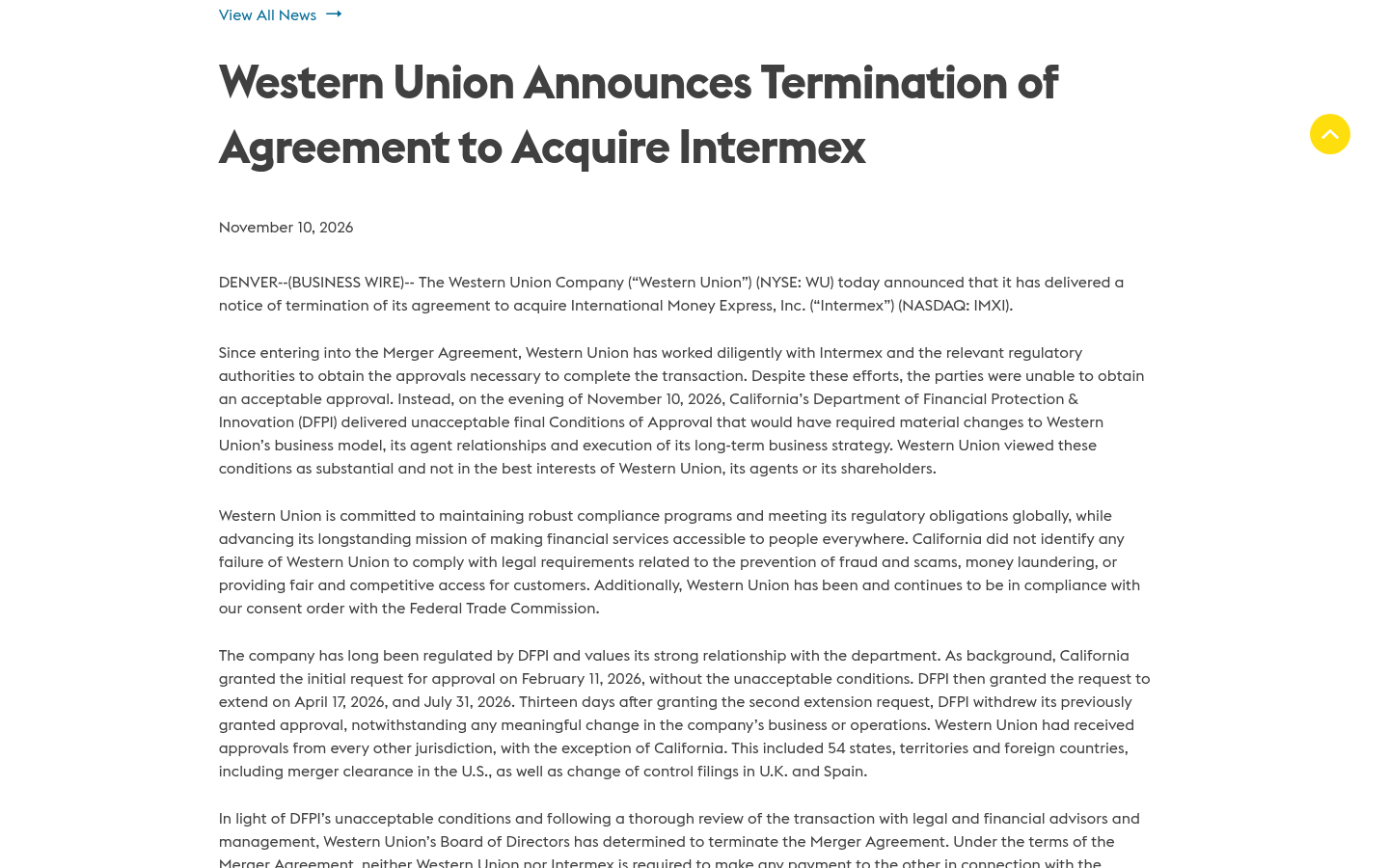
- Shifting approval: California first approved the deal on 11 February 2026 and extended that approval twice, then withdrew it 13 days after the second extension.
- No compliance finding: Western Union said California did not identify any failure on fraud, scams, money laundering or fair access.
- Contract right: The merger agreement let either side walk away if the deal had not closed by the 10 November outside date.
- Firm position: A spokesperson told Payments Dive the company stands by its decision and will vigorously defend against the lawsuit.
Intermex's Side
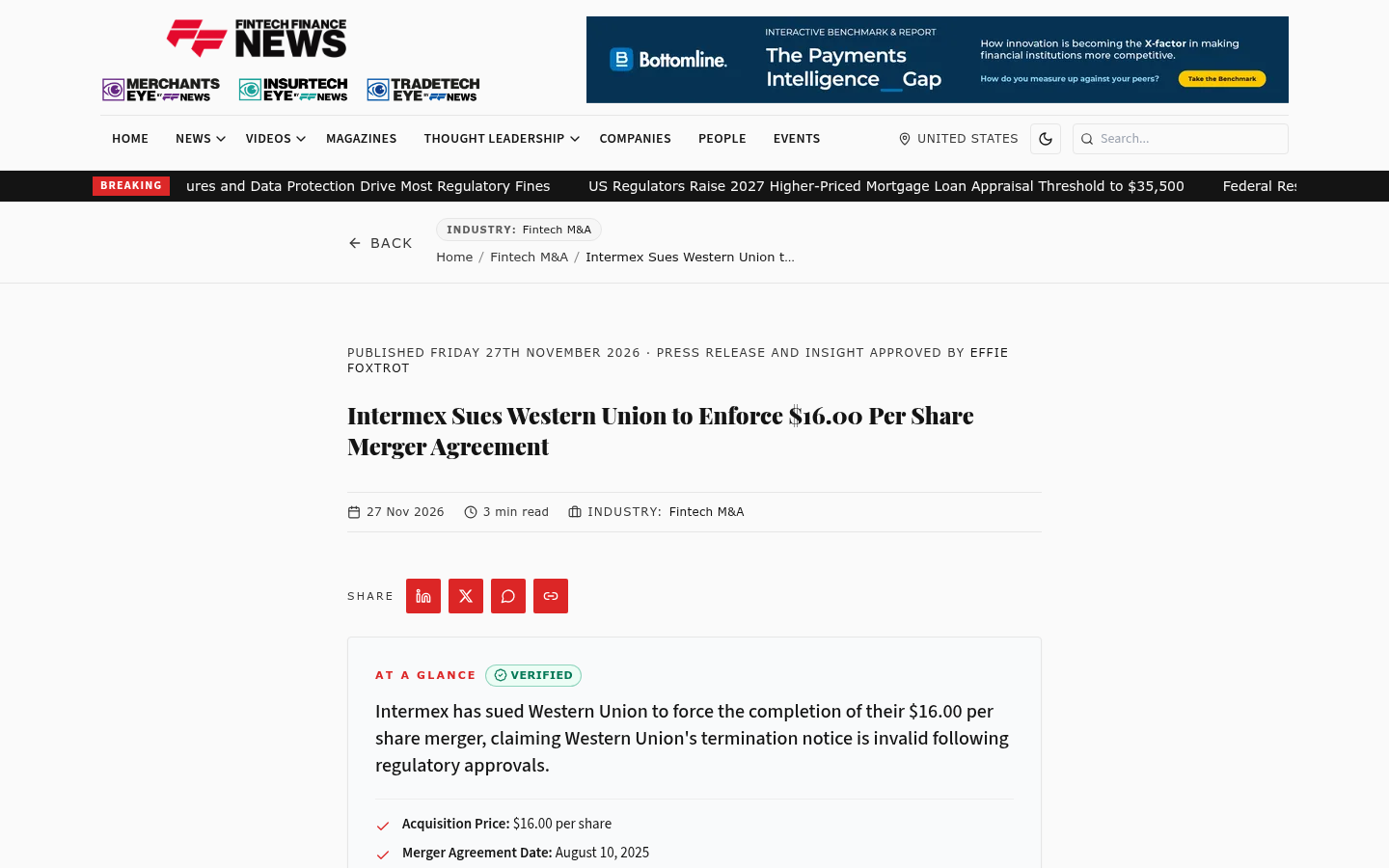
Intermex says the termination is invalid because every closing condition had been met once California issued its conditional approval, and the deal was ready to close. It filed suit in the Delaware Court of Chancery seeking specific performance, an order forcing Western Union to complete the purchase at $16 per share in cash (Source: FF News).
- Breach of contract: Intermex argues Western Union did not use reasonable best efforts to win California's approval, so it had no right to terminate.
- Running down the clock: The lawsuit says Western Union offered nothing to the regulator and let the outside date arrive.
- Private meetings: Intermex alleges Western Union's CEO met California's DFPI head privately and discussed whether the $16 price was too high.
- Buyer's remorse: Intermex says Western Union came under shareholder pressure to escape the deal as the remittance market weakened.
- Remedies sought: Specific performance, injunctive relief and damages.
These are allegations in a complaint. Western Union disputes them, and none has been tested in court.
Why California Mattered
Money transmitters in the US need a licence in almost every state, and a change of control needs each state's approval. That gives a single large state real power over a national deal.
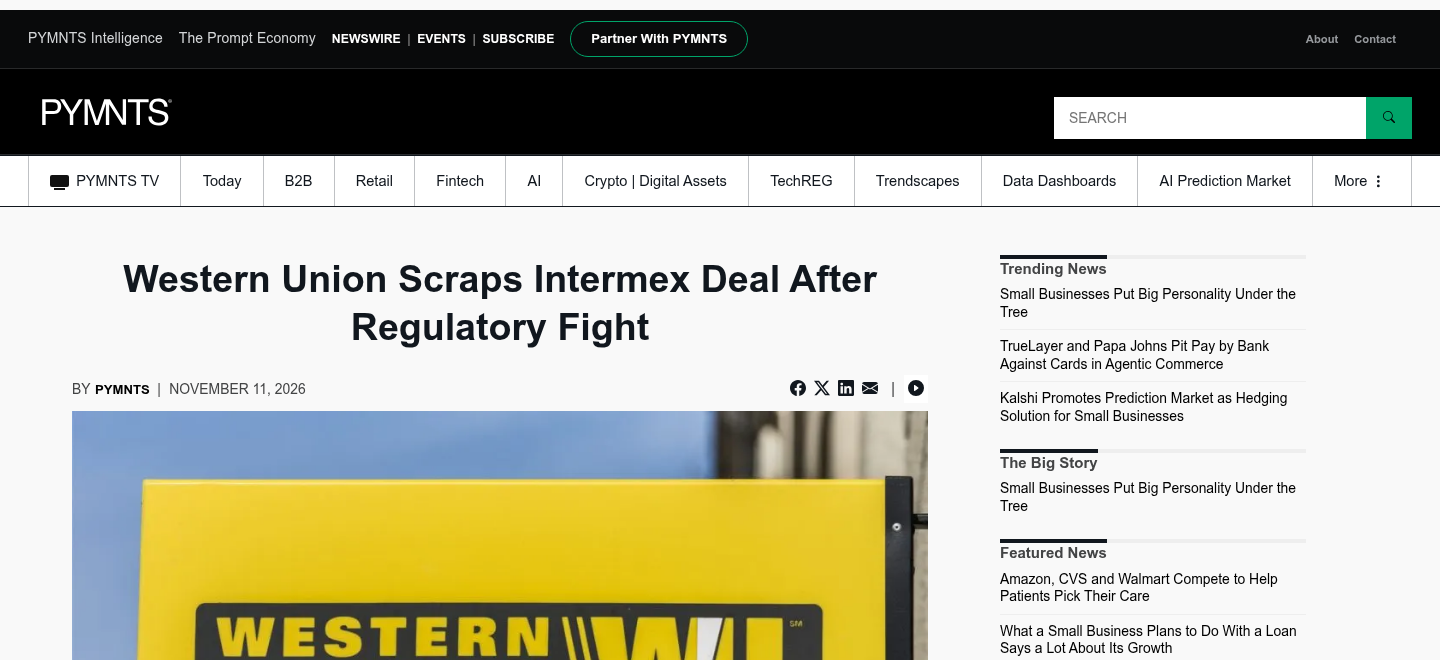
California's DFPI, led by former CFPB director Rohit Chopra, gave conditional approval on 10 November and said its conditions were designed to prevent fraud, scams and money laundering and ensure fair and competitive access to financial services, according to PYMNTS (Source: PYMNTS).
- New York precedent: New York's DFS approved the deal in August after Western Union made commitments on remittance services and locations in the state.
- Political pressure: New York City Mayor Zohran Mamdani had asked the state regulator to block the deal, arguing it would hurt the city's immigrants.
- Timing risk: State-by-state licensing makes remittance mergers slow, which raises the chance that a contract's outside date arrives first.
A Shrinking Remittance Market
The deal was struck in a different market. Since then, US remittances have come under pressure from several directions at once.
- Fewer senders: Changes in US immigration policy have reduced the number of migrant workers sending money home.
- Mexico decline: The lawsuit says remittances to Mexico fell about 4% to $62.5 billion last year, the first drop in 11 years.
- A new tax: A 1% US excise tax on remittances took effect on 1 January 2026, as covered in our guide to the US remittance tax.
- Shift to digital: Customers keep moving from retail agents to apps, which weakens the value of a store network like Intermex's.
Those trends explain why the $16 price may look high to Western Union now, and why Intermex wants the deal enforced rather than renegotiated.
What It Means for Senders and the Industry
For customers, nothing changes today. Both companies keep operating separately while the case runs. Our list of Western Union alternatives and our Remitly vs Wise comparison show the options senders already have.
- Consolidation slows: The case shows how hard it is to close a large US remittance merger, which may deter future deals.
- Digital players gain: App-first providers face fewer agent-network issues and less exposure to the retail decline.
- Stablecoin rails grow: Western Union itself is betting on stablecoins, with its USDPT stablecoin on Solana, a move that matters more if retail remittances keep shrinking.
What to Watch
- Expedited schedule: Whether the Delaware court fast-tracks the case, as it often does in merger disputes.
- Western Union's response: Its formal answer and any counterclaims.
- California's role: Whether the DFPI comments on the dispute or on its conditions.
- Settlement: Whether the companies agree a lower price or a break-up payment.
- Intermex results: How its business holds up while the deal is in limbo.
Conclusion
We tracks the forces reshaping remittances, and the Intermex lawsuit shows how quickly a strategic deal can turn into a legal fight when the market moves.
Western Union says it used a contractual right after a regulator imposed unacceptable terms. Intermex says Western Union ran down the clock to escape a price it no longer liked.
The Delaware court will decide which reading of the merger agreement holds.
Either way, the case highlights the pressures on traditional remittance players: fewer senders, a new tax, a shift to digital and a slow, state-by-state approval process.
Read Next
- OakNorth's US Bank Charter: What the CUB Deal Means for Foreign Fintechs
- Best Apps to Buy Nvidia Stock in Singapore (2026): 5 Brokers Compared on Fees and FX
- Private Health Insurance Rebate Changes: What Over-65s Lose From April 2027
FAQs
1. Why is Intermex suing Western Union?
Intermex is suing Western Union to force it to complete their August 2025 merger at $16 per share. Intermex says Western Union's termination on 10 November 2026 was invalid because all closing conditions were met and Western Union breached its obligations.
2. Why did Western Union terminate the Intermex deal?
Western Union terminated the Intermex deal because it said California's DFPI imposed unacceptable conditions that would have required material changes to its business model and agent relationships. The deal had also passed its 10 November 2026 outside date.
3. How much was the Western Union and Intermex deal worth?
The Western Union and Intermex deal was worth about $500 million, or $16 per Intermex share in cash. It was signed on 10 August 2025.
4. Does Western Union owe Intermex a break-up fee?
Western Union does not owe Intermex a break-up fee under its reading of the merger agreement. Western Union says neither company must pay the other on termination, while Intermex is seeking specific performance and damages in court.
5. Does the lawsuit affect Western Union or Intermex customers?
The lawsuit does not affect Western Union or Intermex customers directly. Both companies continue to operate separately and process money transfers as normal while the case runs.
Disclaimer: This content is provided for informational purposes only and does not constitute legal, financial, or investment advice. Claims described here are allegations made by the parties and have not been decided by a court. Details reflect publicly available information as of November 2026 and may change as the case proceeds. Check official filings and company statements for the latest updates.
Join the official Coincamps community:
Telegram: https://t.me/coin_camps
Recommended
Highnote Applies for a US National Bank Charter: What It Means for Embedded Payments
Nov 30, 03:27
Emirates Islamic Alternatives (2026): 4 Islamic Banks to Switch To After the DIB Deal
Nov 30, 01:30
SpaceX vs Tesla Stock (2026): Growth, Cash Burn, Control and the Merger Question
Nov 29, 23:32
Weekly Preview | US Nonfarm Payrolls, Jensen Huang to Testify Before the Senate; Binance to Open Trading in Over 1,000 Hong Kong Stocks and ETFs
Nov 29, 20:36United Fidelity Bank Failure: What Happens to Your Money and FDIC Coverage
Nov 29, 17:25
Payoneer vs Wise in 2026: Fees, FX Rates and Payouts
Nov 29, 15:14