
Stablecoin Liquidity Pools 2026: PancakeSwap v4 & Curve APY
Last updated: September 28, 2026
Stablecoin liquidity pools have become the backbone of decentralized finance, offering some of the most consistent and capital-efficient yield opportunities available to crypto holders in 2026.
With billions in stablecoin TVL spread across Ethereum, Base, Arbitrum, and other networks, pools like Curve's 3pool and Aerodrome's USDC-USDT have redefined what low-slippage, low-risk liquidity provision looks like.
This guide covers the best liquidity pools for stablecoin pairs in 2026, breaking down the top platforms, yield opportunities, key evaluation criteria, and the risks every LP should understand before deploying capital.
Key Takeaways
- Stablecoin pools limit impermanent loss because both assets target the same dollar peg, though a depeg can still cause real losses.
- On Sep 28, 2026, PancakeSwap stable-stable pools on BNB Chain with over $1M in liquidity earned about 0.02% to 1.05% in 24h trading-fee APR (PancakeSwap).
- The largest reward-driven Curve stable pools paid about 2.2% to 4.6% APY, while Curve 3pool paid close to 0% (DefiLlama).
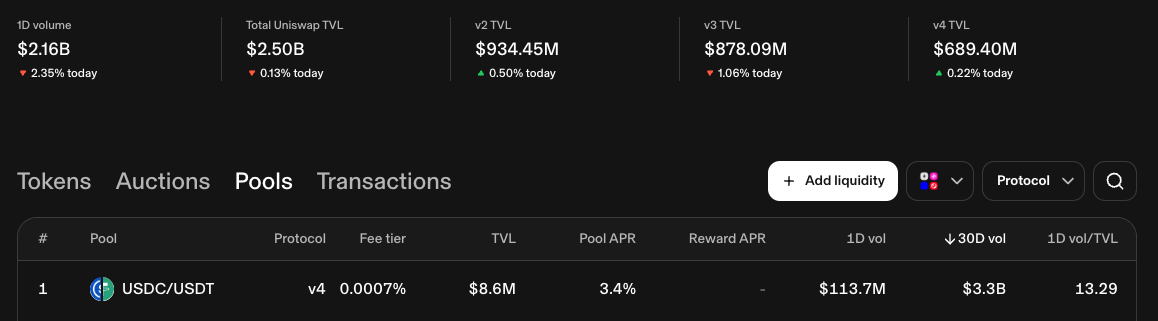
- Uniswap v3’s USDC-USDT 0.01% pool on Ethereum held $34.3M and paid about 0.88% APY from fees alone (DefiLlama).
- On PancakeSwap Infinity (v4) you add liquidity by choosing a CLAMM or LBAMM pool, entering amounts, setting a range and confirming in your wallet (PancakeSwap).
What Is a Liquidity Pool?
A liquidity pool is a smart contract that holds two or more tokens and enables decentralized trading without the need for a traditional order book. Instead of matching buyers and sellers directly, traders swap against the pool itself, and the price adjusts algorithmically based on the ratio of assets inside.
Liquidity providers (LPs) deposit equal value of both assets into the pool and, in return, earn a proportional share of every trading fee generated by swaps. The more volume a pool processes, the more fee revenue it distributes to its LPs.
The pricing mechanism behind most pools is an Automated Market Maker (AMM) model. Standard AMMs use a constant-product formula, which works well for volatile asset pairs but produces unnecessary slippage when applied to stablecoins that should always trade near 1:1.
This is where StableSwap invariants, pioneered by Curve Finance, make a significant difference. By using a pricing curve specifically optimised for near-parity assets, StableSwap pools allow much larger trades to execute with far less price impact, making them the preferred architecture for stablecoin pairs.
A few key terms worth understanding before evaluating any pool:
1. TVL (Total Value Locked):
The total value of assets deposited in a pool. Higher TVL generally means deeper liquidity and lower slippage for traders.
2. Impermanent Loss (IL):
The temporary reduction in value an LP experiences when the price ratio between pooled assets shifts away from the ratio at the time of deposit. In stablecoin pools, this risk is small because both assets target the same dollar peg.
3. APY (Annual Percentage Yield):
The annualised return an LP earns, combining trading fees and any additional token emissions or rewards.
4. Emissions:
Governance token rewards (such as CRV or AERO) distributed to LPs as an additional incentive on top of trading fees.
5. Ve-tokenomics:
A governance model where users lock tokens (e.g., veCRV, veAERO) to earn boosted rewards and voting rights over which pools receive the most emissions.
What Are the Benefits of Liquidity Pools for Stablecoin Pairs in 2026?
Stablecoin liquidity pools occupy a unique position in DeFi: they offer yield-generating opportunities with a risk profile considerably lower than most other on-chain strategies. Here is why they have attracted significant LP capital heading into 2026.
1. Near-Zero Impermanent Loss.
Because stablecoin pairs like USDC-USDT or USDC-DAI are both designed to hold a dollar peg, the price ratio between them stays close to parity. This dramatically reduces the impermanent loss that plagues LPs in volatile asset pools, making stablecoin pools far more predictable for long-term liquidity provision.
2. Consistent Yield.
Returns vary widely by venue. On September 28, 2026, DefiLlama showed the largest reward-driven Curve stable pools paying roughly 2% to 5% APY, mostly from CRV and partner incentives, while fee-only stable pools on Uniswap and PancakeSwap generally paid under 1%. Treat any headline APY as a snapshot, not a promise.
3. Capital Efficiency Through Concentrated Liquidity.
Innovations introduced by Uniswap v3 and expanded in v4 allow LPs to concentrate their capital within a tight price range around the peg. This means the same amount of capital generates significantly more fee revenue than a full-range position would, as long as the price stays in range.
4. Deep Liquidity for Large Trades.
High-TVL stable pools can absorb large trades with minimal slippage. This makes them essential infrastructure for protocol treasuries, institutional traders, and DeFi protocols that need to rebalance large stablecoin positions efficiently.
5. Multi-Chain Availability.
Stablecoin liquidity pools are no longer confined to Ethereum mainnet. In 2026, strong pools exist on Base, Arbitrum, Optimism, and BNB Chain, offering LPs the choice between maximum depth on Ethereum and low gas costs on Layer 2 networks.
6. Composability With the Broader DeFi Ecosystem.
Stable LP positions are not static. Many LPs deposit into Curve, receive LP tokens, and then stake those tokens on Convex to earn boosted CRV rewards on top of base fees. Others use LP positions as collateral in lending protocols like Aave or Morpho to layer additional yield through looping strategies.
7. 2026 Trends Worth Noting.
The stablecoin pool landscape is evolving quickly. Uniswap v4 hooks enable programmable pool logic including dynamic fees and auto-rebalancing.
Intent-based routing via aggregators like 1inch and Jumper increasingly directs swap volume to the deepest pool across any chain, benefiting LPs on less prominent networks. Yield-bearing stablecoins like USDe, sUSDS, and USDY are entering pool ecosystems, adding a native yield layer on top of LP fees.
Key Criteria for Evaluating Stablecoin Liquidity Pools in 2026
With dozens of pools and platforms competing for LP capital, knowing what to evaluate is just as important as knowing which pools rank highest. The following criteria should guide every decision before deploying stablecoins into a liquidity pool.
1. Depth and Slippage.
TVL is the most direct indicator of pool quality for traders and LPs alike. Deeper pools absorb large trades with less price impact, generate more consistent fee volume, and attract more routing from aggregators.
When evaluating a pool, check its TVL on DefiLlama and compare it against recent daily volume to gauge fee-earning potential.
2. Yield Sources.
Understanding what makes up the advertised APY is critical. Fee-based yield is sustainable as long as trading volume continues. Emission-based yield from governance tokens can boost returns significantly but is subject to dilution as more liquidity enters the pool and as token prices fluctuate.
A pool with a healthy split between fee revenue and emissions is preferable to one that relies almost entirely on token rewards.
3. Fee Structure.
Stablecoin pools use the lowest fee tiers available. Uniswap v2 charges a flat 0.30% on every pool, v3’s standard tiers are 0.05%, 0.30% and 1% with additional tiers enabled by governance, and v4 lets pool creators set any fee, including dynamic fees through hooks (Uniswap docs). The deepest stable pools on Uniswap and PancakeSwap typically sit in a 0.01% tier. Always verify the exact fee tier before depositing.
4. Chain-Specific Advantages.
Ethereum mainnet hosts the deepest and most composable stable pools but comes with high gas costs that can erode returns for smaller LPs. Layer 2 networks like Base, Arbitrum, and Optimism offer lower fees and growing liquidity, making them attractive for LPs who interact with their positions frequently or manage active concentrated ranges.
5. Smart Contract Risk.
Every pool carries smart contract risk regardless of its reputation. Before deploying significant capital, review the protocol's audit history, check whether insurance coverage is available via platforms like Nexus Mutual, and consider the age and track record of the contracts.
Newer protocols or factory pools with less history carry higher risk than battle-tested deployments.
6. Incentive Sustainability.
Emission-based APY can look attractive but can decline sharply if governance token prices fall, if emissions schedules reduce, or if a large influx of new LPs dilutes the reward pool. Evaluate whether the protocol has mechanisms to sustain incentives, such as Curve's gauge voting or Aerodrome's ve(3,3) model, which routes emissions based on locked token votes.
7. Depeg Risk.
Stablecoin pools are not entirely immune to impermanent loss.
A depeg event in any of the pooled assets, even a temporary one, creates a price imbalance that generates real IL for LPs. Stick to pools containing the most reliable stablecoins (USDC and USDT have the strongest track records) and monitor peg stability regularly, particularly in pools that include newer or algorithmic stablecoins.
Curve Finance: The Undisputed Leader for Stablecoin Swaps and Low-Slippage Liquidity
Curve Finance is the protocol that established the standard for stablecoin liquidity pools, and in 2026 it remains the single most important venue for large, low-impact stable swaps.
Its StableSwap invariant, designed specifically for assets that trade near parity, produces less slippage than standard constant-product AMMs on large trades, which is why Curve has long been a default venue for protocol treasuries and institutional participants.
1. Signature Pools:
The flagship is the 3pool (USDC, USDT, DAI) on Ethereum, one of the most liquid and widely referenced pools in all of DeFi. Curve also operates crvUSD pools, pools featuring FRAX, USDe, and various yield-bearing stablecoins through its factory system, as well as deployments across Arbitrum, Base, Polygon, and other networks.
2. 2026 Stats:
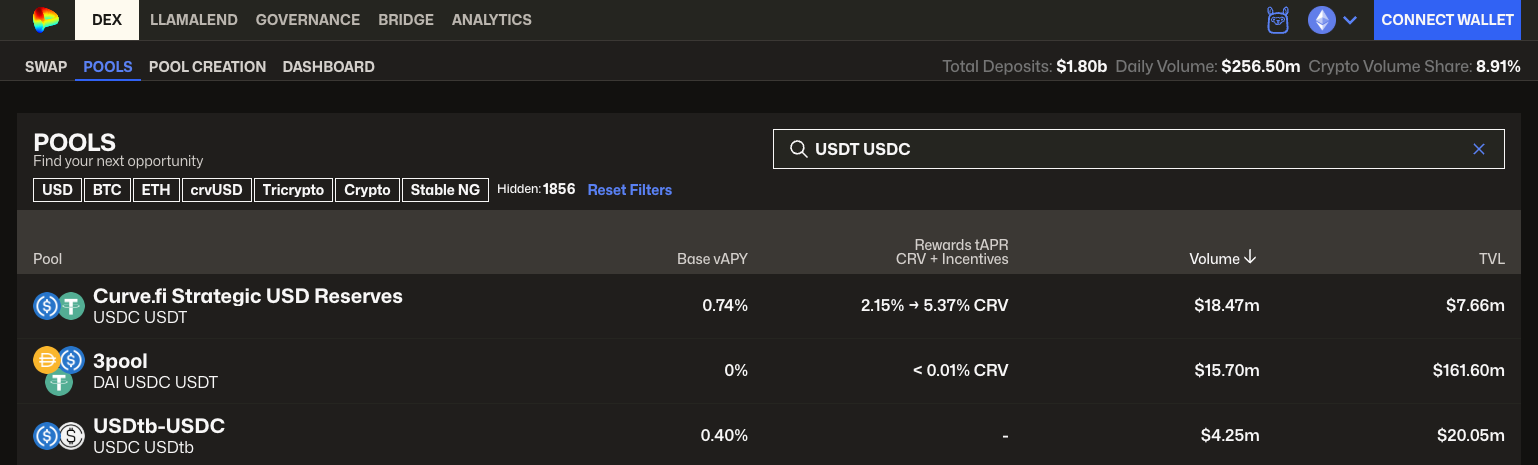
According to DefiLlama yields data on September 28, 2026, the original 3pool (DAI-USDC-USDT) on Ethereum held about $161.2 million but paid close to 0% APY. The action has moved to newer pairs: USDC-RLUSD held $59.5 million at about 4.61% APY, PYUSD-USDC $32.5 million at about 3.93%, USDT-crvUSD $36.5 million at about 3.17%, and FRAX-USDe $34.0 million at about 2.23%, with most of that yield coming from rewards rather than fees.
3. Yield Mechanics:
LPs in Curve pools earn a base return from trading fees. On top of that, Curve distributes CRV governance token emissions to stakers, with boost multipliers available for LPs who lock CRV for veCRV. The most common strategy for maximising Curve yield is staking LP tokens on Convex Finance, which aggregates veCRV voting power to provide boosted CRV rewards to depositors without requiring them to lock CRV themselves.
Combined returns of roughly 2.2% to 4.6% APY were available on the largest reward-driven Curve stable pools on September 28, 2026 (DefiLlama), while 3pool itself paid close to zero. Convex boosting can lift CRV rewards further.
Pros:
- Deepest stablecoin liquidity of any protocol, especially on Ethereum
- Lowest slippage for large stable swaps
- Multi-chain deployment covers all major networks
- Minimal impermanent loss due to StableSwap design
- Strong composability with Convex, Aave, and other protocols
Cons:
- CRV emissions can dilute yield over time as more LPs enter
- Historical exploit in 2023 (a Vyper compiler vulnerability) raised concerns, though mitigations and audits have since been strengthened
- Gas costs on Ethereum mainnet can be significant for smaller positions
Best For:
Large swaps, conservative long-term LPing, protocol treasuries seeking reliable stable yield, and passive investors who want a set-and-stake strategy via Convex.
Uniswap v4 and Concentrated Liquidity: Capital-Efficient Stable Pools with Programmability
Uniswap is one of the largest DEXs across EVM chains, and v4’s hooks and flexible fees add a level of programmability and capital efficiency that makes it a compelling option for stablecoin LPs willing to manage their positions actively.
The core innovation relevant to stable LPs is concentrated liquidity, introduced in v3 and refined in v4. Rather than spreading capital across the full price curve, LPs can target a very tight band around the peg for a USDC-USDT pool.
Within that range, their capital acts as if it were a much larger position, generating proportionally more fees per dollar deployed. For stablecoin pairs that almost never trade outside a very tight band, this is a highly effective approach.
1. What v4 Adds:
Uniswap v4 introduces hooks, which are programmable extensions that can modify pool behaviour before or after swaps, liquidity changes, and other actions. For stablecoin pools this opens the door to dynamic fee adjustment based on market volatility, automatic position rebalancing when prices drift, and custom logic for yield distribution. These features are still maturing but represent a meaningful step forward for active LP strategies.
2. Signature Pools:
USDC-USDT and USDC-DAI concentrated positions remain the primary stable pairs. v4 hook-powered pools are growing in adoption among more sophisticated LPs and protocols building on top of Uniswap's infrastructure.
3. Yield Mechanics:
Unlike Curve, Uniswap does not distribute governance token emissions to LPs. Returns are fee-driven, so yield depends on volume routed through your range. On September 28, 2026, the USDC-USDT 0.01% pool on Ethereum paid about 0.88% APY (1.38% 30-day average), while a v4 USDC-USDT dynamic-fee hook pool showed 8.30% on the day but only 2.23% on a 30-day average, a reminder of how volatile fee APYs are.
If the price moves outside your range, you stop earning fees entirely until you rebalance.
Pros:
- Strong ecosystem integration and routing from major aggregators
- v4 hooks enable highly customised and automated pool strategies
- Fee-only yield model is more sustainable than emission-dependent returns
- Broad multi-chain deployment across all major EVM networks
Cons:
- Active management is required for tight concentrated positions
- No governance token emissions mean yield is lower than Curve in low-volume periods
- Very large stable trades may still experience more slippage than Curve's StableSwap architecture
Best For:
Active LPs who are comfortable managing price ranges, developers building custom pool logic with v4 hooks, and DeFi protocols that need deep integration with the Uniswap routing ecosystem for mid-to-large stablecoin trades.
L2-Native Powerhouses: Aerodrome on Base and Emerging Competitors
As Layer 2 networks have matured, a new generation of DEXs has emerged that are purpose-built for their specific chains. These protocols combine the ve-tokenomics model pioneered by Solidly with the low gas costs and growing native stablecoin ecosystems of L2 networks. In 2026, the result is a category of stablecoin pools that can compete directly with Ethereum mainnet venues on yield while offering significantly lower transaction costs for LPs and traders alike.
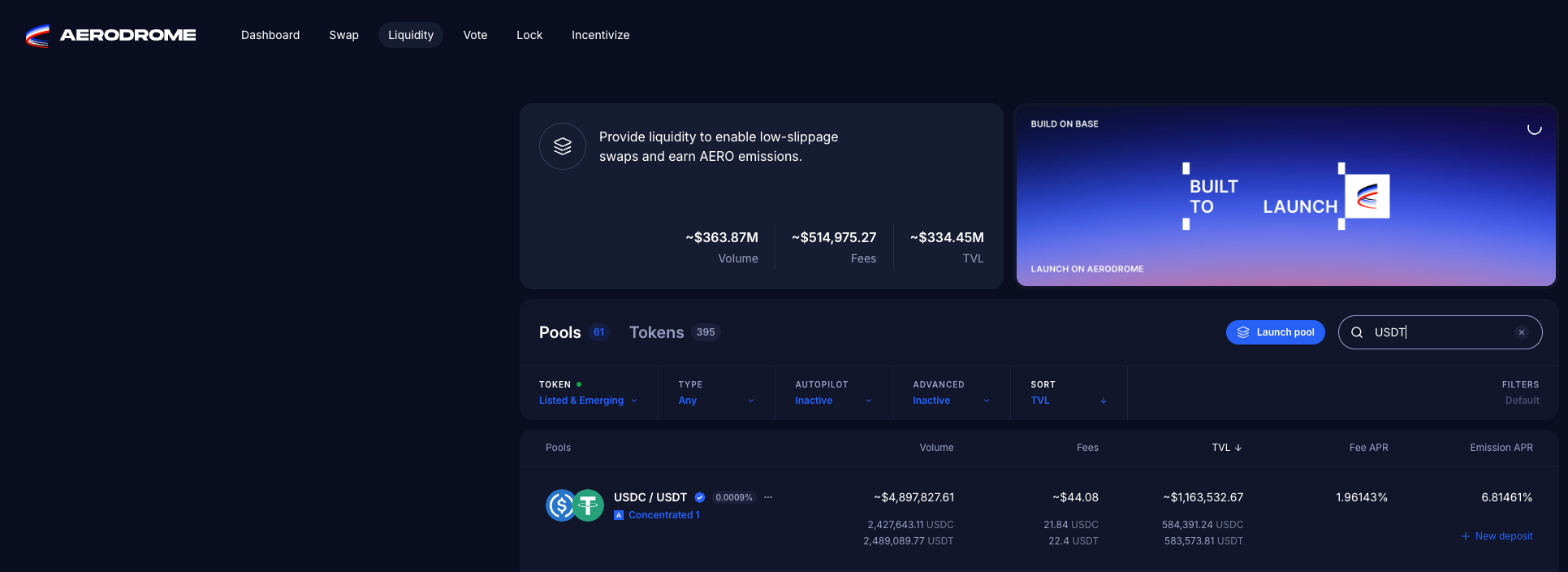
Aerodrome (Base): The Dominant Stable Venue on Coinbase's L2
Aerodrome is a fork of the Solidly AMM architecture, enhanced with a ve(3,3) vote-incentive model and deployed on Base, Coinbase's Ethereum Layer 2. It has become the dominant liquidity venue on Base and one of the most important stablecoin pool platforms in the L2 ecosystem.
The ve(3,3) model works by allowing AERO token holders to lock their tokens for veAERO, which grants voting rights over which pools receive AERO emissions each week. Protocols and large LPs compete to direct emissions toward their preferred pools by voting or bribing veAERO holders, creating sticky, incentive-driven liquidity that is self-reinforcing.
Signature Pools: USDC-USDT, USDC-DAI, and USDC-USDbC (the native Base stablecoin variant) are the primary stablecoin pairs. These pools benefit from Base's growing ecosystem activity and Coinbase's continued efforts to drive stablecoin adoption on-chain.
2026 Stats: Base held about $5.02 billion of USD-pegged stablecoins on September 28, 2026 (DefiLlama). Aerodrome’s Slipstream USDC-USDT CL1 pool held about $1.6 million and showed about 22.19% APY, mostly from fees, which shows how smaller, tightly concentrated pools can out-earn deep ones while carrying more range and liquidity risk.
Pros:
- Low gas costs on Base make frequent interactions and compounding practical
- ve(3,3) model generates sticky, vote-incentivised liquidity that resists sudden withdrawals
- Competitive APY combining trading fees and AERO emissions
- Growing Base ecosystem driven by Coinbase's retail and institutional user base
Cons:
- Primarily Base-specific, though cross-chain routing is increasing inflows
- Yield depends partly on AERO token price and emission sustainability
Best For: Base ecosystem users, LPs looking for cost-efficient stable yield, and cross-chain participants routing stablecoin flows through Base.
PancakeSwap v4 (Infinity) Stablecoin Pools: APY and How to Add Liquidity
PancakeSwap is the main stablecoin liquidity venue on BNB Chain. Its latest AMM generation, PancakeSwap Infinity (often called v4), supports two pool types, CLAMM (concentrated liquidity, for active LPs who set custom price ranges) and LBAMM (Liquidity Book, with liquidity spread across price bins for more passive LPs), plus Hooks that customize pool behavior such as dynamic fees (PancakeSwap). Older v3 and v2 pools remain live alongside Infinity.
Live PancakeSwap Stablecoin Pool APYs (September 28, 2026)
The table lists the largest stable-to-stable pools on BNB Chain by liquidity, using PancakeSwap’s own pool data retrieved on September 28, 2026 (PancakeSwap pools). APR is the trading-fee return over the previous 24 hours, annualized, and excludes any CAKE farm rewards or third-party incentives the interface may show.
| Pool (BNB Chain) | Version / fee | Liquidity | 24h fee APR |
|---|---|---|---|
| USDT-USDC | v3, 0.05% | $39.3M | 0.064% |
| USDT-USDC | v3, 0.01% | $30.1M | 0.145% |
| USDT-U | v3, 0.01% | $19.0M | 0.023% |
| USDT-USD1 | v3, 0.01% | $5.29M | 0.150% |
| USDT-U | Infinity CLAMM | $2.03M | 1.053% |
| USDT-USDC | Infinity CLAMM | $1.23M | 0.264% |
| USDT-BUSD | v3, 0.01% | $1.17M | 0.438% |
The takeaway is blunt: the deepest PancakeSwap stable pools currently earn well under 1% from fees, in a range of about 0.02% to 1.05% across pools with more than $1 million in liquidity (PancakeSwap). The smaller Infinity USDT-U pool earned the most because its daily volume was large relative to its liquidity. Check each pool page for live figures and any extra rewards before depositing.
How to Add Liquidity on PancakeSwap Infinity
PancakeSwap’s official guide describes the flow for both pool types:
- Go to the Liquidity page on PancakeSwap and connect a wallet on the right network (BNB Chain for the pools above).
- Toggle the "Infinity" view to see Hook-enabled pools.
- Choose a pool, for example an LBAMM or CLAMM USDT/USDC pool, and click "..." then "Add Liquidity", or open the pool to view details.
- Enter the amount of each token and select a price range. For LBAMM, also pick a liquidity shape: Spot, Curve or Bid-Ask.
- Approve the tokens and confirm the transaction in your wallet.
For stable pairs, a narrow range around the peg concentrates your capital and earns more fees per dollar while in range, but you stop earning if the price leaves it. A Spot or Curve shape centered on the current price is the simpler choice for passive LPs. PancakeSwap also notes that LPs earn trading fees when their liquidity is used and should be mindful of impermanent loss (PancakeSwap). If you are funding from another chain, compare routes with our cross-chain bridge guide first.
Comparison Table: Best Liquidity Pools for Stablecoin Pairs in 2026
| Platform / Pool | Chains | Key Stable Pairs | APY snapshot (Sep 28, 2026) | Yield Sources | Best For |
|---|---|---|---|---|---|
| Curve | ETH + L2s | 3pool, USDC-RLUSD, PYUSD-USDC | 3pool near 0%; top reward pools 2.2–4.6% (DefiLlama) | Fees + CRV + incentives | Large swaps, passive LPs |
| Uniswap v3 / v4 | Multi-EVM | USDC-USDT | 0.88% (v3 0.01%, Ethereum) (DefiLlama) | Fees only | Active LPs, composability |
| PancakeSwap v3 / Infinity | BNB Chain | USDT-USDC, USDT-USD1, USDT-U | 0.02–1.05% 24h fee APR (PancakeSwap) | Fees (+ CAKE where farmed) | BNB Chain users |
| Aerodrome | Base | USDC-USDT | 22.19% on a $1.6M CL1 pool (DefiLlama) | Fees + AERO emissions | Base ecosystem, low-gas LPing |
| Velodrome | Optimism | USDC-USDT, USDC-DAI | Varies by pool | Fees + VELO emissions | Optimism users |
| Balancer | Multi-EVM | Multi-stable pools | Varies by pool | Fees + BAL + lending yield | Custom multi-stable pools |
Conclusion
Stablecoin liquidity pools remain one of the lower-risk ways to earn in DeFi, but 2026 yields are modest. Fee-only pools on Uniswap and PancakeSwap mostly pay under 1%, reward-driven Curve pools pay a few percent, and higher numbers usually mean smaller pools, incentives or tight ranges that need active management.
Whether you are a passive LP looking for steady, set-and-forget returns or an active manager optimising positions across multiple chains, the stablecoin pool landscape in 2026 offers stronger, more diverse, and more composable options than at any previous point in DeFi's history.
Read Next
- Our SEO & AEO Authority Report
- We Partners with The Grid to Launch the Industry's Largest Stablecoin Directory
- Bitcoin Policy Institute Releases “Stablecoin Supremacy”
FAQs:
1. What is a stablecoin liquidity pool?
A stablecoin liquidity pool is a smart contract that holds two or more stablecoins, allowing users to trade between them while liquidity providers earn a share of the trading fees generated by each swap.
2. What is the difference between a stablecoin liquidity pool and a volatile asset liquidity pool?
The difference between a stablecoin liquidity pool and a volatile asset pool is that a stablecoin pool holds assets that trade near a 1:1 ratio, which minimizes impermanent loss, while a volatile pool holds assets whose prices fluctuate independently and can result in significant impermanent loss for liquidity providers.
3. What is impermanent loss in a stablecoin liquidity pool?
Impermanent loss in a stablecoin liquidity pool is the temporary reduction in value an LP experiences when the price ratio between the pooled assets shifts away from the ratio at the time of deposit, though in stablecoin pools this risk is significantly reduced because both assets are designed to maintain a stable dollar peg.
4. What is the best liquidity pool for USDC and USDT in 2026?
It depends on chain and style. On Ethereum, Uniswap v3’s USDC-USDT 0.01% pool held $34.3 million at about 0.88% APY on September 28, 2026 (DefiLlama); on BNB Chain, PancakeSwap’s USDT-USDC 0.01% pool held $30.1 million at about 0.145% 24h fee APR (PancakeSwap). For comparison with lending yields, see our USDC APR guide.
5. What is the typical APY for stablecoin liquidity pools in 2026?
On September 28, 2026, fee-only stablecoin pools on major DEXs mostly paid under 1% APY, while the largest reward-driven Curve stable pools paid about 2.2% to 4.6% (DefiLlama). Double-digit figures usually come from small pools, token incentives or narrow concentrated ranges.
6. How do I add liquidity to a PancakeSwap v4 stablecoin pool?
Open the Liquidity page, toggle the Infinity view, pick a CLAMM or LBAMM stable pool, enter amounts and a price range, then approve and confirm in your wallet (PancakeSwap).
Disclaimer:
This content is provided for informational and educational purposes only and does not constitute financial, investment, legal, or tax advice; no material herein should be interpreted as a recommendation, endorsement, or solicitation to buy or sell any financial instrument, and readers should conduct their own independent research or consult a qualified professional.
Join the official Coincamps community:
Telegram: https://t.me/coin_camps
Recommended
Desk: Brent Crude Tops $110, Musk's Net Worth Drops 528.6 Billion in Four Days After Tesla Roadster Launch
Oct 17, 21:49
JST Fifth Buyback and Burn Successfully Concludes: Over 170 Million Tokens Worth Approximately $23.53 Million Burned, Buyback Mechanism Set for Comprehensive Upgrade
Oct 17, 20:10
BitTorrent Brand Upgrade and Initial BTT Buyback & Burn Launch Simultaneously, Dual Engines Usher in New Era of Web3 Infrastructure
Oct 17, 20:00
Asia Market Daily: Japan's BOJ signals more rate hikes while Korea targets offshore perpetual platforms (2026/10/17)
Oct 17, 17:01Why did Papertrade backfire on you?
Oct 17, 17:01
The 'Strict Father' of Northern Myanmar: This Company Deploys 200,000 "AI Best Actors" to Strike Back Against Scammers
Oct 17, 15:34