
Ditching Meme speculation to build an "Alipay for machines"? Solana steps directly into the fray, racing to become the underlying banking layer for AI agents.
Summary:
The Solana Foundation has officially launched its dedicated AI infrastructure portal, solana.ai, simultaneously rolling out five official products including pay.sh, micro-payment channels, and confidential computing, while consolidating 28 core ecosystem projects across the web into a unified landscape.
Unlike the previous community frenzy around AI concept tokens, this official move marks a significant pivot in the convergence of public chains and AI. Alongside Base, which positioned itself around the x402 protocol, and NEAR, which is fully transitioning toward intent execution, mainstream public chains have abandoned the fantasy of running large models directly on-chain. They are collectively retreating to their stronghold: financial settlement. This means that with human user growth plateauing, the new battleground between public chains has shifted toward the machine economy arena for capturing default wallets and payment channels for the next generation of "silicon-based agents."
In recent years, whenever people mentioned "Solana plus AI" in crypto, what usually came to mind were somewhat absurd spectacles of speculative mania. From autonomous tweet-posting terminals to AI meme coins that pumped overnight by 100x, the AI narrative on public chains has felt more like an emotional casino where attention is paid for, one hype cycle after another.
But at this stage of the market, Solana's newly launched solana.ai appears to have ripped off all that superficial packaging.
This time, there are no frantic token issuance slogans or incitements of wealth myths. Instead, the Solana team has placed a more pragmatic commercial positioning at the top of the page: “Where machines meet money.”
In conjunction with this new portal launch, the Solana Foundation unusually rolled up its sleeves and debuted five foundational tools in one go:
These include pay.sh, an agent payment protocol focused on per-call, account-free billing; high-frequency streaming micro-payment state channels; an on-chain verifiable confidential computing solution developed jointly with hardware teams; Milo, a transactional AI agent that autonomously monitors markets and rebalances positions 7×24 hours a day; and an out-of-the-box developer platform.
Meanwhile, the official team has neatly integrated 28 core ecosystem projects spanning compute, training, frameworks, and payments into this landscape.
This does not appear to be a routine PR showcase. For the first time, Solana has completely tethered a full assembly line designed for AI agents to spend their own funds and execute their own tasks directly onto its own chain.
Officials Step In to Build Infrastructure, Solving How AI Agents Spend Money
A review of the new portal's core technical documentation reveals that the five underlying tools offered by the official team are not conceptual demos. Instead, they provide direct standardized solutions targeting the most painful bottlenecks AI agents face during on-chain interactions.
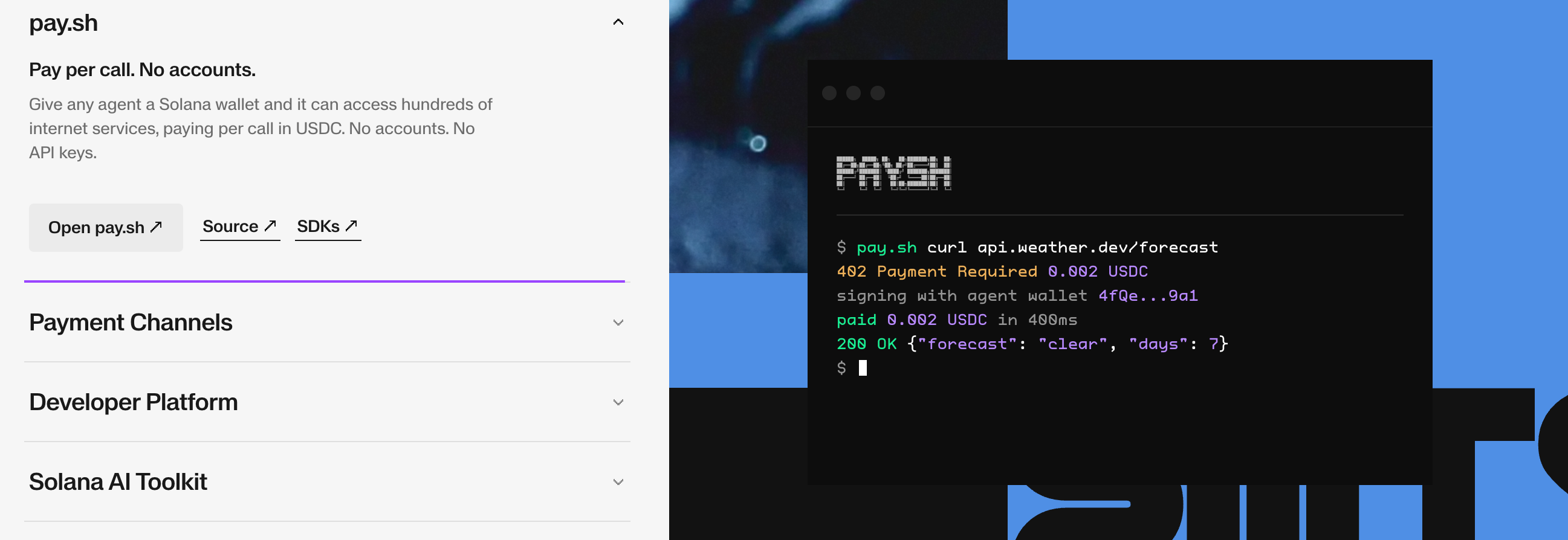
Leading the pack is the per-call agent payment protocol pay.sh.
Previously, when developers enabled agents to call external internet services, they had to manually register accounts, bind fiat credit cards, and generate lengthy API keys for them. pay.sh flattens all these intermediate steps:
All that is needed is a Solana wallet configured for the agent, allowing it to call external APIs per transaction using USDC directly. In the official example, calling a weather service interface once deducts 0.002 USDC straight from the wallet, with no passwords, no usernames, and zero risk of API key leakage or unauthorized transactions.
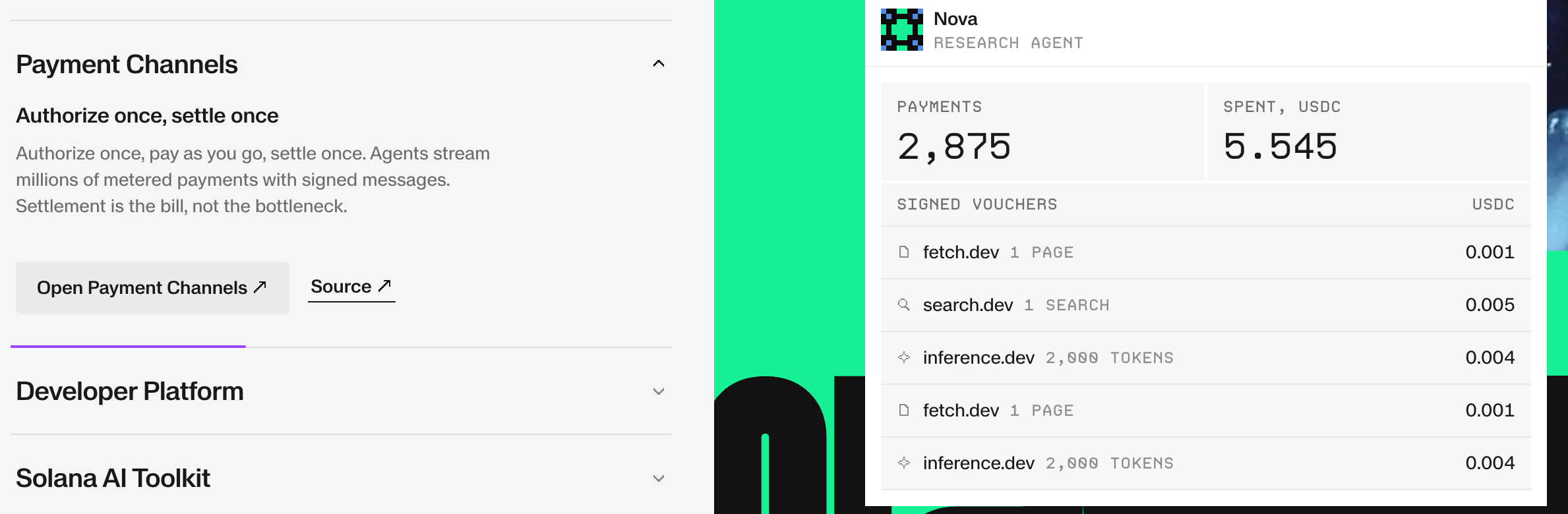
The second tool is micro-payment state channels (Payment Channels).
When an agent needs to invoke LLM tokens thousands of times in sequence, or scrape web pages at millisecond-level frequencies, even though Solana confirms a single transaction in just 200 milliseconds, launching an on-chain transaction for every invocation is still inadequate.
State channels adopt an architecture of “one-time on-chain authorization, off-chain streaming signature billing, and final one-time on-chain settlement,” specifically designed to handle sub-second high-frequency throughput and prevent high-volume requests from congesting the on-chain network.
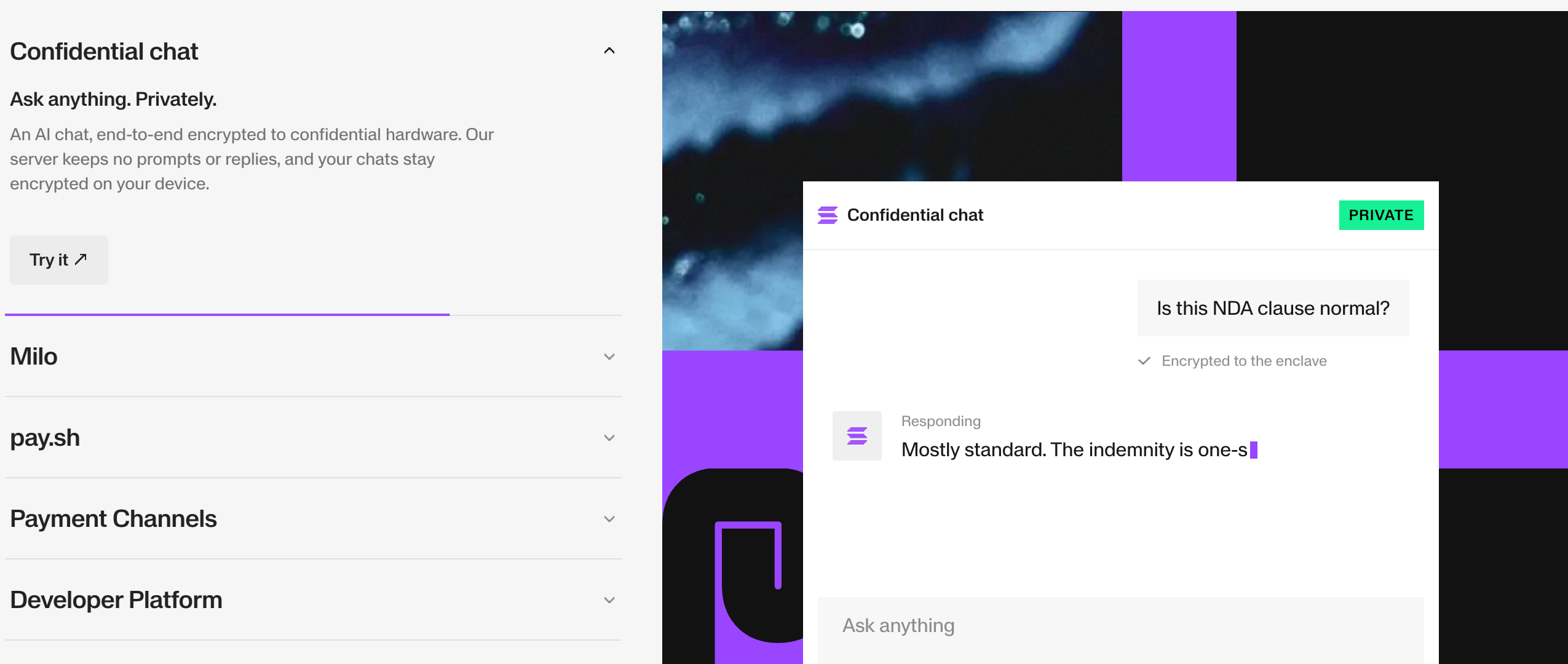
The third tool is the confidential computing solution (Solana Confidential Compute).
Developed in partnership with the Nito team, this solution leverages hardware-level Trusted Execution Environments (TEE) to run open-source LLMs off-chain. The official demo ran GPT-OSS 120B directly.
User prompts and uploaded PDF files are encrypted locally, with the server retaining no plaintext. The hardware's security integrity generates cryptographic proofs on the Solana chain for verification, attempting to alleviate enterprise-grade clients' concerns over data leakage.
As for the remaining two tools, Milo is positioned as a 7×24-hour autonomous market-monitoring and dynamic position-rebalancing trading agent demo, capable of automatically balancing SOL and USDC positions when on-chain volatility spikes. The accompanying Developer Platform outputs standard REST APIs, enabling engineers to generate wallets for agents, set daily spending caps with one click, and includes built-in compliant address screening and fiat cash-out channels.
Cataloging 28 Ecosystem Projects, the Landscape Hides Many Familiar Faces
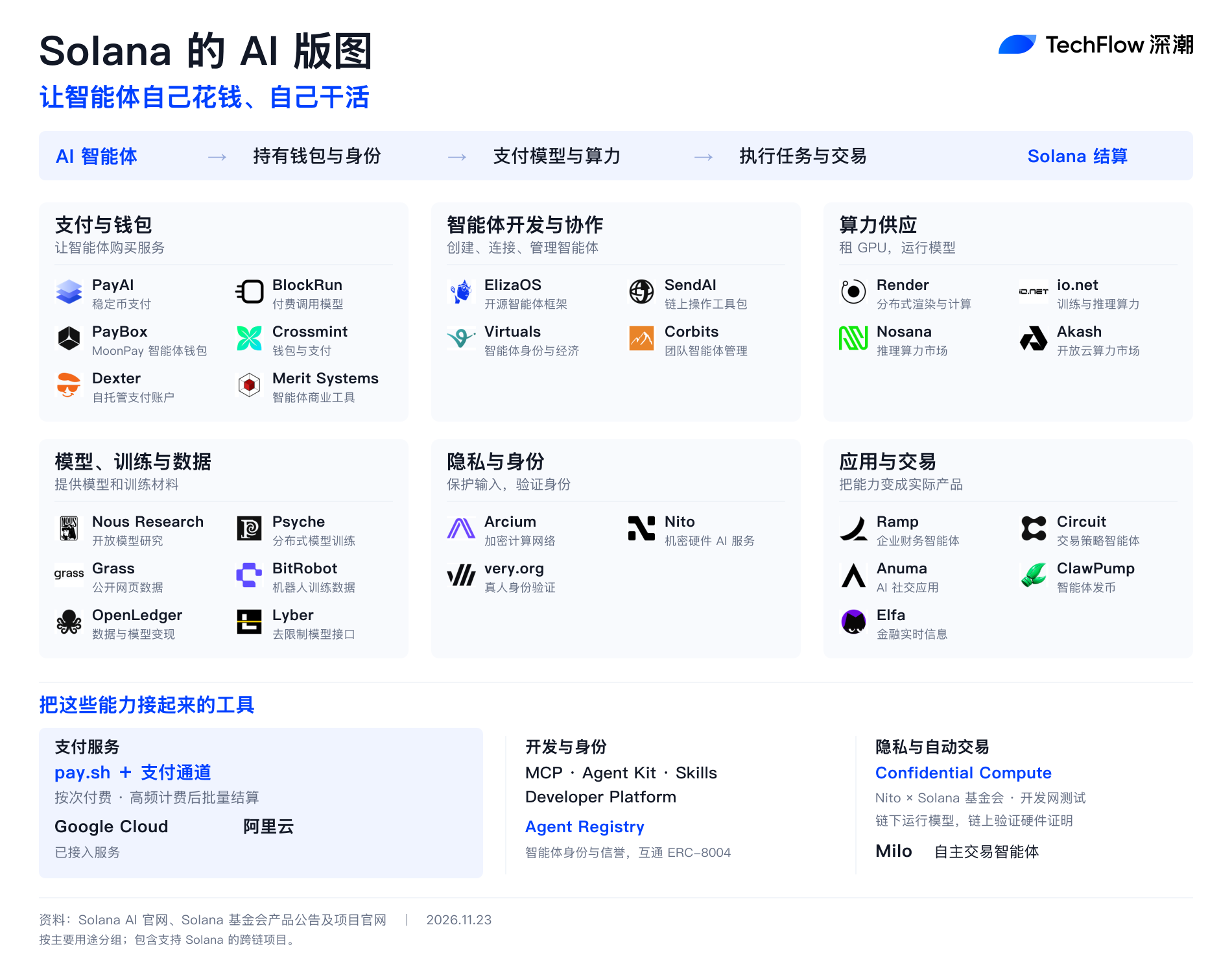
Beneath the five foundational tools created by the official team, solana.ai has conducted its first centralized consolidation and categorization of 28 core AI projects across the web, featuring quite dense information across six major sectors.
In the agent development and collaboration sector, alongside open-source framework ElizaOS, on-chain operation toolkit SendAI, and team collaboration tool Corbits, the most noteworthy addition is Virtuals Protocol.
Having almost monopolized the agent token issuance narrative on the Base chain previously, Virtuals has cross-chained to Solana to build an agent collaboration network, clearly drawn here by its massive trading liquidity.
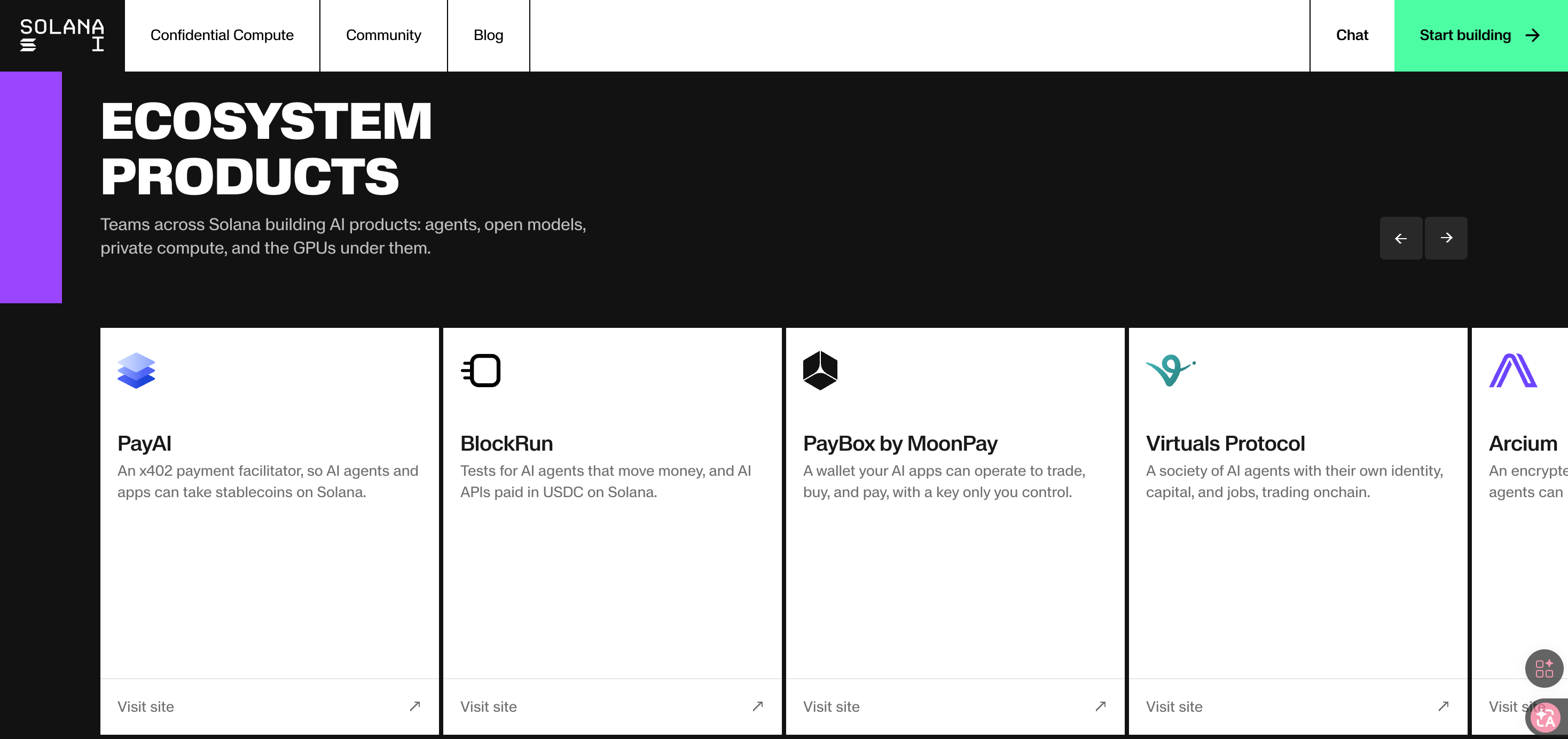
In the payments and wallet channels section, officials highlighted PayAI, BlockRun, MoonPay’s PayBox, Crossmint, and self-custody account Dexter. The portal disclosed a set of hard data: the cumulative volume of agent API payments running on the x402 protocol within Solana has already exceeded 37 million transactions.
In compute supply and data infrastructure, Render, io.net, Nosana, and Akash form the distributed GPU faction; BitRobot, responsible for providing bot training data, along with Grass, which scrapes public web data, and the model monetization protocol OpenLedger, constitute the data supply layer. At the privacy and identity layer, alongside encryption computation providers Arcium and Nito, there is very.org, which offers human verification; the application layer covers corporate finance agents Ramp, strategic trading agents Circuit, and real-time financial information app Elfa, among others.
Among these listed projects, there is also a controversial model interface project named Lyber.
While mainstream tech giants impose increasingly strict security reviews and ethical guardrails on LLMs, Lyber specializes in offering so-called "abliterated" model APIs. It is fully compatible with OpenAI and Anthropic code formats, supports second-level USDC top-ups on Solana, and focuses on safe red-team testing and gray-hat development tasks that conventional commercial LLMs outright refuse to process.
The official team's generous inclusion of Lyber in the portal reveals Solana's extremely pragmatic attitude toward the genuine needs of grassroots developers.
When AI Becomes Strategic Territory for Public Chains
Juxtaposing these products and ecosystems reveals Solana's clear strategic objective: to rapidly establish payment and communication standards for AI agents on its own network, mounting a frontal defense against encroachment from competitors.
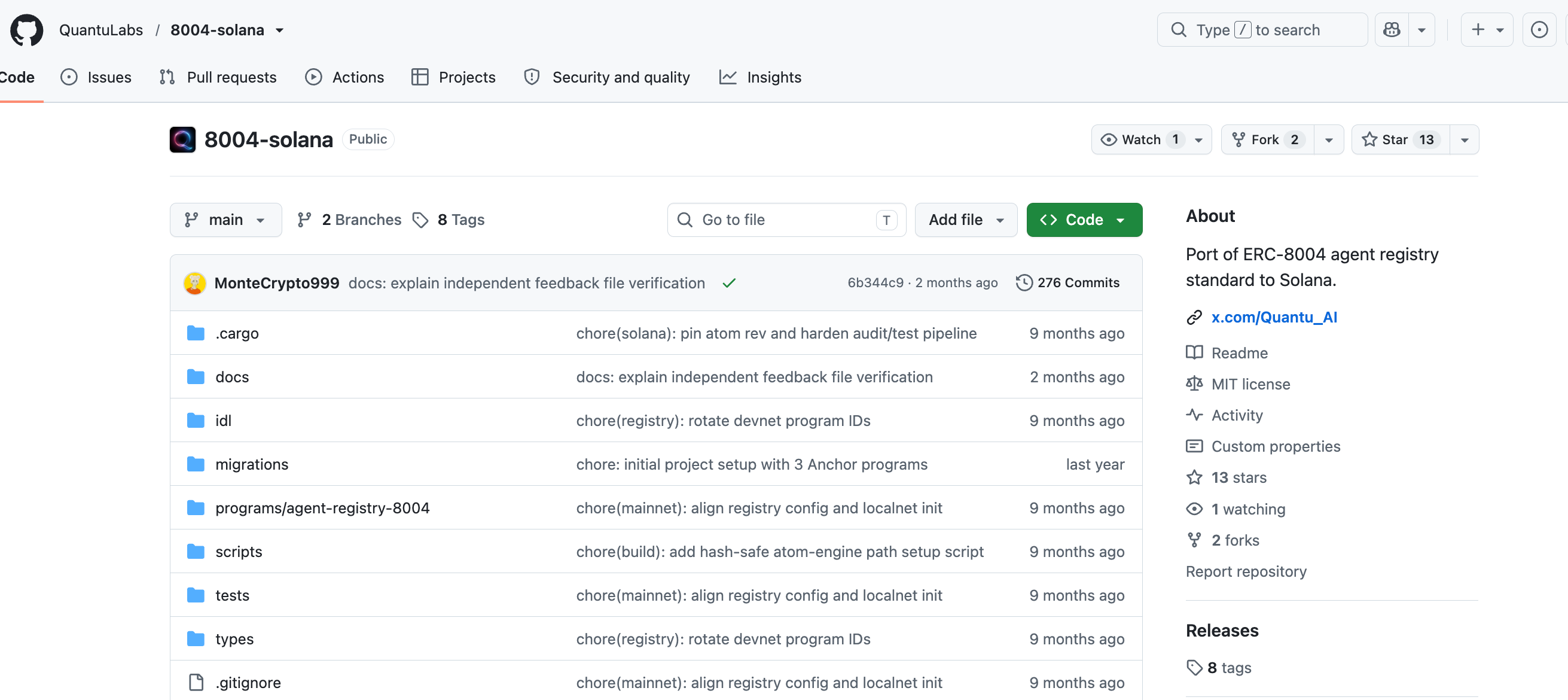
A look at its official companion open-source developer kit shows that beyond the Solana MCP remote server directly integrated into Cursor and Claude Code, alongside an Agent Kit supporting over 60 types of on-chain operations, the codebase also features the 8004-solana specification.
This is obviously an active alignment with the ERC-8004 agent identity and credit registration standard heavily promoted by the Ethereum community. On the micro-payment front, it also fully embraces the x402 specification spearheaded by Coinbase.
I believe this sense of urgency largely stems from external competition, particularly the transformation of leading public chain projects toward AI in the past year.
For instance, leveraging Coinbase's compliance pedigree and developer relations, Base previously secured the minds of the first wave of agent developers with AgentKit; NEAR has gone straight for a full-chain transformation, betting on chain abstraction and intent execution.
Solana spent the past year grabbing eyeballs and fees through Meme coins, but consistently lacked a systematic moat in serious developer infrastructure. The official team stepping in to build products themselves is likely an attempt to retain control over agent execution and settlement channels before rivals can form a monopoly.
Nevertheless, this intricate machine landscape currently still faces practical challenges.
The vision of a machine economy is highly appealing, yet currently, the vast majority of so-called AI agents on-chain remain essentially token issuance scripts and high-frequency speculation tools draped in an AI guise. As for scenarios where agents use USDC to purchase weather data or search services from external internet services on a per-call basis, much like pay.sh does, it remains unproven how many can actually break away from traditional fiat settlement systems like Stripe and truly run on blockchain technology in the real commercial world.
The official team completing the toolset and structuring the ecosystem indicates that the infrastructure for this machine ledger has been laid.
However, for those monitoring the ecosystem and holding tokens, issuing Meme coins only stimulates fleeting network hype. Whether this newly deployed payment assembly line can convert into continuous, genuine on-chain fee consumption is the sole trump card that will determine the value of this new landscape.