
Goldman Sachs initiates coverage on Unitree Robotics: assigns a sell rating, target price 347.1 yuan
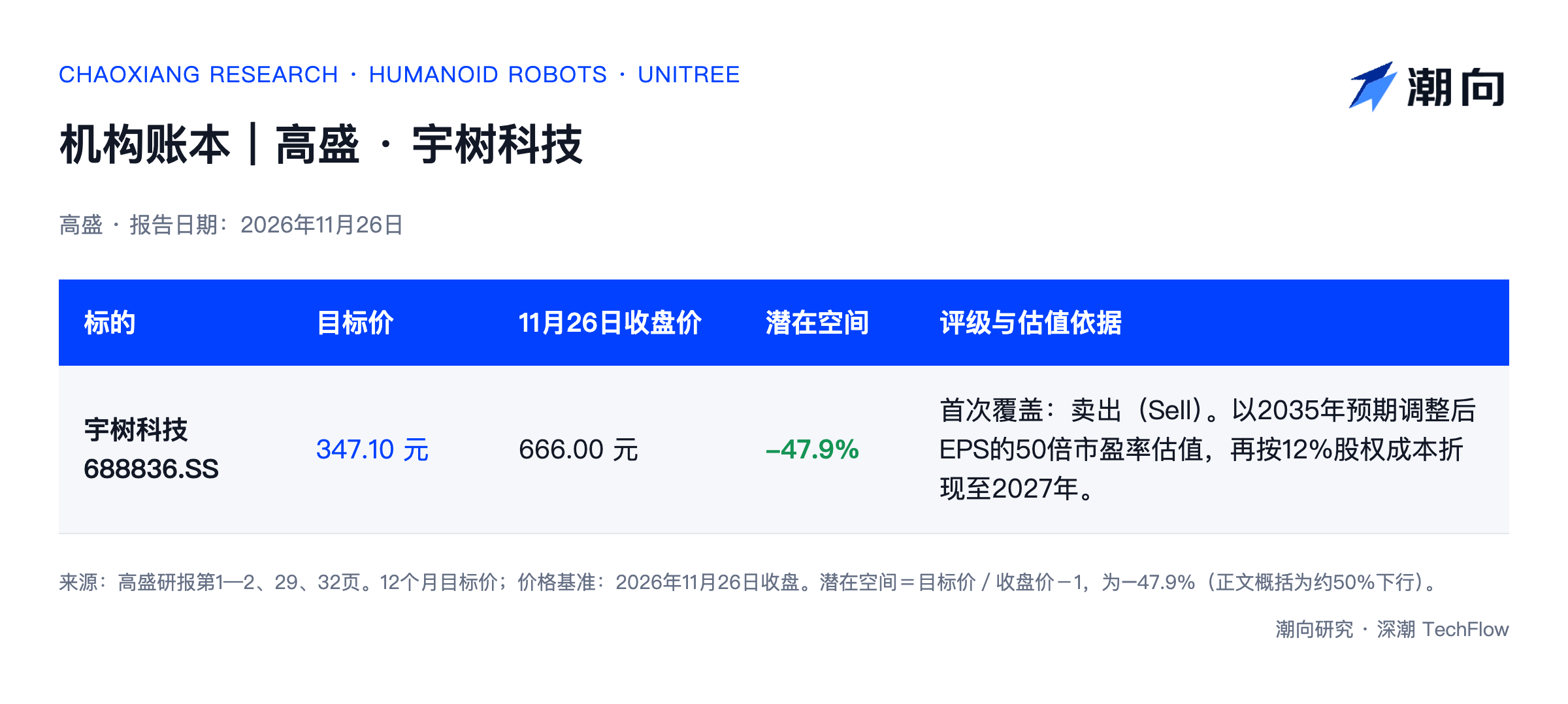
Commercial robotics leader Unitree Robotics (688836.SS) has received a cautious valuation from a leading foreign investment bank. In its inaugural coverage report released on November 26, 2026, the Goldman Sachs Asia Industrial Technology Analyst Team (Jacqueline Du) assigned a “Sell” rating to Unitree Robotics, setting a 12-month target price of 347.10 RMB, implying a 47.9% downside from the current stock price of 666.00 RMB. Goldman Sachs acknowledges Unitree’s first-mover advantage in low-cost actuators and motion control, but believes the current valuation has already priced in top-three global market share and long-term high profit margin expectations.
Industrial Implementation Imminent, Early Market Share Likely to Gradually Decline
Leading in early shipment volume does not directly guarantee a final industry landscape.
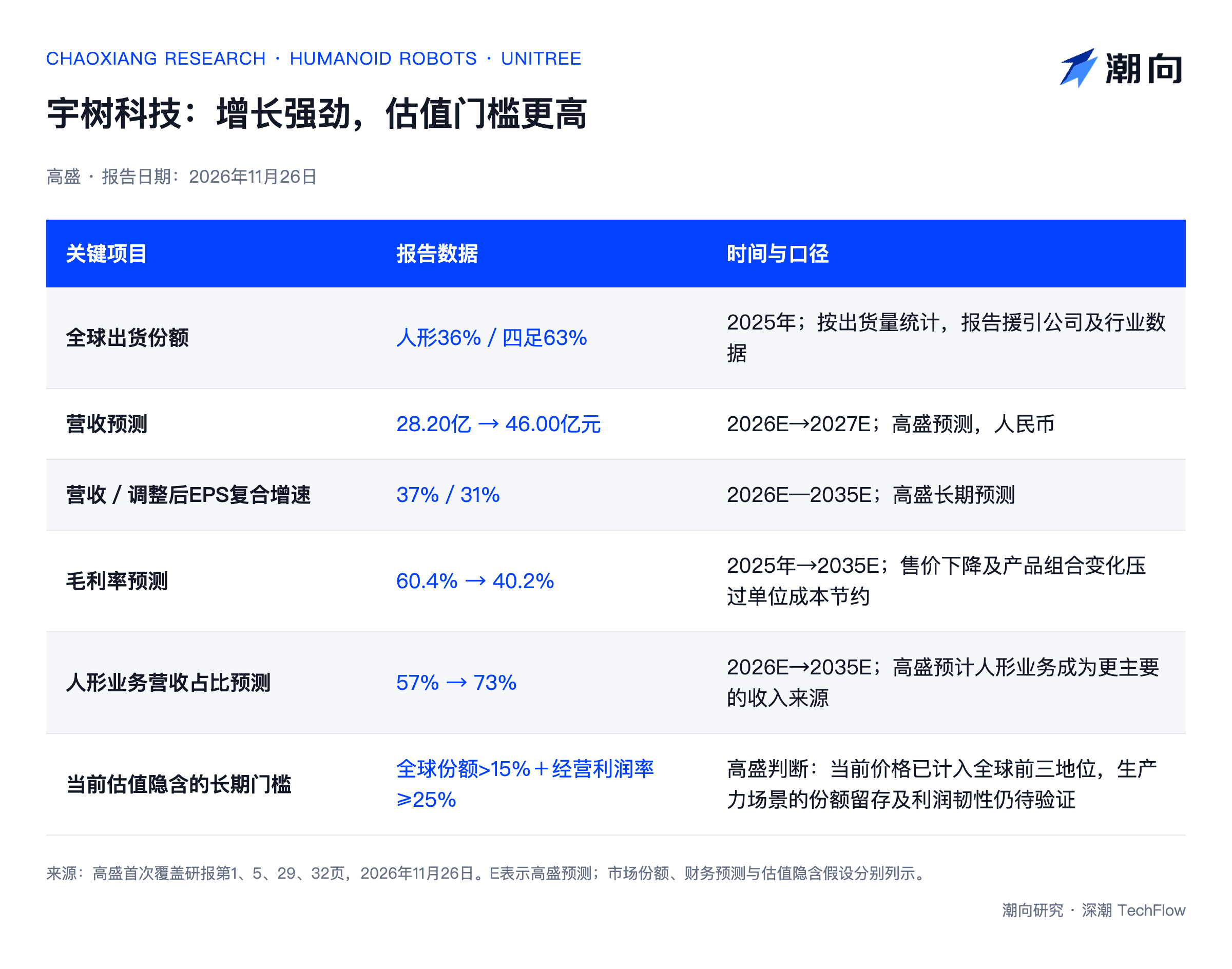
In 2025, Unitree Robotics captured 36% of the global humanoid robot shipment share and 63% of the quadruped robot share, leveraging robust motion control capabilities, integrated self-developed low-cost actuators, and strong mindshare among research developers. However, the competitive landscape has already begun to shift. Third-party data shows that in the first half of 2026, AgiBot’s global humanoid robot shipments reached approximately 8,400 units (44% share), surpassing Unitree’s approximately 5,900 units (31% share).
The real test lies in the shift of downstream demand. Currently, Unitree Core shipments remain highly dependent on the G1 platform launched in 2024, primarily flowing into scientific research education, stage performances, and data collection centers. Goldman Sachs anticipates that as industry focus shifts to “productivity scenarios” such as factory manufacturing and commercial services, customer procurement standards will pivot toward dexterous manipulation, task reliability, and deployment economics, areas where Unitree’s industrial validation remains insufficient.
Drastic changes in demand structure will directly pull down overall market share. Goldman Sachs forecasts that the proportion of scientific research and education in global humanoid robot shipments will shrink from 26% in 2026 to 2% in 2035, while industrial applications will surge from 26% to 39%. Since Unitree is expected to maintain a 10% to 12% share in research education and commercial consumption, but only holds a 5% share in industrial applications, its probability-weighted global humanoid robot market share is projected to gradually decline from 36% in 2025 to 6% in 2035 (with a 40% probability of ranking in the global top three with a 15% share).
Limited Barriers in Self-Developed Brain, Accessing External Models May Pressure Profits
The commercial tipping point for embodied intelligence depends on the value distribution between the “brain” and the “body.”
Unitree excels in hardware and motion control (the cerebellum), achieving a 100% self-development rate for motors and a 97% rate for both LiDAR and optical cameras. However, regarding the AI software stack (the brain) that determines general intelligence, Goldman Sachs believes Unitree has not yet established significant differentiation compared to top global and Chinese competitors.
The company is attempting to bridge these gaps through capital expenditure. According to the IPO prospectus disclosed in August 2026, Unitree plans to allocate 2 billion RMB (48%) of its approximately 4.2 billion RMB in raised funds toward AI foundational model R&D, with 39% directed at the large model “brain” and 37% at motion control “cerebellum.”
Nevertheless, industry technological paradigms are undergoing subtle evolution. As cutting-edge multimodal large models like GPT-6 Astra and Claude Fable penetrate the physical world, robotic high-level reasoning intelligence is gradually becoming modularized and externalized. If third-party frontier large models directly power low-cost bodies in the future, Unitree, leveraging cost-effective hardware and mass production scale, could become a commercialization vehicle for third-party AI models, thereby shedding the heavy burden of foundational R&D.
However, the flip side of this double-edged sword is homogenized competition. When multiple hardware manufacturers can access equally capable external large models, the differentiating barriers for complete machine manufacturers will be weakened. Competition will devolve into pure cost battles and a frenzied race on iteration speed, subsequently exerting downward pressure on long-term profit margins.
Price Wars Combined with Rising Domestic Share Push Gross Margins Back Toward 40%
The sweet period of high gross margins is facing direct impact from an industry-wide price-cutting wave.
Goldman Sachs data indicates that the rollout pace of new global humanoid robots continues to accelerate, with over 91 new models launched in the first half of 2026 alone. To capture early market share, Goldman Sachs projects that the industry average selling price (ASP) will decline at a compound annual rate of approximately 6% from 2026 to 2035. Given Unitree’s inherently aggressive pricing strategy (e.g., G1 starting at $13,000, R1 starting at $4,000), its humanoid robot ASP is expected to drop by roughly 4% annually, falling from 133,000 RMB in 2026 to 90,000 RMB in 2035.
Supply chain cost reductions struggle to fully offset the price war. Although Unitree expects unit costs to decrease by 11% from 2025 to 2030 and 2% from 2030 to 2035 through motor production line automation (cutting manual labor costs by 57%) and vertical integration, the erosion of profits from declining selling prices and shifting regional structures is far more severe.
Fluctuations in the share of high-margin overseas markets further amplify this pressure. In 2025, Unitree’s overseas business gross margin reached a high of 69%, significantly exceeding the domestic figure of 54%. Impacted by geopolitical tensions and U.S. chip export controls (such as the new regulations released by BIS on November 16, 2026, involving restrictions on remote computing power, with Unitree’s G1/H1 and H2 Plus utilizing Nvidia Orin and Thor chips respectively), the proportion of low-margin domestic orders is expected to rise. Goldman Sachs forecasts that Unitree’s consolidated gross margin will gradually decline from 60.4% in 2025 and 54.9% in 2026 to 40.2% in 2035, with operating profit margin simultaneously dropping from 23.4% in 2026 to 15.2% in 2035.
Distant Valuation Priced for Perfection, Sensitivity Analysis Points Downside
Setting aside short-term hype, Unitree Robotics’ fundamental growth remains impressive, but the stock price has moved too fast.
Goldman Sachs predicts that driven by the surge in global humanoid robot shipments from 75,000 units in 2026 to 6.5 million units in 2035, Unitree Robotics’ total revenue CAGR from 2026 to 2035 will reach 37% (rising from 2.82 billion RMB to 47.779 billion RMB), while net profit CAGR will hit 31% (increasing from 693 million RMB to 7.815 billion RMB). Furthermore, backed by approximately 5.92 billion RMB in net proceeds from its STAR Market IPO and an extremely short cash conversion cycle (approximately 9 days), the company maintains ample net cash on hand. Its average cash return on invested capital (CROCI) for 2026–2030 is projected to be a robust 38%, firmly placing it in the top tier of the China Industrial Technology sector covered by Goldman Sachs.
The issue lies in valuation multiples. The current stock price of 666.00 RMB implies a massive market capitalization of 269.4 billion RMB for Unitree, equating to a 60x forward Price-to-Sales (P/S) ratio for 2027 and a staggering 154.5x forward Price-to-Earnings (P/E) ratio for 2028. Goldman Sachs employs a discounted future earnings approach, applying a 50x P/E multiple to 2035 forecasted EPS and discounting back to 2027 using a 12% cost of equity, resulting in a 12-month target price of 347.10 RMB (implying a 31x forward P/S ratio for 2027).
Sensitivity testing reveals a highly asymmetric risk-reward profile. Goldman Sachs calculates that unless Unitree can simultaneously maintain a top-three global market share (exceeding 15%) and sustain an operating profit margin above 25% in 2035, a decade from now, the current stock price faces significant pressure for valuation correction. Goldman Sachs notes that upside risks may arise if the transition to factory productivity scenarios exceeds expectations, industry price cuts slow down, or monetization from partnerships with third-party frontier large models accelerates.
This article is a compilation and interpretation by TechFlow Research of third-party brokerage research reports. The forecasts, metric breakdowns, and related judgments cited herein represent the views of the respective brokerage analysts, reflecting only their affiliated institutions' stances. They do not constitute the views of TechFlow Research nor should they be construed as investment advice.
Markets carry risks, and decisions must be independent. This article should not serve as the basis for buying or selling any securities.