
Big tech's fresh graduate hiring quotas are being reallocated to AI budgets.
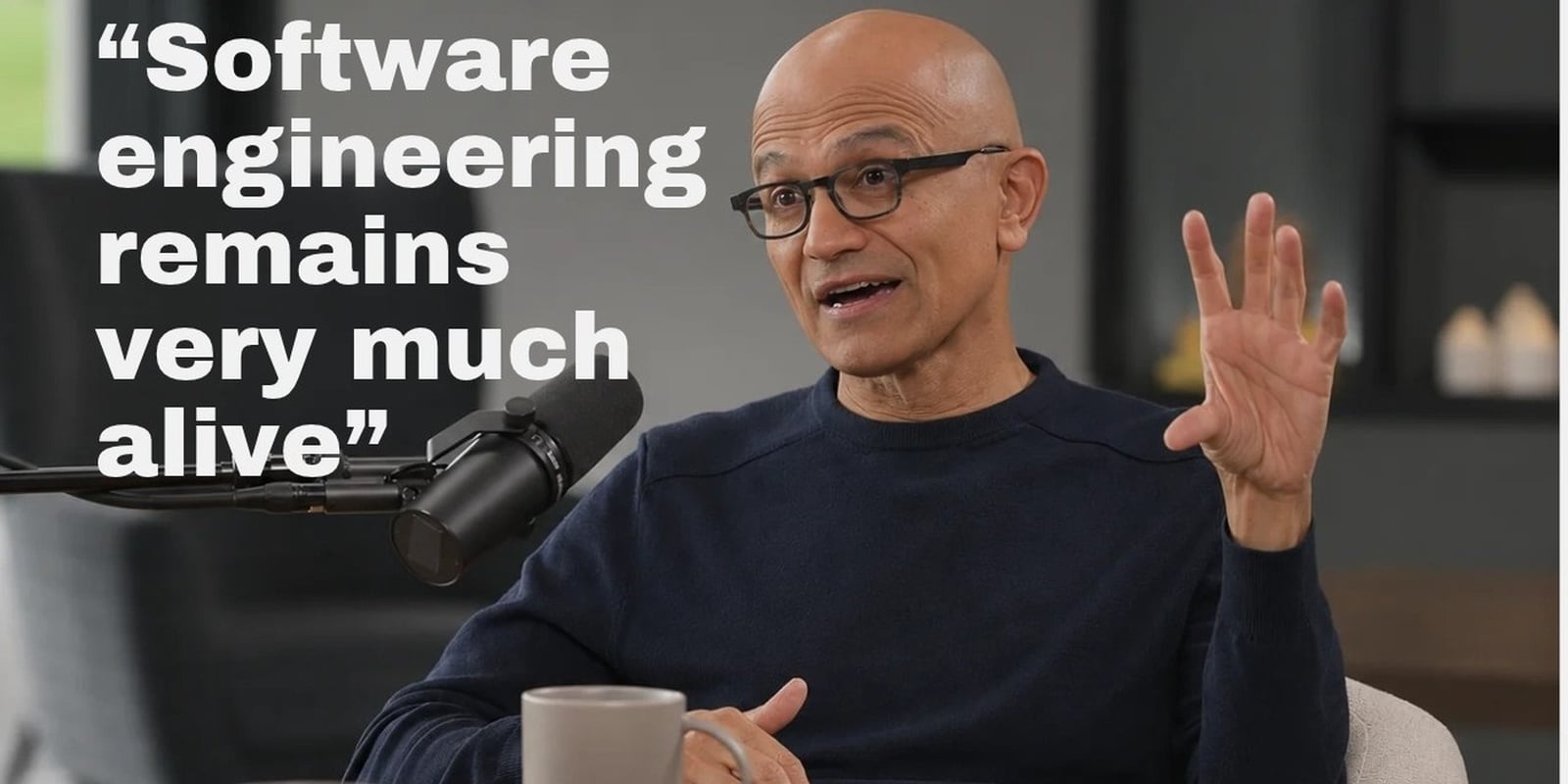
In the AI era, Microsoft—one of the largest tech companies willing to reshape its own organizational structure and known for its bold initiatives—has once again emerged as a pioneer in AI-driven organizational practices. But this time, Microsoft isn't bringing good news; it has publicly admitted that "Microsoft has slowed down its hiring pace for recent graduates."
In a recent episode of The Pragmatic Engineer podcast, when the host asked Microsoft CEO Satya Nadella whether Microsoft was still hiring recent graduates, Nadella publicly acknowledged on the show that Microsoft's graduate hiring had indeed decelerated, adding that "many companies are doing the same."
Explaining this conclusion, he noted that the "top priority right now is ensuring everyone internally is moved into the right roles," and building out the "software factory" model where humans and AI share software development tasks.
However, in his plan, the second step after role reallocation is to fully utilize the AI budget first. Discussing AI-native companies built around AI from the start, Nadella said, "What is an AI-native company? They start with an AI budget and one person. That person uses up the AI budget, then says, let's add another person." He added his own assessment: "Every company will start to look like this."
These remarks not only caused a stir but also stand in stark contrast to his own statements from ten months ago. During the Davos Forum in January, while being interviewed by a podcast, Nadella had said, "I still strongly believe in campus recruiting because AI acts as a mentor helping newcomers get up to speed faster."
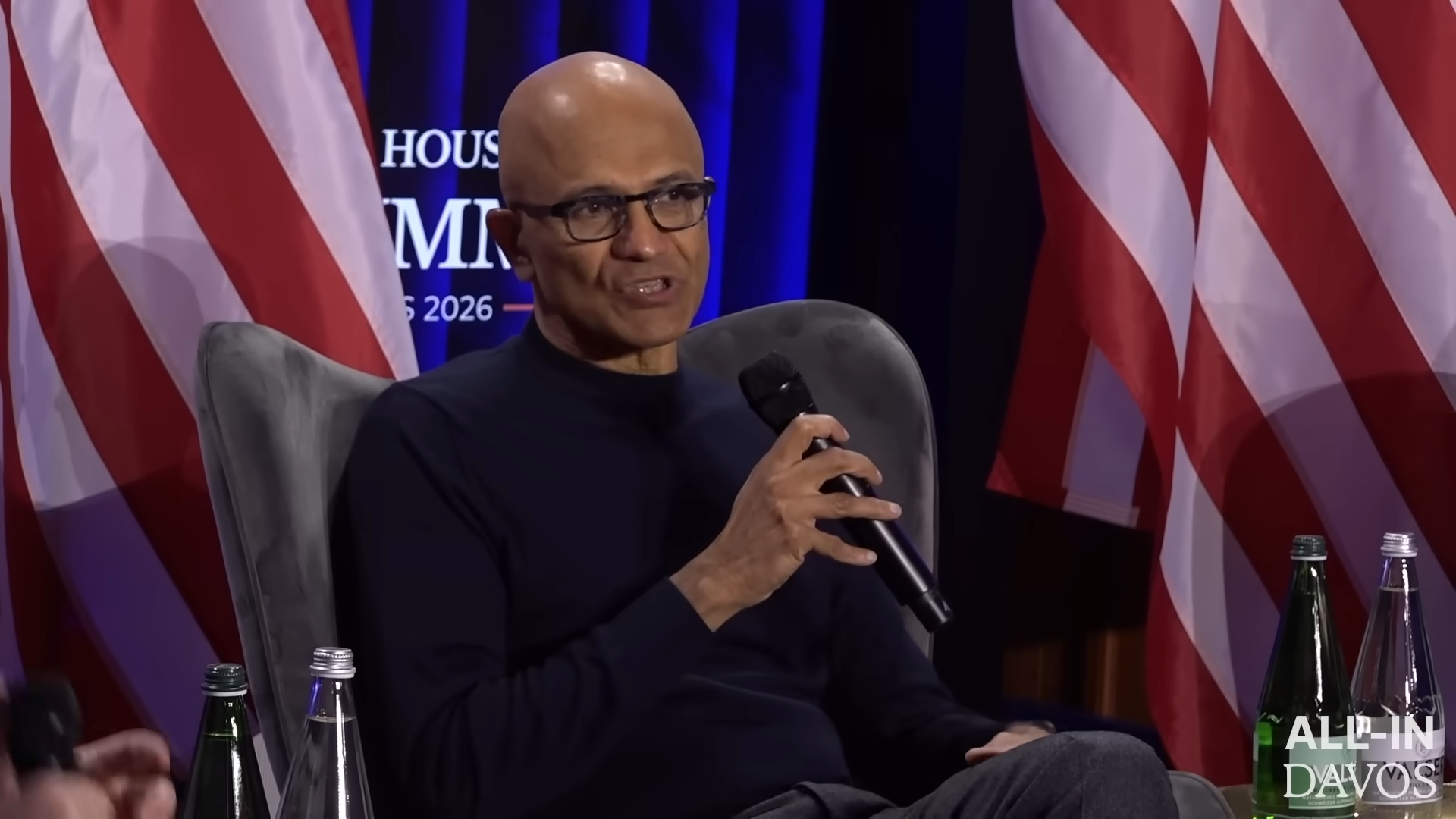
What he might not have realized at the time is that ten months later, AI would shift from being a mentor for newcomers to becoming a budget that companies feel compelled to spend before hiring anyone new.
Microsoft's Own Calculations
As Microsoft's current CEO, Nadella has always been viewed as a shrewd professional manager. His willingness to contradict his own words from ten months ago in public must mean that internally, Microsoft has already recognized new realities in its AI-driven organizational transformation. This marks the first time in a decade that Microsoft's workforce has shrunk while the company's business continues to grow.
According to Microsoft's fiscal year annual report, the company currently employs approximately 223,000 full-time staff, a decrease of roughly 5,000 over the past year, while revenue simultaneously grew by 18%. This is Microsoft's first annual employee decline since wrapping up its Nokia mobile phone business in 2016.

The department that saw the greatest reduction was product research and development, indicating that business growth is no longer driving engineering headcount increases at the old ratio. Microsoft's annual report notes a reduction of about 3,000 roles in R&D, marking a second consecutive year of decline. This means three out of every five net jobs eliminated were in R&D, and that's before factoring in the new round of layoffs announced in July, affecting around 4,800 positions.
Currently, Microsoft is focusing on redeploying its existing workforce, which aligns with Nadella's statement of first moving internal staff into appropriate roles before prioritizing new hires. This is also why Microsoft recently offered voluntary severance packages to most software engineers for the first time, allowing employees to choose whether to accept them before December.
When encouraging employees to move to teams better suited to them within Microsoft, Nadella added, "If you feel professionally stagnant in your current team, vote with your feet."
Nadella also showed genuine emotion, acknowledging the challenges large organizations like Microsoft face amid AI-driven restructuring: "I really wish I could sit here and tell you everything stays the same. But I can't."
Nadella's comment that "every company will start to look like this" rings true, as opportunities for newcomers across the entire tech sector are narrowing sharply. A June report from venture capital firm SignalFire showed that compared to 2019, newcomer and entry-level hiring at 12 major tech companies, including Microsoft and Apple, had dropped by approximately 65%.
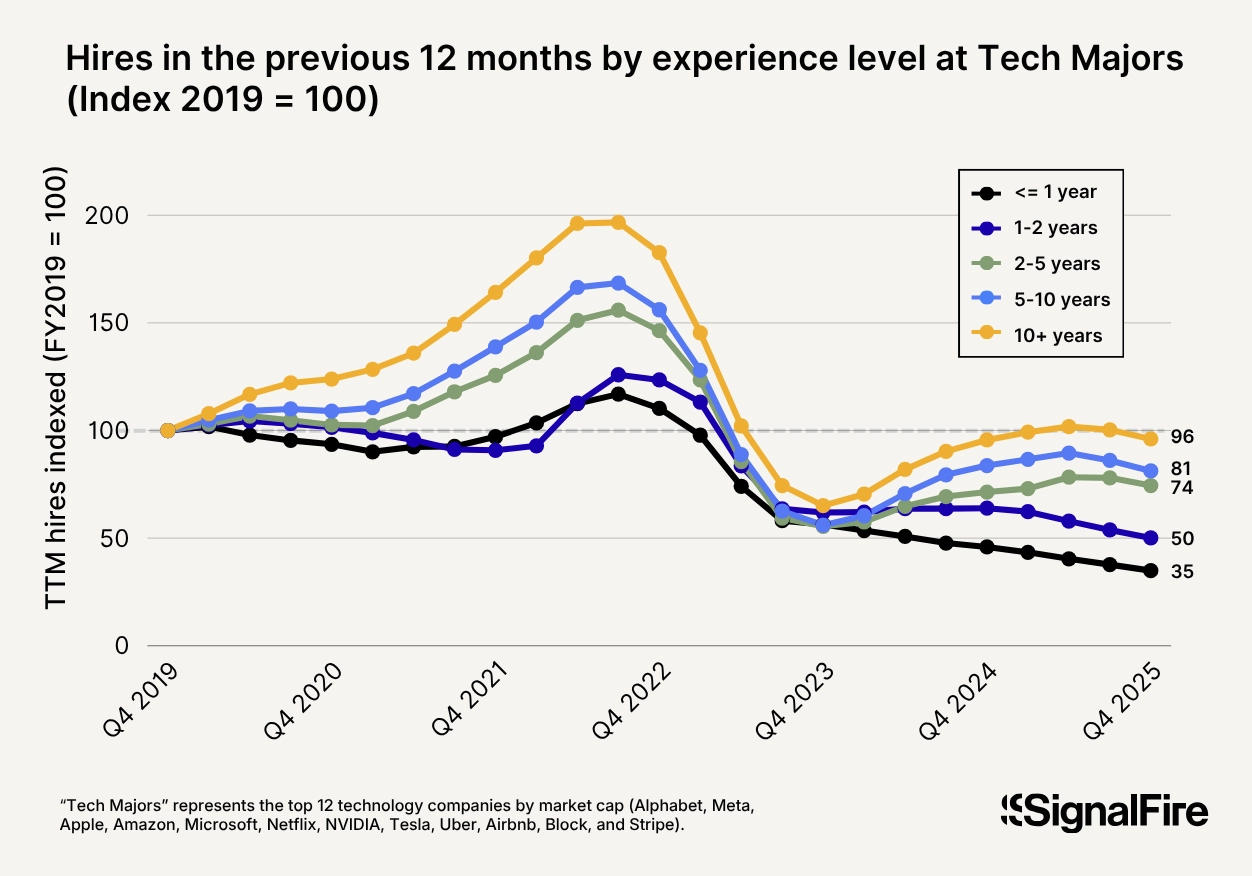
The same report indicated that overall hiring at these major companies only fell by 25% compared to 2019, with the sharpest contraction hitting those fresh out of school. Early-stage startup newcomer hiring saw even steeper declines. In April last year, Shopify CEO Tobi Lütke wrote in an internal memo: "Before teams request additional headcount and resources, they must first explain why AI cannot handle it."
In May last year, Anthropic CEO Dario Amodei also told media outlets that AI could eliminate half of all entry-level white-collar jobs within five years. While such warnings may not come to pass entirely, they are enough to tighten the nerves of job-seeking young people and their parents.
As for Microsoft, it was already one of those 12 major companies cutting back on newcomer hiring. Nadella speaking out on the issue merely laid bare a choice the industry has already been making for over a year.
A Contraction Without Layoffs
Unlike layoffs, reduced hiring has never been a major news headline. Its effects can only be traced through corporate financial reports and internal studies. Last November, MIT's Lindsey Raymond and Microsoft Research's Eleanor Dillon published an unpublished paper on the preprint server arXiv. The study examined GitHub Copilot, Microsoft's enterprise AI assistant that automatically completes code during writing.
By comparing companies based on their original contract renewal dates, those pushed into adopting Copilot earlier saw a 29% reduction in quarterly technical hires a year later, while turnover rates and total technical headcount remained stable.
The reduction primarily targeted entry-level roles. Among the same batch of companies, hiring for junior software engineers dropped by roughly 40%, with steeper declines observed for roles focused heavily on coding, while experienced engineer hiring showed no significant change.
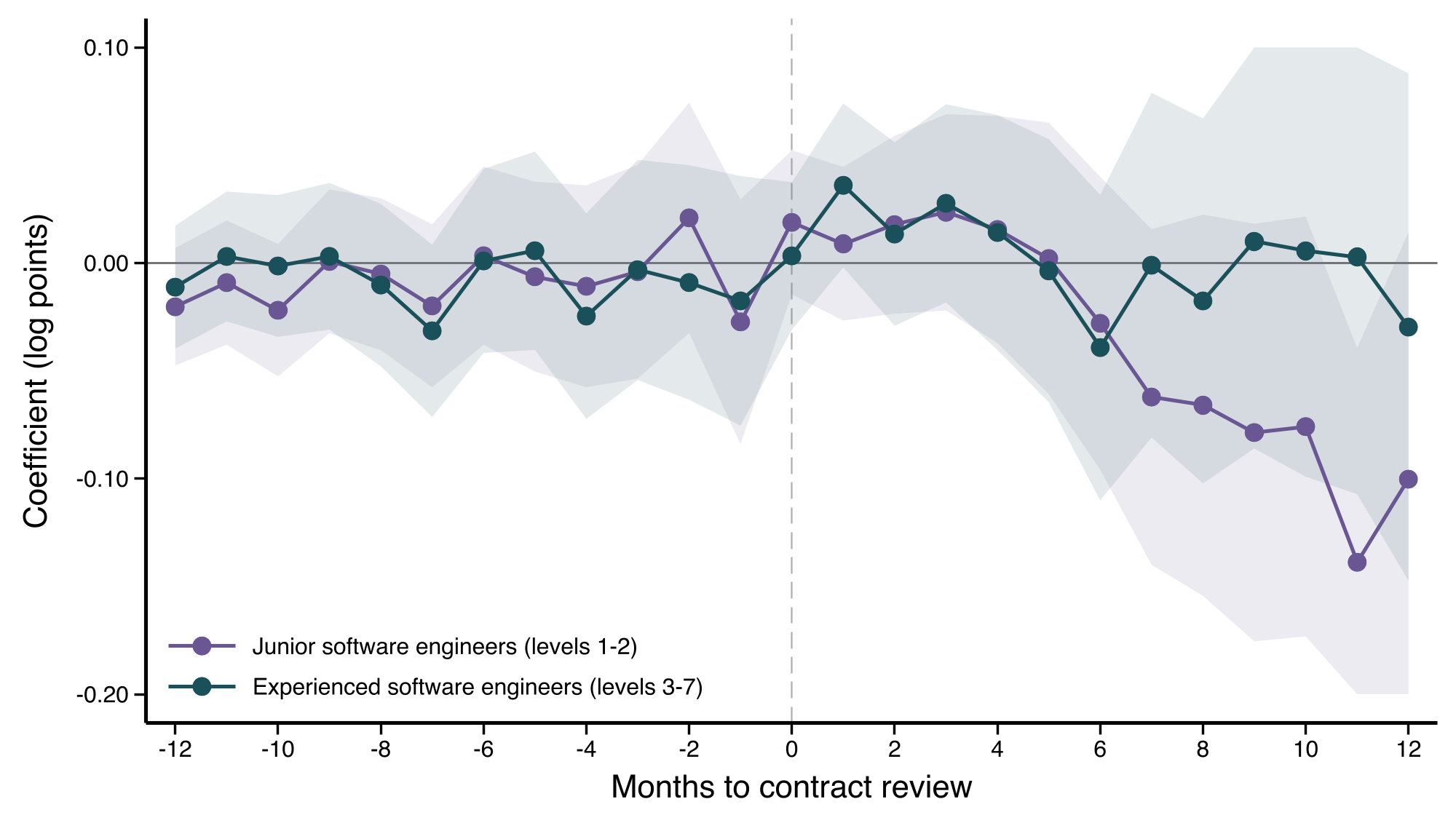
However, the 29% figure cited in the paper is a broad estimate. The authors also note that at least half of the reduction in technical hiring since 2022 stems from broader industry contraction, the sample consisted entirely of large multinational corporations, and the study only evaluated first-generation autocomplete tools.
Researchers at Stanford University's Digital Economy Lab, led by Erik Brynjolfsson, observed the same phenomenon using data from US payroll service provider ADP. An August update showed that among occupations most vulnerable to AI, employment for 22-to-25-year-olds was roughly 19% below expected levels as of June this year, and the gap continues to widen.
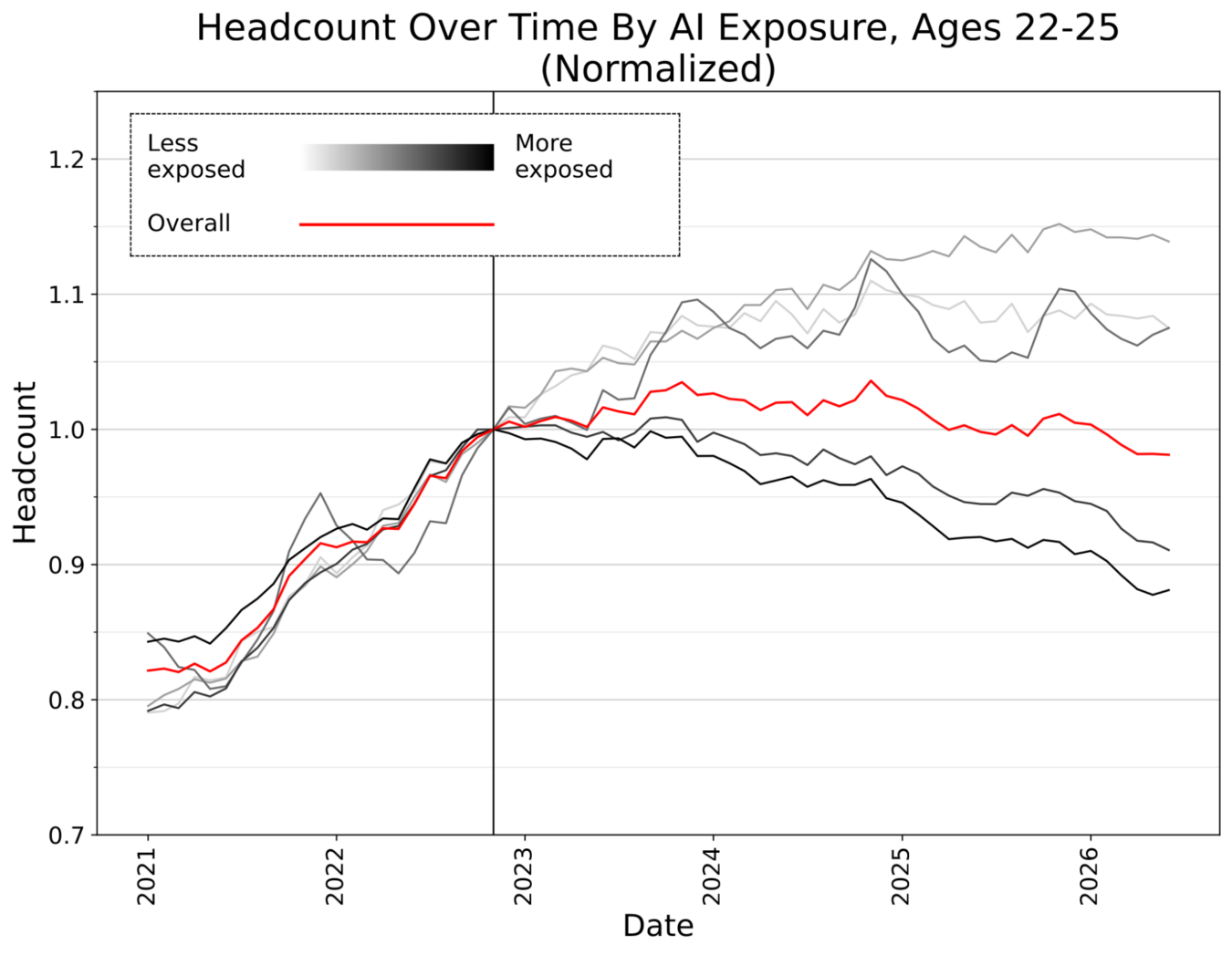
The shortfall stems mainly from fewer youth hires, as companies divert recruitment funds toward purchasing AI compute credits, then hire ready-made experienced staff. Entry-level tasks requiring basic coding according to specifications are likely to be taken over by AI first. Once human-machine collaboration handles this portion, companies lose the incentive to train novices from scratch. The paper also found that companies adopting the tool early hired senior employees with longer average work experience and higher proportions of master's and doctoral degree holders.
The Diamond Pyramid
Moreover, under AI's influence, corporate workforce structures are reshaping as well.
Lucy Beaumont from talent assessment firm SHL told CNBC, "If past organizations resembled a pyramid, what we see today is a diamond." Meaning fewer newcomers at the base, but more experienced individuals in the middle.
Yet there is an obvious question that everyone has avoided discussing: the experienced, judgment-capable professionals in the middle of this diamond shape originally honed their skills through those same entry-level tasks.
AI eliminates the grunt work of typing basic code, but it cannot generate that seasoned judgment in a newcomer's brain. Cheney Hamilton from research firm Bloor told CNBC, "AI raises the floor for newcomer output, but it does not equip them with the ability to judge where outputs go wrong."
Not only are hands-on practice opportunities dwindling for newcomers, but relying solely on AI to deliver results makes it incredibly difficult to develop into seasoned professionals.
Many industry insiders recognize the hidden dangers behind this self-defeating logic. In August last year, AWS CEO Matt Garman mentioned in an interview that some executives claimed "AI could replace all junior employees in a company," to which he retorted, "That's the dumbest thing I've ever heard." He argued that newcomers are "probably your cheapest employees, and also the ones most eager to use AI tools."
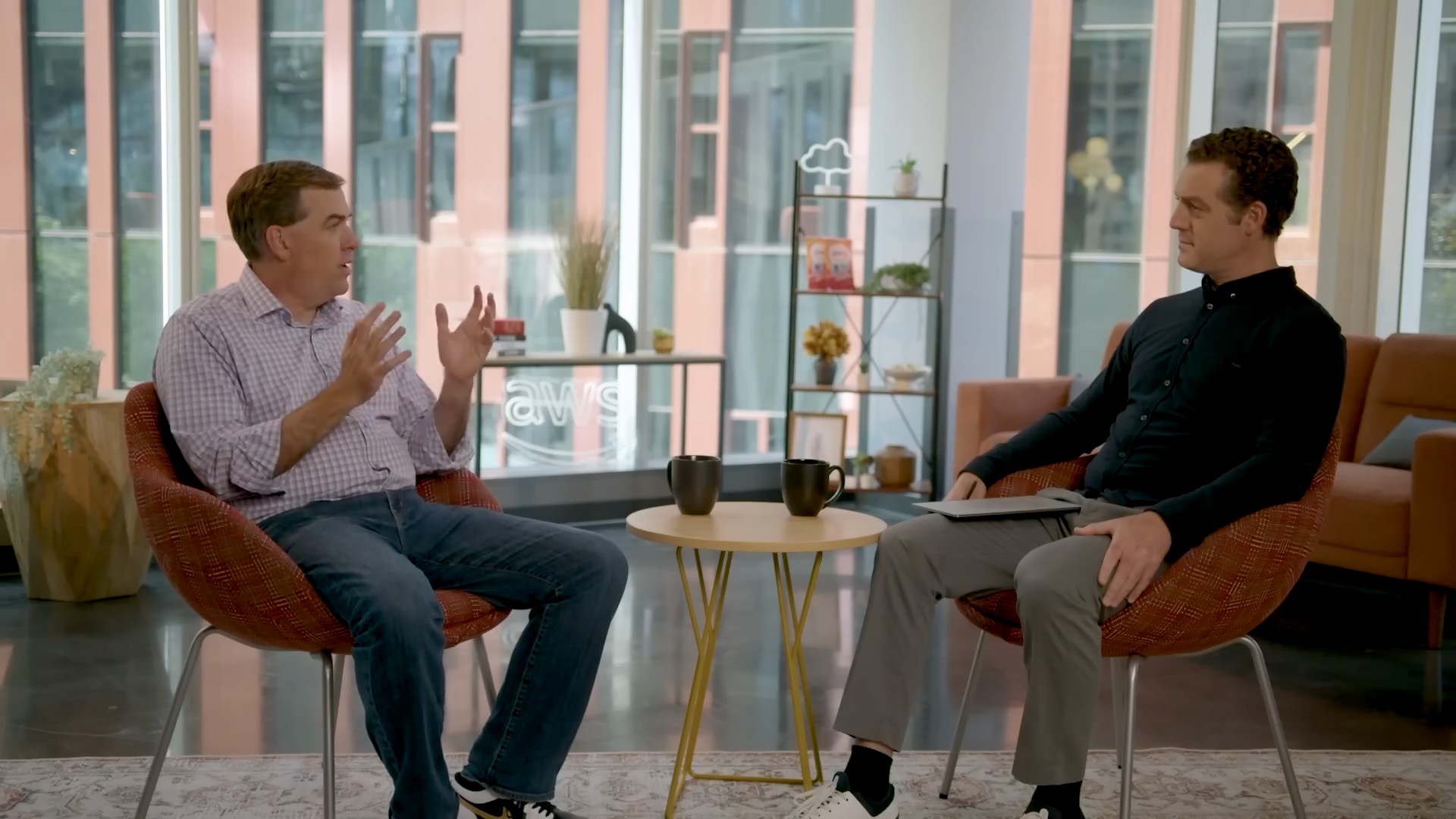
Garman fears a deeper long-term talent gap, questioning, "In ten years, if no one accumulates experience or learns anything, how do we cope?" Thus, he concluded, "This is precisely why we absolutely must continue hiring recent graduates."
While the logic is clear, it translates into a collective dilemma for each company. Mentoring graduates consumes veteran staff's energy, and once trained, they might leave. Cutting new hires and boosting AI budgets yields immediate cost savings this year.
From a corporate accounting standpoint, reducing new hires is a highly profitable trade, with the option to poach seasoned professionals trained elsewhere in a few years. But if every company in the industry follows Nadella's advice—waiting until AI budgets are fully spent before hiring again—no one will be training newcomers, and the pool of senior engineers available to recruit will shrink drastically in a decade. It's just that this long-term tally hasn't yet hit the major companies' financial reports; instead, the anxiety is being borne upfront by job-seeking youth and their parents.
Microsoft's own actions reflect hesitation. On one hand, it sells Copilot to enterprises and slows campus recruitment; on the other, it collaborates with Carnegie Mellon University on the PRAISE mentoring program for newly minted engineers. Nadella also remarked on the podcast, "I think it's too early to map too many things onto long-term trends." Interpreted by the host, this suggests he views the current anomalies stemming from the restructuring phase as temporary, believing entry-level hiring will rebound once processes stabilize.
But even if we are merely in a transitional period, Nadella's phrase about starting with "an AI budget and one person" has already rewritten career entry paths.
Pushing that logic forward, what young people graduating soon must prove is no longer just that they work faster than their peers, but rather that despite allocating the next tranche of AI budget, the company should still invest in hiring them as an individual.
For Microsoft and the entire tech sector, what will truly be scarce going forward may no longer be those who can write code by hand, but rather those capable of identifying where AI makes mistakes. Yet such individuals cannot materialize out of thin air; companies must give newcomers opportunities and cultivate them through gradual hands-on training.
After calculating the immediate AI budgets, the question the industry will inevitably have to answer has likely shifted from "should we still hire newcomers?" to "where do newcomers go to become seasoned professionals?"