Bitcoin Ecological Layer Three: Exploring the Ecological Evolution of Bitcoin

Original title: Layer by Layer: An In-Depth Exploration of Bitcoin's Evolving Ecosystem (3 of 4)
Original author: Kyle Ellicott, Yan Ma, Darius Tan, Melody He, Spartan Group
Original compilation: 0xNirvana
"Bitcoin Ecological Layer: Pulling Back the Curtain of the Trustless Financial Era" is a report on the Bitcoin ecology Research reports on the development of various aspects of the system. This report was co-authored by the Spartan Group team, Kyle Ellicott, and several experts who provided feedback and insights and generously gave their time to review the final version of this article. This report was drafted in December 2023 and the data contained in it are current at the time of writing. This article is the third in a series of four articles.
Please move to the first two articles: "Bitcoin Ecological Layer" : Pulling back the curtain on the trustless financial era》 《 Bitcoin Ecological Layer 2: Bitcoin Economic Awakening.
The concept of Bitcoin Layers was proposed in 2018 to solve its scalability challenges, which represents the evolution of Bitcoin. An important turning point. Historically, various efforts looking to enhance Bitcoin L1 performance have shared the same goal: enabling off-chain transactions to increase the scalability of the network. These attempts all revolve around a secure settlement layer provided by L1. The Bitcoin ecological layer draws inspiration from Ethereum’s layered architecture and has evolved into a series of solutions, including L2, L3, data layer and application layer. These innovations reflect the Bitcoin network’s adaptability to its inherent limitations and demonstrate Bitcoin’s inherently progressive attitude toward a more powerful and versatile blockchain infrastructure.
The emerging Bitcoin ecosystem is introducing a variety of features that will further transform the network's performance. These ecological layers provide:
● Smart contract programmability: Enables the execution of complex finance and contracts directly on the Bitcoin network Transactions are possible.
● Improved throughput speed:Significantly shortened transaction processing time, transactions in some ecological layers Speeds can be achieved in less than 30 seconds.
● Trust-minimized BTC to L2 cross-layer transfer:Promotes BTC Safe and efficient transfers between ecological layers provide a solution to the problem that the federal system approach adopted by Bitcoin is too centralized.
● Cost-effectiveness:Due to the reduction in transaction costs, for a wider user group In terms of transactions, it lowers the threshold and access difficulty of Bitcoin transactions.
● Asset issuance and Rollups: Provides a new way for asset creation and packaged transactions , to improve efficiency.
● Interoperability and privacy measures: Enhance the network with other blockchain systems interaction capabilities and protect user privacy.
● Virtual machines (VMs) and other specific features:Support includes games, finance , media and decentralized science (DeSci) and other various applications.
These ecological layers based on Bitcoin L1 are of strategic significance, using L1 as a basic platform similar to "cold storage" to store BTC assets. This layered architecture not only allows BTC assets to be seamlessly transferred between different ecological layers, thereby releasing more than $850 billion of dormant capital in Bitcoin, but also applications built on these ecological layers will be able to benefit from Bitcoin. The security and stability of the currency are unmatched.
Bitcoin Ecological Layer Picture (March 2024)
As of the fourth quarter of 2023, significant progress has been made in the development of the Bitcoin ecological layer, especially on L2 solutions. Bitcoin’s ecosystem has expanded to include Sidechains, Drivechains, Merge-Mined Chains, and Proof-of-Stake Chains. . During the same period, we also witnessed the emergence of multiple protocols, token standards, cross-chain bridges, rollups, and other innovative solutions.
These developments are not just technological leaps, but also highlight a paradigm shift in Bitcoin’s utility, opening up new paths for user adoption and application deployment. The layered architectural approach highlights Bitcoin’s ability to adapt and evolve, thus further consolidating its position in the ever-changing digital world. The following sections detail key innovations within these categories, demonstrating the dynamic and forward-thinking nature of Bitcoin’s layered ecosystem.
The second layer of Bitcoin is composed of the "Four King Kong" ” Led by: Stacks, Lightning, RSK and Liquid. These four entities are responsible for executing the majority of Bitcoin L2 transactions, shaping the landscape of Bitcoin’s scalable solutions. Each L2 solution has its own unique features and capabilities that uniquely contribute to the growth and scalability of the Bitcoin ecosystem.
Comparison of Bitcoin L2 "Four King Kong"
1. The Bitcoin L2 project Stacks was started in 2017 and was co-founded by Princeton computer scientists Ryan Shea and Muneeb Ali to enable smart contracts for Bitcoin. The initial version of the Stacks network launched in January 2021, allowing smart contracts and decentralized applications to use Bitcoin as a secure L1 network. Stacks Bitcoin L2 activates the Bitcoin economy through its Proof-of-Transfer (PoX) consensus mechanism, which runs in parallel with Bitcoin’s Proof-of-Work (PoW) consensus and reuses Bitcoin’s computing power .
● The security of the network is further enhanced through "Stacking", in which Stacks token holders Commit to using the network's native STX token (worth $252.87 million in the current stacking cycle) to verify transactions, secure the Stacks network, and earn rewards in the form of BTC.
● Smart contracts on Stacks are coded using Clarity, a human-readable native language that responds to Bitcoin transactions and asset-native swaps with BTC.
● STX token, used as fuel on L2, was the first to obtain approval from the U.S. Securities and Exchange Commission (SEC) in 2019 Recognized tokens and decentralized SEC update filings as non-securities assets before the launch of the mainnet in 2021.
● STX is among the top 50 projects in the entire crypto industry, and as of the time of writing, is also in the top 100 on CoinMarketCap The only Bitcoin L2 native token. In the 2022 Electric Capital Developer Report, developer activity on STX ranked 38th in the entire industry. Among them, the number of monthly active developers on STX has continued to grow since 2015, and as of October 2023, there were 175 Active developer.

The number of monthly active developers on Stacks. Source: Electric Capital
● Potential influencing factors in the future
○ The Nakamoto network upgrade (Q2 2024) will enable Stacks to enable fast and affordable BTC transfers via L2 while also having 100% security consistent with the Bitcoin network sex (recombination resistance). In addition, the transaction speed of the network will be reduced from the current single settlement time of 10 to more than 30 minutes to about 5 seconds per block. The speed is increased by about 1,000 times, which is far better than the time between two Bitcoin block outputs. required time. As of December 2023, the upgrade development has reached two major milestones, namely the v0.1 version of "Mockamoto" and the v0.2 version of Neon, which is a "controlled" test network with a single miner, a single Stacker and stacker signature functions.
○ sBTC is a decentralized asset linked to Bitcoin 1:1, which can be Deploy and transfer BTC between coins and Stacks (L2), and can act as Gas in transactions without the need for additional assets. sBTC transfers are 100% guaranteed by Bitcoin’s hashing power. To reverse a transaction, Bitcoin itself must be attacked.
○ 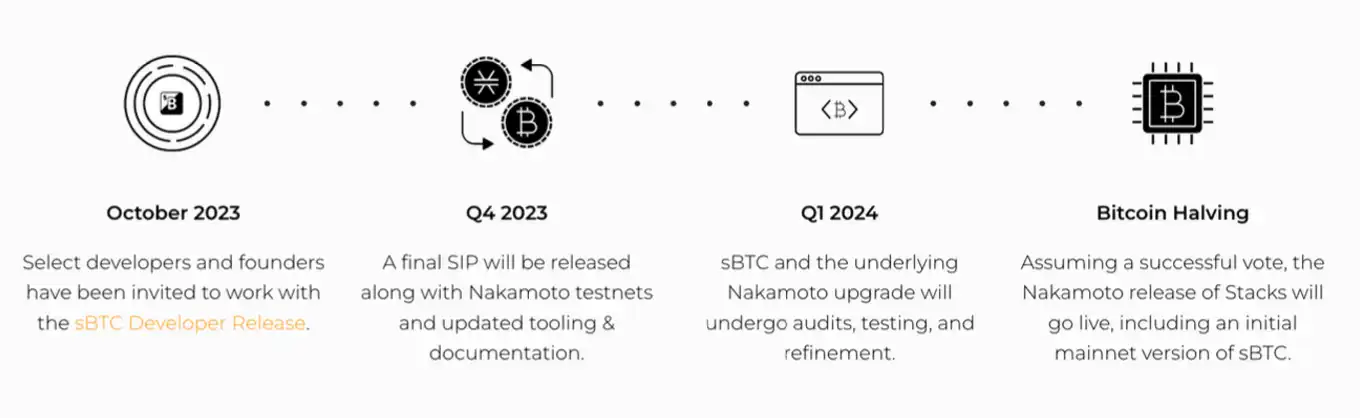
sBTC release plan source: sBTC
● The successful operation of the Stacks layer has made Bitcoin a fully programmable asset, and this transformation is based on Conducted in a decentralized manner. This will lead to more demand for Stacks and Bitcoin. This scenario could provide fertile ground for a rapidly growing Bitcoin economy, unlock hundreds of billions of dollars in passive Bitcoin capital, and make Bitcoin the backbone of a more secure Web3 network.
2. Lightning Network was released in 2018 (the white paper was released in 2016), which makes Bitcoin Micropayments on the Internet can be completed instantly, regardless of geographical location, and at very low cost. The Lightning Network’s significant transaction processing capabilities and growing adoption highlight its role in enhancing Bitcoin’s scalability and transaction efficiency.
● The protocol uses smart contracts to create payment channels, combining on-chain settlement and off-chain processing.
● When a channel is closed, transactions are consolidated and sent to the underlying network, the Bitcoin network. The native asset of the Lightning Network is Lightning Bitcoin.
● As of August 2023, the network processes approximately 213,000 routing transactions per day, totaling approximately 660 per month million transactions, accounting for about 52% of the public capacity of the network. These ballpark figures represent a 1,212% increase since August 2021 when K33 estimated 503,000 Lightning payments.
● Additionally, on average, the Lightning network handles at least the equivalent of 47% of Bitcoin’s on-chain transactions every day quantity.

The Lightning Network is boosting Bitcoin’s daily transaction volume. Source: River
3. Rootstock (RSK) Founded in 2015 by RSK Labs, the network brings Ethereum Virtual Machine (EVM)-compatible smart contracts to Bitcoin through its RSK Virtual Machine (RVM) coins. Using RVM, developers can port Ethereum contracts to Bitcoin. RSK’s native asset is Smart Bitcoin (RBTC), which remains 1:1 pegged to BTC but is not trustless. Because the security of its blocks is based on "merged mining," RBTC still relies on a centralized custodian, which highlights the compromise between security and decentralization of L2 solutions.
4. Liquid Network Released by Blockstream in 2018. Liquid Network serves as a Bitcoin sidechain that enables users to conduct fast, secure, and confidential transactions on Bitcoin. Liquid Network operates independently of Bitcoin, has its own ledger, and has abandoned utilizing Bitcoin’s Proof of Work (PoW) consensus mechanism, instead relying on the Liquid Federation, which consists of approximately 60 members, to create new zones. piece. Liquid Network’s native asset is Liquid Bitcoin (L-BTC), which is a “packaged” version of BTC. Liquid Network’s independent operations demonstrate the diversity of approaches within the Bitcoin L2 ecosystem.
Today, although no Bitcoin L2 solution holds more than 10,000 BTC or has millions of users, the potential for exponential growth remains Not to be underestimated, the critical role of these solutions in improving Bitcoin’s scalability and functionality in the future is constantly being reinforced. As Bitcoin L2 technology continues to improve, developers have begun to open up multiple ways to make Bitcoin-related rapid experiments possible while maintaining the stability of the core network. The success of future L2 solutions will depend on their ability to address current development limitations by providing a full execution environment (such as the EVM) to support a more inclusive development environment.
Exploring to improve the expansion of the Bitcoin ecological layer During the process, a new problem emerged: the impossible triangle of L2. When looking back at blockchain’s Impossible Triangle and applying it to Bitcoin’s L2, these issues still exist, but the trade-offs are slightly different. In the L2 impossible triangle, choices are restricted to:
· Open network or federated network.
· Whether to introduce new tokens.
· Have a complete/global virtual machine (VM) or only limited off-chain contracts.

The industry has already tried " "Squaring" this "impossible triangle" allows existing Bitcoin miners to switch to L2 mining to achieve resource reuse. RSK (formerly Rootstock) and Drivechains are examples of those trying this. In this approach, miner incentives become an open issue, similar to the early Ethereum situation where on-chain gas fees may not be enough to provide incentives for miners.
● Lightning Network chose A and B. The open network has no tokens, but no global state. Complete virtual machine (VM).
● Stacks chose A and C, has an open network and a complete virtual machine, and introduced a new token (STX).
● Liquid chose B and C, which have no tokens but complete virtual machines, and operate the network in a federation manner.
In early discussions, developers mentioned adding new opcodes to Bitcoin (L1), which could theoretically help solve Existing issues. For example, opcodes like op-snark-verify can be used to verify L2 network computations in Bitcoin (L1). However, implementing changes such as soft or hard forks has historically been challenging in Bitcoin, suggesting that such a solution may not be feasible in the short term.
Looking to the future, the Bitcoin ecosystem will most likely expand beyond the few existing L2 solutions, and hundreds of new ones will need to be added. solutions to fully explore and unleash the potential of the network. Currently, developers are weighing the choices in the L2 trilemma to achieve as close a balance as possible. A trend is forming to utilize an open network where anyone can freely enter and exit and mine, providing a complete virtual machine (VM) environment for smart contracts and taking global state as its core attribute. This approach mimics successful architectures in other blockchain ecosystems such as Ethereum and Solana, and is expected to have a huge impact on shaping the future trajectory of Bitcoin L2 technology development.
In addition to the existing four giants, the Bitcoin ecosystem has Rapid experimentation continues, with projects emerging in areas ranging from infrastructure tools to standards and protocols. These innovations are actively introducing new category definitions as technology stacks take shape to fill existing technology gaps in application requirements.
Ark is an experimental L2 protocol launched in May 2023. Through its always-on, trustless intermediary tool Ark Service Provider (ASP), Ark enables users to make low-cost, anonymous off-chain scalable payments in Bitcoin. As users transact on the protocol, recipients can receive payments without needing to obtain inbound liquidity, while maintaining recipient privacy while reducing costs compared to the Lightning Network.
Babylon, released at the 2023 Cosmoverse Conference, is a network using a proof-of-stake (PoS) mechanism, including two security Sharing protocol for use between Bitcoin and other PoS networks: Bitcoin timestamps and bridgeless staking.
Botanix (Spiderchain L2) is a proof-of-stake (PoS) Ethereum Virtual Machine (EVM) designed for Bitcoin, utilizing The distributed multi-signature network achieves two-way anchoring with Bitcoin and enhances its interoperability.
Interlay is a modular and programmable network connecting Bitcoin and the multi-chain ecosystem, running as a parachain of Polkadot. Interlay has created a decentralized Bitcoin bridge tool capable of minting iBTC, or “valued BTC,” a multi-chain asset backed 1:1 by Bitcoin.
MintLayer is a network using a Proof of Stake (PoS) mechanism, designed to serve as a side chain for Bitcoin and is decentralized DeFi-related activities have been targeted and optimized, including atomic swaps, etc. With MintLayer, users do not need to use a wrapped version of Bitcoin or a smart contract language (such as Solidity, etc.) to create tokens because the network is based on the UTXO model and only need to create transactions containing additional data. The network is designed to produce a block every 120 seconds using Verifiable Random Functions and reach finality after 1000 blocks.
Inscriptions (Ordinals). The innovative framework "Ordinal Theory" released on June 30, 2022 immediately triggered a cultural wave about building in the Bitcoin ecosystem. Just a few months later, in December 2023, developers began turning to Ordinals (Ord), which enables inscription on Bitcoin without the need for separate sidechains, tokens, or updates to the Bitcoin Core network. ). These inscriptions are immutable, on-chain, non-monetized digital artifacts (such as Bitcoin NFTs) that contain original file data (video, audio, pictures, executable software, etc.), and they will be permanently recorded in Bitcoin on, and can be transferred or sent to Bitcoin addresses, wallets, etc.
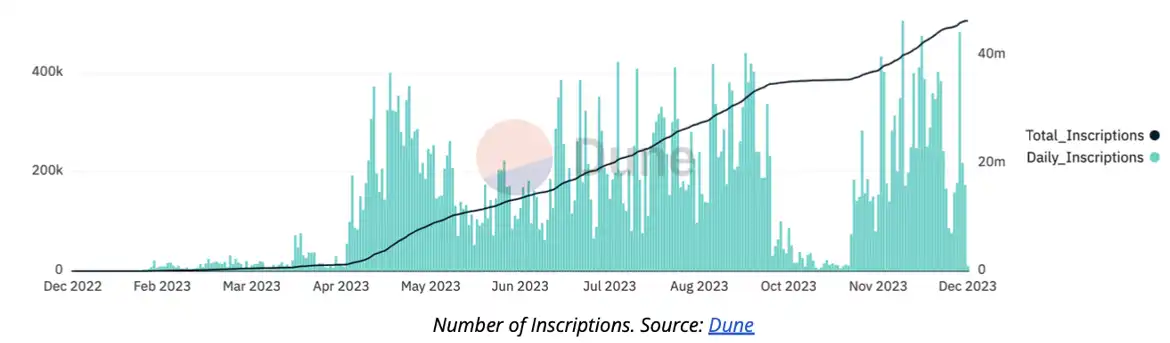
The development of Ordinals since the first inscription on December 14, 2022 The path continues to grow exponentially, with new experiments, infrastructure tools, and standards emerging. In the first 90 days, more than 460,000 engravings were completed, and over the full year to date there have been more than 46.2 million engravings, with fees incurred during the period amounting to approximately 3,365 Bitcoins (worth approximately $148.8 million).
RGB Network (Really Good Bitcoin) is a Bitcoin-based protocol that utilizes Lightning Network technology, but is not a token protocol.
Threshold Network is a privacy-focused merged network that combines the functionality of Keep and NuCypher, allowing users to leverage the secrets provided by Keep Network through off-chain containers and NuCypher Privacy tools for management and dynamic access control to protect private data. Threshold created the tBTC Bitcoin Bridge, a decentralized and permissionless cross-chain bridge that bridges the Bitcoin and Ethereum networks.
Developers are currently releasing numerous new protocols and standards every week, and these protocol experiments are only a small part of them. The continuous introduction of new protocols and standards symbolizes the vitality and evolution of the Bitcoin technology stack. The momentum generated by these developments, especially in the context of the upcoming Bitcoin halving event in the second quarter of 2024, indicates that the Bitcoin ecosystem still has great prospects for further innovation and adoption.
After multiple emerging protocols emerged one after another, the community also Beginning to experiment with new token standards, this provides a first preview of possible token designs that take advantage of Bitcoin’s unique architecture. While these standards are still in their infancy, it’s worth noting that developers are beginning to recognize and embrace these new tools as they are launched, realizing their similarities to similar products in the Ethereum ecosystem.
BRC-20 is an experimental token standard created by DOMO and released in early March 2023, aiming to create fungible tokens on Bitcoin. This standard leverages Ordinal engraving and JSON data, mimicking Ethereum's ERC-20 model, but is tailored for the Bitcoin ecosystem and has limited functionality. Multiple platforms quickly followed suit and developed tools and launchpads to support this experimental token standard (ALEX, Bitget, Leather, OrdinalsBot, UniSat Wallet, Xverse, etc.). Notably, as the first token deployed under the standard, the ORDI token reached a market cap of over $1 billion by May 2023, ranking 52nd on CoinMarketCap with a market cap of over $1.3 billion at the time of writing.
BRC-721E is an experimental token standard similar to the widely adopted ERC-721, jointly launched by Bitcoin Miladys, Ordinals Market and Xverse. In its initial state, the experimental standard allows users to bridge NFTs from Ethereum to the Bitcoin network, inscribing a stripped-down version of the NFT and its link to the original Ethereum version, complete with airdrop capabilities. Once the NFT is bridged, it will automatically appear on the Ordinals Market. This experiment opens up multiple possibilities for cross-chain interactions between the two networks.
ORC-20 is an experimental open token standard designed to provide a more flexible namespace while maintaining backward compatibility with BRC-20 , and UTXO will be introduced in future development to prevent double-spend payment problems.
ORC-CASH is an experimental token standard based on Ordinals Protocol, designed to best fit the UTXO security model and serve as a simplified version of the ORC-20 standard .
RUNES was proposed by Ordinals founder Casey Rodarmor in September 2023 as an alternative to the BRC-20 standard and an experimental alternative token protocol. . Runes is designed not to rely on off-chain data or require the use of native tokens, but instead holds balances via UTXOs, and transactions are identified through specific script conditions.
SRC-20 is a token standard created by Mike In Space, known as Bitcoin Stamps (Bitcoin Secure Tradeable Art Maintained Securely), they are Digital artworks stored directly on the Bitcoin blockchain cannot be prune because they exist in the UTXO set (unsent transaction).
STX-20 is an experimental inscription protocol standard, released in December 2023, which aims to embed protocol information in the metadata of STX token transfers. Create and share digital artifacts on the Stacks blockchain, with messages limited to 34 symbols. The release of STX-20 resulted in one of the largest blocks ever seen on the Stacks network, containing over 10,000 transactions.
In addition to scalability, developers are also Committed to bringing rollup technology to Bitcoin, and also making huge efforts to add a vital security layer to it. Although these technologies are still in the early stages of development, there are already some noteworthy experimental projects such as Urbit, Rollkit, ZeroSync, Alpen Labs, Bison Labs, Chainway, Kasar Labs, and many more.
Other experiments in the ecosystem include specially designed protocols such as 1btc, BNSx and Rooch Network, with new classification definitions emerging such as Drivechains (Driven Chains), Spiderchains (Spider Chains), Federated Chains (Federated Chains), Spacechains (Space Chains) and Softchains (Softchains), each has witnessed the development of projects aimed at contributing to the expansion of the technology stack.
These innovations enhance the intrinsic value of the Bitcoin network and upgrade Bitcoin's positioning into a more versatile and secure platform. They play a key role in increasing network scalability and improving its ability to support a variety of applications. As these technologies continue to develop, they are expected to significantly enhance the network's ability to handle larger transaction volumes and diverse applications, while still adhering to fundamental principles such as privacy maintenance and security assurance. The endless innovations in the Bitcoin ecosystem share one ultimate goal, which is to create a smooth enough user experience without worrying about whether the infrastructure can provide sufficient support.
Bitcoin is solving the problem through its second layer (L2) The innovation of solutions and the development of privacy-enhancing technologies are shaping a trustless financial ecosystem. These developments mark a significant shift in Bitcoin’s functionality and potential impact on the financial industry. Thanks to improved privacy, security, and scalability, Bitcoin is poised to support diverse financial applications from traditional financial transactions to innovative decentralized finance (DeFi) solutions. This transformation highlights Bitcoin’s growing role no longer just as an asset, but as a fundamental building block in building a more secure, efficient and inclusive financial system. As these technologies continue to be adopted, Bitcoin becomes increasingly central to building trustless financial systems, further solidifying its position as a key pillar of the future financial system.
Since our initial report, the Bitcoin ecosystem The system has witnessed significant development. Notably, the value of Bitcoin exceeded $63,000 for the first time since November 2021, marking a significant rebound in the market. Meanwhile, the landscape of Bitcoin second-layer solutions (L2s) is rapidly expanding, with DWF’s L2 tracker now listing 28 new Bitcoin L2 projects. So the question becomes, how to accurately assess the potential of these L2s?
Bitcoin Magazine has established an editorial policy that defines true Bitcoin L2 based on three criteria: using Bitcoin as a native asset, using Bitcoin This has generated quite a bit of discussion as an execution mechanism for transaction settlement and demonstrating functional dependence on Bitcoin. Because this definition classifies many emerging platforms, especially those moving towards decentralized extensions with their own tokens, as "meta-protocols" or "parasitic chains" rather than true L2 solutions.
Despite these classifications, many project parties or users do not care much because the broader goal is still to enhance the entire ecosystem. Here are some notable innovations that piqued our interest:
● Merlin Chain - by the team behind BRC-420 and Bitmap Leader, this asset-centric L2 aims to bridge significant L1 assets and their user base to L2, with total value locked (TVL) exceeding $2 billion as of the end of February.
● B-squared Network - The platform adopts a modular approach, using zk-rollup as the execution layer with B² Hub Combined, decentralized storage is integrated with the Bitcoin network, resulting in a comprehensive ecosystem covering consensus, data availability, and settlement layers.
● BounceBit - This is a Bitcoin re-pledge chain where users can use LSD for BTC staking and on-chain While farming, earn original CeFi income and basically "re-pledge" on Bitcoin. TVL has also surged to over $500 million this month, successfully raising capital.
● BOB - This project utilizes the Ethereum Virtual Machine (EVM) to enable the creation and execution of smart contracts.
● BEVM - Achieving decentralization between Bitcoin and BEVM through the combined POS consensus of Bitcoin light nodes and Taproot threshold contracts interaction.
● Citrea - zkEVM on Bitcoin, proofs are recorded on Bitcoin and verified by BitVM .
It is worth noting that the rise of many emerging Bitcoin L2 projects is mainly driven by Chinese teams and supported by huge Chinese communities. These communities It has brought a large amount of TVL, indicating that the Bitcoin ecosystem is moving back to the East.
These projects have successfully improved Bitcoin’s cross-chain capabilities, leveraging their previous construction experience to achieve significant growth. However, this surge has also raised concerns about potential liquidity fragmentation for L2 solutions, as Ethereum has demonstrated. Instead, this provides an opportunity to expand the use of Bitcoin assets and attract more Bitcoin users to these new platforms. Despite the similarities between many of these products, the future of Bitcoin L2 remains uncertain and dynamic, with further developments to look forward to.
Original link
Recommended
The Wall Street Journal: How is AI Trading Stealing the Limelight from Cryptocurrency?
Aug 15, 14:00
Tencent Still Has a Dream
Aug 15, 11:27
To Catch North Korean Hackers, They Set Up a Fake Project
Aug 15, 10:00
From Litigation to Settlement: Positive Signal Released by HTX's Negotiation with FCA
Aug 14, 19:32
11,742 Shipping Addresses Exposed Alongside Trezor Orders
Aug 14, 19:01
Founder Interview: FOMO Creator Explains How They Added 30,000 Users in One Day and Became One of the Fastest-Growing Crypto Apps
Aug 14, 18:37