
Tencent Still Has a Dream
Original Title: "Tencent Still Has Dreams"
Original Author: Insightful Beating
On August 12, 2026, Tencent released its Q2 financial report.
Capital expenditure for the quarter was $52.78 billion. Three months ago, this number was $31.9 billion. Looking back a year, the total for the whole year was only $79.2 billion.
The company has always been known for its financial restraint. Its pace of acquisitions was once so slow that the market doubted whether it really wanted to enter the AI arena. Now, it has ramped up its spending to this level within a year.
During the same earnings call, Ma Huateng said Tencent is building a "brand-new, AI-empowered Tencent." The rebranding of Tencent Cloud to HY, with the upcoming launch of Hy4. The last time the company described itself as "brand-new" was back in the early days of WeChat.
Tencent still has dreams. Its dream is not just AI; it aims to relearn how to be an unstable company.
In 2018, Pan Luan said in "Tencent Has No Dreams" that Tencent is like water. Water benefits all things without contention, flowing wherever there is a channel. Water has no personality, so water has no dreams.
Water flows downhill by nature, going against the current is the act of rebels. In 2026, this 28-year-old company did something against its nature. It acknowledged that the article from eight years ago was right, acknowledging that living like water was no longer sustainable.
Water
At 9:00 PM on May 5, "Tencent Has No Dreams" was published. Thirteen thousand words.
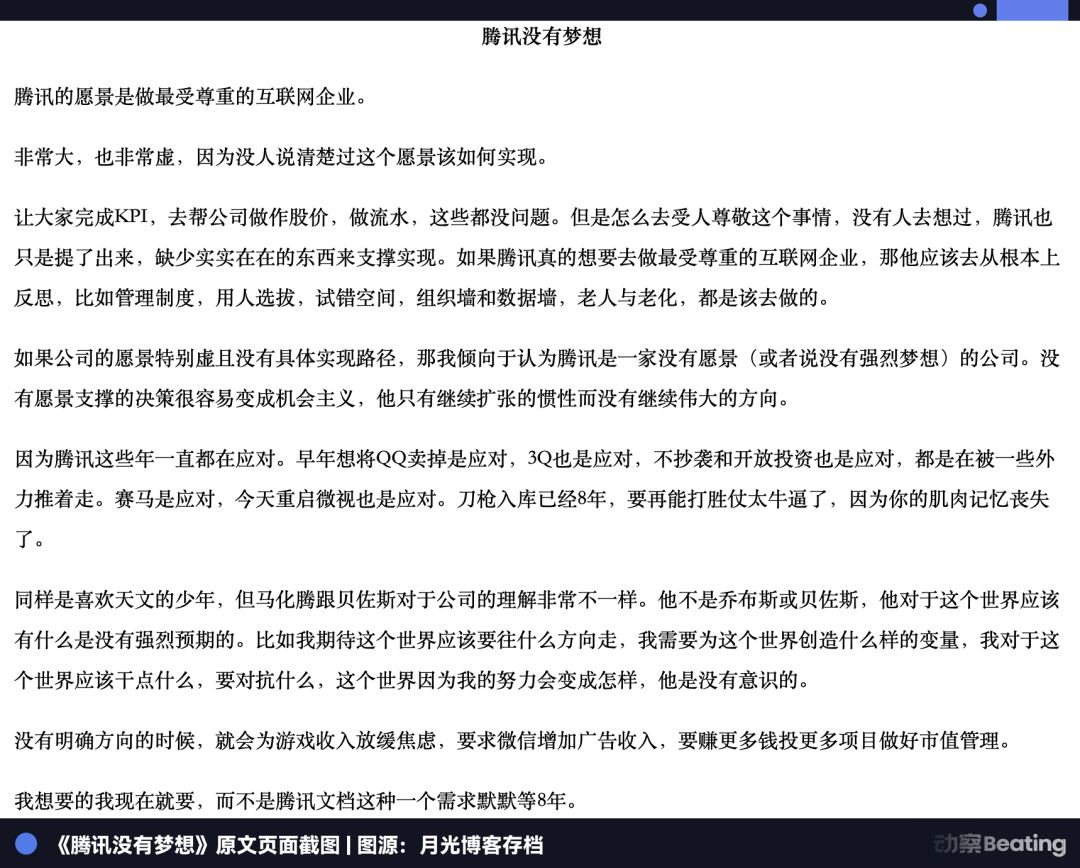
At 2:00 AM, Liú Chìpíng and Tencent's PR Director, Zhang Jun, responded on Moments. Liú Chìpíng said Tencent is a bigger organization and ecosystem than the outside world imagines; "simplifying Tencent into a product's pros and cons, a strategic deployment, or one person's will is too narrow."
At 2:19 AM, a screenshot purportedly of Ma Huateng's response started circulating on Moments.
At 2:39 AM, the real Ma Huateng finally spoke, replying to a friend concerned about him, saying, "Criticism is good."
He then said:
"From writing the first line of code, my ideal has always been how to create the best product, not how much money to make."
During the day, the national media almost entirely quoted that screenshot that was suspected to be a response from Pony Ma. Even Zhang Yiming spoke up for Tencent on his Moments, saying this was a "Don Quixote-style imagination." Tencent is not only powerful but also constantly evolving in various dimensions.
Zhang Jun was on a long-haul flight that day. After landing, he said, "While we are certainly not as bad as the outside world thinks, the criticism has also made us realize that we are not as good as we think we are."
Of course, there were also some different opinions about that article at the time. Hong Bo said that many of the issues mentioned in the article are indeed real problems, but for such a large company, is there a single correct answer? "Perhaps the author thinks that Zhang Yiming is the only correct answer. He is somewhat superstitious about Zhang Yiming."
The article also recounted an earlier story. In early 2011, shortly after the Three-Quarter War had just ended, Tencent held an executive meeting to discuss Tencent's open capabilities. Pony Ma asked the 16 executives present to each write down on a piece of paper what they believed to be Tencent's core competency, resulting in a total of 21 answers. Finally, two were chosen.
Capital, Traffic.
The word "Capital" was advocated by Liu Chiping. Openness means releasing traffic and turning it into investment. With traffic open and capital open, "I no longer do it myself."
These two words have governed Tencent for a decade. WeChat manages the entrance to traffic, investment manages the exit of traffic, with games and advertising in between generating a steady stream of cash. JD.com's e-commerce entrance entered the WeChat Nine-grid, Sogou took over search, and Meituan took over local life. Traffic exchanged for equity, equity exchanged for allies. Over the course of a decade, Tencent's market value increased tenfold, surpassing Facebook. When that article was published, it still seemed invincible.
Looking back eight years later, rereading it would reveal that the article almost prophesied every subsequent tumble Tencent took.
On December 23, 2021, ten years later, Tencent distributed 14.7% of its JD.com shares to its shareholders, valued at approximately HK$100 billion. In January 2022, it reduced its holdings in Sea, cashing out $3.2 billion. In November 2022, it further distributed 9.6% of Meituan, around HK$159.4 billion.
The "core competency" identified back then, capital, was personally dismantled by Tencent. The water, which had flowed for decades, began to ebb for the first time.
The First AI Dream
There was a passage in that article that few paid attention to at the time. It mentioned Tencent's AI. The AI Lab's Go program "Jueyi" was defeated by two amateur creations. One was a personal hobby of a ByteDance VP, and the other was a side project by several engineers from the WeChat translation team.
Few people realize that Tencent's first AI dream had already begun two years before that article was published.
In the spring of 2016, when AlphaGo defeated Lee Sedol, the world took its first serious look at artificial intelligence. Chinese internet companies seemed to hear a starting gun. That year, Tencent Vice President Yao Xing established the AI Lab. The following year in October, Alibaba's DAMO Academy was founded, announcing a three-year investment of $100 billion.
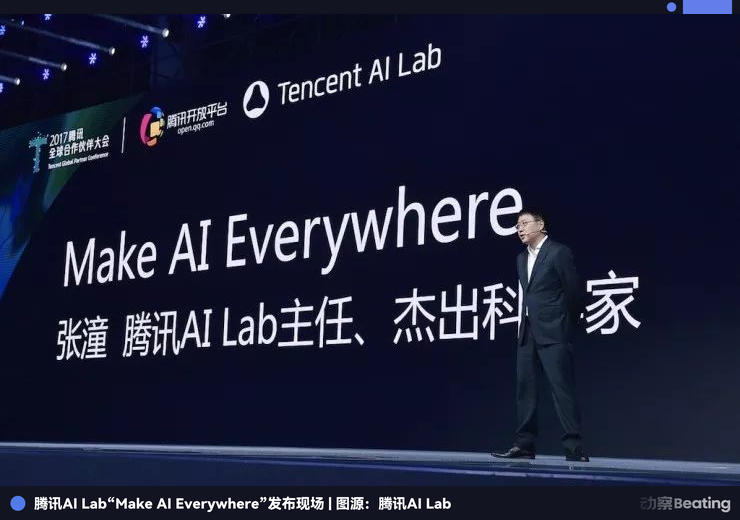
On March 23, 2017, Tencent announced the appointment of Zhang Tong as the head of the AI Lab. Zhang Tong, one of the top Chinese scholars in machine learning, previously served as the Deputy Dean of Baidu Research Institute. Upon joining, he said, "Chinese talent worldwide has a strong technical advantage in the field of AI, presenting an opportunity for China in AI development."
At that time, the AI Lab had more than 50 scientists, with over 90% holding AI-related doctoral degrees and having overseas study backgrounds. Not content with this, in May 2017, Tencent appointed Microsoft Research's Chief Researcher Yu Dong as the deputy director of the AI Lab, in charge of the newly established Seattle laboratory. The reason for setting it up in Seattle was that many Microsoft employees were reluctant to leave the area, so Tencent placed the lab next to Microsoft.
The opening of the first dream was grand. In March 2017, Jue Yi won the UEC Cup in Japan, and by the end of the year, it reached the top of the Dragon Star Wars. Go was the calling card of AI in those two years. After AlphaGo, every AI had to be able to play Go, and that was also Tencent AI's shining moment.
Then, the dream began to falter.
The problem lay in Tencent's own approach. On September 30, 2018, Tencent launched the 930 Transformation and established CSIG. Three days after the transformation, Cai Xin published a report that directly pointed out the issue:
"Three AI teams are still divided, how can the 2B business harness racing mechanism be broken?"
AI Lab, Youtu, and WeChat AI each operated independently, with no data sharing or talent exchange.
On January 3, 2019, Zhang Tong stepped down from his company management position and returned to academia. He later went to the joint laboratory of HKUST and Innovation Works. A number of the more than 50 scientists dispersed, and Zhang Zhengyou took over as director.
In 2021, Yao Xing also left. Instead of joining any big tech company, he founded his own company, Yuanxiang, focusing on the "fully interconnected internet." Among the angel round investors, Tencent and Hillhouse Capital are listed.
In December 2025, Yu Dong, the head of the Seattle lab that year, left the AI Lab and joined Capital One in the United States. Three months later, on March 21, 2026, Tencent officially dissolved the AI Lab, with some staff joining the Hybrid Mega Model Team.
From Zhang Tong's appointment to the dissolution of the lab, nine years. The complete life cycle of a dream.
Tencent's first AI dream did not fail to start, nor did it lack importance. It recruited the most expensive talent in the field and built the lab next to Microsoft. It died on a simpler problem; the company didn't know how to nurture a dream that couldn't immediately generate revenue.
Research didn't land, the business didn't provide support, three lines raced against each other, none lost, so none won.
Disassemble
On September 30, 2018, five months after "Tencent Has No Dreams" was published, Tencent launched the 930 transformation. MIG was dissolved, PCG and CSIG were established, and the six major business groups took shape. Pony Ma wrote in a company-wide letter:
"Rooted in the consumer internet, embracing the industrial internet."
No one can prove that the article prompted this transformation, but what's important is the resonance. The issues mentioned in the article, Tencent began to acknowledge themselves. This was Tencent's biggest change in six years, and Pony Ma said this made him feel "like walking on thin ice every day."
After the transformation, the newly established CSIG at Tencent, led by Tang Daosheng, announced that CSIG would no longer use the horse-racing mechanism.
Horse-racing was Tencent's heritage, and WeChat was the product of horse-racing. In 2010, several teams were simultaneously working on mobile instant messaging, and Zhang Xiaolong's team in Guangzhou won. This mechanism produced Tencent's last great product.
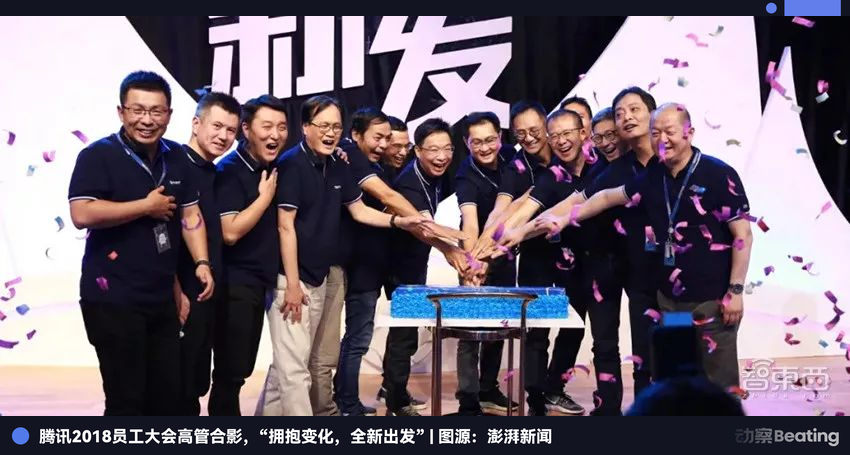
On November 11, 2019, Tencent's 21st anniversary, Pony Ma sent a company-wide letter, announcing a new mission and vision:
"User-centered, technology for good."
The old vision of Tencent was to be the "most respected Internet company," very grand, and very vague, no one knew how to achieve it. A year and a half later, Tencent changed it.
Then there's Tencent Cloud. Placed high hopes during 930 for the industrial internet, it didn't go smoothly. In 2021, Tencent Cloud stopped pursuing scale and shifted to reducing losses. In 2023, Tang Daosheng clearly stated the intention to transition from an integrator to being integrated, scaling back unprofitable total integration projects. The gross profit margin of financial technology and enterprise services slowly climbed to 51% by 2025.
The cost is that the ambition of this transformation, from "recreating another Tencent," has shrunk to "making a positive profit."
Aside from reducing losses, these five years have also borne fruit. Tang Daosheng has coined a term for the industrial internet, called C2B. The industrial internet is not only ToB and ToG, but also ToC. Ultimately, the B side and G side of the industrial internet still belong to the C side. Products like Tencent Meeting and WeCom have taken this path. They did not recreate another Tencent but taught Tencent how to create cloud-based software and how to no longer directly monetize traffic.
On its 930th anniversary, Yang Guoan said Tencent is starting to break away from the "second-generation rich" path of relying on social media and gaming for a living. This statement is only half correct; the path is indeed changing, but the reliance remains. Many years later, Tang Daosheng will say that large models, like the cloud, are difficult to monopolize. The confidence behind this statement stems from the five years of reducing losses.
In May 2023, Liu Chiping stepped down as an executive director. He is still the president and still heads the investment committee. But the symbolic meaning is clear. The person who advocated "capital as the core competency" has stepped down from the board. Some media outlets calculated his total compensation over 16 years to exceed 2.3 billion yuan.
From 930 to 2023, Tencent has been almost entirely about "dismantling" for five years. Dismantling organizations, dismantling investments, dismantling visions, and dismantling horse races. It knew it was sick, so it took off its old clothes one by one. However, the most challenging part for a company is not changing direction but admitting that even after changing direction, it still doesn't know the answer. The second transformation of the industrial internet ultimately ended in loss reduction.
Water has shifted its course, but it is still water.
Tide
On May 19, 2023, at a shareholder meeting in Hong Kong, Pony Ma was asked about AI. He said:
"AI is a once-in-a-century opportunity for the internet."
He added that Tencent will not release unfinished products to boost the stock price.
This statement conveys both clarity and sluggishness. The clarity lies in his perception of the significance of this revolution. The sluggishness is evident because by the time of this statement, Baidu's Wenxin Yiyi had been released two months ago, Alibaba's Tongyi Qianwen had been released for a month, and Tencent's model still required another four months. On September 7, 2023, the Hunyuan Mega Model was officially released, focusing on "eliminating gibberish."
Security and restraint, Tencent's consistent posture.
After almost a year of restraint, in November 2024, Tencent open-sourced the Hunyuan-Large model. With 389 billion parameters, it was then the world's largest open-source MoE model. A company that had always been aloof to open source finally opened the doors to its model.
On May 30, 2024, Tencent Yuanbao was launched. The company's external statement was: "Don't compete for short-term advantages with a big model."
A year later, it contradicted itself.
On February 13, 2025, Yuanbao integrated DeepSeek-R1 Full Blood Edition for free. Three days later, WeChat Searchlight quietly launched AI Search, also integrating DeepSeek. Tencent specifically stated that this feature would not read users' chat records or Moments. On March 4, Yuanbao topped the China region's Apple App Store free download list.
This was the last time the old traffic magic was manifested. By integrating the opponent's model and injecting its own traffic, it rose to the top in a month.
Then, Tencent wanted to manifest once again.
At an employee meeting on January 26, 2026, Pony Ma announced a new tactic. "Yuanbao Plan," distributing 1 billion red envelopes during Chinese New Year. He said he hoped to recreate the moment of WeChat red envelopes eleven years ago.
On New Year's Eve in 2014, WeChat Red Envelopes were launched. 8 million users, 40 million red envelopes. Jack Ma called it "the Attack on Pearl Harbor." On the following year's New Year's Eve, WeChat collaborated with CCTV's Spring Festival Gala, and people across the country shook their phones at the TV. Overnight, red envelopes were sent and received 1.01 billion times. The landscape of mobile payments was rewritten between these two New Year's Eves.
That was Tencent's last surprise attack completed through products and traffic. In the eleven years that followed, it never experienced such a night again.
During the 2026 Chinese New Year, Tencent used 1 billion to try to buy back that night.
It didn't buy it back. A few days after the red envelope event went live, WeChat made the first move. Around February 4, WeChat restricted Yuanbao's red envelope grabbing links from opening, citing "inducing high-frequency sharing by users" and "causing harassment to users."
Their own product was blocked outside their own gate.
Yuanbao responded, stating that they were urgently adjusting the sharing mechanism. WeChat's PR director responded with four words:
"Treat all equally."
To be fair, WeChat was not completely indifferent. Invitations to the Yuanbao Plan were initially allowed to spread through WeChat friends, group chats, and Moments. This was Tencent's most core relationship entrance, and WeChat opened a crack for it. But in the end, Yuanbao couldn't squeeze through that crack.
At its peak, Yuanbao had over 50 million daily active users and 114 million monthly active users. Then, the tide receded. Yuanbao dropped out of the top ten on the Apple Store free list. Subsequent data from QuestMobile showed that once the red envelope event ended, Yuanbao's daily active users fell back to pre-Chinese New Year levels.
By March 2026, the monthly active users of Yuanbao's standalone app reached 57.35 million, with only three AI applications in China having over 100 million monthly active users: Dou Bao, Qian Wen, and DeepSeek.
Three months later, during the shareholders' meeting on May 13, 2026, Pony Ma made a heartfelt statement:
"A year ago, we thought we had boarded a ship, only to find out that the ship was leaking. We started looking for another ship, and now we feel like we have boarded it, but the seat is still not secure. We hope the ship can sail faster."
In 2014, WeChat Red Packets changed the payment landscape overnight. In 2026, Tencent repurchased the same lesson for 10 billion. Traffic is not users; water is still water. It can lift anything to the top, but it cannot retain anything.
In June 2026, Tencent invested 10 billion in the first round of funding for DeepSeek. Some interpret this as Tencent admitting it cannot develop it internally, so it had to buy it.
A 27-year-old Chief Scientist cannot change the organizational inertia of a hundred thousand people company. The lessons learned from nine years of AI Lab are there. It's not that there is no talent; it's that this company used to digest talent and dreams in its own best way.
Countercurrent
In 2026, countercurrent.
First, look at the money. In the full year of 2024, Tencent's capital expenditure was 76.7 billion RMB, a 221% year-on-year increase. In 2025, it was 79.2 billion. In the most intense year of the AI arms race, this number only increased by 3%. Meanwhile, ByteDance's estimated capital expenditure exceeded 160 billion, and Alibaba announced a three-year investment of 380 billion.
Tencent didn't spend the money on cards and instead chose to buy back shares.
In 2025, it repurchased around 80 billion Hong Kong dollars in shares and, including dividends, returned over 240 billion Hong Kong dollars to shareholders in two years. During the annual earnings call on March 18, Liu Chiping explained that in 2025, due to GPU supply constraints, they couldn't buy cards. It wasn't that they couldn't buy them; they didn't want to buy at a high premium. The day after the financial report, Tencent's stock price fell by over 6%.
Then came 2026. In the first quarter, capital expenditure was 31.9 billion, and in the second quarter, 52.78 billion. The total for the first half of the year was 84.68 billion, exceeding the full year of 2024. During the call, Liu Chiping hinted that they might reduce buybacks in the future and invest in AI. The abacus that had been calculating ROI for ten years was set aside in 2026.
Let's first look at the organization. In December 2025, Tencent upgraded its large-scale model research and development architecture, establishing the new AI Infra Department, AI Data Department, and Data Computing Platform Department. In March 2026, the AI Lab was disbanded. The vessel of the first dream was dismantled, and the personnel and assets were merged into Meta-Universe. A company dismantled its own research institution that had been established for nine years, holding a funeral and handover ceremony on the same day.
Next is the individual. In December 2025, Tencent announced that 27-year-old Yao Shunyu was appointed Chief AI Scientist of the "CEO/President's Office," reporting to President Liu Chiping.

Yao Shunyu, born in 1998, is from Hefei, Anhui. He attended Hefei No. 1 High School, ranked third in the province in the science stream in the 2014 college entrance examination, and was admitted to Tsinghua University's Yao Class. At Tsinghua, he organized a rap music club. His high school homeroom teacher recalled that this child, who ranked third in the province in the science stream, loved to rap, dance, and play basketball.
He obtained his Ph.D. from Princeton University, during which he created the ReAct framework and the Tree of Thought, and led the SWE-bench project. Today, half of the world's AI research is built on the scaffold he erected. In August 2024, he joined OpenAI, contributing to the Operator and Deep Research teams. He departed in September 2025. Three months later, he became Tencent's Chief AI Scientist at the age of 27.
When asked why he chose Tencent, his response was:
"The most important thing is that everyone is very honest."
On January 10, 2026, after joining, he made his first public statement, focusing on how "Claude Code is reshaping the computer industry." On June 5, he had a conversation with Tang Daosheng and was asked if Tencent AI was lagging behind. He replied:
"AI is a long-term game, and the second half is just beginning."
Tang Daosheng added, "This is a long-distance race, a marathon, and Tencent still has very rich scenarios."
In Tencent's AI landscape, there are two main forces.
One is in TEG, the Meta-Universe. After Yao Shunyu took over, it consolidated the model research, data, and training infrastructure scattered across various departments. The disbanded AI Lab saw some researchers incorporated into the Large Language Model Department, while others moved to the Industry-Academia Research Cooperation Center.
The other force is in WXG, WeChat. Its name is WeLM. In 2022, WeChat released this Chinese pre-training model with 10 billion parameters, outperforming similar models on 18 Chinese tasks. In August 2025, WeChat unveiled WeChat-YATT, a large-scale model reinforcement learning training framework. By 2026, the new generation of WeLM shifted to a sparse MoE architecture, with a base version of 800 billion parameters, activating only 30 billion per inference; the extended version reached 1.3 trillion parameters, activating 49 billion. On July 9, the WeChat AI team publicly shared the Hidden Decoding research, detailing two new models in a paper.
People are also moving back and forth. By the end of 2025, Xu Can, a senior researcher at MixNet, transferred to WeLM. Xu Can is the creator of WizardLM, who proposed Evol-Instruct at Microsoft in 2023, allowing large models to generate challenging questions for themselves. After his departure, MixNet's post-training team split into several groups, each forging ahead on their own.
Two armies, two logics. MixNet has centralized computing power, data, and model resources. WeLM has WeChat's native entry point, mini-program services, and feedback from billions of real users. They collaborate and compete. The battle for Tencent's AI entry point occurred right in their own home.
In 2019, Zhang Xiaolong said, "Every day, one hundred million people teach me how to make products." On January 9, 2020, during a WeChat open class, Zhang Xiaolong was absent. He recorded a 13-minute video discussing seven thoughts on information interconnection, acknowledged two mistakes in the public platform, and announced the intention to create short-form content.
A little over ten days later, Video Number was launched. This was WeChat's only direct counterattack during those aggressive years of Douyin. That battle later proved one thing: Tencent's product capabilities were not extinct; they had always resided within the WeChat ecosystem.
In 2021, he summarized WeChat's decade with two words: connection, simplicity.
He said he hoped that WeChat would always remain a small and beautiful product, with its own soul, aesthetics, creativity, and ideas. Once upon a time, Pan Luan called him the "fool among the smart people."
During the 2026 Chinese New Year, it was this fool's product cleanliness obsession that blocked Yao Bao's 1 billion red envelopes outside of WeChat. The most restrained part of Tencent turned out to be the most product-oriented. In 2026, WeChat was pushed to the forefront. With the integration of AI into WeChat Search, WeChat Agent began testing, and the AI assistant "Xiao Wei" began gradual deployment. Some said that this time, Zhang Xiaolong had bet everything.
Large models had long since entered WeChat's ecosystem. In the ad recall process for Video Number and Moments, there was a system called LEADRE deployed, running on a MixNet model with 1 billion parameters.
In June 2026, "Xiao Wei" began small-scale grayscale testing. Users could directly command it to operate WeChat's native functions and call mini-programs to complete tasks. People involved in the internal testing mentioned that Xiao Wei's main model was WeLM, and some responses would invoke DeepSeek.
In June, the WeChat Open Platform did something more radical. Mini-programs could access the WeChat AI ecosystem. In automatic mode, the platform would read the mini-program's source code, analyze the page structure, and allow WeChat AI to operate directly. In developer mode, developers could encapsulate business capabilities as skills, which, once approved, could be called upon by WeChat AI. WeChat aimed to let AI grow into its own hands.
Lastly, there's that $10 billion deal. In June 2026, DeepSeek completed its first round of financing, totaling over $50 billion. Liang Wenfeng personally contributed around $20 billion, CATL around $5 billion, and Tencent around $10 billion. It is said that Liang Wenfeng personally selected the investors.
Investment is Tencent's best move. However, this investment can also be seen as a new posture. Eight years ago, Tencent's investment was to "counter Alibaba," a defensive move. Today, it is investing in a company that has temporarily outpaced itself, and has even opened its most valuable traffic portal, WeChat, to this company's model. The kind of company that it once "integrated" through investment is now acknowledged as a mentor by Tencent through investment.
Water flows downwards by nature, but going against the current is the affair of rebels.
In 2026, Tencent continues to flow with the tide, with traffic, investments, and ecosystem all intact. At the same time, it is starting to swim against the current, pouring substantial resources and its most core assets into uncertainties without seeing returns. Its dream has returned.
Epilogue
The conclusion of "Tencent Has No Dreams" reads:
"Hopefully, Tencent won't need to wait another four and a half years to reflect and review."
Tencent waited not just for four and a half years, but for eight.
During these eight years, it distributed "capital" to shareholders, opened up "traffic" to competitors, and sent the winner-takes-all mechanism into history. The old vision has been replaced with a new one, and the AI Lab it built with its own hands has been dismantled. Finally, a 27-year-old young man has taken the seat of chief scientist. Everything that was once predicted to fall, has fallen. The ebb of the gold rush, the reduction of cloud losses, the funeral of the first AI dream. After falling, it is still moving in that direction.
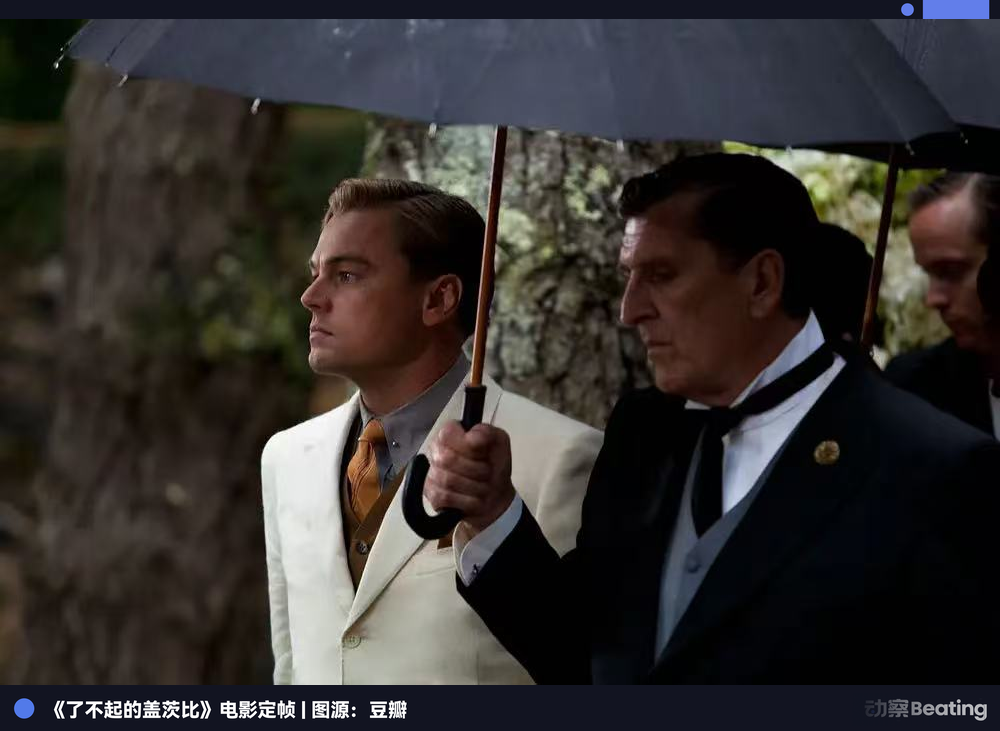
"The Great Gatsby" was written in 1925. Gatsby was a man who staked his entire life on the "past." He bought a mansion on the opposite shore of Long Island Sound, hosted parties every night with all lights on, just for a green light across the bay. Behind that light lived the girl he had loved five years ago. In the last few pages of the novel, Fitzgerald wrote a passage for Gatsby, and for all those who want to rewrite time:
"So we beat on, boats against the current, borne back ceaselessly into the past."
Gatsby swam against the current to return to the past. He believed that as long as he rowed fast enough, time would reverse, and old dreams would reignite. He failed. Bullets pierced the pool, the party disbanded, and that green light always remained across the bay.
Tencent is also rowing, but it is rowing against the current so as not to return. Not to go back to the self that only had capital and traffic, only had certainty, and only had a life as smooth as water.
Tencent still has dreams.
Original Article Link
Recommended
To Catch North Korean Hackers, They Set Up a Fake Project
Aug 15, 10:00
From Litigation to Settlement: Positive Signal Released by HTX's Negotiation with FCA
Aug 14, 19:32
11,742 Shipping Addresses Exposed Alongside Trezor Orders
Aug 14, 19:01
Founder Interview: FOMO Creator Explains How They Added 30,000 Users in One Day and Became One of the Fastest-Growing Crypto Apps
Aug 14, 18:37
Tether Receives Fourth Audit, but Transparency Concerns Regarding USDT Remain Unresolved
Aug 14, 17:00
Sandi's Buyback Arithmetic: 2030 EPS to See $787
Aug 14, 16:32