Sandi's Buyback Arithmetic: 2030 EPS to See $787

TL;DR
· Based on the TMT Breakout analysis, if SanDisk's mid-term profit margin framework is met, and continues to repurchase shares at around $1500 per share, CY2030 EPS could approach $700.
· The company has committed to returning 100% of post-reinvestment excess free cash flow to shareholders, primarily through stock buybacks.
· This outcome is highly dependent on NAND prices, AI customer long contracts, cash flow conversion rate, and repurchase average price, and is not formal guidance from management.
Following SanDisk's Analyst Day where the FY2030 mid-term framework was announced, the market has begun to calculate the potential EPS amplification effect of high profit margins and ongoing share buybacks.
According to TMT Breakout's projection, if SanDisk's revenue growth, profit margin, and free cash flow targets are all achieved, and the related cash is used for buybacks at a price of around $1500 per share, CY2030 EPS could mechanically reach around $700.
This is not earnings guidance provided by the company, but rather a valuation model based on multiple optimistic assumptions. The core logic is that AI data center demand will support NAND prices and margins, long-term customer arrangements will increase revenue visibility, strong cash flow will reduce share count through buybacks, further amplifying EPS.
TMT Breakout stated that CY2027 buyer EPS forecasts are still above $300. Starting from this level, incorporating SanDisk's FY2030 mid-term framework can project a longer-term EPS space.
The framework provided by management includes: maintaining revenue growth in the high double digits, gross margin of around 80%, operating margin of around 75%, adjusted free cash flow margin of around 50%, with capital expenditures kept at a mid-single-digit percentage of revenue.
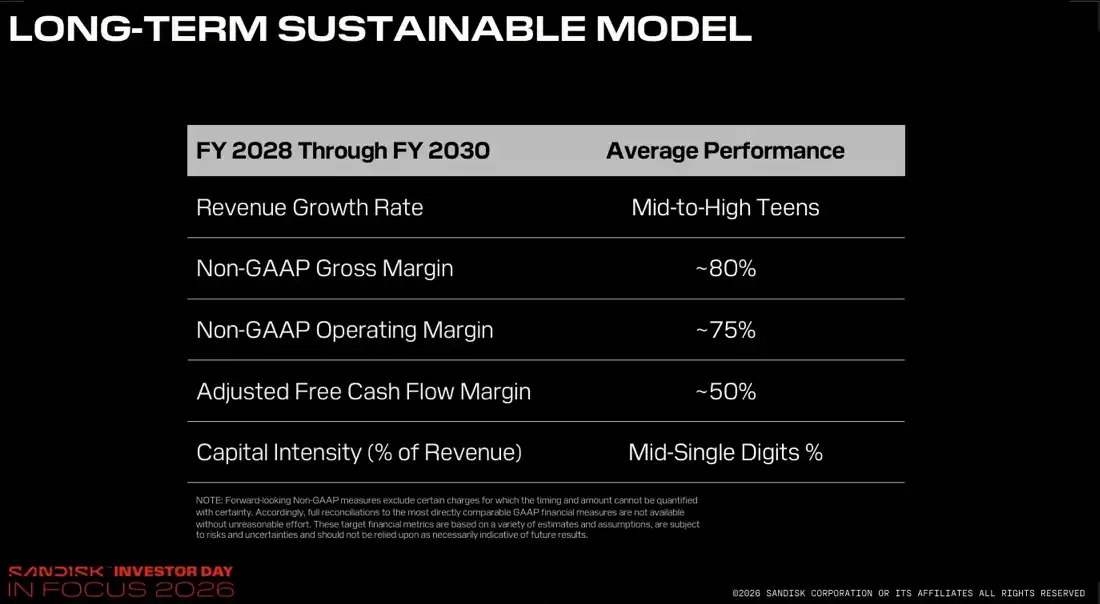
SanDisk expects revenue to maintain high double-digit growth from FY2028 to FY2030, with an average gross margin of around 80%, operating margin of around 75%, and adjusted free cash flow margin of around 50%.
Of these, the approximately 80% gross margin broadly meets some investors' expectations, but the revenue growth outlook is more positive. The report states that market expectations for revenue growth in FY2028, FY2029, and FY2030 were approximately 20%, -17%, and -28% respectively, still carrying significant traditional NAND cycle assumptions.
What truly drives CY2030 EPS toward the $700 vicinity is the stock buyback-induced share shrink.
The management has formally committed to returning 100% of excess free cash flow to shareholders after completing business reinvestment and maintaining a debt-free balance sheet, mainly through stock buybacks. TMT Breakout further assumes that this cash will be used for buybacks at an average price of around $1,500 per share, thereby deriving a CY2030 EPS close to $700.
It is important to differentiate that the 100% excess free cash flow return to shareholders is part of the company's capital allocation policy, while the $1,500 per share buyback price and the approximately $700 EPS are third-party model assumptions, not management commitments.
Whether this buyback model holds will first depend on SanDisk's ability to sustain high-profit margins and significant free cash flow over the long term.
The management's outlook on NAND prices is more optimistic than that of some investors, expecting prices to remain stable or increase by 2027, while there have been market views anticipating a 15% to 20% decline. This divergence is crucial: if NAND prices reenter a downward cycle, gross margins, free cash flow, and buyback capabilities may all come under pressure simultaneously.
Demand visibility mainly comes from AI data center customers and long-term partnership arrangements. The original text states that SanDisk has established 8 NBM customer arrangements, with 3 involving U.S. hyperscalers, with contract durations of up to 4 to 5 years.
Through these arrangements, around two-thirds of the FY2028 capacity has already been booked, with FY2029 coverage levels possibly close to FY2028. The report also mentions that some customers have recently added to their demand.
These contracts enhance mid-term order and cash flow visibility, but do not prove that NAND has completely escaped the cycle. Long-term contracts can reduce demand fluctuations, but ultimate profitability still depends on contract pricing, actual purchase volumes, cost changes, and new supply.
For a company with an adjusted free cash flow profit margin target of around 50%, buybacks could become a key variable affecting earnings per share.
As total profits grow, ongoing buybacks further decrease the outstanding share count, leading to EPS growth outpacing net profit growth. The lower the stock price, the more shares that can be repurchased with the same amount of cash, enhancing the EPS amplification effect.
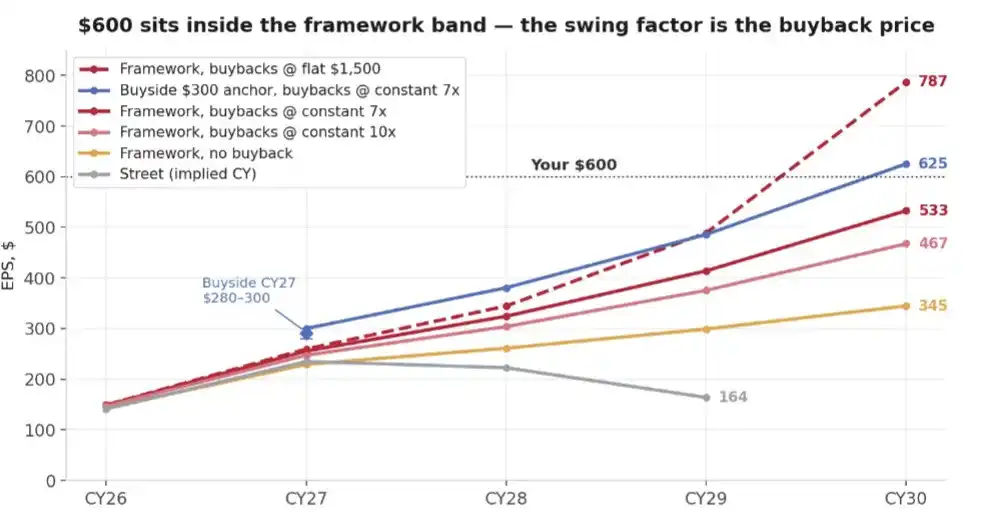
Under different buyback prices and valuation assumptions, the gap in SanDisk's CY2030 EPS estimates is significant; in a scenario where $1500 per share is continuously bought back, the EPS is around $787, which is not the company's target.
However, this mechanism also works in reverse. If SanDisk's stock price is significantly higher than the assumed $1500 per share in the model, the amount of shares that can be repurchased with the same amount of money will decrease, and the CY2030 EPS will be lower than the mechanical calculation result.
Free cash flow itself also has uncertainty. If future NAND prices fall, profit margins are below target, or capital expenditures and business reinvestment needs increase, the excess cash available for buybacks will also decrease.
Therefore, an EPS close to $700 cannot be taken as a benchmark forecast. The premise for its realization includes: high double-digit revenue growth continuing, gross margin remaining at around 80%, adjusted free cash flow margin reaching about 50%, excess cash continuously used for buybacks, and the actual buyback price not substantially exceeding the model assumption.
In addition to its traditional NAND business, SanDisk also disclosed progress on its next-generation HBF technology.
According to management, HBF has already taped out, with samples expected to be available in 2027 and possible volume production starting in 2028. The company positions it as a high-bandwidth storage solution for AI computing, claiming it can provide HBM-level bandwidth at about one-eighth the cost and achieve capacities 8 to 16 times larger than the latter.
If the related performance, cost, and mass production targets are achieved, HBF may help SanDisk gain higher value in the AI storage market and strengthen its leverage to secure long-term collaboration agreements with hyperscale cloud customers.
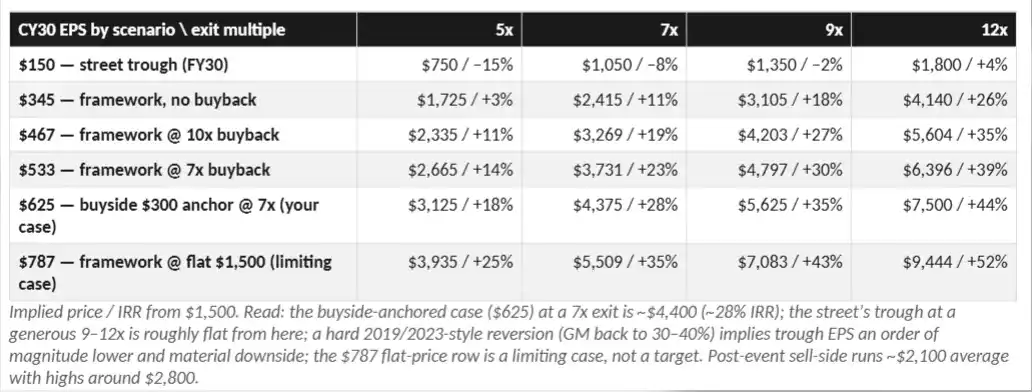
SanDisk's long-term valuation highly depends on the EPS trajectory and exit P/E ratio; the $787 EPS belongs to the restrictive scenario of continuous buyback at $1500 per share, rather than a benchmark forecast.
However, HBF is currently still in the pre-volume production stage. Sample validation, customer adoption, manufacturing yields, and scale delivery all have uncertainties and cannot directly serve as definitive support for the $700 EPS calculation.
What truly shifted analysts' view of SanDisk was the market's imagination of the duration of this NAND upcycle and the use of cash flows. The high margin framework, customer collaboration agreements, and buyback commitments provided by management collectively offer a more optimistic valuation path than the traditional cyclic model.
However, TMT Breakout also acknowledges that the most challenging question in the current market is still whether this cycle can extend beyond 2028. A near $700 CY2030 EPS represents the upper end of the optimistic scenario, with hurdles to overcome including NAND prices, profit margins, stock buyback prices, and execution capabilities.
Recommended
Tether Receives Fourth Audit, but Transparency Concerns Regarding USDT Remain Unresolved
Aug 14, 17:00
Hong Kong Dollar Stablecoin 'Great Exodus'
Aug 14, 14:27
BofA Analysis: Micron's $100 Billion Cash Flow, Can It Navigate the NAND Cycle?
Aug 14, 13:17
X Publicizes Full Recommendation Algorithm, How to Write Posts for High Exposure
Aug 14, 13:14
A $2.25 billion Green Bond, How Jane Street's Lease Made Its Way into the Financing Structure
Aug 14, 13:08
Before the AI Bubble Bursts, 'Big Short' Makes $100 Million from Subscription Fees
Aug 14, 12:48