Bitroot: the master key to open the door to the Bitcoin ecosystem

Original source: Bitroot

Bitcoin soared to more than $67,000, and the bull market has arrived. With a market value of US$1.32 trillion, there is a huge ecological market, and infrastructure projects are still the "golden shovel" for tapping market potential.
In the early stages of a bull market, Bitcoin prices tend to absorb most of the liquidity and rise first. However, from the perspective of the blockchain ecological architecture, Ethereum plays an important role in ecological development, providing financial services, security consensus, artwork rights confirmation and other important tasks. Often the final hot and high-value projects end up on Ethereum. However, starting in 2023, currency issuance protocols based on the Bitcoin mainnet have become popular in the market, such as runes, inscriptions, etc. The popularity they have driven has focused market liquidity on the Bitcoin ecosystem, and in the process of subtle expansion of Bitcoin ecological impact.
At the same time, the popularity of Bitcoin L2 continues unabated. As an important expansion of the Bitcoin ecosystem, the outbreak of BTC Layer2 still needs an opportunity, and the market needs to see that Bitcoin For the ecosystem to rise, it is not enough to rely solely on the current currency issuance agreement. After this wave of Bitcoin ecological tokens is over, people will think about whether, in addition to chasing hot hype, the Bitcoin ecosystem needs to be more complex and reliable. For continuous application scenarios, we need infrastructure to provide various sustainable empowerment for the Bitcoin ecosystem. And all this requires tokens with more features. At the very least, they should be as functional as ERC-20.
The currency issuance protocol using smart contracts is still the focus of the development of the Bitcoin ecosystem
The current asset issuance protocols on the Bitcoin chain, such as BRC-20, are derived from Bitcoin’s Taproot upgrade and Ordinals protocol. Although these technologies provided new ways to create and manage tokens on the Bitcoin network and once served as liquidity aggregation projects, they are significantly different from Ethereum's ERC-20 token and NFT standards and do not support smart contracts. This is mainly due to some technical and design concept obstacles:
Smart contract functional limitations: Bitcoin’s design mainly focuses on its function as currency, and its native support The scripting language of Ethereum is relatively simple and does not support complete Turing-complete smart contracts like Ethereum. This means that ERC-20 or ERC-721 (NFT) standard contracts cannot be deployed directly on Bitcoin in the same way.
Taproot upgrade: Although the 2021 Taproot upgrade enhances Bitcoin’s privacy, efficiency, and provides more complex smart contract functions, these functions are inconsistent with the Ethereum platform The smart contract capabilities are still limited compared to . Taproot has added some smart contract functionality through technical improvements such as Schnorr signatures, but it is still not enough to support complex ERC-20 or NFT operations.
BRC-20 and Ordinals Protocol: BRC-20 is a Bitcoin token standard inspired by ERC-20, although it allows Create a token similar to ERC-20, but due to the lack of native smart contract support, its functionality and flexibility are far less than ERC-20 on Ethereum. Meanwhile, the Ordinals protocol provides a primitive form of support for NFTs by allowing individual satoshis to be tokenized on Bitcoin to store data, but this is still relatively basic compared to the mature NFT standard on Ethereum.
Technical and cultural differences: There are significant technical and cultural differences between the Bitcoin community and the Ethereum community. The Bitcoin community is more focused on keeping the network simple and secure, while Ethereum encourages innovation and complex application development. As a result, complex token systems and NFTs are not as valued and supported on Bitcoin as they are on Ethereum.
Despite these limitations, protocols such as Bitcoin’s BRC-20 and Ordinals offer new possibilities for the tokenization of Bitcoin assets and the creation of NFTs. However, how these are implemented on Bitcoin is fundamentally different from the ERC-20 token and NFT standards on Ethereum due to technical limitations and community cultural differences.
Bitcoin needs a better token protocol to run smart contracts.
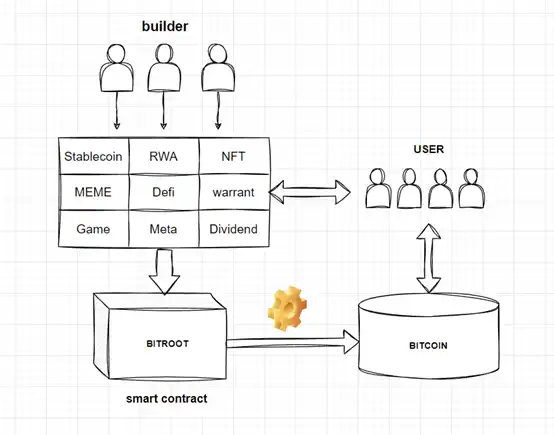
Bitroot is a platform built on the Bitcoin blockchain that extends Bitcoin’s core functionality to allow users to create and trade multiple A digital asset that imitates Ethereum’s ERC-20 token mechanism. The core mechanism of this platform is "edge writing", which embeds additional data into Bitcoin's standard transactions so that the Bitcoin blockchain can store more information and perform more complex tasks.
Different from other Bitcoin currency issuance protocols, Bitroot provides a certain level of smart contract functionality, allowing users to create and trade custom assets, and be able to Trade on decentralized exchanges. However, these operations are based on the Bitcoin blockchain, which means that every transaction requires paying Bitcoin mining fees. Bitroot does this by embedding additional data into regular Bitcoin transactions, an approach that allows the Bitcoin blockchain to store more information and thus support more complex functionality. Although these Bitroot transactions occur on the Bitcoin blockchain, they contain specific Bitroot data that allows Bitroot nodes to interpret this data and build their own transaction ledger on top of the Bitcoin network.
In addition, Bitroot also supports recent technical upgrades of Bitcoin, such as Taproot and Ordinals protocols, further strengthening its capabilities in smart contracts and digital assets, and providing support for the Bitcoin chain. Provides the technical foundation for creating NFT-like assets. Bitroot provides an Ethereum-like asset issuance platform that enables users to create, buy and sell unique digital assets. These assets range from digital collectibles to tokens representing physical items. As a second-layer solution similar to Bitcoin, Bitroot leverages Bitcoin’s underlying technology to add additional functionality while maintaining the security of the Bitcoin blockchain.
bitroot is considered a "second layer" solution for Bitcoin. It is built on top of Bitcoin, thereby inheriting the original blockchain's security while providing additional functionality. This includes multi-signature addresses, governance and voting mechanisms, and decentralized exchanges (DEX). These features allow bitroot to not only be used to issue and trade unique assets, but also to support more complex operations such as team collaboration and asset allocation.
It is worth noting that bitroot, through its DEX, allows users to trade various assets without trusting a third party. This differs from traditional centralized exchanges, which typically require a central authority to facilitate the matching of trading pairs. The emergence of decentralized exchanges provides an important means to promote free trading of assets and allow users to control their own assets.
bitroot is an attempt at implementing a Layer 2 solution on Bitcoin, which uses the Bitcoin blockchain to enhance transactions. Scalability and functionality make it possible to issue tokens like ERC-20 and NFT on Bitcoin, although it may not be completely suitable for all scenarios, especially those that require highly complex smart contract support. But it provides a feasible solution for the current smart contract operation and is constantly improving. The implementation and application of bitroot demonstrates the potential of the Bitcoin blockchain beyond being a monetary system, providing a way to create and trade unique digital assets on top of Bitcoin.
Adhere to the will of Bitcoin , decentralization.
The will of Bitcoin is decentralization. To issue and manage tokens on the Bitcoin blockchain, decentralization is a necessary condition. Bitroot uses Bitcoin Coin’s blockchain is a decentralized public ledger that ensures transactions and assets are secure and cannot be tampered with. This means that no single entity can control or change transactions that have already taken place.
Open source protocol: bitroot is an open source protocol, which means that its code is public and anyone can audit, modify or run their own nodes, which increases transparency and reduces the risk of single points of failure.
User-controlled assets: Tokens issued through bitroot are completely controlled by users, and users have private keys, which represents complete control of assets. This contrasts with the traditional banking system or the way assets are managed by a central authority.
Permissionless participation: Anyone can use bitroot to create and trade tokens without the need to obtain approval from any central authority. This is in line with the principles of decentralization and permissionlessness, where everyone has equal opportunity to participate and innovate.
Security of decentralized networks: bitroot benefits from the decentralization of the Bitcoin network in terms of security. The Bitcoin network is maintained by thousands of nodes around the world, making any attempt to attack or manipulate the network extremely difficult and expensive.
bitroot uses the Bitcoin blockchain, which provides decentralized features that make token issuance and management both safe and transparent, in line with decentralized finance (DeFi). ) core principles.
Smart contracts are also the future direction of the Bitcoin ecosystem
The role of smart contracts in the Bitcoin ecosystem The importance does not need to be elaborated, as can be seen from the current hot Bitcoin application market. Tokens issued using bitroot play a cornerstone function for the operation of smart contracts on Bitcoin.
1. Functionality similar to ERC-20 tokens brings the possibility of DEFI development to Bitcoin.
Half of the credit for the prosperity of Ethereum is due to the development of DEFI. The on-chain financial protocol has created the driving force for ecological development, and liquidity has injected surging blood into the Ethereum ecosystem. Bitcoin, with a market value three times that of Ethereum, has greater potential. Functions such as staking, locking, releasing, signing, voting, and governance are technological breakthroughs achieved by bitroot on the Bitcoin network. At the same time, as a Bitcoin network user, by using bitroot, you can index assets, monitor market data, and manage your assets more conveniently and intelligently. Based on this, the functionality of Bitcoin network smart contracts has been greatly improved, providing basic services for the operation of DEFI.
2. Supporting the latest ERC-404 protocol, the Bitcoin ecosystem will have liquid NFTs.
Whether it is an inscription or a rune, this is a similar imitation of NFT and fails to achieve the functionality of NFT. ERC-404 is an emerging Ethereum token standard. It is a token that combines the ERC-20 and ERC-721 standards, encapsulating the uniqueness of NFTs and the fungibility and liquidity associated with ERC-20 tokens. Sex. Using bitroot, you can directly issue ERC-404, creating a "symbiotic relationship between graphics and currency". It can not only be applied to projects such as RWA, DID, MEME, etc., but from the perspective of NFT, the release of liquidity can be used in all aspects of games and art. There is more room for imagination.
3. bitroot provides smart contract co-construction to build a prosperous Bitcoin ecosystem
bitroot expands the programmable functionality of tokens and expands the ways in which tokens can be used. Using bitroot while building smart contracts on other chains can jointly build more creative protocols, increase protocol functions, and jointly prosper the Bitcoin ecosystem.
After the emergence of currency issuance protocols such as Ordinals and BRC20, Bitcoin has ushered in new changes and will transform from just a value storage currency to a financial ecosystem. , from zero-interest assets to assets with interest. This has led to a surge in liquidity and second-layer solutions in the Bitcoin ecosystem, and infrastructure is often the most important constraint. Bitroot adopts a bottom-up model to first solve the issue of Bitcoin network asset issuance and then build Bitcoin. Apply the protocol to continue empowering the Bitcoin ecosystem.
According to Bitroot’s official Twitter announcement, OAT activities will begin on Galxe today

Twitter link visibleHere
Recommended
The Wall Street Journal: How is AI Trading Stealing the Limelight from Cryptocurrency?
Aug 15, 14:00
Tencent Still Has a Dream
Aug 15, 11:27
To Catch North Korean Hackers, They Set Up a Fake Project
Aug 15, 10:00
From Litigation to Settlement: Positive Signal Released by HTX's Negotiation with FCA
Aug 14, 19:32
11,742 Shipping Addresses Exposed Alongside Trezor Orders
Aug 14, 19:01
Founder Interview: FOMO Creator Explains How They Added 30,000 Users in One Day and Became One of the Fastest-Growing Crypto Apps
Aug 14, 18:37